

he Sue waste consortium was funded by the Engineering and Physical Sciences Research Council (EPSRC) under its sustainable urban environment (Sue) programme to carry out an integrated, multi-disciplinary programme of research into waste resource management in the urban environment. The consortium aimed to address some of the most pressing issues facing modern-day waste management practitioners and policy makers. This briefing provides an overview of the background, mode of operation and outputs of the consortium, which have yielded potential benefits both for UK research capabilities and the waste management industry. It has advanced the knowledge base in a way that should enable more informed policy and decision making. This will in turn contribute to the ultimate goal of sustainability in urban waste resource management.
1. BACKGROUND
Many of the world’s resources are being used more quickly than they can be regenerated. They must therefore be managed much more carefully if the general quality of life in developed countries is to extend to an increasing proportion of the world’s population. By 2030, 60% of the world’s population (some five billion people) will live in urban areas.1 Strong linkages between development, urbanisation and increased consumption of resources make the need to devise strategies for sustainable urban waste resource management especially urgent. In Europe, increasing public awareness of and political emphasis on the need for better management of resources currently treated as waste are evidenced by major legislation over the past decade or so.2–8
The Sue waste consortium brought together six leading UK universities (Southampton; Imperial, Goldsmiths and University Colleges, London; Surrey and Sheffield), local authorities, waste management companies and other industry bodies to carry out a programme of research focused on the challenges and opportunities for waste resource management within the urban environment. The research was funded by the Engineering and Physical Sciences Research Council (EPSRC) under its sustainable urban environment (Sue) programme. The objectives of the consortium were to build on the underpinning scientific expertise of the individual partners to
carry out research, with particular emphasis on the constraints and opportunities of the urban environment, that would
in the short to medium term, inform policy and contribute to meeting impending legislative requirements without making an inappropriate and irrevocable commitment to any particular type of treatment technology, facilities or infrastructure
(ii)in the medium to long term, contribute to the development of waste resource management strategies that are optimal in environmental, societal, technological and economic terms
engage with local authorities, regulatory bodies and the waste management industry in defining research needs and priorities, carrying out projects and implementing research results
develop a profile and reputation for high-quality research enabling current policy in urban waste resource management to be challenged and future policy influenced, both nationally and internationally.
The programme of work was designed to draw on, utilise, and add value to the extensive research in various relevant and related areas already being undertaken by the partners, and to complement, rather than duplicate, other major waste management research programmes such as the Waste Resource Action Programme (Wrap) and work carried out through the Landfill Communities Fund programme.
Although the work of the consortium focused on the application of engineering science and technology in urban waste resource management, the need to interact strongly with other disciplines was recognised from the outset. The generation of waste and the way it is presented for collection and subsequently managed within the urban community depends heavily on human behaviour, both individually and collectively. It was recognised, therefore, that engineering and scientific research must be informed by social, economic and political realities as well as seeking to challenge and influence the relevant strategy and policy framework.
2. CONTEXT AND SCOPE
Waste management is often perceived to have an underdeveloped scientific and philosophical base, and is more complex than is usually understood by the general public or even policy makers. It is multi-disciplinary in nature, requiring input from, and interaction between, a number of core disciplines including engineering, science, social science and economics. Without understanding these interactions, legislation in isolation is unlikely to have the desired effects of bringing about high levels of resource utilisation and reducing uncontrolled emissions of greenhouse gases and other pollutants potentially associated with waste disposal. There is, therefore, considerable scope for development and improvement in
process and treatment technologies
waste management strategies that address and exploit particular attributes of the urban environment, such as transportation networks and residential/commercial infrastructure
understanding the full environmental, economic and societal impacts of these technologies and waste management strategies
understanding the impact of human behaviour and societal pressures on waste arisings and on the efficacy of the methodologies deployed.
To provide a context for the research consistent with current thinking in waste management, evolution of the subject towards resource management9 was taken as a given; the work of the consortium was carried out within a framework represented by the resource cycle (Figure 1).
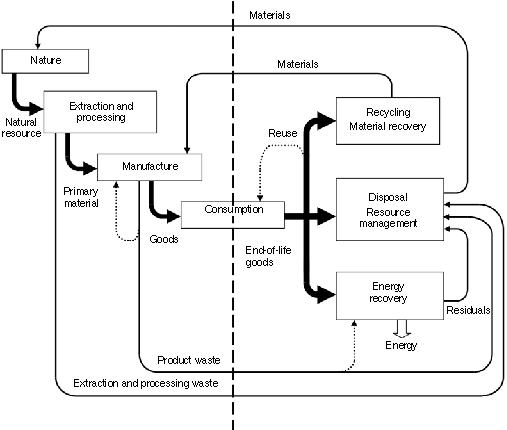
The resource cycle consists of a number of processes, each of which has inputs (materials and energy) and outputs (products, energy and waste). Waste outputs from one process may be used as resource inputs to another or even the same process. To date, closure of the cycle – that is the return of waste or used resources to the environment in a way that enables them to be extracted and used again – has rarely occurred except in a haphazard way and on a geological timescale. The volumes of virgin or waste resource input, product and waste output from each process depend on a complex interaction of technological, economic and societal factors. Minimisation of environmental impacts is now an important driver, but historically this has not generally been the case.
As the consortium was concerned with resource management downstream of consumption rather than efficiency in manufacture, the research addressed activities within the area to the right of the vertical dashed line shown in Figure 1.
3. THE RESEARCH PROGRAMME
The research programme was managed as a series of eight inter-related projects, coordinated across the participating research groups to address four thematic objectives (Table 1).
The research programme (projects and thematic objectives)
| No. | Project title | Project summary | Thematic objective(s) addressed | ||||
| 1 | Industrial and social ecology of urban resource flows | Development of a suite of models using national statistical datasets and ethnographic analysis to enable mapping of waste arisings within the urban environment | (a) Understanding waste arisings | ||||
| 2 | Appropriate scales and technologies for energy recovery by thermal processing of waste in the urban environment | Life cycle analysis and mathematical modelling of thermal treatment processes including gasification and pyrolysis. Practical investigation of the effects of waste stream inputs on process outputs | (d) Appropriate technologies and scales | ||||
| 3 | Appropriate scales and technologies for bio-processing of organic urban wastes, including energy production from anaerobic digestion of waste in the urban environment | Life cycle assessment of biological treatment processes for waste.Practical assessment of the environmental impacts of home composting and the effects of scale on anaerobic digestion facilities | (a) Understanding waste arisings(b) New whole-life modelling tools(d) Appropriate technologies and scales | ||||
| 4 | Commercial and industrial waste audit of SMEs | Development of computer-based interactive data acquisition and feedback software to provide SMEs with options for improving environmental performance through waste reduction | (a) Understanding waste arisings | ||||
| 5 | Transport and logistics: assessing the performance and optimising recovery from household waste sites | Investigation of the key factors influencing the use and efficiency of HWRCs | (c) Understanding and quantifying impacts of infrastructure architecture | ||||
| 6 | Networks and benefits: assessment, operation and performance of multi-benefit schemes for waste avoidance and reuse | Investigation of collection and disposal operations for bulky household waste and evaluation of national schemes for furniture recovery | (c) Understanding and quantifying impacts of infrastructure architecture | 7 | Interfacing the infrastructure: domestic waste management schemes and the intersection of public/private space and services | Use of ethnographic methods and modelling based on secondary datasets to investigate barriers to participation in recycling schemes and structural constraints on individuals’ waste generation, reuse and recycling behaviour | (a) Understanding waste arisings(c) Understanding and quantifying impacts of infrastructure architecture |
| 8 | Energy footprint modelling for MSW management | Development of a model to assess material and energy balances for a range of waste and resource management activities | (b) New whole-life modelling tools |
Understanding and predicting waste arisings within the urban environment.
Developing modelling tools to assess the environmental impacts and relative benefits of different waste management strategies on a life cycle basis.
Understanding and quantifying the impacts of infrastructure and logistics systems architecture on participation in waste minimisation, reuse and recycling schemes.
Developing appropriate technologies and scales for sustainable waste management in the urban environment.
The research programme was guided by a steering committee comprising government, industry, end-users and academic members. The committee provided direction in terms of the research and guidance on dissemination of the results and their translation into policy and practice.
The key to optimising value from the work was the sharing of projects between the research partners based on their particular areas of expertise (Figure 2). This arrangement also ensured integration of the research centres and projects into a single coherent programme.
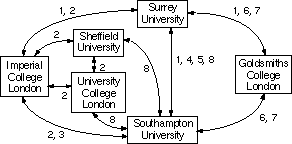
Projects linking research partners (project numbers are matched to project titles in Table 1). Not shown on the figure, the Open University was an academic partner in project 4
Projects linking research partners (project numbers are matched to project titles in Table 1). Not shown on the figure, the Open University was an academic partner in project 4
4. METHODS AND KEY OUTPUTS
4.1. Understanding and predicting waste arisings
National statistical datasets and ethnographic analysis were used to develop a suite of models that together formed a framework for understanding the social ecology of resource and waste flows to enable mapping of arisings within the urban environment.10 The models developed were as follows.
Local area resource analysis (Lara): a highly socio-economically disaggregated model to estimate household resource use and waste arisings in small geographical areas.11 Lara forms the basis of AR-Gini, an area-based indicator of resource inequalities also developed in this project.12
Business waste mapping: enabling geographical mapping of business waste arisings by type of waste and business sector.
Waste input–output: a model to estimate the upstream wastes that arise as a result of household expenditure. The model covers 122 business sectors and differentiates between different types of commercial and industrial wastes.
A specific study of textile recycling examined the barriers to and motivators for textile recycling, and identified links between textile recycling and levels of deprivation. The study also compared reported quantities of textile recycling with results obtained from Lara.
This thematic objective was addressed for garden waste by
developing a method for the prediction of rates of green waste generation in urban and peri-urban areas
collecting and analysing a large body of primary data on green waste generation rates at household level with linked information on householders’ chosen management and disposal options
an evaluation of the environmental impacts of composting.
A method for auditing commercial and industrial (C&I) wastes was developed by creating a computer-based interactive data acquisition software package (a so-called smart questionnaire) that could be tailored by the enquirer to fit his/her data needs. The concept also allows feedback of information to users, providing them with the opportunity to improve their environmental performance by minimising or recycling their wastes. Key features include
the application of geographically based information provision using the GoogleTM mapping system as a facilities locator and
the development of software allowing the construction of a customised questionnaire based on database information provided by the system manager through a suite of administration pages, with the capability of generating customised reports on the user’s environmental performance.
4.2. New and improved life cycle modelling tools
Life cycle analysis is a vital part of determining the sustainability of both thermal and biological treatment processes. An analytical framework was developed to facilitate comparisons of the relative sustainability of large- and small-scale thermal waste treatment options.13,14 Work on an environmental assessment of options for green waste management used data from the Southampton area as a basis for deriving models to compare different collection, treatment, reuse and disposal options.
Before the start of the Sue programme, an energy footprint model had been developed to assess the energy expended in carrying out waste and resource management activities.15–17 The model was extended and used to assess the relative efficiency/inefficiency of a wider range of materials and processes than previously considered. These included routes to explore processing of the organic fraction of municipal wastes through anaerobic digestion and composting, the overall energy efficiencies of waste incineration, and accounting for the energy inputs in sorting of wastes in materials reclamation facilities (MRFs). Thus the model can now consider holistically the collection, transport and processing of wastes for reuse, recycling and recovery.
The model was used to develop a mechanistic simulation in the form of a flowchart-based spreadsheet for calculating the overall energy and materials balances for different waste management options. From this, primary data on energy flows were derived for a number of different types of waste management processing options.
4.3. Impacts of infrastructure, logistics and system architecture
The ways in which people react to the introduction and application of waste management systems can have a considerable impact on the effectiveness of the systems concerned. Work contributing to this thematic objective examined how individuals use existing recycling facilities; models were built to determine how they might react to the introduction of new schemes.
A model was developed to investigate the significance of key factors (vehicle type, compaction type, site design and time/seasonal effects) that influence the variability in observed net amenity bin weights produced by household waste recycling centres (HWRCs), also known as civic amenity sites.
By considering a group of 11 HWRCs in West Sussex, the model was used to identify the mean and deviation of weights of amenity and garden waste dispatched from the sites. This analysis allowed examination of the practices adopted by the sites and identification of the most efficient.18,19 A technique was also developed to quantify the transport impacts associated with visitor trips to HWRCs using local authority ‘user apportionment’ data. Using HWRCs located in Hampshire, the potential benefits of selective local bring-site enhancements were quantified (in terms of reduced householder transport road miles travelled) with the aim of reducing greenhouse gas emissions associated with this service.
Collection and disposal operations for household bulky waste were examined to identify factors contributing to performance and technical efficiency. Quantities and types of materials arising, and the current disposal and/or recovery routes, were determined.20 Furniture recovery schemes nationally were examined, evaluated and classified, and the findings were used to make recommendations to improve the operational effectiveness and maximise the recovery opportunities of bulky waste collections.20,21
The potential benefits and effects of surplus retail food distribution were considered through analysis of food donations by large retailers for redistribution through the charity FareShare. Surplus food needs to be donated early in the supply chain to maximise utility for recipients; however, logistical and brand ownership issues may militate against this. The project considered current limitations and possibilities for improving and extending the service delivery model.22
Ethnographic methods were introduced to complement modelling based on secondary datasets in order to develop an understanding of the constraints of urban social architecture and infrastructure on individuals’ waste generation and management behaviour, and to identify means by which local authorities can engage residents living in high- and medium-density housing in recycling schemes. This approach enabled the implications of different evaluation methodologies to be elucidated, and an insight to be developed into structural constraints on individuals’ waste generation, reuse and recycling behaviour in terms of regulation, infrastructure, architecture and local economies. It also enabled the reliability and weaknesses of standard methods of policy setting based on macro waste generation, population or expenditure statistics to be investigated.23
As recycling and recovery of wastes become more advanced and reliance on the individual to behave in a certain way increases, understanding the behavioural science of waste management becomes more important. A mix of ethnographic, qualitative and quantitative approaches was used to investigate and evaluate barriers to participation in recycling schemes by residents living in medium- and high-density households. Ways of overcoming these barriers were identified and recommendations to increase the effectiveness of bulky waste collection schemes were produced.20,21
4.4. Appropriate technologies and scales
Work under this thematic objective focused on composting, anaerobic digestion and thermal processes (principally gasification and the production of storable char by pyrolysis) for energy recovery. Contrary to common perception, biological and thermal approaches are complementary rather than competitive because, in general, each is suitable for different components of the waste stream. If material and energy recovery is to be optimised, the choice of treatment is not as extensive as it would appear from the political debate that often surrounds the subject, and the treatment that should be adopted is in fact clear.
An in-depth review was carried out of traditional and advanced thermal treatments in the UK and elsewhere to examine the future role of fluidised bed technology and its technical feasibility for the combustion and gasification of waste for energy recovery. A comprehensive set of scenarios was developed to explore the appropriate scale and technologies for the thermal processing of waste, ranging from 2000–260 000 t/year combustion and gasification plants employing steam turbines, gas engines, fuel cells and combined-cycle gas turbine (CCGT) for the recovery of energy.
A techno-economic analysis using process design and a discounted cash flow analysis was developed to evaluate the relative performance of moving grate energy-from-waste (EfW), combined heat and power (CHP), fluidised bed combustion and gasification systems at different scales. The technical analysis compared the conversion efficiency and electricity generated. The economic analysis compared the capital and operating costs and projected revenues. Economic evaluation was based on the levelised cost of waste processing net of revenues (i.e. the average annual financial flows at present-day prices including revenues received, investment, interest, operating costs, etc.) including renewable obligation certificates (ROCs), fossil fuel levy exemption certificate revenues, packaging recovery notes (PRNs) and sales of secondary aggregates (i.e. bottom ash). The analysis demonstrated the potential competitiveness of gasification systems applied to combined electricity generation and district heating, and the environmental benefits of CHP in terms of reduced carbon dioxide emissions.24
The mathematical model Flic25 was developed to enable simulation of two-phase (solid fuel and gas) thermal processes including combustion, gasification and pyrolysis for moving grate applications, fixed bed incineration and packed bed gasification and pyrolysis. Mass and energy balances were carried out for incineration, pyrolysis, gasification and hot gas cleaning.
At a practical level, various material feedstock streams were tested (including wood, cardboard, refuse-derived fuel and untreated municipal solid waste (MSW)) to determine the ideal range of air flow, maximum burning rates, secondary (over-fire) air requirements and ignition front characteristics.26 Of particular interest was the combustion behaviour of textiles and the impact of such fast-igniting materials on overall furnace conditions.
The research also considered utilisation of the products of pyrolysis,27 including
char as a stable, storable fuel; its comparison with anthracite coal and its gasification behaviour using ultra-superheated steam
pyrolysis liquid; establishing difficulties in its use and how these could be overcome by mixing with methanol.
It was concluded that a number of the limitations currently facing pyrolysis and gasification can be overcome and that the technologies have potential to produce fuel feedstock, heat and/or electricity at competitive energy efficiencies and low environmental impacts and with flexibility of use.
The cleaning of hot gases from gasification using molten tin was demonstrated and this technique was shown to be superior to the use of oxide-based sorbents. A kinetic study indicated the improved efficiency of sodium bicarbonate over hydrated lime for the abatement of acidic gases (hydrochloric and sulphuric) during gas cleaning in an industrial-scale combustion plant processing 250 000 t/year of waste. (The used sorbent can be returned to the supplier for recycling.)
Prior to the Sue programme, there was a major gap in the literature regarding the environmental impact of home composting and how it compares with large-scale centralised composting. The available techniques for measurement and analysis of the emissions from home composting were identified and compared, and an accurate and reliable method devised.28 This enabled the potential for environmentally harmful emissions from home composting to be assessed, and the physical and chemical properties of home-produced compost were compared to the standards applied to commercial compost such as PAS 100.29 This work has added substantially to the body of knowledge regarding the relationship between key factors such as temperature, oxygen concentration, pH, moisture content and feedstock properties and identified that the mechanism for home composting is air diffusion rather than bulk convective flow, as previously thought.
The environmental impacts of unmonitored and potentially poorly managed home composting were compared with well-monitored and controlled centralised composting. The associated transport and equipment costs were then included and the optimal policy for the treatment of household garden waste established. The most important finding was that home composting has the lowest environmental impact of green waste management options and should be encouraged wherever possible as the preferred method of treating household garden waste. For a centralised composting system, it was found that kerbside collection has a lower environmental impact per tonne of green waste collected than bring-sites such as HWRCs.
The benefits and effects of scale on anaerobic digestion facilities, including those potentially using relatively uniform biodegradable waste from sources such as on-site catering outlets, were identified. Work included a case study to determine whether such systems could supply some of the energy requirements of large institutions by digestion of the wet organic fraction of their waste, including catering and estates wastes (grass clippings, etc). The study used data from the University of Southampton as a typical large public-facing institution. It was found that the per capita generation of organic wastes at the workplace was small and even when estates wastes are included, there is unlikely to be sufficient waste to justify the cost of building and operating an on-site anaerobic digestion plant.
Laboratory-based anaerobic digestion studies showed that source-segregated food wastes from catering facilities are difficult to digest as a sole substrate owing to unstable interactions between high concentrations of ammonia and volatile fatty acids.30,31 Operating protocols that could contribute to reactor stability were identified; these include increased retention time, supplementation with trace elements, and uncoupling of liquid and solids retention times with longer solids retention.
In addition to the laboratory studies of aerobic and anaerobic digestion, data from the Southampton area were used to develop appropriate life cycle assessment indicators for comparing different green waste management strategies encompassing collection, treatment, reuse and disposal, at a conurbation-wide scale. Urban waste management scenarios that include anaerobic digestion as a recovery option scored highly in the life cycle assessment owing to the potential for energy recovery and consequent savings in greenhouse gas emissions through fossil fuel displacement.
5. APPLYING THE RESEARCH TO THE REAL WORLD
Collaborators and end-users were involved in the development of each project and of the research programme as a whole. Individual and project-based interactions were strengthened through the steering committee meetings, supplemented by three industry/end-user open meetings and dissemination events held at intervals over the programme period.
Interactions with collaborators and end-users also included the provision of advice and documentation that has helped to set policy and strategy at company, national and international level. Results of the work have been published in over 100 refereed journal and conference papers, as well as leaflets and CDs (through the Department for Environment, Food and Rural Affairs) on certain elements of the programme. Selected working papers are available from the internet32 and presentations have been made at specialist seminars in engineering, waste management and social sciences organised by the American Anthropological Association (San Francisco, USA), Centre for Community and Urban Research (London), Chartered Institute of Wastes Management (CIWM), Furniture Recycling Network, London School of Economics, London Technology Network, Max Planck Institute of Anthropology (Halle, Germany), National Industrial Symbiosis Programme, the Open University/Resource Recovery Forum (Winchester) and others. A final dissemination event was held in London in April 2008, hosted by the Resource Recovery Forum, and a specialist session held at the CIWM Conference in Paignton in June 2008.
The work carried out by the consortium has generated new research ideas and is influencing research now being carried out by members and others. However, perhaps the major achievement of the consortium will be its impact in promoting sustainability in urban waste resource management practice by providing, for the first time, authoritative and definitive guidance on six key issues facing those responsible for planning and strategy.
5.1. Quantifying the waste stream
For many years, waste management in the UK has been characterised by a lack of up-to-date datasets to form the basis of waste modelling, giving rise to a general lack of resolution, clarity and robustness. One of the difficulties associated with making appropriate technological choices and investment decisions in relation to current or impending legislation on waste is this absence of reliable data on waste arisings by material and product types. A nationally applicable framework for mapping local material flows through the industrial ecology has now been developed.10,11 Although the framework has certain data limitations, it is a pragmatic, financially efficient tool for use in waste management planning and for identifying waste ‘hotspots’. The work of the consortium also enhanced our understanding of the social dimensions of the life cycle of materials,23 a prerequisite for effective behaviour change initiatives. The smart questionnaire provides a tool for collecting accurate information on the waste resource pool potentially available for reuse and recycling, particularly from the small and medium sized enterprises (SMEs) sector.
5.2. Maximising reuse and recovery of waste resource through better design of collection systems and bring-facilities
The value and significant contribution made by the charity and community sector to bulky waste management in the UK has been demonstrated, and the societal advantages highlighted.20 A number of recommendations were made to improve operational effectiveness, partnership working and opportunities to maximise recovery of goods for reuse. These include the need for closed collection vehicles, shared storage space, long-term funding stability and closer collaboration between public and private agencies.21
HWRCs have been shown to be very effective in encouraging recycling, but the transport impacts associated with their use may counteract the environmental benefits from the material recovered.18 The use of more localised bring-sites for material consolidation could significantly reduce the vehicle mileage – and thereby the environmental impact – associated with the current disposition of sites, indicating that as climate change mitigation measures grow in importance, changes will inevitably be required in the criteria used in public service decision making.
The importance of effective HWRC site management was identified by bin-weight modelling work. This has led to the development of an approach that will allow local authorities to better monitor the relative performance of their sites using existing weigh ticket databases.19
5.3. The limitations of recycling
The energy footprint modelling tool enables an assessment of the extent to which energy can be expended in recycling selected materials before it becomes counter-productive to do so (or, in terms of a close proxy, when there is no net reduction in the carbon footprint).15,17 Alternative collection activities and waste treatments can thus be examined according to their environmental benefit, and decisions taken appropriately. Energy was used as the measure because it is a non-varying unit of value, unlike financial costs, and one that can readily be converted into equivalent carbon emissions from fossil or other fuel usage to provide an additional indicator of one of the major components in overall environmental impact. It does not, however, take into account explicitly potential fugitive emissions of other greenhouse gases such as methane.
Using the energy footprint model, the extent to which recycling should be pursued can be answered for selected materials, various waste collection strategies and different geographical locations of treatment facilities. The model will be of practical use in forming a basis for comparison of different recovery technologies and providing a uniform set of criteria on which the energy efficiency of a process or management option can be assessed. In the last 12 months this has become a major consideration in the evaluation of processes in the UK government’s new technologies demonstrator programme (NTDP)33 for the treatment of biodegradable MSW. Energy footprint principles are being applied to the assessment of NTDP plants operated by Bioganix (aerobic composting), Biocycle (anaerobic digestion) and Merseyside Waste Disposal Authority/Orchid (advanced mechanical heat treatment).
5.4. Maximising waste resource recovery in a high-density urban environment
The tools and models developed within the programme provide the geographical information required for effective planning of urban waste resource management, infrastructure and shared commercial and domestic facilities. In addition, the main factors that need to be considered in improving the interface between recycling collection infrastructures and domestic space in densely built, older estates have been identified, providing a basis for the design and evaluation of future high-density conurbations. Physical constraints may include restricted access for collection crews and vehicles, or inadequate chutes located at the end of long slab-block buildings. Ameliorative designs have to be tailored to each estate and building. New-build estates are better placed to integrate recycling management mechanisms and take advantage of the recommendations made, but are increasingly likely to have to take the logistical problems of high-rise accommodation into account – a challenge that goes well beyond social housing. In all cases, it is essential that the domestic/public interface of recycling infrastructures is designed through consultation with residents and with both the architectural and environmental specificity of the area and collection systems in mind. The research has highlighted the need to consider human behavioural science in the design of recovery systems in the future.
5.5. Thermal treatments for energy recovery
There is considerable uncertainty over the performance of smaller scale and emerging options for the thermal treatment of waste, yet policy at national and regional/local levels is looking for major expansion in use of these approaches to contribute to greater sustainability and meet EU policy objectives. The research has provided methods and evidence to inform this debate and allow analysis of the future role for these approaches on a more robust footing than has been the case in the past. It is not sensible to burn wet biodegradable wastes such as kitchen, food and green wastes – these should be composted (preferably at home) or subjected to anaerobic digestion with energy recovery by way of biogas capture and use.
The benefits – in terms of both energy efficiency and fuel usability and quality – of segregating high calorific value wastes and subjecting them to an appropriately engineered thermal process have been demonstrated. Mass burn of unsorted urban waste cannot give an optimal return in energy terms. As gasification and pyrolysis becomes more economic, exploitation of these technologies will increase. Many of the issues that have to date given rise to high maintenance costs on such plants may be overcome. Whatever thermal treatment technology is applied, the largest benefits are most likely to be realised through the use of combined thermal cycles such as district heating and power schemes or eventually the use of gas turbines and waste heat recovery.
5.6. Dealing with green and food wastes
Our understanding of the main mechanism of aeration in home composting has been changed and it has been shown that home composting is the most sustainable approach to dealing with green waste in an urban environment. Local authorities can use these findings to support existing home composting schemes or to establish new ones.
The most resource-efficient way of dealing with kitchen wastes is by anaerobic digestion with energy recovery through biogas capture and use. The findings on anaerobic digestion of source-segregated food wastes30,31 from domestic and catering sources are highly significant for the design and operation of full-scale plant, and should lead to the development of both practical engineering and operational solutions to the problems of potential process instability. They also provide a platform for further research into the fundamental science underlying system behaviour and the interactions that lead to inefficiencies in carbon transfer and energy production.
6. CONCLUDING COMMENTS
The research programme carried out by the Sue waste consortium has helped strengthen the capability and capacity of the UK research base in sustainability within the urban environment. It established a coherent consortium for research in sustainable urban waste management, with strong end-user interaction and engagement. It enabled the formation of essential cross-disciplinary links, particularly between engineering and the social sciences. This is considered to be essential in informing future waste management options and policies.
The multi-disciplinary nature of the programme exposed all participants to the importance of taking such an approach to waste resource management and will help underpin UK regulatory and policy in the future. In addition to supporting nine related PhD students and 12 postdoctoral researchers, the programme led directly to a significant increase in the number, quality and relevance of archival papers in conference proceedings and journals (including two themed issues of this journal).
Dissemination of the work of the consortium raised awareness within the waste management industry of the benefits of taking part in academic research. It informed national, regional and local government on the subject matter covered by the programme and the tools developed to improve the quality of setting policy and decision making in the future. The research is of great practical value. It has not only laid a foundation for future research but also, more importantly, for future policy and sound evidence-based waste resource management practice.
ACKNOWLEDGEMENTS
The authors thank all participants in the Sue waste consortium who provided material for this overview paper, Dr Paul Dacombe who managed the consortium during the initial stages, Dr Peter Hedges for instigating the Sue programme and EPSRC for funding the work carried out by the consortium (grant reference GR/S79626).

