

Purpose
The purpose of this paper is to assess previous research on conditions for managers’ learning and development in daily work practices and how such conditions may influence their sustainability and also to propose a concept and a heuristic model that reconceptualizes and expands on the theoretical foundations generated in previous studies of managers’ learning and development at work.
Design/methodology/approach
This paper is based on an integrative literature review. The literature search identified 1,403 unique studies. Nine qualitative and seven quantitative studies met the relevance and quality criteria and were included in the review.
Findings
The results of the review found associations between managers’ learning conditions, career opportunities, individual engagement and sustainability. However, the small amount of empirical data used in the reviewed studies and the cross-sectional design of the studies make it difficult to establish the nature of the relationship between different variables.
Practical implications
The results of this paper show that managers need to care for and take advantage of opportunities for their own development and not only function as creators of their employees’ development. Employers should keep in mind that the development environment includes managers and employees.
Originality/value
This paper contributes with an original concept of managers’ development environments and a conceptual model that integrates theory with results from the included studies. Based on the model, propositions that may serve as an agenda for future research are formulated.
Introduction
For managers, a key part of the work revolves around creating and maintaining favourable working conditions for their employees. Several studies have covered this managerial task in themes such as how managers contribute to employees' health, learning and motivation at work (Inceoglu et al., 2018; Lundqvist et al., 2022; Wallo et al., 2022a). However, scant research has focussed on the manager's work conditions and long-term sustainability at work in terms of access to health, learning and career development initiatives. The limited research that exists shows that managerial work is a so-called “active work situation” (Bernin and Theorell, 2001; Karasek and Theorell, 1990), meaning a high degree of demands coupled with a high degree of resources, such as control, autonomy and influence (Johansson et al., 2013). A demanding work situation coupled with resources to handle such demands is hypothesized to increase intrinsic motivation and promote learning and well-being (Karasek and Theorell, 1990). Studies have shown that managers generally have a higher degree of both demands and resources than employees, which is often stated as a possible explanation for why managers' health, in general, is better than the health of their employees (Debus et al., 2019; Lundqvist, 2013).
Managers’ health can also be seen as a central aspect of their leadership. The managers' work environment is directly impacting their health which, in turn, is important for their leadership (Efimov et al., 2020; Kaluza et al., 2020; Lundqvist, 2013). However, the general knowledge of what constitutes conditions for managers' learning and development is limited (Andrianova and Antonacopoulou, 2020), especially in relation to their sustainability. This is troubling because a growing body of research indicates that pursuing managerial roles is no longer an important career goal, specifically for younger generations (Auvinen et al., 2022). In other words, the patterns of daily managerial work reported on since the early studies of Carlson (1951) and Mintzberg (1973), which portray the manager’s job as fragmented, hectic and stressful, do not seem to be particularly appealing to employees looking to pursue their careers. In a longer perspective, this development will likely be detrimental to organizations’ abilities to secure a steady supply of managerial competence in terms of being an attractive employer and having the ability to retain managers. Therefore, we argue that it is important to identify knowledge gaps and critically review the total knowledge in the field to build an agenda for future research that can take a holistic perspective.
Following the above reasoning, the purpose of this study is twofold. First, based on an integrative literature review, we will assess previous research on conditions for managers’ learning and development in daily work practices and how such conditions may influence their sustainability. Second, we will propose a concept and a heuristic model with research propositions that may serve as an agenda for future studies.
Theoretical background
Managers’ work
According to Mintzberg (2009), being a manager means having responsibility for an entire or part of an organization (e.g. a department). Studies of managerial work have been done since the 1950s and have generated a fairly comprehensive picture of what generally characterizes the daily work situation (Carlson, 1951; Mintzberg, 1973; Stewart, 1982). Empirical patterns that frequently recur, regardless of the managerial level or type of organization studied, are that managers' work is carried out under high time pressure, that many managers work long days and sometimes even evenings and weekends (Efimov et al., 2020). Moreover, the job is fragmented and reactive, as work tasks tend to change quickly in both degrees of abstraction and difficulty (Hales, 1986; Yukl, 2013). Large parts of a manager’s job are focussed on handling crises and disturbances while working with improvised problem-solving (Tyrstrup, 2006). Managers also tend to prioritize performance-oriented activities over development-oriented ones because their work is evaluated using short-term follow-up indicators. In addition to these sub-optimal incentives, they tend to have large administrative workloads (Wallo et al., 2013).
Earlier research on managers' work has mainly focussed on describing managers' actions and behaviours and often categorized them into different roles (Mintzberg, 1973). Few studies have tried to understand and explain why managers act as they do (Hales, 1999). However, Stewart's (1982) model of the demands, constraints and choices that affect managers' discretion is an early attempt to contextualize managers' work. According to Stewart, there are demands in all organizations that the manager must consider, such as achieving goals, attending meetings, following procedures and working on designated tasks. There are also constraints inside and outside the organization that limit what the manager can or may do, such as laws and regulations or access to different types of resources. Depending on the nature of the constraints, the work the manager can perform is, thus, conditioned. Choices concern the activities that the manager can do but is not obliged to do. The manager can, for example, choose how much time is spent on different tasks, how a task is to be solved, with whom the manager is to work or who can be delegated to solve a task. The demands and constraints greatly affect the choices, especially in the short term. In the slightly longer term, managers can make their mark on the work.
The demands, constraints and choices the manager makes may differ, for example, because of the type of industry, organization and managerial level (Bernin and Theorell, 2001; Lundqvist, 2013; Tengblad, 2012).
Managers’ learning
When it comes to the question of how managers handle their work situations and balance the demands, constraints and choices, previous research has pointed to the importance of having access to opportunities for workplace learning and development. Several studies of leadership training and other types of formal competence development are available (Wallo et al., 2020). However, with some exceptions, such as action learning (McLaughlin and Thorpe, 1993), training often take place some distance from the workplace. Knowledge of managers’ opportunities for informal learning (Ellström, 2001), which takes place in daily work, is relatively undeveloped (Wallo et al., 2012). Learning refers to permanent or semi-permanent changes in how individuals think and act (Billett, 2004). Learning can be formal and organized through planned education and courses, but there is also informal learning embedded in the performance of daily work tasks (Ellström, 2001; Martin et al., 2018).
Within research on workplace learning and human resource development, several theoretical concepts are relevant to all employees in organizations and, thus, also include managers. To capture the premises under which learning may occur, concepts such as learning climate, learning environment, learning culture or learning conditions are often used. Common to these concepts is the idea that external and internal factors, depending on how they are combined, create conditions under which learning is more or less likely to occur (Kyndt et al., 2009). External organizational factors can be related to, for example, industry-specific conditions, competitive pressures or market conditions. Internal organizational factors concern the nature of the work tasks, the work organization, the support from management and supervisors, opportunities for feedback, the organizational culture in the workplace and the discretion of the learning subject (Fuller and Unwin, 2004; Kock and Ellström, 2011; Skule, 2004; Wallo et al., 2022b). However, while an organization may create favourable conditions for learning, this is not enough for learning to be initiated. Studies have shown that there must be a reciprocal interaction between the learning subject and the workplace conditions. Therefore, learning depends on the individual’s engagement with workplace affordances (Billett, 2004).
Career development
An outcome of workplace learning is career development (Crouse et al., 2011) which primarily implies being promoted and climbing the “career ladder” (Driver et al., 1993). The goal to climb upwards in the organization to gain responsibility and power has been described by Schein (1985) as one of five “career anchors”. Other career anchors concern the individual wanting to find independence and freedom in a profession that suits his/her lifestyle and work style, to seek a secure job that matches a great need for security and stability or to look for positions that offer creative stimulus. The opportunities for career advancements are not just a matter of what the organization can offer in terms of new positions. Van der Sluis and Poell (2003) suggest that an individual’s learning behaviour will also likely influence how the career development process unfolds. Similarly, Ali et al. (2022) argue that an individual’s career identity is fostered by participation in learning activities at work.
Managers’ sustainability
When considering a manager’s learning and career development together, the question becomes to what extent research studies that use these theoretical starting points, that is, learning theory and career development theory, take into account the unique conditions that characterize managerial work and how it contributes to our understanding of what it is that could make a managerial position feel sustainable? When talking about sustainability in managers, it is common to refer to managers’ leadership and how they create a sustainable balance for their employees, for example, between engagement, productivity, learning and well-being (Eldor, 2017; Liu et al., 2021; Nikolova et al., 2019).
However, given that it seems increasingly difficult to recruit and retain managers, the issue of how the managerial work situation can become sustainable warrants further attention. Previous research investigating sustainability in working life has targeted various aspects to capture the concept, such as health and well-being, commitment and motivation, and the desire to stay in the role or position (Picco et al., 2022; Skagert et al., 2012). Capturing sustainability with these concepts is not entirely unproblematic. For example, health and well-being are sometimes used interchangeably, but the terms can sometimes mean different things (McDowell, 2006). For instance, in research contexts, a distinction is typically made between whether the focus is on discomfort, stress and illness or whether the focus is rather on positive expressions such as energy, joy and satisfaction. The desire to stay or leave one's job is also a complex phenomenon to study, as it can be an intention to change jobs or actual mobility. The intention to change jobs is often based on dissatisfaction with the work situation. At the same time, actual mobility also can be explained by a desire to develop and move on in the career (Reineholm et al., 2012).
A sustainable work situation for managers is, thus, important because of the influence they have over the organization of work and other individuals. However, the knowledge regarding managers’ conditions for learning and development concerning to their sustainability is limited.
Method
This paper is based on an integrative literature review of empirical research guided by steps outlined by Torraco (2016). This method is appropriate for new or emerging research areas and is also suitable for empirical studies with both quantitative and qualitative methods (Rozas and Klein, 2010). The first step was to establish focus, content and limitations following the purpose of the study. Next, criteria were formulated for which studies to include or exclude in the search and review process. The inclusion criteria were: the studies should focus on working life and workplace contexts and examine managers’ opportunities or conditions for learning and development in relation to managers’ sustainability in terms of health, well-being, commitment, motivation, job mobility and employability. The studies were also required to be peer-reviewed scientific articles written in English and should contain empirical material. Studies that did not meet the criteria for inclusion were excluded.
The searches were conducted in the Scopus and Web of Science databases and resulted in 1403 unique studies (Figure 1). Search terms used to capture leadership were “Leader*” or “Supervisor*” or “Manager*”. Examples of search terms used to capture learning and development, and sustainability were: “Conditions for learning” or “Opportunit* for development” or “Learning environment” or “Innovat* climate” or “Leaders' learning”, AND “Sustainability” or “Health” or “Turnover” or “Manager* retention” or “Motivat*”. Three additional studies were added via citations, reference lists and research websites such as ResearchGate. All searches were conducted in March 2022.
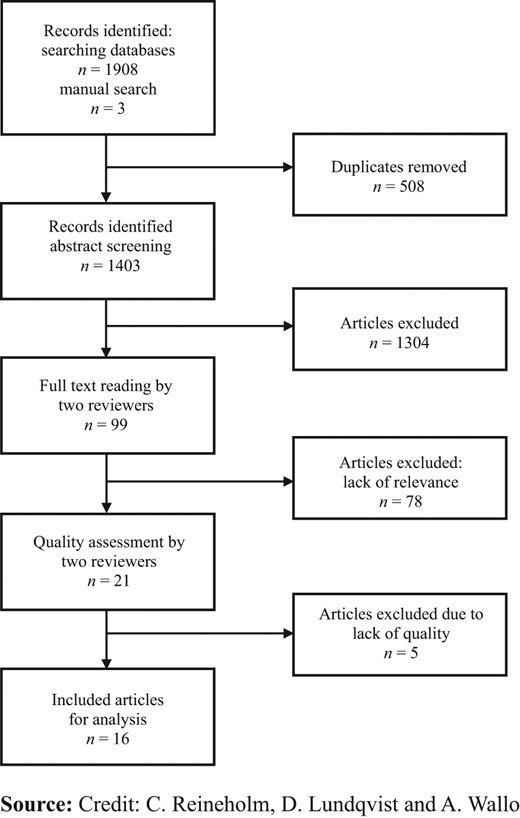
The studies were screened based on title and abstract, and 99 studies were selected for relevance review based on the inclusion criteria for the literature review. After reviewing the downloaded full texts for relevance, 21 studies met all inclusion criteria. These 21 studies underwent a quality assessment based on recognized protocols for quantitative (Tompa et al., 2016) and qualitative studies (SBU, 2020). All studies were reviewed and graded in a three-point quality assessment: low, medium-high or high quality. Of a total of 11 quantitative studies reviewed for quality, 7 studies were assessed to be of high or medium quality. Of ten qualitative studies reviewed for quality, nine were assessed as being of high or medium quality. Thus, a total of 16 studies were included in the review.
All three authors read all included studies, and information gathered from each study was compiled in tabular form per a narrative synthesis method (Booth et al., 2022). The tables contained information about the purpose or focus, analysis method and results of each study. In the next step, the factors in the articles that could be traced to managers’ learning and development opportunities and sustainability were examined. In the third and final step, six aspects emerged in the analysis: three aspects of learning and development (Conditions that support learning, Career opportunities and Individual engagement) and three aspects of sustainability (Health and well-being, Career mobility and Desire to stay).
Findings of the review
The included studies were all published between the years 2007 and 2021, most of them published in the past five years. Nine of the included studies were based on a qualitative methodology, and seven studies were based on a quantitative methodology. An overview of the studies is presented in Table 1.
Overview of included articles: people, exposure, outcome and data collection
| Author (year) | People | Exposure | Outcome | Method |
|---|---|---|---|---|
| Babic and Hansez (2021) | 320 female managers in a global health-care company, Belgium | Different treatment, glass ceiling | Job strain, job engagement, job satisfaction, intention to quit | Survey |
| Cherkowski and Walker (2016) | 12 (t1) and 6 (t2) school leaders in public schools, Canada | Collaboration, safe learning climate | Flourishing as a leader | Qualitative survey |
| Döös et al. (2015) | Nine middle managers in a global software communication industry, Sweden | Re-design/free organizational structures, create action space | Autonomy, room for maneuver, learning-oriented leadership | Interviews |
| Ekrot et al. (2018) | 541 project managers and 135 coordinators in 134 companies, Austria, Germany, Switzerland | Qualification opportunities, career paths | Intention to quit, Job satisfaction | Survey |
| Eriksson and Dellve (2020) | 23 managers and process leaders in health care, Sweden | Workplace learning, health-promoting leadership | Work Life Balance | Interviews |
| Froehlich et al. (2014) | 135 bank managers, Austria | Organizational learning climate | Career development | Survey |
| Gustavsson and Fogelberg Eriksson (2010) | 42 industrial managers, Sweden | Learning, career opportunities | Career development | Interviews |
| Hagerman et al. (2019) | 14 first-line managers in elderly care, Sweden | Structural empowerment | Psychological empowerment | Interviews |
| Plimmer et al. (2021) | 1652 public sector managers, New Zealand | Innovative climate | Employee resilience | Survey |
| Rodriguez-Gomez et al. (2020) | 715 school leaders in primary and secondary schools, Spain | Organizational learning culture | Professional motivation, professional competency | Survey |
| Thomas-Gregory (2014) | 14 middle managers in a school of health care, Great Britain | Leadership and academic development opportunities | Job satisfaction | Interviews |
| Tjulin et al. (2019) | 18 first-line municipal managers, Sweden | Workplace learning, health-promoting leadership | Work Life Balance | Interviews |
| Tørstad and Bjørk (2007) | 19 nurse leaders at ward level and 24 executive nurse leaders, Norway | Career ladders | Career advancement | Focus groups |
| Wastesson et al. (2021) | 35 first-line managers in elderly care, Sweden | Workplace learning | Willingness to stay | Interviews |
| Zia et al. (2021) | 388 managers in manufacturing SME, Pakistan | Supervisory feedback environment | Informal learning, work engagement | Survey |
| Zopiatis and Constanti (2007) | 200 hotel managers, Cyprus | Motivational factors, turnover factors, leakage factors | Motivation, turnover, leakage | Survey |
Conditions that support learning
The first theme that emerged from several of the analyzed studies concerns organizational conditions that support learning. Conditions that support learning are defined as how managers perceive that their work environment enables learning and professional development at work, as well as in-depth knowledge or new ways of thinking and creativity. Here, the studies used concepts such as learning climate, learning environment and learning culture to capture this phenomenon.
Some studies found that a positive learning climate or culture was important for managers’ motivation, engagement and development as a leader (Cherkowski and Walker, 2016; Eriksson and Dellve, 2020; Rodriguez-Gomez et al., 2020). It is also believed that this is important for managers to handle their work situation (Eriksson and Dellve, 2020; Plimmer et al., 2021). In the study by Cherkowski and Walker (2016), managers’ experiences of flourishing in their work of leading schools were investigated. The results showed that safe learning communities were created through collaboration with others. In a safe learning climate, one dares to take risks to learn, challenge oneself and be innovative and try different ways of teaching and learning. The study indicates that a safe learning climate characterized by commitment and collaboration creates opportunities for managers to flourish as leaders. A similar result was found in the study by Rodriguez-Gomez et al. (2020) on managers in primary and secondary schools. They found significant positive associations between a learning-friendly culture, motivation for the profession and willingness to work as a school principal. Zia et al. (2021) examined the importance of managers’ learning for their work engagement, defined as part work enjoyment and part motivation. The study found a positive association between the informal learning of managers and their work engagement. Another positive association was found between feedback from superior managers and informal learning. The study thereby shows that an environment where feedback was given from superior managers strengthened lower-level managers’ informal learning, which in turn strengthened their work engagement.
Organizational learning climate and how managers’ active work and learning process contributed to the results of a health-promoting leadership intervention were investigated in the study by Eriksson and Dellve (2020). The results showed that managers took on different assignments in the program differently, indicating that interventions and training programs need to be customized for each organization. Organizations need to provide managers with sufficient conditions and resources to apply health-promoting leadership, increase motivation and promote a balanced work and private life. An encouraging learning and innovation environment can also contribute to managers’ resilience to work-related challenges, as found in the study by Plimmer et al. (2021).
Two studies (Tjulin et al., 2019; Wastesson et al., 2021) were based on a workplace learning perspective. Tjulin et al. (2019) followed a health-promoting leadership intervention, and the results showed that managers’ workload was at the limit of what they could handle and that time for reflection and long-term planning was limited. The managers also lacked designated time for the intervention and learning, highlighting the importance of giving managers time to reflect and discuss together and an arena for learning. The study showed that workplace learning and coaching in health-promoting leadership could support managers in their leadership and increase their balance between work and private life. In the study by Wastesson et al. (2021), new first-line managers were in focus. In their study, help and social support from colleagues were found as important factors for workplace learning. The study showed that organizations need to arrange good conditions for learning and support for new managers and prepare them for their future assignments to retain new managers.
Career opportunities
The second theme from our analysis relates to managers’ career and qualification opportunities. Career development was referred to how managers perceive their opportunities to advance and make a career, that is, to be promoted or to move on to other assignments, and how such opportunities are encouraged in their organizations.
In the study by Tørstad and Bjørk (2007), career ladders as professional development in nursing were investigated. The purpose of the career ladders was to offer learning and development in practice, but the result showed a mixed picture. Although the career ladders were part of hospitals’ strategic plans, the program had a low priority among some of the senior executives. The study indicates that career ladders need to be sanctioned and made visible throughout the organization to promote career advancement.
In the study by Froehlich et al. (2014), the complex relationship between personal and contextual factors in relation to managers’ job performance, career development and perceived competence was investigated. The study found that the learning climate of managers by itself was associated with the managers’ job performance, career development and perceived competence. However, when other factors were considered simultaneously (such as learning style or leadership style), the learning climate inhibited these other factors' effect. Therefore, caution is warranted as several factors may interact. The study by Thomas-Gregory (2014) showed that good leadership development opportunities and personal qualities, such as resilience and flexibility, increased job satisfaction.
Two studies investigated managers’ career and learning opportunities concerning job satisfaction, motivation and willingness to stay. Zopiatis and Constanti (2007) let hotel managers rate ten factors in how important they were for:
their work motivation;
their intention to remain with the employer; and
remaining in the industry.
All three areas were rated similarly, but the top factors were considered to be appreciated for their work, having interesting work, having good work conditions and having good career opportunities. The study emphasizes the importance of managers’ work conditions and career opportunities for their work motivation and willingness to continue being a manager. Ekrot et al. (2018) showed that managers’ career and learning opportunities created a feeling of being trusted, seen and supported by the organization, which in turn provided higher job satisfaction and willingness to remain in the organization. The study also found that learning opportunities were as a moderator in the relationship between career and organizational support, which showed that the relationship between career and organizational support was only significant if learning opportunities also existed.
Two studies had a clear gender perspective. Gustavsson and Fogelberg Eriksson (2010) investigated differences between male and female managers’ learning and career opportunities. Although the opportunities for learning and development were good, female managers experienced fewer advancement opportunities than men. The study indicates that managers’ learning and career development could be more transparent to retain both female and male managers. Babic and Hansez (2021) investigated unequal treatment and the presence of a glass ceiling among female managers. They found that organizations’ treatment of managers in terms of access to equal career and development opportunities had consequences for job strain, job engagement, job satisfaction and intentions to quit, which could add contributing effects by creating conflicts between work and private life.
Individual engagement
Two studies (Döös et al., 2015; Hagerman et al., 2019) investigated managers’ discretion and room for action by capturing how managers can affect the organizational structure to gain autonomy by adjusting work regulations and activities. The study by Döös et al. (2015) showed that managers performed various actions to influence and adjust work in the organization. Social and organizational structures were broken up or disregarded to create room for action and autonomy. Organizations that allow managers to find new organizational connections and relations and new ways to work and lead can give managers a sense of autonomy, room for manoeuver and trust. Similar results were found by Hagerman et al. (2019) in their study on first-line managers in elderly care. They found that opportunities to influence and make decisions gave the managers a sense of control over their work.
Sustainability
The existing studies seem to suggest an association between conditions for learning and opportunities for career development and sustainability, in terms of:
the managers' health and well-being;
career mobility; and
the desire to remain in the organization or the managerial position.
The reviewed studies show that learning conditions, career opportunities and individual engagement are related to all three examined aspects of managers’ sustainability even if there is a slight difference in what is emphasized the most. However, it is also important to underline that these three aspects may influence each other. On the contrary, it appears plausible that they can reinforce each other in their impact on sustainability.
Furthermore, the findings suggest that there may be indirect links between development opportunities and managers’ sustainability. For example, Ekrot et al. (2018) showed that career opportunities were associated with managers' willingness to stay and health and well-being through organizational support. Another example is Babic and Hansez (2021) who showed that work–life balance was an intermediate factor for more health-related outcomes.
The studies highlight not only sustainability for managers but also other issues related to leadership practice and managers’ performance. Although few studies consider this, it is still worth noting. In some studies leadership practice and managers’ performance are seen as secondary effects of sustainability, that is, the development opportunities can contribute to sustainability which in turn contributes to better performance and leadership (Tjulin et al., 2019), while other studies do not (Froehlich et al., 2014).
It is also important to note that while the conditions for learning, career opportunities and individual engagement contributes to managers’ ustainability, the managers’ sustainability also seem to have reciprocal effects. These reciprocal effects are mainly found in qualitative studies such as the ones conducted by Cherkowski and Walker (2016) or Döös et al. (2015). Thus, these relationships tend to be very complex with several different factors and interdependencies. Froehlich et al. (2014) also pointed out this complexity and interdependency.
Managers’ development environments – definition and conceptual model
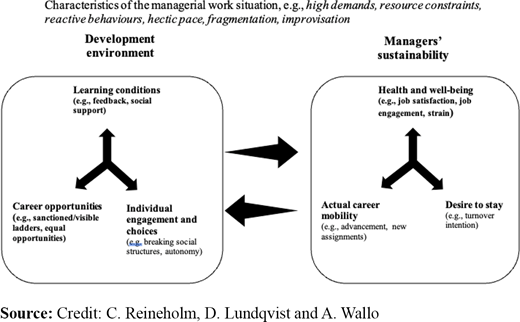
When taken together, the relatively few available previous studies have so far been able to provide a rather limited image of what factors constitute a sustainable environment for managers and how these factors are related. With a few exceptions (Tjulin et al., 2019; Wastesson et al., 2021), most of the studies have empirically investigated managers without identifying and discussing the unique characteristics that comprise managers’ daily work situations (Carlson, 1951; Mintzberg, 1973; Stewart, 1982). Furthermore, a large number of the previous studies, first and foremost in the quantitative articles, focus on the workplace or the organization where the connection to the managers’ situation becomes more indirect. Therefore, there is a need to find a concept that builds on both learning and career theory. Our suggestion is to use the following concept: managers’ development environments. We define this concept as an organizational environment that encourages daily workplace learning and offers a wide range of vertical and horizontal opportunities for career development. Such an environment is characterized by an interaction between a workplace climate that encourages both formal and informal learning, transparent career paths and a structure that enables job mobility within the organization. A development environment is dynamic and should not be seen as determining the actions of managers; rather, managers are part of shaping the environment by virtue of their choices and actions. An organizational environment that not (actively) encourages formal and informal learning and has limited career development opportunities, and a low degree of internal job mobility can, thus, be characterized as a negative or constrained development environment. In line with Billett (2004), the development environment depends on both workplace affordances and individual engagement (Stewart, 1982).
To study how the managers’ development environment is related to sustainability and other outcomes, such as leadership and work performance, we propose the model below (Figure 2), which is an attempt to integrate the results from the studies in the review and situate them within the characteristics of managerial work as described in the managerial work literature (Carlson, 1951; Mintzberg, 1973; Stewart, 1982). Hopefully, this model can bridge the gaps and serve as a heuristic tool for further advancements in the field.
Knowledge gaps and propositions for future research
In line with the model presented above, it is possible to identify several areas needing more research. Drawing on the key categories of the components of the model and the knowledge gaps identified in the review of previous empirical studies, we develop a set of research propositions that should be examined in future research.
Managerial work characteristics influence on managers’ development environment and their sustainability.
Research regarding the importance of managers’ development environment seems to be a relatively new and still evolving field, especially in relation to their sustainability, and there is a need for more research in this area. Managers’ work conditions, in general, have been investigated in previous studies (Lundqvist et al., 2013), but few of the reviewed studies seem to situate their studies within this managerial research tradition. Managers’ development environment and their sustainability are, therefore, investigated without considering how the managers’ general work situation provides a framework for or shapes these aspects. The control span is one example of a factor that likely influences the managers’ development environment:
The general work characteristics of managers’ daily work influence and shapes their development environment and their sustainability.
The interrelation between the three aspects of managers’ development environments.
Based on the findings of this review, the development environment seems to consist of several mutually interrelated aspects. On the one hand, there are opportunities provided by the organization for learning and career development. On the other hand, there is the individual manager’s motivation, engagement and choices to partake in and use the opportunities provided. The development environment, therefore, consists of the interaction between the opportunities an organization provide and individuals’ choice to participate and engage, which makes the development environment of a manager dynamic and ever-changing:
A development environment of managers consists of several different aspects that mutually influence each other, and therefore, it is dynamic and not static.
The relation between managers’ development environment and managers’ sustainability.
Despite the limited amount of previous research, the studies in this field seem to suggest that the development environment of managers is related to their sustainability. This link needs, however, to be further explored, in terms of strength, mediation and direction. The strength concern how much influence the learning environment has on sustainability; currently, there are too few studies to provide an answer. The mediation is concerned with whether the learning environment directly affects sustainability or if it influences other aspects, which in turn influence sustainability. Some reviewed studies suggest this may be the case, finding that managerial resources, such as support, mediate the relationship (Ekrot et al., 2018). Finally, the direction is concerned with the direction of the influence. Although most previous research investigates the development environment as influencing sustainability, it is conceivable that a reciprocal process of influence exists, at least over time:
Managers’ development environment and their sustainability is reciprocally related indirectly (mediated) and directly (unmediated) over time.
The interrelation between the three indicators of managers’ sustainability.
Based on the findings of this review, the sustainability of managers seems to consist of several aspects that are mutually interrelated. Like their development environment, managers’ sustainability is not static either and depends on several aspects, such as their development environment and their general work situation. However, considering managers' generally high social capital (Lundqvist et al., 2013), an unsustainable work situation will likely result in the manager leaving their jobs. For instance, a gender perspective was found in two of the studies in this review (Babic and Hansez, 2021; Gustavsson and Fogelberg Eriksson, 2010), showing differences in the developmental environments of male and female managers. Based on these limited results, it is difficult to draw any definite conclusions. However, it indicates that the conditions for men and women may differ, providing different sustainability for male and female managers. However, this area needs more research. That differences exist in the conditions for men and women to be managers has been studied for many years (Fogelberg Eriksson, 2005), but more research is needed on what such differences can lead to in terms of their sustainability.
The sustainability of managers consists of several different aspects that mutually influence each other.
Methodological refinement in the field.
In addition to more research in the field, it is also crucial that studies are of high quality and with a longitudinal design. It is, of course, difficult to discuss causality when it comes to such complex phenomena as studied in this literature review. However, with a longitudinal design with repeated measures, directions can at least be indicated. Of the studies included in this literature review, all (except one) had a cross-sectional design, that is, measurements were made at one time, which makes it impossible to see the direction of the connections. We simply cannot say with certainty that it is the development environment that makes or contributes to the sustainability of managers, or if it is the case that it is “sustainable” managers who value their development environment as better, for example, because they enjoy work and feel good. It is also possible that this relationship is not so linear that the development environment creates sustainability. However, sustainability itself may also be a prerequisite for the development of the environment, that is, that there are reciprocal relationships. This was found in the assessed qualitative studies and also highlighted in other contexts in previous research (Kaluza et al., 2020; Lundqvist, 2013):
This field of research can be advanced by developing and validating instruments that measure the development environment and sustainability of managers, and their interrelations, by incorporating longitudinal designs.
Limitations of the review
The present review has some limitations. First, managers’ development environments and sustainability are theoretical complex concepts which have been rather difficult to operationalize. Second, the area is also relatively new, resulting in limited research studies. Although the list of search terms was long, there is always a risk that we might have overlooked a term. Third, studies of management training were not included in this review because we wanted to capture the context of the daily work and not formal competence development interventions.
Conclusions and implication for practice
One conclusion that can be drawn from this integrative literature review is that it is difficult to unequivocally establish that a good development environment creates sustainability in managers because there is not enough scientific evidence. While we can see some associations, more high-quality research is needed to investigate this further.
A practical implication is for the top management and organizational functions working to support managers, such as HR specialists, to analyse how the development environment of managers’ can be strengthened. Formal competence development can be important to consider, but the consequences of formal training programs are often limited without being combined with opportunities for informal learning in daily work (Wallo et al., 2020). However, the development environment is dependent on organizational affordances and activities and individuals’ participation and engagement (Billett, 2004; Stewart, 1982). Finally, managers’ career paths can look different. A career step may as well go sideways to try a new direction and not always upwards. Managers can also take a step down and leave the managerial position for a period. Working as a manager for periods or with shared responsibilities may be an opportunity to increase managers’ sustainability.
Fundings: This research was funded by Ledarna, a union for managers in Sweden.

