


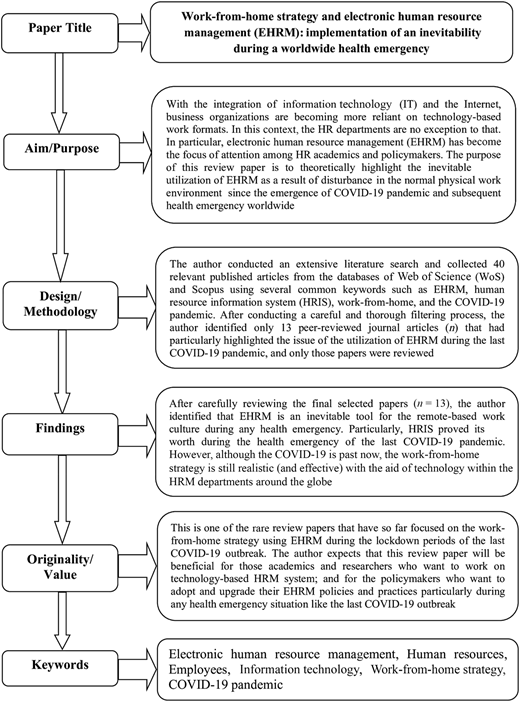
With the integration of information technology (IT) and the Internet, business organizations are becoming more reliant on technology-based work formats. In this context, the HR departments are no exception to that. In particular, electronic human resource management (EHRM) has become the focus of attention among HR academics and policymakers. The purpose of this review paper is to theoretically highlight the inevitable utilization of EHRM as a result of disturbance in the normal physical work environment since the emergence of COVID-19 pandemic and subsequent health emergency worldwide.
The author conducted an extensive literature search and collected 40 relevant published articles from the databases of Web of Science (WoS) and Scopus using several common keywords such as EHRM, human resource information system (HRIS), work-from-home, and the COVID-19 pandemic. After conducting a careful and thorough filtering process, the author identified only 13 peer-reviewed journal articles (n) that had particularly highlighted the issue of the utilization of EHRM during the last COVID-19 pandemic, and only those papers were reviewed.
After carefully reviewing the final selected papers (n = 13), the author identified that EHRM is an inevitable tool for the remote-based work culture during any health emergency. Particularly, HRIS proved its worth during the health emergency of the last COVID-19 pandemic. However, although the COVID-19 is past now, the work-from-home strategy is still realistic (and effective) with the aid of technology within the HRM departments around the globe.
This is one of the rare review papers that have so far focused on the work-from-home strategy using EHRM during the lockdown periods of the last COVID-19 outbreak. The author expects that this review paper will be beneficial for those academics and researchers who want to work on technology-based HRM system; and for the policymakers who want to adopt and upgrade their EHRM policies and practices particularly during any health emergency situation like the last COVID-19 outbreak.
1. Introduction
The global spread of the lethal COVID-19 epidemic caused significant disruption on both the business and non-business entities. The COVID-19 pandemic was widely recognized as a substantial business disaster and health emergency that led to the loss of numerous lives; and put a catastrophic impact on human resources of many enterprises. The COVID-19 pandemic not only caused widespread concern about the overall health and welfare of people, but also led to a crisis in organizational management in the afflicted countries and areas covering most of the globe. Several governments worldwide had to enforce strict lockdown measures to address the health risks caused by the epidemic, resulting in the temporary suspension of all in-person human resource management (HRM) activities. Globally, the pandemic compelled a significant shift away from traditional face-to-face workplace culture toward a work-from-home or remote work culture. Approximately 80% of the world’s organizations mandated their employees to engage in remote work while 91% of the work teams had to establish remote work arrangements since the onset of the epidemic (Draghici, Stankevičiūtė, Khanchel-Lakhoua, Brancu, & Şahin, 2025; Sachdeva et al., 2024; Allyn, 2020). The pandemic drove an immediate transformation of HRM practices by implementing a work-from-home strategy, although such a strategy did not bring adequate independence and contentment among employees rather than making them disheartened as they had been under constant vigilance and monitoring through different tracking software (Draghici et al., 2025; Sachdeva et al., 2024; Allyn, 2020).
Although it is extremely difficult to anticipate and plan ahead for a distressing event like the last COVID-19 outbreak, it has now been more crucial than ever to have a remote working strategy in place and utilize information technology (IT), specifically electronic human resource management (EHRM), to carry out HRM functions from homes or remote places. An essential aspect of successfully conducting EHRM activities from remote locations is to closely monitor the needs and preferences associated with these activities. The COVID-19 pandemic compelled nearly all organizations, business and non-business alike, to carry out HRM tasks remotely. Consequently, it has become crucial to examine how employees adapt to the difficulties associated with the evolving field of HRM. The COVID-19 pandemic demonstrated that the duties and responsibilities of many occupations may be effectively carried out remotely, allowing employees to comfortably interact with their colleagues using online platforms instead of commuting to their physical offices (Friedman, 2020). Prior research on remote work indicated various advantages, including the ability to attend to household responsibilities (Versey, 2015), minimizing interruptions (Fonner, 2012), and saving time on transportation (Kelliher, 2010). Amidst the battle against worldwide catastrophes like the last COVID-19 outbreak, IT can play a significant role in ensuring the uninterrupted operation of routine business activities. It can also be leveraged to create innovative digital strategies enabling businesses to not only survive but also thrive during uncertain times (Draghici et al., 2025; Sachdeva et al., 2024; Rahman & Rahman, 2021; Ågerfalk, 2020).
Therefore, considering the infectious nature of the last COVID-19 epidemic and its delayed status among the world population, many researchers and organizational policymakers have raised several questions, such as (1) How can IT-based EHRM contribute to performing regular HRM activities amid worldwide health emergency? (2) Is work-from-home strategy capable to administer HRM activities? To answer these two basic but important questions, this review paper searched and highlighted the key findings of the existing literature that had particularly focused on EHRM and work-from-home strategy during the pandemic-related health emergency. Due to the impact of COVID-19 like emergencies, employees may be required to adapt their personal and professional lives, and adopt technologies such as IT and the Internet in innovative and effective ways (Draghici et al., 2025; Sachdeva et al., 2024). The fundamental purpose/objective of this review paper is to identify how HRM has converted itself with the help of IT and the Internet in order to conduct regular activities as part of changed context of working environment during the last COVID-19 pandemic. Figure 1 indicates the graphical representation of the abstract.
2. Research methodology (literature search and filtering techniques with justifications)
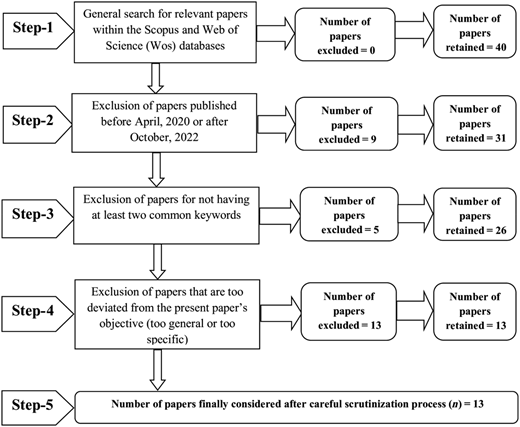
This review paper was written based on the peer-reviewed published journal articles from April, 2020 to October, 2022 to highlight the research works that specifically focused on the role of EHRM on work-from-home strategy during the last COVID-19 pandemic. However, it should be noted that no book chapter, working paper, thesis/dissertation and/or, conference paper was considered in writing this review paper. For due purpose, the author searched in and collected the relevant papers (theoretical, review, and research) from two most popular databases [Scopus and Web of Science (WoS)] using the common keywords of this review paper, such as EHRM, HRIS, HRM, work-from-home, and the COVID-19 pandemic. Only those papers were selected where all of these or at least two of these keywords were present.
On the other hand, the motivation behind using only these two research databases was that they are the leading search engines to get the quality scientific articles. These databases provide high-quality meta-information and have the uppermost probability to be within the title, abstract, and keywords. After the initial search, the author found only a handful of relevant papers (40). After removing the papers which were published before April, 2020 or after October, 2022, the number of papers stood to 31. Afterward, some of those papers (5) were removed from consideration that did not include the major keywords such as EHRM, work-from-home or the COVID-19 pandemic. Finally, the author discarded 13 papers where the themes were too general or too specific. Lastly, after careful filtering process, the number (n) of papers selected for review stood to 13. However, due to the strict boundary of finding the relevant published papers (only the peer-reviewed published papers in the databases of Scopus and WoS from April, 2020 to October, 2022), the author had to write this review paper based on only a handful of peer-reviewed published articles, and it is the main limitation of this review paper. Figure 2 indicates the graphical representation of the literature search and filtering techniques applied for writing this review paper.
3. Literature review
The unforeseen and abrupt consequences of the last COVID-19 pandemic compelled numerous organizations, especially in heavily impacted countries/regions, to reassess their approach to conduct their day-to-day activities. The COVID-19 pandemic necessitated the need for adaptability, the ability to modify methods, and the adoption of IT and the Internet technologies to carry out organizational functions in a distinctive manner. Traditional HR processes relied heavily on extensive documentation and a lengthy administrative procedure, resulting in a slow and inefficient process. The global COVID-19 pandemic greatly hindered the ability to carry out the organizational activities in the traditional manner due to widespread compulsory lock-downs occurring at various times and in different locations (Draghici et al., 2025; Sachdeva et al., 2024; Hosain & Jakia, 2023; Hossin, Chen, Hosain, & Asante, 2022; Lai, Hossin, Li, Wang, & Hosain, 2022). As a result, the HR departments worldwide had to find alternative methods to ensure smooth functioning of their organizational activities. However, the HR departments had effectively maintained their operations with the assistance of IT in such circumstances (Rahman, Mutsuddi, Roy, Al-Amin, & Jannat, 2020). The COVID-19 pandemic placed immense pressure on the organizations’ HR departments to support their planned goals, and prioritize actions that bring value, ultimately resulting in changes to job content and expectations for the HR professionals (Draghici et al., 2025; Sachdeva et al., 2024; Rahman & Rahman, 2021). IT-based HRM enables employees to work independently, providing them with autonomy and flexibility when working remotely. This approach also encourages employers to prioritize employee well-being (Delanoeije, Verbruggen, & Germeys, 2019). Nevertheless, working remotely can present occasional challenges, as personnel from the same team are required to operate in different locations independently where time zones can vary (Kramer, 2020).
The COVID-19 pandemic mandated a shift to remote work for employees, a deviation from the prior working environment. The prolonged pandemic (early 2020 to late 2022) also led to mandatory quarantine, resulting in difficulties with transportation, safety, duty allocation, and discussions for remote workspaces. Furthermore, the HR departments had to adapt to digital platforms and casual working environments in order to maintain normal business operations. A multitude of organizations were principally perplexed and ill-equipped to handle the unforeseen alterations. Subsequently, those organizations prioritized digital transformation due to the pandemic-induced delay (Savić, 2020). The integration of IT with HRM practices, also known as EHRM, had actually, already taken place even before the pandemic began. It was during the COVID-19 epidemic when employees began working from home and significantly increased their use of IT. Indeed, the majority of enterprises worldwide would be unable to sustain their operations without the support of IT and the Internet. The existing literature on work-from-home has primarily focused on exploring and theorizing the technological aspects of this strategy, while neglecting the importance of EHRM in organizational management (Rahman & Rahman, 2021; Coibion, 2020). Many empirical studies so far have primarily examined the impact of COVID-19 on the labor markets, including increased unemployment, poverty, tourism decline, and hunger (Coibion, 2020). Regardless of our acknowledgement, the COVID-19 pandemic persisted a long period of time (almost three years) exerting a significant impact on a substantial number of employees globally. The individual employees had experienced severe psychological distress as a result of their fear of being infected by the virus (Draghici et al., 2025; Sachdeva et al., 2024; Hossin et al., 2022; Lai et al., 2022; Sarfraz, Ji, Asghar, Ivascu, & Ozturk, 2022). The integration of technology in regular HRM operations, including EHRM, by organizations was heavily influenced by the severity of the COVID-19 epidemic and the following mandatory shutdown(s) around many parts of the globe.
According to a survey conducted in March 2020, 88% of organizations worldwide either encouraged or mandated their workers to work-from-home during the COVID-19 pandemic (Gartner.com). Despite the global prevalence of stress and anxiety, organizations were unable to halt their normal operations; and were continuing to expect their employees to be prepared for long-term remote work. The COVID-19 epidemic caused significant uncertainty, adversely affecting the mental well-being of numerous employees worldwide (Draghici et al., 2025; Sachdeva et al., 2024; Sarfraz et al., 2022). The COVID-19 pandemic brought attention to the crucial role of HR managers in effectively addressing the health and safety concerns of employees. Although, the epidemic is no longer in existence now, it is important to emphasize the influence of such worldwide disaster on HRM in both the service and manufacturing sectors, which are subject to medium to long-term restrictions. The COVID-19 pandemic compelled many organizations to adhere to legislative or organizational mandates, in order to mitigate the danger of infections or transmission of the virus. This review paper is an attempt to highlight the implementation of remote work strategies and EHRM in relation to the challenges experienced by employees during the COVID-19 pandemic.
3.1 Work-from-home or remote working strategy under the COVID-19 situation
The work-from-home or remote working strategy provides employees with a harmonious integration of their personal and professional lives, allowing them to balance their family lives and work responsibilities. It eliminates the need for commuting, offers flexible working hours, reduces expenses related to office equipments; and decreases office utility costs such as electricity and gas. Additionally, it enhances geographical coverage for employees (Draghici et al., 2025; Sachdeva et al., 2024; Nickson, 2012). The emergence of automation, IT and data sharing technologies has created significant potential to leverage the capabilities of EHRM while maintaining normal operations. According to Delanoeije (2020), implementing a work-from-home approach can enhance employee productivity, job engagement, and job performance; which in turn, reduces employee turnover intention. Remote working opportunity provides numerous benefits, including decreased time spent in commuting, decreased involvement in office politics, decreased need for office space, decreased absenteeism, higher motivation, improved gender diversity, increased job satisfaction, and increased productivity (Mello, 2007). The COVID-19 pandemic disrupted our normal way of life, necessitating the adoption of new daily routines and preventive measures to curb the spread of virus. These measures aimed to prioritize public health and safeguard the stability of national and global economies, recognizing the crucial role played by human resources in all commercial operations.
According to information retrieved from LibHunt, a job statistics portal, approximately 37% of jobs in the United States were capable of being carried out remotely during the COVID-19 pandemic. These jobs include tasks such as financial transactions, business management, and professional and scientific services. However, jobs in the sectors such as manufacturing, healthcare, farming, and hospitality are not suitable for remote work. The remote working practices in the banking business encompass the coordination of planning, implementation of policies and regulations, establishment of sustainable infrastructure, utilization of real-time communication, and adoption of IT developments to streamline procedures. The technology components involved in home office-based work include cyber physical systems (CPS), the Internet of Things (IoT), and enhanced connectivity (Draghici et al., 2025; Sachdeva et al., 2024; Rahman & Rahman, 2021). These technologies collect and store real-time data on the Web and transfer it across the Internet networks as a continuous flow of information between various devices, components, and systems (Apanaviciene, Vanagas, & Fokaides, 2020). Amidst the pandemic, when the health experts advised lockdowns and quarantines, the effectiveness and deficiencies in carrying out organizational activities had been reduced. A significant proportion of employed individuals had to convert their residences into workspaces, disrupting the normal operations of the HR departments and causing service interruptions. The interruptions had caused various issues for office work in developing and undeveloped countries, due to insufficient power supply and unreliable Internet connections at home. Although enterprises may lack proficiency in methodology and technical expertise, concerns about the safety and security of employees compelled them to implement remote working methods.
3.2 IT, EHRM, and work-from-home
The aim of this review article is to focus on the themes of work-from-home (remote working), EHRM, and flexible workplace, specifically exploring their relationships with IT and the Internet during the last COVID-19 epidemic. Employers may seek quantitative data regarding their employees, such as the number of contracted human resources, the amount of work performed, variations in timing, pace of work, and differences in working locations (Kalleberg, 2001). The advancement and widespread use of technology, particularly in the field of IT, has transformed the globe into a virtual environment, enabling individuals to operate from any location. Over time, standard workplace spaces are no longer sufficient for meeting diverse demands, or responding to fast-paced and unpredictable events. The COVID-19 epidemic had expedited the necessity of adapting to remote work with the assistance of IT. One such instrument that particularly aided employees and consumers during the pandemic by minimizing physical contacts, and ensuring health and safety was the technology of mobile-based online payment platforms (Hosain & Kamal, 2024). Despite encountering some problems, this technology enabled (and, still enabling) the individuals to carry out online banking and other payment operations (Hosain & Kamal, 2024; Jawad, Parvin, & Hosain, 2022).
Although the users do not take such concerns into consideration when it comes to their health and safety; lower perceived utility, lower perceived ease of use, and low quality of the Internet connectivity reduce user satisfaction when using EHRM to work from their homes. The motivation behind employees’ interest in remote working lies in their willingness to embrace new working technology, and willingness to adapt to a different work environment, despite the hurdles involved. Interventions from EHRM can have a significant impact on this procedure (Thompson & Smith, 2010), and software can be utilized to convert employees’ knowledge into a digital format (Draghici et al., 2025; Sachdeva et al., 2024; Mabey & Zhao, 2017). The extent to which these procedures are implemented is likely to depend on the nature of the tasks to be carried out; and the equilibrium between human and technical contributions (Flecker & Schönauer, 2016). When addressing EHRM in the context of remote work, two primary aspects are taken into account: organizational factors and individual characteristics (Rahman & Hosain, 2021). Remote work facilitates the employees’ needs related to expenses, training, technology utilization, and corporate communication (Draghici et al., 2025; Sachdeva et al., 2024; Rahman & Rahman, 2021).
Remote working, particularly working from home is conductive for employees’ well-being and organizational trust (Draghici et al., 2025; Sachdeva et al., 2024; Grant, Wallace, Spurgeon, Tramontano, & Charalampous, 2019). Digitization facilitates remote work, allowing employees to engage in various forms of job disintegration. This includes managerial disintegration through complex employment relationships involving both direct and subcontracted workers, temporary disintegration through the use of part-time and shift employees, contractual disintegration through the individualization of employment relationships; and spatial disintegration through the use of small and isolated work units (Rahman & Rahman, 2021). The main results of these advances can include more flexibility and mobility, which benefit both people and enterprises (Ludivine, 2017).
4. Key findings identified from literature survey
This is a review paper with the purpose of identifying the importance of EHRM and work-from-home strategy with the help of IT and human resource information system (HRIS). Table 1 highlights the basic findings identified from reviewing the literature.
Key findings identified from literature survey
| Findings | Paper type and title | Source(s) of literature |
|---|---|---|
| The COVID-19 catastrophe forced organizations to consider that working remotely is possible; and can produce benefits and results in terms of autonomy, motivation, and trust, to the detriment of physical presence, which is not as important to guarantee productivity | Research paper: “Remote working in Italian SMEs during COVID-19: Learning challenges of a new work organization” | Barabaschi et al. (2022) |
| Telework and occupational health relationship as working dynamics can change throughout the progression; and hopefully cessation, of the COVID-19 pandemic | Research paper: “Telework, worker health, and well-being: a review and recommendations for research and practice” | Beckel and Fisher (2022) |
| A combined set of “hard” HRM strategies related to the financial aspects and “soft” HRM strategies related to keeping employees’ well-being during the COVID-19 crisis gives the best results in forming job performance through job-related attitudes and eventually strengthening organizational performance | Research paper: “COVID-19 oriented HRM strategies’ influence on job and organizational performance through job-related attitudes” | Bieńkowska, Koszela, Sałamacha, and Tworek (2022) |
| Since work from home strategy provides employees more control over how much time they give to work and family life, remote e-working enhances employee focus while they work from their homes, thereby increasing their job satisfaction. Job satisfaction is an important predictor of whether remote work enhances organizational commitment. A satisfied e-worker feel more emotionally connected to the organization and more obliged toward the organization | Research paper: “Unlock the black box of remote e-working effectiveness and e-HRM practices’ effect on organizational commitment” | Alshibly and Alzubi (2022) |
| Organizations require a detailed description of the emergency working context; and should realize how it works to understand the new world, new ways, that is important to us | Theoretical paper: “Lessons from entrepreneurs Covid-19 affecting in resource work in business digital approach” | Tanphan, Pongsamran, Saounpong, Visitnitikija, Yeesoontes, and Mahamud (2022) |
| E-management (including EHRM) in the Lithuanian municipalities until the COVID-19 pandemic was applied only in exceptional cases due to legislation and workplace stationarity. However, during the epidemic, e-management in municipality administrations was treated not as an alternative but as the only possible choice | Research paper: “E-management as a game changer in local public administration” | Vilkaite-Vaitone and Povilaitiene (2022) |
| A combined global collaboration initiative among research centers, allowing information about COVID-19 impacts can be shared easily with the help of IT. It will support a universal policy to discover a response to the epidemic addressing cultural and social issues | Review paper: “The role of IT-based technologies on the management of human resources in the COVID-19 era” | Vahdat (2022) |
| The skills and knowledge of employees, the economic situations of the organizations, payment pattern, cloud availability, and the current IT infrastructures of the organizations have positive impacts on human resource efficiency in the COVID-19 period | Research paper: “Do cloud-based enterprise resource planning systems affect the productivity of human resources in the COVID-19 era?” | Yao and Azma (2022) |
| The COVID-19 pandemic accelerated digitalization trends at the same time, heightening the necessity of employee resilience; and well-being in adapting to wider unemployment and technological disruption | Review paper: “Preparing workplaces for digital transformation: An integrative review and framework of multi-level factors” | Trenerry, Chng, Wang, Suhaila, Lim, Lu, and Oh (2021) |
| Work-from-home strategy implemented by the HR departments in Pakistan improved the faculty members’ performance during the COVID-19 pandemic | Research paper: “Impact of work-from-home human resource practices on the performance of online teaching faculty during coronavirus disease in 2019” | Irshad, Umar, Rehmani, Khokhar, Anwar, Qaiser, and Naveed (2021) |
| HR practitioners, as the key players in strategic HRM, need to grab the management innovations under the crisis situations to improve organizational work flexibility and effectively address the work-from-home strategy | Review paper: “Influence of working from home during the COVID-19 crisis and HR practitioners’ response” | Chen (2021) |
| Existing HRM literature has overlooked the potential paradigm-shifting prospects that can ultimately equip the HR professionals with the knowledge required to respond to disruptions caused by three mega-trends: the flexible workforce, the dizitized business models, and Artificial Intelligence (AI) and Machine Learning | Review paper: “Disrupted HR?” | Minbaeva (2021) |
| The COVID-19 epidemic posed various unwanted consequences, such as, economic shock, global health crisis, change in social behaviors, and challenges at the organizational levels to continue business operations. Thus, the HR strategies need to be flexible, strengthen internal efficiency, require talent acquisition, and make innovative modifications based on organizational requirements for smoothly functioning business activities | Review paper: “Innovative human resource management strategies during the CODID-19 pandemic: A systematic narrative review approach” | Azizi, Atlasi, Ziapour, Abbas, and Naemi (2021) |
Source(s): Literature survey
As a summary note, all of the 13 reviewed papers concentrated on the necessity to rely more and more on automation, technological investment, and IT to maximize the performance of organizational human capital; and to continue the tactical operations during worldwide health emergencies like the last era of COVID-19 pandemic. The scarcity of papers focusing on these all the important issues like EHRM, COVID-19, and work-from-home indicates that more and more theoretical, review, and empirical papers should be written on these topics to enrich academia.
5. Implications for theory and practice
5.1 Theoretical implications
This is basically a review paper highlighting the importance of IT-based EHRM on the work-from-home strategy during the last COVID-19 pandemic. This review paper is expected to contribute to the understanding of the technology and IT on EHRM applications; and operational efficiency of the organizations during an emergency period like the last COVID-19 pandemic that had shaken the world absolutely disrupting our normal way of day-to-day lives. The paper describes EHRM as an integration of IT and the Internet with the regular HRM practices. The author observed that the number of papers published on these areas is still quite scarce.
For example, the author identified only 40 (from where, 13 were considered) papers focusing on the role of EHRM on remote working strategy during the last COVID-19 pandemic. In the author’s view, this number is quite insufficient, considering the increasing importance of related issues. Therefore, he believes that this review paper will induce further theoretical and empirical research initiatives on these important HRM areas to enrich the existing literature. Although this is a review paper, it can still guide the researchers and the academics to motivate and conduct relevant theoretical as well as empirical investigations with the assistance of highlighted findings of this paper.
5.2 Practical implications
The last COVID-19 pandemic significantly disrupted and nearly transformed the usual functioning and daily operations of numerous organizations. Conversely, technology advancements and participation had resulted in the implementation of optimal methods that are anticipated to continue even in the future. The most notable technology advancements include Artificial Intelligence (AI), Machine Learning (ML), data analytics, cloud-based platform, gamification, and Internet of Things (IoT). The HR departments have so far made significant progress in becoming the strategic partners of their organizations and have further demonstrated their importance in the organizations’ success. The HR departments have taken proactive measures to streamline the organizational structure, enhance the learning environment, establish platforms, and implement effective change management strategies in a timely manner. Integrating technology into HR operations is a path for the HR departments to take on the role of strategic partnerships. HR analytics is playing a crucial role in enabling the HR professionals to make data-driven decisions rather than relying on organizations’ manual documented data.
In fact, HRM has exposed its superior capability than expected during the period of pandemic with the aid of technology and information systems. This paper simply highlights the development of EHRM related literature at the time of COVID-19 pandemic. The author tried to combine the relevant literature in one paper to highlight the importance of IT within the HRM practices at the emergency periods. He strongly believes that the HR managers and the organizational policymakers will invest more resources in adopting, developing, and maintaining EHRM practices due to their superior efficiency and speed of performance. He hopes that the findings reported in this review paper will guide them to make the right decisions regarding EHRM as a technical tool for enhancing HR effectiveness and efficiency.
6. Limitations and further scope
This review paper has some obvious limitations. First of all, it only highlighted the previous findings. An empirical investigation with more variables and responses from the users (such as, HR professionals or other employees) would have been more productive for upcoming researchers. Second, this paper selectively reviewed only 13 published papers from April, 2020 to October, 2022, due to the acute scarcity of the relevant papers. Third, this review paper lacks suggestions that could guide upcoming researchers. The author believes that these limitations may have confined the paper’s scope. However, the author firmly believes that considering these limitations as the research gap, further research initiatives will be conducted.
7. Conclusion
As an obvious fact, the impact of COVID-19 pandemic on both business and non-business organizations was indubitable. We experienced a comparatively long-term impact of the last pandemic compared to other related pandemics that took place in the past, such as SARS and Ebola; and can conclude that COVID-19 was not the last disaster that the world had faced. Many countries around the world came across the second and third waves of the COVID-19 pandemic. The superior technological period when the concepts like agile HRM and AI have gained momentum, are the organizations using technology-based HRM and prepared for a crisis such as COVID-19? In most cases, the answer is certainly “no”. However, those organizations that have prepared for such crisis time with the aid of technology and strengthened their EHRM practices will be more successful in gaining the competitive advantage over their rivals undoubtedly.
The integration of technology within the HRM practices had facilitated effective solutions for numerous organizations during the worldwide breakout of the last COVID-19 pandemic. Such an integration not only safeguarded the employments of many workers, but also ensured the physical and emotional well-being of employees, as they carried out their duties remotely from their residences. The implementation of AI, ML, and data analytics is enabling the HR practitioners to become strategic leaders. However, automation and gamification are assisting them in discovering novel methods of engaging employees and enhancing their work experiences, while also prioritizing mental well-being and physical health safety. The practices of EHRM are undergoing innovative changes, with several distinct initiatives being implemented in the methods of operation. Anticipated advancements in HRM are projected to persist during the both pandemic and non-pandemic periods.
Funding: The author did not receive any funding for writing this paper.

