


Grit is a novel, rather an important psychological variable that has been associated with performance in the English as a second or foreign language (ESL/EFL) context. However, there is a dearth of research on the relationship of grit and pronunciation performance among EFL learners. Consequently, the current study sought to establish the association between grit and the pronunciation performance of Saudi EFL learners by employing pronunciation self-efficacy beliefs as a mediating variable.
A quantitative correlational research design was deployed in this research. Data were collected from 350 Saudi university EFL learners using questionnaires and a pronunciation test.
Findings indicated that both the dimensions of grit (i.e. perseverance of effort and consistency of interest) showed a significant and positive association with the learners' pronunciation self-efficacy beliefs. Also, the pronunciation self-efficacy beliefs showed a significant and positive association with the pronunciation performance. Lastly, findings indicated that pronunciation self-efficacy beliefs mediated the association between girt (i.e. perseverance of effort and consistency of interest) and pronunciation performance.
The study’s findings have implications for the EFL classroom. By incorporating grit and self-efficacy beliefs into students, teachers can enhance their students' English pronunciation performance.
Introduction
English language is the leading lingua franca in today's world (Suresh, 2017). For successful communication in the English language, pronunciation plays a vital role (Fraser, 2000; Huwari, 2019). While English speaking requires certain other subskills including pragmatics, vocabulary and grammar, pronunciation carries the utmost importance (Fraser, 2000). Furthermore, Gilakjani and Sabouri (2016) affirmed that one could not be involved in effective oral communication without proper pronunciation of the words in the given language.
In spite of the crucial role of pronunciation in oral communication, Saudi English as a foreign language (EFL) learners' English pronunciation is poor (Al-Rubaat & Alshammari, 2020; Naser & Hamzah, 2018). Although Saudi EFL students learn the English language for six years at school (Shehzad, Alghorbany, Lashari, & Lashari, 2019a; Shehzad, Alghorbany, Lashari, Lashari, & Razzaq, 2019b; Shehzad, Razzaq, Dahri, & Shah, 2019c), they still face difficulties in communication and pronunciation (Naser & Hamzah, 2018).
Previous studies indicated that Saudi EFL learners' poor pronunciation could be attributed to several factors including first language interference (Al-Rubaat & Alshammari, 2020; Hago & Khan, 2015), incompetent teachers (Naser & Hamzah, 2018), ineffective teaching methods (Alfehaid, 2015) and learners' attitudes towards learning pronunciation (Naser & Hamzah, 2018). However, there is scarcity of research in the psychological factors that can affect the pronunciation skills of Saudi EFL learners (Al-Rubaat & Alshammari, 2020).
In their study, Alhadabi and Karpinski (2020) concluded that some of the factors responsible for academic achievement include learners' self-efficacy combined with abundant amounts of grit. Self-efficacy has been extensively examined in relation to academic performance. However, grit is still a novel variable and thus it has been comparatively understudied. Duckworth, Peterson, Matthews and Kelly (2007) unveiled grit as a variable in their study. There are two dimensions of grit, i.e. “perseverance of effort” and “consistency of interest” (Duckworth et al., 2007). Extensive review of the literature indicates that grit is a crucial predictor of academic performance (Lee, 2020; Wei, Gao, & Wang, 2019). However, the relationship of grit with English pronunciation performance has not been investigated. Also, Datu, Valdez and King (2016) recommended that future researchers should conduct research in non-English speaking contexts involving the grit variable. Therefore, the current study intends to explore the association between “grit” (perseverance of effort and consistency of interest) and the pronunciation performance of EFL learners in the context of Saudi Arabia by employing pronunciation self-efficacy as a mediating variable. In particular, this study was guided by the following objectives:
To determine the degree of association between grit (perseverance of effort and consistency of interest) and pronunciation self-efficacy among Saudi EFL learners.
To determine the degree of association between pronunciation self-efficacy and pronunciation performance among Saudi EFL learners.
To determine the mediating role of pronunciation self-efficacy between grit (perseverance of effort and consistency of interest) and the pronunciation performance among Saudi EFL learners.
Literature review
Pronunciation problems of Saudi EFL students
According to Hago and Khan (2015), Saudi EFL learners fail to follow the International Phonetic Alphabet (IPA) when pronouncing words involving consonants as well as vowels, which consequently impedes effective communication. Ahmad (2011) conducted a study on Saudi EFL learners and found that they faced hurdles while pronouncing the following consonant sounds: /ŋ/, /v/, /d/, /t∫/, /ᴣ/, /p/. In addition to this, Saudi EFL learners face problems in articulating other English consonant sounds such as /r/, /t/, /k/, /l/ and /d/ (Hago & Khan, 2015). These difficulties stem from the fact that some English consonant sounds are entirely absent in the Arabic sound system such as /p/, /ŋ/ and /v/. Even the other consonant sounds that seem analogous to Arabic consonant sounds like /k/ or /t/ vary in the manner as well as their place of articulation. An example can be seen in the case of Arabic /t/ being alveolar and aspirated when it comes in initial position and is followed by a vowel as in tea /ti:/. However, /t/ in the Arabic sound system is dental as well as un-aspirated when it comes in the same position as in /ti:n/ (Hago & Khan, 2015). In addition to the consonants, previous research also revealed that Saudi EFL students face difficulties in pronouncing the English vowel sounds correctly. For instance, Ababneh (2018) found that multiple students pronounced the /e/ sound incorrectly, replacing it with /i, eɪ, æ/ in words such as “well” and “let”.
Pronunciation performance
Previous studies examined a variety of variables to determine their effect/relationship with English pronunciation performance. For instance, some researchers investigated the relationship between computer-assisted language learning and English pronunciation performance (Elimat & AbuSeileek, 2014; Young & Wang, 2014), while others examined the relationship between pronunciation learning strategies and pronunciation performance (Véliz Campos, 2018; Sardegna, Lee, & Kusey, 2018). Moreover, previous studies compared the effect of native and non-native English pronunciation instruction on the pronunciation performance of students (Levis, Sonsaat, Link, & Barriuso, 2016).
In addition, some research has been conducted involving the association between psychological variables and pronunciation performance. For instance, Szyszka (2011) conducted a study to determine the connection between anxiety and English pronunciation performance among 48 EFL students. Results revealed that there was a substantial and negative relationship between the two variables. In addition, numerous studies investigated the association between learners' beliefs about learning pronunciation and pronunciation performance (Nushi, Jafari, & Golesorkhi, 2019; Pawlak, Mystkowska-Wiertelak, & Bielak, 2015). Lastly, the relationship between self-efficacy beliefs and pronunciation performance was the focus of studies by Sardegna et al. (2018) and Yang (2017). Currently, there is no research conducted into grit, pronunciation self-efficacy and pronunciation performance using a single framework.
Grit, self-efficacy and academic performance
The concept of grit was first coined by Duckworth et al. (2007). They defined the term grit as “perseverance and passion for long-term goals” (p. 1087). Moreover, they introduced two facets of grit, i.e. “Perseverance of effort” and “Consistency of interest”. “Perseverance of effort” refers to the degree of effort that people employ while encountering challenges. “Consistency of interest” refers to people's tendency to stick to a related group of interests over a prolonged period of time. Previous studies, in the English as a second language (ESL)/EFL context, demonstrated the relationship of grit with several academic outcomes including general academic performance (Lam & Zhou, 2019), foreign language performance (Wei et al., 2019), EFL reading performance (Mulcahy-Dunn, King, Nordstrum, Newton, & Batchelder, 2018), vocabulary performance (Kramer, McLean, & Shepherd Martin, 2018) and EFL learners' willingness to communicate (Lee, 2020). Currently, though there are no studies that have investigated the association between grit and English pronunciation performance, evidence exists in which self-efficacy acted as a mediating construct between grit and academic performance (Alhadabi & Karpinski, 2020; Wolters & Hussain, 2015). Likewise, self-efficacy was also a strong predictor of pronunciation performance (Sardegna et al., 2018; Yang, 2017). Thus, on the basis of the previous literature, self-efficacy was added as a mediator between grit and pronunciation performance in this study (see Figure 1). In the current study, there are two independent variables, i.e. grit perseverance of effort (G-PE) and grit consistency of interest (G-CI). Pronunciation self-efficacy beliefs (PSEB) is the mediating variable. Lastly, pronunciation performance (PP) is the dependent variable.

Based on the review of the previous literature, the following hypotheses were generated:
There is a positive and significant association between grit (perseverance of effort) and pronunciation self-efficacy.
There is a positive and significant association between grit (consistency of interest) and pronunciation self-efficacy.
There is a positive and significant association between pronunciation self-efficacy and PP.
Pronunciation self-efficacy mediates the association between grit (perseverance of effort) and PP.
Pronunciation self-efficacy mediates the association between grit (consistency of interest) and PP.
Methodology
A quantitative research approach was used to establish the association between grit (perseverance of effort and consistency of interest) and pronunciation performance by using pronunciation self-efficacy as a mediator.
Participants
The population of the study consisted of 980 Saudi male EFL students majoring in English. Only male students were considered due to gender segregation in the Saudi higher education context. A sample was selected from four public universities. In particular, the English majors in universities A, B, C and D comprised 303, 247, 225 and 205 students, respectively. In order to determine the study sample, a multistage cluster sampling technique was employed. Creswell (2005) affirms that multistage cluster sampling technique is the most appropriate in settings where the population is large. In the first stage, the population was divided into four main clusters (i.e. universities). Since only students who were doing a bachelor degree in English language consisting of 8 semesters were selected, in the second stage, the population of each university was divided into several clusters (i.e. semesters). Afterwards, data were collected from students in each of the eight semesters by using simple random sampling. Furthermore, the size of the sample from each cluster was based on its population. For instance, as can be seen in Figure 2, university A had a larger population (i.e. 303 students), thus, a larger sample (i.e. 108 students) was selected from it.
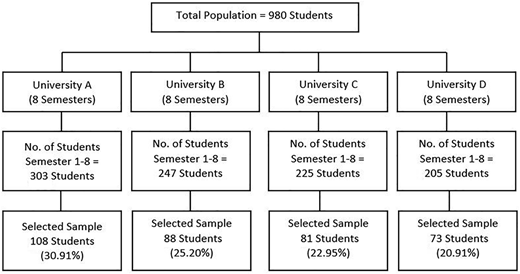
In order to determine the sample size, a sampling determination table presented by Krejcie and Morgan (1970) was employed. According to Krejcie and Morgan (1970), the appropriate sample size for a population of 1,000 should be 278. Therefore, to meet the sample size requirements, data were collected from 350 students.
Data collection instruments
In order to gather the data, two questionnaires and a pronunciation test were used. The “grit scale” (see Appendix 1) was adopted from Duckworth et al. (2007) to collect data related to the independent variables, i.e. the two dimensions of grit (“Perseverance of effort” and “Consistency of interest”). There were a total of 12 items in the “grit scale”. Items 1 to 6 were related to “Consistency of interest” (e.g. “I often set a goal but later choose to pursue a different one”). Items 7 to 12 were related to “Perseverance of effort” (e.g. “I finish whatever I begin”). The “grit scale” is considered reliable as the Cronbach's alpha values related to “Consistency of interest” and “Perseverance of effort” were greater than 0.90 (see Table 3). In addition, the “English pronunciation self-efficacy scale” (see Appendix 2), consisting of four items (e.g. “I can acquire accurate English pronunciation if I practice”), was adopted from Shehzad et al. (2019a, b, c) to collect data related to the mediating variable, i.e. PSEB. This instrument is considered highly reliable with a Cronbach's alpha value of 0.94 (see Table 3). Lastly, an “English pronunciation test” (see Appendix 3) was adapted from Véliz Campos (2015) to collect data related to the dependent variable, i.e. pronunciation performance. The test consisted of three sections. The first section contained 20 words and 10 short phrases. The second section contained 10 sentences, and the third section consisted of three short dialogues. In order to assess the pronunciation performance, a rubric (see Appendix 4) was adopted from Véliz Campos (2015). The rubric comprised three main criteria including vowel production, consonant production and nuclear accent placement. The scale of the rubric ranged from 1 (i.e. poor) to 5 (i.e. excellent).
Data collection procedures
The data collection lasted for two weeks. Before the collection of data, the participants were informed about the objectives of this research. They were also told that their identities would be kept anonymous and they were asked to sign a consent form. Afterwards, the researchers self-administered the questionnaires and pronunciation test. The questionnaires were administered collectively (i.e. with groups of students), whereas, the pronunciation test was administered individually. The participants were given 20 minutes to fill in both questionnaires. It took approximately five minutes for each student to complete the pronunciation test. Students' pronunciation tests were recorded. Six English language instructors were asked to evaluate the students' pronunciation performance. The evaluators were provided with the recordings that were obtained during the data collection. To ensure the credibility of the raters, only those language instructors who had taught phonetics and phonology for more than ten years were selected. They were provided with the rubric to evaluate the pronunciation of the participants a week before the data collection so that they could get themselves apprised of the benchmark. Each of the six raters signed a consent form before the evaluation process and were given monetary compensation once the evaluation task was completed.
Results
This study employed a two-phase model to analyse the gathered data (Hair et al., 2010). The first phase is called “measurement model evaluation”, and the second phase is known as “structural model evaluation”. In particular, the first phase comprises scrutinizing the reliability of each item, evaluating internal consistency reliability, discriminant validity and convergent validity. The second phase comprises the assessment of direct and indirect associations among constructs (Hair et al., 2010).
Initially, the data were examined for outliers, missing values and normality. The skewness and kurtosis values were within the acceptable ranges (see Table 1).
Descriptive statistics (N = 350)
| No | Missing | Mean | Median | Min | Max | Standard deviation | Kurtosis | Skewness | |
|---|---|---|---|---|---|---|---|---|---|
| G-PE1 | 1 | 0 | 3.559 | 4 | 1 | 7 | 1.731 | −0.911 | 0.164 |
| G-PE2 | 2 | 0 | 3.618 | 4 | 1 | 7 | 1.728 | −0.722 | 0.103 |
| G-PE3 | 3 | 0 | 3.566 | 4 | 1 | 7 | 1.88 | −1.021 | 0.154 |
| G-PE4 | 4 | 0 | 3.671 | 4 | 1 | 7 | 1.831 | −0.876 | 0.145 |
| G-PE5 | 5 | 0 | 3.474 | 4 | 1 | 7 | 1.813 | −1.07 | 0.113 |
| G-PE6 | 6 | 0 | 3.678 | 4 | 1 | 7 | 1.711 | −0.642 | 0.21 |
| G-CI1 | 7 | 0 | 3.349 | 2 | 1 | 7 | 2.275 | −1.179 | 0.547 |
| G-CI2 | 8 | 0 | 3.217 | 2 | 1 | 7 | 2.191 | −0.991 | 0.606 |
| G-CI3 | 9 | 0 | 3.204 | 2 | 1 | 7 | 2.421 | −1.254 | 0.627 |
| G-CI4 | 10 | 0 | 3.151 | 2 | 1 | 7 | 2.221 | −0.928 | 0.732 |
| G-CI5 | 11 | 0 | 3.25 | 2 | 1 | 7 | 1.971 | −0.701 | 0.636 |
| G-CI6 | 12 | 0 | 3.112 | 2 | 1 | 7 | 2.021 | −0.632 | 0.715 |
| PSEB1 | 13 | 0 | 3.263 | 2 | 1 | 7 | 2.288 | −1.124 | 0.618 |
| PSEB2 | 14 | 0 | 3.237 | 2 | 1 | 7 | 2.197 | −1.023 | 0.594 |
| PSEB3 | 15 | 0 | 3.349 | 2 | 1 | 7 | 2.301 | −1.174 | 0.581 |
| PSEB4 | 16 | 0 | 3.25 | 2 | 1 | 7 | 2.553 | −1.43 | 0.576 |
| PP | 17 | 0 | 3.026 | 2 | 1 | 5 | 2.179 | −0.801 | 0.763 |
Note(s): G-PE = grit-perseverance of effort; G-CI = grit-consistency of interest; PSEB = pronunciation self-efficacy beliefs; PP = pronunciation performance
Measurement model
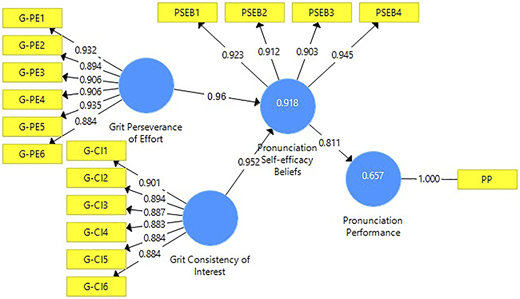
The purpose of assessing the measurement model is to determine the validity and reliability related to the instruments and items. A software program named SmartPLS 3.0 was used to assess the measurement model. In particular, composite reliability (CR), average variance extracted (AVE), convergent validity, discriminant validity and factor loadings were evaluated. Hair et al. (2010) recommend that the values of factor loadings and AVE ought to be greater than 0.5 (see Figure 3, Tables 2 and 3). Moreover, regarding CR, Fornell and Larcker (1981) recommend that its value ought to be greater than 0.7 (see Table 3). Tables 2 and 3 show that the values of CR, AVE and factor loadings lie within the suggested ranges. In addition, Heterotrait-Monotrait (HTMT) ratio method was employed to determine the discriminant validity. Table 4 shows that HTMT values lie within the prescribed range.
Factor loadings
| Grit Consistency of Interest | Grit Perseverance of Effort | Pronunciation Performance | Pronunciation Self-efficacy Beliefs | |
|---|---|---|---|---|
G-CI1 | 0.901 | |||
G-CI2 | 0.894 | |||
G-CI3 | 0.887 | |||
G-CI4 | 0.883 | |||
G-CI5 | 0.884 | |||
G-CI6 | 0.884 | |||
G-PE1 | 0.932 | |||
G-PE2 | 0.894 | |||
G-PE3 | 0.906 | |||
G-PE4 | 0.906 | |||
G-PE5 | 0.935 | |||
G-PE6 | 0.884 | |||
PP | 1 | |||
PSEB1 | 0.923 | |||
PSEB2 | 0.912 | |||
PSEB3 | 0.903 | |||
PSEB4 | 0.945 | |||
Note(s): G-PE = Grit-Perseverance of Effort; G-CI = Grit-Consistency of Interest; PSEB = Pronunciation Self-Efficacy Beliefs; PP = Pronunciation Performance | ||||
Heterotrait-Monotrait (HTMT) ratio
| Grit-consistency of interest | Grit-perseverance of effort | Pronunciation performance | Pronunciation self-efficacy beliefs | |
|---|---|---|---|---|
| Grit-consistency of interest | ||||
| Grit-perseverance of effort | 0.297 | |||
| Pronunciation performance | 0.896 | 0.327 | ||
| Pronunciation self-efficacy beliefs | 0.515 | 0.305 | 0.835 | |
Structural model
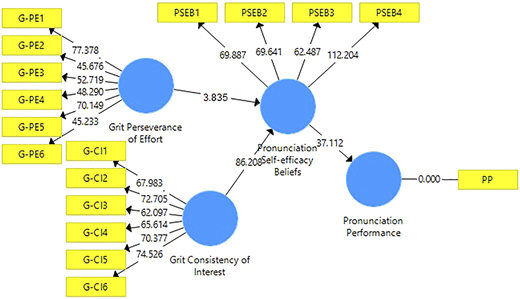
With the intention of analysing the structural model, bootstrapping function was used. Bootstrapping is considered as one of the crucial steps in undertaking the mediation analysis (Hayes, 2009; Zhao, Lynch, & Chen, 2010). Figure 4 shows the bootstrapping results. More particularly, t-value, p-value and path coefficients of all the variables are shown in Figure 4. Furthermore, the acceptance and rejection of hypotheses regarding direct associations between variables is shown in Table 5.
Direct effect results
| Original sample (O) | Sample mean (M) | Standard deviation (STDEV) | T-statistics (|O/STDEV|) | P-values | |
|---|---|---|---|---|---|
| Grit-consistency of interest → Pronunciation self-efficacy beliefs | 0.952 | 0.952 | 0.011 | 86.208 | 0.000 |
| Grit-perseverance of effort → Pronunciation self-efficacy beliefs | 0.96 | 0.96 | 0.25 | 3.835 | 0.000 |
| Pronunciation self-efficacy beliefs → Pronunciation performance | 0.811 | 0.812 | 0.022 | 37.112 | 0.000 |
All of the hypotheses regarding direct associations (i.e. H1, H2, H3) are accepted as shown in Table 5. More particularly, G-CI showed a significant and positive association with PSEB (β = 0.952; p = 0.000). In addition, G-PE also showed a significant and positive association with PSEB (β = 0.96; p = 0.000). Last but not least, PSEB was positively and significantly associated with pronunciation performance (β = 0.811; p = 0.000).
Table 6 shows the results related to mediation analysis. It is apparent that PSEB mediated the association between G-CI and PP (β = 0.771; p = 0.000). Likewise, PSEB mediated the association between G-PE and PP (β = 0.751; p = 0.000). Thus, the research hypotheses related to indirect associations (i.e. H4, H5) were also accepted.
Indirect effect results
| Original sample (O) | Sample mean (M) | Standard deviation (STDEV) | T-statistics (|O/STDEV|) | P-values | |
|---|---|---|---|---|---|
| Grit-consistency of interest → Pronunciation self-efficacy beliefs → Pronunciation performance | 0.771 | 0.773 | 0.023 | 33.044 | 0.000 |
| Grit-perseverance of effort → Pronunciation self-efficacy beliefs → Pronunciation performance | 0.751 | 0.753 | 0.2 | 3.751 | 0.000 |
Discussion
The findings regarding the first research objective indicated that both the dimensions of grit, i.e. G-PE and G-CI, showed a positive and significant association with PSEB. This finding is in accordance with past studies (Alhadabi & Karpinski, 2020; Wolters & Hussain, 2015). Thus, current findings indicate that Saudi EFL learners exerted higher amount of effort and retained their interest in learning English pronunciation, which in turn increased their PSEB. Furthermore, the degree of association of G-PE with PSEB was stronger compared to G-CI. This particular finding is also in line with previous studies (Alhadabi & Karpinski, 2020; Wolters & Hussain, 2015). The possible reason for this finding could be attributed to the collectivist culture in Saudi Arabia. Datu et al. (2016) added that people living in collectivist countries may give less importance to consistency of interest than those living in individualistic cultures/countries. People who belong to individualistic societies are expected to identify themselves in terms of their individual traits and recognize themselves as different or separate from other individuals (Markus & Kitayama, 1991). Alternatively, individuals in collectivist cultures (e.g. Japan, China, KSA etc.) place significant stress on interpersonal harmony and on the quest of shared ambitions (Kwan, Bond, & Singelis, 1997). Based on this cultural background, it is quite probable that consistency of interest may hold less relevance for the individuals in collectivist cultures. In collectivist cultures, individuals are expected to prioritize their ambitions in accordance with the others' ambitions; as opposed to individualistic cultures, where individuals' ambitions mirror their personal choices (King, McInerney, & Watkins, 2012; Markus & Kitayama, 1991).
Regarding the second research objective, the study revealed that pronunciation self-efficacy showed a substantial and positive connection with pronunciation performance. In simple terms, the stronger the PSEB, the better the English pronunciation performance of the Saudi EFL students. This finding is in agreement with previous studies which showed a substantial connection between self-efficacy and academic performance (Mutlu, Andarab, & Karacan, 2019; Sabti, Md Rashid, Nimehchisalem, & Darmi, 2019; Shehzad et al., 2019a, b, c). In addition, Artino (2012) conducted a meta-analysis of studies related to psycho-social variables. The findings of meta-analysis revealed that out of nine most frequently researched psycho-social variables, self-efficacy was the most considerable predictor of performance. Also, this result supports the fundamental tenet of Bandura's social cognitive theory. Bandura (1986) affirmed that an individual's performance hinges upon one's self-efficacy beliefs. It is possible that Saudi students' use of social media may have enhanced their pronunciation self-efficacy and performance. Sharma (2019) conducted a study on Saudi EFL students and concluded that they used social media extensively and showed positive attitudes towards communicating in the English language via social media. Several other researchers confirmed that English pronunciation of EFL students can be improved by their extensive usage of social media (Wang, 2017; Xodabande, 2017).
Lastly, the findings related to the third research objective indicated that pronunciation self-efficacy mediated the association between the dimensions of grit and pronunciation performance. Abundant evidence is found in the previous literature, which affirmed that self-efficacy acted as a mediating variable between grit and academic performance (Alhadabi & Karpinski, 2020; Wolters & Hussain, 2015). Aforementioned studies indicated that grittier students have higher self-efficacy beliefs in their personality, which consequently improves their performance.
While the current findings are in line with those of previous studies, this study is novel in its nature on two grounds. First, the study variables (i.e. grit, PSEB and pronunciation performance) have not been considered in a single framework in any of the previous studies. Second, various studies were conducted on the relationship between grit and self-efficacy beliefs as well as self-efficacy beliefs and performance. However, there is a lack of research regarding these three variables in the context of pronunciation performance generally and pronunciation performance of EFL students in particular. Therefore, this study fills a significant gap in the previous literature.
It is important to mention here that the recordings of the study participants revealed that the errors made by them while pronouncing some words were typical of Saudi EFL students' pronunciation problems. For instance, in the present study's pronunciation test, the participants pronounced /t/ in words such as: “cut”, “set”, “seat” and “Italy” as a dental consonant sound. Also, they pronounced /p/ in words such as “A purple tie with black stripes” and “passport” as the consonant sound /b/. Likewise, the participants pronounced /e/ in words such as “set”, “tent” and “tennis” as vowel sounds /i, eɪ, æ/. These findings are akin with numerous studies conducted in the Saudi EFL context (Ababneh, 2018; Ahmad, 2011; Hago & Khan, 2015). Despite the errors, the statistics proved that the pronunciation performance of the study participants was above-average. As Table 1 shows, the mean score of the participants was 3.026 out of 5. The possible explanation for this could be that in comparison to the junior semester students, the senior semester students might have made less mistakes in correctly pronouncing target words in English and that consequently would have elevated the average mean score for the sample. Gilakjani (2012) affirmed that the more time students spend in receiving foreign language instruction, the better their pronunciation gets.
Conclusion
This study aimed at identifying the extent of the relationship between two grit dimensions (i.e. perseverance of effort and consistency of interest), PSEB and pronunciation performance of Saudi EFL learners. To achieve this objective, a correlational research design was employed. Questionnaires and a pronunciation test were used to gather data from 350 Saudi university students. The findings of this study revealed a positive and substantial connection between grit and PSEB. Furthermore, findings indicated that PSEB was positively and substantially associated with pronunciation performance. Lastly, PSEB mediated the association between grit and pronunciation performance.
The present study offers several valuable educational and pedagogical implications for EFL students, teachers and curriculum leaders. First, it is imperative that EFL learners ponder upon their interest and anticipated effort for learning the correct pronunciation of the English words. As the findings of the present study indicated, both dimensions of grit (i.e. consistency of interest and perseverance of effort) were responsible for the improved pronunciation, therefore, EFL students can try to inculcate these facets of grit in their personality in order to improve their pronunciation of English words. In addition, EFL pronunciation teachers can employ effective motivational strategies to remind the students that learning the correct pronunciation of a foreign language can be a challenging endeavour; however, they can overcome this challenge through perseverance of effort and consistency of interest in learning it. Finally, EFL curriculum leaders could include materials that help students develop non-cognitive factors such as grit and self-efficacy beliefs. They may organise talks and seminars regarding the importance of grit and self-efficacy beliefs in academic performance.
The current research study has certain limitations. First, it employed quantitative research design. An in-depth analysis of the phenomenon of grit could have been attained by using a qualitative or mixed-methods research design. Second, data were collected only from male students. Thus, generalizing the findings to the opposite gender could be problematic. Third, this research employed a cross-sectional research design. Employing a longitudinal research design could help make the picture clearer by collecting data over time. Last but not least, the study did not take into consideration the possible varied language proficiency of the participants belonging to different study semesters. It is recommended that future researchers consider the possibility that students of different semesters could have varied proficiency in the foreign language. Pertaining to that, the research process could be made even more rigorous, and consequently, the findings would be better representative of undergraduate Saudi EFL students.
Despite the limitations, this research has made a significant contribution to the field of EFL pronunciation. Since pronunciation plays a key role in effective communication, EFL learners can become more effective communicators in English by incorporating non-cognitive factors like grit and self-efficacy beliefs in their repertoire of strategies. This is particularly important in today's era where English language is the lingua franca. Moreover, it is hoped that this study would prove to be a launch pad for future research regarding language skills and other non-cognitive factors.
The authors confirm that this research received no specific grant from any funding agency in the public, commercial, or not-for-profit sectors.
References
Further reading
Appendix 1
Grit scale
| No | Statement | Strongly disagree | Disagree | Neutral | Agree | Strongly agree |
|---|---|---|---|---|---|---|
| Consistency of interests | ||||||
| 1 | I often set a goal but later choose to pursue a different onea | 1 | 2 | 3 | 4 | 5 |
| 2 | New ideas and new projects sometimes distract me from previous onesa | 1 | 2 | 3 | 4 | 5 |
| 3 | I become interested in new pursuits every few monthsa | 1 | 2 | 3 | 4 | 5 |
| 4 | My interests change from year to yeara | 1 | 2 | 3 | 4 | 5 |
| 5 | I have been obsessed with a certain idea or project for a short time but later lost interesta | 1 | 2 | 3 | 4 | 5 |
| 6 | I have difficulty maintaining my focus on projects that take more than a few months to completea | 1 | 2 | 3 | 4 | 5 |
| Perseverance of effort | ||||||
| 7 | I have achieved a goal that took years of work | 1 | 2 | 3 | 4 | 5 |
| 8 | I have overcome setbacks to conquer an important challenge | 1 | 2 | 3 | 4 | 5 |
| 9 | I finish whatever I begin | 1 | 2 | 3 | 4 | 5 |
| 10 | Setbacks don't discourage me | 1 | 2 | 3 | 4 | 5 |
| 11 | I am a hard worker | 1 | 2 | 3 | 4 | 5 |
| 12 | I am diligent | 1 | 2 | 3 | 4 | 5 |
Note(s): aItem was reverse scored
Source(s): Adopted from Duckworth et al. (2007)
English pronunciation self-efficacy scale
| No | Statement | Strongly disagree | Disagree | Neutral | Agree | Strongly agree |
|---|---|---|---|---|---|---|
| 1 | I feel confident that people understand me when I talk in English | 1 | 2 | 3 | 4 | 5 |
| 2 | I think I can improve my English pronunciation on my own using online materials | 1 | 2 | 3 | 4 | 5 |
| 3 | I am satisfied with my English pronunciation progress this last year | 1 | 2 | 3 | 4 | 5 |
| 4 | I can acquire accurate English pronunciation if I practice | 1 | 2 | 3 | 4 | 5 |
Source(s): Adopted from Shehzad et al. (2019a, b, c)
English pronunciation test
| 1. Half | 11. Cart | 21. A fast black bus |
| 2. Leave | 12. Blood | 22. A hot cup of coffee |
| 3. Cut | 13. Lab | 23. A large circus |
| 4. Sit | 14. Minute | 24. A lovely suntan |
| 5. Ward | 15. Belief | 25. A piece of meat in a minute |
| 6. Live | 16. Naughty | 26. A pot of hot sauce |
| 7. Seat | 17. Bruise | 27. A fussy nurse in an orange suit |
| 8. Work | 18. Italy | 28. Mashed potato and a pork chop |
| 9. Cat | 19. Saturday | 29. A tent and all the equipment |
| 10. Set | 20. Passport | 30. A purple tie with black stripes |
Source(s): Adapted from Véliz Campos (2015)
Rubric to evaluate pronunciation performance
| Assessment criteria | Level 5 (excellent) | Level 4 (very good) | Level 3 (good) | Level 2 (fair) | Level 1 (poor) | Score |
|---|---|---|---|---|---|---|
| Vowel production | Phonemic differences in vowels are clearly observed at all times. Vowel length is produced appropriately depending on the corresponding phonological environments | Phonemic differences in vowels can almost always be observed. Vowel length is produced appropriately, only with minor inconsistencies | Phonemic differences are often produced appropriately. Vowel length is often produced appropriately, in most vowel quality contrasts | Phonemic differences are sometimes produced correctly; vowel length is sometimes produced correctly, especially in the most common vowel contrasts | Phonemic differences are occasionally produced appropriately; vowel quantity in contrastive use is generally not observed | |
| Consonant production | Phonemic differences in consonants are clearly observed at all times. Consonant clusters are produced correctly. Allophonic features such as aspiration are produced correctly, depending on the phonological environments | Phonemic differences in consonants can almost always be observed. Consonant clusters are almost always produced correctly, with only seldom epentheses and/or elisions. Allophonic features such as aspiration are for the most part produced correctly in various contexts | Phonemic differences can often be observed. Consonant clusters are produced correctly most of the time, yet some epentheses and/elisions can be detected. Allophonic features such as aspiration are generally produced correctly in most phonological contexts | Phonemic differences can sometimes be observed. Consonant clusters are sometimes produced appropriately, yet with some epentheses and/or elisions. Allophonic features such as aspiration are sometimes produced correctly, with some inconsistencies | Phonemic differences are occasionally produced appropriately. Consonant clusters are usually produced with either epentheses and /or elisions. Allophonic features such as aspiration are very rarely produced correctly | |
| Nuclear accent placement | Intonation groups are correctly produced and can easily be identified; nucleus placement is correctly marked, especially in cases of contrast | Intonation groups are produced correctly and can be identified; nucleus placement is marked correctly, with occasional misplacements | Intonation groups are produced correctly most of the time; nucleus placement is often marked correctly | Intonation groups are sometimes marked appropriately, with hesitation in intonation-group marking; nucleus placement is marked correctly in some cases, usually of contrast | No clear identification of intonation groups, with much hesitation; nucleus is placed consistently placed wrongly, in both broad (all new) and narrow (contrastive) focus |
Source(s): Adopted from Véliz Campos (2015)
Appendix 2
Appendix 3
Section I
In this section, you will see a set of 20 isolated words and 10 short phrases. Allow yourself some 30 seconds to look at them and then read them into the recording device.
Now, pause the recording.
Section II
In this section, you will see 10 sentences. Allow yourself some 30 seconds to look at them and then read them into the recording device.
Will you please buy a small tart for tea?
Talk to me on Saturday afternoon, before your tennis lesson.
I believe Bob and Vivian will travel to Bolivia in October.
She doesn't speak Spanish to other Spanish speakers.
Peter and Sue are going to the noisy zoo in the park.
She watches television in the morning and then washes her car.
Don't lose it! My granny saved them for the kids.
Sam was singing a love song and wiggling his fingers.
John yawned while he was reading a book about British culture.
George joined in the search for the old treasure.
Now, pause the recording.
Section III
In this section, you will see three short dialogues. Allow yourself some 30 seconds to look at them and then read them into the recording device.
A: We mustn't forget Ann's birthday. Shall I get her a book or a CD?
B: Well, it's her sister who likes reading. Ann's fond of music. And clothes.
A: That settles it then. What size does she take?
A: Could I have your name, please?
B: Robinson
A: And your first name?
B: George Robinson.
A: Which flat shall we choose?
B: Well the one in Churchill Square had a lovely kitchen, but the one in Church Street was much better.

