The paper undertakes a bibliometric analysis and assessment of journal publications in the field of container terminal operations research (CTOR), in an attempt to identify high-impact papers (HIPs) published in Science Citation Index/Social Science Citation Index (SCI/SSCI) journals of CTOR subject category from 1973 to 2020.
A structured approach for identifying the HIPs is developed based on the utilization of bibliometric and network analyses.
The CTOR papers are assessed in terms of publication outputs, distribution of outputs in SCI/SSCI journals, authorship, institutions and countries, as well as citation life cycles of papers with the highest total citations since their publication until the year 2020. The results show that between 1989 and 2015, there were 82 HIPs in the field of CTOR, which have been cited at least 200 times, with more than 50% of these citations allocated in the second part of paper citation life cycle according to the database of Google Scholar.
The practical implication of the aforementioned reviewing and assessing journal publications of CTOR is that it offers the ability to reveal the tone of its development through addressing main characteristics of the relevant HIPs as determined by the highly cited papers in this field of research.
This paper offers a unique analysis and assessment in the field of CTOR by identifying the relevant HIPs and their associated scientific actors (authors, institutions and countries), thus facilitating the future research effort in the field of CTOR.
1. Introduction
This paper has examined several interesting publications on the container terminal (CT) operations modeling by Operations Research (OR) techniques based on mathematical models. These models were developed to solve optimization problems inside CT using a variety of solution methods, each designed to account for the special mathematical properties of the model (see more in Vis and de Koster, 2003; Steenken et al., 2004; Stahlbock and Voss, 2008; Bierwirth and Meisel, 2010, 2015; Carlo et al., 2014a, b, 2015; Roy et al., 2020).
It is well known that citation counts are very often used to support the evaluation of the quality or impact of published papers. The main focus of this paper is primarily directed towards the platform of data collection, data handling and data analysis, all aiming to provide insights into the differences in coverage between Google Scholar (GS), Scopus (S) and Web of Science (WoS) in relation to identified high-impact papers (HIPs) of Container Terminal Operations Research (CTOR) published in the Science Citation Index/Social Science Citation Index (SCI/SSCI) journals.
A CT represents a complex system consisting of principally the same subsystems. The CT process can be divided into the following principal links with the specification of CT operations: ship-berth link with the loading/unloading stage of ships, an internal transport link for moving containers from apron area to storage area and vice versa, container storage inside container yard and receiving/delivery operations from/to external vehicles. The CT operations modeling by OR techniques are developed at these links either separately or complementary to each other.
In the scientific literature, a very common issue is how to select a shorter or longer list of outstanding papers in a specific research field. It is a necessary task with respect to a larger number of papers which significantly contributed to a field-specific research progress and which lead to wider recognition in science. These papers are classified as Classic papers, also called “most frequently cited papers” or “highly cited papers” (Garfield, 1987; Ho, 2014). The methodology to analyze highly cited papers as h-Classic papers could be found in Martinez et al. (2015), Moral-Munoz et al. (2016) and Lopez-Robles et al. (2021). By following the common principles of these studies, the present paper develops a methodology to determine outstanding papers or HIPs of the CTOR. The scientific research field under consideration has been extensively studied by the aforementioned most cited review papers (out of a total of more than 1,650 SCI/SSCI journal papers), but not from the aspect of bibliometric analysis. The main aim of the present paper is to cover this shortcoming of the above mentioned review papers, as well as in previous others. In order to identify and analyze characteristics of CTOR HIPs in the SCI/SSCI journals, an internal database was hereby developed, spanning over the time period of 1973–2020.
The rest of the paper is organized as follows. The methodology used to collect and analyze HIPs is discussed in Section 2. Section 3 deals with the selected papers and citations that were included in the calculation of citation impact indicators. In Section 4, the main research themes (RTs) of CTOR are determined and citation count analysis of them is conducted. The main findings and conclusions are summarized in Section 5.
2. Methodology
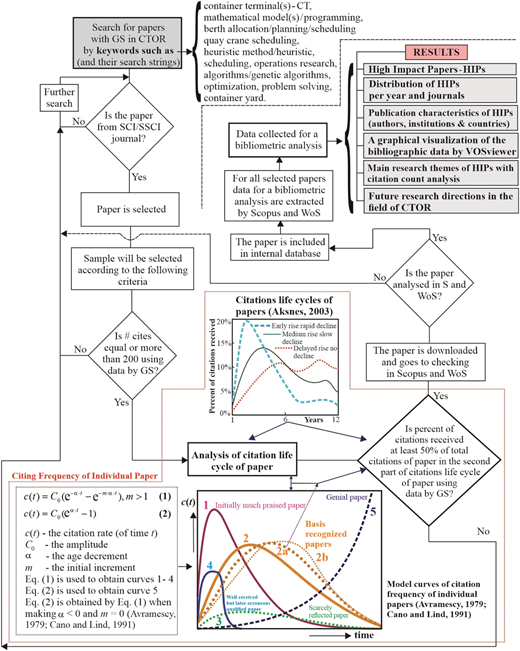
The present paper follows a systematic literature review approach which according to Kitchenham et al. (2007) presents “a method that enables the evaluation and interpretation of all accessible research relevant to a research question, subject matter or event of interest”, whilst the search methodology and procedures are shown in Figure 1. As a first step, the research theme was finalized and the research concept for conducting the papers search was determined. GS was used to search for relevant papers based on the selected keywords: “CT/CTs”, “mathematical model(s)/programming”, “berth allocation/planning/scheduling” and others listed in Figure 1.
Further, we have used truncated combinations of a few groups of search strings in order to collect the published papers: “CT(s) AND Berth Allocation/Quay Crane Scheduling”, “CT(s) AND Mathematical model(s)/programming”, “CT(s) AND Heuristic method/Heuristics”, and “CT(s) AND Algorithms/Genetic Algorithms”. Only papers published in SCI/SSCI journals were considered. A citation count TCGS was introduced, which denotes the total citations in GS ever since the publication of the paper until the end of 2020. TCGS ≥ 200 was used as the first filter to extract the cited papers. This threshold is arbitrary but was chosen because it provides that the selected papers should be cited much more than the average paper of CTOR. Further, the paper's citation life cycle was considered which identified the citations received annually using a complete time window (i.e. from publication to the end of 2020). Instead of absolute numbers, relative shares were used as the basis for the analysis to calculate the percentage of the citations received. The second filter to select the cited paper was defined as follows: the paper received at least 50% citations of the total citations in the second part of the paper citation life cycle. In the case when the paper age has an odd number of years, the received citations in the middle year were divided by half. A mathematical expression (Eq. 1) describing the typical citing frequency distributions as a function of papers' age is given in Figure 1 (left part below) (Avramescy, 1979; and Cano and Lind, 1991). Model curves of citations frequency of individual papers are shown in Figure 1 (central part below) (Avramescy, 1979; and Cano and Lind, 1991). Although there are many paper citation frequency distributions which cannot be obtained by Eq. (1), for instance, curves with two or more peaks or other irregular features, a trend line can be approximated. This expression was used to obtain curve 2 and its two approximations 2a and 2b, the peaks of which are shifted slightly to the right with “slow decline” as an explanation of the second filter. This filter confirms that these papers age slowly (Aversa, 1985; Cano and Lind, 1991; Aksnes, 2003). They could be categorized with terms – a “slow decline” paper; a “no decline” paper –according to Aksnes (2003) (see citations curves in small separate illustration inside Figure 1). Several papers of the total selected papers could not pass this filtering.
To confirm the advantage of this process, a search of these selected papers was conducted in the Scopus and WoS. This way multiple research databases (GS, Scopus and WoS) were used for bibliometric analysis of HIPs in the CTOR. A few papers of the total selected papers published in SCI/SSCI journals which passed the first two criteria could not pass filtering in the Scopus or WoS. The 82 papers having at least 200 citations and at least 50% of the total citations in the second part of the paper's citation life cycle, as well as reported by Scopus and WoS, were retrieved as HIPs for further analysis. All papers collected in Table A1 of Appendix 1 presents a list of the datasets that were created in described steps and procedures.
The literature database is shown in Table A1 and contains 82 HIPs. The citations to each of the 82 papers were extracted from GS, Scopus and WoS during February 2021. This process revealed that the highlighted 82 HIPs had 30,392 total using data by GS, 17,025 using data by Scopus and 13,247 using data by WoS.
3. Results and discussion
3.1 General important observations
In the present paper, the search produced a count of 1,674 CTOR relevant papers which have been published in 83 SCI/SSCI journals. The full text of each paper was screened and included in this analysis after meeting the following criteria: (1) exclusive coverage of CTOR and its applications; (2) contain determination of the key issues on the CTOR; (3) coverage research and studies that explore explicit modeling concept of CTOR or conducted literature review of them; (4) contain identification of approaches and tools useful for modeling processes based on CTOR; (5) coverage of relationship between the theoretical issues and their application related to CTOR and (6) coverage practical aspects and conducted experiments in relation to CTOR. Further, the present analysis does not contain papers from journals published by Multidisciplinary Digital Publishing Institute (MDPI) and does not contain papers published in journals which are not SCI/SSCI ranked. The number of CTOR papers showed a positive growth trend from 1997 to 2020.
The previous described methodology was used as the impartial criteria to systematize the identification of the HIPs of CTOR. Using this methodology, the relevant papers were identified and are listed in Table A1 across several dimensions. The first one, for each paper, has been specified “mark” by A1 to A9, B1 to B9, …, I1 to I9 and at the end J1, respectively (used only as abbreviations to simplify further analysis). The papers are listed in the drop-down menu by the total number of citations for each paper in GS.
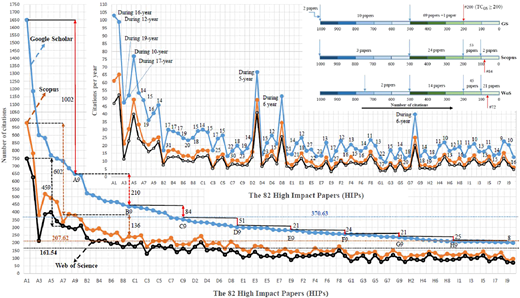
Figure 2 shows the frequency distribution for the 82 HIPs and their typical hyperbolic distribution. This is the distribution of the number of citations versus paper number, with papers numbered in order of decreasing citations in GS. Most (85.4%) of the papers collected 200 to 500 citations in GS, while 30% of the papers in Scopus and 17% of papers in WoS. This analysis seems to demonstrate that citation frequency is one of the several valid and very useful indicators to describe HIPs.
A short comparison between the present analysis and that of Moral-Munoz et al. (2016), as well as that of Lopez-Robles et al. (2021), was conducted. The main properties are based on the analysis of the three research areas such as intelligent transportation systems (ITSs), applied intelligence (APIN) and CTOR. Some important findings of the present analysis of HIPs are the following: the average citations per paper is higher than in both other cases; the CTOR was considered on a much broader basis of journals; the proportion of the papers of the CTOR that are considered to be highly cited is higher than in the ITS and APIN because the average citations per paper is also higher; the present methodology can be used to develop a good procedure to identify HIPs and the most cited paper counted 402 of citations in APIN and 229 in ITS, whilst the present database gives 748 of citations in CTOR using data by WoS.
Further, Appendixes 2 and 3 (Supplementary material entitled Supplementary tables) were included to conduct part of the bibliometric analysis of HIPs in CTOR. These tables of the HIPs include the following: frequency distribution of HIPs and ratio between each of them; comparison between our analysis and Moral-Munoz et al. (2016) analysis, as well as Lopez-Robles et al. (2021) analysis; top keywords found in the HIPs of the CTOR; the top 15 HIPs; most productive authors of the HIPs; the 20 countries contributed to the 82 HIPs and record of the HIPs in the CTOR.
3.2 Bibliometric analysis of HIPs in CTOR
3.2.1 Distribution of HIPs per year of publication and journals
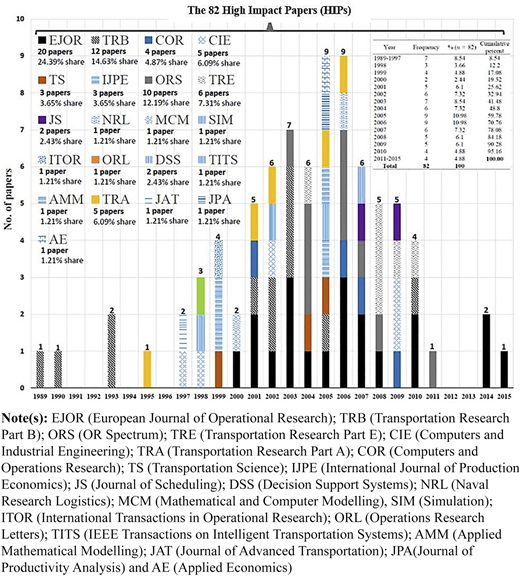
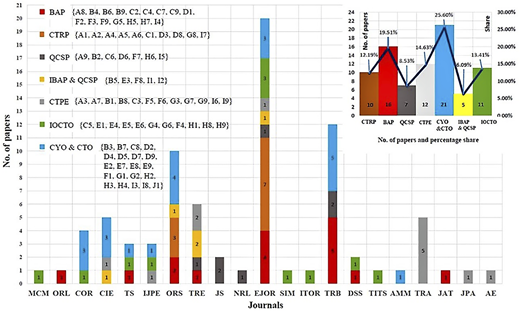
The distribution of HIPs according to the journals in which they are published and the year of publication is presented in Figure 3. This figure also shows the percentage share of published papers in each journal. As shown in Figure 3, the 82 HIPs were published in 21 SCI/SSCI journals.
The first HIPs were published in 1989, 1990 and 1993 in Transportation Research Part B (TRB), respectively. The years associated with most of these papers are 2005 and 2006. More than 75% of HIPs are published from 2001 to 2010, namely, HIPs of the present database are usually 16 years of age because the window of the citation period demonstrates that each paper grew up in a specific time window to achieve citation peak. CTOR papers tend to catch the attention of the research community for a long time period after their publication. The best fitted citation frequency distribution for most of them is the one described by curve 2b in Figure 1 (citing frequency of individual paper).
Most of the 82 papers have been published in European Journal of Operational Research (EJOR), TRB and OR Spectrum (ORS), which accounted for 42 papers or 51.21% of all selected papers. A detailed list related to the different years of publication of HIPs is provided in Figure 3 (top right corner).
3.2.2 High-impact papers
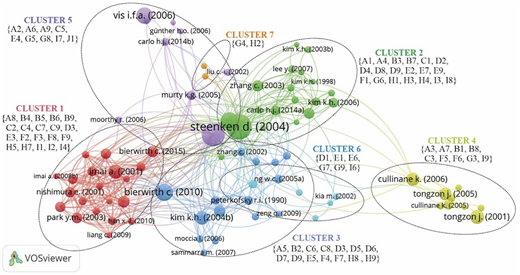
To highlight the HIPs, a network visualization of most influential papers by citations count was conducted as shown in Figure 4. The 82 HIPs were analyzed with VOSviewer based on data from Scopus (www.vosviewer.com; van Eck and Waltman, 2010).
The center of network visualization in Figure 4 shows the most influential papers highly cited and referred to other papers. In the analysis, 82 HIPs were identified for evaluation, out of which 79 are connected to each other. To identify close links and active interactions among HIPs in CTOR, paper mapping and the seven clusters are given.
3.2.3 Most productive authors, institutions and countries
The results of author analysis have identified those researchers who have made significant contributions to the 82 HIPs. Among the 208 authors' contributions to the 82 HIPs, only 120 names of authors have appeared. So, 35 authors wrote two or more papers. The remaining 85 authors have appeared only on one paper (30 authors as the first author of the paper, 33 authors as the second one, 18 authors as the third author of the paper and 4 authors as the fourth author of the paper). The average number of authors per paper was 2.5, whilst 9 (11%) of the papers were written by a single author, 23 (28%) by two authors, 36 (44%) of the papers were written by three authors and 12 (14.6%) by four authors, whilst the maximum number of authors in a single paper was five in the two cases (2.4%).
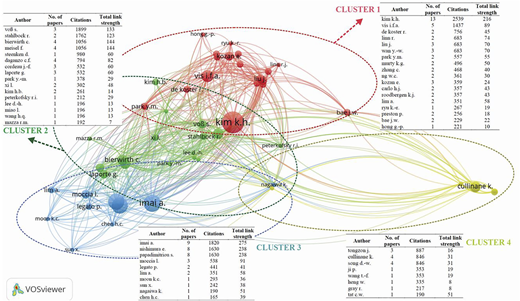
Figure 5 visualizes the leading authors connected with each other (www.vosviewer.com; van Eck and Waltman, 2010). It is very common to observe that more productive authors have more connectivity. Results from the analysis are divided into four clusters, which categorize the authors' contribution by the number of papers and citations, as well as total link strength (TLS).
A potential bias in the analysis of authorship/institutions might have occurred if different authors had the same name or authors used different names with the passage of time or in the case when authors changed their affiliation. The latter occurs frequently, and it solved by putting different marks on the family name of authors and on the HIPs. In that way, the affiliation for each author or paper is precisely determined.
The HIPs with author address information in the published papers were further analyzed regarding institutions and countries. Altogether, the HIPs originated from 30 institutions (i.e. universities) in 14 countries. The top two most productive institutions were in the Republic of Korea (RoK) and Japan, where 22 (27%) HIPs originated. The first one, Pusan National University (RoK), had published 13 papers with the most first authors on the 12 papers. The second one, Kobe University of Mercantile Marine (KUMM), published four papers, and Kobe University (KU) contributed to five papers and World Maritime University (WMU) contributed to six papers. Eight out of nine of these papers were written by two authors from Japan (KUMM or KU) and one from Greece (University of Piraeus), among others, where the first author almost in all papers had two affiliations (KUMM or KU and WMU).
The contributions of different countries were estimated by the location of the affiliation of at least one author of the published paper. Among the top productive countries related to the number of originated HIPs were Asian countries (RoK (14), Hong Kong (12), Japan (10) and so on); three North and Central American countries and eight European countries, respectively. The RoK, Hong Kong and United States had high productivity in terms of the total number of papers, the total number of citations (Germany, RoK and Hong Kong), average citations per papers, TLS (Hong Kong and the Netherlands), national collaborative (RoK), internationally collaborative (Hong Kong and Japan), single-author paper (Singapore and United States), first author (RoK and Japan) and corresponding author papers (Japan and Hong Kong). Domination in papers from the maritime mainstream countries was not surprising since this pattern occurs in other scientific fields.
4. Citation count analysis of main research themes in CTOR
4.1 The main research themes in CTOR
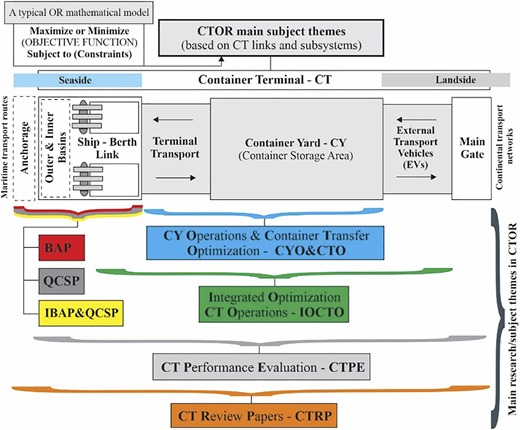
Figure 6 presents a schematic classification of the main RTs in CTOR and provides an indication of the research engagement in each main link at CT in port. The analysis of the 82 papers is conducted. These papers are categorized into seven RTs: Berth Allocation Problem –BAP, Quay Cranes Scheduling Problem – QCSP, Integration of BAP and QCSP –IBAP&QCSP, Container Terminal Performance Evaluation – CTPE, Container Yard (CY) Operations and Container Transfer Optimization – CYO&CTO and Integrated Optimization CT Operations – IOCTO, associated with CT review papers – CTRP. The interrelationships among them are shown in Figure 6, where for each theme the predominant CT link/links are presented to describe the main operation process or processes.
As shown in Figure 7, the 82 HIPs were classified into RTs in CTOR with associated papers for each theme inside curly brackets: BAP with 16 papers (19.51%), QCSP with 7 papers (8.53%), IBAP&QCSP with 5 papers (6.09%); IOCTO with 11 papers (13.41%); CYO&CTO with 21 papers (25.60%), CTPE with 12 papers (14.63%) and CTRP with 10 papers (12.19%). It can be seen that the papers with all RTs were published only in EJOR, while ORS and TRE have the papers published with four various RTs. The papers with three RTs were published in TRB, CIE, TS and IJPE, while all other journals have papers with one or two RTs.
4.2 Citation count analysis
The distribution of the citations per journal and RTs for the 82 HIPs as obtained by GS shows the following: EJOR had the highest number of citations, with a little more over 8,000; 46.3% share is of papers by CTRP; ORS has obtained 4,940 citations with 61.5% share of papers by CTRP; TRB has received 4,790 citations with an almost 47% share of papers by BAP; TRA has collected 3,142 citations only by papers from CTPE; TRE has obtained 1,553 citations with 36% share of papers by IBAP&QCSP, while other journals have collected fewer than 1,300 citations.
To confirm which RTs and journals aggregate more citations, we conducted an analysis of the average number of citations per paper for each theme and journal. The results indicate 449 citations per paper for BAP in TRB, 1,013 citations per paper for CTRP in ORS, 647 citations per paper for QCSP in EJOR, 472 citations per paper for IBAP&QCSP in ORS, 628 citations per paper for CTPE in TRA, 397 citations per paper for IOCTO in DSS and 356 citations per paper in CYO&CTO in EJOR.
Therefore, a detailed analysis between the four journals (EJOR, ORS, TRB and TRE) and RTs has been conducted which aggregated citations per journal for the 82 HIPs for data extracted by WoS. The results indicate that all RTs participate in the collection of 3,615 citations for EJOR; four RTs have received 2,312 citations for ORS; three RTs have collected 2,027 citations for TRB and four RTs have obtained 733 citations for TRE.
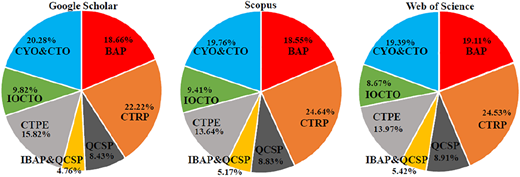
The percentage distributions of the RTs of the 82 HIPs citations count for data retrieved from GS, Scopus and WoS are presented in Figure 8. The results indicate a very balanced level of percentage share for the four RTs from 16% to 22% in GS, 13.6%–24.6% for data by Scopus and 14%–24.5% for data from WoS. Other three RTs have been shared from 5% to 10%. Although CTPR is most influential (22.22–24.64%), the three others RTs (CYO&CTO, BAP and CTPE) have attracted more than 50% citations count, while IOCTO, QCSP and IBAP&QCSP have collected 23% for data by GS, 23.41 for data from Scopus and 23% for data by WoS. If only the ship-berth link at CT is considered, then BAP, QCSP and IBAP&QCSP represent a share of 31.85%, 32.55 and 33.44% for data from GS, S and WoS, respectively.
These results generate a large amount of citations or have a relatively high value for participation in citations count. Therefore, there is a strong incentive in these journals to promote the RTs further. Overall, the results show that the citations concept has been implemented in a wide range of RTs in order to deduce which RTs and journals have attracted more citations, as well as to highlight the research issues that evolved from traditional RTs such as BAP and QCSP into IOCTO, CYO&CTO and IBAP&QCSP.
5. Conclusions
5.1 An outline of the main findings
This paper has detected the availability of a significant number of HIPs in the field of CTOR from SCI/SSCI journals, through the development and application of a bibliometric analysis. The output results were compared with the concept of h-Classics.
The bibliometric analysis of HIPs highlighted the following main findings:
The presence of 82 HIPs constitutes almost 5% of the whole CTOR literature throughout the period under consideration;
Although most HIPs were not highly cited in their early years, they were mainly published in high-caliber journals;
The prevailing RTs of HIPs are CYO&CTO, BAP, CTPE and IOCTO with regard to the number of published papers, whilst CTRP, CYO&CTO, BAP and CTPE have received the highest number of citations;
The higher level of the average number of citations per paper was associated with CTRP, QCSP, BAP and CTPE.
The most of citation life cycles distributions or citing frequency of the RTs of HIPs reached peak during 2015 or later, indicating that visibility dynamics affect the citation life cycles of HIPs which received more than 50% citations during the second part of their citation life cycle;
The escalating number of HIPs has mainly been accomplished through international collaboration, where Hong Kong and Japan are the leading partners;
The domestic collaboration patterns were mostly being promoted by Pusan National University;
Scientists/researchers from Far East countries have dominated the authorship of HIPs with 65% participation, followed by authors from eight European countries with 54%, from North and Central American authors with 20% and so on.
Most of the institutions/universities involved in the publication of HIPs are located in maritime nations and/or leading port cities, thus providing a clear indication of their apparent interest in CTOR.
5.2 Future research directions
According to the bibliometric analysis of the CTOR papers, one can identify some new and important RTs' gaps and opportunities for further studies, presented as follows: (1) Which are the most popular RTs? (2) Which RTs appear to be exhausted (i.e. showing diminishing research interest) with the passage of time? (3) Are there any research gaps which have to be covered? (4) In a multi-disciplinary research area (such as CTOR), which scientific tools and specializations appear to offer the highest input/contribution? and (5) Is there a consistent picture of repeated research publications with slight modifications?
The publication and citation trends of RTs' papers are presented in Figures 7 and 8 which provides some useful insights, whilst trend function of CTOR papers significantly increases. Although CTRP is a predominant RT to gain citations, the most popular RTs are BAP, CYO&CTO and QCSP as shown in Figures 7 and 8. This also shows that CTOR is a scientific domain of high research interest, as relevant HIPs are increasingly emerging.
If we have a look at Figure 6, BAP and QCSP will be more and more integrated by IBAP&QCSP. Further, BAP optimization based on environmentally friendly port aspects would be a new or refreshed RT. Citation life cycles distributions of the RTs show each RT could be extended and modified based on its consistent citation trend, but primarily environmental aspects, various uncertainty and CT automatization, digitalization and electrification will produce the new themes surely.
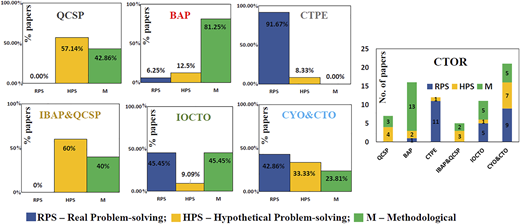
Based on this bibliometric analysis of exact data, the study revealed a few research gaps. First of them, which is done here, indicates that CTOR has not been studied through revealing the scientific actors and RTs that have made the highest impact of CTOR development. This highlighted some additional research gaps which have to be covered: a framework was proposed that divides CTOR into seven RTs with several dimensions which could be further studied by relationship between each RT; Bibliometric characterization of CTOR in comparison with other research areas in port and maritime logistics; Alongside publication and citation dimensions of RTs, much important could be dimensions of the real problem-solving (RPS), hypothetical problem-solving (HPS) and methodology approach (M) as empirical nature of HIPs based on smart CT concept in foreseeable future.
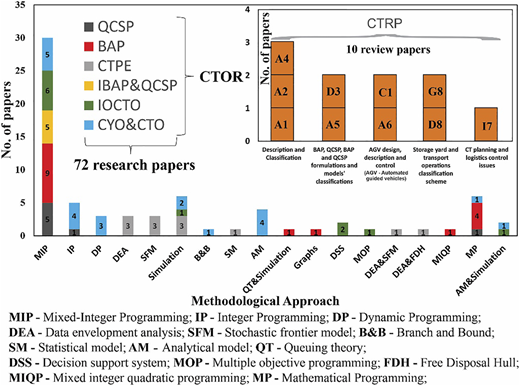
In terms of scientific tools, results show that MIP has been used in over 40% of the HIPs and is therefore the most widely used technique in CTOR (see Figure 9), whilst all programming techniques (MIP, IP, DP, MOP, MIQP and MP) are applied in more than 63% of HIPs. These methodology approaches are primarily reflected by progress in OR which was consistent with the growth of information technology and the increasing demand for quick and reliable solutions to complex problems. New developments of integrated problem-solving of seaside and landside operations planning, terminal transport operations and container storage yard modeling can be applied on the real CT. A considerable part of the transition of RTs can be explained by automated operations inside CT which admit modeling processes via various OR techniques.
To show a consistent picture of HIPs of CTOR, Figure 9 is presented with additional results of HIPs empirical nature given in Figure 10 by RPS, HPS and M. According to Figure 9 typical mathematical OR models are applied to maximize or minimize objective function(s) with various constraints, whilst the empirical nature of 72 HIPs is shown in Figure 10. These results indicate that specified scientific tools have been used to solve a CT related issue as a real-life problem in 25% of the papers, whilst 36% dealt with a hypothetical problem and the remaining 39% have investigated theoretical issues with various experiments. The distributions per RT are shown. Various methods were used to solve proposed models in HIPs such as simulated annealing, genetic algorithms (GA), GA-s based heuristics, Tabu search heuristics, stochastic beam search algorithm, branch-and-bound, branch-and-cut algorithm, squeaky wheel optimization, decision tree, corridor method, column generation, various heuristics and metaheuristics or a combination of some of them. Improving the application of these methods is of great importance in CTOR future research.
In a highly expanding CTOR, ongoing and future research efforts have to be facilitated through the provision of an easily and reliably accessible portfolio of research knowledge. A systematic detection of HIPs involving multiple bibliometrics indices offers the ability to improve on the focus and organization of the research community in the field of CTOR. This is particularly important since CTOR-related HIPs represent a number of research areas, such as port economy, port policy, port management, dry ports, port environment, port sustainability and port digitalization, among all others.
As the number of CTOR papers increases rapidly with the passage of time, the application of the aforementioned methodology is expected to offer an increasingly refined and more reliable picture on the trends associated with this specific research field, therefore leading to further improvement, coordination, collaboration and orientation of the CTOR community on areas/themes of mutual interest. Relating future research to the existing knowledge is the building block of all academic research activities, and maritime research is no exception. Knowledge production within the field of maritime research is accelerating at a tremendous speed, while at the same time remaining fragmented and interdisciplinary. This makes it hard to keep up with state-of-the-art research and to be at the forefront, as well as to assess the collective evidence in a particular research area. This is why the analytics of scientific literature are more relevant than ever.
The value of this paper relates to its potential to communicate to researchers and practitioners the up-to-date scientific body of knowledge and experience in the field of CTOR, by revealing the most influential publications and the emerging trends in relation to the specific CTOR topics and applied techniques/tools, as well as authorships, affiliations, etc. In this context, the paper plays an important role in the CTOR research focus and orientation by highlighting the literary topics and origins of the highest scientific interest during almost 50 years till the end of 2020 through their impact assessment. Furthermore, it provides a valuable hub of reference to facilitate scientific networking for the promotion of collaborative research in the field of CTOR.
References
Appendix 1 See Table A1 as the internal database in the paper
Supplementary material
The supplementary material for the article can be found online.