


The purpose of this study aims to investigate the relationship between employees’ personality traits and their job performances (including task performance and contextual performance) of Taiwanese freight forwarders by using responses from a NEO Personality Inventory-Revised Form (NEO-PI-R) questionnaire survey.
One of the most popular personality trait model is the five-factor model (FFM), which includes the big five domains, namely, openness, conscientiousness, extraversion, agreeableness and neuroticism (OCEAN). Each of these five domains includes six facets. Previous researchers have used OCEAN factors to describe the relationship between human personality and job performance. NEO Personality Inventory is a professional psychological assessment instrument published by psychological assessment resources. Multivariate analysis technique and regression technique are used to analyze surveyees’ responses.
Research results reveal the following four issues. The seniority of employees in a company has a positive relationship with their conscientiousness. Employees with higher score on the facets of the neuroticism domain have a negative correlation with their task performance and contextual performance. The relationship between employees’ openness to experience and job performance (both task performance and contextual performance) is not significant. Employees’ seniority has a positive correlation with both their task performance and contextual performance. In a nutshell, freight forwarding industry in Taiwan can use the facets in the neuroticism domain to screen and recruit appropriate job applicants. In addition, retaining senior employees could increase a forwarder’s task performance and contextual performance by their high degree of conscientiousness.
FFM model is a psychological theory dealing with the personality traits and human behavior. Freight forwarding is a labor-intensive business and is one of the most important sectors in the logistics industry. According the authors’ knowledge, the application of FFM on the logistics industry is simply not existed.
Introduction
Logistics industries play a critical role in world economy and forwarding industry as an important component of logistics industry, and it has direct effect on logistics industry. Freight forwarding is a labor-intensive industry. It is estimated that there are more than 800 freight forwarding companies in Taiwan. Among them, all of the ocean freight forwarders have employed over ten thousand staffs in Taiwan. The quality and personal trait of their employees might influence the performance of a freight forwarding company ( Appendix 1).
It is reported by a senior executive in the industry that the annual employee turnover rate in the forwarding industry in the Great Chinese region might be as high as 27 per cent ( Appendix 2). One professional human resource training company estimates the average training cost of a new employee is approximately US$3,500 (Muller, 2011). If a new employee leaves and has to be replaced, such cost will be around US$4,700 (Investtopedia, 2015). Another report by PR Newswire (2015) indicates that a company’s employee turnover rate is a costly part of doing business. The employee’s replacement expenses include the cost of advertising, headhunting fees, human resource costs, loss of productivity, new hire training and customer retention which might add up to anywhere from 30 to 200 per cent of a single employee’s annual salary. High employee turnover rate is one of the employers’ major hidden costs if they could not select the right employees during the interview processes. In addition, customer satisfaction is influenced by employee behaviors. You can never overemphasize the importance of including “personality” factors as part of the recruitment and selection processes (Stone and Ineson, 1997 cited in Aksu, 2008).
Five-factor model (FFM) model is a psychological theory dealing with personality traits and human behaviors (Filip et al., 2001). Freight forwarding is a labor-intensive business and is one of the most important sectors in the logistics industry. According to the authors’ knowledge, the application of FFM in logistics industry is simply not existing.
Literatures reviews on the five-factor model and job performance
Traits, the primary unit of personality description, are relatively enduring and people may have very different traits. Personality inventories are questionnaires to measure the scores on a number of traits or characteristics. The NEO Personality Inventory, Revised (NEO PI-R) is the best-known and most empirically supported measure of the five factors. There are many models to measure the personality traits to select the appropriate employees in a broad spectrum of industries. Searching through the Science Direct database, it is found there are 43,421 literatures discussing the relationship of personality traits and the FFM, and 8,614 articles discussing the relationship between personality trait and job performance. FFM is one of the most popular personality measurement models (Filip et al., 2001). The FFM is investigating the five major personalities of openness, conscientiousness, extraversion, agreeableness and neuroticism (OCEAN). Openness is characterized by terms including original, ideas and imaginative. Conscientiousness is about the self-control, perseverance, achievement-striving and ambition. Extraversion is defined as the sociability, affection, friendliness and talkativeness. Agreeableness is perceived as trusting, straightforwardness, sympathetic and cooperative. Neuroticism is perceived as worry, insecurity and self-consciousness (Costa and McCrae, 1992; White, 2003).
There are critics on the FFM. Ashton (1998) discusses the relationship between employee personality and job performance and concludes the responsibility and risk-taking scales of the Jackson Personality Inventory could have higher validities than the Big Five dimensions with respect to job performance. Parker et al. (1993) indicate that the theoretical parameters of the five-factor personality model were assessed by subjecting the 30 subscales that comprise this scale to confirmatory factor analysis (CFA). Results from the CFA indicated a poor fit between the obtained factor structure and the hypothesized dimensions corresponding to the FFM. Dudley et al. (2006) examined the personality–performance relationship, and they compared the predictive power between general personality traits of the FFM and the narrow traits. They conclude their research results by suggesting that there are benefits in considering the narrow traits of conscientiousness in the prediction of performance. Bowler et al. (2009) assessed whether individuals with higher or lower levels of cognitive complexity have personalities which comprise a greater or lesser number of factors than the five in the FFM model, and they found individuals with lower levels of cognitive complexity have personalities best described by a three-factor model, whereas individuals with higher levels of cognitive complexity have personalities which can be best described by a seven-factor model. And they argued about whether the appropriateness of applying universally the FFM to individuals of differing levels of cognitive complexity should be discussed.
However, abundant literatures support the application of FFM on various occasions. Ones and Viswesvaran’s (1996) research concluded that “broader and richer personality traits predictors, including FFM, will have higher predictive validity than narrower traits”. Hurtz and Donovan (2000) indicate many previous studies and analyses that were not derived from actual FFM measures. They use the meta-analysis technique to estimate the relationship between the criterion-related validity of FFM and job performance and contextual performance. They indicate there are complex relations among the Big 5 and performance. Day and Silverman (1989) also study the relationship between specific personality variables and job performance of accountants. Their research finding indicates three personality scales (orientation towards work, degree of ascendancy and degree and quality of interpersonal orientation) are significantly related to important aspects of job performance. Blickle et al. (2009) reviewed the Hogan’s (1991) socioanalytic perspective of performance prediction and investigated whether interactions of the FFM constructs of agreeableness and conscientiousness with political skill predict job performance. They found conscientiousness has interaction with political skill, and it does also significantly predict job performance. Blickle et al. (2010) investigated a sample of 112 car salespersons whether interactions of the FFM constructs of extraversion and openness to experience with political skill predict sales performance. They suggested that for individuals possessing great political skill, higher levels of extraversion of them were associated with higher levels of sales. For individuals possessing low political skill, higher levels of extraversion were associated with lower levels of sales.
Furnham and Fudge (2008) reviewed the previous FFM or personality traits literatures which suggested individuals with high Conscientiousness and Extraversion, as well as low Neuroticism, perform better in sales occupations. They test this argument by surveying 66 sales consultants from a sports organization, and these sales consultants are asked to complete the NEO-FFI form, and it was found that scores correlated with their sales performance. Conscientiousness and Openness has a positive relationship with sales, and agreeableness has a negative relationship with sales. However, the statistic relationship between sales performance and personality of Extraversion and Neuroticism is not significantly supported. Penney et al. (2011) review the literatures linking the Big Five personality traits with job performance and indicate there are trait interactions and conclude the capability to predict that employee behavior could be improved by considering the interaction among the traits. van der Linden et al. (2010) performed a meta-analysis on the inter-correlations among the Big Five personality factors (OCEAN) to test for the existence of a General Factor of Personality (GFP). Their study indicated that the GFP has a substantive component, as it is related to supervisor-rated job performance.
Borman and Motowidlo (1993) indicated that job performance included task performance and contextual performance. They tested the merit of the distinction made between task performance and contextual performance. Task performance is defined as the employee’s performance on the company’s core tasks and skills. Contextual performance is defined as the employee’s performance on the company’s non-core tasks, including providing assistance to his/her colleagues. Van Scotter (2000) studied the relationships between task performance and contextual performance with turnover, job satisfaction and affective commitment, and concluded that task performance and contextual performance predicted turnover and job satisfaction. Bing et al. (2011) studied the relationship between political skills and job performances. They found that political skill is a valid predictor of both task and contextual performance ratings. Beck et al. (2009) indicated job performance is a multidimensional concept that encompasses both task-related and contextual performance factors that include the importance of social skills as a predictor of job performance. Springer (2011) reviewed Campbell’s (1990) research in industrial and organizational psychology and developed some broad items of job performance that could be applicable across various jobs. These items include eight general factors of job performance:
job-specific proficiency;
non-job-specific task proficiency;
written and oral communication;
demonstrating effort;
maintaining personal discipline;
maintaining peer and team performance;
supervision/leadership; and
management/administration.
Sisco and Reilly (2007) performed a study to test the effectiveness of using a biographical inventory as an alternative to a traditional personality inventory in measuring the FFM of personality. All participants completed the newly developed Biodata Inventory and the NEO-Five Factor Inventory. They found the relationship of the Conscientiousness biodata scores to grade point average and task completion performance was statistically significant. Kappe and van der Flier (2010) used multiple and specific academic performance criteria (i.e. classroom lectures, skills training, team projects, on-the-job training and a written thesis) to examine the predictive validity of the Big Five personality traits on 135 students in The Netherlands. They also found that Conscientiousness is highly correlated to performance in higher education, regardless of which performance criterion was used, and that Neuroticism is positively related to performance when the assessment conditions are less stressful. Barrick et al. (1991) examined the relationship of the Big Five personality dimensions to three job performance criteria and found conscientiousness has consistent relations with all job performance criteria for all responding occupational groups. Barrick et al. (1993) assessed the relationship of conscientiousness to job performance by linear structural equation modeling showed that salesman high in conscientiousness are more likely to have higher job performance:
Conscientiousness personality trait has positive correlation with job performance.
Conscientiousness trait has positive correlation with task performance.
Conscientiousness trait has positive correlation with contextual performance.
Yang and Hwang (2014) investigated the relationship between personality traits, job performance and job satisfaction in the financial, securities and insurance industries in Taiwan. They found extraversion is the only personality trait that shows a significant influence over job satisfaction. Meanwhile, Hurtz and Donovan (2000) showed that conscientiousness is positively relative to job performance in a meta-analysis. Thus, it is hypothesized that extraversion is positively influence job performance:
Extraversion personality trait has positive correlation with job performance.
Extraversion trait has positive correlation with task performance.
Extraversion trait has positive correlation with contextual performance.
Judge and Erez (2007) investigates employees’ emotional stability and extraversion personal traits on their job performance at a regional health and fitness center, and they found both of the abovementioned personal traits useful to predict employees’ job performance. Simon (2013) studies the team personality and its impacts on team performance by meta-analysis technique, and she found that the operationalizations of team emotional stability can significantly predict team performance:
Emotional stability personality trait has positive correlation with job performance.
Emotional stability trait has positive correlation with task performance.
Emotional stability trait has positive correlation with contextual performance.
Witt et al. (2002) studied the relationship between conscientiousness and job performance would be stronger for persons high in agreeableness. They also find workers with high conscientiousness and low in agreeableness get lower ratings of job performance than workers with high agreeableness. Yang and Hwang (2014) conducted surveys on Chinese employers to find out the relationship between the employees’ five major personality traits and their job performance. They found all five personality traits significantly influence job performance, with agreeableness showing the greatest effect:
Agreeableness personality trait has positive correlation with job performance.
Agreeableness trait has positive correlation with task performance.
Agreeableness trait has positive correlation with contextual performance.
Bing and Lounsbury (2000) studied job performance and openness among residents in the southeast employed in US-based Japanese manufacturing companies by a step-wise hierarchical regression technique. They found that openness predicted the job performance for these employees. O’Connor and Paunonen (2007) reviewed the relations between the Big Five personality dimensions and post-secondary academic achievement, and found Conscientiousness, in particular, to be most strongly and consistently associated with academic success. In addition, Openness to Experience was sometimes positively associated with scholastic achievement, whereas Extraversion was sometimes negatively related to the same criterion, although the empirical evidence regarding these latter two dimensions was somewhat mixed:
Openness personality trait has positive correlation with job performance.
Openness trait has positive correlation with task performance.
Openness trait has positive correlation with contextual performance.
Research methodology and research structure
Research structure
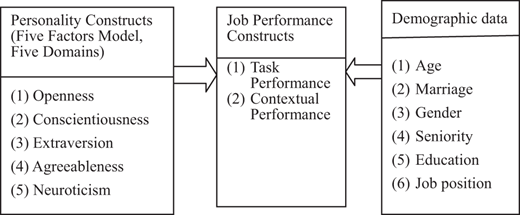
Description statistics and regression analysis techniques are used to analyze the survey results. The regression analysis can be performed to look into the relationship between the job performance and five domains in the FFM. NEO Five-Factor Inventory (NEO-FFI-3) questions are translated into Chinese and are used to design the questionnaire. NEO-FFI-3 is composed of five domains, and each of the domains is represented by six specific scales (Table I). The questionnaire included 60 questions that assessed the five domains and 30 facet scales in the FFM. Three regression models are then tested (Figure 1):
relationship of the five domains with the overall job performance;
relationship of the five domains with the task performance; and
relationship of the five domains with the contextual performance.
Facet scales in the five-factor model
| Five domains (OCEAN) | Thirty facet scales | |
|---|---|---|
| Openness (O): Openness to experience | 1. Fantasy | 2. Aesthetics |
| 3. Feelings | 4. Actions | |
| 5. Ideas | 6. Values | |
| Conscientiousness (C) | 7. Competence | 8. Order |
| 9. Dutifulness | 10. Achievement striving | |
| 11. Self-discipline | 12. Deliberation | |
| Extraversion (E) | 13. Warmth | 14. Gregariousness |
| 15. Assertiveness | 16. Activity | |
| 17. Excitement-seeking | 18. Positive emotions | |
| Agreeableness (A) | 19. Trust | 20. Straightforwardness |
| 21. Altruism | 22. Compliance | |
| 23. Modesty | 24. Tender-mindedness | |
| Neuroticism (N): Emotional stability | 25. Anxiety | 26. Angry hostility |
| 27. Depression | 28. Self-consciousness | |
| 29. Impulsiveness | 30. Vulnerability | |
Sampling
Globally, there are around 40,000 freight forwarding companies that employed 8 million staffs in 150 countries (Elite, 2015; Chi, 2005). There are 830 freight forwarding companies that employed 10,681 professionals in Taiwan in 2013 (Maritime and Port Bureau of the MoTC, 2015). Anonymous questionnaires were distributed to 1,280 employees in according to the top 100 ocean freight forwarding members in Taipei in the early 2013, and 168 copies of them are returned in 2013. Of the 146 returned questionnaires, two are uncompleted. The response rate is as high as 11.41 per cent (Table II), and the demographic data of the respondents are shown in Table III. As freight forwarders in Taiwan are overburdened to answer too many academic surveys, it is highly likely they would not respond to our surveys unless we have their oral agreement first. Thus, the research team members have called the reception department of these leading forwarders to find the appropriate staffs who have expressed that they are willing to fill in and return our questionnaire and to know the number of employees of the companies. For forwarder of larger scale, more copies of questionnaires are posted to its sales department. As the questionnaire is of anonymous type, it is impossible for the authors to know the exact background of the respondents. In a multiple regression model, maintaining power at 80 requires a minimum sample of 50 and preferably 100 observations for most research situations (Hair et al., 2006). Thus, the number of our respondents is appropriately to carry out the regression analysis between personality constructs and job performance constructs.
The response rate
| Response and non-response | No. of surveyees | Valid respondents | Valid response rate |
|---|---|---|---|
| Response | 1,280 | 146 | 11.41% |
Demographic data of the respondents
| Demographic variables | No. | (%) |
|---|---|---|
| Gender | ||
| Male | 72 | 49.3 |
| Female | 74 | 50.7 |
| Age | ||
| Under 20 | 4 | 2.7 |
| 21-30 | 50 | 28.7 |
| 31-40 | 46 | 34.2 |
| 41-50 | 38 | 26.0 |
| Over 51 | 12 | 8.2 |
| Education | ||
| High School | 20 | 13.7 |
| College | 108 | 74.0 |
| Graduate School | 18 | 12.3 |
| Marriage | ||
| Married | 76 | 52.1 |
| Single | 70 | 47.9 |
| Seniority | ||
| Under 2 | 22 | 15.1 |
| 2-5 | 34 | 23.3 |
| Over 5 | 90 | 61.6 |
| Job scope | ||
| Internal OP | 92 | 63.0 |
| External sales | 54 | 37.0 |
Research findings
There are four subsections in the research findings section:
description on the sampling, response rate and respondents’ demographic data;
internal consistency reliability (Cronbach’s alpha reliability) is tested, and it is used to judge the consistency of results across items on the same test of the responses of the personality traits and job performance of the employees in the ocean freight forwarding industry;
regression analysis technique is used for modeling and analyzing the relationship between a job performance variable and the five domains of the FFM; and
analysis of variance (ANOVA) on the respondents’ demographic data and their job performance.
Internal consistency of the questionnaire on the personal traits constructs
Overall, Cronbach’s alpha measure of reliability for the FFM personality traits questionnaire is 0.683. To increase all alpha values of the five domains to over 0.7, some questions were deleted from the questionnaire in the Openness domain. Question items 3, 8, 33, 38 and 58 were deleted, and the internal consistency of the Openness domain is increased to 0.704. One of the authors has interviewed the respondents after the survey, and respondents have complained that some questions in the openness domain are very difficult to reply. Thus, these five questions in the openness domain are removed from the FFM model (Table IV).
Internal consistency of the personality traits construct
| Domains | Item | Question | Corrected item-total correlation | Cronbach’ α if item deleted |
|---|---|---|---|---|
| Openness (O): Cronbach’s α value 0.728 | 3 | I don’t like to waste my time daydreaming (R) | −0.189 | 0.367 |
| 8 | I believe that it’s better to stick to your own principles than to be open-minded. (R) | −0.068 | 0.313 | |
| 13 | I am intrigued by the patterns I find in art and nature | 0.267 | 0.161 | |
| 18 | I believe letting students hear controversial speakers can only confuse and mislead them. (R) | 0.169 | 0.206 | |
| 23 | Poetry has little or no effect on me. (R) | 0.161 | 0.214 | |
| 28 | I often try new and foreign foods | 0.056 | 0.260 | |
| 33 | I seldom notice the moods or feelings that different environments produce. (R) | 0.143 | 0.224 | |
| 38 | I believe we should look to our religious authorities for decisions on moral issues | 0.082 | 0.250 | |
| 43 | Sometimes when I am reading poetry or looking at a work of art, I feel a chill or wave of excitement | 0.309 | 0.156 | |
| 48 | I have little interest in speculation on the nature of the universe or the human condition. (R) | 0.297 | 0.153 | |
| 53 | I have a lot of intellectual curiosity | 0.063 | 0.258 | |
| 58 | I often enjoy playing with theories or abstract ideas | −0.140 | 0.354 | |
| Extraversion (E): Cronbach’s α value 0.78 | 2 | I like to have a lot of people around me | 0.605 | 0.744 |
| 7 | I laugh easily | 0.460 | 0.761 | |
| 12 | I have felt overpowering joy | −0.442 | 0.854 | |
| 17 | I really enjoy talking to people | 0.711 | 0.733 | |
| 22 | I like to be where the action is | 0.383 | 0.769 | |
| 27 | I usually prefer to do things alone. (R) | 0.274 | 0.778 | |
| 32 | I often feel as if I’m bursting with energy | 0.689 | 0.739 | |
| 37 | I am a cheerful, high spirited person | 0.759 | 0.73 | |
| 42 | I am not a cheerful optimist. (R) | 0.48 | 0.758 | |
| 47 | My life is fast-paced | 0.289 | 0.777 | |
| 52 | I am a active person | 0.685 | 0.739 | |
| 57 | I would rather go my own way than be a leader of others. (R) | 0.484 | 0.758 | |
| Conscientiousness (C) facets: Cronbach’s α value 0.909 | 5 | I keep my belongings neat and clean | 0.498 | 0.908 |
| 10 | I’m pretty good about pacing myself so as to get things done on time | 0.747 | 0.897 | |
| 15 | I’m not a very methodical person. (R) | 0.421 | 0.912 | |
| 20 | I try to perform all the tasks assigned to me conscientiously | 0.737 | 0.897 | |
| 25 | I have a clear set of goals and work toward them in an orderly fashion | 0.560 | 0.905 | |
| 30 | I waste a lot of time before settling down to work. (R) | 0.535 | 0.907 | |
| 35 | I work hard to accomplish my goals | 0.815 | 0.894 | |
| 40 | When I make a commitment, I can always be counted on to follow through | 0.647 | 0.901 | |
| 45 | Sometimes I’m not as dependable or reliable as I should be. (R) | 0.555 | 0.906 | |
| 50 | I am a productive person who always gets the job done | 0.815 | 0.893 | |
| 55 | I never seem to be able to get organized. (R) | 0.619 | 0.903 | |
| 60 | I’m picky about how jobs should be done | 0.805 | 0.894 | |
| Neuroticism (N) facets Cronbach’s α is 0.905 | 1 | I am not a worrier (R) | 0.442 | 0.911 |
| 6 | I have a low opinion of myself | 0.631 | 0.898 | |
| 11 | When I’m under a great deal of stress, sometimes I feel like I’m going to pieces | 0.768 | 0.891 | |
| 16 | I rarely feel lonely or blue. (R) | 0.468 | 0.905 | |
| 21 | I often feel tense and jittery | 0.799 | 0.899 | |
| 26 | Sometimes I feel completely worthless | 0.617 | 0.896 | |
| 31 | I rarely feel fearful or anxious | 0.477 | 0.869 | |
| 36 | I often get angry at the way people treat me | 0.398 | 0.900 | |
| 41 | Too often, when things go wrong, I get discouraged and feel like giving up | 0.639 | 0.893 | |
| 46 | I am seldom sad or depressed. (R) | 03531 | 0.902 | |
| 51 | I often feel helpless and want someone else to solve my problems | 0.728 | 0.92 | |
| 56 | At times I have been so ashamed I just wanted to hide | 0.739 | 0.877 | |
| Agreeableness facet (A): Cronbach’s α value 0.7637 | 4 | I try to be courteous to everyone I meet | 0.718 | 0.708 |
| 9 | I often get into arguments with my family and co-workers. (R) | 0.598 | 0.726 | |
| 14 | Some people think I’m selfish and egotistical. (R) | 0.657 | 0.717 | |
| 19 | I would rather cooperate with others than compete with them | 0.527 | 0.731 | |
| 24 | I believe to be cynical and skeptical of others’ intentions. (R) | 0.591 | 0.722 | |
| 29 | I believe that most people will take advantage of you if you let them. (R) | 0.368 | 0.75 | |
| 34 | Most people I know like me | 0.518 | 0.735 | |
| 39 | Some people think of me as cold and calculating. (R) | 0.57 | 0.728 | |
| 44 | I’m hard headed and stubborn. (R) | −0.528 | 0.835 | |
| 49 | I generally try to be thoughtful and considerate | 0.558 | 0.73 | |
| 54 | If I don’t like people, I let them know it. (R) | 0.051 | 0.785 | |
| 59 | If necessary, I am willing to manipulate people to get what I want. (R) | 0.385 | 0.749 |
Validity of the survey
The FFM questionnaire is designed according to the NEO Inventories, a psychological assessment instrument distributed by the American psychological literatures publisher, PAR Inc. This personality assessment instrument has been tested and heavily used in the Western world, but it is rarely used by most of Asian academicians. The questionnaire is translated into Chinese by one of the authors and is then reviewed by a transportation psychologist in Taiwan. Thus, the content validity of the questionnaire is supported.
Internal consistency of the job performance constructs
Job performance was evaluated using the following two measures: task performance and contextual performance. First, eight items were used to measure the task performance. Second, 16 items were used to measure the contextual performance. Subjective perceptual measures of employees’ job performance were adopted by Yu (1996). Internal consistency value (Cronbach’s alpha) of the job performance questionnaire is shown in the following Table V.
Internal consistency of the job performance constructs
| Job performance facets | Item | Questions/Measurement constructs | Corrected item-total correlation | Cronbach’s α value if item deleted |
|---|---|---|---|---|
| (1) Contextual performance Cronbach’s α value is 0.963 | 9 | I always cooperate with my colleagues of the same team | 0.839 | 0.959 |
| 10 | I frequently show my patience during my working time | 0.681 | 0.962 | |
| 11 | I frequently shoulder extra works for my company and colleagues | 0.697 | 0.962 | |
| 12 | I used to follow operation procedure and work guidelines, and avoid assuming my colleagues’ work assignment | 0.789 | 0.960 | |
| 13 | I wish my company can arrange me to handle a challenging mission | 0.590 | 0.964 | |
| 14 | I am always willing to help my colleagues to complete a mission which has no relationship with me | 0.776 | 0.961 | |
| 15 | I pay attentions to important events to avoid unexpected incidences | 0.828 | 0.960 | |
| 16 | I fully support my superiors’ decisions | 0.779 | 0.961 | |
| 17 | I have considered job ethics in my work | 0.812 | 0.960 | |
| 18 | I have encouraged and supported my colleagues when they encountered challenges | 0.814 | 0.960 | |
| 19 | I have voluntarily solved problems in my company | 0.803 | 0.960 | |
| 20 | I do control myself and obey the work codes in my company | 0.833 | 0.960 | |
| 21 | I am willing to handle a difficult assignment from my company | 0.875 | 0.960 | |
| 22 | I do shoulder extra work, and am willing to help my colleagues and my team to improve their performance | 0.812 | 0.959 | |
| 23 | In general, I am willing to help my colleagues and tried to put myself in my company’s shoes to consider the company’s situation | 0.789 | 0.960 | |
| (2) Task performance (Cronbach’s α 0.941) | 1 | I must complete work assignment according to standard operation procedure | 0.719 | 0.938 |
| 2 | I am familiar with the SOP of my work | 0.795 | 0.932 | |
| 3 | I often well plan and arrange my work progress | 0.795 | 0.932 | |
| 4 | I have paid attention to the sanitary and safety issues during my work | 0.801 | 0.932 | |
| 5 | I always keep my work shop floor clean and tidy | 0.795 | 0.932 | |
| 6 | I used to have my work tools and stationery in fixed places after I used them | 0.821 | 0.930 | |
| 7 | My average working efficiency is high | 0.783 | 0.932 | |
| 8 | In general, I can complete my work according to my company’s request | 0.802 | 0.930 |
The overall internal consistency value for the job performance construct is 0.973, which is larger than the threshold value of Cronbach’s alpha 0.7.
Validity of the job performance
The measurement items of the job performance constructs are initially proposed by Barrick and Mount (1991) to investigate the relation of the “Big Five” personality dimensions to three job performance criteria (job proficiency, training proficiency and personnel data), and are being used by many academicians to evaluate the staffs’ performance in the service industry since then. Thus, these measurement items of the construct have the content validity.
Descriptive statistics on the personality traits construct and job performances construct
Questionnaires are designed according to the five-point Likert scale, each number represent different meaning as follows: 1, strongly disagree; 2, disagree; 3, neutral; 4, agree; and 5, strongly agree.
Authors have made conversion on the reverse questions when keying the respondents’ replies so that the replies can indicate whether there is a positive correlation between personality trait and job performance. Items (20), (4), (5), (55) and (35) were perceived to be the top five important questions.
Four of the top five important items are in the “Conscientiousness (C) Facets”, and their average score is near 4.0, which indicates most staffs of the ocean freight forwarding industry perceived conscientiousness as the most key successful factor if they want to prevail in the competitive freight forwarding market. Item 4 of the Agreeableness Facet (A) was ranked as the second most important personality trait with an average score of 4.0274 which implies courteousness is a necessity to solicit the shippers using forwarders’ freight services (Table VI). Thus, sales team members of the forwarding industry do always wear suits to show their respect to their potential customers before they have a chance to introduce their freight services. On the other hand, the five lowest score items are all in reverse questions, and the respondents mostly do not think that they have these five negative emotions.
Descriptive statistics on the personality trait and performance constructs
| Items | Question description | Average score | SD | Rank |
|---|---|---|---|---|
| 20 | I try to perform all the tasks assigned to me conscientiously | 4.0822 | 0.89370 | 1 |
| 4 | I try to be courteous to everyone I meet | 4.0274 | 0.91245 | 2 |
| 5 | I keep my belongings neat and clean | 3.9863 | 0.87390 | 3 |
| 55 | I am able to get organized | 3.9175 | 0.95348 | 4 |
| 35 | I work hard to accomplish my goals | 3.9041 | 0.78465 | 5 |
| 15 | I’m a very methodical person | 3.9041 | 0.95981 | 6 |
| 24 | I believe not to be cynical and skeptical of others’ intentions | 3.8493 | 1.00928 | 7 |
| 19 | I would rather cooperate with others than compete with them | 3.8493 | 0.95265 | 8 |
| 60 | I’m picky about how jobs should be done | 3.8356 | 0.89774 | 9 |
| 50 | I am a productive person who always gets the job done | 3.8219 | 0.90281 | 10 |
| 17 | I really enjoy talking to people | 3.7534 | 0.90935 | 11 |
| 9 | I rarely get into arguments with my family and co-workers | 3.7397 | 0.81696 | 12 |
| 45 | Most of times, I’m as dependable or reliable as I should be | 3.7123 | 0.96436 | 13 |
| 2 | I like to have a lot of people around me | 3.6986 | 0.99561 | 14 |
| 14 | Some people think I’m not selfish and egotistical | 3.6712 | 0.89837 | 15 |
| 40 | When I make a commitment, I can always be counted on to follow through | 3.6575 | 0.85341 | 16 |
| 10 | I’m pretty good about pacing myself so as to get things done on time | 3.6575 | 0.86935 | 17 |
| 49 | I generally try to be thoughtful and considerate | 3.6164 | 0.84377 | 18 |
| 39 | Most people think of me as warm and not calculating | 3.6027 | 0.87781 | 19 |
| 7 | I laugh easily | 3.6027 | 0.99638 | 20 |
| 53 | I have a lot of intellectual curiosity | 3.5890 | 0.87932 | 21 |
| 13 | I am intrigued by the patterns I find in art and nature | 3.5890 | 0.96947 | 22 |
| 25 | I have a clear set of goals and work toward them in an orderly fashion | 3.5753 | 0.86471 | 23 |
| 52 | I am an active person | 3.5753 | 0.83196 | 24 |
| 34 | Most people I know like me | 3.5342 | 0.78319 | 25 |
| 57 | I would rather be a leader of others than go my own way | 3.5068 | 0.89943 | 26 |
| 37 | I am a cheerful, high spirited person | 3.4795 | 0.86778 | 27 |
| 30 | I don’t waste a lot of time before settling down to work | 3.4658 | 0.92919 | 28 |
| 32 | I often feel as if I’m bursting with energy | 3.3973 | 0.82898 | 29 |
| 18 | I believe letting students hear controversial speakers will not confuse and will not mislead them | 3.3973 | 1.03735 | 30 |
| 42 | I am a cheerful optimist | 3.3699 | 0.99313 | 31 |
| 38 | I believe we should look to our religious authorities for decisions on moral issues | 3.3151 | 0.95564 | 32 |
| 28 | I often try new and foreign foods | 3.3151 | 0.81440 | 33 |
| 59 | Even if necessary, I am not willing to manipulate people to get what I want | 3.2055 | 1.05355 | 34 |
| 33 | I frequently notice the moods or feelings that different environments produce | 3.1918 | 0.89221 | 35 |
| 47 | My life is fast-paced | 3.1918 | 0.84422 | 36 |
| 54 | If I don’t like people, I won’t let them know it | 3.1233 | 0.9732 | 37 |
| 29 | I believe that most people will not take advantage of you if you let them | 3.0822 | 0.87803 | 38 |
| 43 | Sometimes when I am reading poetry or looking at a work of art, I feel a chill or wave of excitement | 3.0548 | 0.83150 | 39 |
| 22 | I like to be where the action is | 3.0274 | 0.86995 | 40 |
| 27 | I usually prefer to do things alone | 3.0137 | 0.79045 | 41 |
| 48 | I have strong interest in speculation on the nature of the universe or the human condition | 2.95890 | 0.90429 | 42 |
| 23 | Poetry has major effect on me | 2.9315 | 0.93287 | 43 |
| 46 | I am frequently sad or depressed | 2.8356 | 0.78198 | 44 |
| 16 | I frequently feel lonely or blue | 2.7945 | 0.86537 | 45 |
| 1 | I am a worrier | 2.7808 | 1.20470 | 46 |
| 12 | I have felt overpowering joy | 2.6849 | 1.03918 | 47 |
| 31 | I rarely feel fearful or anxious | 2.63.01 | 0.85808 | 48 |
| 36 | I often get angry at the way people treat me | 2.6027 | 0.82565 | 49 |
| 44 | I’m not hard headed and not stubborn | 2.5890 | 0.87932 | 50 |
| 41 | Too often, when things go wrong, I get discouraged and feel like giving up | 2.5068 | 0.88386 | 51 |
| 11 | When I’m under a great deal of stress, sometimes I feel like I’m going to pieces | 2.4795 | 0.9442 | 52 |
| 21 | I often feel tense and jittery | 2.4247 | 0.94160 | 53 |
| 56 | At times I have been so ashamed I just wanted to hide | 2.4247 | 0.88062 | 54 |
| 3 | I do like to waste my time daydreaming | 2.3699 | 0.97904 | 55 |
| 51 | I often feel helpless and want someone else to solve my problems | 2.3151 | 0.86405 | 56 |
| 8 | I don’t believe that it’s better to stick to your own principles than to be open-minded | 2.3014 | 0.92323 | 57 |
| 6 | I have a low opinion of myself | 2.1918 | 1.03625 | 58 |
| 58 | I often enjoy playing with theories or abstract ideas | 2.1781 | 1.04539 | 59 |
| 26 | Sometimes I feel completely worthless | 2.0822 | 1.0202 | 60 |
Regression analysis on the personality trait and job performance
Multiple regression analysis technique is used to look into the relationship between the five personality traits and each of the following job performance constructs:
task performance construct;
contextual performance construct; and
overall job performance construct.
The five personality traits will be the independent variables, while each of the three performance constructs is the dependent variable. R-square (the coefficient of determination) is used to tell the prediction ability of our proposed regression model on the basis of other related information. DW statistics is used to test for serial correlation in the residuals containing lagged endogenous variables. The variance inflation factor and tolerance are both used to measure the degree of multi-collinearity of the ith independent variable with the other independent variables in a regression model. The relationships of the job performance construct and FFM personality traits are shown in the following three tables (Tables VII-IX).
Regression model 1 (personality traits and task performance)
| Model 1 | |||||||
|---|---|---|---|---|---|---|---|
| Independent variables | Dependent variable | Regression coefficient | t value | Significance | Adjusted R2 | Durbin–Watson | VIF |
| Neuroticism | Task performance | −0.014 | −0.115 | 0.909 | 0.73 | 2.219 | 3.67 |
| Extraversion | 0.233 | 2.307 | 0.024* | 2.69 | |||
| Openness | −0.097 | −1.045 | 0.3 | 2.3 | |||
| Agreeableness | −0.023 | −0.246 | 0.806 | 2.246 | |||
| Consciousness | 0.752 | 6.234 | 0.000** | 3.84 | |||
Note:
Denotes significance at 0.05, and ** denotes significance at 0.01 levels
Regression model 2 (personality traits and contextual performance)
| Model 2 | |||||||
|---|---|---|---|---|---|---|---|
| Independent variables | Dependent variable | Regression coefficient | t value | Significance | Adjusted R2 | Durbin–Watson | VIF |
| Neuroticism | Contextual performance | 0.26 | 2.122 | 0.038* | 0.705 | 1.9645 | 3.277 |
| Extraversion | 0.312 | 2.967 | 0.004** | 2.693 | |||
| Openness | 0.197 | 2.025 | 0.047* | 2.3 | |||
| Agreeableness | 0.175 | 1.822 | 0.073 | 2.246 | |||
| Consciousness | 0.522 | 4.159 | 0.000** | 3.846 | |||
Note:
Denotes significance at 0.05, and ** denotes significance at 0.01 levels
Regression model 3 (personality traits and overall job performance)
| Model 3 | |||||||
|---|---|---|---|---|---|---|---|
| Independent variables | Dependent variable | Regression coefficient | t value | Significance | Adjusted R2 | Durbin–Watson | VIF |
| Neuroticism | Job performance | 0.123 | 1.098 | 0.276 | 0.754 | 2.113 | 3.679 |
| Extraversion | 0.28 | 2.918 | 0.005* | 2.693 | |||
| Openness | 0.046 | 0.524 | 0.621 | 2.3 | |||
| Agreeableness | 0.075 | 0.861 | 0.393 | 2.246 | |||
| Consciousness | 0.662 | 5.771 | 0.000** | 3.846 | |||
Note:
Denotes significance at 0.05, and ** denotes significance at 0.01 levels
Analysis on the demographic data and job performance
Different demographic characteristics of the respondents might have various impacts on their job performance. Thus, ANOVA between demographic data and job performance is made in the following table.
ANOVA table reveals that age and marriage status have significant correlation with job performance. To be more specific, this research results imply the older the staff, the higher the job performance, and the married staff have higher job performance than the unmarried ones. This finding might be a little bit odd to the managers in the forwarding industry where young salesmen are mostly at their late twenties and early thirties.
Correlation between personality traits and job performance
To sum up the research findings in Section 4.7, eight of the fifteen hypotheses are supported: H1, H1.1, H1.2, H2, H2.1, H2.2, H3.1 and H5.2.
In a short summary, items of the consciousness facet and extraversion facet have positive correlation with the task performance and contextual performance (and hence the overall job performance). In the regression model 3, five personality traits in the FFM model have high correlation with the overall job performance. The coefficient of determination is as high as 0.754 which implies around 75 per cent of variance of the overall job performance could be explained by the personality traits of the FFM model. Personality traits do have significant influence on the overall job performance.
In addition, items in consciousness facet have the greatest impact on the overall job performance. In regression model 3, the coefficient of determination (β value) of the consciousness facet is 0.662. This finding is consistent with Barrick and Mount’s (1991) research report which pinpoints consciousness is the necessity of good performance on a job. Extraversion facet is the second important facet influence on job performance. The coefficient of determination (β value) is 0.28 with p-value less than 0.05, which implies it has significant correlation with overall job performance. Persons with high extraversion personality trait are self-confident, active, show off, pro-social activity oriented and enjoy staying with crowd. Freight forwarding business is a performance-oriented industry; sales representatives of a forwarding company have to contact with shippers frequently and require good communication and human skills to deal with their customer demands. Staffs with extraversion personality traits can easily close the relationship with shippers and thus could have better job performance when compared to their non-extraversion-oriented cohorts.
Conclusion and suggestions
Other personality traits, such as neuroticism, openness and agreeableness, have no significant correlation with overall job performance. Demographic variables such as age and marital status have significant correlation with job performance. In addition to their financial support obligation to their family, old staffs are usually senior staffs with many working experiences and personal networking; thus, they are comparatively diligent than their younger and single cohorts.
Freight forwarders in Taiwan have to recruit thousands of graduates from universities annually. These young salesmen’s turnover rate is high which will result in high recruitment and orientation cost. If an appropriate personality train inventory could be used to test the job applicants before the new staffs are accepted to work for a forwarder, then the new employees’ long-term retaining rate will be high.
It will be beneficial both to universities and the freight forwarding industry if the latter can help maritime and logistics universities set up a personality inventory test bank, then undergraduate students can know the fitness of their personality with their future possible jobs. It will remove inefficient learning progress for those students’ personalities that are not fit with the freight forwarding industry. The freight forwarding industry can also cooperate with leading job banks to improve their databases with appropriate personality inventory survey questions. Thus, these leading job banks would not forward inappropriate job applicants to the freight forwarding industry.
Implications for further research
Respondents of this research are limited to sales representative work in the ocean freight forwarding companies in Taiwan. In terms of geographical coverage, future research could generalize the current research findings by posting questionnaires to ocean freight forwarding companies located in leading maritime nations. Future researchers could also include the operation staffs of the freight forwarding companies as their surveyees. The personalities of shipping professionals work in the operation department and sales department of a freight forwarding companies might be quite different.
Authors are much obliged to two anonymous reviewers’ constructive comments which greatly improve the quality of this paper. The authors would like to express their sincere thanks for the help received from Mr Kuo-Dung Chao during the questionnaire surveys. The research is financially supported by Grant NSC-101-2410-H-019-017 from the Taiwan’s National Science Council.
References
Further reading
Appendix 1
The OCCs’ revenue, number of staffs and revenue in Taiwan
| No. of Ocean Freight Forwarder Companies (OFFs) in Taiwan | ||||||||||||
|---|---|---|---|---|---|---|---|---|---|---|---|---|
| Year | 2004 | 2005 | 2006 | 2007 | 2008 | 2009 | 2010 | 2011 | 2012 | 2013 | 2014 | 2015 |
| Number of company | 607 | 638 | 661 | 672 | 718 | 745 | 764 | 788 | 808 | 828 | 854 | 871 |
| Number of staffs | 11,167 | 8,456 | 10,380 | 7,498 | 10,480 | 11,779 | 11,331 | 11,776 | 9,470 | 10,681 | NA | NA |
| Revenue (Billion NTD) | 42.8 | 40.9 | 59.9 | 46.5 | 52.7 | 41.4 | 58.6 | 43.7 | 58.4 | 56.1 | NA | NA |
Note:
Revenue value is an unpublished statistics data reported by Executive Yuan
Appendix 2
Average staffs turnover rate in the logistics industry in China
| Average turnover rate | Executive officers level (%) | Directors level (%) | Managers level (%) | Supervisor level (%) | Senior staffs (%) | Junior staffs (%) |
|---|---|---|---|---|---|---|
| Average | 3.1 | 5.0 | 8.0 | 13.5 | 10.5 | 14.5 |
| Ship owners | 0.0 | 3.5 | 6.4 | 7.7 | 6.6 | 14.2 |
| Freight forwarding | 4.2 | 3.2 | 7.0 | 7.1 | 13.7 | 14.9 |
| Logistics companies | 0.0 | 16.7 | 12.5 | 20.9 | 11.2 | 27.4 |

