Sustainable fishing practices are essential for preserving marine ecosystems and supporting the livelihoods of coastal communities. This study aims to investigate currently practised fishing gear types used in motorised fishing crafts and to assess fishers’ knowledge, awareness and perceptions regarding the ecological impacts of different fishing gears along the southern Kerala coast (Thiruvananthapuram), a district with the highest fisher population.
This study employed a mixed-methods approach, combining quantitative and qualitative data. The research used multistage random sampling approach, key informant survey, five-point Likert scale analysis and descriptive statistics.
The study revealed that gears such as boat seines, gill nets, long lines and hand lines are commonly used in small-scale motorised crafts. There is a shift from gill net to boat seine even though fishers are aware of sustainable issues. The increasing use of boat seines with high mast lights, which indiscriminately capture all fish, including juveniles, was found to be unsustainable.
Since the practice of boat seines with high mast light is increasing, there is a need for targeted awareness campaigns, gear regulations enforcement, biodegradable materials promotion and incentives for adopting low-impact technologies. Collaborative efforts among stakeholders are critical to ensure the long-term sustainability of fishing activities along the Kerala coast.
1. Introduction
India is the world’s third-largest fish producer (3.53 m tonne) in 2023, where Kerala contributes a significant role (6.87 lakh tonne) in its economy, employment and food security (CMFRI, 2024). The sector supports millions of livelihoods and contributes significantly to the state’s gross domestic product. The fishers are using different types of fishing gear and crafts. The three categories of fishing crafts – mechanized, motorised and non-motorised – collectively make up the total catch in the sector with different usage of gears (CMFRI, 2024). There is a high correlation between types of fishing gear and sustainability. The intense pressure on marine resources caused by overfishing and destructive fishing practices poses a significant threat to the long-term viability of Kerala’s fisheries. While enhancing productivity, motorised fishing vessels are often equipped with gears that can be particularly damaging to the marine ecosystem, including bottom trawls and encircling nets (purse seine) that can lead to high levels of bycatch and habitat destruction.
The concept of “sustainability” in fisheries hinges on a balance between economic needs, ecological preservation and social equity (FAO, 2022). Achieving this balance necessitates a strategic shift towards fishing practices that minimize environmental impact, maintain biodiversity and ensure resource availability for future generations. The global push towards sustainable development goals (SDGs), particularly SDG 14 (Life Below Water), underscores the urgency of addressing unsustainable practices in the fishing sector (ESCAP, 2023).
The global shift towards sustainable fisheries management, guided by organizations like the Food and Agriculture Organization (FAO) of the United Nations, emphasizes reducing bycatch, minimizing habitat damage and controlling fishing capacity through responsible fishing practices and the adoption of sustainable gear (FAO, 2022). While research demonstrates the effectiveness of gear modifications like bycatch reduction devices in trawls (Eayrs, 2007) and baited hooks as alternatives to gillnets (Brewer et al., 2006), developing countries face implementation challenges due to resource constraints, socioeconomic factors and infrastructure limitations (Allison and Ellis, 2001). Reliance on traditional, often unsustainable, gear is influenced by historical practices, limited capital access and lack of awareness about alternative technologies (Smith, 2004). Ensuring the acceptability and uptake of new technologies within local communities is crucial, with community-based management approaches proving more effective in promoting sustainable practices (Berkes et al., 2000). Indian fisheries, similarly, face challenges including the detrimental effects of bottom trawling on benthic habitats and fish stocks (Vivekanandan et al., 2010). Unsustainable gear use is influenced by target species, market demands and financial resources, with studies documenting the negative impacts on marine ecosystems and dependent communities (Gopakumar et al., 2011; Sumaila et al., 2012). Research specific to Kerala highlights ecological challenges and socioeconomic realities of fishing communities, addressing issues like overfishing (Kurien, 1996), the impacts of trawling (Pillai et al., 2000) and the need for effective management (Nair, 2006), including considerations of climate change (Venkatesan et al., 2017) and integrated coastal zone management (Raj et al., 2017). Despite this body of research, a gap remains in understanding the specific perceptions and experiences of fishers regarding alternative fishing gear.
Sustainable fisheries management has become a global priority in response to growing concerns about the degradation of marine ecosystems, overfishing and the widespread use of destructive fishing gear (Pauly et al., 2002; Worm et al., 2006). In particular, the role of fishing gear in determining the ecological sustainability of marine harvests has received considerable attention in academic and policy circles. Several studies highlight the negative ecological impacts of non-selective and destructive fishing gear, such as bottom trawls, purse seines and gillnets, which result in habitat damage and high bycatch rates (Chuenpagdee et al., 2003; FAO, 2022).
The sustainability discourse has increasingly emphasized the importance of traditional and passive fishing gear, which is often seen as more selective and less disruptive to marine habitats. Research conducted in various parts of the world, including India, suggests that traditional gear types – such as hooks and lines, traps and shore seines – can support sustainable fishery practices when managed effectively (Salagrama, 2006; Bavinck, 2011). These gear types are typically employed by small-scale and artisanal fishers, who often possess intimate ecological knowledge and fishing practices passed down through generations (Berkes et al., 2000).
In the Indian context, study by Kurien (1996) emphasize that traditional fishing practices along the Kerala coast reflect a deep-rooted cultural and ecological sensitivity. However, modernization pressures, including motorisation and commercialization, have altered traditional fishing dynamics and gear usage patterns. Despite the adoption of motorised crafts, many fishers continue to rely on traditional gear due to factors such as affordability, ecological knowledge and community norms (Lobe and Berkes, 2004). Yet, the sustainability of these practices under changing socioeconomic and environmental conditions remains under-examined.
Moreover, recent assessments of the Indian marine fishery sector have pointed out that the effectiveness of traditional gear also depends on regulatory frameworks, fishing intensity and the health of marine stocks (CMFRI, 2024). Studies such as those by Sathiadhas and Prathap (2009) have called for an integrated gear management strategy that includes monitoring traditional gear usage, particularly in motorised fleets, which may exploit deeper and more diverse fishing grounds than non-motorised crafts.
Despite the extensive literature on destructive fishing methods and the global call for sustainability, few studies have focused specifically on how traditional fishing gear is being used in conjunction with motorised fishing crafts in regions like southern Kerala. This intersection is crucial, as motorisation can increase fishing effort and range, potentially altering the sustainability profile of otherwise traditional gear (Bavinck et al., 2012). The integration of traditional fishing gear with modern information and communication technologies (ICTs) among small-scale motorised fishers in Kerala has contributed to improvements in both their livelihoods and environmental sustainability (Mariadason et al., 2025). Motorised fishing vessels in Kerala represent a significant proportion of the fishing fleet and rely heavily on gear types that are known to have detrimental effects on marine ecosystems. These include: bottom trawling (destroys seabed habitats, leading to a loss of biodiversity and impacting benthic life), encircling nets (e.g. purse seines) (it can lead to overfishing and depletion of fish stocks in localized areas when used indiscriminately) and boat seine (it can lead to bycatch of small fishes).
While abundant literature exists on the impact of destructive gears and the need for sustainability, a crucial gap lies in the empirical assessment of fishers’ perceptions and willingness to adopt new gear types in Kerala. Specifically, there is a need for an in-depth analysis of fishers’ knowledge and understanding of sustainable fishing gear. Factors influencing their gear choices: understanding economic, social and technical determinants is key to promoting change.
This research seeks to fill these critical gaps, offering a better understanding of the ground-level realities of fishing communities in Kerala and identifying feasible pathways for positive change. Thus, this present study aims to investigate the potential for transitioning towards sustainable fishing gear among motorised fishing vessels in Kerala. Specifically, the research seeks to: (1) Identify the currently practiced fishing gear types among motorised fishing crafts in the Thiruvananthapuram district of Kerala. (2) Assess fishers’ knowledge, awareness and perceptions regarding the ecological impacts of different fishing gears.
2. Materials and methods
This study employed a mixed-methods approach, combining quantitative and qualitative data collection to investigate motorised fishing in Kerala. The research was conducted in the Thiruvananthapuram district using a multistage random sampling approach. Three fishing villages, namely Pozhiyoor (PZR), Vizhinjam South (VZM) and Anjengo (ANG), were chosen based on geographical location in the Thiruvananthapuram district. Within each village, a multi-stage random sampling approach was used, first selecting key fishing landing sites based on size and activity, followed by a combination of convenience and snowball sampling to select 50 fishers each practicing motorised fishing craft for a structured survey. This survey was conducted in the first week of August 2024, face-to-face interviews in the Malayalam language, collected data on demographics, fishing gear, perceptions of sustainability, economic and social factors, willingness to adopt new technologies and information sources, using five-point Likert scales for perception-based questions. The qualitative component involved purposeful sampling to conduct ten semi-structured interviews with a subset of survey respondents, local fisheries experts and government officials. These interviews explored ground-level challenges, perceptions of fishing regulations, feasibility of alternative gears, potential solutions and the policy framework. Quantitative data was analysed using descriptive statistics (frequencies, percentages, means and standard deviations), non-parametric tests for Likert scale data and inferential statistics to examine relationships between variables such as demographics, gear usage, sustainability perceptions and adoption behaviour.
To assess the internal consistency of the measurement, a five-point Likert scale, both Cronbach’s alpha and McDonald’s omega coefficients were calculated. The scale reliability statistics indicate a high level of internal consistency within the measurement instrument. The mean score of 3.98 (SD = 0.566) suggests that, on average, respondents tended to agree with the items, with relatively low variability in their responses. Both Cronbach’s alpha and McDonald’s omega coefficients are reported at 0.984, which is considered excellent and suggests that the items on the scale are highly interrelated and consistently measure the same underlying construct. While such high reliability coefficients are desirable, values approaching 1.0 may indicate redundancy among items, implying that some items could be measuring the same aspect repeatedly. Therefore, while the scale demonstrates strong internal consistency, it may benefit from a review to ensure that each item contributes unique information to the overall construct being measured.
3. Results
3.1 Demographic characteristics of the motorised fishers
Table 1 shows the survey respondents (n = 150) were predominantly male, aged 15–65 years, with a median age of 45. Most had a primary level education (60%), followed by secondary (30%) and above secondary (10%) education. On average, they had 20 years of fishing experience (ranging from 5 to 45 years) and a family size of five members, with fishing as the primary source of income. Monthly income from fishing boats ranged from INR 10,000 to 15,000 (USD 120 to 180), varying with the season and catch.
3.2 Types of fishing craft and gear in the motorised sector
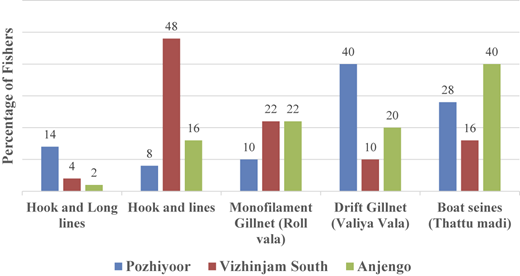
Table 2 shows the characteristics and usage patterns of different types of motorised fishing crafts and gears. IBM crafts equipped with hooks and long lines (45–70 feet) are used for multi-day trips and account for 6.7% of usage. OBM crafts demonstrate a wider variety of gear: hook and lines (22–28 feet) are used for single-day trips (24%), monofilament gillnets (22–36 feet) are popular for one-day trips (18%) and drift gillnets (22–36 feet) are predominantly employed for multi-day trips, 23.3%. Boat seines (24–32 feet) are commonly used for single-day operations (28%). Boat seines, hook and lines and drift gillnets are the most frequently used gears, reflecting preferences for specific fishing durations and gear efficiency. The study result also shows that several fishers use multiple types of gear at different times of the year. The choice of gear was often linked to specific species targeted, seasonal fishing patterns and the location of fishing grounds.
Figure 1 shows the dominantly used gears in fishing village-wise are drift gillnet (Valiya vala) in Pozhiyoor (40%), hook and lines in Vizhinjam South (48%) and boat seines (Thattu madi) in Anjengo (40%). It also indicates that various types of fishing gear are being used across the study areas, with no distinct trend in gear adoption among fishers. This diversity in gear usage has implications for the sustainability of marine fishing, as certain gear types may have a lower environmental impact and contribute to more responsible fishing practices for a better future.
3.3 Awareness and perceptions regarding ecological impacts
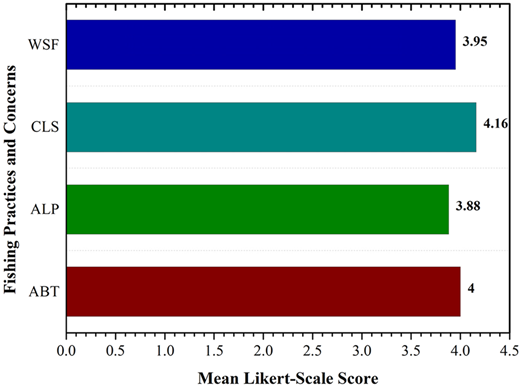
Table 3 shows the findings of awareness and perceptions by using the Likert five-point scale and standard deviation. There is a better awareness among fishers regarding the ecological impacts of their fishing practices. More fishers with 3.94 in the Likert scale mean and SD 0.65 were aware of the detrimental effects of bottom trawling on seabed habitats, and fishers with 3.88 in the Likert scale mean and SD 0.59 recognized the impact of large mesh nets on bycatch. Concerns about the long-term sustainability of current practices were expressed by most fishers with 4.16 on the Likert scale mean and SD 0.61, and more fishers with 3.95 on the Likert scale mean and SD 0.6 showed a willingness to adopt sustainable fishing gear. Additionally, fishers with higher education levels demonstrated a greater emphasis on sustainability, reflected in a mean Likert score.
Figure 2 illustrates the awareness and perceptions regarding fishing practices, where concerns about the long-term sustainability of current practices (CLS) are shown to be of relative importance among other parameters on the Likert scale.
3.4 Influence of economic factors on fishing gear selection
The choice of fishing gear among small-scale motorised fishers along the southernmost coast of Kerala is significantly influenced by economic factors such as gear cost, maintenance expenses and monthly income levels. As shown in Table 4, fishers with limited financial capacity – particularly those in the low gear cost category (below INR10,000), predominantly preferred gill nets (42.1%), with an average monthly income of INR18,500 and a gear cost of INR 7,800. Those in the medium gear cost category (INR10,000–25,000) favoured hook and line (28.5%), while fishers able to afford gear costing over INR 25,000 showed a preference for ring seines (29.4%), corresponding with a higher average income of INR 25,000. Similarly, maintenance cost also influenced gear choice: 60.4% of fishers with maintenance expenses below INR 2,000/month preferred gill nets, whereas 39.6% of those incurring higher maintenance costs chose ring seines. Income level further reinforced this pattern, gill nets were preferred by 58.2% of fishers earning less than INR 20,000/month, while hook and line (21.2%) and ring seines (20.6%) were more common among higher income brackets. These patterns clearly demonstrate that economic capacity plays a crucial role in determining fishing gear choices, with lower-income fishers opting for more affordable and low-maintenance gear and higher-income fishers investing in more expensive and productive options. This economic stratification has important implications for both sustainable fisheries management and livelihood security.
4. Discussion
The research findings highlight a complex intersection of factors influencing the use of fishing gear among motorised fishers in Kerala. While there is a better level of awareness regarding the ecological impacts of destructive fishing practices, this does not automatically translate into action. Economic factors are critical in shaping gear choices, with many fishers feeling constrained by the high cost of sustainable alternatives. The study also underscores the significance of social and cultural factors, with many fishers expressing a strong preference for traditional practices.
The economic realities of the fishing sector cannot be ignored. The high cost of sustainable gear, combined with the perception of lower short-term yields, presents a significant hurdle for many fishers. Fishing is a high-risk profession, and any decrease in short-term profitability can have serious implications for their livelihoods. Government subsidies and financial aid are often insufficient and do not reach the fishers who need them the most due to a lack of awareness or corrupt practices.
The social and cultural dimensions of fishing are deeply entrenched within the communities. Fishing is often a family tradition passed down through generations, and fishers may be less receptive to adopting new practices that deviate from these traditions. The lack of awareness of the efficiency of the new gear as well as the lack of proper demonstration also hinders the adoption process.
The primary gears used by motorised crafts in the southern coastal regions of Kerala include hook and line, handline, gillnets with small and large mesh sizes and boat seines. The high expenditure per trip combined with low revenue compels fishers to seek more efficient and profitable options for gears and crafts.
In recent years, fishers have adopted boat seines for deep-sea fishing, using large motorised inboard and outboard crafts. This shift has fostered a collaborative system among crafts, allowing them to stay at sea for longer durations and achieve higher catches. The sharing nature of this approach increases individual fisher's earnings and enhances overall efficiency. Under this system, one outboard motor (OBM) boat uses its craft to transfer fish from another craft, which then transports the catch to landing centres and harbours for sale at better prices. This innovative method not only saves time but also ensures that fresher, higher-quality fish reach the market.
The success of this approach has drawn more fishers towards deep-sea boat seines, transitioning away from near-shore operations. Deep-sea boat seining primarily targets high-value species such as tuna, sailfish, shark and kingfish. Although the mesh size of boat seines (locally known as Madi) is similar to that of shore seines, this method is specifically designed for deep-sea fishing, offering better prospects for profitable fishing practices.
The study has several important implications for fisheries management in Kerala. The lack of training and technical support in the use of sustainable fishing gear also limits the adoption of more sustainable practices. There is an urgent need to shift towards a more integrated approach to managing the sector. This requires investing in financial incentives, enhanced training and support, community engagement, stricter enforcement and technological innovation. However, this study adds specifically to the context of motorised fisheries in Kerala and has provided a deep understanding of the fishers’ perception of sustainability and their willingness to adopt sustainable practices.
5. Conclusion
This research provides a detailed analysis of the current fishing gear usage, perceptions of sustainability, barriers to adoption and potential pathways for transitioning to more sustainable practices among motorised fishers in Kerala. The study reveals that the transition to sustainable gear is not merely a technological challenge but is interwoven with economic, social and cultural factors. The high cost of alternative gears, the lack of adequate training and information, resistance to change and ineffective implementation of regulations all play a role in hindering progress. The path towards sustainable fishing in Kerala necessitates a multi-pronged approach such as financial support, skill development, community engagement and involving fishing communities in the planning and implementation of management strategies, policy reforms and technological innovation.