


This paper aims to contribute to the literature on innovation culture in maritime companies in Greece by identifying the extent of innovation culture within the Greek maritime companies of our sample.
An exploratory sequential mixed-methods design was applied by utilizing a qualitative analysis based on the conduction of semi-structured interviews. From the results, a context-specific five-factor measurement scale was developed, tailored to the unique operational environment of the shipping industry. Furthermore, two linear mixed models and a correlation matrix were conducted to evaluate the hypotheses of this paper. Lastly, an innovation score was calculated and ranked from the sample, to identify varying levels of innovation maturity.
The findings indicate that five main factors contribute positively to the overall imprint of the innovation culture in maritime companies. Furthermore, maritime companies in Greece have a moderate culture of innovation, and finally, they are shaping culture of innovation within the companies and not the employees.
There are two main limitations in this paper. Firstly, the sample could be larger than the sample collected. Secondly, the data collected were only from employees and not from the seafarers. These limitations come due to the restriction of access to maritime companies in general and in their vessels.
As there are not any empirical studies in the aspects of innovation culture in maritime in Greece, this paper aims to bridge this gap.
1. Introduction
The rapid development of computational technologies (such as artificial intelligence, machine learning and big data analytics), the internationalization and globalization of markets, as well as the fast ways in which commercial transactions conducted today give businesses a unique opportunity for extroversion and innovation. Similarly, modern trends, both in the field of workforce management and human capital in general, as well as in the development and promotion of products and services in a global environment, are a critical factor that every business and every industry is called upon to address.
Building on the points discussed above, the same applies to the competition between maritime companies, which ranges from having less fuel consumption and modern and autonomous vessels to delivering a vast variety of goods in many destinations. In addition to the factors described above, another critical aspect for the success of maritime businesses is to be able to support innovation and make innovative products or services.
Therefore, in this paper, we aim to investigate innovation culture in maritime sector in Greece. The contribution of this paper is twofold. First, it expands the existing literature on innovation culture. Second, it develops a measurement tool designed to assess the extent of innovation culture within the Greek maritime companies included in our sample. The additional one is to examine if the demographic characteristics of maritime employees (e.g. years of experience in industry, age group and education) are the ones to affect the culture of innovation in companies or if the maritime companies are shaping it.
To conclude, the following sections of this paper are organized as follows. Section 2 sets the necessary literature review (e.g. organizational culture and innovation culture, frameworks and its characteristics) as well as the shipping sector in Greece. Section 3 focuses on the identification of the research gap, the methodology and the main hypotheses. Section 4 emphasizes the results of the qualitative and quantitative analysis. Lastly, Section 5 concludes the paper, along with its limitations, policy recommendations and proposal for future research.
2. Literature review
2.1 The shipping industry in Greece
Shipping has always played an important and integral part of Greece. Greek shipping managed in 2020 alone to contribute about 13 billion euros to the Greek economy, directly or indirectly, offering more than 160 thousand jobs (Deloitte, 2020).
The maritime companies on a global scale are called upon to face a number of challenges in different dimensions. As previously mentioned, such challenges can range from optimizing routes in order to reduce the delivery time of various goods, saving energy and fuel (therefore reducing costs and saving resources) to purchasing or building new and more technologically efficient and advanced vessels.
Accordingly, Greek maritime companies hold a dominant position on the world shipping map. This important performance is not a coincidence, as they come to crown the great history of Greece in this field. Greek shipowners continue to operate in this highly competitive market by improving the connectivity with the global transport market (Greece Investor Guide, 2020). After 2021, Greek maritime companies managed more than 3,000 ships with a capacity of 200,000,000 tons dwt. In addition, revenues for the period 2015–2021 amounted to 13 billion euros per year, reaching approximately 7.5% of the country’s Gross Domestic Product (GDP) (Dandoglou, 2022). Until 2021, Greek shipowners had more than 5,500 ships, corresponding to about 21% of the global fleet, in terms of tonnage. It is important to mention that during COVID-19, the capacity increased by 7.4% (Review of Maritime Transport, 2021).
Despite the technological urgency, the organizational capability of shipping firms to innovate remains under-researched, so there is a need to focus more on the human capital and the organizational culture.
2.2 The role of culture in organizations and innovation
The Dutch social psychologist, Geert Hofstede (1991), states that culture can be defined as a collective programming of the mind, which has the ability to distinguish members of one group from another group. UNESCO (2002, p. 12) defines culture as “culture should be regarded as the set of distinctive spiritual, material, intellectual and emotional features of society or a social group, and that it encompasses, in addition to art and literature, lifestyles, ways of living together, value systems, traditions and beliefs”. Some of the main characteristics of culture include the potential to change, to be shared and to communicate from one group of people to another. Furthermore, culture can be dynamic and does not remain in a permanent state (Colbert, 2010; Hecht, 2021).
The culture that exists in the business environment is the organizational culture. Stock and Zacharias (2011) mentioned in their work that organizational culture can be the norms, the values and how an organization can support people and innovation. According to Schein (2004), organizational culture is the focus on people. The main purpose is to have the right climate within organizations. Lastly, organizational culture can be divided into four types – the clan culture, the adhocracy culture, the hierarchy culture and the market culture.
On the other hand, as organizational culture is important, innovation plays a significant role in the prosperity and profitability of a company. It can also contribute to a bigger market share. This is where companies can be transformed and can invest in an innovative culture, a subset of organizational culture.
Euchner (2022) describes innovation culture as the place where something new can happen with regularity. Similarly, culture of innovation can be the process that a company follows and the common set of values, behaviors, attitudes and beliefs that everyone on the company shares (Ali and Park, 2016).
In this context, the key to promoting and maintaining competitive advantage is the culture of innovation as it has crucial elements that can make it unique, rare and irreplaceable, while in addition, the innovative culture helps a business to be a knowledge-based economy (Shereefa et al., 2022). According to a study from Manly et al. (2023), companies with a culture of innovation are able to be more productive and innovative by 60% more than companies that do not have a strong culture of innovation.
Currently, international literature and other research papers (Dombrowski et al., 2007; Kalyani, 2011; Losane, 2013; Ulusoy et al., 2015; Ceausu et al., 2017; Hazem and Zehou, 2019) suggest some of the characteristics and key determinants of innovation culture.
Some of them include the autonomy of movements, the collaboration, the competent leadership, the creativity, the democratic communication, the encouragement, the experimentation, the fair leadership, the flexibility, the freedom of movement, the motivation, the open collaboration, the rewards, the risk taking, the safe spaces, the support, the teamwork and trust.
2.3 Frameworks of culture of innovation
The literature also includes several conceptual frameworks that are trying to measure, often in different ways, the innovation culture of an organization or a business. Therefore, the purpose of this section is to present the most important of them.
Primarily, a framework developed by Zemanova et al. (2022) aims to create an approach for innovation culture based on some central pillars – communication and collaboration, innovation, change as a core value, employee participation and engagement.
Moreover, Davies and Buisine (2022) developed a framework for innovation culture that is called external links, innovative team, organization context innovative individuals, innovative leaders and managers.
The last framework concerns the creation of a culture of innovation, which has been created by Korkpoe and Nyarku (2013). The authors have identified important points that can lead to a culture of innovation. Among them are knowledge sharing, organizational learning and risk tolerance.
3. Identification of the research gap
As mentioned through the literature review, there were many studies that tried to identify the characteristics and key determinants of innovative culture and build sustainable frameworks.
For our case even though there are substantial research existing on the economic performance of Greek maritime companies and the aspects of innovation, there are not empirical studies in the aspects of innovation culture. Specifically, it remains unclear how culture of innovation works in this environment and to what extent.
Furthermore, to the best of our knowledge, there is not any study that identifies culture of innovative aspects in the maritime sector globally. Therefore, this paper aims to bridge this gap in literature.
3.1 Research methodology
To investigate the innovation culture within the Greek maritime companies, an exploratory sequential mixed-methods design was applied by utilizing a qualitative analysis based on the conduction of semi-structured interviews. Afterward, a context-specific five-factor measurement scale was developed, tailored to the unique operational environment of the shipping industry. Moreover, two linear mixed models (LMM) and a correlation matrix were conducted to test the hypotheses. Lastly, an innovation score was calculated and ranked from the sample, to identify varying levels of innovation maturity.
It is important to note that due to the anonymity protocols, individual demographic data were not cross-linked to specific vessel type. However, the diversity of the 30 firm samples ensures that the findings reflect a broad spectrum of vessel categories in the maritime industry.
3.2 Research hypothesis
Our main objective is to find whether the maritime companies or the demographic characteristics of employees (e.g. years of experience in industry, age group and education) are the ones to affect the culture of innovation.
For those reasons, the following research hypotheses were formed.
Null hypothesis (H01):
The demographic characteristics of the employees do not have a significant effect shaping innovative culture within maritime companies.
Alternative hypothesis (Ha1):
The demographic characteristics of the employees do have a significant effect shaping innovative culture within maritime companies.
Null hypothesis (H02):
Maritime companies do not have a significant effect on shaping innovative culture within maritime companies.
Alternative hypothesis (Ha2):
Maritime companies do have a significant effect on shaping innovative culture within maritime companies.
3.3 Research design
For the research design, we implemented exploratory sequential mixed methods. Based on these insights and existing literature, a context-specific measurement scale was developed, tailored to the unique operational environment of the shipping industry.
4. Data analysis
4.1 First phase: qualitative analysis
For the purpose of this analysis, the first step was the conduction of semi-structured interviews with seven maritime employees/managers from various departments (such as administration, accounting and operations) and from maritime companies that have small, medium and large numbers of fleets. That was important in order to ensure that the survey instrument was grounded in the specific operational realities of the Greek maritime employees.
As Guest et al. (2006) report, the necessary sample that must be collected in a qualitative survey so that it can be analyzed and interpreted effectively is six people. After the conduction of the semi-structured interviews, with the help of Taguette, a free and open-source tool, we imported research materials, highlighted and tagged quotes from the interviews. The next steps were to transcribe all the results, hierarchy them thematically and extract valuable information. That analysis helped us to develop the final questionnaire. Five key determinants, as shown in Table 1, of innovative culture were identified through that procedure and are introduced below.
Five key factors of innovation culture
| Factor | Description | Representative quote |
|---|---|---|
| F1: Communication and cooperation | The way that company members communicate and cooperate | “ … we have a cooperative environment so that anyone can go to their manager and tell them their idea … if we have good ideas we can then implement it.” |
| F2: Recognition and rewards | The way management rewards and recognizes the employees | “ … this is more than just part of our culture, as there are now specific processes that help to propose specific proposals and reward the people for the good work …” |
| F3: Suitable and continuous training | The way companies invest in training and education of the employees | “ … programs are provided that are mostly on the subject of each department, as there are many departments in which, in order to function, you need specialization due to the industry …” |
| F4: Work autonomy | The way management supports working autonomy for the employees | “ … we try our best to give the necessary autonomy of tasks and work to our people … this can strength them …” |
| F5: Psychological safety | The way working environment (e.g. other members, management etc.) treats the employees | “ … it is important to have a positive climate and environment, without creating problems, and for this reason there is no punishment if a mistake is made … everyone can resolve the concerns with management …” |
4.2 Second phase: quantitative analysis
For the second phase, a questionnaire was constructed according to five factors and given to shipping companies’ employees. A total of 30 (n = 30) companies participated, comprising a total of 111 employees (n = 111). All the data were analyzed with Jamovi statistical program.
As shown in Table 2, the demographics of the collected sample include gender distribution, where it is well balanced between males and females. The age distribution of the sample indicates that the majority (61.1%) falls within the younger age group of 18–35. The educational level of the employees in the sample indicates generally high level of education as all but three hold a university degree. Lastly, the departments in which the employees worked were primarily operations, technical and finance.
Demographic data
| Counts | % Of total | Cumulative % | |
|---|---|---|---|
| Frequencies of gender | |||
| Gender | |||
| Male | 57 | 51.4 | 51.4 |
| Female | 54 | 48.6 | 100.0 |
| Frequencies of age | |||
| Age | |||
| 18–25 | 34 | 30.6 | 30.6 |
| 26–35 | 45 | 40.5 | 71.2 |
| 36–45 | 20 | 18.0 | 89.2 |
| 46–55 | 8 | 7.2 | 96.4 |
| 56+ | 4 | 3.6 | 100.0 |
| Frequencies of education | |||
| Education | |||
| High school graduates | 3 | 2.7 | 2.7 |
| Undergraduate degree holders | 53 | 47.7 | 50.5 |
| Postgraduate degree holders | 53 | 47.7 | 98.2 |
| PhD holders | 2 | 1.8 | 100.0 |
| Frequencies of department | |||
| Department | |||
| Other department | 6 | 5.4 | 5.4 |
| Commercial/Marketing department | 7 | 6.3 | 11.7 |
| Legal department | 1 | 0.9 | 12.6 |
| Finance and accounting department | 16 | 14.4 | 27.0 |
| Technical department | 18 | 16.2 | 43.2 |
| Operations department | 45 | 40.5 | 83.8 |
| Human resources department | 12 | 10.8 | 94.6 |
| Health, Safety, Quality, and Environment (HSQE) department | 6 | 5.4 | 100.0 |
To validate the newly developed instrument, an exploratory factor analysis was performed. The sampling adequacy was confirmed by the Kaiser–Meyer–Olkin index, which was 0.813, exceeding the recommended threshold of 0.70 (Bartlett, 1950). Additionally, Bartlett’s test was statistically significant (χ2 = 1,149, p < 0.001), indicating that the correlation matrix was suitable for factor extraction. Based on the screen plot and the Kaiser criterion, a five-factor solution was identified. The first factor exhibited strong eigenvalues of 6.173, respectively. Collectively, the five-factor model accounted for 60.1% of the total variance, which is considered satisfactory for social science research.
This structure suggests a robust underlying framework for the constructions being measured. Lastly, reliability was confirmed via Cronbach’s alpha at 0.819, with all factors exceeding the 0.70 threshold (Tavakol and Dennick, 2011).
Α correlation analysis (Pearson’s r) was conducted to examine the preliminary associations among the extracted factors and to verify the construct validity of the scales. Furthermore, examining the correlation matrix was an essential preliminary step before conducting the LMM, in order to check for potential multicollinearity among the predictors. As shown in Table 3, all correlations were below the threshold of 0.80, indicating that multicollinearity is not a concern for the subsequent mixed models (Morris and Lieberman, 2015).
Correlation matrix
| F1 company Lvl | F2 company Lvl | F3 company Lvl | F4 company Lvl | F5 company Lvl | Total index | ||
|---|---|---|---|---|---|---|---|
| F1 company Lvl | Pearson’s r | – | |||||
| df | – | ||||||
| p-value | – | ||||||
| F2 company Lvl | Pearson’s r | 0.502** | – | ||||
| df | 29 | – | |||||
| p-value | 0.004 | – | |||||
| F3 company Lvl | Pearson’s r | 0.296 | 0.647*** | – | |||
| df | 29 | 29 | – | ||||
| p-value | 0.106 | <0.001 | – | ||||
| F4 company Lvl | Pearson’s r | 0.560** | 0.471** | 0.392* | – | ||
| df | 29 | 29 | 29 | – | |||
| p-value | 0.001 | 0.008 | 0.029 | – | |||
| F5 company Lvl | Pearson’s r | 0.585*** | 0.298 | 0.269 | 0.641*** | – | |
| Df | 29 | 29 | 29 | 29 | – | ||
| p-value | <0.001 | 0.104 | 0.144 | <0.001 | – | ||
| Total index | Pearson’s r | 0.771*** | 0.807*** | 0.714*** | 0.777*** | 0.706*** | – |
| Df | 29 | 29 | 29 | 29 | 29 | – | |
| p-value | <0.001 | <0.001 | <0.001 | <0.001 | <0.001 | – | |
Note(s): *p < 0.05, **p < 0.01, ***p < 0.001
To test the research hypotheses, LMM were conducted. This approach was selected because it accounts for the non-independence of observations within the same firm (nested data), treating “Firm” as a random effect.
As for the first model, we observe that there is a variation equal to 33% (Intraclass Correlation Coefficient [ICC] = 0.333). Therefore, based on this, we can proceed to use the multi-level models for both the level of factors and the level of individual characteristics, since the culture of innovation is a corporate characteristic. As for the second model, for the demographic part, the ICC of the characteristics (years of experience in the industry, gender, age) was calculated with a final ICC score = 0.0181. This shows us that only 1.81% of the variation in the sample is due to differences between companies. Consequently, there was no statistical significance in this multi-level model either.
Regarding the first hypothesis, the analysis revealed that the demographic characteristics of the employees do not have a significant effect shaping innovative culture within maritime companies. Consequently, alternative hypothesis (Ha1) was rejected, and null hypothesis (H01) was confirmed.
For the second hypothesis, the analysis revealed that maritime companies do have a significant effect on shaping innovative culture. Consequently, alternative hypothesis (Ha2) was confirmed, and null hypothesis (H02) was rejected. Therefore, the empirical approach we extracted through our research demonstrates that the culture of innovation is a characteristic that emerges through the organizational culture and the lines set by each shipping company. Consequently, it is not affected by the individual perception of the employees.
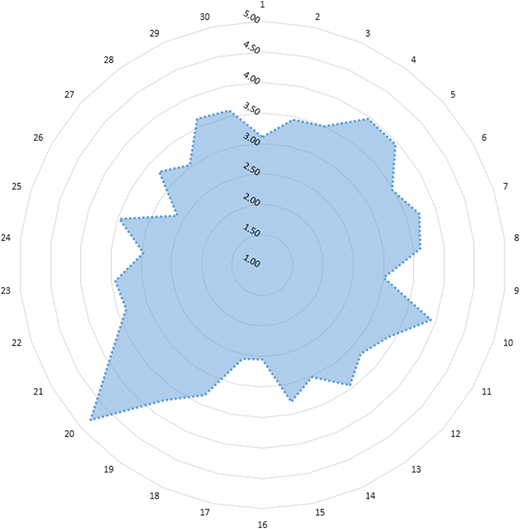
Lastly, within the sample of the maritime companies, we utilized a structured 1 to −5 scoring framework. The framework applied the data from the questionnaire, and the results are presented in Figure 1. The lowest and highest scores were 2.55/5.00 and 4.80/5.00. The average score in culture of innovation of the 30 companies was 3.40/5.00. The results indicate a moderate score of innovative culture among the maritime companies of our sample. A possible explanation is that the organizational culture inside the maritime companies in Greece is still trying to adopt modern organizational values while moving away from more conventional, traditional styles.
5. Conclusions
In conclusion, the objective of this research was to contribute to the international literature about innovation culture in maritime companies in Greece. Thus, this paper bridged qualitative insights with quantitative validation to explore innovative culture within the maritime sector in Greece.
The findings indicate that five main factors contribute positively to the overall imprint of the innovation culture in maritime companies. Furthermore, maritime companies are the ones who are shaping culture of innovation and not the individual perception of the employees. Taking that into consideration, the companies can make the necessary adjustments (e.g. specific and dedicating trainings/seminars, other necessary reforms etc.) in order to transform their organization culture into a more innovative one. Finally, the results of our study discovered that maritime companies in Greece have a moderate culture of innovation. As it was mentioned previously, this may be due to the organizational culture inside the maritime companies in Greece, which are still trying to adopt modern organizational benefits while moving away from more conventional, traditional management styles.
Additionally, for the first time, the field of innovation culture for the shipping industry is reflected at the Greek and international level. Our paper sets a new benchmark that can enable maritime companies from other nations to take into consideration and lead the way into measuring their culture of innovation. The results of international literature, as have been extensively reported in the theoretical framework, for the part of innovation culture, are limited to capturing only some of the dimensions of it, and the other frameworks presented are mostly used with a theoretical purpose.
Lastly, this research gives the opportunity in other sectors to apply the results of this paper as a starting point. This will help to draw useful conclusions that will lead to the optimization of their innovation and cash flows, thus adding another critical dimension.
5.1 Paper limitation, future research and policy recommendations
Despite the contribution of this research, this paper is not without limitations. Firstly, in this research, the results analyzed are only gathered from onshore employees and not from seafarers, which was mostly due to the fact that it is very difficult to have access in such areas. Likewise, there is a limitation at the level of literature, as the research on the culture of innovation concerning maritime companies has not been studied and researched, so it is not possible to compare our data with, for example, data from maritime companies abroad. Lastly, the sample could be larger than the sample collected; this limitation comes due to the restriction of access to shipping companies in general.
5.2 Future research
For future research, it is proposed to conduct specific case studies which will emerge through the analysis of various maritime companies in terms of innovation culture. In addition, it is proposed to conduct a more international survey on the research culture with both foreign and Greek shipping companies. This would lead to a comparative analysis of the results and use of the information for further future investigation. Lastly, as this paper was based on a relatively small sample, we suggest that future research should be conducted with more companies and employees.
5.3 Policy recommendations
For the policy recommendations, it is proposed to create innovation clusters with the participation of shipping companies and other organizations. Through this way, a great opportunity is given to further develop the culture of innovation as cooperation, and the exchange of good practices can occur between shipping companies, other public bodies and universities. Furthermore, it is proposed to create a special financial tool by the government, which maritime companies will use in order to fund dedicated innovation and knowledge management departments. Maritime companies could be able to evaluate and invest in innovative practices of their employees, taking another decisive step towards improving their innovative culture. In closing, as the findings suggest that innovation culture is not merely a technical requirement but a strategic asset. Maritime companies should formally integrate KPIs that emphasize innovative culture into their corporate governance frameworks. This ensures that innovation is treated as a core business function rather than an ad-hoc project. Lastly, in this direction it is recommended to use psychometric tools (personality, values, abilities and skills) to analyze the results and to take targeted actions that will improve and promote the culture of innovation.
Ethical statement
This paper did not involve clinical or experimental human-subjects research. The data were collected through online interviews and questionnaires that focused on non-sensitive feedback related to the research topic. Participation in the paper was entirely voluntary, and consent was obtained from all participants prior to data collection. All responses were aggregated and analyzed anonymously to ensure that no personally identifiable information could be linked to individual participants.

