


The purpose of this study is to investigate how Confucian culture influences the selection of higher-quality auditor selection in Chinese listed companies.
Using data from Chinese listed companies from 2003 to 2020, this study examines the relationship between Confucian culture and auditor selection. This study explores mechanisms such as social trust and moral self-discipline, information disclosure quality and mitigation of Type II agency problems (i.e. tunnelling). The authors conduct cross-sectional analyses to assess the moderating roles of corporate governance and international cultural influences.
Confucian culture significantly influences the selection of high-quality auditors, with this effect mediated by social trust, moral self-discipline, better information disclosure and less Type II agency problems (i.e. tunnelling). The association is stronger in firms with robust corporate governance and interacts positively with foreign cultural factors to enhance high-quality auditor selection. When firms do not choose Big 10 auditors, firms guided by Confucian ethics strategically prioritize industry specialists to maintain audit quality.
This study contributes to the literature by applying imprinting theory, agency theory and signaling theory to explain how Confucian culture, as an informal institution, influences corporate governance decisions. This study highlights the multiple channels through which cultural values shape auditor selection. By examining how informal institutions complement formal governance practices, the findings of this study provide practical insights for corporate leaders, auditors and policymakers, emphasizing the significance of cultural values in enhancing audit quality and ethical business standards.
1. Introduction
This study investigates the influence of Confucian culture on auditor selection in Chinese listed companies. Prior research on auditor selection has predominantly focused on economic and regulatory factors within the formal institutional framework, such as agency issues, whereas the role of informal institutions like culture has received relatively limited attention. Although several studies have examined the impact of corporate governance on auditor choice (Guedhami et al., 2009; Lin and Liu, 2009; He et al., 2014; Cheng et al., 2015; Fang et al., 2017; Zhang et al., 2019), the cultural aspects of auditor selection remain relatively underexplored (Habib et al., 2019).
Institutional economics suggests that cultural norms guide and constrain behavior, influencing the formation of formal institutions (Greif, 1994). In this context, Confucian culture operates as an informal institution because its deeply rooted values and social norms shape individual and organizational behavior, even in the absence of formal regulations. As a longstanding cultural system, Confucianism impacts social and economic life in East Asia by promoting ethical standards, social trust and communal harmony. These cultural norms, emphasizing virtues such as benevolence, righteousness and integrity, can significantly influence corporate governance practices, including auditor selection.
Existing literature has begun exploring how Confucian culture affects corporate behavior. For instance, Ye et al. (2022) examine how Confucian values promote stable auditor–client relationships by fostering trust and moral self-discipline. However, Ye et al. (2022) do not address the critical first step of strategically selecting high-quality auditors. Auditor selection is a deliberate decision that reflects a firm’s governance priorities and commitment to rigorous oversight, which is distinct from merely maintaining long-term relationships. The broader auditor selection literature primarily examines economic, regulatory and governance factors (Wang et al., 2008; Guedhami et al., 2009; Lin and Liu, 2009), but largely overlooks informal institutions such as Confucian culture. By addressing this gap, our study enriches the literature by integrating cultural norms into the discussion of auditor selection, revealing how Confucian values shape strategic governance choices.
We hypothesize that firms influenced by Confucian principles are more likely to select high-quality auditors perceived as beneficial to stakeholders. In the main tests, we proxy Confucian influence by proximity to Confucian temples and measure auditor quality using affiliations with Big 10 audit firms as an indicator of auditor quality. Our findings demonstrate a robust association between Confucian values and the choice of prestigious auditors – a relationship that remains consistent across multiple robustness and endogeneity tests.
Furthermore, drawing on imprinting theory, signaling and agency theories, we examine the mechanisms through which Confucian culture influences auditor selection. Specifically, we explore three pathways: ethical governance, information disclosure quality and mitigation of agency problems. First, Confucian values that emphasize social trust and moral discipline imprint ethical decision-making, promoting the engagement of high-quality auditors. Second, firms influenced by Confucian values tend to adopt better information disclosure practices, signaling transparency and a commitment to robust oversight. Third, Confucian-influenced firms exhibit lower levels of Type II agency problems (tunnelling), indicating reduced agency conflicts and a preference for auditors who reinforce credible governance.
Cross-sectional analyses show that strong corporate governance frameworks amplify Confucian culture’s positive effects on auditor selection. Firms with Confucian values are more likely to select top-tier auditors in environments receptive to global influences, suggesting a synergy between Confucian principles and international standards.
Further analyses reveal that Confucian-influenced firms consistently prefer high-quality auditors, choosing both international Big 4 auditors and local Big 8 audit firms. In contexts where non-Big 10 services are used, Confucian-influenced firms tend to engage industry specialists to assure audit quality, highlighting the influence of Confucian culture in promoting rigorous auditing practices beyond merely the selection of high-profile auditors.
This study makes two primary contributions to the literature on corporate governance and cultural influence in emerging markets.
First, it extends the literature on how informal institutions – specifically Confucian cultural values – shape strategic corporate decisions, such as the selection of high-quality auditors. Prior research has largely emphasized economic, regulatory and governance determinants of auditor choice (Wang et al., 2008; Guedhami et al., 2009; Lin and Liu, 2009; He et al., 2014; Cheng et al., 2015; Fang et al., 2017; Zhang et al., 2019). Our study shifts the focus to deep-rooted cultural norms. We demonstrate that Confucian ethics – emphasizing trust, accountability and moral conduct – encourage ethical oversight and transparency, even in contexts with well-developed formal governance structures. This has practical implications for corporate leaders, auditors and policymakers. For executives, understanding the influence of Confucian values can guide strategies that uphold ethical standards and ensure high audit quality. Auditors may better align their services with culturally driven expectations, strengthening auditor–client relationships. For policymakers, the findings suggest that integrating cultural values into governance frameworks can enhance corporate transparency and ethical behavior.
Second, the study fills a key gap in the literature by extending and differentiating itself from Ye et al. (2022). Whereas Ye et al. emphasize Confucian values in sustaining long-term auditor–client relationships, our study focuses on the initial, intentional selection of high-quality auditors as a reflection of Confucian ethical imperatives. This perspective broadens the understanding of cultural influence by capturing its impact at the very outset of governance decisions. In doing so, it contributes to ongoing discussions about the interplay between formal governance mechanisms and informal cultural institutions, especially in emerging markets like China, where traditional values coexist and interact with global standards.
The remainder of the paper is structured as follows: Section 2 outlines the literature review and hypothesis development. Section 3 details the research design and sample. Section 4 presents empirical findings. Section 5 provides additional analyses. Section 6 concludes.
2. Literature review and hypothesis development
2.1 Auditor selection
The audit service market operates based on principles of supply and demand, resulting in a variety of audit services across different contexts (Simunic and Stein, 1987). High-quality auditors are often engaged by firms to mitigate agency problems, where managerial self-interest could conflict with shareholder interests (Francis and Wilson, 1988; Habib et al., 2019). Agency theory suggests that independent audits are essential for mitigating managerial opportunism, with larger auditors recognized for providing superior audit quality, thereby enhancing corporate governance and financial reporting reliability (DeAngelo, 1981; Dye, 1993; Lennox, 1999). Empirical evidence consistently shows that firms audited by reputable auditors benefit from lower debt and equity capital costs (Pittman and Fortin, 2004).
Previous research on auditor selection has largely focused on formal institutional factors, including regulatory environments, governance structures and economic considerations (Wang et al., 2008; Guedhami et al., 2009; Lin and Liu, 2009; He et al., 2014; Cheng et al., 2015; Fang et al., 2017; Zhang et al., 2019). In Contrast, informal institutions, such as culture, have been less extensively studied. Some studies, for example Hope et al. (2008), use Hofstede’s cultural dimensions to examine how national culture shapes auditor preferences. Despite these efforts, research specifically addressing the influence of Confucian cultural norms on auditor selection remains scarce. Recent literature, primarily within the Chinese context, has started to bridge this gap. Ye et al. (2022) examine how Confucian culture influences auditor–client relationship stability. However, our study uniquely investigates how Confucian culture affects the strategic initial selection of high-quality auditors from a firm perspective, thereby contributing to the broader auditor selection literature.
2.2 Confucian culture and corporate behavior
2.2.1 Institutional background of Confucian culture.
Confucianism has profoundly shaped social, ethical and economic life in East Asia for centuries, and its principles continue to influence modern business practices. At the core of Confucianism are the values of benevolence (Ren), righteousness (Yi), propriety (Li), wisdom (Zhi) and trustworthiness (Xin), which together form the ethical framework guiding this study. These values provide a foundation for understanding how cultural norms can shape corporate governance and auditor selection.
Benevolence (Ren) emphasizes kindness and a moral duty toward others, fostering universal love. Righteousness (Yi) prioritizes ethical principles over personal gains. Confucius said, “The noble-minded are concerned with righteousness, while the petty-minded are concerned with profit” (“Analects, 6.28”) and “Wealth and high position attained through unjust means are like floating clouds to me” (“Analects, 7.16”). In the context of business ethics, righteousness encourages managers to integrate moral values into economic decisions (Lam, 2003; Yuan et al., 2023), thereby restraining managerial self-interest and opportunistic behavior.
Propriety (Li) advocates for harmony through adherence to social norms and responsibilities. In business contexts, Li enhances corporate governance by ensuring rule compliance and role fulfillment (Chan, 2008; Ip, 2009), contributing to the company’s economic benefits (Yuan et al., 2023). Li influences companies to prioritize governance when selecting auditors, avoid collusion and consider the actual corporate situation.
Wisdom (Zhi) means that the wise stay composed, focusing on long-term goals rather than short-term gains. In the context of business ethics, managers influenced by Zhi consider balancing stakeholder interests, mitigating information asymmetry and developing effective governance mechanisms (Du, 2015, 2016; Chen et al., 2019; Kong et al., 2023).
Trustworthiness (Xin) values loyalty and sincerity, which is “valued more than gold and jade” in Confucianism (“Liji”). This principle encourages personal integrity among employees (Chan, 2008; Ip, 2009), thereby reducing the chance of collusion and malicious activities.
Collectively, these Confucian values instill a framework for ethical conduct and decision-making in businesses, encouraging practices that not only comply with moral standards but also contribute to sustainable corporate value and efficient operations.
2.2.2 Confucian culture and corporate behavior.
Confucian culture, deeply ingrained in Chinese society (Waldmann, 2000), significantly influences institutions, social interactions and economic activities. These institutions play a crucial role in shaping an economy’s incentive structure, thereby influencing the direction of its economic change and growth (North, 1991). Imprinting theory (Marquis and Tilcsik, 2013) suggests that cultural imprints contribute to shaping organizations and individual development over time. Managers influenced by Confucian culture apply these ideals to business practices, prioritizing the interests of all stakeholders (Chan, 2008; Ip, 2009). This ethical approach helps mitigate conflicts and managerial self-interest (Jebran et al., 2019).
Confucian culture has received attention for its value in contemporary managerial practices (Romar, 2002). Lam (2003), Ip (2009) and Yuan et al. (2023) all highlight the lasting significance of moral personhood and harmonious social structure found in Confucian culture in shaping business ethics and leadership practices in China.
Empirical studies underscore Confucian ethics’ role in reducing agency costs, mitigating manager–shareholder conflicts (Chen et al., 2020) and protecting minority shareholders (Du, 2015). Kong et al. (2023) show Confucianism mitigates corporate risk-taking, leading to reduced demand for directors’ insurance. Jin et al. (2023) associate stronger Confucianism with lower compensation among chief executive officers and smaller pay gaps, in line with core Confucian values.
Confucian culture has also been found to enhance certain aspects of corporate behavior. For instance, Chen et al. (2019) demonstrate that Confucianism improves investment efficiency by reducing overinvestment without leading to underinvestment. In addition to its impact on efficiency, Confucian culture influences other corporate behaviors. Yan et al. (2021) find a positive association between Confucian culture and corporate research and development investment, indicating a cultural influence on innovation. Moreover, Lei et al. (2022) show that firms in culturally diverse cities engage in less tax avoidance, suggesting that Confucian values promote ethical financial practices.
Furthermore, Confucianism influences financial reporting quality. It promotes accounting conservatism (Du et al., 2022), alleviates corporate earnings management (Yu et al., 2021) and reduces corporate irregularities (Tang et al., 2022).
Confucianism’s effect extends to financial markets. Xu et al. (2019) find that Confucian culture reduces stock price crash risk by mitigated agency conflicts, improved financial information quality and restrained managerial overconfidence. Jebran et al. (2019) find that Confucianism curbs managerial suppression of bad news, leading to a reduced stock price crash risk. Liu and Chiang (2022) show that Confucianism reduces underpricing of initial public offerings by addressing information asymmetry and managerial rent-seeking behaviors. It also influences corporate bond ratings and credit spreads (Zhai and Tang, 2023).
However, Confucianism also presents challenges. For instance, Du (2016) finds a negative relationship between Confucianism and the presence of women directors on corporate boards. Similarly, Xu et al. (2023) report that the emphasis on masculinity in Confucian values negatively affects female entrepreneurship in China, though this effect can be mitigated by managerial experience. In line with these findings, Jin et al. (2023) show that stronger adherence to Confucianism is associated with a wider gender pay gap. Cheng et al. (2023) find that Confucianism influences altruistic behavior during family firm succession, dependent on close blood ties between successors and founders as well as the presence of independent boards or reputable auditors.
Overall, the empirical evidence suggests that Confucian values impact various facets of corporate decision-making and performance, shedding light on the intricate relationship between culture and business practices in China. Understanding these dynamics can be valuable for policymakers, practitioners and researchers, particularly in the context of emerging markets where formal institutional development is still evolving.
2.3 Hypotheses development: Confucian culture and the selection of high-quality auditors
In the audit services market, managers’ self-interest can create agency problems and information asymmetry, leading to potential costs for shareholders. To mitigate these issues, firms often engage high-quality auditors (Francis and Wilson, 1988; Habib et al., 2019). While most research emphasizes economic and institutional factors, less is known about the influence of informal institutions such as culture. Confucian culture – prominent in East Asia – promotes ethical values including benevolence, trust and moral self-discipline. These values could either reduce the need for external monitoring by lowering agency risks or, conversely, lead firms to select high-quality auditors to signal commitment to governance and stakeholder trust. The discussion below explores these competing views.
On one hand, Confucian culture may promote the engagement of high-quality auditors. Imprinting theory suggests that long-standing cultural values leave enduring marks on organizational behavior (Marquis and Tilcsik, 2013). Confucian values instill a strong ethical framework within firms, encouraging trustworthiness, self-discipline and accountability (Du, 2016; Chen et al., 2020). These values enhance social trust, promote cooperative behavior and reduce opportunism (Fukuyama, 1995; Yu et al., 2021; Tang et al., 2022). Although such internalized ethics could substitute for external oversight, firms may still engage high-quality auditors as a visible commitment to transparency and stakeholder-oriented governance. Moreover, the Confucian emphasis on respect for authority (The Book of Rites) reinforces a preference for prestigious auditors who are viewed as reputable and authoritative figures.
Signaling theory offers additional support for this view. Engaging high-quality auditors sends credible signals about a firm’s governance quality and information integrity, reducing perceived risks for external stakeholders (Spence, 1973; Fan and Wong, 2005; Pittman and Fortin, 2004; Jiang et al., 2019). Confucian culture also strengthens a firm’s commitment to transparent financial reporting and high-quality disclosures (Yang et al., 2022), which further motivates the choice of reputable auditors who can externally validate these disclosures (Chen et al., 2020; DeFond et al., 2000).
In addition, in emerging markets like China, where controlling shareholders often engage in tunneling and expropriation of minority interests (Wang et al., 2008), firms with weaker governance tend to select lower-quality auditors to avoid detection (Lin and Liu, 2009; Khan et al., 2015). By contrast, Confucian-influenced firms are typically more aligned with minority shareholder interests and exhibit fewer Type II agency conflicts because of their strong ethical orientation (Du, 2015; Gu et al., 2024). As a result, they are more likely to view high-quality auditors as governance partners who reinforce transparency, credibility and stakeholder trust.
On the other hand, there are reasons to expect that Confucian culture may reduce the demand for high-quality auditors. According to agency theory, the primary role of external auditors is to monitor managers on behalf of shareholders and reduce agency conflicts (Jensen and Meckling, 1976; DeAngelo, 1981; Dye, 1993; Lennox, 1999; DeFond and Zhang, 2014). However, the internalized ethical norms promoted by Confucian culture may reduce these conflicts inherently, lessening the perceived need for external monitoring.
Similarly, signaling theory suggests that firms with strong internal controls and governance may not need to rely on high-quality auditors to establish credibility (Spence, 1973). Firms influenced by Confucian values may already project strong reputations through their operational transparency, financial performance and internal discipline (Ji et al., 2017). As such, they may perceive reduced marginal benefits from engaging costly high-quality auditors.
Given these theoretical arguments and considering the competing implications regarding the effect of Confucian culture on auditor selection, we propose the following null hypothesis:
Confucian culture has no significant effect on the engagement of high-quality auditors.
3. Research design
3.1 Sample and data
We analyze a sample of listed Chinese A-share companies from 2003 to 2020. Financial data are sourced from the China Stock Market and Accounting Research database, and institutional data is collected from the Wind database. Confucian culture-related variables are derived from the Chinese Research Data Services database. The study period begins in 2003, corresponding with the first availability of accounting firm rankings, and concludes in 2020 to preclude the influence of post-2020 capital market reforms.
From the initial pool of 45,406 firm-year observations across the Chinese A-share market, we exclude financial sector firms, firms under Special Treatment categories and those with missing control variable data. The final sample includes 34,046 firm-year observations. The sample selection process is summarized in Panel A of Table 1.
Sample distribution
| Panel A: Sample selection | ||||
| All listed firms in A-share market from 2003 to 2020 | 45,406 | |||
| Observations in the financial industry | 1,111 | |||
| ST, ST* and PT observations | 3,217 | |||
| Observations with missing value in control variables | 4,823 | |||
| Missing value in computing the principal component of corporate governance index | 2,209 | |||
| Final observations | 34,046 | |||
| Panel B: Sample distribution by year | ||||
| Year | Number of companies | Number of companies using a Big10 auditor | % | |
| 2003 | 941 | 173 | 0.184 | |
| 2004 | 987 | 195 | 0.198 | |
| 2005 | 998 | 218 | 0.218 | |
| 2006 | 929 | 138 | 0.149 | |
| 2007 | 951 | 164 | 0.172 | |
| 2008 | 884 | 298 | 0.337 | |
| 2009 | 914 | 319 | 0.349 | |
| 2010 | 1,567 | 583 | 0.372 | |
| 2011 | 1,846 | 790 | 0.428 | |
| 2012 | 1,961 | 1,082 | 0.552 | |
| 2013 | 2,130 | 1,311 | 0.615 | |
| 2014 | 2,169 | 1,340 | 0.618 | |
| 2015 | 2,349 | 1,404 | 0.598 | |
| 2016 | 2,653 | 1,609 | 0.606 | |
| 2017 | 2,973 | 1,821 | 0.613 | |
| 2018 | 3,020 | 1,758 | 0.582 | |
| 2019 | 3,194 | 1,927 | 0.603 | |
| 2020 | 3,580 | 2,209 | 0.617 | |
| Total | 34,046 | 17,339 | 0.509 | |
| Panel C: Sample distribution by industry | ||||
| Industry | Number of companies | Number using a Big 10 auditor | % | |
| Agriculture, forestry and fishing | 470 | 157 | 0.334 | |
| Mining | 709 | 391 | 0.551 | |
| Manufacturing | 22,268 | 11,455 | 0.514 | |
| Utility | 1,129 | 567 | 0.502 | |
| Construction | 842 | 401 | 0.476 | |
| Wholesale and retail | 1,809 | 773 | 0.427 | |
| Transportation and warehousing | 1,064 | 615 | 0.578 | |
| Hospitality | 121 | 62 | 0.512 | |
| Information technology | 2,038 | 1,118 | 0.549 | |
| Real estate | 1,491 | 763 | 0.512 | |
| Leasing and business services | 435 | 243 | 0.559 | |
| Scientific research and technology services | 293 | 170 | 0.580 | |
| Water, environment, and public facilities | 383 | 207 | 0.540 | |
| Residential services, repairs and other services | 61 | 10 | 0.164 | |
| Education | 21 | 16 | 0.762 | |
| Health and social work | 59 | 38 | 0.644 | |
| Culture, sports and entertainment | 339 | 184 | 0.543 | |
| Public administration and social work | 514 | 169 | 0.329 | |
| Total | 34,046 | 17,339 | 0.509 | |
Source(s): Authors’ own work
3.2 Measuring auditor choice
Following Fang et al. (2017), we define high-quality auditor selection (A_CHOICE) as a binary variable (Big10), equal to 1 if the firm employs a Big 10 auditor and 0 otherwise.
In China, the Big 10 auditors – which include the Big 4 global firms, second-tier international firms like BDO and large domestic firms such as ShineWing – are commonly used as a proxy for high-quality auditors. While the Big 4s dominate the audits of multinational companies, large domestic firms have gained credibility in auditing state-owned enterprises (SOEs) and locally listed firms. This broader classification captures both international audit standards and local expertise, which is particularly relevant in China’s segmented audit market, where domestic audit firms play a significant role. Thus, the Big 10 provides a more representative proxy of high-quality auditing than the Big 4 alone, especially in a context that combines global demands with domestic regulatory requirements (Wang et al., 2008). Prior research indicates that Big 10 auditors in China deliver superior audit quality compared to their non-Big 10 counterparts (Gul et al., 2013; Jiang et al., 2019).
3.3 Measuring Confucian culture
The influence of Confucian culture is measured by the proximity of Confucian temples relative to company headquarters. This measure is based on the premise that Confucian culture has historically shaped ethical norms and governance practices, particularly through the integration of Confucian education and state authority in the imperial examination system (Yang and Liu, 2018).
We calculate the number of Confucian temples within 100 km, 200 km and 300 km of each company’s registered headquarters, based on the method used by Du et al. (2022) and Jin et al. (2023). We apply a logarithmic transformation to the count of temples. The geographic proximity is calculated using the following formula:
where ω and μ represent the latitude and longitude in radians; R is the Earth’s radius (6371.004 km); and the subscript i and j denote the locations of the company and the temples, respectively. This formula provides a quantitative measure of Confucian cultural influence based on spatial proximity to Confucian temples.
The significance of Confucian temples in disseminating Confucian thought lies in their historical integration with Confucian institutions, often located together as “left temple, right school” (Yang and Liu, 2018). This spatial arrangement highlights the temples’ dual role in Confucian education and state governance, especially through the imperial examination system, which linked academic success within these institutions to prestigious political roles. The density of Confucian temples reflects not only the spread of Confucianism but also its integration in the local socio-political fabric, which in turn influences corporate behavior, including auditor selection. As a result, companies situated closer to these cultural hubs may be more likely to choose auditors that align with Confucian values of integrity and ethical governance.
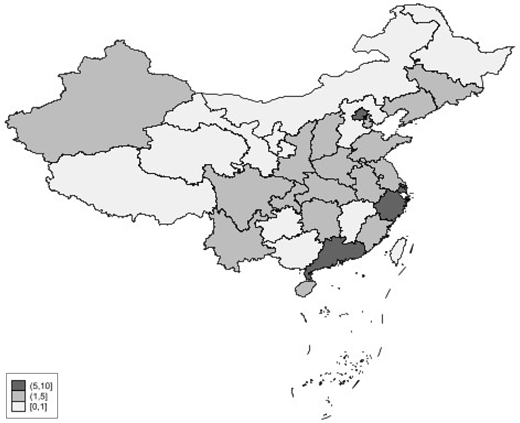
Figure 1 shows that Confucian temples are concentrated in central and southern China, whereas Figure 2 shows that Big 10 auditors are more prevalent in the eastern coastal regions. This lack of spatial overlap suggests that Confucian temples and Big 10 auditor availability are not perfectly aligned, offering preliminary evidence that cultural factors, rather than mere auditor availability, may play a significant role in auditor selection.
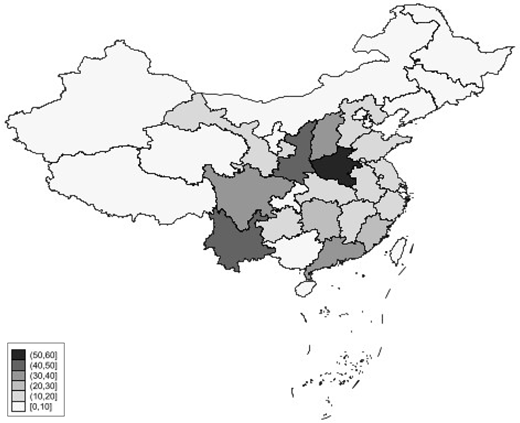
Mean distribution of companies using Big 10 accounting firms from 2003 to 2020
Source: Authors’ own work
Mean distribution of companies using Big 10 accounting firms from 2003 to 2020
Source: Authors’ own work
3.4 Empirical model
We estimate the following model to examine the impact of Confucian culture on auditor choice:
where β1 represents the effect of Confucian culture on auditor choice. The dependent variable, A_CHOICE, is measured by Big10 in the main tests and by Violate in the robustness tests. The variable of interest, ln_con_i, captures the influence of Confucianism and is measured by the density of Confucian temples within three different radii (100 km, 200 km and 300 km) around the company’s location and logarithmically transformed to derive ln_con_1, ln_con_2 and ln_con_3.
We follow Fang et al. (2017) and control company-specific characteristics that might influence auditor choice. These include company size (SIZE), financial leverage (LEV), return on assets (ROA), equity issuance (ISSUE), asset turnover (ATURN), the current ratio (CURR) and sales growth (GROWTH). Considering the specific context of the Chinese market, we include an indicator variable for firms that issue shares to foreign investors (FOREIGN), given that such firms are often subject to stricter external monitoring from foreign investors (DeFond et al., 2000; Guedhami et al., 2009). We also account for state-owned enterprises (SOE), as these firms typically enjoy easier access to financing (Wang et al., 2008; Guedhami et al., 2009). We also control regional economic development using local GDP (GDP) and include religious traditions (RELIGION) to account for religious factors that may affect auditor selection. The corporate governance index (CG), which is measured as the first component score from a principal component analysis of five corporate governance indicators (Xu et al., 2019), is also controlled to account for the level of corporate governance in the company. Finally, we include year and industry fixed effects to control unobserved heterogeneity over time and across sectors, and we winsorize continuous variables at the 1st and 99th percentiles to mitigate the effect of outliers.
Detailed variable definitions can be found in Appendix.
4. Empirical results
4.1 Descriptive statistics
Panel B of Table 1 shows an increasing trend toward Big 10 auditors among sampled firms from 2003 to 2020. Less than 22% employed Big 10 auditors before 2008; this proportion grew to approximately 35% during the period from 2008 to 2010 and further increased to around 60% post-2013. As shown in Panel C of Table 1, the education and health and social work sectors predominantly chose Big 10 auditors, with an adoption rate of over 64%.
Panel A of Table 2 presents descriptive statistics. The means of Confucian culture variables (ln_con_1, ln_con_2 and ln_con_3) are 1.788, 2.662 and 3.233, respectively, consistent with earlier studies (Du et al., 2022; Jin et al., 2023). The distributions of control variables are consistent with those reported by Fang et al. (2017). Panel B of Table 2 presents the Pearson correlations between variables used in the main model. Except for the expected high correlation between CURR and LEV, correlations between the control variables are less than −0.6, indicating minimal multicollinearity impact on the empirical model.
Descriptive statistics
| Panel A: Summary statistics | ||||||||||||||||||||
| Variable | N | Mean | p25 | p50 | p75 | SD | Minimum | Maximum | ||||||||||||
| ln_con_1 | 34,046 | 1.788 | 1.386 | 1.946 | 2.398 | 0.721 | 0.000 | 2.944 | ||||||||||||
| ln_con_2 | 34,046 | 2.662 | 2.565 | 2.773 | 3.178 | 0.784 | 0.000 | 3.989 | ||||||||||||
| ln_con_3 | 34,046 | 3.233 | 3.219 | 3.401 | 3.611 | 0.783 | 0.000 | 4.543 | ||||||||||||
| SIZE | 34,046 | 21.930 | 21.008 | 21.760 | 22.651 | 1.285 | 19.189 | 25.968 | ||||||||||||
| LEV | 34,046 | 0.436 | 0.266 | 0.428 | 0.591 | 0.216 | 0.052 | 1.138 | ||||||||||||
| ROA | 34,046 | 0.043 | 0.015 | 0.041 | 0.075 | 0.069 | −0.322 | 0.234 | ||||||||||||
| ISSUE | 34,046 | 0.473 | 0.000 | 0.000 | 1.000 | 0.499 | 0.000 | 1.000 | ||||||||||||
| ATURN | 34,046 | 0.632 | 0.350 | 0.531 | 0.780 | 0.437 | 0.042 | 2.538 | ||||||||||||
| CURR | 34,046 | 2.430 | 1.083 | 1.588 | 2.627 | 2.623 | 0.214 | 16.672 | ||||||||||||
| GROWTH | 34,046 | 0.194 | −0.014 | 0.118 | 0.284 | 0.486 | −0.685 | 3.558 | ||||||||||||
| FOREIGN | 34,046 | 0.063 | 0.000 | 0.000 | 0.000 | 0.244 | 0.000 | 1.000 | ||||||||||||
| SOE | 34,046 | 0.414 | 0.000 | 0.000 | 1.000 | 0.493 | 0.000 | 1.000 | ||||||||||||
| GDP | 34,046 | 10.224 | 9.686 | 10.330 | 10.937 | 0.916 | 7.421 | 11.615 | ||||||||||||
| RELIGION | 34,046 | 6.425 | 5.366 | 6.921 | 7.596 | 1.594 | 2.944 | 8.306 | ||||||||||||
| CG | 34,046 | −0.001 | −0.495 | −0.245 | 0.396 | 0.607 | −0.715 | 1.610 | ||||||||||||
| Moral | 33,500 | 5.692 | 5.507 | 5.585 | 6.121 | 0.507 | 3.886 | 6.610 | ||||||||||||
| Trust | 33,406 | 0.180 | 0.140 | 0.169 | 0.212 | 0 0.076 | 0.028 | 0.431 | ||||||||||||
| DS | 22,913 | 1.994 | 2.000 | 2.000 | 2.000 | 0.627 | 1.000 | 4.000 | ||||||||||||
| Tunnel | 34,046 | 0.021 | 0.003 | 0.008 | 0.020 | 0.037 | 0.000 | 0.241 | ||||||||||||
| Panel B: Correlations | ||||||||||||||||||||
| Big10 | ln_con_1 | ln_con_2 | ln_con_3 | Trust | Moral | DS | tunnel | SIZE | LEV | ROS | ISSUE | ATURN | CURR | GROWTH | FOREIGN | SOE | GDP | RELIGION | CG | |
| Big10 | 1.000 | |||||||||||||||||||
| ln_con_1 | 0.034*** (0.000) | 1.000 | ||||||||||||||||||
| ln_con_2 | 0.052*** (0.000) | 0.794*** (0.000) | 1.000 | |||||||||||||||||
| ln_con_3 | 0.032*** (0.000) | 0.676*** (0.000) | 0.921*** (0.000) | 1.000 | ||||||||||||||||
| Trust | 0.087*** (0.000) | 0.207*** (0.000) | 0.101*** (0.000) | 0.100*** (0.000) | 1.000 | |||||||||||||||
| Moral | −0.146*** (0.000) | 0.052*** (0.000) | 0.108*** (0.000) | 0.102*** (0.000) | 0.045*** (0.000) | 1.000 | ||||||||||||||
| DS | −0.125*** (0.000) | −0.069*** (0.000) | −0.061*** (0.000) | −0.057*** (0.000) | −0.055*** (0.000) | 0.040*** (0.000) | 1.000 | |||||||||||||
| tunnelg | −0.011* (0.095) | −0.006 (0.403) | 0.002(0.751) | 0.001 (0.940) | 0.002 (0.728) | 0.015** (0.022) | 0.018*** (0.006) | 1.000 | ||||||||||||
| SIZE | 0.144*** (0.000) | −0.018*** (0.006) | −0.023*** (0.001) | −0.004 (0.595) | 0.118*** (0.000) | −0.230*** (0.000) | −0.213*** (0.000) | −0.019*** (0.005) | 1.000 | |||||||||||
| LEV | −0.055*** (0.000) | −0.058*** (0.000) | −0.045*** (0.000) | −0.027*** (0.000) | −0.013** (0.048) | 0.009 (0.199) | 0.166*** (0.000) | 0.033*** (0.000) | 0.405*** (0.000) | 1.000 | ||||||||||
| ROA | 0.077*** (0.000) | 0.038*** (0.000) | 0.043*** (0.000) | 0.034*** (0.000) | −0.021*** (0.002) | 0.049*** (0.000) | −0.344*** (0.000) | −0.046*** (0.000) | 0.004 (0.578) | −0.410*** (0.000) | 1.000 | |||||||||
| ISSUE | 0.032*** (0.000) | 0.014** (0.034) | 0.016** (0.014) | 0.019*** (0.003) | 0.015** (0.024) | −0.061*** (0.000) | −0.089*** (0.000) | −0.008 (0.210) | 0.148*** (0.000) | 0.011* (0.091) | 0.074*** (0.000) | 1.000 | ||||||||
| ATURN | 0.002(0.759) | 0.033*** (0.000) | 0.051*** (0.000) | 0.050*** (0.000) | 0.006 (0.402) | 0.100*** (0.000) | −0.053*** (0.000) | 0.030*** (0.000) | 0.048*** (0.000) | 0.156*** (0.000) | 0.098*** (0.000) | −0.032*** (0.000) | 1.000 | |||||||
| CURR | 0.028*** (0.000) | 0.061*** (0.000) | 0.037*** (0.000) | 0.027*** (0.000) | −0.031*** (0.000) | 0.050*** (0.000) | −0.072*** (0.000) | −0.009 (0.158) | −0.320*** (0.000) | −0.644*** (0.000) | 0.260*** (0.000) | −0.049*** (0.000) | −0.182*** (0.000) | 1.000 | ||||||
| GROWTH | −0.006 (0.392) | 0.010 (0.123) | 0.010(0.131) | 0.009 (0.159) | −0.040*** (0.000) | 0.036*** (0.000) | −0.043*** (0.000) | −0.014** (0.039) | 0.031*** (0.000) | 0.032*** (0.000) | 0.229*** (0.000) | 0.117*** (0.000) | 0.086*** (0.000) | −0.045*** (0.000) | 1.000 | |||||
| FOREGIN | 0.065*** (0.000) | −0.063*** (0.000) | −0.041*** (0.000) | −0.033*** (0.000) | 0.047*** (0.000) | 0.078*** (0.000) | −0.063*** (0.000) | 0.001(0.849) | 0.218*** (0.000) | 0.103*** (0.000) | 0.005 (0.481) | −0.009 (0.178) | 0.025*** (0.000) | −0.084*** (0.000) | −0.013* (0.051) | 1.000 | ||||
| SOE | −0.074*** (0.000) | −0.080*** (0.000) | −0.067*** (0.000) | −0.035*** (0.000) | −0.041*** (0.000) | 0.044*** (0.000) | −0.050*** (0.000) | −0.003(0.629) | 0.271*** (0.000) | 0.281*** (0.000) | −0.110*** (0.000) | −0.056*** (0.000) | 0.072*** (0.000) | −0.212*** (0.000) | −0.046*** (0.000) | 0.198*** (0.000) | 1.000 | |||
| GDP | 0.182*** (0.000) | 0.135*** (0.000) | 0.206*** (0.000) | 0.183*** (0.000) | 0.322*** (0.000) | −0.027*** (0.000) | −0.129*** (0.000) | −0.017*** (0.009) | 0.126*** (0.000) | −0.123*** (0.000) | 0.075*** (0.000) | 0.073*** (0.000) | 0.027*** (0.000) | 0.038*** (0.000) | −0.044*** (0.000) | 0.008 (0.218) | −0.284*** (0.000) | 1.000 | ||
| RELIGION | 0.046*** (0.000) | 0.027*** (0.000) | 0.189*** (0.000) | 0.179*** (0.000) | −0.309*** (0.000) | 0.159*** (0.000) | −0.001 (0.913) | 0.005 (0.487) | −0.055*** (0.000) | 0.014** (0.041) | 0.022*** (0.001) | −0.022*** (0.001) | 0.088*** (0.000) | −0.054*** (0.000) | −0.007 (0.261) | −0.027*** (0.000) | −0.096*** (0.000) | 0.279*** (0.000) | 1.000 | |
| CG | 0.091*** (0.000) | 0.107*** (0.000) | 0.073*** (0.000) | 0.050*** (0.000) | 0.075*** (0.000) | −0.015** (0.025) | −0.014** (0.034) | −0.000(0.969) | −0.250*** (0.000) | −0.276*** (0.000) | 0.115*** (0.000) | 0.026*** (0.000) | −0.086*** (0.000) | 0.245*** (0.000) | 0.018*** (0.007) | 0.038*** (0.000) | −0.473*** (0.000) | 0.235*** (0.000) | 0.021*** (0.002) | 1.000 |
Note(s): Panel A summarizes the descriptive statistics. Panel B reports Pearson correlations. All continuous variables are winsorized at the top and bottom 1%. All variables are defined in Appendix
4.2 The baseline regression
Table 3 reveals that proximity to Confucian temples is positively associated with the likelihood of selecting Big10 auditors. The coefficients for ln_con_1 (proximity within 100 km) and ln_con_2 (within 200 km) are 0.054 and 0.069, respectively, both significant at the 1% level. Meanwhile, ln_con_3 (within 300 km) also shows a positive association, though its impact is relatively less significant at the 5% level. These findings confirm H1, which posits that Confucian cultural influence, as measured by proximity to Confucian temples, positively affects the selection of high-quality auditors. Additionally, all variance inflation factors are below 5, indicating that multicollinearity is unlikely to be a concern in this analysis.
The baseline regression
| (1) | (2) | (3) | ||||
|---|---|---|---|---|---|---|
| Big10 | Big10 | Big10 | ||||
| Variable | VIF | VIF | VIF | |||
| ln_con_1 | 0.054*** (5.270) | 1.07 | ||||
| ln_con_2 | 0.069*** (7.077) | 1.13 | ||||
| ln_con_3 | 0.020** (2.074) | 1.14 | ||||
| SIZE | 0.148*** (19.747) | 1.66 | 0.149*** (19.831) | 1.65 | 0.149*** (19.816) | 1.66 |
| LEV | −0.220*** (−4.194) | 2.36 | −0.223*** (−4.240) | 2.36 | −0.226*** (−4.306) | 2.36 |
| ROA | 0.828*** (6.685) | 1.99 | 0.833*** (6.720) | 1.99 | 0.827*** (6.671) | 1.99 |
| ISSUE | −0.069*** (−4.626) | 2.07 | −0.070*** (−4.693) | 2.07 | −0.069*** (−4.626) | 2.07 |
| ATURN | 0.091*** (4.804) | 4.11 | 0.090*** (4.712) | 4.11 | 0.095*** (4.999) | 4.11 |
| CURR | 0.002 (0.625) | 3.34 | 0.002(0.574) | 3.34 | 0.003 (0.696) | 3.34 |
| GROWTH | −0.046*** (−2.986) | 1.28 | −0.047*** (−2.999) | 1.28 | −0.047*** (−3.000) | 1.28 |
| FOREIGN | 0.641*** (18.776) | 1.30 | 0.637*** (18.663) | 1.30 | 0.640*** (18.744) | 1.30 |
| SOE | −0.074*** (−3.997) | 2.70 | −0.077*** (−4.156) | 2.70 | −0.073*** (−3.963) | 2.71 |
| GDP | −0.032*** (−2.738) | 1.29 | −0.043*** (−3.574) | 1.33 | −0.029** (−2.427) | 1.35 |
| RELIGION | 0.012** (2.376) | 1.24 | 0.007(1.489) | 1.25 | 0.010** (1.964) | 1.25 |
| CG | 0.098*** (6.810) | 1.54 | 0.100*** (6.944) | 1.53 | 0.101*** (7.044) | 1.53 |
| _cons | −4.180*** (−21.773) | −4.142*** (−21.555) | −4.180*** (−21.773) | |||
| Industry | Y | Y | Y | |||
| Year | Y | Y | Y | |||
| N | 34,046 | 34,046 | 34,046 | |||
| Pseudo R2 | 0.105 | 0.105 | 0.104 | |||
Note(s): This table examines the association between Confucian culture and the selection of high-quality auditors. All variables are defined in Appendix. Continuous variables are winsorized at the top and bottom 1%. Year and industry fixed effects are included but not shown. We report two-sided t statistics computed using standard errors clustered by firm. *, ** and ***indicate significance at the 10, 5 and 1% levels
4.3 Mechanism tests
To further understand how Confucian culture influences the selection of high-quality auditors, we examine three potential mechanisms: ethical governance, information disclosure quality and mitigation of agency problems.
4.3.1 Trust and moral self-discipline – the ethics channels.
We propose that Confucian culture influences auditor choice through the ethical governance channels. Values such as benevolence, trustworthiness and moral restraint foster mutual trust and self-discipline within firms, reducing opportunistic behavior and encouraging transparent governance. These internalized norms may lead firms to view high-quality auditors as not only monitors but also aligned partners in sustaining ethical and reputational standards (Du, 2016; Chen et al., 2020; Ye et al., 2022).
Specifically, social trust promotes cooperation and openness (Fukuyama, 1995; Du et al., 2022), while moral self-discipline supports voluntary compliance with high governance standards (Wang et al., 2021). Together, they represent key dimensions of Confucian ethical influence. To test this mechanism, we use two proxies: Trust (regional social trust) and Moral (moral self-discipline). Following Baron and Kenny’s (1986) mediation approach, we first examine whether Confucian culture predicts these mediators (Stage 1), then whether the mediators affect auditor choice while attenuating the direct effect of Confucian culture (Stage 2).
As shown in Panel A of Table 4, Confucian culture significantly increases both Trust and Moral. In Stage 2, both variables significantly predict the engagement of high-quality auditors, while Confucian culture remains a significant predictor – indicating partial mediation.
Mechanisms
| Panel A: Trust and moral self-discipline: the ethics channels | ||||||||||||
| Channel = Trust | Channel = Moral | |||||||||||
| Stage 1 | Stage 2 | Stage 1 | Stage 2 | |||||||||
| (1) | (2) | (3) | (4) | (5) | (6) | (7) | (8) | (9) | (10) | (11) | (12) | |
| Trust | Trust | Trust | Big10 | Big10 | Big10 | Moral | Moral | Moral | Big10 | Big10 | Big10 | |
| ln_con_1 | 0.015*** (33.013) | 0.052*** (4.889) | 0.070*** (31.385) | 0.049*** (4.677) | ||||||||
| ln_con_2 | 0.009*** (20.592) | 0.071*** (6.935) | 0.078*** (36.612) | 0.067*** (6.490) | ||||||||
| ln_con_3 | 0.011*** (24.662) | 0.019*(1.810) | 0.083*** (37.840) | 0.015(1.393) | ||||||||
| Channel | 0.332*** (2.601) | 0.349*** (2.756) | 0.410*** (3.234) | 0.135*** (5.165) | 0.125*** (4.749) | 0.147*** (5.601) | ||||||
| Controls | Y | Y | Y | Y | Y | Y | Y | Y | Y | Y | Y | Y |
| Industry | Y | Y | Y | Y | Y | Y | Y | Y | Y | Y | Y | Y |
| Year | Y | Y | Y | Y | Y | Y | Y | Y | Y | Y | Y | Y |
| Indirect effect | 0.0019*** | 0.0012*** | 0.0017*** | 0.0032*** | 0.0032*** | 0.0042*** | ||||||
| Direct effect | 0.0172*** | 0.0238*** | 0.0056 | 0.0162*** | 0.0222*** | 0.0037 | ||||||
| Total effect | 0.0191*** | 0.0250*** | 0.0073** | 0.0194*** | 0.0254*** | 0.0079** | ||||||
| N | 33406 | 33406 | 33406 | 33406 | 33406 | 33406 | 33500 | 33500 | 33500 | 33500 | 33500 | 33500 |
| Adj/Pseudo R2 | 0.446 | 0.435 | 0.438 | 0.105 | 0.106 | 0.105 | 0.693 | 0.697 | 0.697 | 0.106 | 0.106 | 0.105 |
| Panel B: The information disclosure quality channel | ||||||||||||
| Channel= disclosure score (DS) | ||||||||||||
| Stage 1 | Stage 2 | |||||||||||
| (1) | (2) | (3) | (4) | (5) | (6) | |||||||
| DS | DS | DS | Big10 | Big10 | Big10 | |||||||
| ln_con_1 | −0.040*** (−7.294) | 0.009(0.712) | ||||||||||
| ln_con_2 | −0.028*** (−5.216) | 0.037*** (2.948) | ||||||||||
| ln_con_3 | −0.024*** (−4.477) | 0.003(0.207) | ||||||||||
| Channel | −0.105*** (−6.755) | −0.104*** (−6.696) | −0.106*** (−6.785) | |||||||||
| Controls | Y | Y | Y | Y | Y | Y | ||||||
| Industry | Y | Y | Y | Y | Y | Y | ||||||
| Year | Y | Y | Y | Y | Y | Y | ||||||
| N | 22,913 | 22,913 | 22,913 | 22,913 | 22,913 | 22,913 | ||||||
| Adj R2/Pseudo R2 | 0.2090 | 0.2081 | 0.2078 | 0.091 | 0.092 | 0.091 | ||||||
| Indirect effect | 0.0014*** | 0.0010*** | 0.0009*** | |||||||||
| Direct effect | 0.0030 | 0.0131*** | 0.0008 | |||||||||
| Total effect | 0.0045 | 0.0141*** | 0.0017 | |||||||||
| Panel C: Mitigation of agency problems: the tunnelling channel | ||||||||||||
| Channel = tunneling by large shareholders (tunnel) | ||||||||||||
| Stage 1 | Stage 2 | |||||||||||
| (1) | (2) | (3) | (4) | (5) | (6) | |||||||
| Tunnel | Tunnel | Tunnel | Big10 | Big10 | Big10 | |||||||
| ln_con_1 | −0.001** (−2.075) | 0.054*** (5.256) | ||||||||||
| ln_con_2 | −0.001** (−2.233) | 0.069*** (7.064) | ||||||||||
| ln_con_3 | −0.001*** (−2.951) | 0.020** (2.032) | ||||||||||
| Channel | −1.152*** (−4.811) | −1.152*** (−4.806) | −1.151*** (−4.808) | |||||||||
| Controls | Y | Y | Y | Y | Y | Y | ||||||
| Industry | Y | Y | Y | Y | Y | Y | ||||||
| Year | Y | Y | Y | Y | Y | Y | ||||||
| N | 34,046 | 34,046 | 34,046 | 34,046 | 34,046 | 34,046 | ||||||
| Adj R2/Pseudo R2 | 0.2405 | 0.2405 | 0.2406 | 0.105 | 0.105 | 0.104 | ||||||
| Indirect effect | 0.0001*** | 0.0001*** | 0.0020** | |||||||||
| Direct effect | 0.0181*** | 0.0234*** | 0.0064* | |||||||||
| Total effect | 0.0182*** | 0.0235*** | 0.0084* | |||||||||
Note(s): Panel A presents results for mediation tests of ethics (measured by Trust and Moral) on the selection of high-quality auditors. Panel B presents results for mediation tests of information disclosure quality (measured by DS) on the selection of high-quality auditors. Panel C presents results for mediation tests of tunneling by large shareholders (measured by tunnel) on the selection of high-quality auditors. All variables are defined in Appendix. All continuous variables are winsorized at the top and bottom 1%. Year and industry fixed effects are included. We report two-sided t-statistics computed using standard errors clustered by firm. *, ** and ***indicate significance at the 10, 5 and 1% levels
Indirect effect decomposition supports this. For Trust, mediation effects are 0.0019, 0.0012 and 0.0017, respectively (p < 0.01), accounting for 9.95%, 4.80% and 23.29% of the total effect. For Moral, indirect effects are 0.0032, 0.0032 and 0.0042, respectively, (p < 0.01), accounting for 6.49%, 12.60% and 53.16% of the total. In some models, the inclusion of Moral reduces the Confucian coefficients – particularly ln_con_3, which becomes insignificant, suggesting that a partial but substantial portion of the effect operates through internal ethical discipline.
These results confirm that Confucian culture promotes ethical behavior, which in turn drives firms to engage high-quality auditors.
4.3.2 The information disclosure quality channel.
The second mechanism through which Confucian culture may influence auditor choice is via enhanced information disclosure quality. Confucian values – particularly integrity, propriety and trust – cultivate an internal commitment to clear and accurate communication (Yang et al., 2022). These values encourage organizational norms that promote openness and discourage misleading disclosures, embedding ethical standards into reporting practices (Hwang et al., 2008; Xu et al., 2019; Du et al., 2020).
Unlike ethical traits, which are often internal and less observable, disclosure quality is outward-facing and visible to regulators, investors and auditors. High-quality disclosure reduces the likelihood of fraud or misrepresentation and enhances the credibility of financial reporting (Chen et al., 2020). Accordingly, firms with stronger disclosure practices are more inclined to appoint high-quality auditors to validate their reporting and signal accountability (DeFond et al., 2000).
We measure disclosure quality using the Disclosure Quality Score (DS) published by the Shenzhen and Shanghai Stock Exchanges. This score, ranging from 1 to 4 (higher scores indicate lower quality), reflects an independent, comprehensive evaluation of firm-level disclosure practices across six dimensions: regulatory compliance, disclosure effectiveness, investor relations, CSR/ESG reporting, enforcement history and responsiveness to exchange inquiries. As the score is determined independently by the exchanges and is not determined by the firm’s choice of auditor, which helps mitigate endogeneity concerns and makes it a valid and robust proxy for the disclosure environment (Wang and Liang, 2008; Jiang and Wang, 2011).
Panel B of Table 4 presents empirical results. In Stage 1, Confucian culture proxies (ln_con_1, ln_con_2 and ln_con_3) are significantly negatively associated with the disclosure score, indicating that firms influenced by Confucian values tend to achieve higher disclosure quality. In Stage 2, better disclosure quality (lower DS) is significantly linked to a higher likelihood of engaging high-quality auditors. Importantly, after including disclosure quality in the model, the coefficients on ln_con_1 and ln_con_3 become statistically insignificant, while the coefficient on ln_con_2 turns positive and increases in magnitude. This shift suggests a full mediation effect for ln_con_1 and ln_con_3, indicating that Confucian culture affects auditor choice entirely through its influence on disclosure quality.
Mediation analysis further confirms this mechanism. The indirect effects of disclosure quality are statistically significant – 0.0014, 0.0010 and 0.0009 (all at the 1% significance level) – accounting for 31.11%, 7.10% and 52.94% of the total effects, respectively. These results indicate that disclosure quality acts as a meaningful and, in some cases, dominant channel linking Confucian culture to the selection of high-quality auditors. In sum, these findings highlight that Confucian values strengthen firms’ commitment to transparency and that this enhanced disclosure environment in turn motivates the engagement of top-tier auditors.
4.3.3 Mitigation of agency conflicts: the tunnelling channel.
A third mechanism through which Confucian culture may influence auditor selection is the mitigation of agency conflicts between controlling and minority shareholders – commonly referred to as Type II agency problems. In China’s capital market, characterized by concentrated ownership structures, controlling shareholders often dominate corporate decisions, creating opportunities for tunneling or the expropriation of resources from minority shareholders (Wang et al., 2008).
High-quality auditors, known for their ability to detect misreporting and enforce transparency, can deter such opportunistic behavior. However, firms facing high Type II agency risks often avoid engaging top-tier auditors to conceal large shareholder expropriation (Lin and Liu, 2009; Khan et al., 2015). We argue that Confucian culture reduces these risks. Rooted in principles of trust, integrity and long-term orientation, Confucian-influenced firms are less likely to engage in self-serving behavior. These values promote internal discipline and ethical governance, making such firms more inclined to engage reputable auditors – even when higher costs are involved.
To test this channel, we follow Jiang et al. (2010) and use Tunnel, defined as the ratio of Other Receivables to total assets, to proxy for Type II agency problems – insider expropriation of tunnelling. This metric captures non-operational receivables – such as intra-group loans, advances or deposits – that are not part of core business activities. Such receivables are widely recognized as a vehicle for tunneling, and their abnormal growth often triggers regulatory scrutiny (Fang et al., 2017). The China Securities Regulatory Commission and stock exchanges routinely monitor this account category as a red flag for insider expropriation.
Panel C of Table 4 reports the results. In Stage 1, Confucian culture proxies (ln_con_1, ln_con_2 and ln_con_3) are significantly negatively associated with tunneling, suggesting that Confucian influence is linked to lower levels of non-operational receivables and, thus, reduced type II agency conflicts. In Stage 2, tunneling (Tunnel) is negatively associated with the engagement of high-quality auditors, implying that firms with fewer signs of insider expropriation are more likely to engage top-tier auditors. The Confucian culture proxies remain significant after controlling tunneling, suggesting partial mediation.
Further mediation analysis shows that the indirect effects through tunneling are statistically significant – 0.0001, 0.0001 and 0.0020 (p < 0.01) – accounting for 0.55%, 0.43% and 23.81% of the total effect, respectively. Notably, after including the mediator, the coefficients on Confucian proxies increase and retain significance, reinforcing the role of tunneling reduction as a meaningful – albeit smaller – mechanism.
In sum, the findings support the notion that Confucian culture discourages tunneling behavior by fostering ethical self-discipline and long-term orientation. This, in turn, reduces agency costs and promotes the selection of high-quality auditors – consistent with Confucian ideals of fairness, responsibility and stakeholder trust.
4.4 Robustness checks
We use several approaches to validate the robustness of our main findings.
4.4.1 Alternative measures of Confucian culture.
First, we use alternative metrics for Confucian culture, Conf_academy and Conf_chair. Conf_academy is defined as the natural logarithm of the number of Confucian academies in the firm’s city of registration, whereas Conf_chair measures the average number of Confucian academies in the home provinces of both the firm’s chairman and general manager (Xu et al., 2023; Cheng et al., 2023). Unlike Confucian temples, which were integral to preparing students for imperial examinations, Confucian academies primarily focused on preserving and disseminating Confucian historiography and traditions, playing a crucial role in spreading Confucian culture regionally.
As reported in Panel A of Table 5, the coefficients for Conf_academy and Conf_chair are 0.085 and 0.039, respectively, both significant at the 1% level. These results are consistent with the main findings, further reinforcing the positive relationship between Confucian culture influence and the engagement of high-quality auditors.
Robustness check
| Panel A: Alternative measures of Confucian culture | |||
| (1) | (2) | ||
| Big10 | Big10 | ||
| Conf_academy | 0.085*** (12.963) | ||
| Conf_chair | 0.039*** (5.177) | ||
| Controls | Y | Y | |
| Industry | Y | Y | |
| Year | Y | Y | |
| N | 31,356 | 26,459 | |
| Pseudo R2 | 0.104 | 0.120 | |
| Panel B: Alternative measure of auditor quality | |||
| (1) | (2) | (3) | |
| Violate | Violate | Violate | |
| ln_con_1 | −0.098*** (−3.352) | ||
| ln_con_2 | −0.130*** (−4.843) | ||
| ln_con_3 | −0.103*** (−3.786) | ||
| Controls | Y | Y | Y |
| Industry | Y | Y | Y |
| Year | Y | Y | Y |
| N | 32,974 | 32,974 | 32,974 |
| Pseudo R2 | 0.179 | 0.181 | 0.180 |
| Panel C: Alternative sample by excluding firms from ethnic minority regions | |||
| (1) | (2) | (3) | |
| Big10 | Big10 | Big10 | |
| ln_con_1 | 0.060*** (5.777) | ||
| ln_con_2 | 0.081*** (7.555) | ||
| ln_con_3 | 0.025** (2.217) | ||
| Controls | Y | Y | Y |
| Industry | Y | Y | Y |
| Year | Y | Y | Y |
| N | 32,984 | 32,984 | 32,984 |
| Pseudo R2 | 0.102 | 0.103 | 0.101 |
| Panel D: Alternative Sample by Excluding Firms from Regions with Strong Influences from both Confucian Culture and the Big 10 Auditors | |||
| Non-Big 10 Auditor and Low Confucianism | |||
| (1) | (2) | (3) | |
| Big10 | Big10 | Big10 | |
| ln_con_1 | 0.017(1.312) | ||
| ln_con_2 | 0.040*** (3.434) | ||
| ln_con_3 | 0.028** (2.490) | ||
| Controls | Y | Y | Y |
| Industry | Y | Y | Y |
| Year | Y | Y | Y |
| N | 16,953 | 16,048 | 16,579 |
| Pseudo R2 | 0.130 | 0.128 | 0.129 |
Note(s): This table presents the results of robustness tests. Panel A shows results with alternative measures of Confucian culture. Panel B uses an alternative measure of high-quality auditors. Panel C displays results after excluding firms from ethnic minority regions. Panel D uses an alternative sample that excludes firms from regions with strong influences from both Confucian culture and the Big 10 auditors. All variables are defined in Appendix. Continuous variables are winsorized at the top and bottom 1%. Year and industry fixed effects are included. We report two-sided t-statistics computed using standard errors clustered by firm. *, ** and ***indicate significance at the 10, 5 and 1% levels
4.4.2 Alternative measure of auditor quality.
We adopt an alternative dependent variable, Violate, indicating a firm’s engagement with auditors who have been previously sanctioned, thereby signaling low auditor quality (Du et al., 2022; Li et al., 2022; Gul et al., 2023). In Panel B of Table 5, the coefficients for ln_con_1, ln_con_2 and ln_con_3 are −0.098, –0.130 and –0.103, respectively, all significant at the 1% level. These negative coefficients suggest that firms under greater Confucian cultural influence are less likely to hire auditors with a history of sanctions, further supporting the argument that Confucian values promote the selection of high-quality auditors.
4.4.3 Alternative sample: excluding companies in ethnic minority regions.
Following Zhai and Tang (2023), we refine our sample by excluding firms from regions with significant ethnic minority populations, such as Xinjiang, Tibet, Qinghai and Inner Mongolia Autonomous Region, where Confucianism may have less cultural influence. The results, detailed in Panel C of Table 5, continue to exhibit positive coefficients for ln_con_1, ln_con_2 and ln_con_3, with values of 0.060, 0.081 and 0.025, respectively. All are significant, reinforcing the positive link between the Confucian cultural influence and the likelihood of engaging high-quality auditors. The findings demonstrate that even after accounting for geographical and cultural diversity, Confucianism continues to play a significant role in promoting the selection of top-tier auditors.
4.4.4 Alternative sample: excluding regions with strong Confucian influence and Big 10 auditor presence.
We address the concern that the positive association between Confucian culture and the selection of high-quality auditors could be driven by a strong correlation between Confucian cultural influence and the distribution of Big 10 auditors in certain regions. To mitigate this concern, we exclude companies from regions with strong Confucian influence and a high presence of Big 10 auditors. Specifically, we count the number of companies selecting Big 10 auditors by year and province and generate the median count. Similarly, we sum the values of the three Confucian culture variables by year and province and calculate their median sum. Finally, we exclude companies located in regions where both values exceed the respective medians.
The results, presented in Panel D of Table 5, continue to show positive coefficients for ln_con_1, ln_con_2 and ln_con_3, with values of 0.017, 0.040 and 0.028, respectively, with only the latter two being significant. These findings reinforce the positive association between Confucian cultural influence and the likelihood of engaging high-quality auditors, providing moderate support for our main results even after excluding regions with strong influences of both Confucian culture and Big 10 auditors.
4.5 Endogeneity analysis
To address potential endogeneity concerns, we use two methodologies: the instrumental variable approach and entropy balancing matching (EBM).
First, we use Chastity archways, symbols of Confucian moral values, as an instrument for the Confucian cultural influence. The variable Chastity is defined as the natural logarithm of the number of chastity archways plus one within the province where the listed firm is located (Ye et al., 2022). These archways reflect the strength of the local Confucian ethos. The first stage results show a positive association between Confucian culture and Chastity, confirming the instrument’s validity. In the second stage, we find a significant positive impact of Confucian culture on auditor selection, as reported in Panel A of Table 6.
Endogeneity issues
| Panel A: Instrumental variable approach | ||||||
| (1) | (2) | (3) | (4) | (5) | (6) | |
| ln_con_1 | ln_con_2 | ln_con_3 | Big10 | Big10 | Big10 | |
| Chastity | 0.190*** (61.641) | 0.268*** (85.932) | 0.231*** (72.829) | |||
| ln_con_1 | 0.429*** (14.600) | |||||
| ln_con_2 | 0.306*** (14.573) | |||||
| ln_con_3 | 0.347*** (14.749) | |||||
| Controls | Y | Y | Y | Y | Y | Y |
| Industry | Y | Y | Y | Y | Y | Y |
| Year | Y | Y | Y | Y | Y | Y |
| N | 34,046 | 34,046 | 34,046 | 34,046 | 34,046 | 34,046 |
| Adj. R2 | 0.164 | 0.278 | 0.248 | |||
| Wald test | 164.55 | 142.76 | 197.09 | |||
| Panel B: Entropy balancing approach | ||||||
| (1) | (2) | (3) | ||||
| Big10 | Big10 | Big10 | ||||
| ln_con_1 | 0.023(1.367) | |||||
| ln_con_2 | 0.082*** (5.294) | |||||
| ln_con_3 | 0.078*** (4.815) | |||||
| Controls | Y | Y | Y | |||
| Industry | Y | Y | Y | |||
| Year | Y | Y | Y | |||
| N | 34,046 | 34,046 | 34,046 | |||
| Pseudo R2 | 0.097 | 0.100 | 0.103 | |||
Note(s): This table presents the results of endogeneity tests using two methods: the instrumental variable (IV) approach in Panel A and the entropy balancing algorithm (EBM) in Panel B. All variables are defined in Appendix. Continuous variables are winsorized at the top and bottom 1%. Year and industry fixed effects are included. We report two-sided t-statistics computed using standard errors clustered by firm. *, ** and ***indicate significance at the 10, 5 and 1% levels, respectively
Additionally, we apply the EBM method, as recommended by Hainmueller and Xu (2013) and McMullin and Schonberger (2020), to further address endogeneity that may arise from systematic differences between firms influenced by Confucian culture and those less influenced. After applying EBM, the treatment group (where d_ ln_con_i = 1) and the control group (where d_ ln_con_i = 0) exhibit similar means, variance and skewness across all control variables (untabulated for brevity). The indicator d_ ln_con_i equals 1 if ln_con_i is above the sample median and 0 otherwise. As shown in Panel B of Table 6, after the EBM adjustment, the results continue to support H1, demonstrating that the association between Confucian influence and the preference for high-quality auditors remains significant even after accounting for systematic differences.
4.6 Cross-sectional analyses
North (1991) highlighted the significant influence of both formal and informal institutions on corporate behavior. In China’s capital market, marked by weak governance and an immature information system (Allen et al., 2005), Confucian culture emerges as a key informal institution that potentially enhances governance effectiveness. This study probes the impact of Confucian ethics on auditor selection amid varying internal governance and external cultural pressures, suggesting that the preference for top-tier auditors influenced by Confucianism might vary across different corporate settings.
4.6.1 Internal monitoring environment.
Corporate governance (CG) is used as a measure of the internal monitoring environment [1]. Following Xu et al. (2019), we construct a corporate governance index (CG) through principal component analysis, incorporating five metrics: institutional investor shareholding, independent director ratio, duality of chairperson and CEO, management shareholding and cross-listing status. The sample is divided into high- and low-CG groups based on the median value of CG.
Panel A of Table 7 reveals a stronger positive association between Confucianism and the selection of high-quality auditors in firms exhibiting robust corporate governance (p < 0.01). It indicates that Confucian principles reinforce the efficacy of internal governance, mitigating agency conflicts and enhancing audit quality. Specifically, the interplay between Confucian ethics and corporate governance sheds light on the dynamic between cultural and institutional factors in shaping auditor selection and, by extension, financial reporting quality in the context of Chinese enterprises.
Cross-sectional analyses
| Panel A: Internal monitoring environment | ||||||
| High CG | Low CG | High CG | Low CG | High CG | Low CG | |
| (1) | (2) | (3) | (4) | (5) | (6) | |
| Big10 | Big10 | Big10 | Big10 | Big10 | Big10 | |
| ln_con_1 | 0.094*** (6.085) | 0.023* (1.681) | ||||
| ln_con_2 | 0.108*** (7.203) | 0.037*** (2.824) | ||||
| ln_con_3 | 0.058*** (3.740) | −0.008(−0.613) | ||||
| Controls | Y | Y | Y | Y | Y | Y |
| Industry | Y | Y | Y | Y | Y | Y |
| Year | Y | Y | Y | Y | Y | Y |
| N | 17,023 | 17,023 | 17,023 | 17,023 | 17,023 | 17,023 |
| Pseudo R2 | 0.076 | 0.121 | 0.077 | 0.122 | 0.075 | 0.121 |
| P value | 0.001 | 0.000 | 0.001 | |||
| Panel B: External cultural environment – OPENCITY | ||||||
| OPENCITY | Non-OPENCITY | OPENCITY | Non-OPENCITY | OPENCITY | Non-OPENCITY | |
| (1) | (2) | (3) | (4) | (5) | (6) | |
| Big10 | Big10 | Big10 | Big10 | Big10 | Big10 | |
| ln_con_1 | 0.224*** (10.705) | 0.004(0.323) | ||||
| ln_con_2 | 0.277*** (13.987) | −0.009(−0.730) | ||||
| ln_con_3 | 0.327*** (13.973) | −0.046*** (−3.872) | ||||
| Controls | Y | Y | Y | Y | Y | Y |
| Industry | Y | Y | Y | Y | Y | Y |
| Year | Y | Y | Y | Y | Y | Y |
| N | 10,543 | 23,503 | 10,543 | 23,503 | 10,543 | 23,503 |
| Pseudo R2 | 0.112 | 0.114 | 0.118 | 0.114 | 0.118 | 0.115 |
| P value | 0.000 | 0.000 | 0.000 | |||
Note(s): All variables are defined in Appendix. All continuous variables are winsorized at the top and bottom 1%. Year and industry fixed effects are included. We report two-sided t-statistics computed using standard errors clustered by firm. *, ** and ***indicate significance at the 10, 5 and 1% levels
4.6.2 Exposure to external culture shock.
In the globalization era, foreign cultural shocks can integrate or override cultures, impacting corporate decisions and behaviors because of varying ideologies (Siegel et al., 2011). This study examines how globalization affects Confucian culture’s influence on auditor selection in China, focusing on coastal cities known for early globalization adoption (Xia and Chen, 2007). We categorize our sample into the OPENCITY group, representing cities with high exposure to globalization, and the non-OPENCITY group, where OPENCITY is defined as 1 if the company is registered in a coastal city and 0 otherwise.
Results from coastal, globally exposed cities (the OPENCITY group) show a significant, positive effect of Confucian values on choosing high-quality auditors (Panel B of Table 7), indicating that Confucianism and global practices can synergistically enhance the preference for high-quality auditors. In contrast, this effect is negligible or negative in less globalized cities (non-OPENCITY), suggesting that globalization can amplify the importance of cultural values in business practices in exposed regions.
5. Additional analyses
5.1. Additional analyses: the effect of Confucianism on audit engagement
Subsequent analyses explore the broader impact of Confucianism on auditing, beyond the selection of high-quality auditors. As shown in Table 8, Panel A, firms influenced by Confucian values experience fewer auditor turnovers (AuditorChange), indicating more stable auditor–client relationships. This is consistent with Ye et al. (2022), who argue that Confucianism fosters long-term relationships based on trust and mutual respect, which likely contributes to reduced auditor turnover.
Additional analyses
| Panel A: Auditor change | ||||||
| (1) | (2) | (3) | (4) | (5) | (6) | |
| AuditChange | AuditChange | AuditChange | AuditChange | AuditChange | AuditChange | |
| ln_con_1 | −0.037*** (−2.683) | −0.037*** (−2.693) | ||||
| ln_con_2 | −0.051*** (−4.002) | −0.052*** (−4.021) | ||||
| ln_con_3 | −0.037*** (−2.858) | −0.037*** (−2.864) | ||||
| Big10 | 0.012(0.583) | 0.013(0.664) | 0.011(0.565) | |||
| Controls | Y | Y | Y | Y | Y | Y |
| Industry | Y | Y | Y | Y | Y | Y |
| Year | Y | Y | Y | Y | Y | Y |
| N | 34,046 | 34,046 | 34,046 | 34,046 | 34,046 | 34,046 |
| Adj R2 | 0.077 | 0.078 | 0.078 | 0.077 | 0.078 | 0.078 |
| Panel B: The influence of Confucian culture on the engagement of international Big 4 auditors | ||||||
| The Full Sample (DV=Big4) | In open city | |||||
| (1) | (2) | (3) | (4) | (5) | (6) | |
| Big4 | Big4 | Big4 | Big4 | Big4 | Big4 | |
| ln_con_1 | 0.017(1.256) | 0.218*** (10.475) | ||||
| ln_con_2 | 0.002(0.193) | 0.273*** (13.838) | ||||
| ln_con_3 | −0.035*** (−2.742) | 0.321*** (13.774) | ||||
| Controls | Y | Y | Y | Y | Y | Y |
| Industry | Y | Y | Y | Y | Y | Y |
| Year | Y | Y | Y | Y | Y | Y |
| N | 34,046 | 34,046 | 34,046 | 10,543 | 10,543 | 10,543 |
| Pseudo R2 | 0.195 | 0.195 | 0.195 | 0.110 | 0.115 | 0.115 |
| Panel C: Big 8 domestic accounting firms in the Chinese market | ||||||
| (1) | (2) | (3) | ||||
| Big8 | Big8 | Big8 | ||||
| ln_con_1 | 0.068*** (6.324) | |||||
| ln_con_2 | 0.091*** (8.859) | |||||
| ln_con_3 | 0.025** (2.396) | |||||
| Controls | Y | Y | Y | |||
| Industry | Y | Y | Y | |||
| Year | Y | Y | Y | |||
| N | 32,061 | 32,061 | 32,061 | |||
| Pseudo R2 | 0.079 | 0.080 | 0.078 | |||
| Panel D: How Does a Non-Big 10 Client Choose the Auditor? | ||||||
| Non-Big 10 Auditor | Big 10 Auditor | |||||
| (1) | (2) | (3) | (4) | (5) | (6) | |
| IS | IS | IS | IS | IS | IS | |
| ln_con_1 | 0.068** (2.429) | −0.038** (−2.422) | ||||
| ln_con_2 | 0.070*** (2.639) | −0.012(−0.790) | ||||
| ln_con_3 | 0.078*** (2.903) | −0.016(−1.052) | ||||
| Controls | Y | Y | Y | Y | Y | Y |
| Industry | Y | Y | Y | Y | Y | Y |
| Year | Y | Y | Y | Y | Y | Y |
| N | 15,402 | 15,402 | 15,402 | 16,501 | 16,501 | 16,501 |
| Pseudo R2 | 0.161 | 0.161 | 0.161 | 0.060 | 0.060 | 0.060 |
Note(s): All variables are defined in Appendix. All continuous variables are winsorized at the top and bottom 1%. Year and industry fixed effects are included. We report two-sided t-statistics computed using standard errors clustered by firm. *, ** and ***indicate significance at the 10, 5 and 1% levels
Additionally, when combined with the findings on reporting quality and audit fees from Panels B and C of Table 6, the results suggest that Confucian culture’s influence is comprehensive. Not only does it affect auditor selection but also fosters a deeper commitment to stable auditor–client relationships, higher audit quality and ethical financial reporting. Together, these outcomes highlight the enduring impact of Confucian principles on both financial reporting practices and the broader auditing environment.
5.2 Additional analyses: the international Big 4 audit firms, local Big 8 auditors and non-Big 10 auditors
5.2.1 The international Big 4 audit firms.
Despite the global perception of the Big 4 audit firms as premier auditors, their presence in the Chinese audit market is relatively limited, with merely 15% of listed firms in our sample opting for Big 4 services [2]. When we substitute Big4 for Big10 as the dependent variable, the results in Columns (1)–(3) of Panel B of Table 8 show that the association between Confucian cultural influence and the selection of Big 4 auditors is not significant.
However, when we narrow the sample to companies located in coastal cities (where OPENCITY = 1), Columns (4)–(6) indicate a different trend. In this subsample of firms more exposed to globalization, Confucian cultural influence (measured by ln_con_1, ln_con_2 and ln_con_3) is positive and significant at the 1% level. This suggests a strong preference for Big 4 auditors among companies in coastal cities that are more integrated with global markets. This finding implies that in environments more open to foreign influences, the alignment between Confucian ethics and the international prestige of the Big 4 firms enhances their attractiveness. It highlights a nuanced interaction between local cultural values and global business practices in the auditor selection process.
5.2.2 The local Big 8 audit firms in Chinese audit market.
In addition to the globally recognized Big 4s, the Big 8 local audit firms (Big8) hold a significant market share averaging 35% in China’s audit landscape [3]. Our analysis extends to the impact of Confucian culture on the selection of top-tier auditors within the non-Big 4 segment. Focusing on the sample that excludes Big 4 audit clients, the results in Panel C of Table 8 reveal a strong positive correlation between Confucian values and the selection of Big 8 auditors, with statistical significance at the 1% level for ln_con_1 and ln_con_2 and 5% for ln_con_3.
This trend highlights Confucianism’s deep influence on the choice of reputable audit services in China, extending beyond the Big 4 to include those big local firms. These findings reinforce the core conclusion of the study, emphasizing the pervasive influence of Confucian culture in shaping auditor selection in the Chinese market.
5.2.3 Confucian culture and the selection of industry specialist auditors in the absence of Big 10 firms.
Beyond the recognized high audit quality of Big 10 accounting firms, the industry expertise of auditors stands out as a crucial factor in ensuring audit excellence. This raises a question: in the absence of Big 10 auditors, do firms influenced by Confucian culture lean toward industry specialist auditors to maintain high audit quality?
Findings in Panel D of Table 8 present a nuanced view of Confucian values’ influence on auditor selection. Among firms that engage Big 10 auditors, Confucian principles have a negligible or slightly negative effect on the selection of industry specialists, possibly because of the already perceived high audit quality of Big 10 firms, which diminishes the need for additional industry-specific expertise. However, among firms that do not engage Big 10 auditors, there is a strong positive correlation between Confucian values and the selection of industry specialist auditors. This suggests that, in the absence of Big 10 services, Confucian-influenced firms deliberately seek specialized knowledge to ensure rigorous audit quality. These findings reflect Confucianism’s influence in promoting audit quality through the preference for specialized expertise when top-tier audit firms are not involved.
5.3 The complementary role of Confucian culture and high-quality auditors in enhancing firm value
In this paper, we argue that Confucian culture functions as an informal institution, influencing companies to engage high-quality auditors as part of their governance strategies. While high-quality audits serve a formal governance role in providing rigorous oversight and ensuring financial transparency, we further investigate how Confucian culture complements the role of external auditors to enhance overall firm performance.
To explore this relationship, we divide the sample into firms with strong and weak influences of Confucian culture. The results in Table 9 show that the use of high-quality Big 10 auditors significantly improves firm value, as proxied by Tobin’s Q, when Confucian cultural influence is strong (Columns (1), (3) and (5) for ln_con_1, ln_con_2 and ln_con_3, respectively). In contrast, the association between Big 10 auditors and firm value is not significant when Confucian influence is weak.
The complementary role of Confucian culture and high-quality auditors in enhancing firm value
| Confucian culture (ln_con_1) | Confucian culture (ln_con_2) | Confucian culture (ln_con_3) | ||||
|---|---|---|---|---|---|---|
| High | Low | High | Low | High | Low | |
| (1)TobinQ | (2)TobinQ | (3)TobinQ | (4)TobinQ | (5)TobinQ | (6)TobinQ | |
| Big10 | 0.043** (2.496) | 0.006 (0.363) | 0.048*** (2.769) | 0.004 (0.229) | 0.046*** (2.769) | −0.000 (−0.023) |
| SIZE | −0.489*** (−57.358) | −0.504*** (−58.769) | −0.502*** (−57.867) | −0.489*** (−58.049) | −0.508*** (−59.734) | −0.484*** (−56.434) |
| LEV | 0.593*** (9.807) | 0.786*** (13.504) | 0.612*** (10.063) | 0.765*** (13.219) | 0.587*** (10.001) | 0.774*** (12.914) |
| ROA | 2.674*** (18.841) | 2.844*** (19.916) | 2.894*** (19.738) | 2.755*** (19.881) | 2.714*** (19.126) | 2.872*** (20.124) |
| ISSUE | 0.169*** (10.117) | 0.175*** (10.319) | 0.152*** (9.023) | 0.176*** (10.488) | 0.151*** (9.195) | 0.184*** (10.611) |
| ATURN | −0.023 (−1.055) | 0.009 (0.418) | −0.027 (−1.296) | −0.011 (−0.479) | −0.007 (−0.343) | −0.031 (−1.372) |
| CURR | 0.020*** (4.986) | 0.027*** (6.409) | 0.019*** (4.364) | 0.028*** (7.017) | 0.020*** (4.692) | 0.026*** (6.492) |
| GROWTH | 0.032* (1.793) | 0.005 (0.267) | 0.033* (1.853) | 0.009 (0.510) | 0.028* (1.678) | 0.010 (0.521) |
| FOREIGN | 0.413*** (11.624) | 0.527*** (13.920) | 0.448*** (12.196) | 0.496*** (13.492) | 0.407*** (11.016) | 0.522*** (14.195) |
| SOE | 0.005 (0.242) | −0.051** (−2.545) | −0.015 (−0.688) | −0.040* (−1.933) | −0.042** (−2.053) | −0.000 (−0.015) |
| GDP | −0.114*** (−6.153) | 0.007 (0.634) | −0.120*** (−6.686) | 0.015 (1.365) | −0.131*** (−7.793) | 0.028** (2.448) |
| RELIGION | −0.021*** (−3.868) | −0.024*** (−3.617) | −0.019*** (−3.115) | −0.028*** (−5.087) | −0.015** (−2.200) | −0.035*** (−6.445) |
| CG | −0.274*** (−16.694) | −0.268*** (−15.777) | −0.303*** (−18.200) | −0.252*** (−15.099) | −0.297*** (−18.023) | −0.250*** (−14.827) |
| _cons | 12.193*** (49.345) | 11.603*** (56.899) | 12.366*** (49.547) | 11.286*** (55.881) | 12.682*** (52.171) | 11.074*** (53.923) |
| INDUSTRY | Y | Y | Y | Y | Y | Y |
| YEAR | Y | Y | Y | Y | Y | Y |
| N | 17,212 | 15,772 | 15,985 | 16,999 | 16,990 | 15,994 |
| Adj_R2 | 0.334 | 0.332 | 0.338 | 0.331 | 0.337 | 0.332 |
Note(s): TobinQ is calculated as market value scaled by book value, in which book value is calculated as total assets minus net intangible assets minus net goodwill. All other variables are defined in Appendix. Continuous variables are winsorized at the top and bottom 1%. Year and industry fixed effects are included. We report two-sided t-statistics computed using standard errors clustered by firm. *, ** and ***indicate significance at the 10, 5 and 1% levels
These findings indicate that Confucian culture complements the formal governance provided by high-quality auditors, enhancing their effectiveness in boosting firm value. In environments where Confucian values are deeply embedded, the cultural emphasis on ethics, trust and integrity amplifies the impact of external audits by fostering a governance environment that is more conducive to transparency and stakeholder accountability. This complementary effect suggests that informal governance mechanisms, such as cultural values, can work alongside formal governance practices to achieve better corporate outcomes.
6. Discussion and conclusion
This study examines the influence of Confucian culture on auditor selection in the Chinese A-share market from 2003 to 2020. We find that Confucian values, driven by social trust and moral self-discipline, significantly influence companies’ decisions to engage high-quality auditors. This relationship is further explained through the information disclosure channel, where firms influenced by Confucian culture demonstrate better information disclosure quality, increasing the demand for high-quality auditors. Additionally, the agency cost channel shows that Confucian-influenced firms have less large shareholder tunneling, which leads to a greater likelihood of choosing high-quality auditor.
The effect is amplified by robust corporate governance and works synergistically with foreign cultural factors in the selection of higher quality auditors. Furthermore, Confucian culture positively impacts the auditor–client relationship. Even for firms that do not engage Big 10 auditors, Confucian-influenced companies continue to prioritize high-quality auditors with industry expertise, highlighting the crucial role of Confucian culture in shaping audit quality assurance strategies.
This study makes significant contributions to the literature on auditor selection by integrating cultural perspectives, specifically Confucian culture, as a critical lens for understanding corporate governance practices. It addresses a gap in the literature that has primarily focused on economic, regulatory and governance factors, offering new insights into how deep-rooted cultural norms influence the choice of high-quality auditors in Chinese companies. By incorporating Confucian principles, this study provides a more comprehensive view of the factors driving auditor selection, particularly in contexts where informal institutions play a crucial role.
Our research extends beyond traditional perspectives by examining multiple channels through which Confucian culture influences auditor choice, including ethical mechanisms, information disclosure quality and the agency cost channels. This multifaceted approach deepens the understanding of how cultural values shape corporate decision-making and auditor selection. Unlike prior studies, such as Ye et al. (2022), which focus mainly on maintaining stable auditor–client relationships through moral values and trust, our study emphasizes the strategic selection of high-quality auditors to ensure rigorous oversight, enhance reporting standards and meet higher expectations for governance.
Additionally, this study demonstrates that Confucian culture not only helps reduce agency conflicts but also complements formal governance structures, external institutional monitoring and external cultural influences. These findings highlight the role of Confucian culture as an informal governance mechanism that enhances the effectiveness of formal practices, particularly in China’s evolving market environment, where formal institutions may still be developing.
Practically, the findings provide valuable insights for corporate leaders, auditors and policymakers. For corporate executives, understanding the influence of Confucian values can inform strategies to uphold ethical standards and ensure high audit quality, thereby enhancing reputation and stakeholder trust. Auditors can tailor their services to better meet the expectations of firms influenced by Confucian principles, fostering stronger auditor–client relationships. Additionally, this study serves as a resource for policymakers, suggesting that integrating cultural values into governance frameworks can further enhance corporate transparency and ethical behavior.
Despite its contributions, this study has some limitations that should be acknowledged. First, the focus on Chinese companies and Confucian culture may limit the generalizability of the findings to other cultural or regional contexts. While Confucianism is influential in East Asia, its impact may differ in regions where cultural values are shaped by different historical, social or religious traditions. Future research could explore how other cultural values or belief systems, such as Buddhism, Islam or Western individualism, affect auditor selection practices in diverse regions.
Second, while the study uses proximity to Confucian temples as a proxy for cultural influence, this measure may not fully capture the complexity of Confucianism’s impact on corporate behavior. Future studies could use alternative or complementary measures, such as surveys or text analysis of company disclosures, to better assess cultural influences. Additionally, exploring how Confucian values interact with specific regulatory or institutional environments could deepen the understanding of culture’s role in shaping governance practices.
Finally, our analysis primarily focuses on high-quality auditors in the context of Confucian cultural influence. Further research could investigate other aspects of auditing, to see if cultural values similarly affect these dimensions.
Appendix
Definitions of variables
| Variable | Definition |
|---|---|
| A_CHOICE | Auditor choice, measured by selecting Big10 auditors in the main model |
| Big10 | Defined as 1 if the incumbent auditor for the year is from a top 10 accounting firm and 0 otherwise |
| ln_con_1 | Natural logarithm of the number of Confucian temples within a 100 km radius of the company’s registered address |
| ln_con_2 | Natural logarithm of the number of Confucian temples within a 200 km radius of the company’s registered address |
| ln_con_3 | The natural logarithm of the number of Confucian temples within a 300 km radius of the company’s registered address |
| SIZE | Company size, defined as the natural logarithm of total assets |
| LEV | Leverage, defined as total liabilities divided by total assets |
| ROA | Return on assets, defined as net income scaled by total assets |
| ISSUE | Defined as 1 if the company issues new shares in the current year and 0 otherwise |
| ATURN | Sales divided by total assets at the end of the year |
| CURR | Current assets divided by current liabilities at the end of the year |
| GROWTH | Growth rate, defined as the difference between operating revenue in the current and prior year divided by prior year operating revenue |
| FOREIGN | Defined as 1 if the firm also issues H-shares or B-shares and 0 otherwise |
| SOE | State ownership, defined as 1 if the company is a state-owned enterprise and 0 otherwise |
| GDP | The natural logarithm of the gross domestic product in the region where the company is located |
| RELIGION | The natural logarithm of the number of Buddhist temples in the region where the company is located |
| CG | Corporate governance index, measured as the first component score from a principal component analysis of five corporate governance indicators: institutional investor shareholding, ratio of independent directors, duality of CEO and chairperson, management shareholding, and cross-listing status |
| Conf_academy | The natural logarithm of the number of Confucian academies in the firm’s city of registration |
| Conf_chair | The average number of Confucian academies in the home provinces of the firm’s chairman and general manager |
| Violate | Whether the company selects a sanctioned auditor as its incumbent auditor for the year, defined as 1 if the incumbent auditor has been sanctioned by the China Securities Regulatory Commission and 0 otherwise |
| Chastity | Chastity, measured as the natural logarithm of 1 plus the number of chastity archways in the province where the firm is located |
| Trust | Regional social trust, which is based on province-level responses to the question “do you believe that vast majority of people in the society are trustworthy?” from the China general social survey |
| Moral | Regional moral self-discipline, which is based on province-level responses to two questions (“would you engage in infringing behavior for your self-interest at the expense of others’ benefit?” and “would you imitate others who gain self-interest from immoral behavior in the society?”) from the China general social survey |
| DS | Disclosure quality score, evaluated by Shenzhen and Shanghai Stock Exchange, ranging from 1–4, with higher score implying lower quality |
| Tunnel | Tunneling by large shareholder, measuring as other receivables divided by beginning assets |
| OPENCITY | Foreign culture shock, defined as 1 if the company is registered in a coastal city and 0 otherwise |
| AuditorChange | A dummy variable defined as 1 if the company changes its auditor in year t and 0 otherwise |
| Audit_fees | The natural logarithm of the audit fee of the company in year t |
| Big4 | Whether the company selects an international Big 4 accounting firm as its incumbent auditor for the year, defined as 1 if the incumbent auditor is from a Big 4 accounting firm and 0 otherwise |
| Big8 | Whether the company selects the Chinese local Big 8 accounting firm as its incumbent auditor for the year, defined as 1 if the incumbent auditor is from a local Big 8 accounting firm and 0 otherwise |
| IS | Whether the company selects an industry specialist as its incumbent audit firm for the year, defined as 1 if, for the incumbent auditor, its audit-clients’ combined total assets in a specific industry exceed 10% of the industry’s overall total assets and 0 otherwise |
| TobinQ | Market value scaled by book value, in which book value is calculated as (total assets – net intangible assets – net goodwill) |
Source(s): Authors’ own work
Notes
We use an index of internal control quality as an alternative proxy for the internal monitoring environment. The results (untabulated) remain consistent.
There are 4,819 firm-years (14.15%) in our sample employing an international Big 4 accounting firm as their incumbent auditor.
According to China Institute of Certified Public Accountants, the ranking of top eight domestic accounting firms varies year by year, with ShineWing, Pan-China, Shu Lun Pan and Moore Global stay stable in the list throughout our sample period.

