

The purpose of this study is to examine the conundrum between engage or non-engage nonmarket strategy approaches and its impact on firm internationalization strategy process. Engage or not to engage: the host market’s political and institutional business environment has become a key question that managers must consider during the internationalization strategy process.
By leveraging a comprehensive search of international business, management and political journals, the authors synthesize empirical and conceptual articles through a systematic literature review to clarify when firms choose engagement versus non-engagement, the mechanisms through which each strategy creates value or imposes costs and the consequences for firm internationalization performance, legitimacy and public welfare.
In advancing international business and NMS literature, the authors aggregated previous research under the framework of engaged and non-engaged NMS approaches and provided an interactive NMS model that organizations can use to enhance their internationalization performance. The authors reveal the role of the Dynamic Capabilities (DC)-Nonmarket Strategy (NMS) relationship and propose how DCs can be used to strategically influence corporate political activity, corporate social responsibility and enhance firm legitimacy in a foreign country. They show the performance implications of integrating both market and nonmarket strategies as a means to achieve sustainable internationalization performance.
The authors’ contributions enable to provide future research directions on the relationship between NMS-DCs and offer justification for the engaged approach adopted by NMS scholars in the International Business literature.
Introduction
The global environmental business uncertainty places a responsibility on organizations to proactively plan and integrate strategies that effectively manage the activities of nonmarket key actors for effective performance and competitiveness in the host country (Oliver and Holzinger, 2008; Harris and Brown, 2021). Nonmarket strategy (NMS) consist of activities within political, social and legal environments (Zhanget al., 2020) of a foreign country, which are distinct and affect the firm’s market activities (supply, demand and competitors) aimed at achieving competitive market advantage. While all firms aim at a nonmarket advantage in foreign countries, NMS research has shown that not all firms have the required resources to effectively manage and influence nonmarket actors’ policies in their favor (Akbar and Kisilowski, 2020; Lux et al., 2011; Liedong et al., 2015; Frynas Child and Tarba, 2017). Literature on NMS has been highly insightful and instrumental in providing organizations with different strategic positioning options in international markets, and this is mainly dependent on the host market institutional framework (Peprah et al., 2022). Organizations can opt to either engage or go the route of non-engage strategies, as detailed in the work of Oliver (1997) and extended recently by De-Villa et al. (2018). Even though these works opened our eyes to the endless possibilities and strategic richness embedded in these approaches, they failed to capture the role of dynamic capabilities (DC) in bringing to success any of these NMS approaches for an organization. It also fails to capture the strategic insight it willed to help an organization manage its international corporate political activities (CPA) and corporate social responsibilities (CSR) for firm legitimacy. Interestingly, the end goal for every organization’s decision to choose between any of these two NMS approaches is either to enhance performance or improve market share and profitability in the international market (Curran and Eckhardt, 2020).
Over the past decade, global market sentiment and the dynamic business environment have significantly shaped an organization’s strategic approaches to international markets, primarily when faced with weak institutional business frameworks in the host market (Peprah et al., 2022). This uncertainty in the global business environment has led to numerous scholarly insights into the management of NMS approaches, which has increased the field’s momentum in the international business (IB) literature. Empirical findings show that the approach adopted by firms during the internationalization process depends on the strength of their internal dynamic capabilities, host market regulatory and political framework, and these approaches determine how firms will strategically position themselves in foreign markets (Oliver and Holzinger, 2008; Schnyder and Sallai, 2020; Adejare et al., 2023).
Previously, the two key elements of nonmarket practices – CPA and corporate social responsibility – have been the focus of insightful and separate systematic literature reviews (SLRs). These include works on CPA (Lawton et al., 2012; Brown et al., 2022; Katic and Hillman, 2023) and corporate social responsibility (Aguinis and Glavas, 2012; Whelan, 2012). Additionally, broader reviews of the field have been provided by Mellahi et al. (2015), Sun et al. (2021), and Moura et al. (2025). However, these reviews failed to answer why firms engage or choose not to engage host country nonmarket stakeholders. We agree with Parnell’s (2018) somewhat narrow descriptions and the importance of firm dynamic capability. We argue that, firm’s dynamic capabilities are at the forefront and determinant of the firm’s market and nonmarket strategies in the international market and should be recognized. Furthermore, the two elements of NMS practices (CPA and CSR) and their usage by firms in the international market to gain legitimacy raise the genuine question of whether organizations are engaging in CSR or CPA practices for the long-haul (relational strategy) or just as a quid pro quo (transactional strategy) (Röell, Arndt, and Benischke, 2024).
Hence, by performing SLR on the decade of publication approaches of NMS adopted by firms to compete in international markets, we aim to answer the following question: between the engaged or non-engaged approaches of NMS, which is more likely to provide a firm with a sustainable competitive advantage, considering the uncertainties surrounding the host country’s political and institutional framework? To achieve this, we review papers on NMS from 2015 to 2024 by aggregating NMS findings into engage and non-engage approaches. We justify this time frame because the research is unique as it aims to extend further the insight and complexities of NMS growing momentum in the IB literature (Wrona and Sinzig, 2018; Sun et al., 2021). A total of 141 articles were identified and analyzed from high-impact 2*ABS-ranked articles or journals in EBSCO, Scopus, and Web of Science that mentioned NMS, CPA, and/or CSR. Hence, we categorize and tabulate the information from these articles considering previously adopted methodologies, construct usage, publication outlets, recent findings of the authors and the approach adopted in each publication.
Our contributions to IB literature are threefold: First, the study synthesizes findings in NMS literature by aggregating NMS publications and findings into engage and non-engage approaches by selecting high-impact and at least 2*ABS-ranked articles or journals. We aim to understand which NMS approaches give firm confidence and success during internationalization. Second, the reviewed literature shows the performance implication of integrating both market and nonmarket theories to achieve sustainable internationalization performance. Hence, the analyses in this study aim to propose an integrative market and nonmarket theoretical framework by examining the salient contribution of the dynamic capabilities perspective and how these enhance firm internationalization performance in IB literature. Third, we expose the critical role of dynamic capabilities in NMS agenda and advance a number of propositions on how DCs can significantly influence NMS strategies during internationalization, thereby enhancing firm performance and legitimacy. This exposition will help us provide direction for future researchers within the NMS and the field of firm internationalization.
Theoretical background – nonmarket strategy and related constructs
Research on the two elements of NMS practices, CPA and CSR, in the IB literature has been widely researched and instrumental in helping firms influence and gain access to critical nonmarket resources (Mellahi Frynas et al., 2015). The CPA strategies are the most commonly used by multinational organizations (MNEs) and are defined by the organization’s activities deployed solely to influence host government policies to its advantage (Oliver and Holzinger, 2008; Mellahi, et al., 2015; Moura et al., 2025). For example, many organizations are known to adopt formal (having a politically exposed person on the company board) and informal (relational strategy) approaches to build effective and cordial relationships with nonmarket stakeholders, thereby gaining political access and ultimately lobbying for favorable policies (Röell et al., 2024). CPA activities involve lobbying, campaign contributions, donations, setting up a political action committee and constituency building, among others (Oliver and Holzinger, 2008; Akbar and Kisilowski, 2020; Johnson et al., 2021; Adejare et al., 2023). Firms can deploy any of these CPA strategies to gain access and influence important nonmarket activities that may impede firm operations. Organizations can also hire external agents such as political consultants, or use trade associations to influence important policies in their favor (Hillman et al., 2004; Hasija et al., 2025). Empirical findings show that lobbying can be achieved directly or indirectly (Mellahi et al., 2015; Gupta et al., 2020) depending on the strategic and relational capability of firms’ top management and the host government’s political and regulatory framework (Colombo et al., 2020; Bitencourt et al., 2019). Direct lobbying involves sponsoring a candidate from the company to contest for a government position under a political umbrella to represent the interests of the firm in policy formulation and implementation (Akbar and Kisilowski, 2020; Shi et al., 2021; Liou et al., 2021). Moreover, firms may agree with a political officeholder to help foster the firm’s agenda in a foreign country (Mbalyohere and Lawton, 2018; Curran and Eckhardt, 2020).
Corporate social responsibility is another significant element of NMS strategies that enable firms to favorably influence relevant stakeholders by engaging in important CSR activities to gain firm legitimacy and enhance firm social capital in the host country. IB scholars, especially those focusing on CSR activities, have argued that most CSR investments made by MNEs in the international market are motivated by reciprocity, thereby losing the genuine impact of social development projects on the host community (Busch and Barkema, 2022). However, the strategy has proven to be a helpful tool that MNEs can deploy to engage and get the attention of relevant stakeholders in the international host market (Huang et al., 2023). Thus, understanding the social environment of business is as essential as the CPA approach, especially if incumbent firms have been using stakeholders’ perceptions to enhance their competitive position in the international market (Doh et al., 2015). Several studies (Husted et al., 2012; Reimann et al., 2012; Vachani et al., 2009) support this notion to the extent that firms tend to engage in CSR to enhance their competitive position, reputation and strategically positioned itself among stakeholders to improve firm advantage in the international business environment.
MNS literature posits that MNEs use three types of tactics to influence NMS activities in favor of the firm (Hillman and Hitt, 1999; Baron, 2001; Heidenreich et al., 2015; Doh et al., 2015; Mellahi et al., 2015; White et al., 2018). The first tactic is information (e.g. direct and indirect lobbying, parading as an expert witness or providing-position-papers), the second is financial incentives (e.g. campaign-contributions, political action committees, etc.). Finally, the third is the building of local government constituency (e.g., empowerment programs, youth supports, public-relation, advocacy). Each of these tactics further elongates the importance of firm dynamic capabilities in NMS agenda as a tool for strategically deploying firm resources and capabilities to enhance the sustainable competitive positions of firms in the host country (Parnel, 2018; Harris and Brown, 2021). On the other hand, the uncertainty surrounding NMS environment (Akbar and Kisilowski, 2015; Heidenreich et al., 2015; White et al., 2015), the management expertise and orientation (Parnell, 2018), the strategic capabilities of the firm (Parnell, 2018), the institutional business framework (Shirodkar and Mohr, 2015; Bonardi and Urbiztondo, 2013), the industry structure, firm-size and age, market-share and resource dependency among others (van Kranenburg and Voinea, 2017) determine the usage and strategic positioning of firm capabilities in NMS agenda. Each of these factors plays a significant role in an organization’s choosing between engaging nonmarket stakeholders or using the non-engagement approach.
Methodology
This paper examines the research on NMS conducted over the past few years. We follow a structured review that focuses on widely used methods, theories, recent empirical findings and constructs (Kahiya, 2018; Paul and Criado, 2020; Paul et al., 2021). The review started in the 4th quarter of 2021 and was finalized at the end of 2024.
The SLR used a multistep search methodology to select articles for analysis. First, we searched articles and journals looking for words and constructs like: political engagement, political ties, non-engagement, NMS, CPA, CSR, multinational corporations, campaign contributions and lobbying in the keyword, abstract, or title of the article using EBSCO, SCOPUS and WEB of Science databases (see Figure 1). Precisely, our search contains the following strings:
 The flowchart shows database searched leading to sources Scopus, Web of Science, and E B S C O. Scopus reports 74 studies, Web of Science reports 39 studies, and E B S C O reports 53 studies. Total number of related studies is indicated as a combined stage linked to these sources.
Literature search framework
The flowchart shows database searched leading to sources Scopus, Web of Science, and E B S C O. Scopus reports 74 studies, Web of Science reports 39 studies, and E B S C O reports 53 studies. Total number of related studies is indicated as a combined stage linked to these sources.Literature search framework
NMS – (CPA, political engagement, non-engagement (and hybrid), political ties, NMS, lobbying, campaign contributions, donations and political risk)
CSR – (corporate social responsibility, social strategy, corporate philanthropy, climate change, CSR, corporate donation, constituency building and community development)
Internationalization – (cross-border, home-host country, MNEs, global strategy, foreign market, institutional voids, corruption and host market uncertainty).
Also, we understand that nonmarket strategies are sometimes embedded in some MNE-constructed foreign myriads and make it difficult to recognize from face value as an NMS strategy. For example, corruption, donation, constituency building and community development, which by definition involve strategic interaction between an organization, society and nonmarket stakeholders, are usually not presented within the scope of political engagement or non-engagement strategies. Thus, we broadened our search for phrases and keywords, even though they are not explicitly mentioned under the nonmarket engagement and non-engagement strategy or both, by individually reading and analyzing the general focus and scope of each downloaded article. This approach enabled us to identify the focus of each article (engagement, non-engagement or hybrid), its contributions to the IB and NMS literature, and the urgent need to incorporate dynamic capabilities into firm NMS strategies. We classified engagement articles by focusing on studies that advocate intentional, direct interactions such as lobbying, political contributions, setting up a political action committee or coalition building. Non-engagement for studies that examine indirect influence through market actions, organizational dynamic design, self-regulation or symbolic strategies without direct contact and hybrid studies are those that explicitly integrate direct and indirect engagement.
Finally, to guarantee quality and standard, each article was explicitly checked against the academic journal guide Chartered-ABS Journal 2024 and the JCR impact factor to ensure that the journal meets the criteria for selection. In total, 166 articles were downloaded from EBSCO, SCOPUS and WEB of Science that mentioned the above keywords. Still, after refining the articles to ensure compliance with our selection criteria using the above keywords and journal ranking, only 141 articles were retained for our analyses (Table 1). The reading of each article also aided in coding and understanding the study’s general dimensions. One author focused on coding, while the other author focused on cross-checking the coding and the general presentation to ensure reliability. Discrepancies were resolved through discussion until a shared interpretation was achieved. Formal inter-coder reliability statistics were not calculated, cross-checking and a consensus-based resolution process were adopted to enhance the robustness and transparency of the coding. The primary topics of the research were coded into subthemes such as political engagement (CPA, NMS, lobbying, campaign contributions, donation, etc.) and non-engagement (CSR, constituency building, community development, philanthropy, etc.). Though rare, articles that had both orientations (engagement and non-engagement) were also considered. Also, while reading and dissecting all the downloaded articles, specific attention was paid to the passive use of firm dynamic capabilities in political engagement and non-engagement strategies in the international market. Additionally, regarding methodological concerns, our analysis primarily focused on empirical research, with a limited number of studies on conceptual research, as shown inFigure 5.
Bibliographic sources
| Bibliographic source | No. of articles | % |
|---|---|---|
| Journal of Organizational Effectiveness: People and Performance | 1 | 0.7 |
| International Business Review | 9 | 6.3 |
| Journal of Management | 8 | 5.6 |
| Journal of International Management | 4 | 2.8 |
| Journal of World Business | 14 | 9.9 |
| Business and Politics | 15 | 10.6 |
| Management International Review | 8 | 5.6 |
| Journal of International Business Studies | 14 | 9.9 |
| Journal of Business Research | 15 | 10.6 |
| Administrative Science Quarterly | 5 | 3.5 |
| Global Strategy Journal | 6 | 4.2 |
| Asia Pacific Business Review | 1 | 0.7 |
| Journal of Hospitality Marketing and Management | 1 | 0.7 |
| Scandinavian Journal of Management | 4 | 2.8 |
| Journal of Business Economics | 2 | 1.4 |
| International Journal of Operations and Production Management | 1 | 0.7 |
| International Journal of Research in Marketing British Journal of Management | 312 | 2.18.5 |
| Multinational Business Review | 9 | 6.3 |
| Journal of Strategy and Management | 2 | 1.4 |
| Group and Organization Management | 2 | 1.4 |
| Strategic Organization | 1 | 0.7 |
| Strategic Management Journal | 3 | 2.1 |
| Total | 141 | 100 |
We restricted the time frame for article selection to ten years (2015–2024). This time frame was chosen to provide deeper insights into the growing momentum, complexities and significance of NMS in organizations and the international business literature. This approach aligns with prior reviews and studies that emphasize the increasing relevance of NMS in recent years (Mellahi et al., 2015; Wrona and Sinzig, 2018; Sun et al., 2021; Dorobantu et al., 2017; Sun et al., 2024). Our research is unique because it focuses on aggregating NMS research under the conduit of engagement and non-engagement approaches and establishes the role that firm dynamic capabilities hold in ensuring internationalization success. The article selection was restricted to journal articles with an impact factor of at least 2* according to the Chartered-ABS Journal Guide 2024. Every article selected was accessed through a Journal Citation Report (JCR) to determine its average yearly citation, and we selected journals with an impact factor of 9 or higher. The justification for this is that the study is interested in high-impact journal publications, and any journals that do not meet these criteria were excluded from the analysis.
Results of literature search
We track the following features: journals with more than one publication on NMS (Table 1 and Figure 2), the number of publications per year (Figure 3), NMS publication by focus (Figure 4), recent publications in NMS research (Table 3), type of studies (Figure 5), widely used construct (Table 3), and thematic analysis. In Figure 2, we present journals with four or more publications on NMS research; however, Table 1 provides an overview of the journal coverage for this study. Our findings indicate that only five journals have published 10–15 articles on NMS research within our time frame: Journal of World Business, Business and Politics, Journal of Business Research, Journal of International Business Studies and British Journal of Management. The top two journals with the highest number of publications are Journal of Business Research and Business and Politics (15 publications each). This is not surprising given that the aims and scope of these journals are to harness global business issues through empirical and conceptual research.
 The bar chart lists journals and their publication counts. Multinational Business Review shows about 6. The British Journal of Management shows about 12. Scandinavian Journal of Management shows about 4. Global Strategy Journal shows about 6. Administrative Science Quarterly shows about 5. Journal of Business Research shows about 15. Journal of International Business Studies shows about 14. Management International Review shows about 8. Business and Politics shows about 15. Journal of World Business shows about 14. Journal of International Management shows about 7. Journal of Management shows about 7. International Business Review shows about 9.
Journals with more than one publication on NMS
The bar chart lists journals and their publication counts. Multinational Business Review shows about 6. The British Journal of Management shows about 12. Scandinavian Journal of Management shows about 4. Global Strategy Journal shows about 6. Administrative Science Quarterly shows about 5. Journal of Business Research shows about 15. Journal of International Business Studies shows about 14. Management International Review shows about 8. Business and Politics shows about 15. Journal of World Business shows about 14. Journal of International Management shows about 7. Journal of Management shows about 7. International Business Review shows about 9.Journals with more than one publication on NMS
 The line graph shows years 2015 to 2024 on the horizontal axis and counts on the vertical axis up to 35. Values are 7 in 2015, 11 in 2016, 8 in 2017, 10 in 2018, 13 in 2019, 29 in 2020, 18 in 2021, 15 in 2022, 13 in 2023, and 11 in 2024. The trend increases to a peak at 29 in 2020 and then decreases to 11 by 2024.
Year of publication
The line graph shows years 2015 to 2024 on the horizontal axis and counts on the vertical axis up to 35. Values are 7 in 2015, 11 in 2016, 8 in 2017, 10 in 2018, 13 in 2019, 29 in 2020, 18 in 2021, 15 in 2022, 13 in 2023, and 11 in 2024. The trend increases to a peak at 29 in 2020 and then decreases to 11 by 2024.Year of publication
Result by types of studies and years
The methodology of each of the 141 articles reviewed was presented and aggregated in percentages to illustrate the most commonly used methods in our study. The findings show that research on NMS is predominantly case-based (49%), followed by survey research methods (27%), as shown in Figure 5. However, mixed-methodology (16%) and cluster analysis (8%) were sparingly used in the NMS literature.
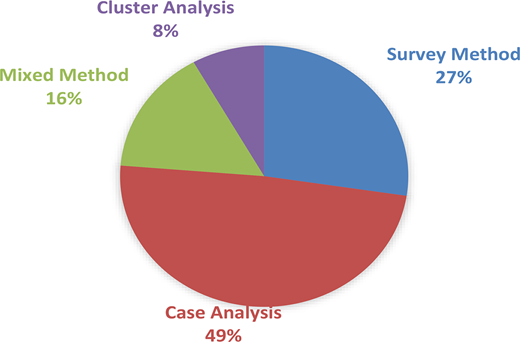
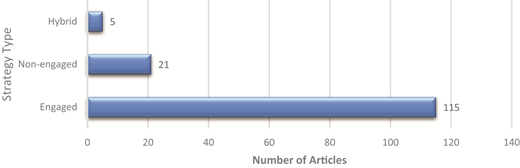
Figure 3 shows the number of articles published within the timeframe (2015–2024) that meet our selection criteria, and the findings show that NMS publication started gaining momentum between 2015 and 2019, the year 2020 shows a significant surge, signaling the growth and importance of the research area for organizations in international business literature. Figure 4 analyzed the 141 articles based on their strategy type and focus, and the results show that articles focused on engagement are 115 (81%), non-engagement are 21 (21%) and hybrid (articles emphasizing both orientations) are 5 (3%). These findings also corroborate the recently published articles in Table 2, which were used to answer the study’s research question. Also, the twenty articles analyzed and presented in Table 2, as opposed to the 141 articles selected for this review, are meant to illustrate recent scholarship in the field. Hence, the 81% articles focused on engagement, the 21% on non-engagement and the 3% on hybrid are all figures generated from coding all 141 articles.
Recent articles on nonmarket strategy
| Author | Objectives | Methods | Findings | NMS approach |
|---|---|---|---|---|
| Shi et al., 2021 | Foreign institutional ownership (FIO) has been aptly researched, but the study has failed to capture how FIO increased regulatory compliance in host governments, making them more dependent on CPA activities | Multiple case analysis | A firm may engage in FIO but sometimes has a negative impact due to increased political dependence and regulatory compliance, which may serve as exposure to firms, especially during a change of administration. A firm can manage exposure and regulatory compliance using CPA to assess and influence the political background. Political dependence and tight regulatory compliance may hinder the firm from meeting its shareholder goal and affect effective resource allocation | Engage orientation |
| Liou et al., 2021 | The paper aims to study the influence of political animosity in developed countries due to the strategic acquisition of firms in developed markets | The study used data from 2005 to 2011 from USA firms and adopted Tobit Regression Analysis | Findings show that due to the increased political animosity in a developed country, EMNCs engage in nonmarket strategy through lobbying capabilities and acquire less ownership stake in a developed country to control less regulatory scrutiny. Also, due to tight legitimacy concerns in a developed market, shareholders of EMNC firms in developed markets have more legitimacy accessibility than others | Engage orientation |
| Harris and Brown, 2021 | The study assesses the relative performance effect of the top management team (TMT) and chief executive officer (CEO) human capital. The study will also take into consideration the external influence of CPA | Case analysis using data from the national collegiate athletic association (NCAA) | The study found that organizations adopt market and nonmarket strategies to influence performance outcomes. Also, the study found that TMT, CEO and CPA interaction positively influences the firm’s performance | Engage orientation |
| Georgallis et al., 2021 | The article focused on industry support policies in the international market and how they affect firms’ choices of foreign market placement | Greenfield investment data was assessed from financial times (fDimarkets database) between 2004 and 2013 | The findings show that supportive foreign policies encourage new entrants into the renewable energy industries. Furthermore, adverse policy changes from One country influence how firms perceive policy in another country | NonengageOrientation |
| Sun et al., 2021 | The research focuses on documenting nonmarket strategy practices, including CPA and SCSR, while considering the integrative effects of both practices on firm performance | Systematic literature review of multinational NMS research | The review grouped multinational MNS into theme, method, theory, context, and level of analysis based on their contributions. The study develops a multiplicity framework to sectionalize NMS research practices such as CPA and SCSR and their integration to examine how impactful each contributes to MNE performance | Engage orientation |
| Hajmohammad et al., 2021 | The paper’s objective is to develop a typology of response to supplier’s misconduct in achieving environmental sustainability by addressing the contentions of NMS stakeholders | Vignette-based methodology | Findings show that NMS stakeholders’ responses impact supplier misconduct and the organization’s response method; NMS stakeholders’ philosophy impacts response intensity. However, firms’ reputations do not affect the response strategy NMS stakeholders adopt when faced with contentions | Nonengage orientation |
| White et al., 2021 | This research examines how firms can manage MNE nonmarket forces in countries with high populism and geopolitical uncertainties | Systematic literature review of Three articles published in the journal of multinational business review | The study provides insight into the relevant use of MNEs in countries characterized by populism and geopolitical uncertainties and advanced Four critical research gaps for future researchers ranging from (i) resilience and firm legitimacy, (ii) diversification, (iii) institutional arbitrage, (iv) integration, of MS-NMS strategy | Engage orientation |
| Johnson et al., 2021 | The research objective is to determine the willingness of consumers to participate in CPA through the influence of constituency building as an NMS practice | The study adopted a Mixed methodology to examine Three case studies, using qualitative Research in One and quantitative in 2 cases research design | The findings show that consumers become politically connected to an organization due to some essential shared characteristics (brand loyalty, information-seeking, issues pertinent to consumers, value-congruency, among others) with an organization’s brand over time, and this motivates consumers to become politically involved on behalf of the company or brand they shared this connection with | Engage Orientation |
| Nalick et al., 2022 | Different organizations have different CEO personalities and ideologies, and these ideologies determine the rate at which firms engage in lobbying activities. This ideology influences the CEO’s political disposition and organizational performance | Panel data of public firms with governance data and CEOs that engage in campaign contributions covering 1998–2018 | Findings show that the CEO’s political ideology and the current political party significantly impact firm lobbying strategies/investment and organization outcomes. Hence, when the CEO’s political party is in power, a firm may lobby aggressively to maintain and protect its strategic asset and vice versa | Engage Orientation |
| Kim, 2022 | This aims to show how Integration strategy (market and nonmarket) provides a significant edge for organizations over climate change policy. Also, why do firms engage in lobbying policies on climate change and others do not? | Using a data set of US SandP 500 firms on climate change policies | The management of a nonmarket environment is challenging and complex when compared to the market environment. Findings show that neglecting the nonmarket environment may challenge the long-term sustainability of organizations due to climate change. The firm, therefore, needs to manage its carbon emissions and forge a sustainable relational strategy with nonmarket stakeholders to manage both market and nonmarket climate issues. Also, organization resources and capabilities are essential to combat market and nonmarket strategies to manage carbon emissions and relative policy changes in the home and host markets. The findings show that central and local political ties have conflicting performance outcomes and firms’ strategic competitive actions on the organization. The study enriched the co-evolution framework in the international business literature by integrating the yin-yang framework to broaden the economic understanding of risks and costs in political disruptions of multinational subsidiaries operating in China. The study proposes Three yin-yang frameworks to analyze NMS strategy better.The research uncovers Seven questions posed by NMS historians to understand better past, present, and future nonmarket strategies for effective integrations of strategic competitive actions. The study found that in an institutionally voided business environment like Nigeria and Ghana, new MNEs need to deploy Three kinds of legitimacy (cognitive, regulative, and normative legitimacies) for successful business performance.The findings show a positive correlation between firm legitimacy and AGM. Findings also show that firm NMS strategies through CPA practices positively influence AGM adoption. Additionally, environmental scanning shows the linkage between green management adoption, CPA practices, and focal firm performance. The findings show that board gender diversity impacts firm performance in foreign markets. Furthermore, the impact of the board gender diversity becomes more robust when the firms have public relations functions and or operate in countries that believe in gender parity. The finding shows that when combined, CPA and CSR strategies have complementary efforts to enhance and help organizations achieve business performance, improving firm competitiveness. Findings show that foreign firms that make political donations through PACs enjoy favorable treatment by getting awarded more government contracts than those that do not.Findings revealed that most US corporate lobbyists charge firms coming from autocratic countries premium fees compared to others, and foreign firms that cannot pay this fee face the issue of illegitimacy.Findings show that domestic firms mounted pressure on MNEs on Two fronts: first, by lobbying the host government for policy changes that focused on patronizing domestic firm suppliers, and second, by spreading unethical rumors that were aimed at vilifying MNEs from being able to penetrate local society | Engage Orientation |
| Zheng et al., 2022Ren and Gao, 2023Bucheli and DeBerge 2024Peprah et al., 2024Ma and Xue 2024Saeed et al. 2024Adomako et al., 2023Ayyagari et al., 2024Kim, and Siegel, 2024Tzeng 2023 | The article focuses on CPA strategy as a critical form of NMS strategy that posits that political ties can determine firm strategic success in foreign markets. This success, however, depends on whether the political ties are associated with the central host government or local NMS actors. This paper explains how subsidiary firms in China adopt NMS strategy to gain legitimacy. The paper focuses on integrating insight from Two multi-level (social and geopolitical) business environments that subsidiary firms confront daily.The study provides historical insight into how firms have been using nonmarket strategies to strategically plan for long-term and economic processes that aid successful internationalization. The articles focus on how new MNEs can leverage NMS strategy to gain legitimacy in institutionally voided business environments with insight from African e-commerce giant (Jumia)The study focuses on understanding the factors surrounding MNE’s decision to adopt alliance green management (AGM) across all their business operations. The study uses the embeddedness perspective to unravel NMS’s impact on the AGM decision and its benefits on firm legitimacy.The study examines board gender diversity in emerging market organizations through the lens of NMS strategy on firm performance. The study aims to understand the relationship between CPA, CSR, and firm competitiveness through the focal view of the resource-based theory. The paper examines foreign firms’ political campaign contributions through (PACs) and their impact on organizations’ access to essential political resources and government contracts in the US. The research shows how firms battle host country liability of foreignness to gain legitimacy by proposing a new theory that incorporates lobbying within NMSThe study seeks to examine how domestic firms challenge MNEs in the host country when there is political hostility between home-host countries | A dataset of Chinese TV manufacturing firms between the years 1993 and 2003 was gathered using bivariate analysis and a logistics regression model. This conceptual paper aims to theorize NMS strategy for selective subsidiary firms for de-globalization in China.The study used Archive-based methods.The study gathered data through in-depth interviews, observations, and archival data of Jumia. The study collected data from 199 firms through in-depth interviews and survey methods; ANOVA was the data analysis method.The study collected data from Chinese and Indian firm’s subsidiaries operating in foreign markets between 2008 and 2017. The data were analyzed using multiple methods of moment regression analysisThe study collected data from 2 Africans and 2 Asian countries. The study uses a hierarchical regression model to test its data.The study used published and available online PAC data on openscreets or Center for Responsive Politics and used a pairwise correlation statistics.The study used empirical data covering the years 1998–2012 and collected from the Center for Responsive Politics in the USThe study conducted a case study analysis between MNEs from Taiwan and domestic firms from China Mainland between the years 2004–2008 | Engage orientation | |
Consequently, Table 2 presents articles published in 2020 that signal the surge (Figure 3) and the importance of NMS practices in the international business literature. We aimed to answer the research question of this study using the findings from this table. The justification for selecting only the most recent articles to answer the research question is that, one, due to space limitations, and Figure 4 already provides a general view of the 141 articles focused on and the strategy types. Additionally, the years 2020 and 2021, as shown in Figure 3, mark a surge in NMS publications across selected journals. Hence, we decided to restrict the selection of the Table 2 article analysis to those years.
Furthermore, the aggregated perspective framework on NMS research (seeFigure 6) in this study was inspired by the works of Oliver and Holzinger (2008) and De-Villa et al. (2018). Thus, our model extends their view, given the current rise in NMS research and the need to create a holistic understanding of the role of firm dynamic capabilities during internationalization. To further enhance our knowledge of NMS research in this review, we highlighted the widely used methodology and the variables that have been extensively researched in NMS (see Figure 5 and Table 3). This suggests that NMS is a burgeoning research area for scholars in the field of international business, and the growing number of publications in this field underscores its contributions and relevance to organizations and the academic community.
Dependent, independent and control variables in NMS research
 The framework presents N M S D C as the core construct interacting with regulatory institutions, standard organizations, interest groups, and media. It is organised through internal capabilities and external capabilities, along with a transactional approach and relational approach. Under the transactional approach, the reactive strategy includes invest in training and skills innovation for improve compliance, flexible operational architecture, and internal low-cost reconfiguration to meets political demand. Defensive strategy includes lobbying to increase the entry barrier, actively advocating on status quo, lobbying to protect the pricing structure. Under the relational approach, an anticipatory strategy includes enhanced reputation and firm legitimacy, enjoys first-mover advantage, anticipate policy change and establish best practices, hire government experts. Proactive strategy includes establishing standards, reshaping public policies to fit firm strength, cooperate with the government to create new entry and exit rule. These strategies connect to value creation associated with non-engagement and value maintenance associated with engage.
Aggregated analytical NMS research perspective
The framework presents N M S D C as the core construct interacting with regulatory institutions, standard organizations, interest groups, and media. It is organised through internal capabilities and external capabilities, along with a transactional approach and relational approach. Under the transactional approach, the reactive strategy includes invest in training and skills innovation for improve compliance, flexible operational architecture, and internal low-cost reconfiguration to meets political demand. Defensive strategy includes lobbying to increase the entry barrier, actively advocating on status quo, lobbying to protect the pricing structure. Under the relational approach, an anticipatory strategy includes enhanced reputation and firm legitimacy, enjoys first-mover advantage, anticipate policy change and establish best practices, hire government experts. Proactive strategy includes establishing standards, reshaping public policies to fit firm strength, cooperate with the government to create new entry and exit rule. These strategies connect to value creation associated with non-engagement and value maintenance associated with engage.Aggregated analytical NMS research perspective
Thematic analysis
An organization’s decision to choose between the engage or non-engage approach for the foreign market depends on numerous factors such as the firm’s internal and external capabilities, host and home countries’ political uncertainty or scrutiny, and the firm’s goal for the subsidiary market (Adomako et al., 2023; Saeed et al., 2024). Also, given the broad NMS research agenda, we explore the different constructs of NMS (e.g. CPA, lobbying capability, relational and transactional capability, etc.) that have been broadly researched to date (Table 3) to understand better the perspective that drives managers’ decisions to choose between engaging or not engaging nonmarket stakeholders. We found that the aggregated view of all the articles reviewed and presented in Table 2 on NMS research mainly focuses on the decision to engage or not engage with the host government’s political structure. For instance, out of the 20 recent articles reviewed in Table 2, 18 of the article orientations are toward engaging with the host government’s political and regulatory structure. At the same time, only two are focused on the non-engagement approach. This suggests that the engagement approach with the host government’s political and regulatory structure will likely help a firm achieve a sustainable competitive advantage in foreign markets over non-engagement, and this was also corroborated in Figure 4. This is not surprising because the engagement approach enables organizations to access essential nonmarket resources, which in turn allows them to enjoy a sustainable competitive advantage and survive in foreign markets (Adejare et al., 2023). Additionally, we found that environmental uncertainty and political disruptions were responsible for the non-engaged approach adopted in these two studies (Hajmohammad et al., 2021; Georgallis et al., 2021).
Additionally, among the 141 articles on NMS strategy, scholars such as Parnell (2018) made a unique contribution to the DC-NMS literature by focusing on management and marketing capabilities and their significant impact on NMS-firm internationalization performance. We noted that dynamic capabilities measures are wide, and although their relevance is only visible in an uncertain market context, they encompass all criteria that an organization can use to measure success, either within engagement strategies or non-engagement strategies in foreign markets. For instance, management, marketing, financial and technological capabilities are all elements of DCs, whereas political capability results from the firm’s management of nonmarket stakeholders, relational capacity, management knowledge, cognitive capabilities and marketing intelligence (Shi et al., 2021; Liou et al., 2021).
Dynamic capabilities in NMS agenda
Result by DC-NMS relationship
A significant number of NMS scholars take a theoretical perspective from the viewpoint of RBV, arguing that firms have the capacity, through their resources and capabilities, to influence or mitigate the influence of stakeholders in foreign markets (Parnell, 2018; Surmeier, 2020; Peterson et al., 2020). Following this viewpoint, we theorize that MS-NMS theoretical integration can address the host market’s environmental, political, and regulatory uncertainties by harnessing the firm’s internal dynamic capabilities to sense, seize, and reconfigure stakeholders’ dynamics, thereby facilitating effective internationalization success. This position was empirically affirmed by Kim (2022) and Adejare et al. (2023). Also, drawing on the linkage between stakeholder theory and RBV (MS and NMS) of the firm (Parnell, 2018; Gaudenzi et al., 2021) found that the missing link between the interconnectivity existing between MS and NMS strategy of the firm is the dynamic role of its resources and capabilities to handle both internal and external challenges to the advantage of the firm (Zheng et al., 2022; Adejare et al., 2023). Furthermore, an organization with strong sensing capabilities would be able to quickly detect early signs of possible changes in regulatory or political shifts, especially in a predictable business environment. Sensing capabilities foster engagement, as an organization can predict possible returns from lobbying and/or engaging in CSR activities (Surmeier, 2020). However, in an opaque business environment, sensing may force a firm to refrain from engaging with nonmarket stakeholders due to the risk of misalignment or over-embeddedness. Thus, we propose that, under a predictable institutional business environment, an organization with strong sensing capabilities is more likely to adopt an engagement-oriented NMS approach, but under an opaque or unpredictable business environment, is more likely to use a non-engagement approach.
Seizing consists of mobilizing resources to act on specific market opportunities. In strong institutions with a clear enforcement of the rule of law, seizing provides support for engagement through lobbying because the channels of influence are dependable. Non-engagement may be preferable in weak institutions where the payoff from seizing opportunities is low or highly uncertain (Peterson et al., 2020). We then propose that a strong seizing capability will likely increase a firm’s engagement approach in a strong institutional business environment; however, in weak institutions, a high seizing capability might not significantly increase the likelihood of engagement with NMS stakeholders.
Reconfiguring capabilities involves reshaping or reorganizing resources to align with the host market’s business conditions. In a homogeneous society with numerous stakeholders and competitors, reconfiguring capabilities enables a firm to navigate a complex system by engaging in alliances and CSR partnerships (Parnell, 2018). However, in a concentrated institution where dominant actors are the norm, reconfiguring capabilities may lead a firm towards non-engagement, as adapting to a situation through compliance might be easier than actively lobbying to influence stakeholders. On this note, we propose that in a homogeneous business environment, an organization with strong reconfiguring capabilities is more likely to adopt an engagement approach of NMS strategies, but in a concentrated institution, it is more likely to adopt a non-engagement approach. In general, the value of dynamic capabilities is seen in an unstable institutional business environment. Thus, an organization that can mobilize its sensing, seizing and reconfiguring capabilities will prefer engaging with stakeholders, especially when changes within the business environment are transparent, thereby making influence a possibility. But in an opaque or unstable (politically chaotic) environment, firm DCs may push for non-engagement due to the risk of being on the wrong side.
Scholars argue that firms that possess strong internal capabilities might consider adopting a non-engagement approach (low visibility, avoidance, transactional, etc.), hence reacting to policies and anticipating changes that may affect firm operations in the business environment (Parnell, 2018; Surmeier, 2020; Peterson et al., 2020) see Figures 4 and 6 . A firm that adopts an engagement approach needs external capabilities (such as lobbying, campaign contributions and political action committees) to compensate for its internal capabilities deficiency. Nevertheless, the position of scholars on these two approaches relies on the availability of slack resources, as well as political and regulatory uncertainties in the international market. This was corroborated by the findings of van Kranenburg and Voinea (2017), who noted that large organizations mainly engage in NMS practices due to their considerable resource advantages.
Result by MS-NMS theoretical integration
The call for theoretical integration between market and NMS is long overdue. Although empirical research and reviews of NMS have, over time, suggested the beneficial effects of these interactions (see Mellahi et al., 2015; Ismayil and Tunçalp, 2024), research addressing this perspective remains fragmented. To be concise in our proposition, we focused only on theories that have been used in over 50 articles in our selection. Our analysis reveals that institutional theory is the primary theory most commonly employed in NMS literature. This finding aligns with the general nonmarket review conducted by (Mellahi et al., 2015). The social network theory and transaction cost perspectives are two other theories that are gaining significant momentum in the NMS literature (Table 4).
Major MS-NMS theoretical perspectives and proposition
| Theories | MS | NMS | MS and NMS | Total no. |
|---|---|---|---|---|
| Institutional theory (including all its variants, e.g. neo-institutional theory, legitimacy assessment, etc.) | 14 | 29 | 10 | 53 |
| Stakeholder theory | 16 | 20 | 7 | 43 |
| Resource dependence theory | 14 | 19 | 11 | 44 |
| Resource-based theory (comprising the dynamic capabilities perspectives) | 15 | 18 | 6 | 39 |
| Behavioural theory | 11 | 15 | 8 | 34 |
| Agency theory | 9 | 6 | 6 | 21 |
| Social network | 3 | 8 | 7 | 18 |
| embeddedness theory | 4 | 9 | 2 | 15 |
| Transaction cost theory | 5 | 9 | 7 | 21 |
| Public choice theory | 4 | 6 | 2 | 12 |
The above theories have been used by over 50 articles in our article collections
These theoretical integrations are necessary to satisfy the concurrent interests of both market and nonmarket forces in foreign markets; for instance, institutional theory stresses how government institutions in domestic and/or international markets can influence firm strategy and structure (Hadani, 2012). The public choice theory emphasizes that self-interest is the ultimate drive for organizations engaging in NMS practices to complement MS activities. Therefore, firms will pursue mutually beneficial arrangements with politicians (Wood and Frynas, 2006; Parnell, 2018; Pei et al., 2012; Adomako et al., 2023). Behavioral theory of the firm assumes that an organization will always seek profit maximization through effective utilization of its political resources and cognitive capabilities when taking business risks, especially when performance expectations are yet to be achieved in the foreign market (Ji-Yub et al., 2011; Liu et al., 2015; Adejare et al., 2023). Similarly, stakeholder theory emphasizes the need for organizations to focus on a broad range of groups and institutional interests, beyond suppliers, customers and competitors, that may influence firms’ operations in the international market (Hillman and Keim, 2001; Parnell, 2018). Resource dependence theory accentuates the importance of acquiring critical resource advantages for a firm’s competitive position (Leroux and Goerdel, 2009).
Thus, while the RBV or resource dependence (MS) explains firm capabilities and how they can be harnessed in the international market, institutional theory (NMS) focuses on explaining constraints or motivations that enhance managers’ perspectives and broaden their view of the opportunities embedded in foreign markets. Additionally, resource dependence offers a proximate mechanism for accessing the internal capabilities of the firm, while institutional theory provides a normative framework to legitimize actions taken when interacting with NMS stakeholders. Findings show that the integration between CSR and CPA leads to overlap in stakeholders’ dependence and firm legitimacy, but empirical integrations remain elusive in NMS literature (Mellahi et al., 2015).
The importance of these integrations demonstrates that while market theories explain firm-level variance within the confines of capabilities and costs, nonmarket theories explain environmental and NMS actor constraints. And together, they depict the circumstances under which engagement and non-engagement are chosen, and if so, whether any of these strategies will succeed in the foreign market. Also, from an RBV lens, lobbying can be perceived as an asset, while from an institutional lens, lobbying can be harmful to firm legitimacy (Brown et al., 2022). Integrating both and factoring in the dynamic capabilities perspective, the firm must know when to lobby and when to invest in CSR.
In other words, to understand why firms act and engage NMS actors, resource dependence theory, stakeholder theory and institutional theory explain the incentives, pressure and motives behind firm actions. While RBV and dynamic capabilities theories demonstrate how firms use their resources and capabilities to respond to an ever-changing business environment, thereby ensuring continued success. In terms of firm internationalization performance and NMS agenda, agency theory, RBV, and political-resource models provide a clear linkage between NMS and firm performance, either through risk mitigation or unfiltered access to resources in the host market (Shirodkar, Rajwani, Stadler, Hautz, and Mayer, 2022; Katic and Hillman, 2023). We previously argued that firms’ internal and external environments are interconnected and interdependent, driving firm performance (Levy and Egan, 2003; Zheng et al., 2022). In this regard, integrating MS and NMS theories will open new conceptual frontiers and provide empirical insights into the relationship between the two constructs, as well as how they can enhance firms’ sustainable performance in the international market.
Furthermore, the CPA and NMS literature suggests that engaging with political actors can be an important determinant of firm internationalization performance by helping to shape regulatory backlash and reducing host market policy uncertainty (Lux et al., 2011). Proactive CPA engagement such as lobbying, campaign contributions or constituency building allows firms to influence host market institutional policies in ways that aligned with firm strategic interests. However, the benefits of engagement or non-engagement are not automatically reflected on firm performance. Lux et al. (2011) argue that the performance effects of CPA depend on alignment between political activity, firm dynamic capabilities and the broader institutional context, implying that over engagement or embeddedness may generate negative returns which affect firm legitimacy in foreign market.
Recent work further emphasizes that CPA non-engagement is not merely an absence of political strategy but a deliberate choice that can protect firms from legitimacy and reputational risks. Hadani et al. (2017) demonstrate a curvilinear relationship between political involvement and firm performance, whereby moderate levels of engagement outperform both low and high levels. This finding highlights the complementary role of non-engagement in constraining over-politicization, mitigating agency problems and reducing public and stakeholder scrutiny. Together, these studies suggest that optimal performance arises from a strategic balance between engagement and restraint rather than from maximal political participation.
This balance becomes especially contingent for MNEs to achieve success in international market. MNEs operate across heterogeneous institutional business environments where norms governing political engagement vary widely, increasing the risk that CPA strategies effective in one country may undermine legitimacy in another. Moreover, the liability of foreignness constrains MNEs’ access to host-country political networks, reducing the effectiveness of direct engagement while amplifying reputational spillovers across borders (Lux et al., 2011; Hadani et al., 2017). As a result, MNEs often benefit from selective engagement combined with strategic non-engagement or indirect approaches, underscoring the highly contingent nature of the CPA–performance relationship in international contexts.
Analysis of nonmarket approaches
The engaged and non-engaged approach of NMS depends on the strategic orientations and the value proposition of the firm management for the international market (Figure 4). Numerous research studies on NMS practices have been conducted, and all of them have centered on the firm’s use of an engaged or non-engaged approach during internationalization. A firm that uses any of these approaches intends to maintain or create value in the international business environment. Furthermore, an organization can use any of these NMS approaches and strategies on a long-haul basis (relational strategy), especially when the firm can project a promising return on internationalization investment in the host market. Especially when the host market institutional framework is perceived to be weak and disadvantageous. An organization may sometimes adopt a quid pro quo (transactional strategies) to engage with nonmarket stakeholders to lobby essential policies to the advantage of a firm (Zhu and Chung, 2014). Interestingly, these approaches have given birth to numerous NMS practices, which are briefly discussed below.
Engagement approach – dynamic capabilities (value maintenance)
NMS literature divides the engagement approach into defensive and proactive strategies (Figure 6). Engaging with the host government’s political structure generally means that firms intend to influence policies and decisions to the advantage of the organization. Scholars argue that firms that use engagement approaches rely heavily on relational and sometimes transactional strategies to achieve competitive positions and market success (Mellahi et al., 2015; John and Lawton, 2017). Conversely, the organization’s material interest, size and availability of necessary resources (finance) determine the mode and extent of firm engagement in IB literature (Parnell, 2018; Lawton, McGuire and Rajwan, 2012).
Defensive strategy: these are the tactics that organizations adopt to influence and change unwanted regulations or policies that affect the corporate existence and future success of firm operations in a country (Adomako et al., 2023). For example, to protect and defend the assets and future existence of tobacco products in the Republic of Ireland, the British Tobacco Company increased the legal pressure in an attempt to lift the smoking restrictions in the country because tobacco restrictions are generally against EU regulations (Marketing Week, 2004; Oliver and Holzinger, 2008; Kim, 2022). Also, lobbying government officials to increase entry barriers in the industry and lobbying to protect pricing structures, among others, are all examples of defensive strategies. When an organization perceives that a change in political structure or regulatory institutions will harm its competitive position and success, it will swing into action to protect its interests and strategic assets. Thus, a defensive strategy requires that the firm uses its social ties/network capacity to protect and defend the company’s interest by advocating for the maintenance of current regulations or the adjustment of the same to favor the organizations (Lawton, Doh and Rajwani, 2014).
Proactive strategy: these are strategies that organizations engage in to develop and redefine the general view of public policies. According to Van Kranenburg and Voinea (2017), a proactive approach can also be referred to as a buffering mechanism. The institutional theory of the firm assumes that organizations that can influence and manipulate the beliefs and values of essential stakeholders in their respective institutional business environments will have the ultimate power and control to dictate standards. This is why many organizations actively engage in professional bodies and participate in media activities, constituency building or coalitions to influence the norms, practices and values of such institutional constituencies (John and Lawton, 2017; Mellahi et al., 2015; Johnson et al., 2021). For example, reconfiguring constituent standards and establishing criteria to enforce current regulatory legislation, among others, are all proactive political strategies. Scholars have argued that firms with greater social legitimacy can influence stakeholders and government officials, gain access to relevant resources and information, and survive during a political shock/upheaval (Aldrich and Fiol, 1994; Oliver, 1997; Oliver and Holzinger, 2008; Mellahi et al., 2015; Lupton, Benham and Jimenez, 2020; Georgallis et al., 2021).
Non-engagement approach – dynamic capabilities (value creation)
Firms can also adopt a non-engaged approach by structuring their internal dynamic capabilities to remain flexible to accommodate policy changes imposed by the host government’s political structure (Mellahi et al., 2015; Harris and Brown, 2021). In doing this, the firm will rely on a reactive and/or anticipatory strategy inspired by the firm’s internal dynamic capabilities to achieve continuous business momentum (seeFigure 6). However, we argue that firms using a non-engaged strategy may sometimes adopt a transactional approach, see Figure 6, when faced with situations that are beyond the control of their internal dynamic capabilities (Frynas et al., 2017). Transactional approaches are one-off approaches adopted by firms to resolve complex environmental problems that may harm the continuous operations of a firm.
Reactive strategy: Compared to proactive and defensive strategies, reactive strategies do not advocate for policy change but maximize firm values through compliance with public policy by effectively and efficiently aligning firm operational processes to meet public policy demands. This view is deeply supported by the dynamic capabilities perspective, given its heavy reliance on the firm internal capabilities to effectively reconfigure and realign its technical and structural processes to meet public policy demands (Teece et al., 2016). For example, its main focus is on continuous improvement in firm structure and processes to make compliance less costly and on-time dissemination of compliance information on production processes to regulators, among others. Furthermore, the speed and efficiency with which a firm can achieve success using reactive strategies require consistently investing in training and retraining its workforce to acquire the skills necessary to meet compliance standards. Additionally, the institutional theory of the firm argues that compliance with government and environmental pressures increases the chances for high performance and survival by enhancing firm legitimacy and social support (Bansal and Roth, 2000; Baum and Oliver, 1991; Mbalyohere and Lawton, 2018; Adejare et al., 2023).
Anticipatory strategy: Anticipatory strategy also involves compliance with public policy demands. However, anticipatory strategy, unlike reactive strategy, adopts both internal and external capabilities to enhance external information scanning and effective knowledge-acquisition to anticipate changes in policies and effectively enact and reconfigure resources to gain a first-mover advantage (Mellahi et al., 2015; Frynas et al., 2006). Dynamic capabilities here are used solely for scanning and predictive ability to gain early knowledge and impending political changes that may disrupt firm operational processes. This way, the scanning and predictive ability of the firm allows the firm to enact processes and respond appropriately to the anticipated public policy changes before implementation. Empirical findings show that consistent environmental scanning was directly linked to a firm’s high performance in the service industry (Andersson and Bateman, 2000; Parnell and Brady, 2019). Thus, customers, competitors, suppliers, government and the general public may perceive an anticipatory strategy as making an organization highly receptive and a pacesetter. For instance, Toshiba and Hitachi enjoyed the first mover’s advantage by anticipating changes in the battery business and then procuring and installing an array of designs focused on acid-free and renewables-batteries (Oliver and Holzinger, 2008). Until now, scholars have yet to reach a consensus on the best approach (engage or non-engage) that firms can adopt during internationalization (De-Villa et al., 2018). However, they affirmed that either approach depends solely on the firm’s resources, strategic business design, capabilities and host market regulatory and political stability (Parnell and Brady, 2019; Mellahi et al., 2015).
Why do firms engage with the host government?
Apart from the negative sentiment surrounding globalization and the dynamic business environmental uncertainties plaguing successful business operations all over the world (Ren and Gao, 2023), organizations are also bewildered by the host country’s institutional void, which highlights the liability of state-ownership (ownership stake), including the liability of foreignness (Peprah et al., 2024; Hasija et al., 2025). The international business literature, particularly the NMS scholars, has accentuated the importance and the need for firm legitimacy, and organizations will do all it takes to improve social ties and enhance firm legitimacy in a foreign country (Sun et al., 2021; Ma and Xue, 2024). Meyer et al. (2014) demonstrate how SOEs in China achieve firm legitimacy by adapting their business operations to comply with the host market rules and regulations, thereby protecting shareholder interest and acquiring less ownership in foreign countries. Furthermore, Li et al. (2017) found that engaging with host government regulatory and political structures enables organizations to access critical resources and information, which may serve as a first-mover advantage for an organization. Research on CPA practices has highlighted numerous benefits of firm political engagement, particularly in a complex business environment (Rajwani and Liedong, 2015; Sun et al., 2021; Mellahi et al., 2015).
Recent findings show that organizations’ political ties are a strategic way of dealing with the complex institutional business environment, even though other scholars believe these ties with the government may be conditional (Zheng et al., 2022). For instance, Parnell (2018) found that the political relational capital gathered from engagement with some foreign firms enhances firm internationalization for some US-based law firms but negatively impacts their financial performance. Empirical findings show that political ties depend on the stability of the host market’s regulatory and political regime, as a sudden change of political power/administration to which the foreign firm is connected may harm the continuous business operations in the host market (Akbar and Kisilowski, 2020). Thus, we argue that firms should avoid over-encroachment/embeddedness through political engagement to curb the negative effect of sudden political change or institutional upheaval in the host market (Nalick et al., 2022).
Conclusion
This study contributes to knowledge in NMS literature in several ways, especially by showing a comprehensive perspective of NMS research. Our findings reflect the need and the reason for the growing momentum of NMS research in the literature and show how firm dynamic capabilities can help organizations to plan and integrate into complex and emerging host markets (Gupta et al., 2020; Alinaghiana et al., 2020; Gaudenzi et al., 2021). Nonetheless, the criteria adopted to select and screen articles may have led to the unintentional exclusion of impactful articles, and this we see as a limitation for this research. However, this systematic literature review followed a rigorous search protocol, incorporating relevant empirical and conceptual findings in the field of NMS research to provide valuable insights and guide future directions on the subject.
Future research directions
The systematic review has revealed several gaps in the literature that need further attention. Our review reveals that dynamic capabilities and nonmarket engagement practices are essential for success in the NMS literature, as posited by Parnell (2018), Sun et al. (2021) and Adejare et al. (2023). However, there is limited empirical research on how nonmarket capabilities are measured in the NMS literature, especially the internal capabilities that enable firms to engage, anticipate, and influence nonmarket environment policies, which extend beyond lobbying and CSR activities. How can an organization operationalize nonmarket sensing, seizing and transformation of opportunities embedded in the host market?. Future research can explore how firms can integrate dynamic capabilities with organizational learning processes to theorize the NMS capability-building lifecycle. There is also a need to understand how firm dynamic capabilities and the path dependence model shape nonmarket engagement practices for firms’ short- and long-term internationalization performance in foreign markets.
We stated that relational and transactional strategies are used interchangeably regardless of MNEs’ approaches and institutional and political issues in the international markets. We also emphasize that each approach depends on the firm’s strategic business framework, political resources and capability to manage policy decisions effectively to the advantage of the firm. However, there is a lack of longitudinal studies on sequencing and capability development. For instance, NMS research lacks longitudinal evidence on when a firm should invest in building a relationship versus using a transactional strategy. When can an organization move from relational ties to transactional tactics during an institutional shift or a crisis? How does an organization know when investment in long-term relational capital has reached its limit, thereby switching to a short-term transactional strategy and vice versa?.
The call by scholars such as (Mellahi et al., 2015; Frynas et al., 2017; and John and Lawton, 2017) to engage a multi-theoretical approach from a discipline outside of social and management sciences to enhance knowledge and understanding of the impact of NMS research on organizations remains unanswered. Multinational corporations face numerous conflicting pressures in their business environment across multiple jurisdictions and single-level theories are insufficient to address the complexity and change of cross-border institutional nonmarket dynamics. Therefore, organizations must integrate institutional pluralism, logics and political bargaining models to explain MNE-NMS local and international coordination and adaptation. Firm must also be able to combine both behavioral and institutional theory to model the micro-foundations of NMS choices. Notably, certain factors play a crucial role in moderating the relationship between NMS approaches and firm internationalization performance. These factors include: Industry characteristics, home-host country combinations and firm-level factors (state-owned enterprises vs private organizations), among others. Future research can investigate the dynamics of these relationships in relation to the factors that influence firm internationalization success.
Finally, our review revealed that firm adaptability to host country NMS practices, regardless of political resources at their disposal, is critical to success in the international market. The findings show that engaging nonmarket stakeholders is more beneficial in the international market than a non-engaged approach. Nonetheless, we found no empirical evidence showing the sustainable impact of firms adopting the non-engagement NMS approach, especially in a market plagued by political disruption and institutional upheaval. This will be another exciting strand that future research can focus on.
Funding
The author(s) received no funding from any individual or organiations for this project.

