Institutional, economic, social and technological advancements enable openness to cope with wicked public management issues. Although open innovation (OI) is becoming a new normality for public sector entities, scholarly knowledge on this topic is not fully systematized. The article fills this gap, providing a thick and integrative account of OI to inspire public management decisions.
Following the SPAR-4-SLR protocol, a domain-based literature review has been accomplished. Consistently with the study purpose, a hybrid methodology has been designed. Bibliographic coupling permitted us to discover the research streams populating the scientific debate. The core arguments addressed within and across the streams were reported through an interpretive approach.
Starting from an intellectual core of 94 contributions, 5 research streams were spotted. OI in the public sector unfolds through an evolutionary path. Public sector entities conventionally acted as “senior partners” of privately-owned companies, providing funding (yellow cluster) and data (purple cluster) to nurture OI. An advanced perspective envisages OI as a public management model purposefully enacted by public sector entities to co-create value with relevant stakeholders (red cluster). Fitting architectures (green cluster) and mechanisms (blue cluster) should be arranged to release the potential of OI in the public sector.
The role of public sector entities in enacting OI should be revised embracing a value co-creation perspective. Tailored organizational interventions and management decisions are required to make OI a reliable and dependable public value generation model.
The article originally systematizes the scholarly knowledge about OI, presenting it as a new normality for public value generation.
1. Introduction
Increasing turbulence and complexity of the environment reconfigure the logic that inspires the functioning of public sector entities (e.g. Barahona and Elizondo, 2014; Demircioglu and Audretsch, 2020), calling for management decisions aimed at organizational flexibility and adaptiveness (Cunningham and Kempling, 2009; Isaac-Henry and Painter, 1991). This happens amidst multiple challenges, which undermine the public sector entities' ability to meet the evolving needs of the community. Financial constraints make it difficult to achieve a compromise between austerity measures and the delivery of high-quality services (Felício et al., 2021). Technological transformations alter value creation processes and revisit conventional management practices (Erakovic and Wilson, 2006). Institutional transitions imposed by the managerialization of the public sector dictate a rethinking of the assumptions laying behind management decisions, propelling proactiveness and resilience in steering public sector entities (Common, 1998).
The shift towards value co-creation has been envisaged as the leading way to cope with such challenges (Palumbo and Fakhar Manesh, 2021). This is especially true where innovation is concerned (Alves, 2013). Innovation broadly encompasses management efforts and decisions directed at introducing new solutions to enhance operational efficiency, foster organizational adaptiveness and advance public services' quality (Queyroi et al., 2022). Collaborative practices empower public sector entities to escape environmental unpredictability (Colovic et al., 2022), revitalizing them with the energy and resources of external stakeholders (Ansell and Torfing, 2021). Therefore, innovation in the public sector is reconceptualized according to an open innovation (OI) perspective, which rejects the conventional one-sided and closed view and relies on “… a process of collaboration and cocreation between stakeholders in order to address societal challenges” (Bekkers and Tummers, 2018, p. 211).
As argued by Chesbrough and Bogers (2014, p. 17), OI is “… a distributed innovation process that involves purposively managed knowledge flows across the organizational boundary”. Three attributes characterize OI (Kankanhalli et al., 2017). First, it originates from a deliberate strategic orientation which sticks to a collaborative blueprint (Feller et al., 2011). Second, it is based on continuous knowledge inflows and outflows, boosting creativity through mutual fertilization (Smith et al., 2019). Third, it is based on distributed learning, which is quintessential to tackle the transversal challenges met by public sector entities (Lee et al., 2012). OI has been argued to fit the public sector, which broadly involves “… all organizations owned by governments, be they national, regional, or local, including state supported institutions” committed to the generation of value for the community (Blais et al., 1990, p. 382). The systemic nature of the public sector facilitates knowledge inflows and outflows across organizational boundaries to nurture public value generation (Radnor et al., 2014). Besides, the publicness of public management issues (Pesh, 2008) legitimizes the involvement of multiple stakeholders in polymorphic endeavours intended to advance the efforts directed at public value generation (De Vries et al., 2018a). Finally, yet importantly, the transition towards smart governance (Ferraris et al., 2018) and the emphasis attached to co-production (Palumbo, 2016) entail a reconfiguration of public value generation models, fostering the adoption of OI practices (Hurmelinna-Laukkanen et al., 2021).
Whilst scholars emphasized the need to “… draw more extensively on open innovation” (De Vries et al., 2018b, p. 159) to deal with the fast-moving scenario experienced by public sector entities (Criado and Guevara-Gómez, 2021), evidence of the requisites (Hameduddin et al., 2020), attributes (Heimstädt and Reischauer, 2019) and implications (Paskaleva and Cooper, 2018) of OI in the public sector is inconsistent. Previous studies argued that research and practice about OI in the public sector are misaligned, due to the heterogeneity of perspectives adopted by scholars and practitioners (Pedersen, 2020). This calls for a systematization of the scientific literature, unveiling the how and why of OI in the public sector. Earlier reviews on this topic have addressed the determinants of OI, the interventions to support openness and the barriers preventing the creation of a collaborative space in the public sector (see, inter alia: Lopes and Farias, 2022; Mu and Wang, 2022; De Coninck et al., 2021). Furthermore, they have been focused either on particular geographical contexts or on specific organizational purposes (e.g. Haley, 2016). However, inadequate efforts have been made to map the state of the scholarly debate contextualizing OI in the public sector. This is a major knowledge gap, which prevents us from fully acknowledging the contribution of OI to public value generation (Fuglsang and Hansen, 2022). To fill this gap, the article advances a hybrid domain-based literature review. A bibliographic analysis enabled us to identify the research streams articulating the extant scholarly debate. Relying on authors' interaction and interpretation to delve into research streams and establish bridges across them, an interpretive approach was embraced to extract evidence of what makes OI viable in the public sector. Consistently with recent trends inspiring the scholarly debate in the field of management decisions (Caputo et al., 2022), our research addresses the following questions:
What is the role of public sector entities in enacting OI?
What is the scope of OI in the public sector?
What are the conditions for establishing OI in the public sector?
The article is organized as follows. Section 2 presents the methodology and describes the study protocol implemented to collect and systematize relevant contributions. Section 3 delivers an overview of the findings, presenting the research streams generated by bibliographic coupling. Section 4 critically discusses the study results, highlighting the implications of our literature review and envisioning avenues for further development. Section 5 concludes the paper, stressing its twofold contribution to theory and practice.
2. Methodology
Drawing on the taxonomy of literature reviews proposed by Palmatier et al. (2017), a domain-based approach was taken to conduct this study. OI was framed as the main domain of this literature review (Fernandes et al., 2019). The public sector was identified as the field within which it was contextualized, acknowledging the salience of OI for public value generation (Mu and Wang, 2022). Hence, OI in the public sector was addressed as a substantive study domain which, as argued by Kankanhalli et al. (2017), shows distinguishing features as compared with OI in the private sector, such as: (1) its focus on public value generation; (2) its target on improving public service performance; and (3) the involvement of citizens, non-profit entities and higher education institutions alongside privately-owned organizations in the pursuit of innovation.
Echoing the study design of previous studies adopting the same methodological outline in different domains (e.g. Casprini et al., 2020 and Dabic et al., 2020), we crafted a hybrid literature review, which consisted of a bibliographic analysis intended to cluster reviewed items into homogeneous research streams and an interpretive theme-based review targeted to deliver a thorough and integrative account of research streams (Paul and Criado, 2020). To enhance the study replicability and reliability, the Scientific Procedures and Rationales for Systematic Literature Reviews (SPAR-4-SLR) proposed by Paul et al. (2021) were followed. As compared with other protocols for conducting systematic literature reviews, such as the Preferred Reporting Items for Systematic Reviews and Meta-Analyses (PRISMA), SPAR-4-SLR was specifically designed for social sciences (Tsiotsou and Boukis, 2022). It disclosed several advantages, including a dependable assessment of the literature being investigated and an increased transparency, replicability and robustness of items' coding, assessment and analysis (Kumar et al., 2022).
This protocol unfolds through three steps, each of which further consists of two sub-steps. During the assembling stage (Step 1) an effort is made to delimit the study domain and identify the data sources for items' collection. In the arranging stage (Step 2) the rules to analyse collected items are defined and the records that are not consistent with the inclusion criteria are discarded. Finally, in the assessing stage (Step 3) included items are carefully analysed and systematized, inspiring the report of the findings. A detailed account of the research protocol is presented below.
2.1 Assemble
The assembling stage started with clearly defining the boundaries of the study domain and involved the selection of the most fitting sources to collect relevant scientific contributions. Since our main target was OI, we decided to focus on it as the primary component of our search string. We did not take into consideration synonyms of OI, such as distributed innovation or networked innovation (Spender et al., 2017), to keep the spotlight exclusively on OI. Moreover, we did not use concepts which embrace an open perspective, but are not immediately targeted at innovation, such as co-production, which focuses on the design and delivery of public services (Palumbo, 2016), open government, which refers to the informational and interactive openness of public sector entities (Meijer et al., 2012) and crowdsourcing, which entails citizens' participation in initiatives directed “… to generate better public services with lower costs” (Liu, 2017, p. 656). The search string comprised a secondary component, which was intended to contextualize our literature review to the public realm. Alongside referring to public sector entities and public administration, we included any potential variations which accounted for the complexity of the public sphere, such as public services and public management. The secondary keywords were reciprocally connected with the Boolean operator “OR”, whilst the primary and the secondary keywords were associated by the Boolean operator “AND”.
Different data sources are available to accomplish literature reviews. Consistently with the approach taken in previous studies consisting of a bibliographic analysis and an integrative systematization of retrieved items (Balzano, 2022), we queried two major sources (Archambault et al., 2009; Mongeon and Paul-Hus, 2016): Clarivate Analytics' Web of Science (WoS™) and Elsevier's Scopus®. We did not set any temporal limitations in our search strategy to be as much comprehensive as possible in our data collection. We contemplated different types of scientific contributions, such as article published in peer-reviewed journals, conference proceedings and book chapters. The inclusion of conference proceedings and book chapters permitted us to consider emergent scholarly contributions presented at academic conferences or hosted in edited books, but which were not already published in scientific journals at the time of this literature review. We excluded notes, erratum and similar records which did not significantly advance the state of knowledge in the study domain. We set a strict language limitation, admitting in the analysis only items published in English. The search was targeted to the title, abstract and keywords in Scopus® and to topic in WoS™. The asterisk (*) was used to catch any variations of the terms included in the query, which is reported below:
((“open innovat*”) AND (“Public Adm*” OR “Public Sect*” OR “Public serv*” OR “Public man*” OR “Public Ent*” OR “*government” OR “public gov*”))
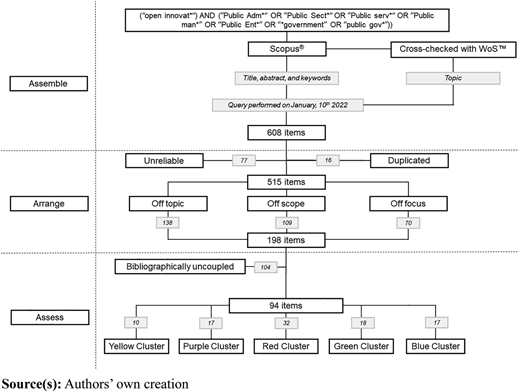
The search string was run on January, 10th 2022 and delivered 608 records on Scopus® and 395 records on WoS™. The items delivered by the two sources were carefully compared. The items collected from WoS™ were also indexed in Scopus®, which rendered a larger number of items. Hence, we decided to use Scopus® due to its larger coverage (Vera-Baceta et al., 2019). Most items involved in the analysis consisted of articles published in peer reviewed journals (52.4%), followed by conference proceedings (33.6%) and books' chapters (9.4%).
2.2 Arrange
The retrieved items were collected in an electronic worksheet. Codes based on authors' name, article's type (e.g. original article, review, conference paper and book chapter), title, source, publisher and year of publication were used to accomplish a preliminary screening of the records. This preliminary analysis led us to remove 16 duplicates from the original database. Furthermore, we decided to retract from the dataset items which were issued by publishers considered to be predatory or facing ethical problems in publishing to ensure the dependability of our literature review. Altogether, 77 contributions were discarded. Next, the authors met to define exclusion and inclusion criteria. Drawing on extant literature reviews (Palumbo et al., 2022), three exclusion criteria were agreed. Items which did not address issues and challenges related to the application of OI in the public sector were rejected as off topic. Besides, records which did not deliver any relevant insights into the role of public sector entities in enacting and nurturing a public value generation model based on OI were retracted as off scope. Finally, contributions which did not deliver compelling evidence on the importance of OI for augmenting the value generation capability of public sector entities were removed as off focus. The authors independently screened the items to purify the dataset. Once individual analysis was completed, the authors had a meeting which was intended to overcome inconsistencies in the inclusion and exclusion of analysed items. The authors did not agree on the exclusion of 78 items. A debate was launched to set disagreements. The majority rule was adopted, i.e. contested items were removed if 2 in 3 authors agreed on their exclusion. As a result of this analysis, 317 items were retracted: more specifically, 138 were off topic, 109 were off scope, and 70 were off focus. Hence, 198 records were admitted to the final step of this literature review.
2.3 Assess
The records which passed the arranging stage were duly examined to identify the main research streams and point out the key themes addressed within and across them. Following the approach taken in previous reviews aimed at investigating the scope of OI (e.g. Kovács et al., 2015), a bibliometric analysis was accomplished, which enabled us to map the intellectual structure of retrieved literature. We used bibliographic coupling as the aggregation mechanism and the visualization of similarity technique to systematize articles into clusters depicting homogeneous research streams (van Eck and Waltman, 2010). This approach assumes that articles citing one or more common references are likely to pertain the same research stream (Boyack and Klavans, 2010). Bibliographic coupling was used because it permitted us “… to construct structural images” of the research streams, relying on the shared research interest of coupled items assessed by the similarity of their reference lists (Zupic and Čater, 2015, p. 430). VOSviewer (vers. 1.6.10) was used to run the analysis.
The output of this methodological approach is displayed in a two-dimensional map, which exploits the outcome of the aggregation analysis to locate items based on their similarity measures. Relatedness is denoted by articles' spatial proximity. The threshold for running the analysis was fixed at a minimum of 5 common references to enhance the internal coherence of research streams and the total citation link strength was set at 10 to ensure the thickness of the clusters (Waltman and van Eck, 2012). In line with previous literature reviews (Balzano, 2022), we allowed a minimum cluster size of 8 items, and we maintained at 1 the resolution parameter to get large enough clusters embedding consistent streams of scientific literature (van Eck and Waltman, 2017). As a result of this routine, 94 items were found to be highly coupled. The full list of selected items is available in Table A1, which is attached to the article and provides descriptive information on the knowledge core of this literature review. The records were clustered in 5 groups, representing different shades of the scientific debate on OI in the public sector. Figure 1 displays a flow diagram depicting the steps which were taken to obtain, analyse and select relevant items.
Drawing on Tranfield et al. (2003), a non-standardized reporting approach was taken to systematize the contributions, which enabled us to achieve an improved explanatory power. More specifically, an interpretive approach was used. The articles were manually coded by the authors, who independently assessed the key themes addressed in the research streams (Bryant and Charmaz, 2010). On the one hand, open coding was used to spot the conceptual and empirical insights delivered by the literature. On the other hand, axial coding was implemented to highlight mutual links across the contributions. At the end of individual analysis, the authors met to discuss inconsistencies and work out a dependable and harmonious account of the research streams. Once all disagreements were set, the authors arranged a final report summarizing the main results of the literature review, which inspired the findings of this article.
3. Findings
3.1 An overview of reviewed contributions
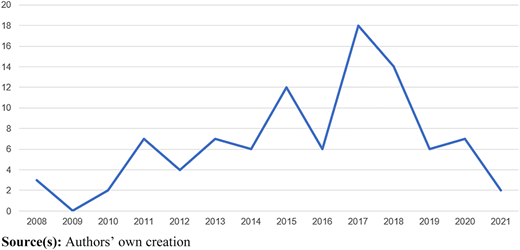
Most items included in this literature review consisted of articles published in peer-reviewed journals (75.5%), followed by conference proceedings (20.2%) and book chapters (4.3%). About 60 different sources covering disparate scientific fields – including business, management and accounting, computer science, engineering, decision sciences and economics – were taken into consideration. As depicted in Figure 2, publication years ranged from 2008 to 2021. More than 2 in 3 contributions were published from 2015 onwards (69.1%), witnessing the salience of the study domain. On average, the records included in this literature review were cited 29 times (σ = 33.4) at the time of this study, ranging from a minimum of 4 citations to a maximum of 181 citations.
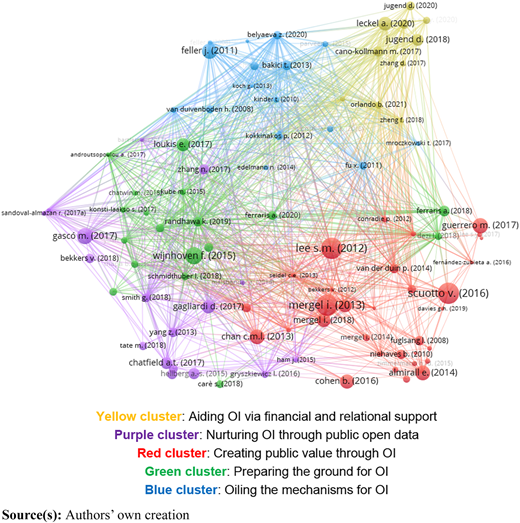
Figure 3 graphically displays the clusters obtained from bibliographic coupling. As synthesized in Table 1, the Yellow cluster consists of 10 items published between 2017 and 2021: it articulates the senior partnership role of public sector entities in sustaining OI via financial and relational support. The Purple cluster includes 17 records published between 2013 and 2018, presenting public sector entities as enablers of OI through open public data. The Red cluster encompasses 32 articles published between 2008 and 2019: it frames a public value creation view of OI. The Green cluster hosts 18 items published between 2015 and 2021, shedding light on the architectures required to put OI at the service of public value creation. Lastly, the Blue cluster accounts for 17 items published between 2008 and 2020: it envisions the mechanisms for exploiting OI for viable public value generation. An interpretive account of the 5 research streams follows.
3.2 Yellow cluster: aiding OI via financial and relational support
Public sector entities are in a critical position to promote the establishment of OI ecosystems, putting multiple stakeholders' ingenuity and creativity at the service of economic and social development (Gershman et al., 2019). However, public sector entities may lack resources and capabilities to manage complex inter-organizational relationships; furthermore, they may be unprepared to abandon conventional innovation practices which stick to a closed perspective. These limitations induce public sector entities to indirectly participate in OI ecosystems. Such indirect participation takes different shapes, ranging from supporting private companies with financial aids (Leckel et al., 2020) to the creation of intermediary organizations to foster inbound and outbound innovation at the crossroad of the public and the private sectors (Gershman et al., 2019).
Jugend et al. (2020, p. 11) identified four dimensions of public support for innovation, i.e.: “… (1) financial support for R&D activities; (2) development through innovation; (3) support for sectorial programs; and (4) university-industry-government collaboration (triple helix)”. Elaborating on this classification, public sector entities support OI using two leverages: financial aids and relational aids. In most cases, they deliver financial assistance to stimulate stakeholders' commitment to OI (Cheah and Ho, 2020). The availability of public funding reduces perceived risks, thus stimulating the willingness of private companies to participate in boundaryless research and development endeavours (Orlando et al., 2021). Besides, financial aids provide incentives to the development of knowledge, skills and capabilities that are conducive to OI (Zheng et al., 2018). These interventions are especially effective when less innovative companies benefit from public support, which is intended at nurturing their research and development potential (Cano-Kollmann et al., 2017).
For what concerns relational aids, public sector entities promote and sustain inter-organizational relationships involving research institutions, private companies and the community in innovation practices. Non-monetary support focused on facilitating networking has been argued to be more effective in enabling OI when complex innovation initiatives are concerned (Jugend et al., 2018). Networking paves the way for a multiple helix approach, which enables the co-creation of shared cultural artifacts to advance collaborative innovation and curb appropriability hazards, thus encouraging joint efforts aimed at OI (Zhang et al., 2017a). Although scholars agree in claiming the importance of public support for OI, they are not consistent in appreciating its implications on the recipients' propensity to implement outbound research initiatives. More specifically, previous studies emphasized that companies benefitting from large amount of support are less willing to participate in collaborative innovation than their counterparts receiving modest support (Ahn et al., 2020). This casts a shade on the effectiveness of public aids to enact OI ecosystems and highlights the need for balancing financial aid with relational aid.
3.3 Purple cluster: nurturing OI through public open data
Alongside delivering financial and relational aids, public sector entities nurture OI by enhancing the stakeholders' access to data concerning public management issues and activities, which can be exploited for innovation purposes (Malsbender et al., 2014). Nevertheless, enabling open data access in a perspective of information intensity is not enough for stimulating OI (Chatfield and Reddick, 2017). Open government data should be purposefully classified, elaborated and managed, advancing their meaningfulness for stakeholders interested in the implementation of inbound and outbound innovation (Gagliardi et al., 2017). This is consistent with embracing a capacity building perspective, empowering stakeholders to participate in addressing public management challenges through the access to timely and relevant open public data (Sandoval-Almazan et al., 2017). Before building infrastructures hosting public open data, it is necessary that public sector entities establish loyal and trusted relationships with stakeholders, stimulating their willingness to use public open data to partake in public value generation (Sandoval-Almazan and Valle-Cruz, 2017). This is consistent with previous research arguing that the arrangement of a shared OI perspective with relevant interlocutors “… is considered more important than obtaining specific innovation results” (Gascó, 2017, p. 90).
Despite the advantages triggered by implementing a data-driven OI framework, it heralds shortcomings which endanger the collective commitment towards exploiting public open data for innovation purposes (Ham et al., 2015). On the one hand, lack of adequate infrastructures, competencies and expertise to ensure the fair access to open data compromises the success of data-driven OI (Hellberg and Hedström, 2015). On the other hand, limited availability of boundary spanners and cross-organizational linkages promoting an alignment between the perspectives held by public sector entities and relevant stakeholders constrains the latter's willingness to use public open data (Yang and Kankanhalli, 2013), with the emergence of barriers to data-driven OI (Tate et al., 2018).
Tailored interventions are required to address these issues. Literature identifies three main areas of intervention. Firstly, a favourable atmosphere for OI should be established at the macro level, enacting a compelling institutional framework which solicits the adoption of an open perspective in managing public open data (Kassen, 2017). Such institutional framework should be embodied in a hybrid (physical and virtual) collaborative environment, where the principles of transparency and openness are stressed, exchanges between public sector entities and stakeholders are nurtured, and a collective enthusiasm towards OI is propelled (Gryszkiewicz et al., 2016). Secondly, public sector entities should empower their stakeholders (including citizens), enabling them to maximize the advantage they can get from open data and putting social capital at the service of public value generation (Bartlett, 2017). Therefore, public sector entities should implement a thick web of connections at the meso level (Bekkers and Tummers, 2018), supporting stakeholders in handling and exploiting public open data (Susha et al., 2015). Lastly, attention should be paid to the “hard” side – e.g. infrastructures and platforms implemented to ensure the reliable access to public open data (Smith and Sandberg, 2018) – and to its “soft” side – e.g. informal support to organizational development initiatives (Zhang et al., 2017b) – of data-driven OI, overcoming resistances to the use of public open data dictated by the inability to accommodate the stakeholders' motivations, approaches and objectives in partaking to OI.
3.4 Red cluster: creating public value through OI
Financial and relational aids and access to public open data are generally implemented as preliminary steps of a fully-fledged OI strategy (Chan, 2013). It is targeted at filling the emptiness of e-government approaches (Assar et al., 2011), engaging stakeholders in developing innovative public services (Bekkers, 2012) and in stimulating local development (Guerrero and Urbano, 2017). For this to happen, tailored initiatives intended to empower stakeholders are necessitated (Almirall et al., 2014), arousing their desire and willingness to participate in a collective endeavour aimed at public value co-creation (Conradie et al., 2012). Stakeholders' engagement may take different forms, according to the specific aims of public sector entities (Fernández-Zubieta et al., 2016) and the characteristics of the institutional field where OI is implemented (Davies et al., 2019). Outside-in models overcome the scarcity of knowledge and resources available to the public sector (Heimstädt and Reischauer, 2019) by leveraging partners' expertise and assets (Niehaves, 2010). Alternatively, inside-out models make the public sector entities' assets available to their stakeholders (Lee et al., 2016), paving the way for public value co-generation (Lee et al., 2012).
Different interlocutors can be involved in OI, which enacts a vivid and viable innovation ecosystem (Fu and Mu, 2014). In most cases, public sector entities embrace a collaborative economy perspective (Cohen et al., 2016), involving private companies in public–private partnerships (PPPs) to accomplish boundaryless innovation (Scuotto et al., 2016). Mutual exchanges between public sector entities and private partners create opportunities for cross-fertilization of knowledge (Hennala et al., 2011), which improves the distributed ability to anticipate environmental trends (Van der Duin et al., 2014) and generate new ideas (Venturini and Verbano, 2017). This has a twofold contribution on public value generation (Katsonis and Botros, 2015). On the one hand, it expedites the public sector entities' ability to avoid disruption in the delivery of public services (Mergel et al., 2014) and to tackle the challenges that compromise public value creation (Martins et al., 2015). On the other hand, it nourishes the collective innovation potential, catalyzing the establishment of a co-creating effort for continuous public value generation through the involvement of talents from the private sector (Lee et al., 2017).
Beyond involving private companies in OI, public sector entities may adhere to a public private people partnership (PPPP) approach (Katsonis and Botros, 2015), empowering citizens to actively partake in the generation of public value (Molinari, 2011). Drawing on extant literature, citizens may participate in different stages of the public value creation process, based on their level of knowledge and experience (Seidel et al., 2013). They can contribute to the design of platforms hosting the exchanges between public sector entities and the community (Charalabidis et al., 2011). Besides, they can act as collectors and/or classifiers of data, extracting new insights and ideas from them to push forward public governance and management (Mergel, 2018). Finally, they can be involved in the co-production of public services, being engaged in initiatives which are intended to enhance the individual and collective well-being (Mainka et al., 2016).
Whilst literature emphasizes the importance of OI for the viability of public sector entities (Zimmermann and Pucihar, 2015), it is still not clear which kind of interventions are required to set the conditions for involving stakeholders in public vale generation and fully capturing the benefits of OI (Fuglsang, 2008). Transparency and participation have been identified as the pillars on which OI strategies should be established (Mergel, 2015). They should be considered throughout the design and implementation of the OI strategy. This entails clarifying the rationale laying behind the adoption of OI, embedding openness in management practices, incentivizing stakeholders' participation in the design of collaborative architectures (Zheng and Hu, 2018) and continuously assessing the implications of OI on public value generation (Mergel and Desouza, 2013).
3.5 Green cluster: preparing the ground for OI
Various shortcomings prevent the implementation of OI in the public sector, which are inherited by the prejudice towards public value co-creation rooted in the conventional bureaucratic model (Dos Santos et al., 2015). Institutional hurdles, such as inconsistent rules regulating stakeholders' participation in public service co-production and the absence of an integrated view inspiring partners' action and communication, slow down the design and the implementation of OI (Ferraris et al., 2020). Moreover, the mismatch between the stakeholders' skills and expertise, the complexity of problems to be addressed, and the public sector entities' limited ability to stick to transparency have been claimed to produce disengagement (Chatwin and Arku, 2017), ushering stakeholders' unwillingness to partake in a boundaryless approach to public value co-creation (Thapa et al., 2015).
Public sector entities should undertake tailored initiatives to cope with these problems and prepare the ground for OI (Randhawa et al., 2019). Scholarly research highlighted that twofold interventions are needed, addressing the technological and the social sides of OI (Paskaleva and Cooper, 2018). From a technological point of view, a virtual terrain on which OI takes its roots should be prepared (Carè et al., 2018). Technologies facilitate the alignment between the new forms of governance embraced by public sector entities and the evolving societal and cultural trends experienced by the community, creating opportunities for public value co-creation (Dezi et al., 2018). Technologies should be put at the service of stakeholders' engagement, curbing the barriers that undermine their ability to contribute to public value generation through data provision and classification, idea generation, service co-production and outcome evaluation (Díaz-Díaz and Pérez-González, 2016). From a social point of view, the success of OI relies on three factors. Firstly, it requires a focus on partners' experiences, consistently with a co-producer-centred model of OI (Konsti-Laakso, 2017). Secondly, a rich network of social ties among partners should be arranged to facilitate knowledge inflows and outflows (Schmidthuber and Hilgers, 2018). Social ties should be imbued with mutual trust, which is a secret sauce in the recipe for OI in the public sector (Ferraris et al., 2018). Thirdly, attention should be paid to the motivations triggering the stakeholders' participation to OI, which are affected by the scope of the project (Wijnhoven et al., 2015), as well as by the monetary and non-monetary incentives used to foster stakeholders' involvement (Schmidthuber et al., 2019).
A multi-level framework should be designed to match the technological and the social sides of OI, accounting for the stakeholders' contributions to public value generation (Kube et al., 2015). It is articulated in a three-layered architecture, consisting of: (1) digital platforms allowing the integration of machine and human reasoning (Androutsopoulou et al., 2017); (2) social media enabling stakeholders to share and report their ideas and perspectives (Loukis et al., 2017); and (3) collective offline events, such as civic hackathons and living labs, which build a physical space devoted to public value co-creation and enrich the relationship between public sector entities and stakeholders (Yuan and Gasco-Hernandez, 2021).
3.6 Blue cluster: oiling the mechanisms for OI
Innovation in the public sector has been traditionally conceptualized sticking to a closed perspective, which overlooks the strengths of inter-organizational relationships (Kinder, 2010). This is consistent with the consolidated bureaucratic culture of the public sector, which represents a constraint for innovation and discourages collaborative processes aimed at value co-creation (Van Duivenboden and Thaens, 2008). To overcome such hurdles, the implementation of OI requires the design of context-specific interventions (Mroczkowski and Miller, 2017), which are tailored to the complexity of the external environment and to the political, social and economic challenges faced by public sector entities (Koch et al., 2011).
OI models rely on four principles, which are constitutive elements of collaborative innovation (Lundgren and Westlund, 2017). Firstly, they should be accessible, enabling all stakeholders to participate in value co-creation. Secondly, they should be transparent, ensuring equity and fairness. Thirdly, they should be participative, empowering stakeholders to fully express their potential for public value co-creation. Fourthly, they should adopt an ethics of sharing, promoting the continuous exchange of information and resources. These core attributes can be variously blended, producing a variety of OI approaches (Feller et al., 2008). Among others, Feller et al. (2011) identified four different configurations of OI, which are characterized by: (1) the aggregation of service co-producers in an integrated ecosystem led by public sector entities and directed towards public value generation; (2) the establishment of a syndication of value co-creators, which is based on resource sharing and is coordinated by public sector entities; (3) the implementation of a consumption approach, according to which public sector entities act as regulators and delegate public value generation to stakeholders; and (4) the design of a co-creating system, entailing a partnership between public sector entities and private partners to advance the public value generation capability.
The feasibility of these models depends on a set of requirements, which oil the mechanisms of OI. Public sector entities should develop proper network management capabilities, aligning the stakeholders' needs and expectations and fostering their activation for the purpose of public value co-creation (Belyaeva et al., 2020). Structural and cultural changes in the design of public sector entities are needed (Parveen et al., 2015), with the introduction of boundary spanning units to hybridize traditional public management practices with insights and perspectives collected from other institutional fields (Fu and Xiong, 2011). Since resistances to change are likely to appear, OI intermediaries should be involved, delegating to them the responsibility for orchestrating the connections and exchanges across the stakeholders participating in public value co-creation (Bakici et al., 2013). Ubiquitous digital infrastructures facilitate the transition towards OI (Edelmann et al., 2014), augmenting the public sector entities' capability to establish positive connections with stakeholders, energizing and empowering them (Koch et al., 2013). Structural changes should be accompanied by a transformation of human resource management practices. Public servants should be empowered and engaged in designing management solutions which are consistent with OI (Hameduddin et al., 2020). Finally, yet importantly, stakeholders' empowerment implies their participation in the evaluation of OI initiatives (Konsti-Laakso and Rantala, 2018), which should contemplate its substantive outcomes, its implications on democratic accountability and its effects on procedural legitimacy, building a greater awareness of OI's impact on public value generation (Kokkinakos et al., 2012).
4. Discussion
4.1 Unravelling OI in the public sector
This literature review provides us with intriguing insights to answer the research questions. The role of public sector entities in enacting OI is evolving. An indirect approach based on financial and relational aids characterized the early attempts of public sector entities to exploit OI. These initiatives primarily aimed at promoting the establishment of knowledge ecosystems from the outside, according to an inside-out approach aimed at soliciting stakeholders to overcome barriers to collaboration and join forces to boost local and national development (Jugend et al., 2020). At a later stage, public sector entities shifted towards promoting OI through open public data, undertaking an inside-out approach (Kassen, 2017). Stakeholders' access to information which is collected, classified and elaborated by public sector entities is conceived of as an artifact stimulating the implementation of inbound and outbound innovation practices at the crossroad of the public and the private spheres (Palumbo and Fakhar Manesh, 2021). Open government data pave the way for the latest stage of OI evolution in the public sector, which is targeted at establishing a fully-fledged partnership between public sector entities and stakeholders to advance public value generation according to a co-creation view and embracing a hybrid – inside-out and outside-in – perspective (Casprini and Palumbo, 2022).
In line with this evolution, a transformation of the scope of OI is acknowledged. The unpredictability of the external environment and the complexity of public management issues make OI essential to enhance the public sector entities' value creation capability and sustain their long-term viability (Lee et al., 2012). Engaging partners in boundaryless innovation is crucial to overcome shortcomings in public finance (Mu and Wang, 2022). Besides, it overcomes the rigidity associated with the bureaucratic nature of public sector entities, facilitating the contamination of management practices inherited from the past with more flexible approaches developed in the private sector (Khanal, 2022). This is critical to improve the adaptability of public sector entities to environmental uncertainty, ensuring public value generation against unforeseen disruption (Heimstädt and Reischauer, 2019) and ushering organizational resilience (Zhang et al., 2022). It is worth noting that OI accommodates technological and institutional changes, complying with the increasing pervasiveness of digital technologies (Ciasullo et al., 2022) – which set the conditions for a digital collaborative economy – and with the transition towards people-centeredness in public management (Palumbo, 2016) – which is underpinned by citizens' participation in public value generation (Mainka et al., 2016).
A socio-technical perspective should be adopted to achieve OI in the public sector (Paskaleva and Cooper, 2018). On the one hand, knowledge sharing and resource integration are spurred by the availability of pervasive and reliable communication infrastructures, within which exchanges across public sector entities and partners are contextualized. On the other hand, OI is continuously nurtured by the stakeholders' commitment to an inter-organizational culture rooted in the value of collaboration and established on the principles of transparency, accessibility, fairness and sharing (Lundgren and Westlund, 2017). Limited ability to manage the intertwinement between the technical and the social side of OI undermines the effectiveness of collaborative innovation, restraining the depth and breadth of knowledge sharing and integration among public sector entities, privately-owned organizations and citizens (Schmidthuber and Hilgers, 2018).
4.2 An integrative framework to unleash OI and avenues for future research
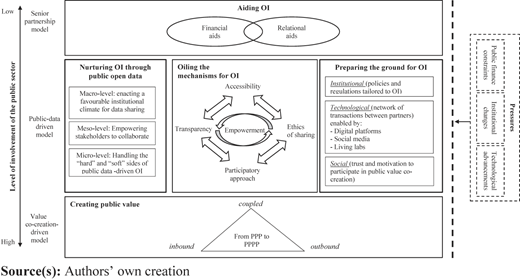
Figure 4 graphically synthesizes the study findings, arranging them into an integrative framework which consolidates the results of this literature review and highlights the manifold manifestations of OI in the public sector. The intensity of public sector entities' involvement in knowledge ecosystems denotes different forms of OI. Since public sector entities are likely to miss adequate competencies to handle inter-organizational networks targeted to innovation, they usually embrace a senior partnership role. In this circumstance, public sector entities are primarily interested in establishing a positive environment for nurturing inter-organizational relationships, creating robust ties across the stakeholders who contribute to public value generation. This happens in diverse ways, including financial and relational support, with the main purpose of advancing the stakeholders' willingness to participate in innovation ecosystems. Specific examples of the senior partnership model are sectoral programs fostering collaborative research in economic domains which are considered strategic for local and national development. They can be implemented enacting a positive climate for OI and facilitating exchanges among companies, research institutions, public sector entities and the community.
Senior partnership can be understood as the initial step of the journey undertaken by public sector entities towards OI. Although it entails an indirect participation to knowledge ecosystems, it enables the acknowledgement of the challenges that prevent OI and sets the conditions for a deeper involvement of public sector entities in boundaryless innovation. Since financial aids and relational support are not necessarily conducive to stakeholders' engagement, they should be accompanied with a committed effort of public sector entities to steer outflows and inflows of knowledge. This prompts the second step of OI, which adheres to a public data-driven framework. Public open data act as triggers of innovation opportunities at the crossroad of the public and the private sectors. Enabling stakeholders to use public data is conducive to their engagement in public value co-creation and augments the spaces for OI. A tripartite intervention is required for this purpose. At the macro level, public sector entities should create a favourable atmosphere for inter-organizational collaboration, boosting the stakeholders' willingness to cooperate and curbing the perceived drawbacks of OI, such as appropriability hazards. At the meso level, public sector entities should empower stakeholders, avoiding backlash in open data accessibility and nurturing a vivid network of inter-organizational relationships. Lastly, the ‘hard’ and ‘soft’ sides of OI should be addressed at the micro level, implementing adequate technological solutions to sustain a public data-driven OI framework and encouraging stakeholders to participate in public value co-generation.
This propels a gradual transition towards a new normality of public value generation, which relies on public sector entities' ability to establish co-creating relationships with their stakeholders, here included private companies, third sector organizations and the community. OI is eventually managed as a public value co-generation model. It is based either on an inside-out approach, which is consistent with public data-driven OI and admits stakeholders to take advantage of public sector entities' assets, or on an outside-in approach, which maintains the senior partnership model and enables public sector entities to absorb knowledge and competencies developed in the private sector to advance public value creation. A combination of the two approaches is possible, paving the way for coupled OI. In this case, public value co-creation reaches its peak when citizens participate in OI according to a PPPP approach. Alongside contributing to public service co-production, citizens may have a role in co-designing the physical and virtual spaces where OI is realized (e.g. implementing a distributed network model which is continuously evolving based on the users' input) and in generating big public open data, which feed the vivacity of OI.
Exploiting OI in a perspective of public value co-creation requires a fertile ground. Institutional, technological, and social interventions are concomitantly necessary to prepare the terrain for OI. The void of public policies and regulation about OI should be filled, fostering common interpretations of innovation strategies, overcoming institutional and cultural barriers to stakeholders' involvement and escaping the mismatch of expectations brought by public sector entities, private companies and citizens. Secondly, technological investments are needed to build reliable and accessible hybrid platforms, hosting multiple interactions between public sector entities and stakeholders. Timely access to open data, unconstrained opportunities for collaboration and continuous exchanges across partners are crucial for augmenting the contribution of OI to public value generation. Lastly, public-value driven OI relies on a thick network of binding relationships among stakeholders. From this point of view, it requires social interventions aimed at creating mutual trust and incentivizing the individual and collective participation to public value generation.
Several oiling mechanisms should be crafted to foster the impact of OI on public value generation. OI initiatives should be based on accessibility, ensuring the broad access to opportunities for public value co-creation to relevant stakeholders. This entails implementing tailored interventions aimed at facilitating the involvement of disadvantaged categories in OI ecosystems. In fact, several stakeholders (e.g. social and cultural minorities) may be unaware of collaborative innovation initiatives or may have less resources to participate in them. Moreover, transparency should inspire OI. Partners should be able to get all information they need to contextualize their role in public value generation. Their access to relevant data and information should be thoroughly ensured. This calls for a participatory approach to the design and implementation of OI: stakeholders should be enabled to partake in all the steps of OI initiatives, starting from the arrangement of inter-organizational platforms until the evaluation of outcomes. Lastly, an ethics of sharing should inspire public value-driven OI, which is consistent with the establishment of a fully-fledged partnership between public sector entities and stakeholders to augment public value generation. Accessibility, transparency, participation and ethics of sharing nurture the stakeholders' empowerment for their involvement in public-value driven OI, catalysing their contribution to the generation of public value.
4.3 Limitations, implications and avenues for future research
The study findings should be read acknowledging the limitations which affected this review. Firstly, consistently with the study aim, our research focused on OI, overlooking germane concepts such as distributed innovation and networked innovation. Whilst this decision permitted us to maintain the spotlight on the study domain, shedding light on the strategies and initiatives taken by public sector entities to exploit OI in order to cope with wicked public management issues, it constrained the breadth of our research. Secondly, the items included in this literature review were collected from Scopus®, which represented the sole data source of this study. Nonetheless, the large coverage of Scopus® and the results of the cross-check with WoS™ confirm the comprehensiveness of our literature review. Lastly, the interpretive approach used to systematize items might have allowed for subjective biases in the articulation of the findings' report. Nevertheless, it permitted us to delve into the key insights delivered in the scholarly literature, pushing forward what we currently know about OI in the public sector.
Conceptual and practical implications can be extrapolated from the study results. From a theoretical perspective, a public value-driven interpretation of OI is proposed. It consists with the transversality of challenges faced by public sector entities and complies with recent advancements in the public management literature, which emphasize the need for shifting towards an ecosystem perspective to enhance public value co-creation. OI is typically initiated by public sector entities through financial and relational support, access to open data and networking aimed at engaging private companies, third sector organizations and citizens in inbound, outbound and coupled efforts targeted at value co-generation. The establishment of a collaborative ecosystem to augment public value generation is essential to cope with the financial and management constraints experienced by public sector entities and achieve a greater organizational flexibility and adaptability. However, OI does not inherently determine public value co-creation, which calls for strategic, management and cultural alignment across public sector entities and stakeholders.
These conceptual insights inspire the practical implications of our literature review. Institutional, technological and social interventions fostering OI should be carefully designed and accomplished to facilitate the calibration of diverging expectations brought by the stakeholders involved in collaborative innovation. To achieve such alignment, public value-driven OI should be rooted in accessibility, transparency and ethics of sharing. They set the conditions for empowering stakeholders and sustain their committed contribution to public value generation, enacting a participatory inter-organizational climate which is conducive to continuous inbound, outbound and coupled OI.
Further research is needed to push forward our understanding of OI in the public sector. Drawing on the integrative framework reported above, three main avenues for further developments are envisioned. Theoretical advancements are required to frame OI according to a public value generation perspective. This entails finding an alignment across OI, public value co-creation and public service co-production to build new public management archetypes that are fitting with the wicked issues faced by the public sector entities. Contextualizing OI to public value co-creation and public service co-production is expected to advance what we know about the role and the scope of OI in the public sector, providing us with insightful implications for theory and practice. Empirical research is necessitated to shed light on the antecedents of effective OI ecosystems and inspire public management decisions. On the one hand, attention should be given to the institutional, technological and social determinants of positive exchanges between public sector entities and stakeholders, collecting evidence of the interventions that should be taken to prepare the terrain for public value-driven OI. On the other hand, public management models conducive to boundaryless innovation should be investigated, framing the practices that lead to vivid and viable knowledge ecosystems for public value co-creation. Last, but not least, longitudinal studies examining the unfolding dynamics of OI ecosystems' establishment and development should be accomplished. More specifically, future research should be targeted at collecting lengthwise evidence of the determinants and implications of collaborative innovation in the public sector, illuminating the manifold implications of inbound, outbound and coupled OI initiatives involving private companies, third sector organizations and citizens in public value co-creation.
5. Conclusion
OI embodies a new model of public value generation which is based on the public sector entities' ability to empower and engage external stakeholders in initiatives aimed at coping with wicked public management issues. The role of public sector entities in enacting OI-based ecosystems is evolving. An inside-out model characterized earlier attempts to establish knowledge ecosystems intended to boost economic and social development. Financial and relational aids express the public sector entities' desire to enable external stakeholders to participate in value co-creation, expanding the reach of the public sector. Applying openness to public data further advances the inside-out perspective and, implicitly, accompanies it with an outside-in perspective. Stakeholders accessing open data provide public sector entities with feedback information and use such data to participate in public management processes. This augments the public sector entities' ability to extrapolate insights from the external environment and to deal with the evolving demands and expectations of the community. Such process paves the way for a new conceptualization of OI, which is eventually understood as a public management model setting the conditions for boundaryless public value co-creation. Tailored management decisions are required to foster the transition towards a public value-based interpretation of OI. Firstly, the institutional and cultural barriers to stakeholders' involvement inherited from the bureaucratic model should be removed, erasing formal and informal obstacles to OI. Secondly, public sector entities should build-up reliable and dependable hybrid platforms hosting continuous interactions among stakeholders and catalysing inflows and outflows of knowledge. Lastly, the values of accessibility, transparency, fairness and sharing should be continuously maintained, propelling the stakeholders' willingness and desire to participate in public value co-creation.
This research has been partially supported by the European Academy of Management (4th Research Grants Scheme).