This study proposes a distinct ecosystem orchestration concept, with the idea to address some of the technology and value proposition uncertainties that can occur during the birth phase of an innovation ecosystem linked to its actor’s relation with each other as well as policymakers and customers. In order to better explain the proposed orchestration concept, Mobility as a Service (MaaS), a technological and social complex, innovative ecosystem, was chosen.
The suggested touring orchestrating model emerges by utilizing multiple case study analyses, focusing on ecosystem construct, orchestration mechanism, and various actors of five selected mobility as service use cases, each presenting one category with unique characteristics. The analysis is complemented by a multi-vocal literature review (MLR) of secondary data.
The study findings reveal substantial barriers to successful collaboration between innovation ecosystem actors, using traditional ways of orchestrating the ecosystem due to competition and unwillingness to invest for the benefit of others or risk of losing their customer base to competitors by joining a MaaS ecosystem, particularly when a new actor as orchestrator is onboarded. Additionally, there is a need to increase incentives and to enhance offerings in order to generate demand and attract stakeholders toward a new innovation ecosystem like MaaS.
Most of the models reviewed in this study are predominantly successful examples of mobility as a service originating from northern Europe and the Baltic region, potentially shaped by the characteristics of these markets. This regional focus represents a limitation of the study. Furthermore, the study’s conceptual nature and lack of practical testing and empirical data support are additional limitations which could be addressed in future research through empirical investigation. The results of this study could assist in shaping future research and contribute to the development of more effective orchestration models and stakeholder management frameworks for managing innovation ecosystems across different industry contexts.
The proposed touring orchestration model (TOM) provides insights not only for the actors in transportation industry but also for providers in other industries; on how to manage uncertainties and risks tied to technology and value proposition while advancing seamless cross-firm collaboration with other market actors during the formation of an innovation ecosystem. It can also facilitate the emergence of unexplored cross-industry business models by leveraging various data-sharing frameworks. The proposed model can also streamline processes and lower costs for policymakers in encouraging transportation and mobility providers to participate in MaaS, as it reduces risks and can offer greater financial advantages for these stakeholders.
The findings of this study enhance the evolving ecosystem literature by exploring orchestration amid technological and value proposition uncertainties. Additionally, this study contributes to the expanding research on MaaS business models and ecosystem orchestration by leveraging data as a service-sharing model.
1. Introduction
The rapid advancement of digital technologies has opened up digital innovation opportunities within firm boundaries, networks of actors (Holmström et al., 2021; Oghazi et al., 2024), cross-industry partners and innovation ecosystems (Adner, 2017; Linde et al., 2021). Innovation ecosystems are dynamic, network-based business environments consisting of interconnected and interrelated actors. They include but are not limited to industry players, government entities, associations and customers who engage in both competition and cooperation to foster and generate innovation, ultimately delivering a value proposition (Reynolds and Uygun, 2018; Adner, 2017; Dias et al., 2020; Autio and Thomas, 2014). Each stakeholder assumes different roles and engages in distinct activities and behaviors (Dedehayir et al., 2018). Innovation ecosystems have gained significant favor due to the rapid advancement of tech innovations (Holmström et al., 2021), and some of the world’s most valuable companies create value by orchestrating such ecosystems (Parker et al., 2017). As noted by Gawer (2014) and de Vasconcelos Gomes et al. (2018), it remains unclear how firms become the ecosystem orchestrator. Therefore, they recommend exploring the linkages, cooperation and competition between the central actor and other firms within an ecosystem as a promising direction for future research. This investigation should consider key ecosystem characteristics, such as the underlying technical infrastructure, the network of involved actors and the value proposition shaped by market dynamics and customer needs. As an example, when travelers book journeys involving multiple modes of transportation, they could either book each segment independently through an individual provider or use a mobility service aggregator that bundles various options together. However, relying on an aggregator may lead to a value leak for the individual providers to the aggregator, and it could well introduce risks such as platform envelopment (Eisenmann et al., 2011). Therefore, a model with a fixed ecosystem leader might not be ideal for every provider, and alternative models, such as decentralized orchestration, might be better suited to orchestrating such innovation ecosystems.
This is one of the reasons why smart mobility has recently attracted significant attention from ecosystem scholars (Paiva et al., 2021; Biyik et al., 2021). The mobility-as-a-service (MaaS) scheme, an innovation ecosystem running on a digital platform, is among those notable smart mobility solutions that have been greatly accelerated thanks to the recent advances in information systems and communication technologies (Ma et al., 2018; Longo et al., 2019). According to Kamargianni and Matyas (2017, p. 4), “Mobility as a Service can be defined as a user-centric, intelligent mobility model in which all mobility service providers’ offerings are aggregated by a sole mobility provider, the MaaS provider and supplied to users through a single digital platform.” MaaS can positively impact customer satisfaction and open new avenues for applying new business models by transportation industry actors and other industries. MaaS utilizes data-driven value creation (Hartman et al., 2016) and value delivery through data sharing (Adner, 2017; Kazantsev, 2023; Bonina et al., 2021). While some aspects of MaaS do exist and the technology is already available (Sorensen, 2018), achieving its complete establishment is not straightforward, mainly because it is a relatively new idea (Roumboutsos et al., 2021) that necessitates close collaboration between both public and private sectors. Moreover, orchestrating such complex innovation ecosystems demands a shared vision among all the actors involved across entire ecosystems (Parida et al., 2019; Appio et al., 2019; Linde et al., 2021; Butler et al., 2021).
One key challenge in orchestrating such ecosystems is designing data-sharing processes between stakeholders. In general, data can be shared in various forms, including “as-a-service” offering, similar to the software-as-a-service (SaaS) model (Tsai, 2014). “Data as a service” (DaaS) utilizes the cloud to provide secure access to business-critical data for internal or external stakeholders over a network, with the primary goal of offering on-demand data access regardless of the location (Wang et al., 2020; Truong and Dustdar, 2010). The data architecture supporting DaaS can be developed in-house or outsourced to DaaS providers. This data-sharing form treats data as a crucial business asset to support data-driven decision making (Zheng et al., 2013). Research on smart mobility solutions has identified a strong connection between big data and mobility digital services (Muthuramalingam et al., 2019), which is essential for effectively implementing MaaS (Güler et al., 2021). Furthermore, many scholars have offered guidance and proposed frameworks for the public sector, governments and policymakers to ensure the success of sustainable MaaS (Li et al., 2021).
Due to the high level of interdependency among actors within innovation ecosystems such as MaaS, a high degree of uncertainty both on collective and individual organizational levels exist and, as a result, the likelihood of failure is greater than in situations where the solution is managed by a single organization (Adner and Feiler, 2019; Thomas and Autio, 2019; De Vasconcelos Gomes et al., 2018). While some studies have acknowledged the role of uncertainties in the creation and development of innovation ecosystems, as well as the importance of understanding their effects, the literature remains largely silent on how innovation ecosystem actors can effectively manage and mitigate the occurrence and impact of such uncertainties (Dattée et al., 2018; de Vasconcelos Gomes et al., 2021).
Thus, orchestrating an innovation ecosystem such as MaaS becomes both technologically and socially complex because various uncertainties exist on different levels. Although findings from various studies in this field underscore the importance of close collaboration between MaaS ecosystem players and support from policymakers (Hlubi and Seftel, 2019) to manage uncertainties, few have focused on the MaaS ecosystem from the perspective of technological and value proposition uncertainties and how the orchestration role as a critical function can manage those (Dedehayir et al., 2018), especially during the birth phase (Moore, 1993) of this innovation ecosystem.
Therefore, this study proposes a distinct ecosystem orchestrating concept to answer the question: How can the MaaS innovation ecosystem be orchestrated by utilizing data sharing as a service?
This study presents the result of a review and analysis of the existing literature on published MaaS conceptual models and commercial business models in operation from the ecosystem orchestration point of view. Utilizing data sharing, it proposes a conceptual MaaS ecosystem model centered on dynamic orchestration (touring orchestration) with theoretical and practical implications.
2. Theoretical background
2.1 Innovation ecosystems
Today, many industries display remarkable levels of interaction with other organizations, participating in the design, production, distribution and implementation of a single product or service and behaving like extensive interconnected networks of organizations (Iansiti and Levien, 2004). This is largely to remain market relevant, find new revenue streams and win market battles. Therefore, to keep their competitive advantage, they increasingly join new networks and ecosystems (Kamalaldin et al., 2021; Iansiti and Levien, 2004). That is why the ecosystem concept has gained much attention in academia and industry over recent years, and it is even expected to take over the traditional way of thinking about products and markets (Lingens, 2021; Jacobides et al., 2018).
Ecosystems have their characteristics and can take different forms depending on their disposition. Regardless of an ecosystem’s form, its design is expected to cover three key elements: structure, activity and orchestrator (Lingens, 2021). Similar to biological ecosystems, business and innovation ecosystems are used quite interchangeably within the literature (Dedehayir et al., 2018). They are formed by large, loosely connected networks of entities (Iansiti and Levien, 2004). Much like species in biological ecosystems, firms interact with each other, and each firm’s performance hinges on the overall health and performance of the entire ecosystem. Moore (1996) describes a business ecosystem as an economic community that creates valuable customer products and services. This economic community thrives on a foundation of interaction between various organizations and individuals, constituting the vital components of the business world. Ecosystem members encompass suppliers, producers, competitors and various other stakeholders. As time progresses, they collectively develop their capabilities and adapt their roles, often aligning with the overarching direction established by one (Dedehayir et al., 2018; Iansiti and Levien, 2004) or more central companies. In a dynamic, heterogeneous network of diverse actors such as an ecosystem, the close relationship between stakeholders plays a crucial role in its overall success because it can greatly improve performance and develop sustainable value co-creation (Marcon Nora et al., 2023; Cresswell et al., 2010). The stability of a business ecosystem hinges on the effective alignment and maintenance of relationships between actors, reflecting actor-network theory’s articulation of a network of actors and their relationships without hierarchical structures, instead incorporating the concepts of mobility, flexibility and innovation (Marcon Nora et al., 2023; Banerjee and Bonnefous, 2011). Innovation ecosystems encompass organizations, fostering their capabilities for collaborative value co-creation centered on a particular innovation (Jacobides et al., 2018; Dedehayir et al., 2018; Autio and Thomas, 2014). Whilst some scholars associate the business ecosystem with value capture and the innovation ecosystem more with value creation (de Vasconcelos Gomes et al., 2018), Adner (2017, p. 42) defines an innovation eco-system as “the alignment structure of the multilateral set of partners that need to interact for a focal value proposition to materialize.” Companies collaborate to create value for a particular customer segment, and the value generated by a firm, as a member of an innovation ecosystem, depends on both upstream components and downstream complements provided by other firms. These elements contribute to the overall value proposition of the given firm (Miehe et al., 2023; Madanaguli et al., 2023). While the specific companies’ roles may change, the role of the ecosystem leader or orchestrator remains highly esteemed within this community (Adner, 2017). This key role enables members to work toward common objectives, align their investments and find complementary roles to support one another (Miehe et al., 2023; Palmié et al., 2022).
2.2 Ecosystem orchestration
For a successful ecosystem, leadership and governance are crucial factors because it is necessary to maintain a balance between standardization and variation, autonomy and control, and individualism and collectivism (Autio, 2022). Among the actors in an ecosystem, the leader or orchestrator undertakes the pivotal role (Lingens et al., 2021). This actor is most of the time responsible for designing the alignment structure between other members and serves as the primary decision maker within the ecosystem (Jacobides et al., 2018; Iansiti and Levien, 2004; Ivarsson and Svahn, 2020; Moore, 1993; Woodside et al., 2012). The orchestration concept has already emerged in various contexts, including strategic management, supply chain, entrepreneurship and marketing disciplines. Here, it has been employed to characterize the activities of committed individuals who enable value-generating interactions for and among parties outside the traditional customer-business relationship (Maas, 2022; Linde et al., 2021; Lingens et al., 2021) An orchestrator, leader or hub typically offers a unified interface for customers and functions as an orchestrator of an ecosystem, while the complementary entities are responsible for delivering services, technological solutions and various assets across diverse settings (Adner, 2017; Valkokari et al., 2017; Miehe et al., 2023). Thus, orchestration encompasses enforcing the established rules of the game, ensuring compliance and promoting transparency to mitigate risks (Parida et al., 2019; Lütjen et al., 2019; Linde et al., 2021). Orchestration has also been linked to a firm’s ability to harness the scattered resources and competencies of external entities and become an intermediary “center of gravity” (Acciarini et al., 2021; Ivarsson and Svahn, 2020). Through the stakeholder theory lens, an ecosystem orchestrator’s role can be analyzed using three key attributes: power, legitimacy and urgency (Macron Nora et al., 2023). As Mitchell et al. (1997) point out, power plays a pivotal role in determining the attention stakeholders receive. Consequently, stakeholder classifications in the literature are often based on their functions and the extent of their influence (Banerjee and Bonnefous, 2011; Hristov and Appolloni, 2022), using different combinations of the three attributes mentioned (Marcon Nora et al., 2023). The orchestrator embodies all three. Autio (2022) argues that in an ecosystem setup where participants actively contribute to the collective offerings without the need for formal one-on-one agreements, achieving the desired outcome necessitates skillful orchestration by a resourceful leader of the ecosystem (Moore, 1993). The orchestrator must exert influence over the others to align their behavior with the ecosystem’s vision, streamlining the collaboration among different stakeholders while fostering innovation (Moore, 1993). As the result of his study, Autio (2022) proposes that effective ecosystem orchestration should encompass activities across four distinct layers: technological, economic, institutional and behavioral.
Additionally, Autio introduces a multilayer framework for ecosystem orchestration throughout the three stages of ecosystem development: initiation, momentum building and maturity (Autio, 2022). This framework provides illustrative instances of orchestration strategies and actions tailored to each layer and stage of ecosystem evolution (Iansiti and Levien, 2004; Hurmelinna-Laukkanen and Nätti, 2018). However, the extant studies are unclear on how the orchestrator should handle evolving uncertainties resulting from innovational changes within the ecosystem (Adner and Feiler, 2019; Thomas and Autio, 2019). While the novel value propositions a firm can achieve through collaboration with other ecosystem actors open the innovation funnel for new ideas and business models, they also present challenges (Lingens, 2023). Many studies have explored various aspects of how established leaders orchestrate different ecosystems to achieve the focal value proposition of their ecosystems. They have also examined how innovation can lead to new value propositions for ecosystem actors. However, there is limited clarity regarding how innovation can affect the role of the ecosystem orchestrator itself, potentially resulting in its substitution, whether temporarily or permanently.
2.3 Mobility as a service (MaaS): an ecosystem perspective
Historically, the transportation industry has predominantly functioned through linear value chains, but this is undergoing rapid transformation with the entrants of various new players. Traditionally, the mobility sector was limited to public transportation providers, such as trains, metro, buses and taxi companies, which were urban travel providers. The advent of electric transportation, such as e-bikes and e-scooters, alongside ride-sharing services, has diversified passenger transportation options (Maas et al., 2022; Kussl and Wlad, 2023). While this variety of choices provides more opportunities for door-to-door travel, it also creates ambiguity for passengers in selecting the most cost-effective, efficient, reliable, flexible and environmentally friendly option. To tackle this challenge, fresh business models are emerging, and innovations permeate various sectors, including the transportation industry and its associated ecosystems (Aapaoja et al., 2017; Butler et al., 2021). One noteworthy concept that has recently attracted considerable attention in the transportation sector is “mobility as a service” (Maas). Mobility as a service bridges the gap between private and public transport operators by combining various transport modes to offer a tailored mobility package to the passenger (Kamargianni and Matyas, 2017; Jittrapirom et al., 2017). According to Hietanen (2014), MaaS can be regarded as a novel idea to revision mobility, a development driven by the emergence of new technologies and behaviors. The bundle of mobility modes of transportation suggests an alternative from ownership-based transport toward access-based transport (Jittrapirom et al., 2017). However, given its potential to enhance customer value propositions, the presence of multiple actors may lead to conflicting interests and integration complexities (Chirumalla et al., 2025), contributing to a high degree of ambiguity in the MaaS ecosystem (Reyes García et al., 2019; Jittrapirom et al., 2017). The final strategic choices of transportation service providers in the MaaS ecosystem are shaped by factors such as their own costs, benefits and governmental and public regulations. Conversely, travelers’ choices are primarily driven by the utility and cost of travel (Ye and Zheng, 2024).
In recent years, MaaS-based business models have been discussed by transport specialists, researchers and MaaS developers (Reyes García et al., 2019). Several examples have either been suggested by researchers or put into practice. One of the earliest and most used examples of the MaaS framework emerged in the fall of 2014 when the Finnish Ministry of Transport and Communications presented its vision of a commercial MaaS operator and started to win support. Soon after, in early 2016, it began to officially operate under the name of “MaaS Global.” “Yet we wanted to find a way to fit everything together, not just regulate, but to create a better life for people and new business opportunities. We started to look at transportation infrastructure as a platform on which services could be built”, said the chief of staff at Finland’s Ministry of Transport and Communications, whom the Finnish government tasked to outline a strategy and architecture for intelligent transport. In the “MaaS global” ecosystem, the MaaS provider or leading mobility operator acts as a focal firm, orchestrating the ecosystem and its several other complementing actors. This included an extended network of firms (Kamargianni and Matyas, 2017), such as transportation and mobility service providers, payment gateways, regulatory affairs, as well as connectivity and infrastructure service providers, all working together and complimenting the ecosystem on different levels.
The MaaS provider or operator aims to alleviate existing pain points associated with traveling and provide users with a better, seamless and advanced travel experience (Kamargianni and Matyas, 2017; Reyes García et al., 2019). This is achieved by aggregating various modes of transport services, ultimately reducing dependence on car ownership and granting travelers easy access to a wide range of transportation alternatives.
3. Research methods
For this study, we have followed a multiple case study analysis approach by focusing on five MaaS use cases, fulfilling three main criteria of being an innovation-driven ecosystem, utilizing data platforms and following innovative city initiatives. This approach has two objectives. First, it enables the researchers to explore a specific question in depth while also considering the impact of the context. Second, by thoroughly examining the empirical aspects of the cases, researchers can again have a multidimensional understanding of the issue.
We have centered our main attention on the design and orchestration of these MaaS ecosystems. A multi-vocal literature review (MLR), encompassing scientific peer-reviewed articles alongside grey literature (Benzies et al., 2006), which comprises white papers, websites and press releases, has also been conducted. Since MaaS and data sharing are novel innovations, secondary data from the Internet can offer extensive value, surpassing the amount of information that can feasibly be gathered through traditional literature analysis. For this purpose, the following criteria have been followed. The literature search was conducted in Google Scholar, Scopus and Web of Science databases using the words “mobility as a service” and “MaaS” as a single query for the first search round. Then, we used a combination of the following keywords (“MaaS” OR “mobility as a service” OR “mobility-as-a-service”) AND (“eco-system” OR “ecosystem”) for the second round of search to ensure no relevant results were missed.
For the first criterion, only sources from 2013 onwards were considered. We then filtered out the duplications, non-open access and non-English results. The second round of filtering was conducted by reviewing the titles and abstracts of the studies. To ensure alignment with our research criteria, we excluded studies that focused solely on the technical aspects of mobility as a service and data sharing among its actors without addressing the business aspects. Our literature review was limited to only sources that were situated within the area of either MaaS ecosystem or MaaS architecture. The filtered literature search ultimately identified 21 MaaS schemes worldwide, including pilots, conceptual models and commercial and operational case studies. Additional relevant sources were also discovered and reviewed during the literature review process. To gain a more comparative perspective and cover both operational and conceptual innovation initiatives, initial screening and analysis of cases were performed. The cases were placed into five distinct categories. Finally, one case presenting each category was synthesized and selected for in-depth analysis. Although it was possible to include all identified schemes or to extend the list further, we excluded those using similar orchestration mechanisms. A summarized overview of the analyzed cases can be found in Table 1.
4. Results
4.1 Orchestration mechanisms
To comprehensively cover the ecosystem orchestration design and its operating model, further exploration of its structure, activity and aspects is crucial (Lingens, 2021). One of the MaaS ecosystem use cases we studied was “MaaS Global”, which was initiated and overseen by Finland’s Ministry of Transportation and Communication, following a bottom-up approach to ecosystem design (Adner, 2017; Autio, 2022). This allowed different actors within the ecosystem to actively and significantly contribute to shaping the scope and framework of their collaboration in the future (Autio and Thomas, 2018). This is noticeable when “Maas Global” narrates its efforts into forming a collaboration between public and private sectors as: “Club for New Transport”. Later, this attracted bright minds from administration, academia and business to come together and develop a future model aligning the interests of both public and private sectors toward more intelligent travel.
In their 2019 study, Reyes García and his colleagues proposed a conceptual model based on an extended MaaS ecosystem. This model combines MaaS, electric mobility systems (EMS) and shared electric mobility to enhance user experience and encourage better partner collaboration through intermodal travel touring innovation. A different example is Siemens’s “Tampere” (Siemens, 2016) or integrated mobility platform (IMP), which emphasizes eco-friendliness and electric mobility by incorporating a middle-layer platform. Scholars and market leaders have put forth numerous other conceptual or technical models, all aiming to improve collaboration between transportation service providers and eliminate the need for individual stakeholders to independently address technical and organizational obstacles. Among these models, the “mobility broker” introduced by Beutel et al. (2014) leverages an open interface concept. This model comprises three layers: data management, mobility broker and end-user applications. As an independent third-party organization, the mobility broker integrates information and services from all available mobility service providers within the ecosystem to generate the best possible intermodal routes for travelers. These routes are then available to different end-user applications through an open interface.
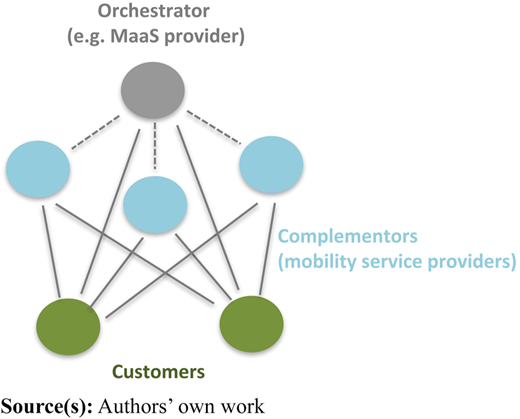
A careful review of our selected studies on the MaaS ecosystem provides us with an important finding, revealing that, similar to other ecosystems defined in the literature (Moore, 1993; Jacobides et al., 2018; Adner, 2017; Miehé et al., 2023), MaaS ecosystems, whether operational or conceptual, share a common feature: the need for an orchestrator or a key leader. In all of the studied cases, this role is filled by a new actor joining an existing ecosystem to offer customers combined transportation options. This pivotal firm’s presence is essential to ensure the alignment and advantageous participation of other complementing actors and to materialize a joint value proposition targeting a defined audience (Lingens et al., 2021; Adner, 2017) – in this case, travelers. This key leading role takes the form of “MaaS” or “mobility provider” in the “MaaS Global” model. It is also featured as “mobility provider” in Poland’s “Vooom”, promoting itself as “One app to ride the city” (Gajewska, 2024), whereas in Siemens’s IMP model it appears as “mobility retailer.” Similarly, this role is called “eMaaS provider” in the eMaaS model and “Mobility broker” in the “mobility broker” model. Although it may directly deliver its own mobility offerings to the customers, it's main role is orchestrating the MaaS ecosystem through aggregating offerings from other providers and offer them to potential customers (Figure 1).
The MaaS innovation ecosystem orchestrator could either be a public transport authority or a private company, each with its own advantages and disadvantages (Kamargianni and Matyas, 2017; Maas, 2022). Private firms often prioritize profit maximization, whereas public sector entities may focus more on social or environmental goals, such as accessible and affordable mobility and more eco-friendly solutions (Smith et al., 2018). Additionally, in most cities, public sector authorities are responsible for regulating the transportation industry (Kamargianni and Matyas, 2017; Reyes et al., 2019; Fenton et al., 2020; Mladenović and Haavisto, 2021). Our analysis of MaaS use cases from an orchestration perspective revealed strong barriers to onboarding a new actor to take on the orchestration role. These challenges arise from governance and operational perspectives, with collaboration among actors identified as one of the most critical issues to address in MaaS ecosystem design (Arias and Garci, 2020). This also aligns with findings from other studies (Smith et al., 2018; Lyongs et al., 2019) that highlight the highly fragmented nature of MaaS ecosystems and the reluctance of transport operators to cooperate with MaaS providers (Gebhart et al., 2023; Ye and Zheng, 2024). This reluctance often results in an unwillingness to allow third parties to resell tickets, a lack of high-quality data and general uncertainty surrounding emerging MaaS business models (Maas et al., 2022).
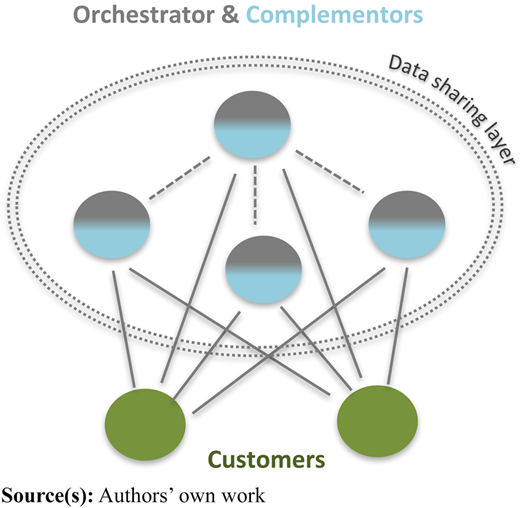
Our study findings propose an alternative approach to the current MaaS orchestration mechanism, which still consists of a community of hierarchically independent yet interdependent actors (Autio, 2022; Adner, 2017) forming a MaaS ecosystem centered on the focal value proposition. However, instead of a new actor joining an existing innovation MaaS ecosystem to become its orchestrator; an existing actor temporarily takes on the leading role to offer the best possible travel routes to customers by aggregation solutions from other available mobility service providers. I refer to this approach as “touring orchestration” because, under specific circumstances, every single existing MaaS innovation ecosystem actor can “tour” toward and take the orchestrator role while offering aggregated travel solutions to customers. The proposed touring model’s core layer consists of independent mobility service providers, such as public transport providers, and car-rental, bike-sharing and e-scooter sharing service providers who share data through a data-sharing platform. All members of this innovation ecosystem built around data sharing can then jointly leverage access to, process, analyze and use the data (Dai et al., 2020) as a digital business asset to coordinate their value co-creation activities (Neff, 2024), without the need to own the data. Each actor could take the orchestrating role based on the customer demand, while others provide complementary services.
4.2 Ecosystem actors and customer roles
Similar to any innovation ecosystem, the design of a MaaS ecosystem involves various stakeholders and actors, including transport operators, data providers, IT infrastructure providers, telecom companies, payment providers, regulatory authorities and customers (Kamargianni and Matyas, 2017; Jittrapirom et al., 2017; Maas et al., 2022). A collaborative multi-stakeholder approach is essential to achieve a seamless transition to a successful MaaS-based innovation ecosystem. This approach involves a network of participants working together to drive the necessary changes and adjustments. The MaaS ecosystem orchestrator plays a key role in creating value for the other participants, enabling them to access broader markets and expand their market share (Kamargianni and Matyas, 2017).
Effective coordination and alignment among stakeholders are vital for successfully implementing MaaS, but this remains one of the most significant challenges (Wong et al., 2020; Maas et al., 2022). While partnerships between MaaS actors can enhance the quality of offerings and strengthen value propositions, they must be approached cautiously because these actors also compete to provide certain services. Though regulators and policymakers are sometimes placed in the outside layer of a MaaS ecosystem, they play a crucial role in enabling the MaaS market. Given that MaaS relies on data sharing, open data and APIs, these actors play a key role in establishing and enforcing data, security and privacy standards and regulations (Kamargianni and Matyas, 2017; Fenton et al., 2020: Chirumalla et al., 2025).
On the other hand, customer demand for personalized services is continuously rising, with travelers seeking options across various modes of transport (Lang and Mohnen, 2019) As a result, MaaS operators face a complex landscape of expectations and uncertainties (Dedehayir et al., 2018; Maas et al., 2022). Therefore, simply creating a MaaS solution will not be sufficient to attract customers. To generate demand, MaaS providers must offer additional value (Maas et al., 2022). Potential customers need to see clear improvements in the value proposition, such as better pricing, enhanced offerings and environmental benefits, before they consider switching from their current mobility options to a new one, especially if they are already satisfied with their existing solutions (Lyongs et al., 2019). Therefore, managing uncertainties surrounding customer demands and expectations is a critical factor for the success of an innovation ecosystem like MaaS. This aspect must be carefully integrated into the value proposition of the MaaS ecosystem (Dattée et al., 2018; de Vasconcelos Gomes et al., 2021). Existing actors may face challenges in maintaining customer satisfaction when a new MaaS player with combined services enters the market. This new entrant intensifies the competition and, therefore, necessitates close collaboration between existing players to deliver a compelling value proposition. To address these challenges and facilitate the complex decision-making process involved in establishing MaaS projects, we recommend that introducing a new sole orchestrator should be avoided. Instead, consideration should be given to empowering existing transport providers by developing a data-as-a-service sharing model. This approach would allow these actors to access each other’s real-time data and enhance their potential to become temporary MaaS providers.
Here, based on customer choice, the mobility provider offering the travel package to the potential traveler takes on a leadership role within the ecosystem and combines all the available real-time and historical data to offer the best solution to the customer (Figure 2). A unique differentiating advantage of this model is the utilization of existing customer bases. There is no need to direct customers to a new platform (e.g. a new application) provided by a new actor who has joined the ecosystem as an orchestrator (Kamargianni and Matyas, 2017; Reyes García et al., 2019). In this model, the customers can continue using the existing applications or websites enriched with fresh and insightful data. Nevertheless, the customer acquisition costs in attracting customers to a new MaaS user interface can be sidestepped. Developing such a user base would be a significant challenge on its own (Lyongs et al., 2019; Ye et al., 2020), requiring a huge effort to engage in various marketing activities and to offer attractive incentives.
4.3 Data sharing as a service
For a successful MaaS operation scheme, one of the most critical criteria to be satisfied is technology and data requirements (Kamargianni and Matyas, 2017). This involves collecting all necessary information, providing administrative functional components and all services that the user requires (Beutel et al., 2014). These capabilities may exist with the ecosystem’s orchestrator and the actors who provide complementary services, or with technology-specific actors who offer these solutions and support the MaaS provider in developing its own platform (Kamargianni and Matyas, 2017). The technical architecture of each MaaS provider’s platform will likely vary depending on the business model, but standardized data sharing among the actors is an essential factor for the success of an innovation ecosystem like MaaS (Pflügler et al., 2016). Various technical solutions have been attempted and proposed, including universal programming (Marchetta et al., 2015) and the use of cloud-based services (Polydoropoulou et al., 2020). But, they all share a common requirement: an effective data-sharing mechanism and a willingness among companies to exchange their data. However, this has been identified as a significant challenge in the MaaS innovation ecosystem due to competition among market players (Polydoropoulou et al., 2020; MaaS, 2022).
One potential solution to increase the likelihood of cooperation and to motivate mobility service providers to share their data could be to empower all involved actors to utilize a data-as-a-service sharing model. This approach would allow each actor to make its data available on demand to other actors in order to enhance their collective value propositions and offer more compelling services to MaaS customers. Moreover, it could leverage travelers’ unique ID or profile together with historical travel patterns previously fed into a shared data platform. Moreover, this model could include other industry actors or value-added service providers, such as telcos, infrastructure providers, advertising agencies, map service providers, municipalities and public authorities. They could share different types of data, through the same data-sharing mechanism and in the form of network or “data as a service” (NaaS or DaaS) to further enrich the joint value proposition (Senyo et al., 2019; Neff, 2024).
5. Discussion – a touring orchestration model for ecosystem orchestration
Let us assume a customer is identified with a unique identifier (α) and requests travel “T” at time “x” from the mobility operator “c.” The travel package offered by mobility operator “C” (Qc) could be a combination of travels provided by other mobility operators, “d,” “e” and “f.” This offering also takes into account the customer’s historical travel data model (Φ), which could utilize advanced data analytics (e.g. machine learning algorithms, large language models and AI), fed by all mobility operators within the ecosystem, along with the customer’s historical locations (P) provided by a telco service provider. In the above example, the mobility operator “C” is the actor in charge of coordinating among the ecosystem actors and making the main decisions on the customer offering (Dattée et al., 2018; Lingens, 2021). In other words, mobility operator “C” acts as the temporary ecosystem orchestrator in this particular scenario. Later and in a different scenario, mobility operator “D” could take over the orchestrating role and offer the same customer (α) a new multimodal travel package (Qd) at time “x + t,” where “t” represents the time difference between the previous and current trip of the customer. Similar to the previous example, the offer to the customer is enriched by leveraging the customer’s historical travel data model δΦ(Tα), with the parameter (δ), distinguishing the travel that occurred between time “t” and “x + t”. The formulas below attempt to summarize the two aforementioned examples.
The proposed touring orchestration model (TOM) stands out regarding ecosystem construct due to its flexibility and resilience, particularly in managing the onboarding and offboarding of actors. This aspect is recognized as one of the major challenges (Wong et al., 2020; Maas et al., 2022) in establishing a MaaS or similar innovation ecosystem. The proposed model can also facilitate a shift toward a “free-market model” (Ye and Zheng, 2024), by make it easier for mobility service providers to engage with the MaaS ecosystem.
Furthermore, our proposed model would assist in the process of persuading other interested actors or service providers to demonstrate the potential benefits they would gain by joining the MaaS ecosystem. This is particularly significant, given that factors such as “competition, losing monopoly position, or power of control and influence” have been identified as key social and cultural barriers to joining a MaaS ecosystem, as highlighted by an analysis based on actor-network theory (Polydoropoulou et al., 2020; Gebhart et al., 2023). In the touring orchestration model, any new actor – whether mobility provider, telco or other services provider – capable of engaging in value creation can seamlessly join the playfield and directly offer its value proposition to potential customers. In this model, all actors can easily possess all three attributes emphasized in the stakeholder theory (Mitchell et al., 1997; Marcon Nora, 2023): power (coordinating with other actors and providing a final offering to the customer), legitimacy (offering a pragmatic solution and attracting public interest through their own platforms) and urgency (swiftly addressing customer demands). All of these are gathered under the framework of compliance with the ecosystem’s legislation and governing model (Wareham et al., 2014; Fenton et al., 2020), which represents a complex and critical factor with significant implications for the implementation and development of such a solution. This complexity underscores the necessity of robust governmental policy support (Ye and Zheng, 2024) and close collaboration between the public and private sectors (Karlsson et al., 2020; Gebhart et al., 2023), as emphasized many times in the literature. This is a key requirement that can directly impact the success or failure of a MaaS model and was likely one of the reasons behind the closure of the Swedish commercial MaaS solution in 2021 (Smith and Sørensen, 2023). The ease of joining and leaving the ecosystem without reliance on a new platform (e.g. applications, Website) contributes to the exceptional modularity of the proposed touring ecosystem design. Furthermore, it significantly facilitates user acceptance and improves user trust (Gebhart et al., 2023) because potential customers will continue using existing platforms. Therefore, if other MaaS ecosystems are to be considered “super modular” (Jacobides et al., 2018) in terms of complementarities – namely, granted some degree of freedom without requiring hierarchical governance and allowing complementors to make their own decisions regarding travel offers, processes, etc. – they still heavily depend on a leading firm as the sole actor interacting with the end users. Conversely, in the touring orchestration model, almost any actor can directly interact and engage with the end user by adhering to base standards and requirements.
In the proposed touring model, revenue sharing can be implemented in several ways. A simple approach could involve heterogeneous sharing rates, where the travel package provider charges the customer for the entire package and then pays back a fraction of the revenue to other providers who partnered in that specific offer. The profit (R) for travel package “Q” provided by mobility operator “C” can be calculated using the below equation, where the parameter “λ” indicates the fraction of the sold package (S) to be shared among the mobility operators. The modeling cost (V), provided by telco “A”, is also deducted from the total travels sold for the journey. If no data model is used or the data model has been generated by the temporary orchestrator (travel provider), the modeling cost could be eliminated from the equation. The model can also be calculated differently if it is provided by one of the other mobility providers.
6. Implications and conclusion
6.1 Academic implications
The current study provides three academic implications. First, it adds to the growing literature addressing ecosystem orchestration under the technological and value proposition uncertainties of an innovation ecosystem (Maas et al., 2022; Arias and Garci, 2020; Fenton et al., 2020). Although the prior literature has deliberated on how the orchestrator needs to consider the timing of different partners when enacting a certain ecosystem blueprint, it does not consider how orchestration can progress when there may be more than one orchestrator who would be ideal at different points in time during the orchestration process. By studying the MaaS case, we advance the ecosystem touring mechanism, which explains how this may occur.
Second, the current study adds to a growing stream of literature on MaaS business models and ecosystems. This article provides insights on how various MaaS ecosystems are orchestrated. The proposed conceptual orchestration model is built on the idea of innovation ecosystem simplification and avoiding the need for a fixed orchestrator. This model aims to promote early and smooth user acceptance while encouraging new actors to join existing ecosystems, with reduced concerns about collaboration and commercial competition among market actors. This is particularly important, given that transport companies have been seen to be reluctant to engage with one another, to allocate budget for the benefit of others, and to risk losing their customer base to competitors by joining a MaaS ecosystem (Karlsson et al., 2017, 2020; Smith et al., 2018; Lyongs et al., 2019; Gebhart et al., 2023). Recent findings by Ye and Zheng (2024) utilizing game theory suggest that the decision of a single stakeholder (among actors, government and travelers) to join the MaaS ecosystem can be strongly influenced by the action of the other parties. Therefore, by increasing incentives for the mobility service providers to join MaaS and ensuring travelers continue using existing platforms, our proposed model can serve as a catalyst, motivating governments and policymakers to offer stronger support for MaaS ecosystems.
Third, it contributes to the body of knowledge by demonstrating how different forms of data sharing, such as data-as-a-service models, can enhance value propositions and address some of its related uncertainties, such as data silos and availability of real-time data (Pflügler et al., 2016; Polydoropoulou et al., 2020; Neff, 2024). At the same time, it shows how these models can improve collaboration between innovation ecosystem actors by enabling the use of data from other innovation ecosystem participants, while maintaining their autonomy and the ability to access new customer bases.
6.2 Managerial implications
The current study provides three managerial implications, particularly for managers in the MaaS sector. MaaS solutions are becoming strategically important due to their potential to impact sustainability goals. However, value propositions are complex, and achieving success in practice demands a profound collaboration between all the MaaS ecosystem actors, where they need to willingly open their data feeds to each other. This has been pinpointed as a strong barrier to the success of such ecosystems (Gebhart et al., 2023; Polydoropoulou et al., 2020; Karlsson et al., 2016). By applying the proposed touring orchestration model, actors in the mobility and transportation industry can begin to formulate and embrace a unique and novel collaboration model with their yesterday competitors and view it as a new way of offering richer value propositions to their existing customers. But, more importantly, they can attract new customer to their platforms, opening up future business model innovation opportunities, without the constraints of existing risks and an unwillingness to cooperate with other market actors and commercial competitors. Additionally, and similar to prior findings, our study results suggest that policymakers must invest considerable effort in finding the right balance of regulations, ensuring that public interests are served while making it straightforward enough for ecosystem actors to embark on the journey. This article highlights the importance of close collaboration, shared vision, and regulatory support in establishing a thriving and user-friendly mobility-as-a-service ecosystem. It states that implementing the proposed model can simplify and reduce the costs for policymakers in motivating transportation and mobility providers to join MaaS because it mitigates risks and offers greater financial advantages for these stakeholders.
Finally, given the numerous similarities shared by innovation ecosystems (Miehe et al., 2023; Madanaguli et al., 2023; Palmié et al., 2022; Alka et al., 2024) across different industries, the proposed touring orchestration model can be applied by practitioners not only within the transportation and mobility sector but also across a wide range of other industries. It also facilitates cross-industry business model innovation, allowing diverse actors to explore new fields of activity by participating in different ecosystems. This flexibility stems from the model’s high degree of modularity and the opportunities and possibilities presented by various forms of data sharing as a service. Implementing and developing the proposed framework poses its own technical challenges and complexities. Implementing successful data sharing is not a straightforward task – for reasons such as data quality, privacy, security, and accountability – in an ecosystem with multiple actors involved.
6.3 Limitations and future research directions
Most of the models and system architectures reviewed in this study are predominantly successful examples of mobility as a service and smart mobility originating from northern Europe and the Baltic region, potentially influenced by European and Baltic market characteristics. This regional focus represents a limitation of the study. Furthermore, the study’s conceptual nature and lack of practical testing and empirical data support are additional limitations. Future research could provide a deeper analysis of the proposed touring orchestration solution, through empirical investigation. The results of this study could assist in shaping future research and contribute to the development of more effective orchestration models and stakeholder management frameworks for managing innovation ecosystems across different industry contexts.
Funding: This study was funded by Östersjöstiftelsen, supporting Nima Yahyapour, the first author.