


The paper aims to propose the definition of individual orchestration competence concept and the identification of its main attributes for orchestrating innovation ecosystems.
A literature review was conducted, from 2006 to 2024, considering Dhanaraj and Parkhe (2006) as a theoretical-conceptual framework, in Scopus and Web of Science databases. Seminal articles, books, articles and references cited in the selected articles were also used.
In this research, we highlight the need for competence for orchestrators to work in an innovation ecosystem. For this, we propose individual orchestration competence and its attributes. Next, we propose the Individual Orchestration Competence Theoretical Model in Innovation Ecosystem.
The results advance the field of orchestration by promoting the expansion of the network and ecosystem orchestration model, from the perspective of orchestrators’ roles and activities and orchestration dimension, to an ecosystemic and dynamic orchestration competence model.
As theoretical contributions, the proposition of individual orchestration competence concept and its attributes. Also the expansion of the existing theoretical model to a competence approach. As managerial contributions, we highlight the orchestration competence required of innovation ecosystem orchestrators.
Social implications are promoted as orchestrators understand their importance in the innovation ecosystem.
The orchestration literature has focused on its roles, activities and dimensions. Recently, the different orchestrators’ roles have been discussed, but little progress has been made. Therefore, this study has the novelty of exploring individual level – the orchestrator –, proposing an individual orchestration competence model.
1. Introduction
Innovation is widely recognized as one of the foundations for promoting economic development and quality of life. In a scenario of open and collaborative innovations, the concept of innovation ecosystems emerges (Granstrand & Holgersson, 2020). Communities of interdependent heterogeneous participants, but hierarchically independent, collectively generate ecosystem value proposition, that usually emerges through collective action, in which ecosystem members interact with each other and with the external environment (Thomas & Ritala, 2021), articulated by the quadruple helix – government, civil society, universities and companies (Carayannis & Campbell, 2009), in which to manage innovation processes is a complex and multifaceted task (Pikkarainen, Ervasti, Hurmelinna-Laukkanen, & Nätti, 2017). This complexity requires the mobilization of actors through orchestration that aims to develop, manage and coordinate the innovation ecosystem, articulated by an orchestrator (Dhanaraj & Parkhe, 2006; Ritala, Armila, & Blomqvist, 2009). Thus, the orchestration approach probably is the most suitable to describe the development, management and coordination activities of the networks (Ritala et al., 2009). Orchestration comprises a set of activities, and when an orchestrator conducts (some of) these activities in a specific manner (e.g. by exerting more or less power on other network or ecosystem members), it can be considered that the orchestrator takes a specific role (Pikkarainen et al., 2017).
The literature on the orchestration of innovation networks and ecosystems begins with a discussion of their key dimensions from the perspective of a single orchestrator (Dhanaraj & Parkhe, 2006). As the complexity of innovation networks and ecosystems has increased, the discussion has shifted to the role of multiple orchestrators (Hurmelinna-Laukkanen & Nätti, 2018; Pikkarainen et al., 2017). With the understanding of the expansion of orchestrators, the discussion of their roles is becoming the state of the art in the literature (Nilsen & Gausdal, 2017; Reypens, Lievens, & Blazevic, 2021). In parallel, studies have sought to open the black box of orchestrators’ activities (Mignoni, Bittencourt, da Silva, & Zen, 2021). We argue that the next step in the field of orchestration theory is to understand the competence of the orchestrator and their attributes.
Orchestrators play an essential role in managing the networks plurality through orchestration, which opens space for network research related to the skills and capacities of the orchestrator (Reypens et al., 2021). We highlight an essential ecosystem competence necessary by all actors in an ecosystem, regardless of their position, and that is the ability to manage dynamic strategic interactions related to innovation (Valkokari, Seppänen, Mäntylä, & Jylhä-Ollila, 2017).
In such context, we argue that there is a difficulty in articulating and orchestrating the actors inserted in the ecosystem - which are orchestrated by individuals who are part of the ecosystem with a focus on relations and innovation processes – identifying as a research gap the need to advance the theoretical field promoting the expansion of the orchestration model of networks and ecosystems approaching the perspective of orchestration competence of this orchestrator (individual) (Valkokari, Seppänen, Mäntylä, & Jylhä-Ollila, 2017; Reypens et al., 2021). We seek to answer the research questions: What is individual orchestration competence? What are the attributes of the orchestration competence to orchestrate in innovation ecosystems?
In this paper, considering the field and theoretical evidences, we defend the thesis that orchestration is a dimension of innovation competence – which comprised a set of personal characteristics, knowledge, competences (or skills) and attitudes linked to the creation of concrete and implemented novelties through collaboration in innovation processes, consisting of five dimensions: creativity, critical thinking, initiative, teamwork and networking (Hero, Lindfors, & Taatila, 2017; Marin-Garcia et al., 2016; Keinänen & Kairisto-Mertanen, 2019). Thus, a specific orchestration competence is necessary, which consists of a set of attributes associated with the orchestrator’s knowledge, skills and attitudes to articulate and orchestrate the actors and all the actions that involve an environment and/or context of innovation.
The results, as theoretical contributions, promote the expansion of the theoretical model of orchestration in networks and in innovation ecosystems organized from the perspective of roles and activities of the orchestrator for an orchestration competence approach, with the proposition of the definition of this competence and its main attributes, considering the orchestration dimensions. In these relationships, we perceive that the different orchestrators’ roles are intertwined and emerge from the relationship between the individual and the action to be performed. That is, the different orchestrator roles influence the dynamics and formation of the innovation ecosystem associated with the attributes of orchestration competence when an orchestrator (individual) acts in a situated context.
2. Literature review
2.1 Innovation ecosystem and ecosystem orchestration
Ecosystems need to adapt quickly to changes, through the agility of their actors’ relationships and governance (De Matos & Teixeira, 2022). The perspective of innovation networks (Dhanaraj & Parkhe, 2006) has been migrating to an innovation ecosystems approach (Gomes, Facin, Salerno, & Ikenami, 2018) in which highlights the quadruple helix model (Carayannis & Campbell, 2009) to collaborate and develop solutions beyond the scope of any organization or person could do individually (Mignoni et al., 2021). Innovation ecosystems consist of communities of interdependent heterogeneous participants, but hierarchically independent, that collectively generate ecosystemic value proposition that usually emerges through collective action, in which ecosystem members interact with each other and with the external environment (Thomas & Ritala, 2021).
In the ecosystem paradigm, the complexity of these relationships requires the mobilization of actors and the environment through orchestration, articulated by an orchestrator (Dhanaraj & Parkhe, 2006; Hurmelinna-Laukannen et al., 2011; Ritala, De Kort, & Gailly, 2023). Orchestration comprises a set of activities aimed at the development, management and coordination of actors that are intended to create and extract values from the network (Dhanaraj & Parkhe, 2006). Therefore, it guides the mode of organization and leadership in relationships with multiple actors (Dhanaraj & Parkhe, 2006; Hurmelinna-Laukanen et al., 2011; Hurmelinna-Laukkanen & Nätti, 2018), respecting the specific identities of each one involved and tries to ensure collaboration between them (Parmentier & Mangematin, 2014) generating innovations for itself and for the network, without the benefit of hierarchical authority (Dhanaraj & Parkhe, 2006).
The ability to orchestrate encompass different processes according to their applicability, comprising a set of actions conducted by one or more orchestrators who perform functions, from the definition of the orchestrator’s role and their key activities in the innovation ecosystem (Dhanaraj & Parkhe, 2006; Hurmelinna-Laukkanen & Nätti, 2018; Pikkarainen et al., 2017).
Dhanaraj and Parkhe (2006) initially discuss the practice of orchestrating innovation networks from three dimensions: knowledge mobility, innovation appropriability and network stability. Hurmelinna-Laukkanen, Möller, and Nätti (2011) propose an expansion to six basic dimensions for orchestration: agenda setting, mobilization, network stabilization, knowledge creation and transfer, innovation appropriability and coordination. Later, Da Silva and Bitencourt (2019) add the co-creation management dimension and Mignoni et al. (2021) add communication management (Table 1).
Orchestration dimensions
| Orchestration dimensions | Process (Actions) | Definitions |
|---|---|---|
| Agenda setting | Directing of ecosystem actors and their tasks | It provides the attraction of people to the activities influencing the mobilization of actors and objectives |
| Agenda organization | It involves creating and communicating an agenda that directs the members of the ecosystem | |
| Network mobilization | Attraction and selection of partners to the innovation ecosystem | It refers to the attraction and selection of partners for the innovation ecosystem, including the motivators |
| Network stabilization | Maintaining collaboration among the ecosystem members | It involves elements of culture, identity formation, values and beliefs |
| Avoid individualism and opportunism | Avoid isolation, migration, collusion and friction | |
| Knowledge creation and transfer | Knowledge sharing that is acquired and implemented in the ecosystem | It refers to the sharing, acquisition and implementation of knowledge within the ecosystem |
| Innovation appropriability | Development of relationships of trust | It ensures that innovators can get the financial results created by the innovations and the stability generated by the collaboration among the members of the ecosystem |
| Extraction the value generated by innovations | Determines an innovator’s ability to capture the profits or benefits generated by the innovation | |
| Dissemination of legal procedures and joint liability for assets | It refers to appropriability through instruments such as patents, copyrights and trademarks | |
| Coordination | Directing the entire planning and monitoring the execution | It creates mechanisms to drive the innovation process It guides the actors toward the same objective |
| Co-creation | Empowerment (active participation of the actors in the decision-making process with more autonomy and responsibilities), connection and social engagement | Encouraging the active participation of the actors in the construction of collective solutions |
| Communication management | Conducting communication activities and disseminating the actions and institutional projects to the public and engage them | It refers to the communication and dissemination of institutional actions and projects to the public and engage them |
Source(s): Prepared by the authors based on Dhanaraj and Parkhe (2006), Hurmelinna-Laukkanen et al. (2011), Hurmelinna-Laukkanen and Nätti (2018), Da Silva and Bitencourt (2019), and Mignoni et al. (2021)
The roles of orchestrators are identified by how they conduct orchestration activities (see Table 2). Several orchestrators can assume various roles (Pikkarainen et al., 2017) in which the orchestrator and its role can be changed over time (Nilsen & Gausdal, 2017). Also, several orchestrators with different roles can generate more value for networks and ecosystems (Hurmelinna-Laukkanen & Nätti, 2018). The following presents a theoretical discussion based on the competences approach.
Main attributes of the individual orchestration competence
| Orchestrator roles | Orchestration dimensions (Orchestration practices) | Capacities… | Orchestration competence attributes | |||||||
|---|---|---|---|---|---|---|---|---|---|---|
| Agenda setting | Mobilization | Network stability | Knowledge creation and transfer | Innovation Appropriability | Coordination | Co-creation | Communication management | |||
| Orchestration activities (work practices) | ||||||||||
| ARCHITECT | Identifying opportunities, setting the goals | Selecting the network members | Following the plans and execution of activities | …to identify opportunities, set goals and plans |
| |||||
| JUDGE | Taking control over plans, determining performance standards | Defining and implementing the network | Setting the innovation rules for value appropriation | Monitoring and adapting performance standards | ...to determine, monitor, enforce and adapt performance standards for participants |
| ||||
| GATEKEEPER | Extracting knowledge from outside the network and disseminating it among network members | …to acquire and transmit information |
| |||||||
| CONDUCTOR | Acquiring and transforming information to strengthen the actors’ own core competences | Allocating tasks to other network members | Sharing knowledge to co-create | …to acquire and exploit information |
| |||||
| REPRESENTATIVE | Sharing knowledge on the network with outsiders Providing and filtering information | Evaluating how much can be shared to maintain innovation appropriability | ...to share information with outsiders |
| ||||||
| LIAISON | Operating as an external intermediate between network members or between networks | Shaping and advancing exchange processes | ...to act as an intermediary in and between networks |
| ||||||
| COORDINATOR | Administrating interaction between network members for increasing ties | Practical administration of interaction between network members | ...to enforce interaction between network members |
| ||||||
| AUCTIONEER | Setting agenda for introducing a joint vision to the network | Creating a joint vision and promoting it | ...to create a joint vision and promote that |
| ||||||
| DEVELOPER | Developing and strengthening the (in) tangible assets | Strengthening the intangible assets | Sharing knowledge to co-create | ...to develop assets for and within network |
| |||||
| PROMOTER | Introducing new ideas into the network; Getting network members to work toward the same goal | Engaging actors into an innovation development | ...to get network members to work for the same goal |
| ||||||
| LEADER | Specifying contributions to the orchestrator to the network, to others; specifying benefits of participation | Motivating and fostering (spontaneous) collaboration | Providing support; managing the texture of interactions with long-term view | Clarifying the roles of network members | ...to motivate collaboration and clarify roles |
| ||||
| FACILITATOR | Bring together different parts to work together/to collaborate | Sharing knowledge to co-create | ...to facilitate the collectively creation …to integrate the members |
| ||||||
| COMMUNICATOR | Conduct communicating activities and disseminating actions and institutional projects to the public and engaging them in the network | ...to communicate and disseminate the institutional actions and projects to the public and engage them |
| |||||||
Source(s): Prepared by the authors based on Dhanaraj and Parkhe (2006), Hurmelinna-Laukkanen et al. (2011), Pikkarainen et al. (2017), Hurmelinna-Laukkanen and Nätti (2018), Da Silva and Bitencourt (2019), Mignoni et al. (2021), Nilsen and Gausdal (2017), and Hurmelinna-Laukkanen et al. (2022)
2.2 Competences and the individual competence dimension
The origin of the notion of competences in the individual dimension is confused with a notion that is relatively associated with it – the qualification notion; in addition, to the notions of attributions and responsibility, from discussions between the 1960s and 1980s. It is contextualized in an environment of formal employment, predominantly industrial work, supported by generally predictable activities and a strong trade base. Thus, the notion of qualification is centered on the preparation of capacities directed towards foreseen or predictable processes in its majority. The concept of competences advances, already in the 1990s, with the intensification of productive restructuring, resulting from another context, in which highlight the acceleration of competition, the logic of service activity, intermittent and informal work, the low predictability of businesses and activities and the crisis in workers’ trade union associations. Therefore, the notion of competences addresses the development of capacities which can be subsequently mobilized in certain situations (Ruas, 2005).
One of the controversial points of the notion of competences is what deals with the limit between expressions capacities and competences. Capacity is what develops and explores in the form of potential and is mobilized in an action that we associate with the notion of competence. That is, it is not about considering competent people, but their actions. Competence is the result of a process of developing capacities in the form of knowledge. At the same time, the development of competence will depend on certain abilities of the individual, which will still depend on their attitudinal type capacities (Ruas, 2005) as a disposition of action for learning. All competence is based on a set of capacities. These capacities assume the condition of competence only when they are mobilized to realize a specific action. The development of an individual’s competence is based on a certain combination of capacities associated with knowledge, skills and attitudes. Through the result of the action, competence is recognized or not (Ruas, 2005).
Competence is not expressed by action but is realized in action through practice. That is, competence emerges at the junction of a knowing and a context, from the mobilization of knowledge and capacities in a determined context in which resources and conditions and/or limitations should be considered. Competences are recognized by knowing (knowledge), know-how (skills) and knowing how to be (attitudes) (Boterf, 2003) at the same time and in an interrelated way (Zabala & Arnau, 2010). The development of competences should be understood based on organizational practices in which work assumes meaning for individuals in their experiences and lives, through interaction and cooperation between individuals (Sandberg, 2000). Considering the emphasis of this study, in respect of the individual competence, it is defined that competence is the capacity to mobilize knowledge, skills and attitudes by the individual faced with the situation, activity, context and culture in which it occurs or is situated (Antonello, 2011).
3. Methodological procedures
We conducted a systematic literature review to construct the contextualization of the proposed research questions and the analysis of the literature (Tranfield, Denyer, & Smart, 2003). This approach is appropriate to achieve a deeper understanding of the concepts of innovation ecosystem orchestration and the perspective of individual competence.
With the proposition of the research question, we defined the search terms based on seminal articles observing the concepts of the theme. It is worth mentioning here that the field of study on competence presents a complexity since terms such as “capacity”, “competence”, “skill”, “capability”, “ability” (singular and plural), among others, are considered synonyms and used at the same time, in different contexts, to direct studies on individuals and organizations. We emphasize that there is a lack of consensus on the use of terms, as we can see in the literature a semantic overlap of the terms mentioned from different perspectives. Considering the competence literature, we highlight that in this study the expressions “capacity”, “competence”, “skill” and “ability” (singular and plural) are not considered synonymous and are related to the individual context. The expression “capability” (singular and plural) is related to the organizational context.
A keyword search was used (“orchestrator” OR “facilitator” OR “articulator” OR “conductor”) AND “innovation” OR “network*” OR “ecosystem*”) AND (“competenc*” OR “skill*” OR “abilit*” OR “capabilit*” OR “characteristic*” OR “role*” OR “activit*”), in the title, abstract and keywords of the articles, in the period 2006 to July 2024, for the construction of the theoretical framework, considering the article by Dhanaraj and Parkhe (2006) as a theoretical framework. The databases Scopus (Business, Management and Accounting area) and Web of Science (Management and Business area) were used, in articles published in periodicals, written in English, Spanish and Portuguese.
After organizing the articles obtained in the two databases, 670 articles were compiled from the search, with the following distribution: Scopus (n = 496) and Web of Science (n = 174). Subsequently, the articles were analyzed, and duplicates were eliminated, leaving 120 articles. Then, the abstracts were read, and the following inclusion criteria were applied: articles that addressed the roles and activities of the orchestrator, aiming to elaborate the contextualization of the perspective of individual competence and the dimensions of orchestration. It is worth noting that the inclusion criterion adopted is because no studies were found with an approach to the individual competence of the orchestrator in the context of an innovation ecosystem. Research gaps and suggestions for future research were found in some studies analyzed regarding the research questions proposed for this review. This step resulted in 10 studies included in the development of the literature review. The selected articles were organized in a specific file, supported by Microsoft Excel software. Classic articles and books were also used, as well as recent articles and references cited in the selected articles.
4. Results and discussions
We present the notion of competence in an ecosystemic perspective, articulating it with elements of the context of innovation and innovation ecosystems, from the theoretical approach of orchestration and competence, focusing on orchestration competence and the Individual Orchestration Competence Model proposition.
4.1 Orchestration competence and main attributes to orchestrate innovation ecosystems
Studies on orchestration started with approach to orchestration dimensions or processes (Dhanaraj & Parkhe, 2006; Hurmelinna-Laukannen et al., 2011), later associated with orchestrator activities and roles (Pikkarainen et al., 2017; Hurmelinna-Laukkanen & Nätti, 2018), complemented by concepts related to orchestrator skills and capabilities (Ritala et al., 2009; Hurmelinna-Laukkanen & Nätti, 2018), considering the terms used by the cited authors here.
Ritala et al. (2009) explain innovation orchestration capability at the organizational and individual level, consisting of interaction between various organizations and between individuals associated with these organizations; that is, individuals sustain formal connections within and between organizations. Organizational capabilities or routines have an equivalent of individual level, comprising the skills and knowledge of these interrelated individuals. From the three orchestration dimensions proposed by Dhanaraj and Parkhe (2006), Ritala et al. (2009) suggest as individual level skills interpersonal communication and social skills, influence and motivation skills, entrepreneurial skills (proactivity and taking responsibility), operational skills such as project management and contracting, as well as balancing skills, that is, the ability to take a systemic view and identify the interest of different parties. However, at the individual level, it is observed that they do not contextualize it in a theoretical perspective of competence. The capacities integrate a set of knowledge, skills and attitudes; that is, the combination and mobilization of these capacities conducting specific action will allow the exercise of competence (Ruas, 2005). We understand, therefore, that the organization of the attributes of individual level capacity proposed by Ritala et al. (2009) have a set of capacities constituted only in the scope of individual’s knowledge and skills.
Hurmelinna-Laukkanen and Nätti (2018) discuss orchestration from the coordination of network activities, the roles that actors assume in conducting orchestration, and the capabilities necessary for orchestration. The role defines what actors do and each role includes a set of orchestration activities. The accomplishment of these tasks denotes specific orchestrator roles. Supported by the idea that orchestrators focus on doing different activities in different contexts and at different points in the evolution of the network, literature has labeled a variety of roles (see Section 2.1). Subsequently, Hurmelinna-Laukkanen and Nätti (2018) discuss that the orchestrator’s capabilities are relevant to determining whether the orchestrator can assume a role or different roles and conduct the activities involved. The dynamic nature of orchestration implies that not all activities are equally highlighted in all situations and can be made in different ways. The authors also affirm that inserting capabilities in this context allows for an understanding of its nature and applicability.
We highlight that, from the perspective of the orchestrator as an individual, the authors Ritala et al. (2009) use in their studies the term “skills” and Hurmelinna-Laukkanen and Nätti (2018) the term “capabilities”. Although the terms “skills” and “capabilities” are used in different theoretical frameworks and models and in various contexts, the studies concerning the individual require a clear and objective definition of the concept. We observed that when Hurmelinna-Laukkanen and Nätti (2018) use the term “individual orchestrator capabilities” they refer to “capacities”; that is, we understand that they are on the threshold of a theoretical controversy point between the terms “capacities” and “competences” (Ruas, 2005). Already when Ritala et al. (2009) use the term “skills”, we understand that, according to Ruas (2005), they are referring to only one of the elements of the concept of competence. That is, the skill is the capacity of an individual to perform a certain role or function, since the skill turns knowledge into action to achieve a specific goal in each situation.
Literature discussions highlight the capacity to generate innovation through collaboration between actors in the innovation ecosystems. Orchestrators influence rules of signification, namely collectively developed beliefs, practices, rules and values concerning what is relevant in the ecosystem (Bonomi Santos, Fernandes, de Oliveira, Mais, & Partyka, 2023). There is a difficulty in articulating and orchestrating these actors, the authors identified as a research gap the need to advance the orchestration theoretical field by proposing an orchestration competence model. We understand the need and importance to advance and contribute theoretically to the field of orchestration, with the concept of individual orchestration competence, considering the theoretical assumptions related to the concept of competence (individual) and its development. We observed that part of the studies has focused mainly on the relationships between the actors of the ecosystem, here we approach the individual level – the orchestrator – that exerts influence on the dynamics and formation of the ecosystem. We understand that each helix agent is an orchestrating actor represented by an individual, and the agents involved act to achieve a common objective and/or purpose.
Therefore, we propose the concept of individual orchestration competence, integrating its attributes, in an ecosystemic perspective, from a disposition of action and perception of the individual. In this study, based on the cited authors, we define orchestration competence as the combination of capacities associated with knowledge, skills and attitudes that when placed in actions for the development, management and coordination of an innovation ecosystem, environments and/or network and innovation contexts, by the orchestrator actor (individual), allow their articulation and their effective and properly interaction among themselves and the other actors involved, in a collaborative, interdependent and co-creative way.
We conclude that the orchestration of an innovation ecosystem is characterized as a set of activities and roles to develop, manage and coordinate the articulations and interactions of interdependent members and the environment in a given context and/or situation performed by an orchestrator (individual). We propose the concept of orchestration competence is constituted considering the orchestration dimensions (orchestration practices), in which the attributes of individual orchestration competence emerge from the orchestration processes (practices and actions) associated with the orchestrator role (function) and orchestration activities (work practices) (see Table 2 organization). Attributes refer to a set of elements – comprising knowledge, skills and attitudes – which integrates orchestration competence. Competence occurs in the individual’s action, that is, the development of competence is associated with the capacity to mobilize one or more attributes in a situated context.
The constructs in Table 2 are associated with orchestration capacities originating from the literature that result in the identification of the 33 attributes of orchestration competence (see Figure 1 organization). The article proposes the expansion of the theoretical model organized from the perspective of orchestrator roles and activities to an ecosystem model of orchestration competence. Different orchestrators’ roles are intertwined and emerge from the relationship between the individual and the action to be performed. The different orchestrator roles influence the dynamics and formation of the innovation ecosystem associated with the attributes of orchestration competence when an orchestrator (individual) acts in a situated context.
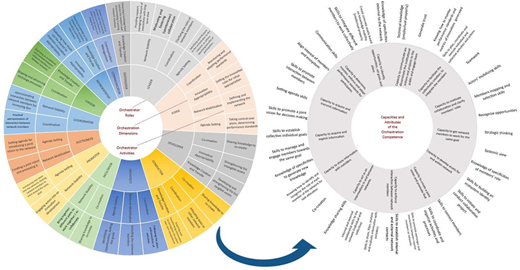
Individual orchestration competence theoretical model in innovation ecosystem. Source(s): Prepared by the authors based on Dhanaraj and Parkhe (2006), Hurmelinna-Laukkanen et al. (2011), Pikkarainen et al. (2017), Hurmelinna-Laukkanen and Nätti (2018), Da Silva and Bitencourt (2019), Mignoni et al. (2021), Nilsen and Gausdal (2017), and Hurmelinna-Laukkanen et al. (2022)
Individual orchestration competence theoretical model in innovation ecosystem. Source(s): Prepared by the authors based on Dhanaraj and Parkhe (2006), Hurmelinna-Laukkanen et al. (2011), Pikkarainen et al. (2017), Hurmelinna-Laukkanen and Nätti (2018), Da Silva and Bitencourt (2019), Mignoni et al. (2021), Nilsen and Gausdal (2017), and Hurmelinna-Laukkanen et al. (2022)
4.2 Individual orchestration competence theoretical model in innovation ecosystem
The orchestrator is fundamental in the design, mapping and analysis of the ecosystems’ pre-initiation stages, which will be important in shaping the ecosystem guidelines later (Souza, Wegner, & Faccin, 2023). Additionally, the orchestrator plans not only the ecosystem but also the actions implemented to motivate members participation and govern it (Terrizzi, Marino, Cinici, & Baglieri, 2024). Considering the dynamics of the evolution of network structures to innovation ecosystems there is a need to appropriate the notion of competence in the form of mobilization of capacities associated with knowledge, skills and attitudes. The orchestrator, in the articulation of actors and all actions that involve an environment and/or context of innovation, demands specific orchestration competence. Orchestration competence is mobilized through its attributes (elements) based on the orchestrator’s individual actions, the orchestrator’s interaction with the members and actors of the innovation ecosystem and the orchestrator’s articulation with the innovation ecosystem itself.
The Individual Orchestration Competence Theoretical Model (Figure 1) organizes the theoretical discussion related to the theoretical constructs presented in Table 2 – with the expansion of the theoretical model organized from the perspective of orchestrator’ roles and activities to a competence approach – presenting the attributes of orchestration competence identified from the description of the orchestrators’ main roles and activities of aligned to the orchestration dimensions, based on Dhanaraj and Parkhe (2006), Hurmelinna-Laukkanen et al. (2011), Pikkarainen et al. (2017),; Hurmelinna-Laukkanen and Nätti (2018), Da Silva and Bitencourt (2019), Mignoni et al. (2021), Nilsen and Gausdal (2017), and Hurmelinna-Laukkanen, Möller, and Nätti (2022).
The orchestration is evidenced as the actors are involved and perceive benefits in acting in the ecosystem (Faccin, Bittencourt, & Machado, 2022). Our model (Figure 1) advances theoretical understanding by presenting an ecosystemic and dynamic perspective, in which the orchestration competence attributes are constructed and constituted in the action and interaction of the orchestrator with the context and other actors; in addition to directing a new look at this orchestrator. The left image (Figure 1) illustrates current literature based on the roles and activities of the orchestrator, considering the orchestration dimensions. The right image (Figure 1) illustrates the orchestration capacities and the 33 attributes of the orchestration competence, considering that the entire competence consists of a set of capacities. These capacities assume the status of competence only when their attributes are mobilized to carry out a specific action. This model offers a theoretical framework for planning training to develop orchestration competence, as well as providing support for the management and orchestration of innovation ecosystems.
5. Conclusions
This paper aims to propose the concept and identify the main attributes of the individual orchestration competence, seen as essential in the ecosystemic action, in the context of the innovation ecosystems. In this context, from an ecosystemic perspective, technical knowledge, skills and creativity of individuals are associated, and also the interrelationship with different actors and the complexity of these relationships that requires the mobilization of actors and the environment through development-oriented orchestration, management and coordination of the innovation ecosystem articulated by an orchestrator. The recent discussions point to the orchestrator’ roles and activities for the articulation of actors and the ecosystem environment, revealing orchestrators with different roles (Hurmelinna-Laukkanen & Nätti, 2018; Pikkarainen et al., 2017).
We understood the need to advance the theoretical field by promoting the expansion of the orchestration model in networks and innovation ecosystem for a discussion competence-based approach. We understood that in the empirical field there is a need for orchestration, articulated by an orchestrator, in innovation ecosystems, but there is a lack of understanding regarding their competence, which the literature does not address with depth and clarity. We argue that we have gone beyond the literature on orchestration roles and activities and entered another field, which is orchestration competence, based on an ecosystemic and dynamic model, where the attributes of this competence are built and constituted in action and interaction of the orchestrator with the context and other actors. So, we propose a new theoretical model (Figure 1) and a new look at this orchestrator.
We argued that if we know how to develop orchestration competence, we can increase the number of orchestrators and innovation ecosystems. It is also understood that the development of orchestration competence enables the work practices of innovation ecosystems performed by orchestrators (individuals) to be directed towards more effective management, considering the strategies adopted and the involvement of all actors.
Based on the context presented in this paper, there are theoretical contributions and practical and social implications. Theoretical contributions include the proposition of the concept, the identification of the main attributes of individual orchestration competence and a theoretical model (Figure 1). Furthermore, directions for expanding the theoretical model of orchestration in innovation ecosystems organized from the perspective of orchestrator roles and activities to an approach of competence and its attributes. The competence approach enables the constituent actors of innovation ecosystems – governments, companies and universities – the organization and development of training programs and the creation of learning spaces for the development of orchestration competence aiming at the constitution of a learning ecosystem. In sum, we push the discussion on orchestration to another level, we deepen this competence to the level of the individual, proposing the concept of individual orchestration competence and also the attributes that constitute it.
As managerial contributions, we have highlighted the orchestration competence required for innovation ecosystem orchestrators. As such, we aim to contribute to public policy programs and training for educational institutions by presenting the orchestration competence attributes. From this, we also seek to promote social implications as the orchestrators become clearer about your importance in the innovation ecosystem. In this way, we aim to generate the externality of expanding innovation ecosystems.
Concerning future studies, we suggest an approach to the empirical field, through interviews with orchestrators in the context of orchestration practice in innovation ecosystems, in order to understand their professional and operational reality, understand their context of practice and understand the competence of orchestration for the identification of new attributes of this competence, as well as the validation of attributes already identified in the literature, thus contributing to the expansion and validation of the proposed competence model. Furthermore, we suggest proposing an artifact in the format of training aimed at developing orchestration competence for the orchestrator’s performance in innovation ecosystems.

