


This study examines how artificial intelligence (AI) is integrated into franchise-based businesses in the digitalized entertainment sector. The aim is to offer a nuanced decision lens to guide managers in fostering value co-creation.
We adopted a qualitative multi-case study research, supported by sectoral analysis and conducted by gathering primary and secondary data. The study focused on four sub-sectors (film and television, music, sports and gaming) to strengthen solidity. Through NVivo [15], we employed an inductive approach to trace AI integration across dynamic capabilities.
The study reveals AI integration shifts franchises along a continuum from full value co-creation to full value co-destruction, with intermediate leaning states. Such effects impact dynamic capabilities, leading to augmentative or substitutive outcomes. This happens through two different processes: optimization achieved with non-intrusive AI integration; disruption determined by intrusive AI. Results identify common mechanisms adopted by multiple companies within the entertainment industry, leading to either outcome.
This research introduces a franchise-applicable “AI Integration–Dynamic Capability Alignment Framework” that enhances managerial decision-making. The study advances existing literature by classifying AI integration through contingency mechanisms. It enables managers to design and scale AI according to the superior outcome. Future research should apply the framework to other sectors and quantify performance effects.
1. Introduction
The rapid integration of artificial intelligence (AI) into modern business has reshaped how organizations operate, scale and engage consumers (Perez-Vega et al., 2021; Ramaswamy and Ozcan, 2018; Haefner et al., 2021). As digital integration comes to an end, the AI-era brings new challenges and opportunities, such as interactive technologies, a massive amount of user-generated content (UGC) and a higher degree of personalization (Grewal et al., 2025; Boppana, 2023; Nawaz et al., 2025). Franchise-based digital businesses, which are highly dependent on consumer perceptions, are deeply involved in this transformation (Bradach, 1997; Perrigot and Pénard, 2013; Bretas and Alon, 2021; Mills and Jeremiah, 2021). These businesses have expanded beyond brick-and-mortar (opening as many physical stores as possible) to scalable, tech-driven frameworks (Mehra et al., 2018; Mills and Jeremiah, 2021). This shift represents the irreversible aftermath of the digital transformation. As AI transformation develops across businesses across multiple sectors, companies cannot ignore these emerging technologies; to stay competitive, they must be aware of the risks associated with their integration.
Prior research does not provide decision-oriented guidance that classifies AI integration outcomes. This makes it difficult for firms to discern when AI augments rather than substitutes, thereby undermining value. To address this issue, our research explores AI integration in franchise-based businesses, assessing both its potential benefits and associated challenges in the evolving digital environment. The central research question is: “How to integrate Artificial Intelligence within franchise-based digital businesses to foster value co-creation?” To address this, we aim to provide effective guidelines to distinguish between augmentative and substitutive effects of AI integration. Furthermore, we conceptualize such effects by applying the logic of value co-creation (Vargo and Lusch, 2004). We focus on the entertainment sector due to its relevance and diversity: it comprises sub-sectors such as film and television, music, gaming and sports, each of which is affected by digital transformation and AI integration. The sector's breadth and ongoing evolution offer a rich landscape to investigate how franchising adapts to technological and behavioral shifts, making it an ideal context for this study.
We ground our study on two theoretical assumptions and operationalize each through a complementary analytical lens. First, we draw on the idea that a sustainable franchise-based business depends on brand cohesion, technological efficiency, human adaptability and organizational identity to identify paths for process optimization (Jang and Park, 2019; Pasmore et al., 2019). Second, we leverage technological change effects to identify a parallel path that leads to process disruption (Uren and Edwards, 2023). To ensure a more practical outlook on these concepts, we track shifts in firms' ability to sense, seize and reconfigure, and we read the customer-facing consequences as either value co-creation or value co-destruction in audience ecosystems (Teece, 2007; Vargo and Lusch, 2004; Lumivalo et al., 2024; Wolf and Madlberger, 2025). To conduct this study, we adopted a multi-case study sectoral analysis to draw results from a variety of contexts. We gather both primary and secondary data to guarantee data triangulation, thus achieving a true-to-reality classification of our case studies and leading to practical managerial outcomes in the ongoing AI era (Yin, 2009, 2018).
Our findings show that AI integration in franchise-based digital businesses produces heterogeneous effects rather than a uniformly positive trajectory. When deployed as an augmentative enablement layer, AI optimizes operations by expanding sensing with timely, legible signals; accelerating seizing through faster option generation and packaging; and strengthening reconfiguring via reusable modules and portable governance routines. These non-intrusive configurations reinforce franchising value drivers: brand cohesion, organizational identity, technological efficiency and human adaptability (Jang and Park, 2019; Pasmore et al., 2019), therefore, supporting value co-creation (Vargo and Lusch, 2004). Conclusively, authorship and decision rights remain contestable and traceable to accountable human actors, enabling process optimization. In contrast, substitutive AI shifts disrupt operations by degrading sensing through proxy metrics or signal noise; downgrading seizing through algorithmic gating and compliance drag, and stalling reconfiguring through fragmented toolchains or ecosystem lock-in. Such intrusive integrations decrease franchise value, thus supporting value co-destruction (Lumivalo et al., 2024; Wolf and Madlberger, 2025). Furthermore, by shifting interpretation, gatekeeping or coordination power toward opaque systems, they lead to process disruption. Consequently, franchises move along four value trajectories – from full co-creation to full co-destruction – depending on the capability-level mix.
Our research advances current managerial debates by introducing a franchise applicable “AI Integration–Dynamic Capability Alignment Framework.” First, we conclude that AI integration can leverage greater dynamic capability development (process optimization) or diminish it (process disruption), thereby impacting franchise value. Second, we categorize these effects within franchise-based digital businesses as “non-intrusive” if authorship and decision rights remain with people (human augmentation) or “intrusive” if a shift to opaque, automated systems occurs (human substitution). Third, we provide a more precise framing by identifying twelve distinct contingency mechanisms for each AI integration effecting franchise value: four for each dynamic capability, distinguished by their augmentative (triangulated listening, real-time insight, HITL experimentation, creator control, pipeline reuse and modular governance) or substitutive (proxy sensing, signal noise, algorithmic gatekeeping, compliance drag, total fragmentation and ecosystem lock-in) outcomes. Finally, we conceptualize the overall outcome on franchise-based digital businesses through four aggregate value trajectories (full value co-creation, value co-creation leaning, value co-destruction leaning and full value co-destruction), which capture the shift from process optimization to process disruption.
Overall, we unveil the mechanisms that allow AI integration to foster value co-creation within franchise-based digital businesses. Managers should use our framework in decision-making processes to align AI with dynamic capability development, thus increasing franchise value. Policymakers should enforce clear transparency and creator-protection rules to promote non-intrusive AI integration and guarantee positive customer response. Future research should test the framework in other sectors, quantify performance outcomes and examine longitudinal and regulatory shocks.
2. Literature review
2.1 Sustainable relationships in franchising to foster value co-creation
Franchising involves a legal agreement between a franchisor and a franchisee, where the franchisee pays to operate under the franchisor's brand and system (Zulkifli et al., 2025). Adopting this model requires identity reconstruction from business owners, who must navigate the tension between previous roles and franchising’s structured norms. This transformation, known as “identity undoing,” is vital for sustainable success (Mills and Jeremiah, 2021). Franchisor-franchisee identity alignment strengthens emotional commitment and performance, while misalignment leads to disengagement and higher turnover (Grünhagen et al., 2025).
As franchising enters the digital era, the expansion of this business model has produced complex, scalable architectures. Multi-unit franchising accelerates growth by enabling franchisees to run multiple outlets, but it must balance standardization with local responsiveness. This is achieved by employing the “plural form,” blending of company-owned and franchised units to manage control and flexibility (Bradach, 1997; Bretas and Alon, 2021). Digital transformation heightens this tension and drives collaboration and technology adoption to stay competitive (Huang et al., 2023). A parallel path is followed by Intellectual Property (IP) franchises, which adopt technology to maximize brand reach, thereby increasing brand recognition. Firms leverage iconic IPs to shape markets and culture, thus creating stronger customer foundations (Wu, 2022; Nichols, 2023; Loock, 2024).
Digital transformation has led franchise-based businesses to operate within audience-driven ecosystems, where the value of the company's output is heavily dependent on customer interactions, enabling value co-creation processes (Vargo and Lusch, 2004; Jenkins, 2006; Castells, 2009; Blázquez, 2023). The success or failure of a franchise is therefore dependent on digital platforms, which act as engagement infrastructures enabling “interactional creation” and value-in-use through user-generated content (UGC) and participatory narratives (Ramaswamy and Ozcan, 2018; Freeman and Smith, 2023). Five micro-level mechanisms – social use, customer orientation/decision making, service experience, use context and customer goals – help designers engineer co-creation into digital services and campaigns (Tuunanen et al., 2024; Walden, 2023). Yet, co-creation has a dark side: misaligned interactions or out-of-touch management decisions can trigger value co-destruction, leading to lower customer engagement, as evidenced by reduced UGCs and fewer responses to participatory initiatives (Lumivalo et al., 2024; Wolf and Madlberger, 2025).
The disruptions brought by digitization have sparked debates about the sustainability of franchise-based businesses. According to the model of “Sustainable Franchisor-Franchisee Relationship” (SFFR), to keep franchise alignment over time, franchisors need to enhance four levers: fairness, autonomy, formalization and support. In this manner, franchisors elevate franchisee trust and commitment, leading to sustainable franchise businesses (Jang and Park, 2019). Furthermore, as franchise-based businesses embrace the digital era, sustainable advantage depends less on static assets and more on dynamic capabilities: the organizational routines to sense technological and demand shifts, seize them through timely business-model choices and reconfigure assets, structures and partnerships to keep pace with change (Teece, 2007). Dynamic capabilities are operational enhancers that engage consumers in value-creation processes, adapting to their changing needs and expectations (Agarwal and Selen, 2009).
2.2 AI integration to reshape digital business processes
Contemporary research has highlighted the role of AI in digital transformation: reconfiguring structures, processes and competitive logic. Organizations must redesign around AI-enabled efficiencies and platform complexity to remain viable (Loebbecke and Powell, 2002; Seppänen, 2025). Sectoral shifts are visible in sports, where personalization and immersion redefine fan engagement (Zhou and Xiong, 2024), and in media, where streaming platforms and tech conglomerates reshape industry boundaries (Sigismondi, 2024). Within Industry 4.0, interconnected systems and real-time analytics enhance production agility and supply-chain orchestration (Veile et al., 2022). Despite its energy intensity, studies have shown that AI's optimization capabilities improve resource allocation and reduce waste, aligning operational performance with sustainability goals (Wang et al., 2025). Collectively, these advances position AI as the central engine of contemporary digital transformation, whose integration is necessary.
As AI's role becomes more relevant, companies need to balance its integration to avoid disruptive shifts in their processes (Sewpersadh, 2023). Effective human–machine collaboration works as a hybrid team of people and AI, that deliberately allocates tasks and shares information to leverage complementary strengths (Xiong et al., 2022). When emerging technologies are integrated into organizations, technology change models help explain how these new tools reshape tasks, structures and governance over time, offering a lens for planned adaptation rather than ad hoc reactions (Konlechner, 2018). The “Sociotechnical Systems Theory” (SST) by Pasmore et al. (2019) states that traditional change models no longer fit, and current technology change trends demand participative redesign of roles, governance and feedback loops so automation complements human work. The “Technological Change Theory” (TCT) postulates AI reshapes digital business models along two paths: optimization, where data-driven tools streamline existing processes and scale personalization and disruption, where AI reconfigures roles, data flows, and value capture to create new offerings and governance needs (Uren and Edwards, 2023).
Applying such theoretical advancements to the company–customer interface clarifies AI's effects on relationships. Participative redesign aligns roles, governance and feedback loops, so human judgment stays accountable at AI-mediated touchpoints (Pasmore et al., 2019). Optimization scales personalization and service quality via AI-augmented customer relationship management (CRM), while disruption creates new value-capture logics and engagement formats (Uren and Edwards, 2023; Belhadi et al., 2022; Boppana, 2023). Emerging tools intensify this: chatbots and virtual assistants deliver localized yet consistent branding; sentiment analysis surfaces perceptions for corrective action (Grewal et al., 2025). In retail, augmented reality (AR) and virtual try-on (VTO) deepen immersion and strengthen loyalty (Nawaz et al., 2025). Outcomes hinge on user literacy and interface usability, for small and medium-sized enterprises (SMEs) seeking responsiveness (Singh and Yadav, 2025; Rehman et al., 2025).
Current Management decision debates fall into two pathways of AI integration: one identifies AI as augmentative systems that support and extend human judgment and creativity, while keeping people in control of core choices and authorship (Jarrahi, 2018; Raisch and Krakowski, 2021). They embed human oversight throughout development and use, functioning as collaborative partners that enhance sensing, ideation and decision-making without supplanting human agency, thereby maintaining accountability with the human (Mosqueira-Rey et al., 2023; Ivcevic and Grandinetti, 2024). Other scholars deem AI as a substitute for human agency in tasks that demand emotional nuance, contextual judgment or creative authorship, with increasing autonomy shifting control and decision-making authority from people to machines (Kellogg et al., 2020; Raisch and Krakowski, 2021). In creative and decision settings, they generate or select culturally meaningful content or make consequential choices without human authorship or oversight, raising authenticity and accountability risks and provoking backlash when control shifts imprudently (Berente et al., 2021; Vaccaro et al., 2024).
2.3 Theoretical speculations
As businesses become increasingly affected by digitalization, AI integration in franchising seems an inevitable rather than optional path (McLuhan, 1994; Perrigot and Pénard, 2013; Haefner et al., 2021). This integrative lens extends franchising research by explicitly centering audiences – customers and local communities – as active agents whose participation shapes offers, channels and brand meaning (Combs et al., 2004; Dant et al., 2011). For example, social media platforms play a pivotal role in this shift, enabling the mass dissemination of AI-generated content and the collection of feedback (Praprotnik, 2016). Overall, outcomes on franchise value hinge on whether AI is implemented as augmentation under clear roles, metrics and escalation paths, or drifts toward substitution under thin or opaque arrangements. Therefore, we can conclude that process optimization refers to AI-enabled changes that increase efficiency and reliability without eroding accountability. Otherwise, process disruption refers to AI-enabled changes that introduce opacity or misalignment, reducing coordination and adaptive improvement.
Empowering trajectories emerge when AI is deployed as a collaborative augmentation layer. Human-in-the-loop systems amplify sensing, ideation, and judgment while keeping authorship and accountability with people (Jarrahi, 2018; Raisch and Krakowski, 2021; Mosqueira-Rey et al., 2023; Ivcevic and Grandinetti, 2024). Within audience-driven ecosystems, this enables engineered value co-creation through UGC, participatory storytelling, and micro-mechanisms of social use, context and goals (Vargo and Lusch, 2004; Jenkins, 2006; Castells, 2009; Blázquez, 2023; Tuunanen et al., 2024; Walden, 2023). Practically, AI-augmented CRM, chatbots and sentiment analysis sustain localized yet consistent branding; AR/VTO deepens immersion and loyalty (Grewal et al., 2025; Nawaz et al., 2025). To avoid brand inconsistencies, responsibility assignment, auditability and contestability must be coded into rules, workflows and data rights, so monitoring becomes routine rather than episodic (Feuerriegel et al., 2020; Pasmore et al., 2019).
Harmful trajectories arise when AI substitutes human agency at sensitive touchpoints, shifting control imprudently and triggering value co-destruction, leading to declining UGC and weaker responses to participatory initiatives (Kellogg et al., 2020; Raisch and Krakowski, 2021; Berente et al., 2021; Vaccaro et al., 2024; Lumivalo et al., 2024; Wolf and Madlberger, 2025). For instance, AI systems can restrict users' ability to know whether an algorithm is acting and how it makes decisions – a phenomenon known as algorithmic opacity – which can lower users' decision-making agencies (Eslami et al., 2019, May). Risks compound through bias, opacity and unequal infrastructural access, undermining fairness and trust in the franchise businesses (Secinaro et al., 2025; Ashik et al., 2025). Misaligned automation can erode identity alignment and emotional commitment, amplifying disengagement and turnover (Mills and Jeremiah, 2021; Grünhagen et al., 2025).
We theorize that franchising management, fit for the ongoing AI-driven era, should focus on balancing AI integration to achieve augmentation rather than substitution. In SFFR's view, to achieve process optimization, it is necessary to achieve brand cohesion and organizational identity (Jang and Park, 2019); SST highlights the need to balance technological efficiency with human adaptability (Pasmore et al., 2019). Through sensing, seizing and reconfiguring, as postulated by Dynamic Capabilities Framework (DCF), companies can achieve these parameters and sustain franchise value (Teece, 2007). We argue that AI integration can enhance dynamic capability development when integrated properly. Therefore, AI can be a potent tool for franchise value. Furthermore, we speculate that the disruptions AI introduces, according to TCT, would lead to a parallel inefficient path of process disruption (Uren and Edwards, 2023). In conclusion, to achieve a sustainable franchise-based business, companies need to align AI integration with dynamic capability development. To conceptualize these effects on dynamic capabilities, we refer to the research field of value co-creation and value co-destruction (Vargo and Lusch, 2004; Lumivalo et al., 2024; Wolf and Madlberger, 2025).
3. Method
3.1 Research setting
To address our research question, we employed an inductive, multi-case study qualitative approach. This method is well-suited to explore the nuanced, context-dependent integration of AI into evolving business models. Such a design enables investigation both within and across different contexts, with the goal of replicating findings among them (Yin, 2003). Moreover, this approach allowed us to conduct an in-depth examination of a small number of cases and analyze them using a diverse range of data sources (Eisenhardt et al., 2016). As for the sampling technique, case studies have been selected adopting the purposive sampling approach. Therefore, in line with our research question, we selected six cases from the entertainment industry, two organizations per sub-sector, and analyzed them. Overall, qualitative research offers flexibility to address current managerial challenges in AI integration, thereby answering the “how” in our research question.
The segmentation into sub-sectors enabled a broader yet focused investigation into specific applications of AI across creative and consumer-centric domains. We employed a sector analysis approach to narrow our focus, as it has proven effective in previous research (Greenaway et al., 1995; Clarke and Gibson-Sweet, 1999; Jain et al., 2017). A small group of entertainment sub-sectors was selected to illustrate a range of AI adoption scenarios while keeping the research manageable and concentrated. The selection criteria included: Level of AI Integration (industries with documented and substantial AI applications, ensuring that findings are grounded in real-world impact); Market Growth and Economic Impact (sectors undergoing rapid evolution due to AI, offering fertile ground for economic and strategic analysis); Degree of Innovation and Disruption (fields where AI has notably altered traditional business models); Consumer Engagement and Behavior Changes (areas where AI affects how consumers interact with content, enabling tailored recommendations and dynamic user experiences); Availability of Data (sectors with sufficient case studies and publicly available information to support empirical investigation); Cross-Sector Collaboration (industries demonstrating technological and creative convergence, essential for understanding AI's systemic impact).
Based on these standards, we selected four entertainment sub-sectors and identified three AI integrations within each:
In film and television, The Walt Disney Company integrates a Sentiment-Misread Automation Layer, reflected in the reception gap around Wish, where audience reactions prompted public discussion about automation while leadership emphasized a cautious, “artist-first” stance – highlighting misalignment between what is produced and how it is experienced. Disney also exhibits an AI Greenlight and Release Optimizer, where optimization pressures shape what is approved, positioned and distributed, and a Fragmented GenAI Production Toolchain, characterized by tool-first adoption that creates handoff friction and rework rather than a coherent end-to-end workflow. Netflix, by contrast, integrates a Recommendation Intelligence Hub through large-scale data engineering and AI-driven personalization, making it a canonical case of algorithmic curation at scale. It further employs a Metrics-Driven Greenlight Gate, in which predictive evidence and performance metrics heavily influence which projects are prioritized or approved, and relies on a Modular Tagging Toolkit, with structured metadata and reusable classification capabilities that support discovery, personalization and rapid reuse across editorial and platform functions.
In music, Spotify integrates an Engagement-Proxy Recommender Stack, in which listening behaviors and engagement signals are the primary inputs shaping what audiences are surfaced. It also deploys a HITL Playlist Curation Copilot, exemplified by the AI-powered “DJ” that assembles and narrates personalized listening in a radio-like format while sustaining responsible oversight, and reflects a Platform-Locked Creator AI Stack, where artist concerns about revenue dilution and unclear downstream implications signal creator-facing dependency on platform-led tooling direction. Capitol Records integrates an A&R Triangulated Insight Dashboard, drawing on audience and market signals to inform scouting, positioning and release strategy. It also operates an AI-Triggered Risk Review Gate, illustrated by the FN Meka involvement and termination as a reputational and stakeholder risk trigger, and shows a Fragmented Label AI Toolchain, where legacy structures and uneven adoption prevent clean integration across creative and marketing workflows.
In sports, LaLiga integrates a Real-Time Match Insight Hub that applies AI to live match data to detect events and generate actionable insights, alongside a MediaCoach Editorial Copilot that enables automated highlights and rapid fan-facing content while supporting editorial packaging at speed, within an Azure/MediaCoach dependence that anchors deployment and scaling in a managed platform stack. Wimbledon's IBM-enabled deployment integrates a Match Chat Signal-Noise Listener via fan-facing Q&A that primarily answers from curated sources, a Compliance-Gated Match Chat Activation in which oversight steps constrain update speed and flexibility, and a Watsonx Governance Control Tower running on Watsonx components, wrapped in Watsonx. governance and is monitored by humans-in-the-loop.
In gaming, Nintendo integrates Real-Time Enhancements through hardware-layer capabilities that shape player experience and developer adoption, a Guardrailed Developer Copilot consistent with leadership framing of AI as supportive rather than substitutive under strong IP control, and Reusable DLSS/RT Modules that diffuse as transferable performance-and-rendering building blocks across titles. Embark Studios integrates a Research-to-Gameplay Proxy Scanner where AI contributes indirectly rather than replacing core player-insight sources, a Live-Ops VO Experiment Loop through large-scale text-to-speech for “barks” and live commentary to accelerate iteration and scale voice output, and a VoiceOps Prompt Asset Registry by managing prompts, model settings and AI-generated voice assets as reusable resources within a hybrid audio workflow.
We treat franchise-based digital business as an organizing logic beyond the classic franchisor–franchisee retail contract. What makes it “franchise-based” is formalized mechanisms that standardize and protect the canon/brand while enabling replication across markets and touchpoints (licensing and rights agreements, platform rules and certification, content standards and revenue-sharing). Under this lens, Disney and Capitol Records exemplify IP- and rights-centric extension; Netflix and Spotify exemplify platform-franchise orchestration of third-party creation through standardized discovery, distribution and monetization; LaLiga and Wimbledon exemplify league/tournament franchises governed by shared rules and brand; and Nintendo and Embark exemplify videogame franchise ecosystems where platform governance and recurring IP-based content support continuity across titles, seasons, and markets. Across cases, we identify an AI integration when a recurring AI-enabled mechanism is embedded in franchise operations (discovery, greenlight, production, distribution and governance). We then classify each integration by (1) its primary dynamic-capability locus – sensing, seizing or reconfiguring – and (2) its intrusiveness, assessed by whether AI augments human judgment or constrains decision rights.
3.2 Data collection
Data were collected from diverse sources, including secondary data such as online documentation, public communications and archival records, as well as primary data, i.e. 24 anonymous direct interviews and physical artifacts (Yin, 2009, 2018). Both these data sources present strengths and weaknesses: while documentation, public communications and archival records are stable, specific and precise, primary data, such as direct interviews and physical artifacts, provide insights into personal views and technical operations, providing an in-depth explanation of the phenomenon observed. Specifically, for each case study, we collected several secondary data sources and at least one primary source, which could be either a direct interview or a physical. The heterogeneity of data enables us to triangulate evidence and achieve convergence through multiple sources of data. Indeed, different sources for each case – data triangulation – enable us to strengthen and corroborate the results. Further, we guarantee the solidity of findings by allowing cross-verification across independent sources.
Regarding the primary data, we followed a rigorous interview protocol. Firstly, the 24 interviewees were contacted by email to inquire about their interest in participating in the interviews. Each interview has been conducted remotely due to the geographical distance from the participants. The interview guidelines were discussed with consensus among all researchers, in light of our research objective. Since we conducted semi-structured interviews, we asked open-ended questions that helped the researchers understand whether and to what extent organizations use AI to create entertainment content, what barriers they face while adopting it, and what the major risks perceived are. In accordance with Kvale’s ethical considerations, participants were fully informed about the study's purpose, participation was voluntary, and confidentiality was rigorously maintained during transcription, analysis and reporting. Lastly, the interviews were fully recorded and transcribed immediately after the meeting (Kvale, 2007).
The interviews were conducted between September and October 2025 and lasted 20–40 min each. Interviews were distributed evenly across the eight cases (three interviews per organization) and covered complementary perspectives relevant to AI-enabled content creation and audience engagement. After transcription, all primary interviews and secondary sources (online documentation, public communications and archival records) were imported into NVivo [15] to build a unified qualitative database. Each focal organization was treated as a case in NVivo, and each item of evidence was classified by source type (e.g. interview versus archival/online documentation) and by sub-sector. This case-and-source classification supported traceability from raw material to coding decisions and ensured that triangulation was conducted not only conceptually, but also operationally through a consistent repository. To strengthen analytic rigor, the coding structure was reviewed iteratively by the full research team. Divergent coding interpretations were resolved through discussion and refinement of node definitions, with changes documented in the NVivo project memos to preserve an audit trail of why and how codes evolved. Where appropriate, NVivo's comparison and review functions (e.g. reviewing coding overlap across coders and cases) were used to flag inconsistencies and trigger reconciliation discussions, ensuring that the final theme structure reflected shared interpretation rather than individual coder drift.
3.3 Data analysis
Our data analysis followed the Gioia methodology's three-phase, inductive progression to ensure qualitative rigor and traceability from raw evidence to theoretical outcomes (Gioia et al., 2013). First, we conducted within-case analysis by coding interview transcripts and secondary materials in NVivo [15] to generate first-order concepts that stayed close to informant language and documentary phrasing. Second, we iteratively abstracted these concepts into second-order themes, and third, we consolidated themes into aggregate dimensions that summarize each case's overall value trajectory. Throughout, NVivo supported an auditable chain of evidence by linking coded excerpts to nodes, enabling constant comparison across source types and cases, and documenting interpretive decisions through project memos and code-definition refinements. Table 1 and sub-Tables 1.1–1.8 present this data structure, showing the progression from first-order concepts to second-order themes and then to aggregate dimensions.
Data analysis
| Sector | 1st order concept | 2nd order themes | Aggregate dimensions |
|---|---|---|---|
| 1.1 – The Walt Disney Company | |||
| Film and TV | “Wish was meant to bridge Disney's past and future, blending hand-drawn artistry with modern computer animation. The result didn't meet expectations — a fully hand-drawn film might have captured that spirit better. Some viewers also found the characters' movements too stiff.” | Signal noise | Full Value Co-Destruction |
| “Mustering $240.3 million … one of the most poorly-received Disney films of all time.” | Algorithmic gatekeeping | ||
| “We're approaching AI with care and patience … we value tools that empower artists but don't see AI as an end goal.” | Total fragmentation | ||
| “Wish feels less like Disney's new Frozen … lacking in magic.” | |||
| 1.2 – Netflix | |||
| Film and Tv | “We can leverage AI to make the production process more efficient, specifically by lowering production costs by about 50% — and this doesn't involve reducing staff.” | Triangulated listening | Value Co-creation leaning |
| “There's an even greater opportunity if we can use AI to make our movies 10% better. It's essential to seize the opportunities that come from adopting and implementing AI, as these technologies — when used efficiently — can help us create films that are measurably stronger and more impactful.” | Algorithmic gatekeeping | ||
| “Data engineering has always been a critical function to enable the business's ability to understand content, power recommendations, and drive business decisions […]. We are intentionally applying data engineering best practices — ensuring that our approach is both innovative and grounded in proven methodologies.” | Pipeline reuse | ||
| “AI is not going to take your job. The person who uses AI well might take your job.” | |||
| 1.3 – Spotify | |||
| Music | “We're building on that innovation by harnessing the power of AI in an entirely new way. [ …. ] We are using artificial intelligence in a “responsible” way.” | Proxy sensing | Value Co- destruction leaning |
| “Our AI DJ allows us to strike the right balance between familiarity and novelty, helping artists reach and connect with more listeners in a meaningful way.” | |||
| “They wanted to make AI tools which “put artists and songwriters first” and respect their copyright […]. However, critics say adding more AI to the platform would result in less streaming revenue for human artists […]. It is unclear exactly what these AI tools will look like” | HITL experimentation | ||
| “With AI DJ, we wanted to tap into the potential of generative AI — not just to reflect what people already like, but to get a feel for how their tastes change throughout the day. It's about picking up on different moments, moods, and vibes, and serving up music that fits right in, in real time” | Ecosystem lock-in | ||
| 1.4 – Capital records | |||
| Music | “If you're booking Capitol Studios for a day, AI can actually help keep the creativity flowing—like suggesting your next chord or lyric so you don't get stuck. These tools are really exciting because they answer a real need in the market: making it easier to start creating without waiting to be in the ‘perfect’ mindset.” | Triangulated listening | Value Co-destruction leaning |
| At Capitol Records, we know that A&R instincts have always been guided by a variety of data. That's why we've developed a tool that adds a new level of insight and foresight to the creative decision-making process.” | |||
| “CMG has officially ended its partnership with the FN Meka project, effective immediately. We sincerely apologize to the Black community for our lack of awareness and sensitivity in moving forward with this project without adequately addressing issues of equity and the creative process involved. We are deeply grateful to those who shared their constructive feedback—your insights were instrumental in guiding our decision to discontinue our involvement with the project.” | Compliance drag | ||
| “‘143’ is an oddly cold dance-pop album … vocal performances that feel vaguely AI-derived […]. It sounds like an AI bot was asked to make a Katy Perry parody album.” | Total fragmentation | ||
| 1.5 – Nintendo | |||
| Gaming | “The Nintendo Switch 2 features NVIDIA DLSS AI-based upscaling technology and hardware-level ray tracing support.2” | Real-time insight | Full Value Co-creation |
| “AI is currently a widely discussed and utilized technology—not only in the field of game development, but also as a means to enhance productivity and support various other aspects of our work.” | |||
| “We recognize the importance of striking the right balance between embracing innovation and preserving what makes our experiences unique. We aim to anticipate the trends, integrating AI in ways that are consistent with our business philosophy and aligned with the evolving needs of the market. Our goal is to harness the potential of AI responsibly, ensuring it enhances creativity, quality, and the distinctive sense of play that defines Nintendo.” | Creator control | ||
| “It is strategically investing in AI solutions that address concrete, long-standing business and design challenges—such as optimizing the balance between hardware costs and performance—while deliberately avoiding the existential risks that generative AI presents to its most valuable asset: its unmatched portfolio of intellectual property.” | Pipeline reuse | ||
| 1.6 – Embark | |||
| Gaming | “It is not our ultimate goal to replace actors; transparency in how we use AI is essential.” | Proxy sensing | Value Co-creation leaning |
| “Embark Studios used generative AI technology to create in-game dialogue. Text-to-voice AI allowed the studio to generate dynamic reactions by in-game characters, including in-universe commentators responding to the match.” | |||
| “The application of generative AI tools enabled a small team of experienced developers to produce the type of games they once developed within larger studios” | HITL experimentation | ||
| “Our broader objective is to leverage the latest global research and, through the use of AI, transform it into engaging and enjoyable gameplay experiences that our game teams can then build upon.” | Pipeline reuse | ||
| 1.7 – LaLiga | |||
| Sport | LaLiga now leverages Azure Arc to extend Azure services to the edge through a single platform, regardless of where workloads are hosted. The organization has also modernized its mobile ticketing system, using Azure Arc to manage, update, and secure its applications, allowing fans to enter stadiums faster and more seamlessly.” | Real-time insight | Value Co-creation leaning |
| “Over 3.5 million data points are generated in every LALIGA match? These data points are processed by MediaCoach using Microsoft Azure technology, revealing new and unique insights.” | Creator control | ||
| “More than 3 million data points are captured and processed in real time during each match. Thanks to AI, the infrastructure can be positioned close to the action to ensure immediate analysis and response” | Ecosystem lock-in | ||
| “Generative AI has shown it can transform not just how we work, but society as a whole. This gives us an incredible opportunity to connect with our fans in new ways and redefine the entertainment industry” | |||
| 1.8 – IBM and Wimbledon's match chat | |||
| Sport | “We've hardly worked on our internal processes to turn Match Chat into an interactive experience, meaning bringing fans into the data instead of just sending it out for them to passively watch.” | Signal noise | Value Co-destruction leaning |
| “We're constantly innovating year-round. Our team runs ongoing programs for digital and data transformation, starting with an ideation workshop each spring. Concepts are tested behind the scenes at major events like the U.S. Open and Wimbledon, and by autumn, we finalize the features that will enhance next year's championships—all while continuously improving our internal processes.” | |||
| “In collaboration with IBM, we created a long-term technology roadmap, resulting in enhanced reliability, scalability, and operational efficiency.” | Compliance drag | ||
| “Partnering with IBM on AI since 2017, we focus on making it meaningful for our players. Our AI-powered commentary helps everyone easily understand what's happening in the game” | Modular governance | ||
To move from first-order concepts to second-order themes, we first mapped each dynamic capability (sensing, seizing and reconfiguring) to the franchise value drivers involved in their development. These value drivers were derived from Jang and Park (2019) and Pasmore et al. (2019): brand cohesion, technological efficiency, human adaptability and organizational identity. Using NVivo, we then (1) assigned each observed AI integration to its primary dynamic capability locus and (2) used excerpt-level “coding cues” (recurring keywords and meaning patterns) to assess whether the integration was non-intrusive (augmenting human judgment and keeping decision rights contestable) or intrusive (constraining and automating decision rights, increasing opacity or friction). This produced 12 second-order themes – four per dynamic capability – structured as two non-intrusive and two intrusive mechanisms. For example, in Netflix (sub-Table 1.2), the Recommendation Intelligence Hub (sensing) is clustered under Triangulated listening (non-intrusive), the Metrics-Driven Greenlight Gate (seizing) under Algorithmic gatekeeping (intrusive), and the Modular Tagging Toolkit (reconfiguring) under Pipeline reuse (non-intrusive).
Finally, we derived four aggregate dimensions by aggregating, for each case, how many of its three AI integrations were coded as non-intrusive versus intrusive. Full value co-creation occurs when 3/3 integrations are non-intrusive; value co-creation leaning when 2/3 are non-intrusive; value co-destruction leaning when 1/3 is non-intrusive; and full value co-destruction when 0/3 are non-intrusive. This rule-based aggregation converted capability-level mechanisms into a comparable, case-level outcome while preserving the underlying evidence trail. For Netflix (sub-Table 1.2), two integrations were non-intrusive (sensing and reconfiguring), and one was intrusive (seizing), resulting in a value co-creation leaning.
4. Findings
4.1 Augmentative AI for sustainable human-led operations
Across the cases coded as augmentative, AI operates as an enablement layer that preserves human authorship while strengthening dynamic capabilities through process optimization. The recurring mechanism is stable across sectors: AI expands sensing through timely, legible signals, accelerates seizing through faster option generation and packaging, and improves reconfiguration by employing reusable modules and governance routines. These deployments reinforce franchising value drivers – brand cohesion, organizational identity, technological efficiency and human adaptability – because decision rights remain contestable and traceable to accountable human actors.
In film and television, Netflix optimizes processes through the Recommendation Intelligence Hub, strengthening sensing via Triangulated listening and reinforcing brand cohesion and technological efficiency through cues such as “data engineering,” “AI-driven personalization” and “deep customer data gathering,” which stabilize how audience demand is detected and interpreted. Netflix also optimizes operations through Modular Tagging Toolkit, strengthening reconfiguration via Pipeline reuse and improving human adaptability and technological efficiency using cues such as “modularizing data and tooling” and “remixing tags, trailers and placements quickly,” which signal that metadata and distribution assets become recombinable building blocks rather than one-off campaign artifacts.
In music, Spotify generates process optimization through HITL Playlist Curation Copilot, strengthening seizing via HITL experimentation and reinforcing technological efficiency and brand cohesion with cues such as “scalable curation,” “playlist assembly” and “audience–track matching,” which compress the path-to-product while retaining curatorial accountability. Capitol Records generates process optimization through the A&R Triangulated Insight Dashboard, strengthening sensing via Triangulated listening and reinforcing organizational identity and brand cohesion through cues such as “audience listening,” “A&R signal mining” and “social/stream data,” which support earlier recognition of rising aesthetics and fan language without displacing label-side judgment.
In sports, LaLiga generates process optimization through Real-Time Match Insight Hub, strengthening sensing via real-time insight and reinforcing technological efficiency and brand cohesion through cues such as “3.5M + data points per match” and “processed in real time,” which expand granular visibility into match dynamics and audience-relevant moments. LaLiga also optimizes activation through MediaCoach Editorial Copilot, strengthening seizing via Creator control and reinforcing human adaptability and organizational identity using cues such as “human judgment,” “override” and “augmented broadcasts,” showing that AI accelerates highlight identification and packaging while editorial storytelling remains human-led. Wimbledon/IBM generates process optimization through Watsonx Governance Control Tower, strengthening reconfiguration via Modular governance and reinforcing organizational identity and human adaptability through cues such as “Watsonx.governance,” “humans-in-the-loop” and “portable, reusable stack,” enabling prompt and guardrail updates through standardized oversight routines rather than ad hoc automation.
In gaming, Nintendo generates process optimization through real-time insight, strengthening sensing via real-time insight and reinforcing technological efficiency and brand cohesion through cues such as “DLSS upscaling,” “AI-assisted ray tracing” and “face-tracking,” which keep product performance and experience design aligned with evolving player expectations. Nintendo also optimizes strategic mobilization through Guardrailed Developer Copilot, strengthening seizing via Creator control and reinforcing organizational identity and human adaptability through cues such as “responsible AI use,” “balance innovation and uniqueness” and “business philosophy,” keeping authorship anchored while accelerating development decision-making. Nintendo further strengthens reconfiguring through Reusable DLSS/RT Modules, advancing Pipeline reuse and reinforcing technological efficiency and human adaptability via cues such as “reusable building blocks” and “recombine across titles,” which institutionalize modular capability across franchises. Embark Studios optimizes processes through the Live-Ops VO Experiment Loop, strengthening seizing via HITL experimentation and reinforcing technological efficiency and human adaptability through cues such as “text-to-speech,” “rapid iteration” and “compressing cycle times,” accelerating live-ops cadence while preserving performance direction as a human decision. Embark Studios also strengthens reconfiguring through VoiceOps Prompt Asset Registry, advancing Modular governance and reinforcing organizational identity and human adaptability through cues such as “models and prompts become managed assets” and “hybrid audio workflow,” formalizing accountability routines that scale AI-assisted production without collapsing creative control into automation.
4.2 Substitutive AI eroding consumer trust and brand authenticity
Across the cases coded as substitutive, AI becomes intrusive by shifting interpretation, gatekeeping, or coordination power toward opaque systems, producing process disruptions that downgrade dynamic capabilities and weaken franchising value drivers. The causal pattern is consistent: sensing is degraded when proxy metrics or model priors replace grounded audience understanding; seizing is disrupted when greenlighting or packaging becomes algorithmically gated, reducing contestability and amplifying sameness; and reconfiguring stalls when toolchains fragment or ecosystems lock actors into vendor-shaped constraints.
In film and television, Disney generates process disruption through Sentiment-Misread Automation Layer, degrading sensing via Signal noise and undermining brand cohesion and organizational identity through cues such as “didn't meet expectations,” “stiff” and “lacking in magic,” indicating that opaque, pipeline-embedded priors blur where audience signals end and automated assumptions begin. Disney also disrupts seizing through AI Greenlight & Release Optimizer, activating Algorithmic gatekeeping and degrading brand cohesion and human adaptability via cues such as “generalized outputs” and “misread brand tone,” shifting packaging and approval toward optimization logics that are difficult to challenge. Disney further disrupts reconfiguring through the Fragmented GenAI Production Toolchain, exhibiting Total fragmentation and degrading technological efficiency and human adaptability through cues such as “brittle, tool-first workflows,” “handoff friction” and “rework,” where adoption amplifies coordination failure rather than capability accumulation. Netflix shows that even mature data stacks can become disruptive when decision rights compress: Metrics-Driven Greenlight Gate degrades seizing via Algorithmic gatekeeping, undermining brand cohesion and organizational identity through cues such as “algorithmic evidence crowds out creative bets” and “over-validation,” indicating that metric certainty displaces contestable editorial judgment.
In music, Spotify disrupts processes through the Engagement-Proxy Recommender Stack, degrading sensing via Proxy sensing and undermining brand cohesion and organizational identity through cues such as “recommendation gravity,” “cannibalizes discovery” and “undervalues emergent micro-cultures,” where engagement-derived inference substitutes for cultural meaning. Spotify also disrupts reconfiguring through Platform-Locked Creator AI Stack, activating Ecosystem lock-in and degrading human adaptability and organizational identity via cues such as “rights, revenue splitting and editorial oversight lag,” “governance friction” and “skepticism,” indicating that creator-side legitimacy constraints cannot keep pace with tool reach. Capitol Records generates process disruption through AI-Triggered Risk Review Gate, degrading seizing via Compliance drag and undermining brand cohesion and organizational identity through cues such as “brand-voice,” “legal checks” and “artist-relations,” which slow mobilization and heighten backlash exposure around AI-tinged assets. Capitol Records also disrupts reconfiguration through the Fragmented Label AI Toolchain, exhibiting Total fragmentation and degrading technological efficiency and human adaptability through cues such as “legacy contracts,” “review layers” and “fragmented tools,” thereby preventing the end-to-end redesign of creative and promotional workflows.
In sports, Wimbledon/IBM generates process disruption through Match Chat Signal-Noise Listener, degrading sensing via Signal noise and undermining brand cohesion and organizational identity through cues such as “answers from curated data” and “hallucinations can misread context,” dulling audience insight and risking perceived inauthenticity. Wimbledon/IBM also disrupts seizing through Compliance-Gated Match Chat Activation, activating Compliance drag and degrading technological efficiency and brand cohesion through cues such as “latency,” “brand-voice review” and “legal checks,” which slow packaging and create mismatches with live tempo. LaLiga shows a reconfiguration-specific vulnerability: Azure/MediaCoach Dependence degrades reconfiguring via Ecosystem lock-in, undermining human adaptability and organizational identity through cues such as “platform-managed updating/securing” and dependency-driven constraints that slow cross-team change and adoption of new formats.
In gaming, Embark Studios generates process disruption in opportunity detection through Research-to-Gameplay Proxy Scanner, degrading sensing via Proxy sensing and undermining brand cohesion and organizational identity through cues such as “content discovery still stems from community listening and product analytics rather than AI itself,” indicating that proxy research signals do not substitute for grounded player meaning and may distort what the studio treats as an actionable opportunity space.
4.3 Overall outcome of AI integration on franchise value
Across the full set of cases, we identify a mixed overall outcome on franchise value rather than a uniformly positive or negative effect. This mixed outcome results from the combined direction of the three dynamic capabilities (sensing, seizing and reconfiguring). In practice, the same organization can strengthen one capability through augmentative, human-led AI while another capability is downgraded due to substitutive AI integration. The net franchise-value trajectory, therefore, reflects the capability-level mix (sensing + seizing + reconfiguring). Figure 1 summarizes the capability-level outcomes for each case: Disney does not strengthen any capability (sensing, seizing and reconfiguring are all downgraded); Netflix strengthens sensing and reconfiguring but not seizing; Spotify strengthens seizing but not sensing or reconfiguring; Capitol Records strengthens sensing but not seizing or reconfiguring; Nintendo strengthens all three capabilities; Embark strengthens seizing and reconfiguring but not sensing; LaLiga strengthens sensing and seizing but not reconfiguring; and IBM & Wimbledon's Match Chat strengthens reconfiguring but not sensing or seizing.
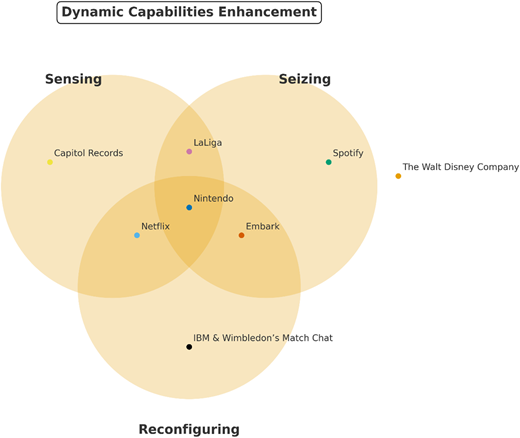
Building on this capability-level mix, we aggregate outcomes into four franchise-value trajectories that capture how AI is experienced at the franchise-ecosystem level – through effects on trust, authenticity, participation and the capacity to reproduce a coherent “canon” across touchpoints. Full value co-creation occurs when AI use strengthens the franchise on all fronts: it improves how the organization spots what matters, makes better choices faster, coordinates action across actors and continuously refines how work is done – without eroding authenticity, trust or accountability. In short, AI amplifies learning and adaptation while keeping humans and governance in control. Value co-creation leaning occurs when AI use is net positive, but benefits are uneven: it clearly improves some parts of sensing, decision-making or coordination, yet creates frictions (e.g. minor opacity, dependence or reduced contestability) that limit learning or slow renewal in other parts. The franchise gains, but not consistently across the full cycle from insight to action to improvement. Value co-destruction leaning occurs when AI use is net negative, because short-term efficiencies or isolated improvements are outweighed by distortions in interpretation, misaligned actions or weakened coordination. The organization may move faster, but in the wrong direction, with reduced ability to learn from reality, correct courses and improve processes over time, so franchise value drivers start to degrade. Full value co-destruction occurs when AI use systematically undermines the franchise: it weakens the organization's capacity to notice and interpret change, choose and coordinate effective responses, and renew routines/resources – often through opacity, over-automation or displaced accountability. In conclusion, AI makes the system less adaptive, less trustworthy and less able to improve, producing compounding erosion rather than learning.
Table 2 presents the overall franchise value outcome for each case study, highlighting the impact of each AI integration. Disney exhibits full value co-destruction, as substitutive integration degrades all dynamic capabilities. Nintendo demonstrates full-value co-creation, achieving process optimization for each dynamic capability. Netflix, Embark and LaLiga lean toward co-creation (single-capability vulnerability), whereas Spotify, Capitol Records and IBM–Wimbledon's Match Chat lean toward co-destruction (single-capability strengthening).
Overall impact of AI on franchise value
| Case study | AI integration | Dynamic capability involved | Outcome generated | Dynamic capability enhanced | Franchise value outcome |
|---|---|---|---|---|---|
| The Walt Disney Company | Sentiment-Misread Automation Layer | Sensing | intrusive | 0/3 | Full value co-destruction |
| AI Greenlight and Release Optimizer | Seizing | intrusive | |||
| Fragmented GenAI Production Toolchain | Reconfiguring | intrusive | |||
| Netflix | Recommendation Intelligence Hub | Sensing | non-intrusive | 2/3 | Value co-creation leaning |
| Metrics-Driven Greenlight Gate | Seizing | intrusive | |||
| Modular Tagging Toolkit | Reconfiguring | non-intrusive | |||
| Spotify | Engagement-Proxy Recommender Stack | Sensing | intrusive | 1/3 | Value co-destruction leaning |
| HITL Playlist Curation Copilot | Seizing | non-intrusive | |||
| Platform-Locked Creator AI Stack | Reconfiguring | intrusive | |||
| Capitol records | A&R Triangulated Insight Dashboard | Sensing | non-intrusive | 1/3 | Value co-destruction leaning |
| AI-Triggered Risk Review Gate | Seizing | intrusive | |||
| Fragmented Label AI Toolchain | Reconfiguring | intrusive | |||
| Nintendo | Real-time Insight | Sensing | non-intrusive | 3/3 | Full value co-creation |
| Guardrailed Developer Copilot | Seizing | non-intrusive | |||
| Reusable DLSS/RT Modules | Reconfiguring | non-intrusive | |||
| Embark | Research-to-Gameplay Proxy Scanner | Sensing | intrusive | 2/3 | Value co-creation leaning |
| Live-Ops VO Experiment Loop | Seizing | non-intrusive | |||
| VoiceOps Prompt Asset Registry | Reconfiguring | non-intrusive | |||
| LaLiga | Real-Time Match Insight Hub | Sensing | non-intrusive | 2/3 | Value co-creation leaning |
| MediaCoach Editorial Copilot | Seizing | non-intrusive | |||
| Azure/MediaCoach Dependence | Reconfiguring | intrusive | |||
| IBM and Wimbledon's match chat | Match Chat Signal-Noise Listener | Sensing | intrusive | 1/3 | Value co-destruction leaning |
| Compliance-Gated Match Chat Activation | Seizing | intrusive | |||
| Watsonx Governance Control Tower | Reconfiguring | non-intrusive |
5. Discussion
Our study identifies 12 contingency mechanisms existing in multiple franchise-based businesses. These are recurring, cross-case decision patterns that steer franchises toward either non-intrusive (optimizing) AI integration that reinforces dynamic capabilities or intrusive (disruptive) AI integration that weakens them. Signal noise is a disrupting contingency mechanism impacting sensing in the following franchises: The Walt Disney Company, IBM & Wimbledon's Match Chat. Triangulated listening is an optimizing contingency mechanism that impacts sensing across the following franchises: Netflix and Capitol Records. Proxy sensing is a disruptive contingency mechanism that impacts sensing across the following franchises: Spotify and Embark. Real-time insight is an optimization contingency mechanism that impacts sensing across the following franchises: Nintendo and LaLiga. Algorithmic gatekeeping is a disruptive contingency mechanism impacting the seizing of the following franchises: The Walt Disney Company and Netflix. HITL experimentation is an optimizing contingency mechanism that impacts seizing in the following franchises: Spotify and Embark. Creator control is an optimizing contingency mechanism that impacts seizing in the following franchises: Nintendo and LaLiga. Compliance drag is a disrupting contingency mechanism impacting seizing in the following franchises: Capitol Records, IBM & Wimbledon's Match Chat. Total fragmentation is a disrupting contingency mechanism impacting reconfiguring in the following franchises: The Walt Disney Company and Capitol Records. Pipeline reuse is an optimization contingency mechanism that impacts reconfiguration in the following franchises: Netflix and Nintendo. Modular governance is an optimizing contingency mechanism that impacts reconfiguration across the following franchises: Embark, IBM and Wimbledon's Match Chat. Ecosystem lock-in is a disruptive contingency mechanism that impacts reconfiguration across the following franchises: Spotify and LaLiga.
Triangulated listening (non-intrusive) is the practice of reading demand through multiple, legible inputs rather than a single metric. It strengthens sensing by combining audience signals from creators, communities and performance data, with AI used to surface patterns while humans retain interpretation and authorship. In practice, it appears as Netflix's Recommendation Intelligence Hub, where large-scale personalization and data engineering stabilize how demand is detected, and as Capitol Records' A&R Triangulated Insight Dashboard, where social and stream data inform scouting without displacing A&R judgment. Real-time insight (non-intrusive) is a continuous, low-latency measurement that keeps signal freshness high. It accelerates sensing by tightening feedback loops. AI-enabled analytics continuously update teams, enabling early detection and quick action for shifts in taste, engagement and sentiment. It is implemented in LaLiga's Real-Time Match Insight Hub (live match data translated into actionable moments) and Nintendo's real-time enhancements that align experience design with evolving player expectations. Proxy sensing (intrusive) is treating model inferences or engagement proxies as the market itself. It weakens sensing when AI outputs stand in for audience reality, as in Spotify's Engagement-Proxy Recommender Stack and Embark's Research-to-Gameplay Proxy Scanner. Signal noise (intrusive) is a contamination of the signal by opaque, pipeline-embedded priors. It further degrades sensing in Disney's Sentiment-Misread Automation Layer and IBM & Wimbledon's Match Chat Signal-Noise Listener, where outputs can misread context and blur audience signals.
HITL experimentation (non-intrusive) is using AI to generate options and evidence, while humans make final allocation decisions. It strengthens seizing by running pilots and A/B tests that compress the path from idea to validated offer, with clear go/no-go authority and timing decisions retained by accountable owners. It is implemented as Spotify's HITL Playlist Curation Copilot (an AI-assisted playlist assembly that preserves curatorial accountability) and Embark's Live-Ops VO Experiment Loop (a rapid text-to-speech iteration that scales output while performance direction remains human-led). Creator control (non-intrusive) is explicit ownership of final creative and managerial judgment, including the right to override AI outputs. It reinforces seizing by protecting authorship and accountability – AI accelerates packaging and execution, but final judgment stays with decision owners. It appears in LaLiga's MediaCoach Editorial Copilot, where highlights and formats are accelerated but editorial storytelling remains human-led, and in Nintendo's Guardrailed Developer Copilot, where responsible use and IP stewardship anchor decisions. Algorithmic gatekeeping (intrusive) is shifting selection and greenlight power into opaque ranking, prediction or approval systems. It weakens the seizing in Disney's AI Greenlight & Release Optimizer and Netflix's Metrics-Driven Greenlight Gate by crowding out contestable creative bets. Compliance drag (intrusive) is the additional friction caused by AI-tainted assets. It disrupts seizing in Capitol Records' AI-Triggered Risk Review Gate and IBM & Wimbledon's Compliance-Gated Match Chat Activation by slowing mobilization and increasing coordination costs.
Pipeline reuse (non-intrusive) is turning AI work into reusable modules – documented prompts, tagging schemes and tooling that can be recombined across projects. It strengthens the reconfiguration by reducing reinvention and enabling teams to quickly reassemble capabilities as needs shift. It is implemented as Netflix's Modular Tagging Toolkit (structured metadata and reusable classification that support rapid remixing of assets) and Nintendo's Reusable DLSS/RT Modules (transferable performance- and rendering-based building blocks diffused across titles). Modular governance (non-intrusive) is portable oversight: clear ownership, monitoring routines, audit trails and escalation paths that travel with the capability. It reinforces reconfiguring by letting AI scale while accountability stays intact, as in IBM & Wimbledon's Watsonx Governance Control Tower (standardized updates to prompts and guardrails under human-in-the-loop monitoring) and Embark's VoiceOps Prompt Asset Registry (prompts, model settings and generated assets treated as managed resources in a hybrid workflow). Total fragmentation (intrusive) is a toolchain and practice inconsistency that breaks end-to-end redesign. It weakens reconfiguring in Disney's Fragmented GenAI Production Toolchain and Capitol Records' Fragmented Label AI Toolchain by creating handoff friction and rework. Ecosystem lock-in (intrusive) is a dependency on a vendor/model/platform that raises switching costs and narrows redesign options. It further degrades reconfiguring in Spotify's Platform-Locked Creator AI Stack and LaLiga's Azure/MediaCoach Dependence by constraining how teams can evolve workflows and governance.
Figure 2 consolidates our findings into the AI-Integration–Dynamic Capability Alignment Framework, a practical map of how AI integration shapes franchise outcomes through capability-specific contingency mechanisms. The framework is structured around the three dynamic capabilities – sensing, seizing and reconfiguring – and locates each contingency mechanism under the capability it primarily influences. It then distinguishes between mechanisms that reflect non-intrusive integration (human-led, contestable decision rights) and those that reflect intrusive integration (substitutive, opaque shifts in interpretation, gatekeeping or coordination power). In doing so, the figure clarifies why franchises can strengthen one capability while degrading another, producing mixed trajectories rather than uniform effects. The rightward movement in the framework represents a shift toward process optimization, where non-intrusive mechanisms accumulate, and outcomes tend toward full value co-creation or value co-creation leaning. The leftward movement represents drift into process disruption, where intrusive mechanisms dominate, and outcomes tilt toward value co-destruction, leaning or full.
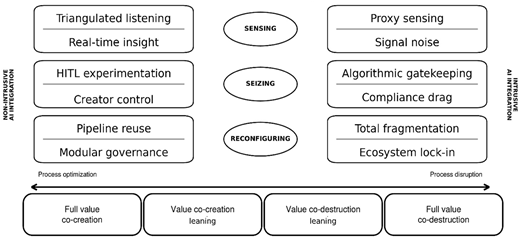
AI integration–dynamic capability alignment framework. Source: Authors’ own work
AI integration–dynamic capability alignment framework. Source: Authors’ own work
6. Implications and conclusions
Drawing on a qualitative, inductive, multi-case design, this paper investigates how AI is integrated into franchise-based digital businesses in the entertainment sector and how this integration shapes value outcomes. Using triangulated primary and secondary evidence across cases and sub-sectors, coded in NVivo, we traced AI-enabled mechanisms to firms' dynamic capabilities (sensing, seizing and reconfiguring) and assessed whether configurations were non-intrusive (augmentative) or intrusive (substitutive). Results show that AI does not yield uniformly positive effects: franchises move along a continuum from full value co-creation to full value co-destruction depending on the capability-level mix. We therefore propose the AI Integration–Dynamic Capability Alignment Framework, which specifies contingency mechanisms to guide managers in designing human-led, contestable AI deployments that optimize processes rather than disrupt them.
Our research offers actionable managerial implications for executives implementing AI in franchise-based entertainment organizations. First, managers should treat AI integration as a deliberate strategic choice, rather than a response driven solely by technological advancement. As our findings demonstrate, unreflective AI integration entails substantial risks, particularly when intrusive mechanisms displace managerial judgment. By contrast, non-intrusive mechanisms preserve human decision-making authority while simultaneously strengthening sensing, seizing, and reconfiguring capabilities. Second, managers must closely monitor how decision rights shift as AI systems scale, especially in relation to content selection and intellectual property ownership, which may otherwise be undermined, thereby eroding core dynamic capabilities. Third, managers should adopt a sustainable approach to AI integration by investing in reusability and portability, enabling rapid reconfiguration without locking the organization into rigid vendor ecosystems. Finally, because AI integration produces heterogeneous, mixed capability trajectories rather than uniform outcomes, managers should leverage both optimized and weakened capabilities, continuously aligning AI integration modes with strategic capability priorities.
Policy makers should treat AI integration in franchise-based entertainment as a governance problem, not only an innovation agenda. We have demonstrated intrusive integration can shift gatekeeping and accountability. Therefore, regulation should mandate disclosure of AI involvement in selection, greenlight and distribution decisions, minimum auditability (logs, provenance and escalation paths), and contestability for creators and users. In parallel, creator-protection rules should clarify IP ownership, consent and compensation when models train on or generate franchise-relevant assets, reducing backlash and compliance drag. Finally, interoperability and data-rights standards can mitigate ecosystem lock-in and support modular governance, enabling firms to innovate while preserving trust and franchise value overall.
Despite these contributions, several limitations should be acknowledged. First, focusing exclusively on the entertainment sector limits the generalizability of our findings to other franchising contexts (e.g. food and beverage, retail). Second, the multiple-case study design, while rich in contextual detail, does not permit statistical inference regarding the prevalence or performance impact of specific AI strategies. Finally, our analysis captures a rapidly evolving technological landscape; emerging AI capabilities may alter the balance between intrusive and non-intrusive applications.
Future research should extend the framework across additional franchising domains and institutional contexts to test boundary conditions (e.g. ownership structures, governance intensity and brand-control requirements). Mixed-method designs could operationalize the proposed mechanisms for aligning capability levels and quantify their effects on financial, creative and stakeholder outcomes. Longitudinal studies are also needed to examine how firms migrate along the co-creation/co-destruction continuum as models mature, data assets scale and regulation evolves, particularly around transparency, IP and labor substitution.
The authors have no acknowledgments to declare.

