As an innovative business-driven solution within the contemporary digital industry, successful subscription retention requires a continuous focus on delivering value to subscribers and maintaining a strong relationship with them over time to stay competitive in fast growing digital business environment. The aim of this research is to comprehensively understand the digital subscription retention antecedents among Generation Z.
A survey was conducted among 385 Generation Z respondents using digital subscription platforms and representing various countries, most of which are European: Portugal is the most represented (20.5%), followed by Poland (17.4%) and Lithuania (14.0%). The research hypotheses were tested using correlation and linear regression analysis.
The findings demonstrate positive relationships between social media, performance expectancy, brand equity and Generation Z’s subscription retention decisions. Whereas close social environment shows only a moderate relationship with Generation Z subscription retention. This finding indicates that social media plays a more significant role for Generation Z subscription decisions than a close social environment.
The findings provide valuable insights for digital subscription-based business managers highlighting the importance of Generation Z customers’ preferences to encourage the subscription retention. Moreover, taking into consideration increasing digital subscription market and shortage of studies in the field, a comprehensive understanding of Generation Z perception and behavior within digital subscription-based businesses’ landscape is needed.
Introduction
Subscription-based businesses have become increasingly popular in recent years due to the convenience and cost-effectiveness businesses offer to their users (Baek and Kim, 2022). The exponential growth was 300% in revenue for all subscription enterprises worldwide from 2012 to 2019 (Eyal, 2022). It is considered that on average one American holds four subscriptions and in the United Kingdom around 81% of households have some sort of subscription (Prezzano, 2022), and Netflix, Spotify, Amazon prime, Apple Music, Coursera or HelloFresh have become a part of customers’ everyday lives. Based upon the research conducted by on consumer behavior in evolving subscription markets, it is apparent that there is a need to further investigate the intricacies of subscription behaviors, strategies and market dynamics considering the changing landscape of subscription markets (McDonald et al., 2023).
Subscription retention refers to a company’s ability to keep its subscribers engaged and paying for its products or services over an extended period (Bischof et al., 2019). Retention is fundamental for subscription-based businesses, playing a crucial role in determining their revenue, profitability and longevity (Eyal, 2022). To improve subscription retention, companies are offering personalized content and recommendations, providing excellent customer service and continuously improving the quality and value of their products or services (Kuo et al., 2009). Successful subscription retention requires a continuous focus on delivering value to subscribers and maintaining a strong relationship with them over time (Prezzano, 2022). Further investigation in this field would yield additional perspectives on strategies to enhance retention rates.
People born between 1997 and 2012 are considered Generation Z (Warren, 2022). Generation Z is the first digital-era generation whose existence revolves around technology. Modern technological solutions are a part of Generation Z natural habit as the Internet was fully developed and accessible since their childhood (Chillakuri, 2020). Consequently, the buying preferences of Generation Z differ significantly from those of previous generations, therefore marketing methods aimed at Generation Z online customers must be tailored accordingly (Thangavel et al., 2019).
Research on the behavioral patterns of Generation Z in the realm of customer behavior was conducted by several researchers (Puiu et al., 2022; Amatulli et al., 2023); however, a gap remains in the understanding of their perception, interaction and behavior within digital subscription-based businesses’ landscape. Another study (Tani et al., 2022) offers invaluable insights into the adoption of subscription-based plans for mobile applications, particularly focusing on consumers’ intentions and motivations. A scholarly investigation conducted by Kim and Kim (2020) has contributed significant insights into the distinctive features of digital subscription platforms and customer behavior in relations to purchase and intentions to retain. Nevertheless, there exists an unexplored research gap in the retention behaviors of Generation Z. The aim of this research is to understand what the antecedents of digital subscriptions’ retention among Generation Z are. Drawing on the resource-based theory (RBT) and transaction cost economics (TCE) subscription-based business models subscription-based models firms receive unique resources (customer data), minimize their transaction costs by ensuring customer loyalty and eliminate repeated acquisition cost. To some extent, this research delves into the modern wave of subscription-based business model (SBBM) seeking to research the most relevant aspects of this model among Gen Z customers.
Literature review and hypotheses
Recognizing the growing significance of customer retention in the dynamic business environment, this literature review also investigates the antecedents of subscription retention, placing particular emphasis on its relevance for businesses seeking to foster loyal relationships with their customers. By analyzing preferences and behaviors of Generation Z, the hypotheses of this research are raised, seeking to design a conceptual model for quantitative analysis.
Subscription-based business model
The subscription-based business model can be defined as a supply agreement between a customer and a company, which provides regular access to a product or service with a periodically recurring fee. Products are available or directly delivered on a monthly, weekly or even daily basis (McCarthy et al., 2017). The current subscription-based business model is undergoing a renaissance and has become prevalent across various industries, including multimedia streaming services, beauty, health, food, fashion and even the flower industry (Tao and Xu, 2018). It obviously enters the digital market with the improved and more innovative business concept, which better reflects the market demand and provides more sophisticated, personalized, unique and value-optimized products and services (Tani et al., 2022).
The subscription-based business model is being adopted across industries, transforming the way companies offer and customers access products and services. Its adaptability and user-centric approach encourage its application in various sectors. Indeed, the subscription-based business model is mostly associated with the supply of streaming service. The emergence of Netflix in the 2000, which provides unlimited service of movies and TV series streaming, increased the popularity of this business model as the number of Netflix subscribers globally increased from 2.61 million in 2004 to more than 180 million as in the first quarter of 2020 (Kim and Kim, 2020). This business model finds extensive adaptability in the fashion and beauty industry and facilitates companies in promoting new products by offering their customers services at reduced prices and sending introductory samples of new brands (Lee et al., 2019). In the realm of manufacturing, the subscription-based business model has found a new area of application contributing to the enhancement of digital platform services by fostering innovation and competitiveness through standardized market prices (Kim and Kim, 2020). The automotive sector, traditionally grounded in conventional sales and leasing structures, is presently undergoing a noteworthy transformation (Smania et al., 2023). The shift towards a service-based approach involves not only operational changes, but also a re-evaluation of value propositions to meet the contemporary needs of customers.
Regardless of a product or industry itself, in general, the subscription-based business model should ensure the generation of continuous revenue through a long-term customer collaboration, which is challenging to retain in today’s dynamic market. This challenge is compounded by shifts in customer behavior, characterized by a preference for customized and high-quality products and services facilitated by intelligent digital platforms (Kim and Kim, 2020). Bischof et al. (2019), have divided this business model into three groups. The first category, referred to as replenishment subscription or predefined subscription in alternative literature sources, entails the regular delivery of frequently used items like food, socks or other goods essential for routine daily needs.
The objective of the discovery or surprise subscription, identified as the second category, is to ensure the uniqueness and surprise effect of a product or service (Bischof et al., 2019). A notable illustration is evident in online shopping experiences, where customers derive delight from the moment of purchase through the receipt and unpacking of shipment.
The final category, denoted as the access or curated subscription category, provides complete access to a product or service through regular or small payments (Bischof et al., 2019). The fundamental idea is that payments can be distributed over time, and customers can anticipate reduced prices with longer commitments to a company.
All these three categories collectively depict the diverse spectrum of subscription-based business models that have surfaced, addressing an array of customer needs and preferences. However, the aim of this research centers on the third category – access or curated, and explores the essential antecedents required to sustain its appeal among the relevant customers from Generation Z.
Prior studies suggests that subscription-based model offers benefits to retailers and customers (Bischof et al., 2019), creating long-term relationships and enabling to generate recurring purchases. From the retailers’ perspective, subscription-based business model due to easier measurement of customer life-time value eventually results in enhanced cumulative profits (Bischof et al., 2019).
The prevalence of this category is on the rise, attributed to the supplementary benefits offered, such as reduced shipping costs or additional discounts upon subscribing to a company’s news. Furthermore, evolving customer shopping behaviors contribute to increased familiarity and comfort with procuring goods through this subscription type. From the perspective of companies, the discovery subscription model presents advantages, such as the ease of integrating and updating subscription content compared to the constant review and implementation of changes, for example, in pricing strategy (Rudolph et al., 2017). Additionally, historical purchase data is readily available, enabling quicker responsiveness to evolving customer needs.
From the customers perspective this model offers the discovery or surprise subscription ensuring the uniqueness and surprise effect of a product or service (Bischof et al., 2019). A notable illustration is evident in online shopping experiences, where customers derive delight from the moment of purchase through the receipt and unpacking of shipment. Moreover, the subscription-based purchase provides for a customer complete access to a product or service through regular or small payments (Bischof et al., 2019). The fundamental idea is that payments can be distributed over time, and customers can anticipate reduced prices with longer commitments to a company.
Generation Z customers’ values and behavior differs from other generations (Priporas et al., 2017) and is characterized as “digital natives” (Puiu et al., 2022) who values e-communication, inclusiveness and uniqueness. Generation Z is very much attracted to digital technologies, prioritizing fast, easy and convenient transactions (Wood, 2021). Consequently, the subscription model may be a good fit for the Generation Z as it enables customers to automatically receive the goods. Even more, the delivery offers to a shopper an effect of surprise and uniqueness. This paper focuses on Generation Z attitudes towards continuation of the adopted subscriptions.
Antecedents of subscriptions’ retention
According to Tani et al. (2022) Subscription-based business models change traditional business market models and stands for a new business model innovation as it changes customer behavior and could be looked at as a potential disruptive innovation (Christensen et al., 2013). Companies seeking to adapt this model must first of all understand their potential customers expectations and preferences, understand what motivates them to use and continue using this model for their purchases. The perception of customer behavior predictors in subscription-based models is a vital area for companies using the model. However, there is limited information on how customers’ behavior differs in subscription-based context. We can assume that customers react differently in the changed purchasing environment and perceive the offered services and products differently. Thus, it is very important for managers to better understand what drives customers to keep using subscription services in order to create a sustainable business model. Antecedents fostering positive outcomes and ensuring sustained customer engagement may exhibit variability based on factors such as product type, content quality, geographic region, financial status and the age of customers. Consequently, gaining a more profound understanding of these attributes, which influence shifts in customer behaviors across diverse product and service categories, becomes particularly crucial for companies whose core business relies on a subscription-based model.
Studies conducted across various industries have revealed that the type of product or service plays a pivotal role in determining the subsequent success of a subscription and, importantly, the overall growth of the business. Specifically, companies are advised to comprehend the nature of their product or service, classifying it as either hedonic or utilitarian (Baek and Kim, 2022). It has been identified that maintaining a subscription can be more intricate when offering goods of the hedonic category. Since these products are often perceived as luxury items, justifying their necessity becomes challenging and repurchase intentions may diminish over time (Baek and Kim, 2022).
Prior studies investigated several factors that may impact customers to make their purchases using a subscription platform, for example Woo and Ramkumar (2018) highlighted time-saving and hedonic motivators for customers’ using subscription services for fashion and beauty product purchase. The utilitarian and hedonic drives analyzed by Chiu et al. (2014) indicated that risk factors related to the e-environment undermine customers’ intention to use the platform for repurchases. The research also revealed that in subscription-based service both utilitarian and hedonic factors predict customer repurchase intention; however, the utilitarian factor is a stronger predictor. Consumer innovativeness alongside utilitarian and hedonic motivators were found as important motivators affecting consumers’ intention to use subscription model for their purchases.
Price, quality of product, assortment, surprise and uniqueness variables were explored by Lee et al. (2019) for beauty products subscription to measure their impact on customer loyalty. The results indicated that product uniqueness and quality are strong predictors of subscribers’ loyalty intention. Ease of purchase and convenience were proven also to have an impact on customers’ intention to utilize subscription models (Bray et al., 2021) confirming that utilitarian motives play a significant role in creating subscription value for the potential subscribers. Conversely, utilitarian products, being more functional and practical, facilitate the retention of subscriptions and the sustained engagement of customers over extended periods. Additional study by Baek and Kim (2022) research affirms this observation, noting that customers' utilitarian motives exert a more substantial influence on continuous subscription use compared to hedonic motives. Similarly, utilitarian motives can strongly motivate subscription ownership by simplifying consumption patterns or reducing decision fatigue, thereby influencing long-term changes in customer habits (Bray et al., 2021). The research (Bray et al., 2021) also introduces the innovative concept that a successful synergy between utilitarian and hedonic motivators is feasible, which may result from a combination of factors such as the hedonic motive of “discovering the new” and utilitarian motives like “ease of use” or “value for money.”
The evolution of technologies has significantly contributed to the advancement of the subscription-based business model, simultaneously intensifying the competitive landscape among providers of products and services. Hsiao and Chen (2017) underscored the significance of content quality as a primary antecedent for initiating and sustaining a subscription. It is particularly influential in areas such as e-books, educational and self-improvement subscriptions. However, Kim and Kim (2020) proposed a counterhypothesis based on their research, suggesting that the importance of the quality attribute may vary across regions or countries.
The success of subscription retention is intricately linked to the economic landscape. The research by Bray et al. (2021) highlighted the connection between higher household income, employment status and a desire to subscribe. Consequently, an understanding of customer demographics, including age, income and habits, provides managers with the opportunity to adeptly tailor their business strategies.
Providers of products and services shall consider the aspect of loyalty, which is also one of the main antecedents for long-term commitments. This attribute can be reinforced through the delivery of customer-centric products or services and exclusive offerings, such as additional discounts based on shopping habits or data derived from customers’ purchase history (Tao and Xu, 2018). In subscription-based business model context establishing durable relationships is important as subscription process advantage of recurring purchases enables retailers to tie customers to the company. A subscription model presupposes a long-term relationship with the customers based on a periodic payment which forces companies to put extra effort to better understand their customers for matching their preferences and motivate them to continue prescriptions. Specifically, the retention of subscriptions and the sustained growth of businesses are contingent upon several integral factors, including product type and brand value, regional adaptation, financial considerations, utilitarian and hedonic motives, as well as understanding customer behavior based on their age. By actively attending to these essential factors, businesses can secure loyal subscribers and establish the foundations for a prosperous future.
Hypotheses
Generation Z is the first digital generation (born after 1995), having grown up with access to the Internet and digital technologies (Sidorcuka and Chesnovicka, 2017). The COVID-19 epidemic, which has spread all over the world, has resulted in substantial changes across a variety of businesses, most notably in consumer behavior. According to Chillakuri (2020) research, numerous stakeholders have begun to focus most of their attention and curiosity on Generation Z. Amatulli et al. (2023) conducted study to determine the effect that a lockout has on the consumption patterns of Generation Z. The empirical evidence that pertains to consumption behaviors exhibited throughout the lockdown era not only demonstrates consumers’ ability to use digital technologies, but also reveals a shift in Generation Z views towards both hedonic and responsible consumption.
Hedonic motivation is based on joy, satisfaction and delights to be provided to consumers by purchasing a product or service (Childers et al., 2001). The concept of hedonic consumption is further elaborated in the business model framework by Morris et al. (2005), who emphasizes the significance of pleasure and experience in consumer behavior. Woo and Ramkumar (2018) in their research demonstrated that subscription-based online shopping matches the needs of modern customers in terms of time-saving and hedonic shopping experience. It remains unclear if hedonic motivation impacts Generation Z retention of digital subscription. Based on this, we raise the hypothesis:
Hedonic motivations positively related to Generation Z retention of digital subscription.
Generation Z holds the perception that electronic purchasing surpasses traditional in-store shopping due to the supplementary benefits it provides (Nguyen et al., 2022). Moreover, active advocacy for the adoption of online buying practices among their relatives, friends and coworkers was prominently observed in this research. This resonates with the research by Ceylan-Dadakoğlu et al. (2023), which highlights the fact that Generation Z places significant value on individuality and authenticity. Building upon these insights, we propose the hypothesis:
Close social environment (peers) is positively related to Generation Z’s retention of a digital subscription.
Social media these days has become a fundamental tool for all types of business, digital in particular, to reach the customer. According to Waworuntu and Mandagi (2022), social media marketing plays an important part in shaping consumers’ impressions of brands and influencing their purchasing decisions for local goods. Taking into consideration Generation Z’s habit of utilizing social media which is related also to their fear of missing out (Herawati et al., 2022), social media is seen as having a significant role in influencing Generation Z consumers. As Generation Z continues to shape the future of digital consumerism, the following hypothesis is raised:
Social media is positively related to Generation Z intention to retain digital subscription.
Representatives of Generation Z create opinions based not just on the quality of items or services, but also on brand’s ethical values, socially responsible behavior and social impact (Dabija et al., 2020). An importance for Generation Z company’s socially responsible behavior and attention to ecology was confirmed by Lukić-Nikolić and Lazarević (2022) study. Bridging this with their perspective on luxury, unlike previous generations who viewed luxury goods as status symbols or reflections of personal success, Generation Z tends to approach luxury brands differently (Shin et al., 2021). Generation Z relationship with luxury brands is less about exclusivity, but more about the brand’s authenticity, social responsibility and the unique experiences they offer. Building on this distinction, Generation Z has a stronger preference towards brand equity compared to Generation Y and Generation X (Sharma and Payal, 2023). Based on the above discussion, we hypothesize:
Brand equity positively is positively related to Generation Z intention to retain digital subscription.
The integration of shopping apps, targeted advertising and the convenience of e-commerce platforms on mobile devices amplifies compulsive buying behaviors (Mason et al., 2022). Instantaneous desires to make a purchase can be sparked by the combination of visual stimulation, endorsements from influential users and peer interactions on social media sites such as Instagram or TikTok. The influence of social media marketing has been noticed in Generation Z customers toward making impulsive purchases (Smith et al., 2012). Thus, we raise the hypothesis:
Generation Z consumer’s impulsiveness positively is related to retention of digital subscription.
With the growing number of services on the internet, the purchasing habits of customers are also changing. Based on Bray et al. (2021) research, shopping habits can depend on income and economic status. Consumers with higher incomes tend to subscribe and value subscription business model as a time-saving opportunity. A good example of this is fashion industry, where there is no longer a need to go from one shopping center to another in search of suitable goods (Tao and Xu, 2018). Based on previous research, we state the following hypothesis:
Price value is positively related to Generation Z customers’ intention to retain digital subscription.
Psychological ownership in the context of e-shopping was observed in Generation Z and these feelings, which are shaped by the overall online shopping experience and include website design, user reviews and product visualization, play a pivotal role in determining whether this segment of customers would return to the same e-platform for future purchases (Nguyen et al., 2022). According to the findings of Wijerathne and Peter (2023), the intention of Generation Z consumers to make purchases online is heavily influenced by two important factors: the perceived levels of enjoyment and the ease use of online shopping experience. As Pham (2021) indicated in his research, the majority of Generation Z use mobile phones, and they dedicate it for online shopping. Given the context and data previously discussed, following hypothesis for further investigation is proposed:
Performance expectancy is positively related to Generation Z customers’ intention to retain digital subscription.
Method
Sample and procedure
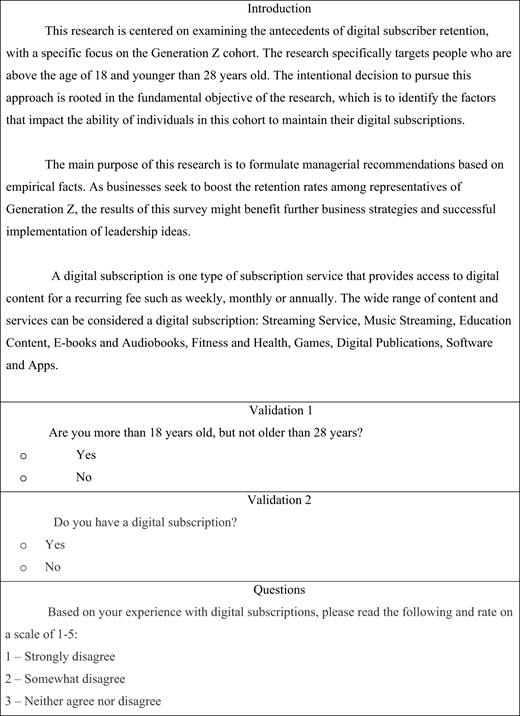
This research is centered on examining the antecedents of digital subscriber retention, with a specific focus on the Generation Z cohort. It specifically targets individuals aged 18 and above, encompassing those under 28 years old. Data from 385 respondents was collected from European countries. Data was collected in November 2023.
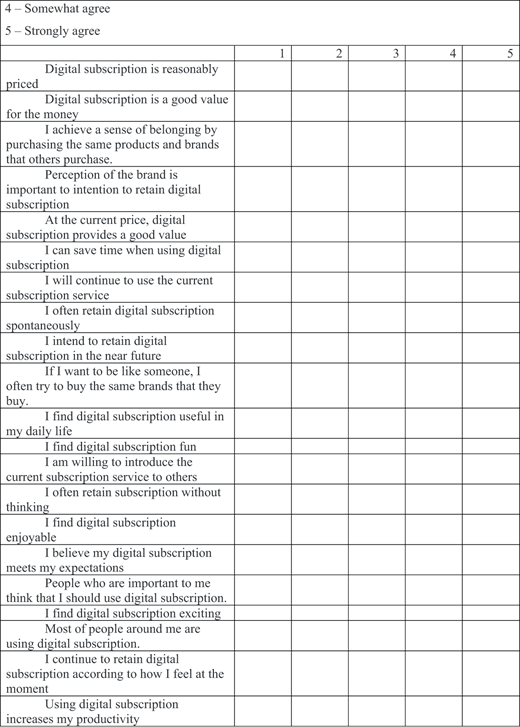
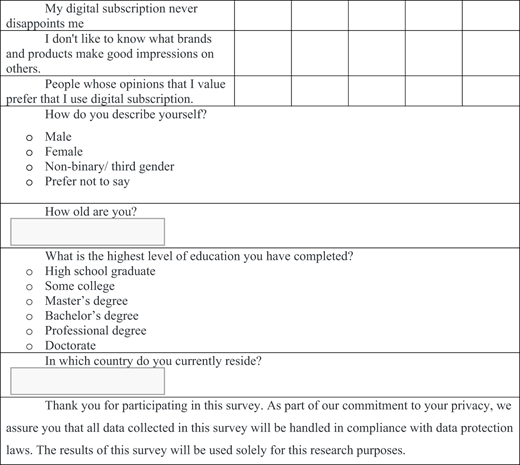
The majority of the respondents come from Portugal (20.5%), Poland (17.4%) and Lithuania (14.0%). Every participant in the sample possesses prior familiarity with digital subscriptions, guaranteeing that their feedback and insights are based on real-world usage and authentic experiences. The online questionnaire ( Appendix) was designed using Qualtrics (https://www.qualtrics.com) and distributed to the population. The responses are obtained through a complex approach, with 19% obtained through acquaintances and 81% via the Prolific (https://www.prolific.com/) platform. Individuals from Generation Z respond to closed-ended questions, utilizing a Likert scale ranging from 1 (strongly disagree) to 5 (strongly agree) to assess antecedents that may positively or negatively affect a retention of digital subscription. Given that approximately 21.6% of the total EU population, approximately 103 million individuals, are estimated to belong to Generation Z (Young People in Europe – a Statistical Summary – 2022 Edition, 2022), the minimum number of respondents sought is 385. The collected questionnaire data undergo analysis utilizing the SPSS Statistics program. Linear regression is used to examine the results of this research and draw conclusions regarding the relationships between dependent and independent variables.
Instrument
The scales for variables, which are well-established and validated, are either adopted or slightly modified to align with the context of digital subscriptions. The scale for evaluating price value is borrowed from research conducted by Hilal and Varela-Neira (2022). Hedonic motivation is assessed using the scale proposed by To et al. (2007). The scale for measuring the intention to retain is sourced from research by Kim and Kim (2020) and Woo and Ramkumar (2018). Scales from the research conducted by Indrawati and Putri (2018) is utilized in developing the scales for variables of social environment and performance expectancy. Additionally, to comprehensively assess social media the supplementary scale, The Attention to Social Comparison Information, proposed by Bearden and Rose (1990) is incorporated. The scale for assessing impulsiveness has been adapted from the research by Rook and Fisher (1995). Scales from the research Punniyamoorthy and Prasanna Mohan Raj (2007) are slightly modified to evaluate brand equity.
Results
The analysis of demographic profile of 385 respondents was performed to evaluate gender distribution, age representation, educational backgrounds and geographic diversity (Table 1).
Demographic profile of respondents
| Frequency | Percent (%) | |
|---|---|---|
| Gender | ||
| Male | 191 | 49.6 |
| Female | 185 | 48.1 |
| Non-binary/third gender | 8 | 2.1 |
| Prefer not to say | 1 | 0.3 |
| Age | ||
| 18 | 5 | 1.3 |
| 19 | 1 | 0.3 |
| 20 | 14 | 3.6 |
| 21 | 45 | 11.7 |
| 22 | 37 | 9.6 |
| 23 | 51 | 13.2 |
| 24 | 41 | 10.6 |
| 25 | 48 | 12.5 |
| 26 | 42 | 10.9 |
| 27 | 52 | 13.5 |
| 28 | 49 | 12.7 |
| Education | ||
| High school graduate | 69 | 17.9 |
| Some college | 67 | 17.4 |
| Master’s degree | 66 | 17.1 |
| Bachelor’s degree | 169 | 43.9 |
| Professional degree | 12 | 3.1 |
| Doctorate | 2 | 0.5 |
| Country | ||
| Portugal | 79 | 20.5 |
| Poland | 67 | 17.4 |
| Lithuania | 54 | 14.0 |
| Others | 185 | 48.1 |
| Total | 385 | 100.0 |
Source(s): Table created by authors
The Shapiro–Wilk test was performed to determine data normality. The results are presented in Table 2. The p-values of all variables are <0.001 (ρ < 0.05), providing strong evidence to reject the null hypothesis that the data follows a normal distribution. Therefore, based on these results of Shapiro–Wilk test, it seems that none of the variables exhibit a normal distribution. Additionally, the skewness and kurtosis values provide information about the shape of the distribution, indicating the degree and direction of departure from normality.
Tests of normality
| Scales | Shapiro-Wilk | Skewness | Kurtosis | ||
|---|---|---|---|---|---|
| Statistic | df | Sig | |||
| Hedonic motivation | 0.958 | 385 | <0.001 | −0.371 | 0.155 |
| Social environment | 0.951 | 385 | <0.001 | −0.529 | 0.744 |
| Social media | 0.965 | 385 | <0.001 | −0.210 | 0.265 |
| Brand equity | 0.954 | 385 | <0.001 | −0.353 | 0.168 |
| Impulsiveness | 0.942 | 385 | <0.001 | −0.747 | 0.939 |
| Price value | 0.911 | 385 | <0.001 | −0.907 | 1.819 |
| Performance expectancy | 0.967 | 385 | <0.001 | −0.392 | 0.071 |
Source(s): Table created by authors
Each scale is tested for reliability, with an overall Cronbach’s alpha ranging between α = 0.764 and α = 0.619. The results are presented in Table 2. Notably, the scales such as intention to retain (0.764), social media (0.710), price value (0.705), brand equity (0.702) and impulsiveness (0.701) demonstrate higher values of Cronbach’s alpha. The results imply a more dependable measurement of the underlying items associated with these scales. Conversely, the remaining scales – hedonic motivation (0.696), performance expectancy (0.682) and social environment (0.619) – exhibit lower Cronbach’s alpha. However, these values do not raise concerns about the reliability of scales, as they fall within acceptable limits of 0.6–0.8.
Descriptive data
Each variable (hedonic motivation, social environment, social media, brand equity, impulsiveness, price value, performance expectancy) was tested among the control factors of the countries with the largest number of responses: Portugal, Poland and Lithuania.
Based on the results provided in Table 3, the mean score of hedonic motivation is the highest at 3.2222 in Lithuania, reflecting a relatively stronger inclination toward hedonically driven motives. The mean score for social environment is 3.6667 in Lithuania, indicating a relatively high perception of social environment. The mean score for social media is 3.2654 in Lithuania, suggesting a moderately high level of perceived social media. In Portugal, the mean of brand equity is 3.2194, suggesting a slightly higher perception of brand strength compared to both Lithuania and Poland. The standard deviation of 0.09340 indicates relatively consistent responses within the Portuguese sample. Based on the results provided, the mean of impulsiveness is 3.7840 in Lithuania, suggesting a relatively high level of impulsivity among respondents. The mean of price value is 4.0370 in Lithuania, indicating a positive perception of the value associated with prices. Performance expectancy descriptive data indicates that the mean of performance expectancy is 3.4012 in Lithuania, indicating a moderately positive outlook on performance expectations.
Descriptive data
| Factor | Determinant | N | Mean | Std. deviation |
|---|---|---|---|---|
| Hedonic motivation | Lithuania | 54 | 3.2222 | 0.08899 |
| Poland | 67 | 3.0199 | 0.10934 | |
| Portugal | 79 | 3.0591 | 0.09454 | |
| Social environment | Lithuania | 54 | 3.6667 | 0.09531 |
| Poland | 67 | 3.6020 | 0.09981 | |
| Portugal | 79 | 3.6456 | 0.08415 | |
| Social media | Lithuania | 54 | 3.2654 | 0.08606 |
| Poland | 67 | 3.2488 | 0.09333 | |
| Portugal | 79 | 3.1688 | 0.09105 | |
| Brand equity | Lithuania | 54 | 3.1543 | 0.12073 |
| Poland | 67 | 2.9851 | 0.11308 | |
| Portugal | 79 | 3.2194 | 0.09340 | |
| Impulsiveness | Lithuania | 54 | 3.7840 | 0.09456 |
| Poland | 67 | 3.7264 | 0.09159 | |
| Portugal | 79 | 3.8397 | 0.07102 | |
| Price value | Lithuania | 54 | 4.0370 | 0.10111 |
| Poland | 67 | 4.0647 | 0.08425 | |
| Portugal | 79 | 4.0844 | 0.06591 | |
| Performance expectancy | Lithuania | 54 | 3.4012 | 0.11159 |
| Poland | 67 | 3.3731 | 0.09120 | |
| Portugal | 79 | 3.2954 | 0.08887 |
Source(s): Table created by authors
To test the hypotheses, Pearson correlation and linear regression analyses were carried out. Hedonic motivation revealed a moderate positive relationship with intention to retain (r = 0.378, p < 0.001), indicating a meaningful but not exceptionally strong relationship. Social environment demonstrates a weaker positive relationship (r = 0.242, p < 0.001), indicating a modest association with intention to retain. In contrast, Social media exhibited a strong positive relationship (r = 0.454, p < 0.001), denoting a robust relationship with the intention to retain. Brand equity showed a substantial positive relationship (r = 0.391, p < 0.001), representing a moderately strong association. Similarly, Impulsiveness displayed a moderately positive relationship (r = 0.358, p < 0.001), suggesting a meaningful but not excessively strong link to intention to retain. Price value demonstrated a moderate positive relationship (r = 0.289, p < 0.001), reflecting a moderate association. Performance expectancy indicated a strong positive relationship (r = 0.410, p < 0.001), suggesting a robust relationship with the intention to retain. The linear regression analysis results are provided in Table 4.
Linear regression analysis results
| Independent variable | Unstandardized coefficients | Standardized coefficients | t | R2 | F | ρ | ||
|---|---|---|---|---|---|---|---|---|
| B | Std. error | Beta | ||||||
| H1 | Hedonic motivation | 0.421 | 0.053 | 0.378 | 7.996 | 0.143 | 63.937 | <0.001* |
| H2 | Social environment | 0.320 | 0.065 | 0.242 | 4.890 | 0.059 | 23.915 | <0.001* |
| H3 | Social media | 0.553 | 0.055 | 0.454 | 9.985 | 0.207 | 99.696 | <0.001* |
| H4 | Brand equity | 0.443 | 0.053 | 0.391 | 8.320 | 0.153 | 69.229 | <0.001* |
| H5 | Impulsiveness | 0.492 | 0.066 | 0.358 | 7.505 | 0.128 | 56.328 | <0.001* |
| H6 | Price value | 0.431 | 0.073 | 0.289 | 5.908 | 0.084 | 34.906 | <0.001* |
| H7 | Performance expectancy | 0.523 | 0.059 | 0.410 | 8.809 | 0.168 | 77.604 | <0.001* |
Note(s): *ρ < 0.05
Source(s): Table created by authors
The linear analysis demonstrated that Social Media (β = 0.454, t = 9.985, ρ < 0.001), Performance expectancy (β = 0.410, t = 8.809, ρ < 0.001) and Brand equity (β = 0.391, t = 8.320, ρ < 0.001) demonstrate the most robust positive relationship with the intention to retain a digital subscription. Correspondingly, all three independent variables in this linear regression exhibit statistical significance: Social Media (F (1, 383) = 99.7, R2 = 0.207, ρ < 0.001), Performance expectancy (F (1, 383) = 77.6, R2 = 0.168, ρ < 0.001) and Brand equity (F (1, 383) = 69.23, R2 = 0.153, ρ < 0.001). These findings provide support for the Hypotheses H3, H4 and H7.
Hedonic motivation (β = 0.378, t = 7.996, ρ < 0.001) and Impulsiveness (β = 0.358, t = 7.505, ρ < 0.001) demonstrated moderate relationships with the retention of digital subscriptions. Consistent with this, both independent variables in the linear regression analysis achieve statistical significance: Hedonic motivation (F (1, 383) = 63.94, R2 = 0.143, ρ < 0.001) and Impulsiveness (F (1, 383) = 56.33, R2 = 0.128, ρ < 0.001). These findings provide support for the Hypotheses H1 and H5.
The least relationship on the intention to retain a digital subscription demonstrated Price value (β = 0.289, t = 5.908, ρ < 0.001) and Social environment (β = 0.242, t = 4.890, ρ < 0.001). Nevertheless, both independent variables in this linear regression analysis exhibited statistical significance: Price value (F (1, 383) = 34.91, R2 = 0.084, ρ < 0.001) and Social environment (F (1, 383) = 23.92, R2 = 0.059, ρ < 0.001). Consequently, these findings provide support for the Hypotheses H6 and H2.
Discussion and conclusions
Recently, researchers have become interested in examining Generation Z customers who are generally considered the largest generational group worldwide (Djafarova and Foots, 2022). Even more Generation Z is a highly educated cohort with strongly express priorities and expectations which differ from other generations’ priorities and expectations. The research addresses the unexplored digital subscriptions-based business interface with Generation Z behavior and highlights the major predictors of this generation subscription retention. The scientific contribution of this study lies in examination of possible digital subscription retention antecedents among Generation Z customers and contributes to a more holistic understanding of the factors’ influencing Generation Z intention to continue using subscriptions services.
Social media, performance expectancy and brand equity are found to have the strongest relationship with Generation Z subscription retention. Members of Generation Z demonstrate a high degree of social media importance for their decisions which goes in line with prior research on Generation Z involvement in social media (Sharma and Payal, 2023). In contrast, social environment was found to be the weakest relationship with subscription retention among Generation Z customers. This finding aligns with previous Muncy and Iyer (2021) research indicating the low relationship of close social environment such as family, friends and colleagues with subscription decisions. This observation goes also in line with other researchers’ findings (Herawati et al., 2022; Martínez-López et al., 2020), who emphasized Generation Z’s tendency to use social media for both informational and social purposes. The heavy reliance of Generation Z on social media as a key source of information, entertainment and connection highlights the significant impact of these platforms on their daily lives. Social media acts as a powerful channel through which Generation Z learns about digital subscriptions, engages with brands and receives recommendations from peers. Recommendations, endorsements and peer-driven content on these platforms can significantly sway their decisions to retain subscriptions. Effective social media strategies, which align with Generation Z’s values, interests and preferences, are crucial in fostering a sense of community and belonging, ultimately aiding in subscription retention (Pradhan et al., 2022). Understanding how to utilize the persuasive power of social media within this demographic’s unique digital ecosystem is key for companies’ long-term success (Morris et al., 2005).
Performance expectancy, according to the findings, has a positive relationship with Generation Z’s retention of digital subscriptions, highlighting the important role of performance expectancy in shaping Generation Z’s subscription retention behaviors. The strong positive relationship between Performance Expectancy and subscription retention emphasizes the importance of meeting or surpassing Generation Z’s performance expectations to maintain their loyalty. Digital subscriptions’ high performance enhances overall customer satisfaction and trust in the service, thereby may positively influence their intention to continue the subscription. This observation is in line with findings of Wijerathne and Peter (2023), who stressed the critical importance of performance and user experience in digital subscription contexts. The research indicates that Generation Z is discerning and intolerant of poor digital service performance, with any user experience shortfalls potentially leading to dissatisfaction and subscription termination.
The strong Brand equity relationship with Generation Z’s subscription retention emphasizes the critical role of brand in the subscription decisions of Generation Z. Characterized by a strong focus on authenticity, ethics and social responsibility, Generation Z evaluates brands and makes consumer choices based on these principles. A significant relationship between Generation Z and brands committed to ethical and socially responsible practices aligns with the findings of Dabija et al. (2020) and Morris et al. (2005). The tendency of Generation Z to favor brands that resonate with their ethical and social principles is more likely to foster loyalty and enhance subscription retention.
The study revealed also that Generation Z’s preference for enjoyment and satisfaction in their digital subscriptions have a strong relationship with their decision to retain these services. This finding aligns with prior research that emphasizes the importance of hedonic elements in the context of digital subscriptions (Ramkumar and Woo, 2018). Furthermore, this finding aligns with the concept of hedonic motivation in consumer behavior, extensively discussed by Prelec and Loewenstein (1998). This alignment further corroborates the significance of pleasure-seeking tendencies in influencing the digital engagement and subscription retention behaviors of Generation Z.
The empirical results showed that impulsiveness has a statistically significant relationship with subscription retention. The findings highlight the need for digital subscription services to focus on capturing the immediate attention and interest of this audience. This observation is in line with research that suggests Generation Z consumers are prone to making impulsive decisions, especially those influenced by social media marketing (Smith et al., 2012).
The study data confirmed that Generation Z is more inclined to maintain digital subscriptions when the pricing is perceived as commensurate with the content and features offered. The relationship between Price value and subscription retention is consistent with the findings of Bray et al. (2021), who noted the pricing strategies importance for subscription decisions.
Practical implications
This research offers insights for businesses in the digital subscription industry, particularly in devising strategies to engage and retain Generation Z consumers. It highlights the importance of understanding this demographic’s unique preferences and behaviors for companies aiming to succeed in this market segment. A key finding is the significant role of influencer marketing (Social Media) that emerges as an effective strategy in digital subscription retention (Martínez-López et al., 2020). Building strategic partnerships with influencers who resonate with Generation Z can significantly impact subscription retention decisions. Companies and businesses should monitor the activity trends of impactful influencers and seek for the ones with significant number of followers and credibility within this demographic, as their endorsements can be a powerful tool in influencing Generation Z’s subscription choices. The brand image of influencers as well declared values shall match the business target audience preferences and choices.
The research also underscores the critical importance of brand equity in subscription retention among Generation Z. Companies should invest in developing and maintaining a positive brand image, focusing on authenticity, ethical practices and social responsibility and reflecting the corresponding values of the target audience. Such efforts align with Generation Z’s values and can foster deeper trust and loyalty. Transparent communication and ethical business practices are essential in establishing a credible and respected brand presence. Performance expectancy’s influence on retention intentions highlights the necessity for a high-quality user experience (Indrawati and Putri, 2018). Companies must ensure their digital subscription services are not only valuable but also user-friendly. Focusing on seamless interfaces, high performance and comprehensive features can significantly enhance user satisfaction and retention rates.
Hedonic motivation is influencing Generation Z’s retention of digital subscriptions. To appeal to this demographic, digital subscription services should focus on creating content that is not only engaging but also aligns with Generation Z’s desire for entertainment and personal satisfaction. Tailoring content to their unique preferences can ensure it captivates and meets their expectations for enjoyment. Addressing Generation Z’s impulsiveness, businesses need to adapt their marketing strategies (Rook and Fisher, 1995). Implementing tactics like limited time offers, exclusive content releases and personalized recommendations can effectively engage this demographic. Such strategies can capitalize on their impulsive buying behavior, encouraging quick decision-making and enhancing subscription retention.
Price value is another important variable influencing Generation Z’s subscription retention decisions. Developing pricing models that reflect the value offered and cater to Generation Z’s price consciousness is important. Flexible and adaptable pricing structures can meet their expectations, aiding in retaining them as subscribers. While having a smaller effect size, the role of social influence, particularly the preferences within Generation Z’s social circles (Social Environment), remains significant (Indrawati and Putri, 2018). Subscription services should consider the impact of peers and social networks in their marketing and retention strategies. Understanding peer influence is key to shaping effective campaigns that resonate with this demographic.
Finally, staying current with evolving trends that may impact Generation Z’s subscription behaviors is crucial. Regular market research and consumer feedback are essential for identifying new variables affecting retention decisions. By implementing these strategies, digital subscription services can effectively attract and retain Generation Z consumers, positioning themselves for sustained success in the competitive digital subscription market as well as periodically adjust the content to the changing preferences of Generation Z consumers.
Limitations and future research
Despite rigorous methodologies, this research has inherent limitations. The reliance on self-reported data introduces the possibility of response bias and errors, suggesting potential future investigations could utilize objective measurements and behavioral data. Additionally, this research solely focused on the age range of Generation Z, from 18 to 28, without considering potential variations within this cohort. Future research may explore age-related variations for a more comprehensive understanding of subscription retention factors. Measuring the differences between Generation Z and respondents from other generations would provide broader perspective for further analysis.
While research primarily employed quantitative methods, future research could benefit from incorporating qualitative approaches such as interviews and focus groups. These qualitative methods can yield deeper insights into Generation Z’s experiences and reasons regarding digital subscriptions, complementing the quantitative findings and providing a more holistic perspective on the topic.
The subscription-based business model has gained significant traction across industries. However, for successful implementation and profitable existence, managers should understand what category of products or services they provide to the market and what business strategy solutions should be implemented to retain customers’ interest, therefore, deeper research on the potential influence of different subscription types on outcomes could provide valuable insights as well as practical implications.
Furthermore, some cross-cultural differences observed in this research, particularly between Lithuania, Poland and Portugal, suggest the need for future research to delve deeper into these variations. It is recommended to conduct similar studies based on geographical locations to explore how regional and cultural nuances impact digital subscription retention among Generation Z. Investigating specific factors that may be more pronounced in certain regions and tailoring retention strategies accordingly can provide valuable insights for businesses operating in diverse markets.
References
Appendix