Following from the United Nations’ (UN) promotion of “prosperity while protecting the planet” and to “leave no one behind” through the Sustainable Development Goals (SDGs), this study aims to examine the role of policy entrepreneurs in influencing current actions and how global SDGs are represented at a local level.
The authors examine SDG policies and practices in India, a developing nation for which SDG success would be transformative, particularly for areas designated as Aspirational Districts. Specifically, the authors analyse an Indian Think Tank/policy entrepreneur and how they engage with other policymakers, auditors, corporates, non-government organisations and civil society to disrupt backlogs and bureaucracy. Their work is theorised in our observations of the actions (interventions) and “talk” or representation of the changes they seek to embed.
India’s interventions and representations include KPIs developed and reported in India to spur change in areas deemed in need of development and the policy entrepreneurs positively present themselves globally as “beacons of sustainability” through reports to the UN. New ways of thinking (governmentality) are evidenced in a bricolage of how actions are represented. Reflecting the complexities of translating global SDGs to local goals, the authors observe the Think Tank interacting with networks of other entrepreneurs to spur SDG achievement.
This research highlights the innovation of policy entrepreneurs in India who represent particular understandings of sustainable development and mobilise actions to ameliorate “underdevelopment”. The authors theorise policy entrepreneurship through Foucault’s governmentality, noting that the Think Tank enacts technologies to change behaviours in Aspirational Districts and blocks. This unique approach leads to unexpected impacts.
1. Introduction
Accelerating evidence of climate change, combined with growing social and economic inequalities, highlights the urgency for governments to pursue sustainable development (Abhayawansa et al., 2021; Ashraf and Rashid, 2024). The United Nations (UN) has been instrumental in establishing 17 Sustainable Development Goals (SDGs) promoting “prosperity while protecting the planet” to “leave no one behind” [1] (LNOB) by 2030 (United Nations General Assembly, 2015).
The SDGs follow the mixed success of Millennium Development Goals (MDGs) set for developing nations. Global interrelationships showed the need to broaden development to all (Ashraf and Rashid, 2024). All 193 UN members have committed to adapt global SDGs to their local contexts, to LNOB. To achieve the SDGs by 2030, they must engage with and motivate their citizens, develop innovative financing approaches for new initiatives and establish measures to evidence success. Yet, with only five years until 2030, research shows that governments have been slow to make policy changes, start new programmes and make progress on the SDGs (Lauwo et al., 2022; Sobkowiak et al., 2020). Further, financing is scarce to underpin new initiatives, especially in developing countries [2]. Indeed, the International Organization of Supreme Audit Institutions and INTOSAI IDI Development Initiative (2019, p. 13) find there are “substantial gaps in identifying and securing resources and capacities, developing innovative mechanisms to secure the resources and dealing with systemic risks”.
Achieving the SDGs demands local policy reform and greater monitoring (Asadullah et al., 2020). Nevertheless, Asadullah et al. (2020) opine that, without urgent policy change, South Asian countries will struggle to meet their SDG commitments. Specifically, Pritchett (2009) identifies that deep-rooted governance problems in India meant it struggled to achieve the MDGs. Success was hampered by unavailable data and poorly designed policy interventions. If the SDGs are to be met, then it is vital to understand the governance of SDG implementation given the prior failings in the approach and capacity of governance networks in many UN member nations (Abhayawansa et al., 2021).
Policy entrepreneurs, “people who seek to initiate dynamic policy change”, (Mintrom, 1997, p. 739) are well placed to spur policy reforms through influencing agenda setting and even starting new programmes. Yet, there is scant attention to how policy entrepreneurs work in spurring SDG implementation or indeed how they are held to account. Our research focuses on India’s policy entrepreneurs and their use of “talk” and “action” to locally contextualise global SDGs. Specific vocabulary and calculability are evident in local problematisations and rationalities representing what should be done (action) about what (talk) (Dean, 1998). In the Indian context, we examine entrepreneurial agency emerging as a form of policy-influencing conduct which has potential for implementing the SDGs. Theorising our findings using Foucault (1991) and Peter Miller (Miller and Rose, 1990; Rose and Miller, 2008), we show how one Indian policy entrepreneur and other actors formed new policy governmentalities to deal with complex SDG imperatives which have led to India’s “SDG score” increasing from the baseline of 57 in 2018–71 / 100 in the 2023–4 year [3].
In answering the research question: how do policy entrepreneurs influence governmentalities of SDG implementation, we explore India’s local customisation of the global SDGs and the entrepreneurial methods used. We observe a policy entrepreneur’s “talk” or representation of sustainable development and the ensuing actions (interventions), including:
calculable performance “dashboards” to spur action in areas of perceived development needs (see also Patnaik, 2015; Saraiva et al., 2024); and
Voluntary National Reports (VNRs) which globally celebrate these policy entrepreneurs as “beacons of sustainability” (Cordery and Manochin, 2023).
New ways of thinking (governmentality) are evidenced in a bricolage of representations of these actions, and interactions with others, reflecting the complexities of SDG achievement.
Our research makes four contributions to the literature on SDG governance. Firstly, we highlight how the “talk” or language used in the local problematisation of sustainable development can diverge from the problematised matter’s essence and representation (as represented by the UN SDGs). By identifying who is “underdeveloped” as a targeted population (Dean, 1998), the policy entrepreneurs create new policies and source funding to take actions on those so represented. While localisation can be beneficial (Hayes et al., 2018; Qureshi and Sutter, 2018), we show also that it can give rise to unintended outcomes and impact. Secondly, we highlight the myriad technologies policy entrepreneurs develop to solve the problem of “underdevelopment”, by acting on citizens’ behaviour and to measure progress towards the ideal. Technology (e.g. data-driven dashboards, competition and programmes identified as “low-hanging fruits”) is key to pressuring conformance. Nevertheless, we highlight the dangers when technologies are attended by incomplete data/information. As a consequence of the technologies they introduce, policy entrepreneurs become experts with increased power over those deemed in need of development. Our third contribution arises from examining the networks policy entrepreneurs develop. Network participants gain expertise in the calculability introduced (e.g. in measuring, as originators, funders and providers of new programmes). Through the incentives calculability offers – resources and power – network participants can direct the conduct of citizens identified as “underdeveloped”. Yet, citizens who are being encouraged to change their behaviours are often excluded from the networks, despite a key mantra of the UN SDGs being to LNOB. Each of these three contributions show that the local customisation of the SDGs can give rise to different understandings and goals than the UN initially intended. While autonomy is advantageous to local customisation, it does, however, require the policy entrepreneur to be held to account. Hence, we present voices from government structures (e.g. the SAI and Public Accounts Committee) and non-government organisations (NGOs) who seek to do this. Fourthly and finally, therefore, this research theorises policy entrepreneurs through a governmentality perspective (Dean, 1998; Foucault, 1982) to respond to challenges from Mintrom and Norman (2009).
The next section introduces the SDGs and then provides an overview of the governmentality perspective and policy entrepreneurship, highlighting the interlinkages that frame our research question. Section 3 describes the context and our research methods. In Section 4, our findings present the talk and actions of an Indian policy entrepreneur who is instrumental in initiating and contributing towards social and environmental change. Finally, Sections 5 and 6 provides a discussion and conclusion with limitations and opportunities for future research.
2. Literature review
All 193 UN member states pledged to achieve the SDGs by 2030 (United Nations General Assembly, 2015) [4] – a challenging task if they are to transform lives and elevate communities from poverty. The UN (2015, para. 72) also expects countries to implement “this Agenda to ensure that no one is left behind”. UN members must track progress, identify achievements and challenges and overcome them through “making informed policy choices” (UN, 2015, para. 74(c)).
From September 2013, the UN established a High-Level Political Forum (HLPF) on Sustainable Development, replacing its annually convened Commission on Sustainable Development initiated in 1993 [5]. The HLPF is credited with a “central role” in monitoring member states’ progress towards the SDGs. Its annual meetings are informed by preceding multi-stakeholder forums on science, technology and innovation (United Nations General Assembly, 2015) [6]. Member states are encouraged to publicly present VNRs at HLPFs, for the UN to track progress and future longer-term orientation. Member states struggle to give voice to the poor and vulnerable they govern as these citizens have no power (Cordery et al., 2023; Hayes et al., 2018). To be “open, inclusive, participatory and transparent […] [HLPF have a] particular focus on the poorest, most vulnerable and those furthest behind” (UN, 2015, para. 74). In effect, these citizens are the problem that needs to be solved.
In this section, we explain how a governmentality perspective can problematise the SDGs, and what it adds to our policy tool analysis. We then develop the “policy entrepreneur” concept and our argument that SDG impact occurs through the particular rationales and practices the policy entrepreneur uses to influence the governance of SDG implementation and to facilitate change.
2.1 A governmentality perspective for sustainable development
Foucault articulated the governmentality perspective stating it is intrinsic to the “art of government”, organising how we think and talk about, as well as how we act upon, particular matters. Governmentality reflects the representation of a particular matter in specific contexts and times. This talk (“representation”) underpins ways of systematically thinking about the problematised matter (Foucault, 1991). In this article, we focus on how districts/regions are identified as requiring “development” and the underlying stigmatising and stereotyping of those districts/regions.
Representation of a problematised matter spurs a need for intervening or acting upon it (Foucault, 1991) leading to the emergence of complex processes or programmes of action on the matter. These incorporate varying forms of knowledge and expertise, language, techniques and instruments – all used to shape the conditions and outcomes of action. Nevertheless, the processes or programs may disregard outcomes and impacts that unexpectedly diverge from the problematised matter’s essence and representation as found in the representation of “underdevelopment” which gave rise to the SDGs and the technologies enacted to correct that underdevelopment.
SDG implementation drives behaviours to govern through technologies of self-direction and regulation, similar to Foucault’s intentional “conduct upon conduct” (Foucault, 1982, p. 789) [7]. As an alternative to external hierarchical models of power, these technologies subtly shape “certain individuals, groups and communities [to] become […] targeted populations” (Dean, 1998, p. 36), with governors aiming to modify behaviour through effecting social and cultural reform (Foucault, 1982; Hayes et al., 2018). Conduct-shaping rationales (e.g. to define who is “under-developed” or “furthest behind” or to use neoliberal logics in policymaking) become dominant and taken for granted. Calculable technologies – including competitive rankings – establish performance indicators, benchmarks and quality audits (Dean, 1998), suggesting development can be determined objectively (quantitatively), downplaying subjective assessments of the quality of life. These technologies cede power to governors (Hayes et al., 2018), as self-governing subjects moderate their conduct to be “acceptable” (Rose and Miller, 2008). Further, interventions may be hampered by underfunding, professional rivalries and an inability to produce the technical conditions to render them workable. Technical drawbacks include a lack of reliable statistics, inefficient communication systems, unclear lines of command, inadequately designed buildings and ill-framed regulations. SDGs, as interventional technologies, will likely face unexpected problems when authorities enact technologies of governance on individuals and groups.
The SDGs’ essential problematisation is that local under-development can be ameliorated through effective interventions and a “framework [that] will be simple yet robust, address all [SDGs] and targets […] and preserve the political balance, integration and ambition contained therein” (UN, 2015, para. 75). Thus, SDGs must be governed. Using a governmentality perspective (Foucault, 1982, 1991; Rose and Miller, 2008), we highlight SDG governance rationalities, including their: local explication, mobilisation of numerous networks and actors and achievement measurement.
Governmentality’s discursive character requires attention to language, specifically the technical devices of writing, listing, numbering and computing which render subjects as knowable, calculable and administrative objects who are amenable to intervention and regulation (Dean, 1999; Rose and Miller, 2008). Vocabulary/language confines what may meaningfully be said and done (Carant, 2017) and may be dissonant with local language and terminology (Hayes et al., 2018). Carant (2017) argues the UN constructs poverty and development as objects beset by unheard voices, competing values and problem-solution frames. To ameliorate this, Ashraf and Rashid (2024) explain how Bangladesh became an active participant in the UN SDG formation, with government agents taking a policy entrepreneur role and initially seeking feedback from local communities/NGOs. However, efforts dissipated as the UN Open Working Group’s work advanced. While the results were positive in that the SDGs reflected input from the Global South (including Bangladesh), Ashraf and Rashid (2024) do not comment on the apparent negative aspects within Bangladesh of the government’s asymmetrical power and agency to their poorest citizens. Ideally, SDG commitments prioritise participation and integration, through policy change. “[I]ntegrated national financing networks” (UN, 2015, para. 62) are required to support such strategies.
We focus on an Indian policy entrepreneur who influences national and international contexts through interpretations and specific actions (governmentalities). Its work and that of others has led to societal impact as envisaged within the SDG implementation agenda. These SDG-related interventions assist India to “learn” new ways of sustainable development, allowing us to analyse how new governmentalities emerge to deal with complex SDG imperatives. This research provides new perspectives on governing SDG implementation towards achievement.
2.2 Policy entrepreneurs
Policymaking is a process of problem recognition realised through ongoing deliberations of various interested parties; it forms plans or programs to draw resources/actions to intervene in the identified problem’s conditions (Abhayawansa et al., 2021). The UN’s global SDGs represent a policy tool prioritised through “the power of numbers to create incentives for national governments and others to mobilise for important objectives” (Fukuda-Parr, 2014, p. 118). Yet, bureaucratic processes, election cycles and interest group opposition to proposals can beset policymaking, slowing its pace or diverting it from effectively resolving the identified problem. Therefore, policy entrepreneurs can act as catalysts through diverting “talk” and “action”, to initiate dynamic policy change [8]. They “play an important role in articulating innovative ideas onto government agendas” (Mintrom, 1997, p. 765), being considered “heroes” as they engender change (Oborn et al., 2011).
To effect change, entrepreneurs must combat heterogeneous interests, focusing on critical issues to gain support in disrupting the establishment (Mintrom, 1997; Mintrom and Norman, 2009). Policy entrepreneurs, therefore, introduce their innovations to large networks drawn from deep and influential relationships with diverse individuals (Meijerink and Huitema, 2010; Mintrom, 1997; Mintrom and Norman, 2009). These relationships enable them to build strong regional and national alliances and to create new forums to discuss and solve problems (Meijerink and Huitema, 2010; Mintrom, 1997; Oborn et al., 2011). Government agents can act as policy entrepreneurs (Ashraf and Rashid, 2024); donor organisations act as policy entrepreneurs in emerging economies, exerting power on resource providers and beneficiaries (Qureshi and Sutter, 2018); international NGOs may also reinforce such policy dissemination activities (Meijerink and Huitema, 2010; Ashraf and Rashid, 2024).
In analysing environmental (water) policy change in 16 countries, Meijerink and Huitema (2010) defined individuals’ complementary roles as “collective entrepreneurship”. Collectivism widens the networks, capacities and skills available to effect innovative policy change (Meijerink and Huitema, 2010) and enables network actors to adopt different roles: “while some may excel in generating new ideas, others are particularly skilled in advocating these issues, and still others can broker or negotiate” (Meijerink and Huitema, 2010, p. 8). Nevertheless, collective entrepreneurship’s polycentric nature may face representation challenges (Bryson et al., 2017; Cordery and Manochin, 2023), potentially competing values and problem-solution frames (Carant, 2017).
While research into policy entrepreneurs is increasing, scant recent literature examines these actors’ less heroic activities (Frisch-Aviram et al., 2019), despite King and Roberts (1992, p. 188) acknowledging policy entrepreneurs have “destructive potential […] laws can be broken, people can be abused, power can go unchecked”. Policy entrepreneur’s work can also yield unintended consequences, especially when simplifications and abstractions re-direct attention away from problematic root causes or solutions. For example, Fukuda-Parr (2014, p. 119) argues that the UN’s MDGs were manipulated to simplify and reduce “a complex and multi-dimensional reality into a single number” as we also see in the SDGs’ disconnection between calculative technologies and concepts such as poverty and development. Hence, when policy entrepreneurs affect broad impacts, they should be held accountable for their actions and the consequences of those actions.
In summary, policy entrepreneurs shape policies and programs that effectively operate as technologies for “governing at a distance” (Rose, 1999; Rose and Miller, 2008). Well-versed in new technologies, they contribute to the dual process of problematising and acting on the behaviour of the governed, whether positive or negative. These technologies underpin the emergence of new expertise to effect change as we observe in India’s problematisation of SDG implementation, its representation and the interventions which form SDG governance. In applying and extending governmentality, we also respond to Mintrom and Norman’s (2009) challenge to further theorise policy entrepreneurship, especially its less heroic side (King and Roberts, 1992). Recognising the opportunities for collective entrepreneurship, we focus mainly on one policy entrepreneur as noted below.
3. Methodological considerations and methods
3.1 Context
To understand how policy entrepreneurs influence SDG governance, our main evidence derives from examining India’s Aspirational District Programme (ADP). India has actively encouraged corporate social responsibility (CSR) over many years legislating minimum CSR “donations” (Arora and Puranik, 2004; Taneja et al., 2022). Similarly, it presents strongly positive SDG reports on how it is progressing to a more sustainable society (e.g. NITI Aayog, 2020, 2021; NITI Aayog and United Nations, 2019). Experiencing rapid change over 30 years since embracing globalisation and substantial economic liberalisation in 1991, nevertheless India’s income disparity remains high; the percentage of the population at the national poverty line has halved since 1990 (from 45.3% to 21.9%), but the lowest 20% of the population received less of the country’s income (it reduced from 8.9% to 8.1%). A local Indian umbrella NGO, Wada Na Todo Abhiyan (2017, 2019), reports the poor remain marginalised, and certain social groups are discriminated against especially in urban areas. Highly heterogeneous living standards occur in this federal republic which comprises central, state and local governments (28 States and 8 Union Territories [UTs] are further disaggregated into more than 700 districts and 664,369 villages). Each State/UT operates a legislature with a degree of autonomy and, although encouraged to work in the national interest, simultaneously works in their local interests by operating “within the spirit of cooperative and competitive federalism” (NITI Aayog and United Nations, 2019, p. v).
While many other South Asian countries met most MDG targets, India and Pakistan could not, with Asadullah et al. (2020) arguing that India’s MDG attempts faltered because of its step-wise approach and single (rather than integrated) policies to deal with human development issues. Despite its strong economic growth, India was described as a “flailing state” with a low capability to implement programs and policies amidst “rampant absenteeism, indifference, incompetence, and corruption” (Pritchett (2009, pp. 3–4). To progress, India required urgent policy innovation and reform (Arora et al., 2019; Arora and Puranik, 2004; Taneja et al., 2022) and support from all levels of government, the private sector and civil society. These shortcomings point to the need for policy entrepreneurs.
A further issue affecting MDG achievement was data shortcomings. While India has strong technical expertise, it experienced sporadic census data, lack of specific data to monitor MDG/SDG achievement, insufficient State/UT data disaggregation and poor transparency and communication understandability (Development Alternatives, 2016; Southern Voice, 2020). In attempting to show it had met the MDGs, India adjusted some targets to suit data, as gaps in base-year indicators and incomplete coverage at State/District level made it impossible to measure progress from 1990 through 2015 (Ministry of Statistics and Programme Implementation, 2017). Unsurprisingly, Saraiva et al. (2024) argue that a performance measurement infrastructure is essential for policymaking and decisions about SDG issues. We now turn to the methods used in this research.
3.2 Methods
While few studies use Foucault’s governmentality to analyse developing countries’ governance, India’s SDG commitments afford opportunities to examine a complex assemblance of talk, action and technologies, each with its conditions of possibility and regularities. We interrogate India’s “complex assemblance” with an analytics of government methodology (Dean, 1999). Analytics of government considers the specific conditions where regimes of practices emerge; hence, we identify the ways of thinking and questioning; the specific ways of acting and intervening; the types of emerging expertise uniquely placed to mobilise definite technologies and programmes; the forms of visibility and ways of perceiving; and the impact on governable entities’ formation.
We undertook extensive documentary analysis and interviews, to facilitate a deeper understanding of India’s SDG implementation (see, for example, Hoque et al., 2017). Documents included both government and non-government material gathered from websites and literature as well as private documents provided by interviewees (see below). We analysed UN reports, the commitments India made to the UN in respect of the MDGs and SDGs and others’ commentary on these as well as documents produced by the Indian Government and especially NITI Aayog, whether authored solely by them or in partnership with others. Critiques were also useful in assessing the impact of NITI Aayog’s institutional entrepreneurship; hence, we analysed reports from India’s Controller and Auditor-General (CAG), the Public Accounts Committee (PAC), INTOSAI and civil society organisations/NGOs. Table 2 provides a schematic of the main documents analysed (except for websites which are cited in this article as footnotes where relevant). Our content analysis of this corpus was sorted into emergent themes for re-examination (Hoque et al., 2017), as the interviews and focus group phase were completed.
These themes included the rationales (talk) and technologies (action) observed. For example, discussion of “being backward” and “lagging key sustainability metrics” were coded to the theme of the problematised matter of “underdevelopment” part of the systematic talk about the SDGs. Types of calculable technologies were extracted from the data and thematically developed into a database to understand “conduct upon conduct” (hence, governing at a distance) and issues of the “measurement infrastructure”. Sub-themes included the policy entrepreneur literature and coding “who is involved” in the talk and action and “who is missing”. We also sought further data to ascertain the impact of leaving behind the missing voices, coding aspects of the policy entrepreneur’s accountability (or lack thereof). Within these themes, periodisation was also evident, from pre-SDGs, 2015 and India’s SDG commitment, to the establishment of NITI Aayog and its programs.
We also undertook seven semi-structured interview sessions with a range of policymakers and one focus group. Interactions were held via electronic means (Microsoft Teams, Zoom) from September 2020 to June 2021. All co-authors participated in all interactions. The COVID-19 pandemic necessitated the use of electronic means rather than face-to-face interviews, potentially being a limitation of the data. Nevertheless, Farooq and de Villiers (2017) suggest that non-physical interviews (telephone, electronic) can reduce the power balance between interviewer and interviewee, provides fewer opportunities to stereotype interviewee based on mannerisms or appearance and can lead to more focused discussion. While Farooq and De Villiers (2017) argue that electronic means are not available to all possible interviewees, during the pandemic such means became a lifeline, were more readily available and used. As interviewers, we were sensitive to the shortcomings of the electronic medium but also built on its strengths, including using an interview guide which had been subject to review, providing the interviewees with an overview of the object of the research, close listening and probing.
As shown in Table 1, interviewees included two NGOs (I1 and I4) that critique the progress of the government’s SDG commitments, and five government staff – three interviewees worked for the CAG (I6–I8) whose stance is similar to the NGOs in critiquing the government’s SDG commitments, but the CAG has more power and evidence to comment directly on NITI Aayog’s work. Two further interviewees were closely involved in NITI Aayog work and the Aspirational Districts and SDG programs (I2 and I3). We also held a focus group (I5) with 12 CAG senior staff which enabled us to understand the breadth of work being undertaken in this populous country. In the interviews and focus group, we used open-ended questions to explore a range of contextual issues. Furthermore, our participants exchanged correspondence with us beforehand and afterwards, including providing non-public materials to aid our analysis. Ethical approval was obtained from the appropriate committee at the authors’ university, with the interviews and focus group discussion being recorded and transcribed, before being analysed against the research question and theoretical concepts as noted above.
Immediately following these interactions, each researcher summarised the issues and themes that emerged. We met frequently, sharing these notes and reflections to enhance our data analysis and interpretation (Hoque et al., 2017) subsequently reviewing the entire corpus against the context and research question, to extract the related content based on our theoretical framework. Through cross-referencing the interviews, focus group, documentary evidence, internet-based metrics and evidence, we triangulated our qualitative data, then using theoretical coding to categorise and derive meaning from it, concentrating on data themes (Hoque et al., 2017). Subsequently, we examined the themes through an iterative process between empirical evidence, theory, literature and the research question, to check that the data were appropriately categorised into parsimonious themes (Hoque et al., 2017). This enabled us to establish representations by key actors (policy entrepreneurs) in India’s SDGs implementation and develop the core arguments of this article.
4. Findings – governmentality and developing policy entrepreneurs
Sustainable development demands urgent action, and India recognised that fundamental changes were required to address “underdevelopment”. Patnaik (2015) explains that India’s progress was impeded from prior centralisation through the National Development Council and Planning Commission which he describes as having an “anti-imperialist” focus. India has increasingly embraced neoliberal policies since the late 1980s, but changes since 2014 have been openly neoliberal (Patel, 2022; Patnaik, 2015). Reflecting this change of focus and taking a new policy approach, the Government established a nodal Think Tank – the “National Institution for Transforming India” (NITI Aayog). Arnold (2021, p. 448) argues that policy entrepreneurs are essential to “often opaque implementation processes” required to cultivate and manage outsider and insider networks. NITI Aayog meets the policy entrepreneur definition as it is expected to champion neoliberal policies and practices across India through motivating States/UTs and lower level governments to enter into public–private partnerships (PPPs) and otherwise attract private capital to spend on what the centre (NITI Aayog) defines as “development” (Patnaik, 2015).
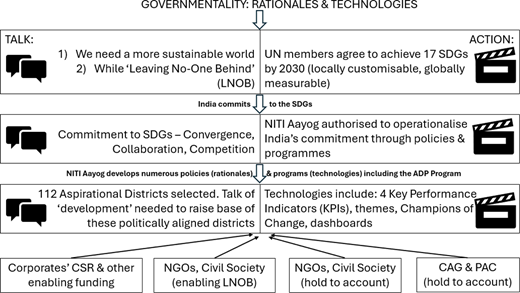
Acting as a policy entrepreneur engaging a network of actors (including other policy entrepreneurs), NITI Aayog has achieved some success, as can be seen in the summary of India’s 2025 VNR noting “135 million people [have been lifted] out of multidimensional poverty between 2015 and 16 and 2019–21 […] and India is on track to achieve health targets for maternal, child, and infant mortality before 2030” [9]. In this section, we analyse how its entrepreneurial activities potentially enable India to overcome data gathering, integrated policymaking and financing issues that could hinder SDG achievement. NITI Aayog can direct the Ministry of Statistics and Programme Implementation (MoSPI) and other ministries, map relevant SDG schemes and work with States/UTs to develop a vision, strategic and action plans (Janardhanan, 2016) [10]. As a policy entrepreneur, NITI Aayog represents an emergent form of conduct (Foucault, 1982); hence, we provide evidence of how this potential hero is held to account for its shortcomings. Its redefinition of “development” links to Patel’s (2022, p. 16) assertion that “Neoliberalism […] is a form of governmentality” and “reaches out to define the soul of human beings”. Analysing governmentality within India’s response to its SDG commitments we consider local problematisations, interventions designed and the technologies used to ensure SDG achievement. Figure 1 maps the context and concepts analysed in our study where this study shows implementation of the 17 SDGs and the need to LNOB leads to particular governmentalities. Table 2 provides the main material used in analysing the stages India has taken.
We do not seek to reduce the complexity of the conditions and practices in India, but to aid the reader in navigating the theory-informed analysis of our key findings that follow. On the right-hand-side of Figure 1, the SDGs arise as an action (goals and targets to meet) and a set of technologies from the specific talk seeking sustainable development that LNOB. For India, NITI Aayog, as the policy entrepreneur, is authorised to choose its preferred interventions (such as the ADP described below) which it then carries out as actions shaped by these rationalities and technologies. On the left-hand-side of row three, we observe talk with NITI Aayog specifically selecting new ADP participants as districts they could work with and which were more likely to achieve success. The action on the third row of Figure 1 includes the dashboards which track the KPIs, the themes chosen by NITI Ayog and the Champions of Change. NITI Aayog also links with other public sector entities such as MoSPSI and other members of the Empowered Committee (not pictured specifically), but various actors are listed at the base of Figure 1.
4.1 Governmentality through problematisation
We focus on the ADP – a NITI Aayog initiative. It works with districts problematised as “underdeveloped” and experiencing severe development challenges. Launched in January 2018 by the Prime Minister (PM), the ADP’s strategy focuses on “three C” rationales: Convergence of Central and State Schemes, Collaboration at all levels down to districts and Competition among districts (Centre for Social and Behaviour Chage, and NITI Aayog, 2022; Patnaik, 2015). Seeking “low-hanging fruits for immediate improvement”, NITI Aayog selected districts they considered deprived according to key health and education metrics. Centre for Social and Behaviour Chage, and NITI Aayog (2022) confirm that there are interventions in almost all 112 Aspirational Districts. NITI Aayog’s CEO convened an “Empowered Committee” to ensure convergence between these interventions and various central ministries’ activities.
The need for this programme because of wide disparity in India’s social achievement was confirmed by an ADP specialist (Interviewee 3), who discussed these districts’ problematisation:
India was ranked 129 among 188 countries despite having a high growth rate. The data shows a very heterogeneous picture of living standards across India, [with] interstate and inter-district variations […]. Some districts are very backwards when it comes to social indicators […] [with] severe development challenges, especially in the health and nutrition sector, education and agriculture […].
Each Aspirational District was hand-selected as capable of showcasing change, particularly because NITI Aayog has no authority to force States/UTs to comply with the SDG targets. Selected States/UTs are more politically aligned and easier to work with. Aspirational Districts are organised into teams at local, State/UT and central levels with “different Ministries providing handholding support […] [and] […] an Empowered Committee to solve the problems […] [Districts] can approach the Empowered Committee […]” (Interviewee 3). Indeed, positive change is occurring with a review of the ADP (UNDP, 2020) confirming that it applies innovative techniques across multiple governance levels and motivates private sector engagement, but recommended more collaboration with NGOs and other development partners.
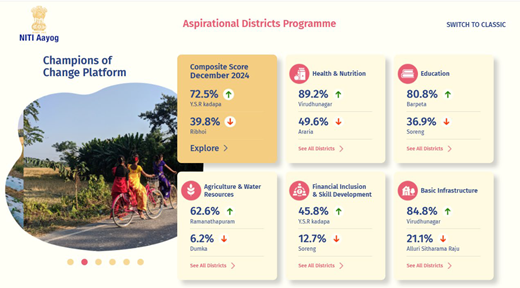
Key to tracking ADP progress is the baseline ranking and “real-time progress” of each district based on 49 indicators from five identified thematic areas [11] and the distance of each district from the state’s and nation’s best is then calculated and reported (NITI Aayog, 2018a). Summary data are publicly available (Figure 2), and website readers can drill down to the district level.
Figure 2 shows a “composite score”, suggesting the ADP is joined-up (as observed by Charnock and Hoskin, 2020), despite the metrics emerging from various programs across various areas and each Aspirational District selecting different targets against the same indicators within the “Champions of Change” dashboard. Nevertheless, this problematisation ranks certain Aspirational Districts as requiring more intense development pressure because their composite score is low. Hence, the top left of Figure 2 shows Ribhoi performing poorly overall (achieving only 39.8% of targets and with a poorer performance from the last measurement period), yet to the right of that box and below it can be seen that Araria, Soreng, Dumka and Alluri Sitharama Raju have also performed poorly in discrete development areas.
We turn to the ADP’s interventions and technologies and how the ADP relates to the SDGs, before considering how NITI Aayog, as a policy entrepreneur, is empowered by other network actors, specifically, corporate entities and civil society, and also how they are held to account by NGOs (for civil society) and government accountability entities such as the CAG and PAC (as pictured at the base of Figure 1 and discussed in Sub-sections 4.4–4.5).
4.2 Governmentality through interventions and technologies
Because the ADP prioritises the Convergence of Central and State/UT Schemes, Aspirational Districts must develop “vision plans” and identify “low-hanging fruits” to convert current schemes into successes. Districts are ranked monthly against broad programme themes. Two private sector entities check metrics (Tata Trust or ID Insight) through household surveys to ensure dashboard data veracity, evidence that interventions have worked and minimise discrepancies (Interviewee 3, see also footnote 15). Such monitoring is “real-time”. Requiring metrics to be entered into a real-time dashboard may address the prior unavailability of data for important indicators with NITI Aayog (2020) promising continuous data improvements. Yet, 80%–90% of India’s workforce is in the unorganised sector or informal employment, and data about these relatively unregulated areas of the economy is largely missing (NITI Aayog and United Nations, 2020, p. 41 notes that metrics are patchy especially in regards to citizens’ long-term heath).
Aligned to programs aiming to engender Competition among Districts, Interviewee 3 notes: “Districts aspire to get good ranks in sectors - sectoral ranking is also there, and then there is overall ranking”. New rankings receive media hype, with enthusiasm about the cities represented in the “top” Aspirational Districts [12]. The PM acclaimed the programme for: “eliminating barriers to the progress of the country, and they have become accelerators for growth instead of impediments” [13]. NITI Aayog (2020, p. 16) suggests that the ADP has:
Been able to generate noticeable results within a short period (March 2018 – July 2019); the average improvement on 49 indicators has ranged from 10 to 59 %. Several districts have also made significant progress and improved their ranks […] The institutional mechanism created under the […] ADP has produced transformative results […] the institutional, programmatic niche developed under the ADP provides an excellent opportunity to integrate SDGs into the implementation and monitoring framework.
Centre for Social and Behaviour Chage, and NITI Aayog (2022) also include stories of change from many districts and interventions carried out/funded by Ashoka University, the Gates Foundation, Save the Children, Tata Trust, US AID and many others.
While initially Government provided no ADP funding, NITI Aayog developed linkages with UNDP into CSR funding, securing promises from Central Government to make small monetary “prizes” to incentivise States to engage with SDG targets (NITI Aayog and United Nations, 2019) [14]. A further UNDP proof of concept developed “matchmaking software” so that corporates with CSR funds could assess and fund government departments’ and NGOs’ proposals. UNDP officers provide technical support and “handhold districts in preparation of a plan of action […] to make meaningful proposals” (Interviewee 2). Nevertheless, interviewees suggested that NITI Aayog has not mapped which districts may gain the most from specific private sector enterprises. Instead, it “is happy to sign SOIs with […] organisations already working in the field”.
4.3 The ADP mirrors policy entrepreneurship in implementing the SDGs
NITI Aayog’s approach to the SDGs matches its ADP policy entrepreneurship. It undertook “national and subnational consultations on SDGs and their implementation strategies, involving Central Ministries, State Governments, local governments, civil society organisations, academia, think tanks, international organisations and other stakeholders” (NITI Aayog, 2020, p. 21). It seeks partnerships to localise SDG understandings, including review mechanisms to measure progress (Partners for Review, 2020). The ADP approach has been deemed so successful that it has been extended to “backward blocks” in an Aspirational Blocks programme (NITI Aayog, 2021) [15]. Indeed, the 2020 VNR (NITI Aayog, 2020) notes that India’s federal system means the central government and States work as “partners and collaborators […] with the coming together of ‘Team India’”.
Although competition stresses prizes and dashboards, the third ADP “C” – Collaboration – does not, potentially impairing planned reductions in extreme social inequality and poverty. Successful sustainable development requires citizen involvement to disrupt institutionalised practices and in rural India knowledge sharing across boundaries can transform social inequality and poverty (Qureshi and Sutter, 2018). Nevertheless, Qureshi and Sutter (2018, p. 1577) find that “rural Indian communities often share perspectives grounded in fate and a mistrust of outsiders […] thus creating important external barriers to knowledge sharing”, suggesting that NITI Aayog’s co-workers in the ADPs will be seen as outsiders. To ameliorate this possible shortcoming and to support these semi-autonomous governments, NITI Aayog and the UNDP work closely on SDG implementation with individual States/UTs, using the SDG Coordination Centre (SDGCC), described as “a whole of the government and the entirety of the society approach where technical experts are driving the localisation of the agenda in the state office” (Interviewee 2). SDGCC is also a knowledge repository to bridge newly elected officials and new bureaucrats replacing those who have moved onto other tasks. UNDP first developed this localisation program as a proof of concept, NITI Aayog then accepted it and operationalised it, trumpeting success in the VNR (NITI Aayog, 2020).
ADP monitoring is a critical implementation mechanism, with NITI Aayog commissioning MoSPI to develop a National Indicator Framework (NIF) to display statistical indicators and disaggregated ADP and SDG data. Following NITI Aayog’s and States/UTs’ development of policies at national and local levels respectively, they attempt to measure policy outcomes and “promote data-driven decision making” to achieve the SDGs (NITI Aayog and United Nations, 2019) [16]. Further, to increase the number of indicators State/UTs measure, NITI Aayog required MoSPI to develop State/UT staff capacity and also enlisted assistance from the UN Resident Coordinator Office in India to develop the “India SDG Dashboard” (a pictorial representation of the NIF) to identify gaps and measure remedial work [17]. The SDG India Index (SDGII) uses NIF data, initially showing 62 indicators (NITI Aayog and United Nations, 2018); it has been continuously updated with SDGII 4.0 including 113 indicators, covering 70 SDG targets and 16 goals (indicators for SDG 17 are not yet available) (NITI Aayog and United Nations Development Program, 2024). These targets are a mix of globally accepted SDG targets, national-level targets and those set by State/UT governments; these last being established through a consultative process (Interviewee 2).
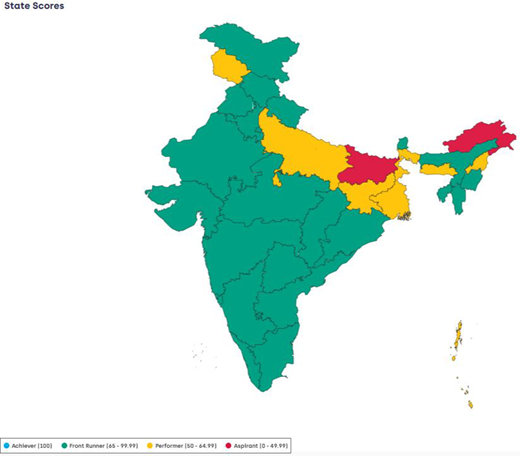
In coordinating data-gathering from various branches of government, the SDGII dashboard (NITI Aayog and United Nations, 2020) encourages Competition between States/UTs to achieve against SDG target indicators. Thence, “cooperative federalism” has become “competitive federalism”. Figure 3 shows how States/UTs are presented as “achievers”, “front runners”, “performers” or “aspirants” (the latter forming ADP’s potential base), while visually distinctive colours are assigned to each category. Regular publication of progress by State/UTs and for India overall is presented as “driving competition […] [through] a structure of evidence-based policymaking by devising a robust mechanism for monitoring and evaluation of outcomes in key sectors of governance” (NITI Aayog and United Nations, 2019, p. 5). Competition is a response to an environment where federalism means that States/UTs have discretion on their SDG implementation involvement.
NITI Aayog (2020) was responsible for developing the national SDG achievement indicators. While Interviewee 2 noted that the number of measured indicators varies by State/UT, many interviewees were concerned that unmeasured gaps would leave some SDG targets and goals unmet. Therefore, reflecting on Qureshi and Sutter’s (2018) exhortation for grassroots collaborations, it is notable that only 60% of States and 30% of Districts initially developed indicators/frameworks that “would enable addressing local aspirations and capturing details of ground level performance with focused monitoring of indicators and goals at the grassroots” (NITI Aayog, 2020, p. 27).
Localisation progress slowed in COVID-19, but by 2019, 23 States/UTs had developed SDG-based vision documents for one or more of the SDGs, and Interviewee 2 argued they increasingly recognise or budget for SDG costs. Software has been developed to enable Central Government Departments to meet new requirements to map their budget requests to SDG indicators, and some States/UTs are following suit (Interviewee 1). However, the UNDP (2020) warned that NITI Aayog should resume capacity building so that the enthusiasm of the first three years did not wane.
PM Narendra Modi congratulated NITI Aayog for developing a “Strategy for New India@75” (NITI Aayog, 2018b, PM introduction) to “bring innovation, technology, enterprise and efficient management together, at the core of policy formulation and implementation […]”; he supported NITI Aayog’s moves to inclusive, efficient policymaking, modernising and improving “inter-personal equity”. NITI Aayog’s, 2020VNR report further represents the SDG implementation effort, detailing new programs and plans for further investment to meet India’s SDGs. The prior VNR also trumpeted the Indian Government’s initiatives “to transform the innovation and entrepreneurship landscape in the country, including the India Innovation Index Framework” (NITI Aayog, 2017, p. 24). India’s development of national indicators received international accolades (United Nations Department of Economic and Social Affairs Division for Sustainable Development Goals, 2019) (and there is a discussion to “scale up the process to other countries” – Interviewee 2).
Next, we show how our policy entrepreneur is held to account (as King and Roberts argue is necessary to limit pitfalls) to assist India’s SDG project.
4.4 Holding SDG policy to account
Numerous network actors could hold NITI Aayog to account as a policy entrepreneur, including India’s CAG (the public sector auditor independent of Parliament) and national NGOs, although power differentials can impact the latter’s effect. India’s CAG developed environmental audit expertise and auditing more than monetary values from the early 2000s (Comptroller and Auditor General of India, 2007, 2020, 2019). Interviewee 6 explained that then:
[…] we decided to start with waste management and […] [undertook] simultaneous audit across India in 22 states […] That report remains the only CAG report which has been reprinted twice because it has such a lot of relevant issues […] a whole lot of people found it very useful, especially the recommendations […] we spoke to the significant things which brought the environment audit into focus.
In addition to this expertise, Interviewee 8 confirmed that recently the SAI’s focus: “has become more comprehensive [with] much attention on the SDGs [which are] inter-related […] But I must tell you that everyone knows that it’s a very humongous task”. Factors are India’s vastness and the need for good data analytics to manage such an audit.
Drawing on this expertise, the CAG was disappointed by NITI Aayog’s initial lack of progress. It challenged NITI Aayog to develop a roadmap aligned with defined milestones against SDG targets, with a “vision document” mapping key schemes. The CAG also called on MoSPI to gain approval for the NIF and improve its operationalisation. The newer SDGII4.0 addresses many NIF issues, and when it was called before the Public Accounts Committee (PAC) (2021), NITI Aayog confirmed it had made procedural changes to respond to CAG critiques. Interviewee 6 noted that the PAC has:
Had a tremendous impact also on public consciousness, because many people come to know about (the SAI work) […] to push the government for changes or publicise government [policies] […] shortcomings […] and push the government to make laws regarding that.
Similar to SDG observations by Abhayawansa et al. (2021), NGOs/civil society and the UN agency in India have also called for reforms to the SDG implementation. For example, one Indian NGO (Agency1) operates a budget-related portal producing research and encouraging citizens to participate in public policy processes at all levels (national, state, district and municipal). As interviewee 3 noted, “the community must be involved in plans of action” if the SDGs are to be implemented successfully [18]. Rather than merely suggesting citizens seek out State/UT and Central Government data, Agency 1 presents:
Visually appealing [data] by providing visualisation but also making it easier to understand so that people get interested and engage. Unless people participate, you cannot have a voice coming from the ground demanding that the government does better (interviewee 1).
Yet, they are frustrated by the slowness of India’s bureaucracy, for example audited annual reports may be published up to two years after year-end.
While NITI Aayog’s dashboard provides speedier updates on SDG progress, our interviews reflect concerns about poor governmental accountability regarding India’s SDG progress, as also critiqued by Development Alternatives (2016), Wada Na Todo Abhiyan (2017) and National Coalition for Education (NCE) (2019) (as also seen in Cordery et al., 2023). These NGOs question whether NITI Aayog can overcome bureaucratic processes and capacity issues in a socially complex, pluralistic and large country. Even when programmes to deal with “underdevelopment” are planned centrally, the local results may be unexpected, and these are left to NGOs to deal with. For example, NCE (2019) highlights increasing privatisation of education has reduced access, they also note under-funding of education reforms and a lack of reliable local data. To achieve equal access to education requires NGOs to raise resources and support students.
4.5 Networked policies: integrating corporate networks and actors
Member states’ SDG commitments require them to give voice to citizens to ensure they “leave no one behind” (LNOB) (UN, 2015). The UN’s “proof of concept” developed by NITI Aayog, note the imperative of private sector initiatives to augment government efforts. NITI Aayog highlight their “continuously partnering with various stakeholders in the public and private sector to achieve the SDGs” (PAC, 2021, p. 24). (Footnote 15 provides examples of corporates involved with Aspirational Districts.) Since 2013, under Section 135 of the Companies Act, 2013, all profit-making companies in India have been required to spend 2% of their average net profit on specified CSR activities (Arora et al., 2019; Taneja et al., 2022); large, listed companies must also report their sustainability practices (NITI Aayog and United Nations, 2019). CSR funds, thus, incentivise States/UTs and Public-Private Partnerships (PPPs) “plug development gaps” at State level (NITI Aayog and United Nations, 2019, p. 81), nationally (especially in solid and liquid waste and clean energy promotion [Interviewee 1]) and accounts for 10% of social sector schemes but is negligible in health (NITI Aayog, 2021). Further, the Confederation of Indian Industry (2018) celebrates business-civil society partnerships, entitling its document as “solutions for the world to achieve SDGs” [19]. One solution, supported by policy entrepreneurs as useful to impact SDG achievement, promotes research and development and new product developments. For example, Interviewee 7 noted: In India […]:
With the LED spread, the electricity requirement for the same amount of light went down by a sixth. So if your requirement for lighting goes down by a sixth, your provision of electricity also goes down […] we need this kind of dynamic working to monitor the [financing] requirements and the outcomes.
In summary, to generate more sustainable development funding, NITI Aayog identifies corporate partners for CSR Funds, to develop PPPs and other tools. Nevertheless, commentators critique the extent to which this achieves the goal of LNOB (Centre for Social and Behaviour Chage, and NITI Aayog (2022; Development Alternatives, 2016; NCE, 2019; Wada Na Todo Abhiyan, 2017).
5. Discussion
This article examines how NITI Aayog, one Indian policy entrepreneur, influences local governmentalities of SDG implementation. We highlight linkages between “talk” (representation) and “action” (intervention) to contextualise the policy reforms and India’s monitoring towards achieving sustainable development. Policy entrepreneurs are disruptive, bringing their concerns to wider audiences and spurring policy reform through actions, information and funding (Mintrom and Norman, 2009). NITI Aayog uses classic policy entrepreneurial tools; for example, developing networks of government departments to integrate efforts and work with its political masters (in particular, the PM). It uses new expertise through calculative technologies (Dean, 1998); problematising and acting on the behaviour of the governed (citizens) to measure progress towards the neoliberal ideal.
To achieve its ends, NITI Aayog engages in dynamic relationships and draws on multiple strategies, as highlighted in the entrepreneurial policy literature (Meijerink and Huitema, 2010; Mintrom, 1997; Mintrom and Norman, 2009). As others note (Dean, 1998; Hayes et al., 2018), the network actors in our research have been “caught in the calculability” introduced by NITI Aayog and the Indian PM to measure the SDGs’ implementation and achievements. Calculability has been spurred by the neoliberal competitive federalism celebrated in the ADP and the SDGII 4.0 innovation. Indeed, NITI Aayog and the PM encourage “competitive federalism” in addition to “cooperative federalism”, with less emphasis on collaboration. Through engaging corporates to incentivise initiatives and prizes as a “carrot” to spur conduct upon conduct, NITI Aayog uses the “power of numbers” – metrics and money – as incentives to mobilise progress on the SDGs (as suggested by Fukuda-Parr, 2014; Hayes et al., 2018) rather than meeting the needs of the poorest. Social objects in a particular concept (re)form within the domain becoming amenable to intervention and regulation (Dean, 1999; Rose and Miller, 2008). This may also be problematic as, for example, the imperative to ensure electricity in all villages may result in electricity to a few houses only (Interviewee 2). Our study also sheds light on the amalgamatic nature of calculability, as although data are incomplete, certain data is made visible as “progress”. NITI Aayog exercises a form of knowledge-power (Lauwo et al., 2022; Sobkowiak et al., 2020) that, along with particular rationales and programs, complements the suitability or completeness of data.
In disrupting structures, NITI Aayog has met roadblocks to reform, including scarce resources which are known to require policy entrepreneurs to seek external assistance (Arnold, 2021). In India this is evident in calls for corporate support (NITI Aayog, 2021). Nevertheless, we have not examined all external parties. Although NITI Aayog is a key player, we cannot be certain that its entrepreneurial activity is sufficiently joined-up and collective, given India’s size and complexity. The roles of other policy entrepreneurs working within India’s networks require further research.
Yet, our study also highlights who is missing from those networks – NGOs and “underdeveloped citizens”. Broad citizen involvement is not only required to LNOB but also has been shown to deliver successful sustainability projects in India (Qureshi and Sutter, 2018) and can assist in necessary capacity building to ensure program executions (Lauwo et al., 2022; Sobkowiak et al., 2020). More work is required.
Mirroring the call by King and Roberts (1992) to hold policy entrepreneurs to account, we also analyse how NITI Aayog has already been held to account for its shortcomings. This ensures they are not seen merely as “heroes” in influencing governmentalities of SDG implementation (Oborn et al., 2011). For example, the Comptroller and Auditor General of India (2019) “preparedness” performance audit called out NITI Aayog’s lack of progress, and NITI Aayog initially sought to blame the Department of Finance for its tardiness (PAC, 2021), before eventually taking responsibility for developing further innovations. Further, the encouragement to undertake capacity building and work more with NGOs reflects shortcomings because of the vastness of India and the work required (UNDP, 2020).
Globally, additional measures to hold UN members to account are required. VNRs provide sanitised discourse of local and global success, as seen in the Indian examples and NITI Aayog (2018b) Strategy for a New India@75 (Cordery and Manochin, 2023). NITI Aayog’s VNRs presented to the UN’s HLPF celebrate India’s SDG implementation, but they also conceal the gaps in data, challenges and under-funding that attend SDG efforts (also observed in Bryson et al., 2017).
Our Indian evidence shows a policy entrepreneur locating “quick-wins” to operationalise its remit to make policies to achieve the SDGs. NITI Aayog approaches SDG implementation through actions (interventions) taken alone and with others – localising the SDGs to be palatable to funders, politicians and (to a lesser extent) citizens. NITI Aayog is challenged to engage with corporates and NGOs/civil society and must answer critiques of its accountability from the CAG and others. Through program and dashboard formulations (representations of the “SDG problem”), NITI Aayog highlights the need for further resources to implement the SDGs, to break down structural barriers and to work around bureaucratic processes and interest group opposition that might slow their progress.
6. Conclusion
Our study addresses the call by Mintrom and Norman (2009) to further theorise policy entrepreneurship, using an example of SDG implementation and Foucault’s (1991) governmentality where talk and actions govern and change citizens behaviours. We also observe new governmentalities emerging to deal with the complex SDG imperatives. LNOB is especially apt in India, where Qureshi and Sutter (2018) argue that knowledge sharing and working across boundaries are essential to reduce social exclusion and raise many out of poverty. Although the UN (2015) encourages member nations to identify and overcome challenges, finding innovations to achieve LNOB requires more than bureaucratic procedures. NITI Aayog has responded by invoking the calculability of the envisaged governmentality.
As a policy entrepreneur expediting change, NITI Aayog introduces new “talk” to define underdevelopment and who can join the ADP. Foucault (1991) theorises that talk enables systematic thinking about a problematisation which will then lead to actions (or interventions). Underdevelopment describes a problematised and targeted population (Dean, 1998) for whom the policy entrepreneur develops programmes to arrest their parlous state. Yet NITI Aayog’s ADP and other sustainable development programmes neither encompass the whole of India, all citizens within the ADPs nor do they aim to achieve all SDGs. Unexpected outcomes are dismissed in talk about localisation of the global SDGs. This amalgam of representation and intervention (Dean, 1999; Rose and Miller, 2008) is interaction-specific, reflecting the complexities of SDG achievement and the temptation to gloss over any limitations in progress (Comptroller and Auditor General of India, 2019; Cordery and Manochin, 2023).
The SDGs and India’s technologies (e.g. SDGII 4.0, CAG preparedness audits, CSR donations, programs and PPPs and NGOs’ work and critiques) enable us to observe the emergence of new governmentalities (as Peter Miller would say, “governing the present”) to deal with complex imperatives. These technologies work to highlight underdevelopment and monitor success. Nevertheless, our research shows that the lack of granular data and the shortcomings of calculability (Dean, 1998) along with neoliberal policies may lead to gaps in programmes which lack integration.
Successful policy innovation requires large networks to disseminate new ideas and influence solutions (Meijerink and Huitema, 2010; Mintrom, 1997; Mintrom and Norman, 2009). NITI Aayog’s networks are vital for ensuring actors in varying capacities and positions of influence will complement the planned core interventions, as Meijerink and Huitema (2010) also found. Indeed, in India, polycentric entrepreneurial activity is driven by the Central Government, States/UTs and Districts in cooperative and competitive federalism (Cordery and Manochin, 2023). We show that key knowledge and dynamics fostered in such networks convey “new” expertise to shape new ways of thinking about how matters should be approached and what forms of intervention are possible. The substantive evidence in this study contributes to the body of governmentality studies with a particular focus on the constitution of expert networks and technologies. Nevertheless, more research could analyse the progress of India and other South Asian countries towards 2030 and SDG achievement, specifically how these networks act “on the ground” and how further funding is sourced and channelled.
We provide evidence that governing discards linear processes when multiple network actors are engaged in framing the SDG “problem” through a representational bricolage. Lauwo et al. (2022) highlight the challenges in “multistakeholder partnerships” seeking to implement the SDGs in a developing country and our study offers further insights into such a “multistakeholder partnership”. We suggest that networks’ dynamics shape the forms of what is considered “expertise”, what success looks like and the role of calculability and competitiveness. We also show the potential for unintended outcomes from interventions and the importance of unacknowledged conditions of representation.
Local policy entrepreneurs, such as NITI Aayog, interact autonomously with the CAG, NGOs and corporates, as they shape technologies for “governing at a distance” (Hayes et al., 2018; Rose, 1999; Rose and Miller, 2008). But they must be held to account (King and Roberts, 1992; Meijerink and Huitema, 2010). We show active government accountability structures (PAC, SAI) along with NGO critiques, but warnings are not always heard by neoliberal reformers. Despite underfunding and bureaucracy within this complex space, policy entrepreneurship in India actively seeks to address SDG implementation, defining new ways of governing through digital dashboards, competitive federalism, preparedness performance audits and international representations that describe a calm beneath which structures and processes are constantly shifting and being reformed into new talk and action.
The author’s colleague Bimal Arora was instrumental in this research. Sadly he passed away in March 2022. Additionally, the authors are grateful for feedback they received from Professors Ivo De Loo and Lee Parker, participants in presentations at Cardiff University and the 2022 British Accounting and Finance Association Conference (BAFA) and of course the reviewers for this Journal. The gracious and insightful input of our interviewees is also acknowledged.
Notes
See: unsdgLink to unsdg. The goals and more detail are available here: unLink to un
See for example COP27: unfcccLink to unfccc
See: pibLink to pib. The index is described below.
For more details see: sdgsLink to sdgs
Unlike the prior MDGs, the SDGs include monitoring as an integral part. Abhayawansa et al. (2021) also argue that such a framework is important for accountability.
Foucault (1982) plays on the double meaning of the French verb “conduire” to “lead/drive” and “se conduire” to behave/conduct oneself.
King and Roberts (1992) call them “bureaucratic entrepreneurs”.
See: sdgLink to sdg
Its remit is broader than merely SDGs, being authorised to focus on different development segments.
81 data points are amassed over: health and nutrition – 30%, education 30%, agriculture and water resources – 20%, basic infrastructure 10%, and financial inclusions and skill development – 10%.
timesofindia.indiatimesLink to timesofindia.indiatimes (October 2021) and in December 2021 timesofindia.indiatimesLink to timesofindia.indiatimes
Interviewee 3 described how grant funding from Jaika (dealers for TATA commercial vehicles) and ID Insight (Bill and Melinda Gates Foundation) of more than USD100 million has been used to make monthly allocations to Districts according to their ranking (e.g. first place provides USD500k subject to an annual maximum). Localised funds have also been provided from other corporate CSRs, such as Piramal (Piramal Health and Piramal Education). Jaika also funds proposals for special projects such as capacity building and data validation. Central Public Sector Enterprises (CPSEs) have also been encouraged to use CSR funds (Taneja et al., 2022) to improve Aspirational Districts. (Proposals are approved by the Empowered Committee and implementations monitored by NITI Aayog.)
Launched in January 2023, this programme identified 500 blocks across 27 States and 4 UTs to reduce underdevelopment, converge schemes and monitor results (About the Aspirational Blocks Programme (ABP)Link to the cited article. ).
The NIF comprised 297 indicators across all 17 goals mapped against ‘the periodicity of data availability, baseline reference period and data sources’ (NITI Aayog, 2020, p. 24).
One sub-national project assessed State budgetary allocations for clean energy climate mitigations. This identified integrated projects, such as one State’s programme subsidising electric bikes for girl students, providing both a social benefit to the girls and resulting in emission reductions.
Internationally, the UNDP’s SDG Impact initiative works to ‘accelerate private sector contributions’ towards SDG achievement (see sdgimpactLink to sdgimpact).