This paper examines how EU-listed shipping companies narrate their sustainability impact through corporate sustainability reports. Using a critical realist ontology, it investigates how companies articulate the structures that shape their sustainability practices, the actions they undertake in response to these structures and the organisational experiences that inform such actions. This study aims to demonstrate how sustainability reporting operates performatively, reproducing or transforming industry structures during a period of major regulatory transition.
This study conducts an interpretive qualitative analysis of sustainability reports issued in 2024 (pertaining to 2023) by shipping companies listed on European stock markets. Reports were selected based on industry classification and the presence of standalone sustainability disclosures or integrated reporting. All documents were examined holistically and abductively, and narrative segments were interpreted through the tripartite critical realist ontology of the real (structures), the actual (actions) and the empirical (experiences). The risk–return–impact (RRI) model served as an analytical lens to explore how financial and sustainability considerations are interwoven in corporate narratives.
The analysis reveals that sustainability reports construct a layered account of sustainability transition in shipping. Companies present structural conditions − such as climate regulation, technological change, capital market pressures and stakeholder expectations − as shaping their sustainability risks and opportunities. They describe actions that either reproduce existing structures (e.g. compliance-driven investments) or seek to transform them (e.g. industry alliances, technological innovation, advocacy). Organisational experiences expressed in the reports highlight identity, commitment, trust and responsibility, indicating how companies make sense of structural pressures and position themselves as agents of change. Across reports, financial and sustainability considerations are tightly intertwined, reflecting the performative interplay of risk, return and impact.
This paper introduces critical realism as a metatheoretical framework for analysing sustainability reporting, offering a novel account of how structures, actions and experiences are narrated within corporate disclosures. It also demonstrates the usefulness of the RRI model as a lens for examining how financial and sustainability logics intersect. By focusing on the shipping industry at a pivotal regulatory moment, this study expands sustainability accounting scholarship with a theoretically grounded explanation of the performativity of sustainability reporting.
1. Introduction
Sustainability reports can be performative, reproducing or transforming structures within and beyond the boundaries of reporting entities. The process of engineering intended or unintended structural change from within may be subject to the paradox of embedded agency (Bouten and Everaert, 2015), yet it remains constitutive of sustainability reporting. The performative effects of such reports encompass both their emancipatory potential and their tendency to reproduce profit-seeking economic activities that contribute to the very social and environmental problems they purport to address (e.g. Parfitt, 2024; Tweedie, 2024; Lehman, 2017). Prior research exploring these tensions has been diverse and fruitful, drawing on legitimacy theory, stakeholder theory, institutional perspectives and post-political critiques inspired by Rancière (Clarkson et al., 2008; Joseph, 2012; Contrafatto, 2014; Brown and Tregidga, 2017; Chakhovich and Virtanen, 2023).
However rich this line of inquiry may be, sustainability accounting research has not yet implemented a critical-realist approach to sustainability reporting. Rooted in a tripartite ontology of structures, actions and experiences (Bhaskar, 1975; Modell, 2017), critical realism offers a distinctive way to examine how reporting entities perceive the structures that enable and delimit their actions and how their actions, in turn, reproduce or transform those structures. This ontology aligns closely with debates on performativity and embedded agency, yet it has not been mobilised to analyse corporate sustainability reports.
To develop such a perspective, this paper turns to the shipping industry, where sustainability challenges are particularly complex and where corporate sustainability reports mediate between global environmental pressures, regulatory transitions, capital market expectations and organisational identity. Accordingly, the paper is guided by the following research questions: How do shipping companies perceive their impact on society and the environment? What stories do they write and publish to communicate this perceived impact? These questions are analytically significant because sustainability reports in shipping not only describe impact but actively shape how companies position themselves as agents of change within an industry undergoing profound transformation.
The shipping sector is a strategically important empirical site for investigating sustainability reporting dynamics. Maritime transport accounts for more than 80% of global trade and an estimated 2.89% of anthropogenic greenhouse gas (GHG) emissions (UNCTAD, 2024; IMO, 2020). Its environmental footprint extends beyond atmospheric emissions to ballast water, bilge water, sewage, garbage and plastic waste, threatening marine ecosystems and coastal communities. Regulatory and technological responses − ranging from IMO conventions and GHG-reduction strategies (IMO, 2018, 2023) to emerging regional initiatives such as FuelEU Maritime − are reshaping business models and sustainability accounting practices. Shipping companies must now report on the Energy Efficiency Design Index, the Energy Efficiency Existing Ship Index and the Carbon Intensity Indicator, while managing a labour force divided between shore-based staff and seafarers whose working conditions, national origins and well-being profiles differ substantially. These features render sustainability reporting in shipping a rich domain for examining how organisations articulate their social and environmental responsibilities.
At the time of writing, EU-listed shipping companies offer a uniquely revealing setting. Their 2023 sustainability reports precede the implementation of the Corporate Sustainability Reporting Directive (Directive 2022 / 2464), which will significantly constrain managerial discretion in sustainability disclosure. This transitional moment produces corporate narratives that reflect not only compliance with emerging regulatory regimes but also organisational interpretations of their role as “active citizens of the Earth” (Maersk, 2024). These narratives illuminate how companies experience structural pressures, enact sustainability actions and frame their readiness to shape − or be shaped by − the evolving sustainability landscape. Against this backdrop, the research question guiding this study is: How do EU-listed shipping companies narrate structures, actions and experiences of sustainability within a critical-realist ontology, and what do these narratives reveal about the performativity of sustainability reporting?
Addressing this question advances sustainability accounting research in three ways. Firstly, it introduces critical realism as a metatheoretical lens for understanding the layered nature of sustainability reporting. Secondly, it demonstrates how the risk–return–impact (RRI) model can operationalise the structural (real), actional (actual) and experiential (empirical) dimensions of sustainability narratives. Thirdly, it offers an interpretive analysis of sustainability reports during a pivotal regulatory transition, showing how companies position themselves as agents within contested sustainability transformations. The contribution of the paper lies not in offering new disclosure metrics or classificatory frameworks, but in re-conceptualising sustainability reporting as an organisational practice situated at the intersection of structural conditions, organisational action and experiential mediation.
Beyond its sectoral focus on shipping, this paper contributes to the sustainability accounting literature by examining sustainability reporting as an organisational and interpretive practice rather than as a neutral disclosure exercise, positioning the analysis within broader debates on how sustainability reporting relates to financial materiality, organisational agency and the articulation of sustainability claims. In doing so, it engages with critical and interpretive strands of sustainability accounting that emphasise meaning-making, ideology, legitimacy and the performative role of reporting, while departing from them by grounding the analysis in a critical-realist ontology and structuring the interpretation through the RRI model. This combination enables a systematic analysis of how corporate narratives articulate the interplay between structural conditions, organisational agency and financial–sustainability considerations. It thereby captures dimensions of sustainability reporting that are not addressed by existing interpretive approaches. It thereby captures dimensions of sustainability reporting that are not addressed by existing interpretive approaches.
The remainder of this paper is structured as follows. Section 2 reviews prior research on sustainability reporting in shipping. Section 3 outlines the critical-realist metatheoretical framework. Section 4 presents the RRI model as an interpretive lens. Section 5 analyses the sustainability reports of EU-listed shipping companies across the three ontological layers, and Section 6 concludes with implications for sustainability accounting research and future inquiry.
2. Prior research
There are only a few prior studies in sustainability reporting in shipping, and they have forged two streams of research. The first stream has assessed the content of sustainability reports vis-à-vis institutional frameworks and stakeholder concerns. The second stream has constructed indices of sustainability disclosure and explored their variety across shipping companies and reports. These two streams of research are not parallel, and they often intersect, forming part of a wider debate about sustainability in shipping.
2.1 Studies assessing the content of sustainability reporting
Studies assessing the content of sustainability reporting in the shipping industry consist of two groups. The first group of papers has mainly explored sustainability reports in container shipping companies and cruises, with the literature on cruises also reflecting the sustainability debate in the tourism industry. Container shipping companies were the topic of research in Zhou et al. (2021) and Di Vaio et al. (2020). Performing content analysis on the non-financial reports of three container shipping companies and one cruise company, Di Vaio et al. (2020) discovered that while container shipping companies perceive their contribution to the attainment of UN Sustainable Development Goals as a fundamental strategic priority, reported information was lacking in terms of comparability, quantity and relevance with respect to the Sustainable Development Goals. While Di Vaio et al. (2020) relied on a qualitative assessment of sustainability disclosures, Zhou et al. (2021) used quantitative methodological equipment to assess and organise the content of sustainability reports. They explored 33 sustainability reports from 12 listed container shipping companies during the 2016–2019 period. Using hierarchical unsupervised text mining, based on latent Dirichlet allocation, they identified three major topics: employee training and management, sustainable business management and sustainable ship operation, each of them being further divided into three subsections. Employee training and management includes employee safety management, employee training and employee supporting activities; sustainable business management includes risk and supply chain management, customer service, law and tax regulations; and sustainable ship operation includes fuel consumption and emission control, wastewater treatment and operational safety. The authors proceeded to suggest the taxonomy that they derived as a proposed sustainability reporting framework in container shipping; their proposal essentially reflects the existing structure and content of sustainability reports.
The second group of papers in this line of research has focused on cruises. Bonilla-Priego et al. (2014) studied corporate social responsibility (CSR) reporting in 18 cruise companies with CSR data on websites only and 11 cruise companies with data on CSR reports, out of a population of 80 cruise companies that were engaging in CSR reporting at the time. The authors measured the quantity and assessed the quality of CSR reporting, providing an interesting taxonomy of sustainability reporting in the cruise industry, which lies at the core of their contribution. They essentially suggested a tri-dimensional analysis. In one dimension sustainability information was distinguished as environmental or socio-economic, in another dimension of the taxonomy information was distinguished as performance-related or management-related and the third dimension of their analysis distinguished sustainability information as hard or soft, depending on the degree of verifiability. A follow-up study was carried out by Font et al. (2016). Building on a subset of the CSR indicators that were identified by Bonilla-Priego et al. (2014), they performed a questionnaire survey that was addressed to internal and external stakeholders of the cruise industry and collected 54 responses from nine groups of stakeholders. Responses revealed that stakeholders did not think that cruise companies’ CSR reports adequately reflected their priorities; stakeholders were placing more emphasis on soft and management indicators, whereas cruise companies were placing more emphasis on hard and performance indicators.
Adopting a qualitative approach to sustainability reporting in cruise companies, Geerts and Dooms (2022) focused on voluntary CSR reporting in the sustainability reports of five cruise companies. They structured their theoretical argument on stakeholder theory and an important part of their contribution pertained to methodology, as they performed a two-dimensional content analysis, classifying business activities across a core-periphery axis and stakeholders across a primary-secondary axis. They found that corporate social actions dominate sustainability reports, but there are substantial differences across cruise companies. Di Vaio et al. (2023) explored the sustainability practices of four out of the five cruise companies that were investigated in Geerts and Dooms (2022). They conducted a manual content analysis which was largely based on the sustainability reports of 2018. Their theoretical framework was structured on the UN 2030 Agenda for sustainable development and their focus was on Sustainable Development Goal 17, “Partnership for the goals.” They mapped cruise companies’ partnerships with external and internal stakeholders, documenting that, while partnerships for sustainable economic development were reported, no measure of partnership effectiveness appeared in the sustainability reports.
2.2 Studies producing sustainability performance indices
Cvivaric Kostic et al. (2021) explored social and environmental disclosure on the websites of 82 freight-shipping companies of the German shipowners’ association. They identified and measured the disclosure of social and environmental information based on the Global Reporting Initiative’s (GRI) taxonomy, 20 information points pertaining to social information and ten pertaining to environmental. They produced evidence that the degree of social and environmental disclosure is positively associated with fleet size, reflecting arguments in Drobetz et al. (2014) that connect the importance and the resources of larger shipping companies with the demand for and dissemination of information on social and environmental impact. Drobetz et al. (2014) also documented a positive effect of sustainability performance on the financial performance of shipping companies, a result that was recently corroborated by Tsatsaronis et al. (2024) who constructed a 17-component CSR performance index for shipping companies, based on content analysis of sustainability reports and the provisions of the ISO 26000 standard. Their sample included companies listed in NYSE, NASDAQ, Shanghai and Oslo, spanning all segments of the shipping industry, and the association between sustainability and financial performance was assessed both in the context of accounting measures (such as return on assets and return on equity), and abnormal stock-market returns that were estimated with multifactor asset pricing models.
Apart from quality assurance standards (such as ISO 26000), the construction of reporting-based sustainability performance measures has also been informed by industry experts in extant research. Tsatsaronis et al. (2024) conducted a survey study of 30 senior maritime experts from 13 companies and organisations (with diverse years of experience and professional posts) which complemented their content analysis of the sustainability reports of 70 shipping companies that were listed in the stock markets of NYSE, NASDAQ, Oslo and Shanghai. The outcome of their work was a reporting framework, and a weighted performance index composed of information items that were suggested to be included in the reporting framework. In subsequent research (with the same sample of shipping companies), Tsatsaronis et al. (2024) used this reporting framework to document the varieties of sustainability reporting across shipping companies, largely highlighting the diversity of topical focus in sustainability reports.
2.3 Commentary
Extant research has been methodologically diverse, using both qualitative and quantitative methodologies, and has yielded policy-relevant reporting frameworks, sustainability metrics suitable for large-scale quantitative analysis of reporting varieties and assessments of reporting responses to institutional frameworks and shareholder concerns. While these findings are both useful and interesting, they have not tried to capture the broader context of the sustainability shift in which reporting practices emerge. This limitation points to an epistemological boundary in extant shipping sustainability reporting research. When this boundary is crossed, sustainability debates increasingly intersect with critical and interpretive strands of sustainability accounting, which conceptualise reporting not as a neutral disclosure device but as a socially embedded and value-laden practice. This literature has explored the role of sustainability reporting in constructing organisational identities, legitimising action, articulating ideological commitments and shaping economic reality (e.g. Hines, 1988; Gray, 2010; Tregidga et al., 2014; Tweedie, 2024). These concerns are directly relevant to the analysis developed in this paper.
Shipping companies are shaped by economic, social, political, technological and environmental structures that exert overlapping causal impacts on the dynamics of shipping companies and the shipping industry. These structures are often reproduced by shipping companies, whereas sometimes pioneering companies may alter some of the structures (industry initiatives are cases in point). Companies do this through their actions, the preparation and publication of a sustainability report being one such action. In this context, they are exposed to positive and negative experiences (e.g. reputational gains and losses) which lead them to decide on their subsequent actions and to reproduce or transform the structures upon them. The analysis of sustainability reports in this context is the contribution of this paper.
3. A metatheoretical framework for sustainability reporting in the shipping industry
This section establishes the ontological grounding required to interpret sustainability reporting as an organisational action rather than a neutral disclosure practice. Sustainability reports can help us understand the process of sustainability transition in shipping, from the point of view of shipping companies. The elements of transition that are relevant to the theoretical argument developed here are:
Shipping companies’ sustainability policies (including the preparation and dissemination of a sustainability report) are shaped by overlapping structural forces such as climate change, the dynamics of global output and trade, the structure and fluctuation of financial markets, geopolitical equilibria and disruptions, technological and scientific progress, regulatory reforms, intra-industry distribution of market power and the organisational identity of shipping companies.
Shipping companies are actors that design and implement sustainability policies. The actions of such actors may reproduce or transform the structural forces described above, either intentionally or unintentionally. For example, shipping companies complying by the law reproduce the structural impact of legal institutions on the shipping industry, whereas shipping companies forming alliances to spearhead technological shifts in the marine economy may lead to a transformation of the legal institutions (as they may pave the way for subsequent regulatory reforms) (e.g. Yliskylä-Peuralahti and Gritsenko, 2014; Poulsen et al., 2021; Alger et al., 2021).
Shipping companies’ actions depend on their experience. Organisational strains, aspirations and perceptions of structural limitations and possibilities drive the emergence of actions in points a and b above, respectively. The way structural frameworks are perceived and experienced by shipping companies shapes the way in which they respond to these frameworks, ending up either transforming or reproducing them (e.g. Hargett and Williams, 2007).
The structural forces along with actors’ experiences and actions (the actors being both individuals and organisations) constitute a blend that is dynamic, always on the move. This means that the structures that shape the dynamics of the shipping industry, the organisational identity of shipping companies and, in particular, their stance and impact on social and environmental change constitute an open system.
The metatheoretical framework that accommodates these properties of the sustainability transition in shipping is the critical realism of Bhaskar (1975, 1979) and Lawson (1997) who applied it in economics. The analysis presented here also draws on Modell’s (2017, 2020, 2024) critical-realist approach to accounting. In this framework, reality is stratified in three layers: the real, the actual and the empirical.
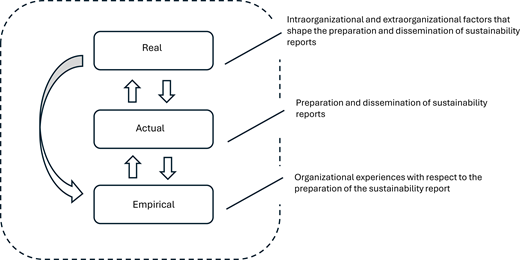
The real is the first layer of a stratified reality, and it consists of the structures that engineer outcomes and events in social and economic life. The causal effect of structures on events is not deterministic but it constitutes a propensity which results in events with a certain degree of regularity (Modell, 2020). The structures can overlap, jointly determining outcomes and, in this sense, observed outcomes are overdetermined (causally determined by more than one factor). For example, when a shipping company installs scrubbers in its vessels, this can be jointly attributed to many factors, including:
environmental structures that necessitate responses to climate change;
legal provisions and their importance for shipping companies;
scientific progress that enables a technological shift in vessel operations;
the dynamics of market power given that companies that are not fast in the lane of environmental transition may find themselves in a position of competitive disadvantage and shrinking market power;
the adoption of environmental concerns by a substantial part of the company’s internal and external stakeholders;
environmental shifts in the regulation and technology of capital markets;
the dynamics of organisational change within the shipping company; and
employees’ and managers’ aspirations and limitations.
None of these factors can explain the investment in scrubbers in isolation from all the others. The investment is contingent upon the overlapping impact of structural causes that take shape and effect in given space and time.
The second layer is the actual, where actors act, their actions being constituents of events in social and economic life. In the case of ESG, actions – casting our attention on the shipping company as an actor – may include the implementation of an investment that reduces vessels’ CO2 emissions, the drafting and implementation of a code of ethics that applies to company operations and delineates conduct within the company as well as across the supply chain, the creation of corporate governance and internal audit bodies that focus on ESG, the design of managerial compensation in a way that it accommodates sustainability objectives, the participation in industry and regional initiatives on climate change, and, more to the point of this paper, the preparation and publication of sustainability reports. These actions are associated with the structures of the real part of the ontology in a bidirectional manner. On the one hand, it is the structures that precede and condition the actions, making them desirable or possible (Modell, 2024). For example, the preparation and publication of a sustainability report is contingent upon regulatory frameworks such as the Taxonomy Regulation or the CSRD in the European Union, the climate change itself, the structure and orientation of investors’ priorities and organisational access to resources and adaptability to change so that company operations and texts reflect the pursuit of specific sustainability objectives. On the other hand, it is the actors’ actions that make structures work, either reproducing or transforming them (depending on structures’ resistance to change). Companies that comply with the regulations plan shipbuilding projects so that they conform with investor expectations and design managerial compensation conditioned on the attainment of ESG objectives reproduce the respective structures. Pioneering company initiatives may anticipate (or even trigger) structural changes, this being the case of environment-minded innovations in shipbuilding or industry alliances for the pursuit of environmental objectives (e.g. Christodoulou and Cullinane, 2021; Pouslen et al., 2016). It should be noted that actors do not plan the transformation or reproduction of structures in a fully conscious or intentional manner; the activation of causal powers is fundamentally indeterminate, and their complex structure precludes perfect foresight (Modell, 2017). Shipping companies cannot foresee with certainty the social and environmental impact of their operations that is reported in sustainability reports, because shipping companies cannot fully know the causal factors that condition their impact on society and the environment. This impact is a semi-transitive object of knowledge because it pertains to “realities emerging at the intersections between natural and social systems, which are susceptible to human interventions but where the antecedents and/or consequences of such interventions are poorly understood or difficult to predict” (Modell, 2024, p. 1263).
The third layer is the empirical. It is the actors’ experiences through their actions and within the structures where they are domiciled that shape their stance with respect to the structures and their intent for subsequent action. Since the topic of the paper is the shipping company and its sustainability report, the experiences that we seek to identify here are organisational, rather than individual, even though:
individual attitudes within the shipping company and stakeholder organisations determine organisational and industry-level outcomes; and
critical realist analyses usually focus on individuals as actors.
For example, in the realm of organisational experience, organisational resistance to change may be a force that impedes a sustainability shift in strategy, investments, stakeholder engagement and the production of corporate texts (like sustainability reports). Strains of corporate viability vis-à-vis the competition, regulatory uncertainty and climate change may foster sustainability-minded organisational shifts (in investments, organisation and corporate texts), ending up reproducing the structural forces that drive these shifts or, in the case of important corporate actors, affecting the pace and content of these structural forces. The tripartite stratification of reality under a critical-realist approach to sustainability reporting in the shipping industry is depicted in Figure 1. The preparation and publication of sustainability reports lies in the “actual” layer of this ontology.
Three clarificatory points are in order. Firstly, the three layers of reality are possibly out of phase with each other. This means that structural effects are not reducible to sums of actions and experiences (the “actual” and the “empirical” part of the ontology, respectively) and that structural forces exist (in part) independently from the actions that reproduce and transform them. For example, climate change existed prior to the emergence of voluntary or mandatory sustainability reporting and the same holds for other forces that shape sustainability reporting like the pursuit of market power and the relationships between shipping companies and regulators, charterers, port authorities and local communities.
The second clarificatory point that is in order is that the interdependence between structures, actions and experiences form a system that is open, constantly on the move. The blend of structural causes, shipping-company actions and organisational experiences that spawn sustainability reports never stays the same. The agential character of this move (situated in experiences and intentional actions) further impedes the detection of fixed, closed systems that engineer identical patterns of events. Openness and, primarily, the agential element in so essential in this three-layer reality that the regularities often detected in empirical research are partial and temporary. They are demi-regularities, in critical-realist jargon. They serve to initiate research interest or to partly corroborate findings, but their role is not central in explaining the emergence and content of sustainability reports in the shipping industry. This is not an argument against quantitative research; after all, quantitative research in sustainability reporting has yielded important insights on measuring sustainability disclosure and detecting its association with patterns in financial performance (e.g. Drobetz et al., 2014; Tsatsaronis et al., 2024). However, qualitative research may be more appropriate when we try to map a three-layer reality that blends structures, actions and experiences in shipping to explain the emergence and the content of sustainability reports.
The third clarification that is in order is that a critical-realist approach to reality assumes that reality is mind-independent, standing “out-there,” regardless of our opinions about it. This is an ontological assertion. Epistemologically, however, critical realism relies on subjectivity. Our transitive and subjective perception is the only way in which perception of reality is feasible. However, it is the fallibility of this perception, being due to how things really are, that matches the assertion of ontological objectivity. For example, there are many ways to explore and measure a shipping company’s impact on marine biodiversity. While the way to measure and assess impact is subjective and rooted − among other things − on reporting frameworks that accommodate diverse readings and are always subject to updates, there are changes in marine biodiversity that are independent of our readings of them and they are part of the reason why some relevant information in the sustainability reports of shipping companies can be shown to be true or false. The difficult part here is that “critical” in critical realism means that the authors of accounts of reality are actors themselves, ending up affecting the reality that their texts purport to map. The author of a shipping company’s sustainability report, especially in the non-mandatory part of it, may affect the formulation of industry standards on what sustainability reporting should contain, how it should serve the purpose of communicating with stakeholders and what sustainability priorities should be adopted by shipping companies.
What remains is the question of how such an ontological framing can be operationalised in the interpretive reading of corporate sustainability narratives, particularly where financial reasoning and sustainability claims intersect.
4. The RRI model
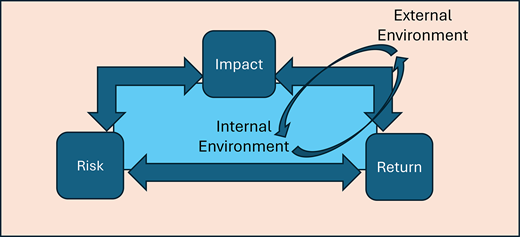
There are many ways in which the real, the actual and the empirical (the layers of a critical realist reality) can be combined to yield explanations of how sustainability reports emerge and what their content means for the reporting entities, the shipping industry, the economy, the environment and society. Given the importance of sustainability reports for capital markets and their complementary character vis-à-vis annual reports and financial statements, an interpretive mechanism of shipping’ companies’ sustainability reports should blend financial and non-financial considerations, highlighting the ways in which, on the one hand, sustainability considerations are filtered with assessments of financial performance and, on the other hand, the pursuit of profit is filtered with assessments of social and environmental impact. This objective can be served with the RRI model (Figure 2). The RRI model is used here not as a decision-theoretic or evaluative framework, but as an interpretive lens for reading corporate narratives.
In the RRI model (Andrikopoulos, 2026), risk and return reflect the risk−return tradeoff in financial economics, which stands as a means of mapping the way financial decisions are made. Impact (I in the RRI acronym) includes both environmental and social impact. To the extent that corporate governance (associated with G in ESG) pertains to the protection of shareholders (via board structure, managerial compensation and internal audit), RR in the RRI model is associated with G in ESG and I in the RRI model is associated with E and S in ESG. Bridging the financial and nonfinancial parts of ESG, the RRI model draws on evidence on the financial materiality of sustainability disclosures (e.g. Christensen et al., 2021; Gibbons, 2024) and it could also serve as response to the “sustainability paradox” of the potentially conflicting sides of double materiality (Argento et al., 2022). The RRI model can also help explain the ways in which the rhetorics of sustainability help moralise corporate profit as legitimate facilitator of sustainability (Alawattage et al., 2023).
The sustainability reports of shipping companies contain materiality assessments that report the ways in which sustainability-related risks entail financial risks and affect shareholder returns. These sustainability-related exposures to risk may be both social and environmental, accommodating, for instance, the financial consequences of political turmoil, pandemics and sea-level rise. Furthermore, investment narratives, like the ones describing impact-minded shipbuilding, are articulated as elements of strategy implementation with respect to sustainability objectives. These are instances where the meaning of risk−return tradeoffs is shaped by estimates of social and environmental impact and, conversely, the practical relevance of impact is measured with the variability of associated monetary payoffs. These instances are part of the fabric of sustainability reports.
In Figure 2, the arrows linking the internal and the external environment of the shipping company reflect the interplay between the shipping company and its environment. The effect of the external environment on the shipping company is rather self-evident and is usually scripted in the part of the sustainability reports that describe risks and assess their materiality. The other arrow, though, is more interesting. It runs from the internal to the external environment of the shipping company, highlighting shipping companies as actors that may affect the very structures that their actions stem from. Narratives of pioneering industry alliances and technological innovations in shipbuilding are parts of the industry reports where the potentially transformative effect of actors on structures may be detected.
5. Empirical results: a critical realist reading of shipping companies’ sustainability reports
In this section, I endeavour in a critical-realist reading of the sustainability reports of shipping companies, with the RRI model equipping the analysis of the real (structural) part of the critical-realist ontology. The texts that are discussed are the most recent sustainability reports of shipping companies whose stocks are listed in stock markets of the European Union. The European Union was chosen so that all reports are prepared under the same institutional and regulatory framework, thereby allowing feasible comparisons between companies and texts. The European Green Deal, Fit for 55, the Taxonomy Regulation, the CSRD and FuelEU Maritime are components of the same institutional terrain, shaping the ways in which listed shipping companies measure and report their impact on society and the environment.
5.1 Methodology
Corporate reports were included in the study if they met three criteria:
the reporting entity was listed on an EU-based stock exchange and included in Bloomberg and Refinitiv, as part of the marine transport industry;
the reporting entity’s main activity involves the commercial transportation of goods and passengers via water (both sea and inland waterways); and
the reporting entity has disclosed on its website either a sustainability report or an annual report with a distinct sustainability component for the 2023 reporting period (published in 2024), provided that the report was available in English.
The listed companies whose reports were explored are: Maersk, TORM, Hapag-Lloyd, Euronav, Exmar, Norden, DFDS, d’Amico, Transport Trade Services, Tallink, Irish Continental Group and Viking Line (Maersk, 2024; TORM, 2024; Hapag-Lloyd, 2024; Euronav, 2024; Exmar, 2024; Norden, 2024; DFDS, 2024; d’Amico, 2024; Transport Trade Services, 2024; Tallink, 2024; Irish Continental Group, 2024; Viking Line). Maersk, TORM, Hapag-Lloyd, Euronav, Tallink, Transport Trade Services, Viking Line and d’ Amico have issued sustainability reports pertaining to 2023, with TORM calling the report “responsibility report.” Norden did not publish a separate sustainability report for 2023, but they state on their website that all annual reports since 2019 are integrated reports that contain both financial and sustainability information. DFDS last report was titled “ESG review” and pertains to 2021, while their annual report for 2023 also contains sustainability information, without being explicitly referred to as an integrated report. Likewise, Exmar and Irish Continental Group did not issue a sustainability report, but they include sustainability information in their annual report for 2023. All sustainability reports refer to the forthcoming implementation of the CSRD, highlighting the transitional character of reporting practices at the time. This transitional moment renders the 2023 reporting cycle analytically appropriate for examining how firms construct sustainability narratives prior to the institutionalisation of disclosure requirements. From a methodological standpoint, this purposive selection supports analytical depth and comparative interpretation within a shared EU institutional and regulatory context shaped by common sustainability reporting reforms (notably the CSRD). The focus on listed companies further reduces variation in reporting incentives and disclosure practices, allowing differences in reporting to be interpreted primarily as organisational variation rather than institutional heterogeneity.
The analysis relied on repeated close readings of the sustainability reports. Given the small corpus, all documents were read holistically rather than coded mechanically. Interpretation proceeded abductively. Narrative passages were examined for how they articulated (a) structural conditions shaping sustainability practices, (b) organisational actions responding to these conditions and (c) experiential stances informing those actions. Segments of text − identified through abductive reading as representative instances of how sustainability-related structures, actions and experiences were articulated − were grouped into these three ontological categories (real, actual, empirical), enabling a layered explanation of how companies narrate risk, return and impact. This form of interpretive document analysis is consistent with critical realist methodology, which emphasises meaning-making and the identification of generative mechanisms over formal coding schemes. Given the small and information-rich corpus, a holistic interpretive approach was adopted. A coding-based procedure would have fragmented the narratives and masked the structural tendencies and agential expressions that a critical realist analysis seeks to uncover. Interpretation proceeded iteratively and comparatively across the corpus. Initial readings focused on how individual reports articulated sustainability-related structures, actions and experiences, which were then examined across companies to identify convergences, contrasts and tensions. This comparative movement across texts enabled interpretations to be refined and reassessed, ensuring that analytical claims were grounded in recurring narrative patterns across reports, as interpreted through the analytical framework, rather than isolated excerpts.
The following sections discuss the texts of sustainability reports across the tripartite critical-realist ontology: real, empirical and actual. The RRI model equips content analysis, mostly serving as a lens for the real (structural) part of the analysis. The content of the texts does not always serve a fast and evident distinction between the real, the actual and the empirical. In line with critical-realist methodology, the analysis does not seek to eliminate subjectivity, but to render interpretive judgements reflexive. Interpretations were continuously assessed against the textual material, the theoretical framework, and alternative plausible readings of the same excerpts. Transparency is supported through the use of verbatim extracts, allowing the assessment of the interpretations put forward in this paper.
5.2 Real
Sustainability reports contain accounts of risks and assess their materiality in ways that cover almost all shipping companies’ exposures to change. These exposures range from climate change, geopolitics and the dynamics of global economy to freight rate fluctuations, regulatory shifts in shipping and changes in naval engineering. The objective here is not to list all causal factors that jointly determine the course of shipping companies. Our focus is on the interplay between financial and sustainability considerations as articulated by shipping companies themselves in their sustainability reports. This focus helps explain how the three pillars of ESG form a unified way of reading and writing corporate stories in shipping. In doing so, they shape the organisational identity of shipping companies and their effect on the shipping industry and the global economy. Our analytical lens is the RRI model that was presented in Section 3. Table 1 presents excerpts from sustainability reports that demonstrate the ways in which shipping companies perceive and communicate the blend of financial and sustainability causal effects that jointly determine organisational choices and market outcomes in the industry. Taken together, the excerpts in Table 1 suggest notable variation in how shipping companies articulate the relationship between risk, return and impact. While some firms frame sustainability primarily as a risk-management and compliance issue, others explicitly integrate impact considerations into financial decision-making, governance structures and access to capital. These differences point to uneven capacities for engaging with − and potentially reshaping − the financial and regulatory structures through which sustainability is operationalised in shipping, rather than a homogeneous industry response.
Impact (I in RRI) in sustainability reports largely pertains to environmental impact (E in ESG) rather than social impact and corporate governance (S and G in ESG). The financial materiality of social impact is explicitly stated only in Hapag-Lloyd’s report, where financial success is attributed to relationships of trust with internal and external stakeholders (excerpt 1). Shipping companies’ narratives on the financial materiality of their governance (in the context of ESG) apply to the role of the Risk and Audit Committees (NORDEN, excerpt 3 – TORM, excerpt 6), performance appraisal (TORM, excerpt 5), the value relevance of transparency (Transport Trade Services – Excerpt 12) and due diligence in mergers and acquisitions (Maersk, excerpt 14).
The sustainability reports demonstrate the ways in which shipping companies perceive the effect of environmental and social impact (I in RRI) on risk-and-return considerations (RR in RRI). The explicit reference to the financial materiality of impact is manifest in credit facilities that are associated with the attainment of environmental objectives (Euronav, excerpt 8). Other structural links between environmental impact and finance can be found in references to stranded assets (NORDEN – excerpt 2, Irish Continental Group – excerpt 13), investment appraisal criteria in impact-minded investments (TORM reports on “smaller investments with short payback time and also larger investments with an expected larger impact” – excerpt 7), access to capital (Euronav, excerpt 10), implications for shareholder wealth (Euronav, excerpt 10), cost of borrowing (Maersk, excerpt 15) and the financial implications of compliance to environmental regulations (Euronav, excerpt 11). These arguments on the financial implications of social and environmental performance can be backed by evidence in prior research showing that shipping companies that score high in terms of social and environmental impact (according to their corporate reports) yield substantial financial gains for their investors (Drobetz et al., 2014; Tsatsaronis et al., 2024). Furthermore, sustainability narratives in shipping companies’ reports resonate with evidence that sustainability reporting has a positive impact on firm value (Plumlee et al., 2015). They can also corroborate arguments in critical accounting literature that sustainability reporting may end up solidifying – rather than undermining – the importance of shareholder wealth (Tweedie, 2024).
NORDEN provides an interesting quantification of materiality: “The impacts were articulated into sustainability topics and subsequently assessed from a financial perspective […]. For this, financial materiality was defined as impacts enabling a risk or opportunity with more than 5 percentage points’ impact on gross margins (CMII)” (p. 73). NORDEN’s annual report exemplifies the perception of a unified RRI terrain with a “Key figures and financial ratios” section (p. 156), where financial performance measures like dividend yield and payout ratio are reported alongside impact metrics like the lost-time incident rate and the energy efficiency operational indicator. While such quantification suggests a high degree of integration between sustainability considerations and financial performance, it also illustrates how impact is rendered legible primarily through financial thresholds. This raises the question of which forms of environmental or social impact remain unaccounted for when materiality is defined in narrowly financial terms.
A comparison across firms suggests different modes of structural engagement: whereas companies such as Euronav and NORDEN articulate sustainability in explicitly financialised terms (credit conditions, asset valuation, quantified materiality), others emphasise governance arrangements or normative principles such as trust and transparency, with more limited articulation of how these translate into financial decision-making. From a critical-realist perspective, these disclosures raise the question of whether the reported linkages between sustainability performance and financial outcomes reflect durable structural change, or whether they primarily represent narrative alignment with regulatory and investor expectations. Sustainability reporting alone cannot resolve this ambiguity, but the combined critical-realist and RRI perspective makes visible how such framings articulate the relationship between financial logics and sustainability claims within broader structural conditions.
5.3 Actual
In the actual part of the tripartite critical realist ontology of ESG in shipping, there are two kinds of actions that are contained in sustainability reports (Table 2 presents the respective excerpts). The first kind are the ones intended to reproduce existing structures that trigger the emergence of events in social and economic life and the second kind are the ones intended to change the structure. The actions of the first kind are often not surprising, fitting anticipated patterns and routines in the shipping industry, such as the compliance with regulations, the implementation of profit-seeking and efficiency-enhancing projects or the adoption of codes of ethics that reflect commonly accepted principles of business conduct.
Examples of the actual part of critical-realist ontology in the shipping companies’ sustainability reports that does not reflect an intention to change underlying structures: “During the year, NORDEN signed the first emissions reduction freight contract, expected to reduce emissions by up to 25% for the client and the first book-and-claim transactions were conducted externally, confirming that decarbonisation products will become a key part of NORDEN’s growth strategy in the coming years” (NORDEN, 2024, p. 15), and “During the year, we had a commercial breakthrough signing the first low-carbon emission contract with the Canadian mining company Teck and secured the first carbon-insetting transactions” (NORDEN, 2024, p. 45). While the sentences in these excerpts describe important actions for the reporting company, they do not manifest evidently any intent to change market structures, regulations, organisational identities or business strategies. This distinction matters, as not all sustainability-related actions carry the same structural implications: some stabilise existing regulatory and market arrangements, while others are framed as attempts to reconfigure industry practices and coordination mechanisms.
The more interesting parts of the sustainability reports are the ones that manifest shipping companies’ intent to change the market they operate in, thereby transforming some of the structures that impact their own actions. These excerpts reflect the role of shipping companies as institutional entrepreneurs, acting as agents of institutional change within wider processes of structural transformation (Chakhovich and Virtanen, 2023). Table 2 shows some examples. As Maersk says, “We see ourselves as active citizens of the Earth” (Maersk, 2024, p. 28) and this implies an active engagement in structural change, as evidenced in launching Laura Maersk (the first container vessel with a dual fuel engine), the proposal of a Green Balance Mechanism in the context of the World Shipping Council, and the vivid critique of COP28. Maersk also argues that their “[…] position is that climate change needs to be tackled with a sense of urgency and action – we cannot wait until the market, regulatory and technical challenges are all resolved” (excerpt 3). Evident in all excerpts is the shipping companies’ perception that the industry is articulated as a network and structural change is to be pursued jointly by the network’s nodes. Within this rationale, DFDS reports collaboration with Arla and the Danish Crown (excerpt 11), Viking Line reports involvement in the Decatrip project (excerpt 14), TORM reports engagement with the Mærsk McKinney Møller Center for Zero Carbon Shipping and the Maritime Anti-Corruption Network (excerpts 12 and 13), NORDEN reports interaction with suppliers (excerpt 9) and Euronav claims coalition leadership in industry initiatives to reduce emissions (excerpts 7 and 8).
It should be noted that, while shipping companies’ intention to change industry structures in the direction of sustainable development can be commendable, it can also trigger concerns about market power. This is the case to the extent that pioneering industry initiatives may be hard to overturn by subsequent regulatory reforms and smaller companies may have hard time viably applying the rules that have been spearheaded by leading companies in the industry (Alger et al., 2021).
A comparison across firms suggests different orientations towards structure-transformative action: while some initiatives – most notably those advanced by Maersk – are framed in explicitly industry-shaping terms, combining technological leadership, regulatory critique and proposals for redistributive mechanisms at the global level, others are positioned as firm- or corridor-specific innovations tied to particular routes, supply chains or stakeholder networks (such as DFDS, Viking Line, NORDEN and TORM). Whether these actions ultimately amount to incremental adaptation or signal attempts at more durable structural change cannot be settled at the level of action alone, but their framing indicates different modes through which firms seek to engage with, reproduce or reshape industry structures, rather than merely signalling alignment with sustainability expectations.
5.4 Empirical
Shipping companies are organisations and experiences at the level of organisations are harder to identify, compared to the experiences and feelings of individuals. The empirical part of the critical-realist ontology applies to how actions and structures are perceived within the shipping company, in ways that trigger subsequent actions. In this section, I identify as instances of experience those articulations that denote emotional states and principles, as opposed to the actions that were presented in the previous section. Table 3 presents excerpts expressing emotional states and principles with respect to sustainability in shipping companies. These excerpts demonstrate feelings of trust, community, commitment, identity and accomplishment that shape sustainability policies across the three pillars of ESG and it is these feelings that equip the shipping companies’ actions in the preceding section, aiming to reproduce or change industry structures.
A comparison across firms suggests different ways in which sustainability-related experiences are articulated: while some companies foreground collective identity, trust and community as internal organisational resources, others emphasise responsibility and ethical commitment in relation to external stakeholders and global practices. One analytically telling dimension of these differences concerns the ideological ground upon which corporate texts emerge, which is rarely made explicit and must therefore be inferred from text structure and content; in a small number of cases, however, ideological commitments are articulated openly. Hapag-Lloyd, when describing its corporate governance (G in ESG), they declare that they implement the German Corporate Governance Code “[…] in a way that is consistent with the principles of the social market economy, taking into account the interests of shareholders, staff and other groups associated with the company,” essentially declaring the company’s stance on the political economy of capitalism in Germany (Hapag-Lloyd, 2024, p. 22, emphasis added). Sustainability reports are a fruitful terrain for the articulation of ideological stances largely because they demonstrate corporate links with society as a whole and the largely unregulated and discretionary character of sustainability reporting so far highlights the value-laden properties of these texts in a clearer manner, compared to their financial counterparts such as financial statements (e.g. Baker and Schaltegger, 2015; Lamberton, 2015; Chabrak et al., 2019).
Interestingly, the emotional states in sustainability reports often refer to employees, locating the emotional terrain on the level of the individuals (internal stakeholders), as opposed to the level of organisations. Hapag-Lloyd talks about dismantling hierarchies to foster a sense of community (excerpt 2), NORDEN reports the feelings of being secure and valued as objectives of its policy vis-à-vis the employees (excerpts 5 and 7) and TORM reports that it fosters employees’ psychological safety (excerpt 9). Euronav’s statement of principles and sense of responsibility on ship recycling (excerpt 10) is indicative of shipping companies’ perception of their playing field being of global reach, fuelling their actions to transform industry structures, as shown in the actual part of the analysis (Table 2).
Viewed across firms, the empirical dimension of sustainability reporting shows that companies differ not only in what they do, but also in how they experience and narrate sustainability. These differences shape the motivational and interpretive resources through which organisations justify, reproduce or contest their actions, reflecting how organisational experience informs action, and indicate how organisational experience mediates the relationship between structural conditions and action in the sustainability transition.
6. Conclusion
Sustainability reporting is a language, a compass and a catalyst for change in the shipping industry’s transition to a more sustainable future, environmentally and socially. The unique conditions of this transition give rise to the question of how things will evolve in the future at the level of the organisations and the industry. The answer to a question so contingent upon special historical conditions is not best served by economic analyses that compile data sets of different organisations and spot interesting patterns and potentially causal effects. Instead, it necessitates a close look at the subtle and fundamental variety across shipping companies in a way that sheds light on the structures that determine companies’ response to the challenges of sustainability, their actions and experiences along the way.
Sustainability reports constitute an essential terrain where structures, actions and experiences are a fabric that corporate stories are made of. In this context, this paper adopted a critical-realist approach to sustainability reporting in shipping companies, using − among other interpretive equipment − the analytical lens of the RRI model (Risk-Return-Impact), that shows the way in which the risk-return framework of conventional financial analysis shapes and is shaped by sustainability considerations.
The critical-realist approach developed in this paper shows how ESG transforms both risk-return and impact considerations, blending them into a single narrative and engine of change at the level of both shipping companies and the industry itself. Furthermore, it shows that major shipping companies are not merely treading the paths carved by policymakers and the forces of climate change, but, instead, they are active agents of change, aiming to take charge of industry transformations. This process is rooted in their experiences, manifested with their actions and governed by their structural properties of their social, economic and natural environment.
The scope of this paper’s findings is limited by its methodological design. Sustainability reports of shipping companies were the only texts investigated to uncover structures, actions and experiences regarding sustainability. These texts are a written testimony of sustainability policies and impact on a corporate level, but do not include evidence on the views, experiences and actions of the people who make impact happen (notably land-based staff and seafarers) and especially people who are responsible for the preparation of these reports, such as auditors and accountants. Moreover, each group of stakeholders in the shipping company’s network has different sustainability actions and experiences to report in their texts, and, without accommodating them, will remain unevenly corporate-centric.
The findings of this study suggest that sustainability reports in shipping should be approached not merely as repositories of disclosed indicators, but as organisational actions embedded in broader structural and experiential contexts. For regulators and standard-setters, this implies that standardisation, while necessary, may not by itself ensure meaningful comparability unless attention is also paid to how firms narrate materiality, agency and responsibility within regulatory frameworks. For assurance providers, the analysis highlights the limits of verifying individual disclosures in isolation, pointing instead to the importance of evaluating narrative coherence and the alignment between reported commitments and organisational actions. For users of sustainability reports, including investors and policymakers, the results underscore the need for a critical reading of corporate narratives, particularly when distinguishing between substantive structural engagement and symbolic or anticipatory positioning during periods of regulatory transition.
Future research should address the limitations of this paper and develop a richer account of structures, actions and experiences that constitute a critical-realist canvas for sustainability in the shipping industry. First and foremost, since the shipping industry is more than shipping companies, accounts and analyses of actions and experiences in shipping should incorporate other actors as well. In this respect, the actions and experiences of shore-based staff and seafarers can be instrumental in demonstrating how structures are reproduced or transformed when it comes to sustainability in the shipping industry (qualitative research, mostly oriented towards interviews, would be a reasonable and fruitful methodological choice). Furthermore, drawing on the network structure of the maritime economy, a bigger picture of sustainability risk, return and impact in shipping must accommodate respective policies and texts from other organisations such as port authorities, customers, suppliers, shipyards, registries and regulatory bodies. Finally, future work should see how sustainability reporting evolves along with regulatory reforms, especially the 2022 / 2464 Corporate Sustainability Reporting Directive in the EU. The implementation of this pioneering framework in sustainability reporting will provide a unique terrain to witness how reporting narratives interact with the economic, social and environmental realities that they purport to account for.