

This paper takes a structured literature review (SLR) approach to identify gaps in the literature and suggest future research opportunities. It focuses on corporate governance (CG) performed outside the formal board of directors’ structure and examines research of alternative CG of small and medium-sized entities (SMEs).
The authors use the SLR method to search the Scopus database, extracting and synthesising findings relating specifically to SMEs’ CG. These are tabulated and described using bibliometric software.
The authors highlight an absence of tailored theoretical approaches to understanding CG in SMEs, which differs from the governance of larger entities. They also find evidence of alternative governance structures in SME CG.
Further research should embrace management and other theoretical perspectives and expanded methodologies, nuances in understanding offered in contextualised settings and awareness of practical implications to better understand the specific setting of CG in SMEs.
SMEs seek to access the scarce resources and skills external to their formal CG structures. Regulators and resource providers should mobilise facilitation and training for this expansion.
The authors synthesise a large body of literature to extract findings specific to SMEs. A unique contribution is our focus on alternative forms of CG in SMEs. Evidence of alternative boards points to resolutions for human capital shortages in SMEs.
1. Introduction
Small to medium enterprises (SMEs) are critical to the health of the economy, contributing disproportionately to job creation (Decker et al., 2014) and providing a source of innovation and growth (Triguero et al., 2014). Translating slower growing SMEs into high growth SMEs should be the goal of governments worldwide, particularly in developing economies. Prior studies suggest that high-growth SMEs rely on individual learning, where “outsourcing and alliances with large established partners enable small firms to increase sales revenue through access to well-resourced innovation processes, industry networks and wider markets” (Dwyer and Kotey, 2016, p. 463). This has been particularly difficult to achieve during the COVID-19 pandemic (Morgan et al., 2020), given isolation and social distancing (Kraus et al., 2020). Company boards of directors or supervisory boards (Faghfouri et al., 2015) can guide organisations during times of crisis. Barroso-Castro et al. (2020) argue that SME growth is directly related to decisions influenced by corporate governance (CG) and directors’ characteristics; however, few small businesses have skilled boards (Berenguer et al., 2016; Wielemaker and Gedajlovic, 2011) and, overall, we know relatively little about the various mechanisms through which SMEs access the resources typically afforded by a board (Audretsch and Lehmann, 2014; Claessens and Yurtoglu, 2012).
Our study builds on the important foundations formed by prior reviews of CG which have highlighted its role in innovation (Asensio-López et al., 2019), entrepreneurial firms (Li et al., 2020) and corporate social responsibility (CSR) (Dwekat et al., 2021). Although providing a helpful start, these reviews focus mainly on larger entities and fail to acknowledge the specific characteristics and challenges of SMEs. Furthermore, academic research into CG of SMEs has typically focused on the role of boards, rather than “how” and “why” questions about SME governance (Audretsch and Lehmann, 2014; Gnan et al., 2015). Lack of consensus on the definition of CG adds to the challenge for studying this in SMEs. A broad definition extending CG past the limits of a board of directors is helpful in the SME context. For this reason, we adopt Gnan et al.’s (2015, p. 355) definition of a “governance system [being] a set of governance mechanisms – both individual and collective – in charge of directing and controlling an organization”.
Where research does address CG in SMEs, there is often failure to acknowledge that theories usually applied to larger entities, such as agency theory, do not operate as expected in SMEs where the traditional owner–manager divide is blurred (Berenguer et al., 2016; Randøy and Goel, 2003). Centralisation of ownership and management in some SMEs has implications for innovation and can result in information asymmetry between investors and management (Mande et al., 2011). Relatedly, Machold et al. (2011) argue that SMEs sometimes tend towards real-time entrepreneurship rather than managerialism, which has implications for the practices of CG in such a context. Work on the functioning of “business groups” (Tajeddin and Carney, 2019) and informal partnerships implies that research has overlooked how SMEs collaborate to overcome resource challenges.
Given these gaps, this study explores the notion that the SME governance literature may be too narrow and does not allow for investigation of more innovative governance models suitable for SMEs. While boards determine strategic direction and can impact value creation, a lack of access to human capital in SMEs means they are unable to create sufficient skill diversity within their boards of directors (Ruef et al., 2003), which may need to be sourced outside of the company to facilitate growth (Dwyer and Kotey, 2016). Saxena and Jagota (2015, p. 55) call for “articulation of governance outside the firm” with a sociocratic model (Saxena and Jagota, 2016) that holds the locus of governance in clusters, industry associations and development agencies.
The article contributes to an emerging narrative in the accounting practitioner literature and elsewhere points to the possibility of outsourcing this knowledge-work by creating alternative boards of directors or appointing “virtual” chief financial officer (CFOs) [1]. “Alternative” board skills are affordable for SMEs and address resource shortages. The literature uses a variety of names to refer to alternative governance structures: informal (Estrin and Prevezer, 2010), venture capitalist (Madill et al., 2005), supervisory [2] (Faghfouri et al., 2015; Van Gils, 2005), business group (Tajeddin and Carney, 2019), informal partnerships (Moss et al., 2021) or peer advisory boards. Company secretarial roles are already outsourced in this manner, with skilled advice offered by accounting firms [3]. These innovative ways of governing might be particularly important for SMEs, and this article synthesises and examines existing references to these to extract common findings and delineate important avenues for future research.
We respond to the challenge posed by Ebrahim et al. (2014, p. 94) to “address governance issues in and around new forms of organizing” by first conducting a broad bibliometrics analysis (Donthu et al., 2021) of the SME governance literature to synthesise what we know about alternative CG from prior studies. Then, we use a structured literature review (SLR) approach (Massaro et al., 2016a) to identify a subset of research on alternative forms of governance relating to SMEs. We contribute by describing this scattered body of literature, both graphically and in terms of the researcher cohort. We find evidence of the need to differentiate CG studies of SMEs, the lack of a cohesive theoretical framework for these studies and evidence of roles played in SME governance by people outside of the formal board of directors. The insights gained in the SLR suggest future research avenues, calling for a contextualised, theory-deriving exploration of CG, specifically in SMEs.
This paper proceeds as follows: Section 2 discusses the dual research methods. Section 3 discusses findings on the broader field of SME governance, and Section 4 focuses on those articles in the study that provide insights relating to alternative forms of governance in SMEs. In Section 5, we draw, discuss and support implications arising from the literature examined and suggest avenues for future research.
2. Research method
This study first takes a broad approach, examining the output from a Scopus search across all business and economics literature (2007–2021). This search aimed to synthesise findings about CG in smaller entities generally, drawn from studies of small/large and listed/unlisted entities. Of the initial 455 articles identified, examination of the titles and abstracts revealed that 112 articles are relevant to our study (see Section 3). This method allows for a mapping of research relating to SME governance in general, asking and answering the question:
Does this research exist or is there an unexplored arena?
It also enables identification of possible theorisation to guide future developments in this area.
Then we adopt a more detailed SLR approach as identified in Massaro et al. (2016a). We examine a unique set of 32 articles excluded from Method 1 to examine alternative governance more closely. SLR can be helpful to open “new and interesting research paths” while at the same time reducing “researcher bias” (Massaro et al., 2016a, p. 770). It allows for the utilisation of technology to access journal articles and is useful for niche research areas that require manual coding of data (Donthu et al., 2021). Here we use it in the absence of a wide body of research about alternative boards in SMEs to identify future research options. As we take a similar approach to an earlier review by Huse (2000), the results can be compared. We follow the ten steps suggested by Massaro et al. (2016a) for preparing an SLR, with Steps 1–8 discussed below, Step 9 in Section 4 of this paper and Step 10 in Section 5.
2.1 Literature review protocol
We developed a protocol to guide the research and define the research questions. We wanted to identify the location of evidence relating to the concept of outsourced, “virtual” or alternative governance structures. Initial boundaries were created by extracting the top governance journals from the Australian Business Deans Council (ABDC) list. We identified those with the terms “Board” and “Governance” in journal title, ranked either A or A* in the list (see Table 1).
All journals with “board” or “governance” in the title from the ABDC list
| Journal title | ABDC ranking |
|---|---|
| Corporate Governance: An International Review | A |
| Regulation and Governance | A |
| Corporate Governance International | B |
| Economics of Governance | B |
| Global Governance | B |
| International Journal of Corporate Governance | B |
| Asian Journal of Accounting and Governance | C |
| Corporate Governance eJournal | C |
| Corporate Governance: The International Journal of Business in Society | C |
| Financial Reporting, Regulation Governance | C |
| International Journal of Business Governance and Ethics | C |
| International Journal of Disclosure and Governance | C |
| Journal of Administration and Governance | C |
| Journal of Business Systems, Governance and Ethics | C |
| Journal of Management and Governance | C |
| The Corporate Governance Law Review | C |
| Corporate Board: Role, Duties and Composition | C |
| The Corporate Board | C |
We also identified the initial nodes for coding the journal articles based on previous SLR studies (Massaro et al., 2015, 2016a, 2016b), including authors and affiliations, country of research, research methods and implications for practitioners and policymakers. Then we added nodes based on other studies related to board structure, including Huse (2000) for the coding of the focus of the paper and the attributes of the board, and van den Heuvel et al. (2006) and Hung (1998) for the board role focus and theoretical perspective nodes. Finally, we added additional implications to allow identification of specifics relating to outsourcing, innovation and SMEs. See Table 2 and the discussion in Section 4.
Selected coding for nodes
| Category | Subnodes | Resultsa | |||
|---|---|---|---|---|---|
| Authors | One node per author | 71 | |||
| Affiliation name | One node per affiliation | 48 | |||
| Country of research | |||||
| Africa | 2 | ||||
| Ghana | 2 | ||||
| Asia | 4 | ||||
| Korea | 2 | ||||
| Taiwan | 1 | ||||
| Thailand | 1 | ||||
| Canada | 1 | ||||
| Europe | 20 | ||||
| Belgium | 1 | ||||
| Denmark | 1 | ||||
| Italy | 4 | ||||
| Norway | 3 | ||||
| Spain | 5 | ||||
| Sweden | 4 | ||||
| The Netherlands | 1 | ||||
| Turkey | 1 | ||||
| USA | 2 | ||||
| No specific country | 4 | ||||
| Size of entity | Small and medium-sized entities | 25 | |||
| Unspecified NFP or charity | 1 | ||||
| Listed (any size) | 3 | ||||
| Small and large | 2 | ||||
| Other | 2 | ||||
| Research method | |||||
| Case study | 1 | ||||
| Interviews | 7 | ||||
| Literature review – Normative | 2 | ||||
| Quantitative cross-sectional | 17 | ||||
| Quantitative longitudinal | 8 | ||||
| Viewpoint | 2 | ||||
| Other | 1 | ||||
| Theoretical perspective | |||||
| Resource dependency theory | 3 | ||||
| Agency theory | 17 | ||||
| Resource-based theory | 4 | ||||
| Stakeholder theory | 2 | ||||
| Stewardship theory | 5 | ||||
| Relational exchange theory | 1 | ||||
| Institutional theory | 1 | ||||
| Social capital theory | 1 | ||||
| Other | 7 | ||||
| Multiple theories | 8 | ||||
| No theory | 6 | ||||
Notes:
aAn article may have been coded twice, if applicable: for example, more than one theoretical perspective may be used in the article, or it may have more than one research method (mixed methods). Unused nodes have been removed from the table to aid understanding
2.2 Research questions
Consistent with Massaro et al. (2016b), our protocol identified three research questions:
How is the CG literature developing with respect to alternative governance in SMEs?
What is the focus of the CG literature particularly relating to alternative governance in the SME sector?
What is the future of CG research regarding alternative governance in SMEs?
2.3 Scope of studies or journal selection, impact evaluation and literature search
To justify our choice of journals, we performed a search for the top 20 cited articles within the Business and Economics subject areas on Scopus using the search terms: Title, Abstract, Keywords in (“SME*” OR “Small and Med*” OR “Small or Med*”, “Board*”) AND (“Governanc*” OR “Virtual*” OR “Outsourc* Board*” OR “director*” OR “Advisory”) AND Subject Area limited to (“BUSI” OR “ECON”). See Table 3 for the search results.
Top 20 articles from Scopus searcha by number of citations
| Authors/year | Journal | Volume | Issue | #Cites |
|---|---|---|---|---|
| Brunninge et al. (2007) | Small Business Economics | 29 | 3 | 207 |
| Huse (2000) | Entrepreneurship and Regional Development | 12 | 4 | 176 |
| Wincent et al. (2010) | Journal of Business Research | 63 | 3 | 124 |
| van Den Heuvel et al. (2006) | Corporate Governance: An International Review | 14 | 5 | 119 |
| Calabrò and Mussolino (2013) | Journal of Management and Governance | 17 | 2 | 118 |
| Abor and Biekpe (2007) | Corporate Governance | 7 | 3 | 114 |
| Gabrielsson and Winlund (2000) | Entrepreneurship and Regional Development | 12 | 4 | 113 |
| Bennedsen et al. (2008) | Journal of Banking and Finance | 32 | 6 | 99 |
| Huarng and Yu (2011) | Management Decision | 49 | 2 | 98 |
| Arosa et al. (2010) | Journal of Family Business Strategy | 1 | 4 | 97 |
| Gabrielsson and Huse (2005) | Corporate Board: Role, Duties and Composition | 1 | 1 | 86 |
| Zahra et al. (2007) | Small Business Economics | 29 | 3 | 79 |
| Madill et al. (2005) | Venture Capital | 7 | 2 | 79 |
| Gabrielsson and Huse (2002) | Venture Capital | 4 | 2 | 78 |
| Van Gils (2005) | European Management Journal | 23 | 5 | 76 |
| Arzubiaga et al. (2018) | Journal of Business Venturing | 33 | 4 | 74 |
| Martín-Ugedo and Minguez-Vera (2014) | Feminist Economics | 20 | 3 | 70 |
| Mínguez-Vera and Martin (2011) | International Journal of Human Resource Management | 22 | 14 | 67 |
| Calabrò et al. (2009) | International Journal of Globalisation and Small Business | 3 | 4 | 55 |
| Abor and Adjasi (2007) | Corporate Governance: The International Journal of Business in Society | 7 | 2 | 54 |
Notes:
aSearch terms: Title, Abstract, Keywords in {[“SME*” OR “Small and Med*” OR “Small or Med*”, “Board*”] AND [“Governanc*” OR “Virtual*” OR “Outsourc* Board*” OR “director*” OR “Advisory”]} AND Subject Area limited to [“BUSI” OR “ECON”]
Only 4 of the top 20 cited articles on the list in Table 4 are sourced from the journals on our ABDC list. We then expanded our search both backwards (i.e. via references) and forwards (i.e. via citations) and into lesser ranked journals (see Section 4.3). We extracted the journals cited in the top 20 article reference lists and tallied the number of times each journal was referenced (Table 4). Positing that the conversation about alternative boards would include all articles that cited the top 20, we compiled the list and counts in Table 5. Tables 4 and 5 also include the average SCImago ranking, the ABDC ranking and the H-index for each of these journals for 2018–2020.
Articles included in the detailed study
| Authors/year | Journal | Volume | Issue |
|---|---|---|---|
| Abor and Adjasi (2007) | Corporate Governance: The International Journal of Business in Society | 7 | 2 |
| Abor and Biekpe (2007) | Corporate Governance | 7 | 3 |
| Arosa et al. (2010) | Journal of Family Business Strategy | 1 | 4 |
| Arzubiaga et al. (2018) | Journal of Business Venturing | 33 | 4 |
| Bennedsen et al. (2008) | Journal of Banking and Finance | 32 | |
| Black and Kim (2012) | Journal of Financial Economics | 104 | 1 |
| Brunninge et al. (2007) | Small Business Economics | 29 | 3 |
| Calabrò and Mussolino (2013) | Journal of Management and Governance | 17 | 2 |
| De Massis et al. (2016) | Family Business Review | 29 | 2 |
| Ebrahim et al. (2014) | Research in Organizational Behavior | 34 | |
| Gabrielsson and Huse (2002) | Venture Capital | 4 | 2 |
| Gabrielsson and Winlund (2000) | Entrepreneurship and Regional Development | 12 | 4 |
| Gnan et al. (2015) | Journal of Small Business Management | 53 | 2 |
| Gubitta and Gianecchini (2002) | Family Business Review | 15 | 4 |
| Hung (1998) | Corporate Governance: An International Review | 6 | 2 |
| Hung and Chen (2009) | Corporate Governance: An International Review | 17 | 1 |
| Huse (2000) | Entrepreneurship and Regional Development | 12 | 4 |
| Joh (2003) | Journal of Financial Economics | 68 | 2 |
| Linck et al. (2008) | Journal of Financial Economics | 87 | 2 |
| Machold et al. (2011) | Corporate Governance: An International Review | 19 | 4 |
| Madill et al. (2005) | Venture Capital | 7 | 2 |
| Mande et al. (2011) | Corporate Governance: An International Review | 20 | 2 |
| Matser and Gerritsen (2010) | Corporate Ownership and Control | 7 | 3–4 |
| Méndez and García (2007) | Corporate Governance: An International Review | 15 | 5 |
| Miller et al. (2012) | Strategic Management Journal | 34 | 5 |
| Randøy and Goel (2003) | Journal of Business Venturing | 18 | 5 |
| Scheela and Jittrapanun (2012) | Venture Capital | 14 | 4 |
| Songini and Gnan (2015) | Journal of Small Business Management | 53 | 3 |
| Soriano (2004) | The Service Industries Journal | 24 | 2 |
| van Den Heuvel et al. (2006) | Corporate Governance: An International Review | 14 | 5 |
| Wincent et al. (2010) | Journal of Business Research | 63 | 3 |
| Zaefarian et al. (2020) | Journal of Small Business Management | NA | NA |
Top 20 journals where the articles in Table 4 are cited/referenced by number of citations/references
| Journal title | Total citations/ journal | H-index | Avg SCImago | SJR | ABDC ranking |
|---|---|---|---|---|---|
| Citations Top 20 | |||||
| Corporate Governance | 37 | 58 | 3.439 | 0.634 | C |
| Journal of Family Business Strategy | 33 | 44 | 4.6 | 1.557 | B |
| Journal of Management and Governance | 33 | 50 | 2.164 | 0.43 | C |
| Corporate Ownership and Control | 32 | 19 | 0.148 | 0.411 | B |
| Small Business Economics | 30 | 131 | 6.918 | 2.202 | A |
| Journal of Small Business Management | 30 | 112 | 5.381 | 1.683 | A |
| Service Industries Journal | 28 | 66 | 4.356 | 1.177 | B |
| Venture Capital | 27 | 51 | 2.887 | 0.802 | B |
| Journal of Business Research | 24 | 195 | 8.575 | 2.049 | A |
| Corporate Governance: An International Review | 22 | 85 | 2.876 | 0.866 | A |
| International Entrepreneurship and Management Journal | 21 | 55 | 6.239 | 1.338 | C |
| Sustainability | 20 | 85 | 3.601 | 0.612 | Not found |
| British Journal of Management | 15 | 108 | 6.021 | 2.407 | A |
| Journal of Family Business Management | 14 | 16 | 0.518 | 2.7 | Not found |
| Management Decision | 13 | 98 | 4.481 | 0.923 | B |
| International Journal of Business Governance and Ethics | 13 | 15 | 0.778 | 0.216 | Not found |
| Review of Managerial Science | 12 | 25 | 5.569 | 1.426 | Not found |
| Journal of Small Business and Enterprise Development | 12 | 67 | 3.3738 | 0.729 | C |
| European Management Journal | 12 | 102 | 5.335 | 1.365 | B |
| European Journal of International Management | 12 | 25 | 2.997 | 0.663 | Not found |
| Journal of Banking and Finance | 11 | 161 | 3.745 | 1.58 | A |
| Journal of Business Ethics | 11 | 187 | 6.381 | 2.209 | A |
| International Business Review | 11 | 95 | 6.892 | 1.773 | A |
| Family Business Review | 11 | 105 | 7.841 | 2.947 | A |
| References Top 20 | |||||
| Strategic Management Journal | 49 | 286 | 9.651 | 11.035 | A* |
| Journal of Business Venturing | 45 | 182 | 13.261 | 7.107 | A* |
| Academy of Management Journal | 44 | 318 | 10.877 | 11.193 | A* |
| Family Business Review | 40 | 105 | 7.841 | 2.947 | A |
| Academy of Management Review | 28 | 270 | 9.476 | 8.446 | A* |
| Journal of Management | 23 | 224 | 13.845 | 7.491 | A* |
| Administrative Science Quarterly | 21 | 181 | 11.152 | 15.098 | A* |
| Entrepreneurship: Theory and Practice | 21 | 155 | 13.748 | 5.365 | A* |
| Small Business Economics | 18 | 131 | 6.918 | 2.202 | A |
| Journal of Financial Economics | 18 | 256 | 8.389 | 11.673 | A* |
| Corporate Governance: An International Review | 17 | 85 | 2.876 | 0.866 | A |
| Entrepreneurship and Regional Development | 15 | 90 | 5.163 | 1.673 | A |
| Journal of Small Business Management | 14 | 112 | 5.381 | 1.683 | A |
| Journal of Management Studies | 13 | 184 | 7.096 | 4.398 | A* |
| Organization Science | 13 | 238 | 5.625 | 6.96 | A* |
| Harvard Business Review | 9 | 179 | 1.976 | 0.826 | A |
| Service Industries Journal | 8 | 66 | 4.356 | 1.177 | B |
| Journal of International Business Studies | 8 | 195 | 10.649 | 4.819 | A* |
| International Entrepreneurship and Management Journal | 8 | 55 | 6.239 | 1.338 | C |
| Venture Capital | 7 | 51 | 2.887 | 0.802 | B |
Seven journals appear in both citation and reference searches. The rankings in Table 4 highlight that the references come from mostly A or A* ABDC journals, while the forward citations are more broadly dispersed. This reflects common academic practice to cite the “top” papers in a field – duplicated in our study by our starting point of the ABDC list in Table 3. We observe that the recommended SLR practice of concentrating on quality journals may result in missing the conversation altogether.
Our final search field of 20 journals in the final list of 20 journals in the study includes an amalgam of the reference and citations journals selecting the top 11 of each.
Journal title:
Academy of Management Journal.
Academy of Management Review.
Administrative Science Quarterly.
Corporate Governance.
Corporate Governance: An International Review.
Corporate Ownership and Control.
Entrepreneurship Theory and Practice.
Family Business Review.
International Entrepreneurship and Management Journal.
Journal of Business Research.
Journal of Business Venturing.
Journal of Family Business Strategy.
Journal of Financial Economics.
Journal of Management.
Journal of Management and Governance.
Journal of Small Business Management.
Service Industries Journal.
Small Business Economics.
Strategic Management Journal.
Venture Capital.
Using the same search terms from Method 1 yielded a list of 237 articles extracted from the journals in the final list of 20 journals in the study [4]. A careful examination yielded a subset of 32 articles with interest for our detailed study into alternative governance. These articles were loaded into an Endnote directory and then transferred to NVivo.
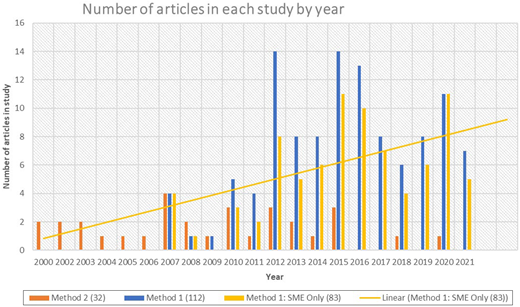
Figure 1 shows that interest in alternative forms of SME governance is spread across the whole period of interest. Also shown here is the historical development of SME governance research from Method 1. This is represented in two ways – both the total study (112 articles) and the SME only subset (83 articles).
2.4 Define an analytical framework and measure reliability and validity of coding
A subset of the articles was coded independently by both authors and the results discussed and amended. There were no changes required to the nodes at this stage. The remainder of the coding was completed by one of the authors.
2.5 Code all the journal articles
The articles were manually coded in NVivo for both methods. Bibliometric analysis on the output from Method 1 was performed using VOSviewer. Issues in the coding were checked with the other author. The results of this analysis are presented in Sections 3 and 4 and can be used to answer RQ1 and RQ2. RQ3 is discussed in Section 5.
3. Small and medium-sized entities governance
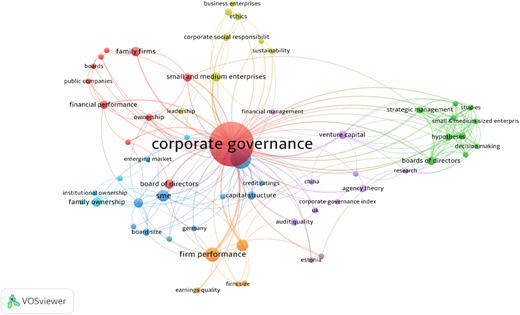
Here, in addition to the historical development displayed in Figure 1, we provide an analysis of the research identified using Method 1, relating to SME governance broadly. We analyse 112 articles. This assists to answer the first research question and contributes by describing this scattered literature graphically and by researcher. In this discussion, we focus on the topics covered in this research, the clusters and networks of keywords using bibliometric tools (Figure 2) and extract the findings specific to alternative CG.
3.1 Small and medium-sized entities governance in the broader literature
Of the 112 studies analysed, 83 studies are focused specifically on SMEs or smaller entities. The remaining studies are focused on larger entities and the subset of smaller entities is used to provide further insight. The most common area of study is the impact of CG on performance or growth (37 articles). Some other areas of study were related to board composition and characteristics (19), capital structure (10), export behaviour and internationalisation (6), entrepreneurial orientation and value creation (5), conceptual/theory development/literature review (4), auditors (4), CSR (4), disclosure (4), earnings management, predictability and quality (4) and strategy development (2). Future research could synthesise the findings in each of these categories. We incorporate some of the findings in Section 5.
3.2 Keyword analysis
Analysis of the keywords in the 112 articles using VOSviewer is depicted in Figure 2. The analysis identifies 9 clusters of keywords that appear at least four times in the keyword lists of the 112 articles. The largest of these (red) identifies that the studies relate to governance in SMEs, particularly focused on performance (board of directors, financial performance, boards, CG, family firms, ownership, small and medium-sized entities). Next there are two significant clusters. The first of these (green) indicates keywords relating to the stakeholders and functions of boards (business and economics; decision-making, strategic management, stockholders); the second (blue) indicates a cluster of studies relating to the structure, characteristics and composition of boards (board composition, size, structure). In yellow, there is a cluster relating to specific topics of interest in CG studies such as CSR, ethics, sustainability, gender and leadership.
3.3 Evidence of alternative governance in the broader literature
Far from being a legal requirement, in this body of research, we find hints at the use of, and need for, alternate CG in SMEs. Shortage of skills in SMEs is informed by Lekhanya (2015) who asserts that “average” entrepreneurs do not have the required skills for CG. Barroso-Castro et al. (2020) underline the importance of knowledge and specialisation for dynamic decision-making. Further, Minichilli and Hansen (2007) highlight the importance of diversity of advice and knowledge in times of crisis and growth (Barroso-Castro et al., 2020); Alzubaidi (2021) find support from outside counsel and consultants; Chiu et al. (2020) mention the importance of external CG provided by Certified Practicing Accountants and Big 4 firms; Kussudyarsana et al. (2020) discuss relational governance arising from informal and network-based sources; and Audretsch et al. (2013) posit that firms employ professional outside teams to provide monitoring in family firms.
The potential for employees to provide the missing strategic skills has been raised but is not clear. Wells and Mueller (2014) find that employees are not seen as a source of missing and needed skills and characteristics for governance, but that independence is essential for directors to provide sufficient monitoring and assist with changing and volatile responsibilities and environments. Durst and Henschel (2014), however, find that some SMEs rely heavily on their employees for strategic opinions.
4. Alternative governance findings, insights and critique
Here we provide an analysis of the smaller set of 32 articles identified using Method 2. This analysis answers the first two research questions:
RQ1. How is the corporate governance literature developing with respect to alternative governance in SMEs?
RQ2. What is the focus of the corporate governance literature particularly relating to alternate governance in the SME sector?
4.1 Author demographics
The 32 articles included in the study were written by 71 distinct authors from 48 different affiliations and there is no concentration of specialisation in any one institution. Seven of the authors contributed to two articles each; Nordqvist, co-authored three articles (Brunninge et al., 2007; De Massis et al., 2016; Machold et al., 2011) and Huse contributed to four (Gabrielsson and Huse, 2002; Gnan et al., 2015; Huse, 2000; Machold et al., 2011). Huse, the most prolific author in our set, has an established interest in CG and Minichilli and Gnan have an interest in both governance and family firms. For these collaborators, then, there appears to be a genuine interest in this area of research.
Regarding the widely dispersed affiliations of the authors, Massaro et al. (2016b) find similar dispersion in their SME study. This highlights the need to differentiate CG studies specifically within the CG area. Massaro et al. (2016b) concur, attributing this dispersion to a lack of focus of authors on SMEs. It could also be attributable to the emerging nature of this topic and difficulty of access to data.
4.2 Regions of research
The regions under study are of interest given the lack of available data on SMEs. Europe is best represented with 20 studies; Asia (specifically Korea, Taiwan and Thailand) has four studies; the USA and Africa have two studies each; only one originates in Canada. This spread indicates some opportunity for further research, particularly in emerging economies, where there are often more SMEs than larger entities. We found no studies in Australasia, South America, India, China and other parts of Asia.
None of the studies appears to be international in nature. However, Massaro et al. (2016b) caution that SMEs are not consistently defined across nations, which must be considered when undertaking cross-country comparison. For example, van den Heuvel et al. (2006) specify a minimum criterion of “employed at least five people”; Abor and Biekpe (2007) discuss firms with “less than a hundred employees”; and Gubitta and Gianecchini (2002) include companies smaller than €15m.
4.3 Research methods
We coded the articles with respect to research methods used, finding an emphasis on quantitative methods. These articles use regression and empirical models to study both cross-sectionally and longitudinally. For example, Hung and Chen (2009) perform a longitudinal analysis of 62 Taiwanese SMEs to examine minimum shareholder requirements. The remaining articles use case studies (De Massis et al., 2016), interviews (Gubitta and Gianecchini, 2002), perform literature reviews (Gabrielsson and Huse, 2005; Hung, 1998) or use mixed methods.
4.4 Theoretical foundations
Not surprisingly, given the topic of CG, agency theory, resource-based/dependency theory and stewardship theory feature frequently. Each of these perspectives generates valuable insight for CG, but the relevance of these lenses in the SME setting remains unclear and requires further exploration. There is a missing cohesive theoretical framework for SME CG studies. Further, some authors have no clear application of theory. This is true particularly for quantitative studies; for example, Black and Kim (2012) and Joh (2003).
van den Heuvel et al. (2006) examine approximately 30 articles to ascertain the role of board members in small and medium-sized family businesses. The dominant theory they identify is agency theory, used to describe a control or monitoring role performed by the board members, including succession planning and “parental altruism” (van den Heuvel et al., 2006, p. 480). Brunninge et al. (2007) examine a sample of over 800 SMEs, concluding that for closely held SMEs struggling with strategic change, an option is to use outside directors on the board. Their article investigates the interaction of different governance mechanisms, identifying that in SMEs, separation of management and ownership is sometimes unclear. This commonly stated lack of separation in SMEs causes dissonance when we note that the most frequently used theory is agency theory that relies on that separation. Many find that the size of a typical SME and owner-manager status of the CEO means there is no agency conflict (Abor and Adjasi, 2007; Calabrò and Mussolino, 2013; Gnan et al., 2015). This is explored further in Section 5, in response to RQ3.
“Control” is fairly evident in the boards studied, but authors also identify a “service role” (van den Heuvel et al., 2006, p. 478) with multiple characteristics, including resourcing, strategic planning and service. The service role is perceived as more important in family businesses (van den Heuvel et al., 2006). van den Heuvel et al. (2006) call for more clarity in defining and ranking the tasks boards undertake, particularly in SMEs.
Application of stewardship theory by Arosa et al. (2010) leads them to conclude that the focus of SME CG should be service and advice. These are both roles easily outsourced. According to Gnan et al. (2015, p. 358), this theoretical perspective is particularly apt when studying SME CG because it “represents agents with cooperative and pro-organizational attitudes and with a natural propensity to align their goals with those of the principal, because of a number of conditions like intrinsic personal features, needs and motivations; identification with the company and commitment to company values; power intended as a service; a collectivistic company culture; and a participative and trust-oriented management philosophy”. Succession planning within families also aligns the family-led SMEs to a stewardship perspective (Hung and Chen, 2009).
Another prominent theory is resource dependency. From a resource-based or resource-led theory perspective, studies emphasise the scarcity of skilled resources available to SMEs for CG. Gabrielsson and Huse (2002) highlight that SMEs can co-opt these resources from outside their organisations [for example, from venture capitalist (VC) firms]. “Familiness” is considered a resource by Matser and Gerritsen (2010), who also use social and human capital to guide their discussion. They highlight the possible use of resources from outside the formal board structure such as “business contacts, networks and tacit knowledge” (p. 473).
Examples of alternative theoretical perspectives include Birnbaum (1984) (alternatives for uncertainty); De Massis et al. (2016) (an extension to new product development (NPD) design principles); and Dunn (1996) (systems theory). This use of alternative theoretical frameworks provides richness of understanding and may be more applicable to SMEs than more traditional theoretical approaches.
4.5 Focus of the articles
Two prominent topics discussed are impact on performance (15 of 32 articles) and governance structures (7 of 32 articles). The impact of CG on firm or company performance extends from the CG literature of large firms into the SME sector (Abor and Biekpe, 2007). Authors note a gap in understanding the functioning of boards of directors in SMEs (Arzubiaga et al., 2018; Machold et al., 2011), particularly where there is less regulation and different control structures (Bennedsen et al., 2008). Consulting advisers providing expertise unavailable within an SME are found to be useful for maximisation of profits and increased returns by Soriano (2004).
The relationship between CG, family ownership and performance is also explored. Merino et al. (2015) find that too much involvement from family members can be detrimental (Bennedsen et al., 2008). Arzubiaga et al. (2018) examine the link between entrepreneurial orientation and innovation, finding that external family members may suppress innovation. Calabrò and Mussolino (2013) highlight that informal and formal governance mechanisms co-exist and create relationships and trust needed for increasing export intensity in family SMEs. The same, “participative governance” between boards and family members is documented by Zaefarian et al. (2020) in the context of positive development of international market information acquisition capability. A stream of research examines the roles played by families and VCs within and outside board structures, and some articles hint at alternative CG. For example, the authority of founding members and concentration of family ownership (Miller et al., 2012; Randøy and Goel, 2003) and the impact of insider/outsider directors on performance (Arosa et al., 2010; Black and Kim, 2012; Hung and Chen, 2009; Miller et al., 2012).
Hung (1998) provides a foundational typology of six major governance roles: “linking, coordinating, control, strategic, maintenance and support”. These are expanded by van den Heuvel et al. (2006), who add definitions for the board’s role focus and theoretical perspective nodes. Using Hung’s (1998) typologies to code the articles in the study, we find that the most common focus is the control role (11 articles). Of particular interest were costs and benefits and the type of monitoring (Ho et al., 2010; Linck et al., 2008; Mande et al., 2011; Randøy and Goel, 2003), accountability norms (De Massis et al., 2016), expropriation of resources (Joh, 2003) and leadership (Machold et al., 2011; Miller et al., 2012).
Eight articles study the strategic role of boards, with Matser and Gerritsen (2010) demonstrating improved strategy and better performance where a governance board operates. Strategic studies focus on advice provision, the impact of a good network (Bennedsen et al., 2008) and the determination of corporate direction (Ebrahim et al., 2014). We see evidence of the key role of external independent directors in the CG literature (Abor and Adjasi, 2007; Songini and Gnan, 2015), including interest in independent directors in SMEs and their influence on strategic change (Brunninge et al., 2007); advising, monitoring (Ho et al., 2010; Randøy and Goel, 2003); and control (Joh, 2003). Linking performance and structure, Abor and Biekpe (2007, p. 29) conclude that “board size, board composition, management skill, CEO duality, inside ownership, family ownership, and foreign ownership” impact firm profitability, particularly the ability to access financing. Hung and Chen’s (2009) SME study concludes that insider shareholding acts as a threshold or tipping factor for performance.
4.6 Understanding optimal small and medium-sized entity board structures
In spite of an emphasis on the relationship between governance structure and performance, a clear understanding of efficient board characteristics, composition and behaviours remains elusive, particularly in the SME context (Barroso-Castro, 2020). Related to governance structure, Brunninge et al. (2007) suggest that a focus in the literature arises from the interaction of management and boards that impacts their ability to adopt strategic change. The importance of getting this structure right is highlighted in several studies (Gabrielsson and Winlund, 2000). For example, the structure of the SME board is identified as a key element in infrastructure and innovation, facilitating access to equity financing (Mande et al., 2011) and providing resource monitoring (Randøy and Goel, 2003). Other topics include innovation and new product development (Arzubiaga et al., 2018; Bennedsen et al., 2008; De Massis et al., 2016; Dunn, 1996) and investment in infrastructure such as information technology. Machold et al. (2011, p. 371) highlight that informality in processes, lack of structure and “role integration” should motivate study of SME boards.
Evidence of the importance of alternative governance structures is provided by Abor and Adjasi (2007) who advocate incorporating the views of employees, unions, communities and other stakeholders. Calabrò and Mussolino (2013) further suggest that formal and informal systems can co-exist in complementary and supplementary ways. For example, family councils may act as substitutes for CG control mechanisms (Gnan et al., 2015), suggesting that SMEs rely on these outside groupings for ownership and monitoring. Gubitta and Gianecchini (2002) examine reliance on non-family members in growing family firms. Moss et al. (2021) argue that characteristic responses to resource scarcity in entrepreneurs, such as bootstrapping, bricolage and creative resourcing, may create unexpected synergies in partnerships and external governance. Studies find that SMEs backed by VCs have differently structured and more active boards (Gabrielsson and Huse, 2002). Madill et al. (2005) add that VCs provide networking, advice, assistance and business intelligence to the firms in which they invest, with Scheela and Jittrapanun (2012) finding they provide non-financial advice, allowing them to overcome risks such as political uncertainty and weak legal systems.
From a board composition perspective, Machold et al. (2011) focus on team performance and role of the CEO, highlighting the importance of the chairperson’s leadership, board development and the knowledge of board members. This could be extended to outsourced or advisory boards, which are likely to perform well on these criteria. Méndez and García (2007) also suggest that owners’ personal networks are important in SME strategy development, raising the question of the influence of outsourced board members’ networks.
5. Discussion and future research
In this study, we have stood on the “shoulders of giants” to undertake a SLR (Massaro, et al., 2016a) and bibliometric analysis of CG in SMEs. This approach afforded a detailed overview of existing literature, including the properties of CG in SMEs and importantly uncovered evidence suggesting the existence of alternative forms of CG. Like Mattei et al. (2021), the following discussion draws upon the above analysis to present critical areas of future research that can build a better understanding of the nature of current CG in SMEs, and, perhaps more importantly, to develop innovative approaches to CG in SMEs to better meet the needs of these organisations. In particular, we emphasise the need to take a broader approach to understand CG in SMEs. In doing so, we address RQ3 of this study.
5.1 A broader understanding of small and medium-sized entity corporate governance
In spite of criticism that boards in SMEs may exist simply to satisfy ceremonial or regulatory requirements (Arzubiaga et al., 2018), there is evidence that well-structured boards can play a far broader and more relevant role for SMEs (Cumming et al., 2021; Gnan et al., 2015). The nature of CG in SMEs and how SMEs access the services and resources afforded by formal CG structures may be more diverse than in their larger counterparts. We find that SMEs are indeed accessing the skills and resources typically provided through CG, but via various mechanisms such as VCs, employees and their business ecosystem.
A significant proportion of literature focused on “control” as a critical function of boards (van den Heuvel et al., 2006). This makes sense in the context of larger organisations, where agency and monitoring have an important function, but arguably less so in SMEs. For example, Bennedsen et al. (2008, p. 1099) highlight that the influence of a CEO as owner as well as manager leads to reduced emphasis by the board on “hiring, monitoring and providing the right incentives for […] daily management”. In smaller firms, the need for control and for a board to act as agents of external stakeholders may be less important than the provision of extra-organisational resources, including networks, knowledge and strategic capability, to augment the generally resource constrained nature of SMEs (Calabrò and Mussolino, 2013; Faizabad et al., 2021; Li et al., 2020). Our analysis found that these resources are being fulfilled in a variety of ways in practice.
Gordon et al. (2012) suggests resource and cost-driven shortages could be resolved by having SMEs focus on parts of CG such as board composition, valued by investors, rather than trying to achieve all roles found in large firms. Madill et al. (2005) find that half of the angels in their study were represented on the board, and that SMEs rely on angel investors for non-financial functions. The literature posits that an important monitoring role is currently played by institutional investors (Chen et al., 2014; Cho and Lee, 2017; D'Angelo et al., 2016). These insights suggest that a broader perspective on what constitutes board structure is warranted and requires future research which delves more deeply into the ways in which SMEs are augmenting their organisational resources.
Furthermore, the influence of board structure on innovation is a worthy focus of future research (Arzubiaga et al., 2018; Sierra-Morán et al., 2021). Randøy and Goel (2003) find that founder-led firms benefit from strategic agility because of lower agency monitoring that is advantageous for innovation. Linck et al. (2008) suggest a positive relationship between smaller, more independent boards and high-growth and high R&D firms. For family SMEs, the literature particularly emphasises innovation (De Massis et al., 2016), the challenges of finding the required skills within the family unit (Arzubiaga et al., 2018) and balancing the need for appropriate skills sets and power sharing (De Massis et al., 2016). These findings suggest the need for research which unpacks the nature of influence that CG has on innovation within SMEs and for research that takes a nuanced approach which encompasses the variation that might exist within different SME forms, such as high-growth, family-owned or industry diversification.
The optimal size of boards in SMEs is also contentious. This is particularly evident in the literature examining board-size impact on performance (Afrifa and Tauringana, 2015; Arosa et al., 2013; Okofo-Darteh and Asamoah, 2020). The direction of impact of board size on performance is particularly unresolved for SMEs. Bennedsen et al. (2008) suggest that board size for SMEs should be determined by trading off skills needed and the costs of free-riding members.
Relatedly, understanding what CG roles are performed within and outside of the formal board structure will be valuable, as this may help to resolve conflicting findings like those for board size and performance in SMEs and identify how SMEs are dealing with the skills gap in CG. The literature on the alliances formed between SMEs and entities from other sectors, largely motivated by the need of resources (Alvarez et al., 2006; Ariño et al., 2008; Dickson et al., 2006; Marino et al., 2008), also offers some options for structuring alternative boards. Ladegard and Rasmussen (2015) pose some useful questions about the roles of independent directors in SMEs: do they act individually or in a group? Do they have specific roles to play? We add: Can these roles be outsourced so that expertise is shared across multiple SMEs, similar to the way in which independent directors may provide directorships to multiple larger entities? This may go some way to relieving the barriers arising from lack of time non-executive directors have to spend on SMEs (Annuar, 2012).
5.2 Many theoretical insights into how small and medium-sized entities corporate governance functions, none definitive
There are many opportunities to further explore theoretical frameworks and develop new theories specifically for SME CG. Also, smaller firms, because of their “relatively simple network arrangements”, might be a good starting point for developing new theory for larger firms, and this could be relevant to their adaptability to new alternative forms of CG.
Collective rather than independent application of theory is suggested by several authors (Miller et al., 2012) as a means to overcome the conflicts arising from common theoretical approaches (particularly agency, stewardship and resource dependency theory) (Gubitta and Gianecchini, 2002). Relatedly, Chen et al. (2014) and Cho and Lee (2017) propose integrating agency theory and a resource-based theoretical perspective to understand the nexus between governance and internationalisation in family firms. Di Vito and Trottier (2021, p.17) suggest advancement in the CG space will occur through the employment of a greater diversity of theory from the areas of management and psychology, such as sensemaking, institutional theory and strategic renewal. Jain and Jamali (2016, p. 267) urge researchers to explore theories from “sociology and socio-psychology” when exploring expanding board roles and the influence of stakeholder groups other than shareholders on CG. We also suggest further research using a paradigm identified by Saxena and Jagota (2015, 2016). Using the theories of articulation of decision-making, institutional theory and organisational contingency theory, these authors introduce a sociological framework for understanding SME CG that takes into consideration the environment and ecosystem of SMEs. This framework should open additional research that incorporates alternative governance.
Access to CG resources has an impact on small firms’ ability to innovate and grow (de Cleyn and Braet, 2012). However, there is evidence that high-growth firms do not need the monitoring functions of the board (Ladegard and Rasmussen, 2015). This is presumably because many high-growth SMEs are owner-managed. What resources and skills are therefore necessary? Barroso-Castro et al. (2020) suggest that research using a contingency view of CG could help to explore different organisational settings and, we suggest, could include examining where and how these resources are currently sourced that would assist with developing an SME-specific understanding of resource-dependence theory (Ladegard and Rasmussen, 2015).
Agency theory should not logically apply to owner-manager firms (Randøy and Goel, 2003), but it is the most common theory we found in the SLR set of articles. To address this dissonance, we conducted a closer examination of these articles. The small size of SMEs and lack of resources mean that delegation and separation of board roles is sometimes difficult (Gnan et al., 2015) and some suggest there is no need for monitoring in SMEs (Abor and Adjasi, 2007). Others rely on large firm studies using the theory and then conclude that it is not relevant for SMEs (Ebrahim et al., 2014). Where the theory appears relevant, authors contend that agency–type conflict lies in the relationship between dominant (family or affiliated) owners and minority shareholders (Arosa et al., 2010; Gnan et al., 2015).
The closeness of relational ties could cause conflict of interest and diminished objectivity. Other similar monitoring conflicts may arise when governance is under the control of inept or too many related members (Bennedsen et al., 2008). This is likely to be most evident in times of crisis or risk, as these relational ties promote more conservative strategy (Brunninge et al., 2007; Merino et al., 2015). Agency conflict also arises in SMEs because of control crises arising from the lack of differentiation between ownership and management and scarce human resources that reduce the CG structures to fora for airing grievances (Gabrielsson and Winlund, 2000; van den Heuvel et al., 2006). Like Oehmichen (2018), we propose that CG SME research should not take these conflicting perspectives as an indication of irrelevance, but instead should seek to further explore agency theory to better understand, and potentially make contributions to, agency theory in the SME context.
5.3 Methods used – more diversity and closer relationship between academe and practice
We found that most studies used quantitative methodology, which is not surprising given the emphasis on performance, while a portion of studies used qualitative methodologies. Given the relatively underexplored and nascent nature of research exploring CG in SMEs and particularly alternative forms of CG in this context, there is a need to ensure that research does not prematurely narrow its focus (Bracci et al., 2021). We therefore support calls for greater emphasis on exploratory research, which will likely use a diversity of qualitative and mixed method approaches (de Villiers et al., 2019; Dwekat et al., 2022). Authors have been using creative combinations to extract insights in other related research areas. For example, Dwekat et al. (2020a) combine bibliometric and social network analysis to examine the effect of boards on CSR. Following calls from Jain and Jamali (2016), and relying on complexity theory, Dwekat et al. (2020b) use fuzzy set qualitative comparative analysis to overcome the shortcomings of symmetric quantitative approaches by supplementing their analysis with qualitative data.
There is a clear need for research which facilitates the development of new theory specifically relevant for the SME context. In the SME space, it is particularly important that research and findings have clear and direct practical applications, and this will be facilitated by collaboration between researchers and practitioners (Massaro et al., 2016a; Rosli et al., 2018). We suggest researchers explore the opportunities and benefits afforded by engaged scholarship which is “a participative form of research for obtaining the different perspectives of key stakeholders in studying complex problems” (Van de Ven, 2007, p. 9). Engaged scholarship is acknowledged for its capacity to strengthen the quality and impact of academic research, which is important given the identified disparity between what appears to be occurring in practice within the SME community and the extant academic understanding (Simba and Ojong, 2017).
5.4 Contextualised research
SMEs are widely variable across, for example, national, regional and sectoral contexts and internally regarding growth intentions and outcomes. With Di Vito and Trottier (2021), we caution against a “one-size-fits-all” approach to understanding CG. Research must be conducted in a way that captures and enables knowledge generation from this heterogeneity. Our findings reinforce the need for contextualised research which will facilitate insight that might otherwise “remain invisible to us” through uncovering “difference where we might otherwise expect sameness” (Welter et al., 2019, p. 321). For example, valuable insights are generated through the exploration of country-specific governance laws which provide valuable insights into how CG impacts performance. In the Netherlands, for example, firms are permitted an advisory and/or supervisory board, and this structure is voluntary for many SMEs (Matser and Gerritsen, 2010). These authors exploit this unique setting to isolate a relationship between governance boards and the existence of written strategic plans and expected marketability of the firm. Relatedly, we note a lack of research in emerging economies. SMEs are responsible for most of the job creation in developing countries, yet we know little about how the likely variation in CG in this context influences SME outcomes (Ararat et al., 2021). Finally, size is a critical component in CG SME research that has not been sufficiently addressed. That is, a contextualised approach to studying CG in SMEs requires moving beyond considering scale as the only difference between SMEs and larger firms (Nolan and Garavan, 2016). This will require a deeper approach to understanding how variation in size might shape CG within the SME context and acknowledging the widely varying national definitions of SMEs (Massaro et al., 2016b).
5.5 Practical implications
Several practical and policy implications can be drawn from our study. Our findings uncover a variety of mechanisms used that afford SME access to skills and resources traditionally generated by CG, such as networks, capital providers and professionals such as accountants and solicitors (Baker and Nelson, 2005; Dwyer and Kotey, 2016). Because SMEs may lack the requisite skills and resources to develop their own alternative CG structures, policymakers could look to create regionally located “pools” of resources that might be accessed by SMEs. Additionally, this study builds a better understanding of the role that CG can play for SMEs. SME owners and managers can benefit from this study by exploring the various avenues for incorporating the benefits of CG in their enterprises. Policy could support such incorporation of CG in SMEs through the provision of training designed specifically to target SME owners and managers to better equip them to leverage CG opportunities, including how they might develop and manage alternative forms of CG for their enterprises. Local regulations may need to be amended to allow for SMEs to use alternative CG rather than the formal board of directors.
Limitations to this study relate to our reliance on citation frequency to narrow our initial list of articles, meaning that we have missed an emerging conversation. However, our broad bibliometric study did not reveal any other obvious sources and in total we reviewed 455 articles in Method 1 and 237 in Method 2.
Notes
See, for example, “What is a virtual CFO?” at https://vcfoassociation.com.au; “Rise of the Virtual CFO” at www.acuitymag.com/technology/rise-of-the-virtual-cfo
In the Netherlands, for example, a two-tier system allows for the creation of supervisory boards almost solely of independent outside members. In some SMEs, this structure is voluntary.
“Company Secretarial Services & Corporate Governance: Outsourcing is increasingly the answer for smaller firms”. Sunday Business Post, Cork, June 15, 2014.
This list is available on request from the corresponding author.

