

Social return on investment (SROI) has received increasing attention, both academically and professionally, since it was initially developed by the Roberts Enterprise Development Fund in the USA in the mid-1990s. Based on a systematic review of the literature that highlights the potential and limitations related to the academic and professional development of the SROI model, the purpose of this study is to systematize the academic debate and contribute to the future research agenda of blended value accounting.
Relying on the preferred reporting items for systematic reviews and meta-analyses approach, this study endeavors to provide reliable academic insights into the factors driving the usage of the SROI model and its further development.
A systematic literature review produced a final data set of 284 studies. The results reveal that despite the procedural accuracy characterizing the description of the model, bias-driven methodological implications, availability of resources and sector specificities can influence the type of approach taken by scholars and practitioners.
To dispel the conceptual and practical haze, this study discusses the results found, especially regarding the potential solutions offered to overcome the SROI limitations presented, as well as offers suggestions for future research.
This study aims to fill a gap in the literature and enhance a conceptual debate on the future of accounting when it concerns a blended value proposition.
Introduction
The world has recently witnessed the decline and fragmentation of established bureaucracies in the face of a progressively more complex system involving the public, private and third sectors (Mintzberg, 2015; Osborne, 2006). New geographies of value creation, including social and environmental dimensions, have emerged and merged into the economic value defining the concept of blended value (Emerson, 2003). Specifically, while economic value is created when there is a financial return on an investment, social value is produced when people’s lives are improved owing to the successful combination of resources, input and processes. Further, environmental value regards the preservation of natural capital and its continuous regeneration (Stiglitz et al., 2009).
The combination and integration of the three dimensions of value has increasingly appealed different types of organizations within the private, public and third sectors.
Since the 2000s, the number of methodologies for assessing economic, social and environmental value has been rapidly increasing, innovating the field of policy, management and accounting (Corvo et al., 2021a).
To satisfy the need for assessing the blended value, different approaches have been used over the years, including cost-effectiveness analysis, cost–utility analysis and cost–benefit analysis (Layard and Glaister, 1994). Among these approaches, a methodology known as social return on investment (SROI) was first developed and promoted in the nonprofit sector by the Roberts Enterprise Development Fund (REDF) in 1996 and concurrently in academia as a social impact assessment tool. During the past decades of the 21st century, the nonprofit sector underwent a period of deep change, being challenged by the paradigm of social innovation and social entrepreneurship (Portales, 2019) and being increasingly involved in multistakeholder relations with profit organizations, public administrations and financial actors. Consequently, the public and private funders (such as the REDF Foundation), businesses and national governments have also become interested in assessing the blended value created, through which public interventions are selected, therefore assuring, the maximization of the “value for money” and, concurrently, an efficient and economic allocation of public resources.
The SROI is one of the most well-known social impact methods (Farr and Cressey, 2019) which represents “the nearest to a current industry standard for project or organizational level social impact reporting” (Nicholls and Emerson, 2015, p. 21). Therefore, using the SROI methodology, socioeconomic value is measured by quantifying the elements comprising an activity’s social value and subsequently monetizing them (Emerson, 2003; Gair, 2002). Although this social impact measurement (SIA) model has been given increasing prominence both academically and professionally, it has been highly questioned in the academic field with regard to its practical and conceptual limitations (Farr and Cressey, 2019; Green, 2019; Maier et al., 2015), which have blurred its efficacy, resulting in fluctuating academic production. Based on a systematic literature review that highlights the potential and limitations related to the academic and professional development of the SROI model, this study aims to systematize the academic debate and contribute to the future research agenda of blended value accounting.
The remainder of this paper is organized as follows. The next section highlights the theoretical roots of SROI and how it has developed throughout the years. After providing an account of the research method implemented to conduct this systematic literature review, the results of the analysis are presented. The last section includes a discussion and concluding remarks on future research paths and the limitations of the study.
Theoretical background
The SROI model was initially developed by the REDF in 1996 as a tool to evaluate capital grant requests made by organizations belonging to the REDF’s philanthropic portfolio. The rationale behind REDF’s willingness to assess their resources’ impact was to evaluate how much people’s lives were improving in reality (Gair, 2002) and simultaneously, broaden the traditional concept of financial return by enclosing “who” the return was linked to and including all the elements contributing to the production of the return.
Since its first application, SROI has been gradually modified and integrated with principles and processes usually applied to economic and financial assessments (e.g. return on investment). It aims to assess an intervention under social, economic and environmental points of view, known as the triple bottom line (Norman and MacDonald, 2004), as each investment has to yield social, economic and environmental returns to create blended value (Emerson, 2003). Moreover, REDF tried to overcome the barriers that nonprofit organizations had experienced for years in assessing nonmonetizable social results, by translating social results into dollars by developing the index of return, which is expressed as the ratio of the estimated value of benefits to the value of the estimated investment required to generate those benefits (Gair, 2002).
The SROI model was developed and structured as a specific blended value-accounting method. First promoted in the nonprofit world and second in academia as an impact assessment tool, it has been defined as a framework for measuring and accounting for the much broader concept of value. It seeks to reduce inequality and environmental degradation and improve well-being by incorporating social, environmental and economic costs and benefits (Nicholls and Murdock, 2012). The first step of the SROI process includes the calculation of the SROI ratio, which is the numerical relationship between monetized benefits and investments (Faivel et al., 2012) or according to Klemelä, a “pseudo-financial parameter” (2016, p. 387). For instance, a ratio of 4:1 indicates that an investment of $1 produces a social value of $4. However, even though the pursuit of a single digit as a summary of the social value created has been overemphasized among the potential results obtained from the SROI analysis, this model is not intended to be one sided and reductive (Klemelä, 2016). Table 1 provides an executive summary of an SROI report to better present the information analyzed through this methodology.
SROI executive summary
| Main sections | Items (described through quali-quantitative information) |
|---|---|
| 1 Scope and stakeholders | 1.1 A description of the organization: its activities and values (if relevant), the activity under analysis, including location, main customers or beneficiaries |
| 1.2 An explanation of SROI, whether it is forecasted or evaluative, the purpose and scope of the analysis | |
| 1.3 A discussion of stakeholders, i.e. types and numbers | |
| 1.4 A description of how stakeholders were involved and the numbers that were consulted | |
| 2 Outcomes and evidence | 2.1 A description of the theory of change for each stakeholder, i.e. how inputs lead to outputs and outcome (presented in a table as well as in narrative form) |
| 2.2 Description of the indicators and data sources used for each outcome | |
| 2.3 Quantity of inputs, outputs and outcomes achieved for each stakeholder group | |
| 2.4 Analysis of the investment required for the activity | |
| 2.5 The length of time over which the outcome is expected to last or against which the outcome will be attributed to the activity | |
| 2.6 Description of the financial proxy to be used for each outcome, together with the source of the information for each proxy and a discussion of the proxies chosen | |
| 3 Impact | 3.1 Description of the other areas or groups against which deadweight is estimated. Deadweight is defined as the measure of the amount of outcome that would have occurred even if the activity had not taken place |
| 3.2 Description of the other organisations or people to which outcomes have been attributed. The attribution is the assessment of how much of the outcome comes from the contribution of other organisations or people | |
| 3.3 Description of the basis for any estimates of attribution and deadweight, flagging up any data gaps and areas for improvement | |
| 3.4 Description of displacement, if included. It indicates the displacement given by new negative elements that overlap with preexisting positive elements. It is also called the “substitution effect,” because it occurs when the externalities determined by an intervention have negative effects not foreseen by the activity | |
| 3.5 Description of the total impact, including the drop off. The drop off indicates the reduction of the impact across time. The calculation of the impact computes the net present value of each outcome. It is important to consider r in the formula (the discount rate, usually set at 3.5%). Having calculated the present value of the benefits, the value of the inputs (the investment) has to be deducted to arrive at the net present value (NPV). NPV = [present value of benefits] − [value of investments] | |
| 4 Social return calculation | 4.1 Calculation of the social return, showing sources of information, including a description of the type or types of social return calculation used. SROI = Net present value of outcomes Net present value of investment |
| 4.2 Description of the sensitivity analysis carried out and why. The sensitivity analysis is a process through which the calculation is tested by analyzing which assumptions have the greatest effect on the model | |
| 4.3 Description of the changes to quantities as a result of the sensitivity analysis | |
| 4.4 Comparison of the social return in the sensitivity analysis | |
| 5 Audit trail | 5.1 Stakeholders identified but not included and rationale for this |
| 5.2 Outcomes identified but not included, for each stakeholder, and the rationale | |
| 5.3 Any financial proxies not included and the rationale |
The SROI analysis can target either a specific program or an entire organization in two different directions: evaluative and forecasting. While the former is conducted retrospectively on outcomes that have already occurred, whose information comes from the organization’s management systems, the latter aims to predict how much social value will be created if the activities meet their intended outcomes with information that should stem from an estimation of the organization’s experience, data from previous years and research based on other people’s experiences (Mook et al., 2015; Nicholls et al., 2012, p. 8).
In pursuing the twofold aim of proving and improving (Arvidson et al., 2010), SROI has spread worldwide since its first discovery in the USA, with different improvements occurring throughout the years. As part of an ongoing process, further advancements of the SROI model were proposed by the New Economics Foundation (NEF) in London and a new version was applied to social enterprises (SEs) throughout the UK with support from the Hadley Trust. One of the guiding principles that drove the expansion of the SROI model was to extend its usage as much as possible by including organizations with limited resources and integrating SROI with social accounting methods. Consequently, two reports were produced by the NEF as guidelines for the correct implementation of the SROI model (NEF (New Economic Foundation), 2007, 2008). In the second edition of the guidelines, Measuring Real Value: a DIY guide to Social Return on Investment, NEF decreased the number of procedural steps, standardized them, provided more knowledge through increasing assistance for organizations willing to implement the model and developed reliable impact indicators and financial proxies whose scarce availability is highlighted as one of the crucial barriers in the SROI analysis (Higham et al., 2018; Lophongpanit et al., 2019; Murzaliyeva et al., 2018; Ribeiro et al., 2018; Willis et al., 2018) leading to what Cooney defines as the “illusion of precision” (2017). Consequently, the choice of financial proxies becomes entirely subjective, compromising the reliability of the model (Gibbon and Dey, 2011; Lingane and Olsen, 2004; Mook et al., 2015).
In 2008, owing to the continuing growth of interest in SIA, a British government-funded program, conducted by the consortium of the SROI network, comprising the NEF, Charities Evaluation Services, the National Council for Voluntary Organizations and New Philanthropy Capital, aimed at measuring social value. Consequently, A Guide to Social Return on Investment was published by the Office of the Third Sector in the Cabinet Office in 2009 (Nicholls et al., 2009) and a revised version was published three years later (Nicholls et al., 2012). Furthermore, to support practitioners in the implementation of the SROI model, the Social Impact Analysis Association was established in the UK in 2011, and four years later, it merged with the SROI Network in a new organization known as Social Value International (SVI), which represented the governing body of the UK national networks. SVI developed a principle-based approach comprising seven principles of social value (The SROI Network, 2015): involve stakeholders, understand change, do not overclaim, only include what is material, value what matters, be transparent and verify the result. The implementation of these guiding principles requires the undertaking of six stages: establishing scope and identifying stakeholders, mapping outcomes, evidencing outcomes and then availability, establishing impact, calculating the SROI and reporting and embedding (Nicholls et al., 2012). More specifically, SROI represents “a special case of implementation of these principles where valuation of the outcomes uses financial proxies to monetize outcomes” (Nicholls, 2017, p. 128). Therefore, SROI cannot be simplified by showing a single digit that is not able to fully explain how much value has been created, as SROI is “a story about change” (Nicholls et al., 2012, p. 8).
Although the first application of the SROI model was registered in the USA and later in the UK, the model has not remained geographically confined to them. In fact, SROI has become an international product applied by a wide range of organizations in Europe and Asia. Interestingly, in addition to the surge of practical guidelines and handbooks produced by organizations and practitioners over the past 30 years, skepticism seems to dominate the academic field regarding the practical implications of SROI implementation. More specifically, while the SROI’s benefits have been widely explained (Arvidson and Lyon, 2014), its limitations have received less attention, resulting in vague academic explanations. Therefore, starting from the analysis of the limitations hindering both the academic and professional development of the SROI model, this study aims to explore the levers that could maximize the potential of this measurement system.
The systematic literature review has some distinctive conceptual and methodological peculiarities. For instance, in addition to the review provided by Manetti (2014) on the usage of SROI by SEs, the review by Maier et al. (2015) concerning the merits and limitations of SROI as a method for evaluation research and the review conducted by Watson and Whitley (2017) on the different social impact assessment methods.[AQ3]
Several aspects differentiate this review from the others. First, although scholars have attempted to review the literature on SROI, none of the reviews available seem to provide a comprehensive approach by investigating the usage of SROI in all sectors. The majority of reviews have primarily focused on one sector, such as health (Banke-Thomas et al., 2015; Hutchinson et al., 2019), environment (Higham et al., 2018) and sports (Gosselin et al., 2020; Keane et al., 2019). Second, this review endeavors to retrieve as many academic contributions as possible by analyzing four databases: Web of Science, Scopus, EBSCO and JSTOR. Third, additional aspects highlighted in this review include the academic production distributed geographically and over the years and, more importantly, the approach taken (cautionary vs optimistic) by the authors toward implementing the SROI. The results presented stem from the data crossing of the different aspects of the SROI analyzed throughout the study.
The next section details the methodological model used to carry out this systematic literature review.
Methodological approach
The understanding of a specific topic requires a review of the existing literature concerning what has already been researched to reveal its main drivers, issues and future research paths (Hart, 1998). Particularly, Hart claims that a literature review involves:
[…] the selection on the topic, which contains information, ideas, data and evidence written from a particular standpoint to fulfill certain aims or express certain views on the nature of the topic (1998, p. 13; 2018).
However, this selection process requires qualitative researchers to implement “methodological pluralism and diversity rather than unitary or simplistic perspectives” (Parker, 2005, 2014, p. 14). Therefore, to systematically review the literature within a specific stream of research, different strategies must be used to detect appropriate studies to guarantee the analysis of only the significant literature (Wirtz and Daiser, 2018).
The first step of this process involves the selection of some common criteria to classify all available studies. This requires denominating and aggregating specific peculiarities to particular concepts and blending them into clusters, thus providing a clear picture of the research field investigated. However, loss of information is unavoidable, but it is compensated by the transparency of the knowledge acquired (Webster and Watson, 2002).
Several scholars such as Braadbaart and Yusnandarshah (2008) and Arduini and Zanfei (2014) claim that confining the analysis to scientific journals as the main sources of current research represents a valid approach to retrieve high-quality literature (Norris and Lloyd, 2006; Webster and Watson, 2002). However, as SROI analysis was originally revealed through a report edited by a private charitable foundation (REDF), both books and grey literature were analyzed in the theoretical framework of this review. This secondary source of knowledge led to the discovery of further publications in academic journals, which were included in the final results. These contributions provided strong inputs to the academic debate regarding the nature of the limitations in the usage of the SROI model and what drives these restrictions to explore the levers that would maximize the potential of this model. However, only academic articles were included in the final data set. Books and grey literature were merely used to understand the foundations of the SROI model.
Grant and Booth (2009) identified 14 different methods for reviewing the literature on a specific topic. However, although scholars have shown compelling examples of reviews such as structured literature review (Cuozzo et al., 2017), scoping review (Ashton et al., 2020) and critical review (Keane et al., 2019), this study implements a systematic literature review as it “seeks to systematically search for, appraise and synthesis research evidence, often adhering to guidelines on the conduct of a review” (Grant and Booth, 2009, p. 94). Additionally, as Gosselin et al. (2020) performed in their systematic literature review on SROI in sports, this study also follows the preferred reporting items for systematic reviews and meta-analyses (PRISMA) statement (Moher et al., 2009). More specifically, this method has been selected for its extensive replicability and transparency compared to traditional literature reviews, as it implies that scholars should follow simple and explicit steps to identify all potentially appropriate articles (Moher et al., 2009).
Figure 1 shows the flowchart of the PRISMA model followed for this review.
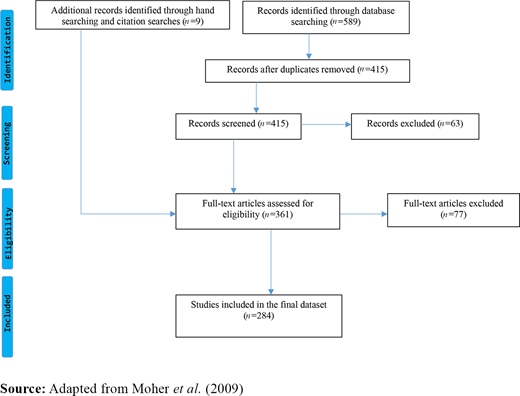
Preferred reporting items for systematic review and meta-analyses flowchart
Preferred reporting items for systematic review and meta-analyses flowchart
The first step involved the identification of all records related to the research topic investigated (SROI). This process required the analysis of the four databases: Web of Science, Scopus, JSTOR and EBSCO, which comprise several additional databases such as GreenFILE, Academic Search Complete, Business Source Complete and EconLit. This search strategy allowed the examination of a broad spectrum of peer-reviewed academic publications. For each database, either the term “Social Return on Investment” or simply “SROI” had to be included in the search fields such as article title, abstract, keywords, keywords plus and full text. The time frame chosen was 30 years (1990–2020). This initial search led to an unfiltered total batch of 589 peer-reviewed academic English-language publications (114 in EBSCO, 179 in JSTOR, 167 in Web of Science and 129 in Scopus).
The second step involved screening for the relevance of the initial 589 articles included in the data set. All titles and abstracts were fully screened, 174 duplicates were removed from the data set and in case of ambiguity, papers were fully read by all the authors, leading to the exclusion of 63 additional studies and a data set of 352 articles. Considering the high number of scientific journals currently available, it is likely that we may have missed some significant publications. However, all the authors of this study feel confident that the developed set of articles should represent a concrete basis for this and further analysis.
The third step of the PRISMA analysis involved testing the articles for eligibility. This meant satisfying the following criteria:
field – articles ought to regard the usage of SROI in any sector;
topic – studies should contain either the words “Social return on Investment” or “SROI” in any part of the article, such as title, abstract, keyword or full text;
study design – only peer-reviewed academic journals were sought to fully acknowledge the validity of our findings;
year of publication – only studies published between January 1990 and December 2020 were included in the data set;
language – only papers written in English were included to avoid conceptual misunderstandings; and
publication status – only international peer-reviewed academic journal articles were included in the analysis.
Further, testing articles for eligibility resulted in 77 papers that did not meet the eligibility criteria. The full text of each article was carefully read by each author, which allowed the addition of nine papers, reaching a final number of 284 studies included in the data set analyzed ( Appendix).
Although there is some debate in the social sciences concerning whether to elucidate the differences between applied and theoretical studies (Ritchie et al., 2013), a clarification of this ought to be made at this point. While theoretical researchers mainly aim at testing, generating or improving thinking within a particular discipline to “generate new theories or test existing theories” (Patton, 2002, p. 215), “applied research is concerned with using the knowledge acquired through research to contribute directly to the understanding or resolution of a contemporary issue” (Ritchie et al., 2013, p. 24). In this research context, applied papers refer to studies that mainly focus on a practical calculation of the SROI to verify its suitability in different contexts. However, theoretical studies refer to the deepening of the understanding of either the reliability of the SROI calculation through the application of the SROI algorithm or, more generally, the validity of the results found in comparison with other SIAs. Both types of studies have contributed to strengthening the SROI theoretical foundations.
For each selected study, data extraction was performed to summarize several information such as author(s), publication year, article title, journal, abstract, type of paper (applied; theoretical), sector analyzed, applicative limitations in the implementation of the SROI and the approach taken by the authors to assess the potential applicability of the model. Regarding the latter, two main approaches were identified and coded: cautionary and optimistic (Fraser et al., 2018; Corvo et al., 2021b). More specifically, a paper was labelled as “optimistic” if it was authored by scholars who applied the SROI method and were either sufficiently satisfied with the results obtained or, more generally, confident regarding the usefulness of this methodology to financially assess the impact of activities, programs and services provided by an organization belonging to either the private, public or third sector. Likewise, a paper was labelled as “cautionary” when either the authors questioned the reliability of the method for theoretical and methodological reasons or when it led to unsatisfactory results in terms of monetized impact. The choice of not labeling this type of paper as “pessimistic” instead of “cautionary” was considering that the negative results could had been driven by other variables such as the sector investigated, type of activities, program or service analyzed and the existence of financial proxy. Transversal analysis among the geographical location where the service was provided or the activity and program was performed, the sector investigated and the type of approach chosen by the author was performed to reveal possible links among these variables, potential limitations and possible solutions that could overcome these barriers. In addition, three main functions have been identified through an analysis of the literature published on SROI:
Legitimation function: The reliability of the SROI stems from its capacity to legitimize the existence and functioning of the projects and organizations primarily aimed at generating social and environmental value (Klemelä, 2016; Luke et al., 2013; Maier et al., 2015; Manetti, 2014).
Strengthening function: This mainly refers to either an organization, association or a project that is financially sustainable. In this case, the SROI aims to highlight to the stakeholders the other dimensions of the blended value created, the environmental and/or social, respectively (Daems et al., 2014; Watson, 2018).
Managerial and communicative function: SROI can increase the internal managerial awareness and the external reputation about the relevance of the impact yielded beyond the generic financial terms on which activities, projects and, more generally, organizations are usually assessed (Hervieux and Voltan, 2019).
In the next section, the results obtained from the analysis of the 284 papers included in the final data set are summarized and presented.
Findings
To assess the academic production expressed in terms of the number of articles published on SROI, Figure 2 shows the temporal academic production that occurred between 1996 (SROI’s first development by REDF) and 2020.
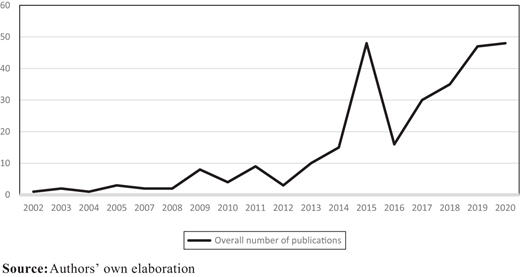
Even though SROI was first introduced in 1996, interestingly, for more than a decade (12 years) the number of articles related to SROI was no more than three per year, with no academic studies published between 1996 and 2001. However, it is worth noting that between 1996 and 2008, the methodological foundations of the SROI were laid through the publication of the most important reports (Chun et al., 2001; Emerson et al., 2000; Emerson and Twersky, 1996; Jones and Tuan, 2000). Moreover, from 2009 to 2013, the number of articles published per year increased slightly, reaching a peak of 48 articles in 2015 and 2020. Unsurprisingly, from 2017 to 2020, academia produced no fewer than 30 articles per year, showing a constantly increasing interest in SROI.
This section presents the main results obtained from the data extraction performed on the 284 articles included in the final data set.
Table 2 shows three main aspects characterizing the evolution of SROI, the type of paper (theoretical vs applied), the approach taken by the author/s (cautionary vs optimistic) and the country of origin. In addition, the transversal approach has been taken to assess the validity and relevance of the results found.
Main results
| Type of paper | |||||
|---|---|---|---|---|---|
| Author/s’ Approach | Applied | ||||
| Legitimation function | Managerial and communicative function | Strengthening function | Theoretical | Total | |
| Optimistic | 79* | 39* | 63* | 45* | 226* |
| Cautionary | 12** | 7** | 5** | 34** | 58** |
| Total | 91 | 46 | 68 | 79 | 284 |
| Country | Applied | ||||
| Legitimation function | Managerial and communicative function | Strengthening function | Theoretical | Total | |
| Africa | 6* | 3* 1** | 1* | 11 | |
| Asia | 9* | 4* | 8* | 21 | |
| EU | 12* 3** | 13* | 13* | 7* 5** | 53 |
| Anglo-Saxon countries | 51* 9** | 16* 6** | 34* 4** | 22* 8** | 150 |
| Unspecified | 1* | 6* 1** | 5* | 15* 21** | 49 |
| Total | 91 | 46 | 68 | 79 | 284 |
Note:
*Optimistic and **Cautionary
The optimistic approach toward SROI prevails substantially. In fact, 226 out of 284 articles (80%) showed an encouraging attitude toward the results obtained from the application of SROI, of which 123 were from Anglo Saxon countries. Further, the cautionary approach prevails among theoretical studies (34 out of 58) and is mainly published in the UK (29%).
The theoretical approach toward SROI is manifested in less than one-third of the data set (79 out of 284 = 28%), of which almost half (43%) manifested a cautionary vision of SROI. The main drawbacks highlighted by the cautionary scholars refer to the “reductionism” critique, that is the excessive attempt to single out a number able to express the complexity of the impact assessment process (Moody et al., 2015; Mook et al., 2015). A more philosophical rather than methodological approach is offered by Maier et al. (2015), who mainly criticize the SROI approach regarding its usefulness, comparability and, more interestingly, its position and role within the branch of social sciences. In this regard, Farr and Farr and Cressey claim that “SROI reduces social complexity to an economic ratio” (2019, p. 240). Furthermore, several scholars firmly reprimand the alleged and unrealistic ability of reducing social complexity based on a positivist and linear approach that can explain unexpected social events (Maier et al., 2015; Mook et al., 2015; Neil, 2014). Other critiques are based on the effective usage of the results offered by the SROI. For instance, according to Neil, “consultants evaluating social value and impact have limited control over how SROI reports are subsequently used by their client, commissioners or service managers” (2014, p. 157).
Overall, the theoretical doubts regarding the implementation of SROI seem to be weakened by the 205 applied papers included in the data set categorized into legitimation, strengthening, managerial and communicative functions. Applied papers outnumbered theoretical studies considering that, through the practical applications of the SROI, the latter can be further advanced, allowing researchers to lay stronger theoretical foundations for social impact assessment.
In the sample analyzed, the legitimation and strengthening functions are predominant over the managerial and communicative ones. In particular, the legitimation function has proved to be relevant in case of financial difficulties encountered by the target organization where the SROI is still able to identify the social value created in the medium and long term. The SROI methodology shows a clear advantage, either for the donor or the target organization, in maintaining the provision of services because of its potential social and economic value. The health sector is particularly prone to highlight the relevance of this SROI function (Bhaumik et al., 2013; Laing and Moules, 2017; Millar and Hall, 2013). Regarding the 91 papers demonstrating the legitimation function of SROI, 60 studies were published in Anglo Saxon countries, of which 22 were published in the UK (Iafrati, 2015; Parks and Brownlee, 2014), 16 in Canada (Akingbola et al., 2015; Shi et al., 2019) and 13 in the USA (Kousky et al., 2019; Ramon et al., 2018). Interestingly, the sector legitimized by the SROI is mainly the welfare sector, particularly health, with 31 studies (Aguilar-Agudo et al., 2019; Goudet et al., 2018; Searles et al., 2016), social inclusion counting 13 studies (Hoffmann et al., 2014; Mihalopoulos et al., 2020) and other sectors such as well-being, education and justice (Akingbola et al., 2015; Lund, 2015; Ravulo et al., 2020).
The strengthening function requires the direct and active involvement of the stakeholders most affected by the impact created through the activities carried out. The objective of actively involving stakeholders in the SROI analysis is twofold: first, understanding what is important and therefore including it in the SROI analysis (Nicholls et al., 2012), and second, consolidating the relationship among stakeholders who are usually not part of the assessment process. A total of 68 applied papers were identified. There is a lack of a predominantly investigated sector; however, health, environmental, infrastructure and rural development are the primary sectors of interest (Barber and Jackson, 2017; Vargas et al., 2019; Venezia and Pizzutilo, 2018). Even for the strengthening function of SROI, Anglo Saxon countries dominate worldwide in terms of publication, particularly the UK (Arvidson et al., 2014; Everard et al., 2017).
Lastly, the managerial and communicative function increases awareness of the multiple dimensions of value and enables the innovation of the organizational communication strategy for the internal environment, linking and motivating the internal stakeholders toward socially relevant goal achievements, and the external environment, shaping a more effective accountability for the engagement of the most crucial stakeholders (donors, funders, users, media partners).This function focuses on the communicative power of the SROI regarding the multiple dimensions of the value created through either an organization or approach. This was shown in 46 out of the 226 applied studies included in the data set. Almost half (22 papers) were focused on Anglo Saxon countries and 13 on European countries (Hirunsalee et al., 2013; Meza-Bolaños et al., 2019; Stuermer and Dapp, 2016; Tulla et al., 2020). It has been demonstrated in a variety of sectors, particularly in the health and finance sectors (Murzaliyeva et al., 2018; Moral Torres et al., 2020). It is also noticeable in culture (Refki et al., 2020; Viganó and Lombardo, 2019; Whelan, 2015), sports (Davies et al., 2020; Osokin et al., 2018) and health sectors (Laing and Moules, 2017; Moral Torres et al., 2020).
However, regardless of the sectors and functions exerted through the SROI, emerging countries seemed to have contributed to the advancement of the SROI assessment process to a minor extent, as the majority of studies, both theoretical and applied, stem from an Anglo-Saxon context.
Social return on investment limitations and levers for improvement
The ability of SROI to validly convey reliable social and environmental impact does not go unchallenged (Klemelä, 2016), leading to an increase in doubts both within the academia (Arvidson and Lyon, 2014; Luke et al., 2013; Pathak and Dattani, 2014) and among practitioners (Fujiwara, 2015; Higham et al., 2018). Consequently, a deeper investigation of these barriers is required and a better understanding of ways to overcome them is necessary to further enhance this methodology and render it more reliable (Arvidson and Lyon, 2014; Banke-Thomas et al., 2015; Nicholls and Murdock, 2012).
Two sets of limitations were identified in the order of recurrence within the data set analyzed.
The first set of limitations is related to the lack of standardization, which represents the most recurrent limitations found in the implementation of the SROI methodology. The high subjectivity characterizing the choice of financial proxies (Goudet et al., 2018; Walk et al., 2015) especially regarding the “soft outcomes” [1] such as well-being and self-esteem (Willis et al., 2018), deadweight and displacement, attribution and drop-off percentage (Farr and Cressey, 2019) can make the entire process extremely subjective and, therefore, hardly comparable across similar organizations, programs and interventions (Banke-Thomas et al., 2015; Jones et al., 2020a, 2020b; King, 2014; Mook et al., 2015; Vaileanu, 2017).
Studies have shown that different individuals working on the same data can produce different final SROI ratios (Cooney and Lynch-Cerullo, 2014). Although the procedural implementation of SROI requires the running of a sensitivity analysis to assess the robustness of the SROI ratio by testing the effect of certain variables, such as the magnitude of discounting factors and the valuation given to important outcomes (Weston et al., 2015), subjectivity is still a factor that blurs the clarity of this method. However, according to Gosselin et al. (2020), robust financial valuation can only partly improve the robustness of the SROI if outcomes are not properly measured and if deadweight is not robustly established using a proper study design. The lack of standardization still remains the main obstacle to the implementation of the SROI model, and it is principally because of the absence of benchmark data, metrics and social performance indicators, which inevitably leads to a condition of “information asymmetry” (Hazenberg et al., 2015) and limited comparability (Hervieux and Voltan, 2019; Maier et al., 2015).
The second set of limitations refers to the lack of resources. SROI analysis is a costly and time-consuming process that requires highly skilled human resources (Hummels, 2012; Millar and Hall, 2013; Watson and Whitley, 2017). Carrying out a comprehensive SROI analysis involves considerable cost implications in terms of the resources required for training and labor (Wood and Leighton, 2010). Moreover, the lack of financial and human resources is strictly linked to the lack of standardization of the SROI implementation process (Jackson and McManus, 2019; Yates and Marra, 2017), which makes the entire process even more resource consuming and subjective (Rangan et al., 2011; Serrano-Cinca and Gutiérrez-Nieto, 2013) than it would usually be in the case of an abundance of resources. Furthermore, the availability of resources is usually directly proportional to the dimensions of the organization or program. Therefore, in the case of small organizations or programs with no standardized procedure to follow, the implementation of the SROI analysis can lead to an incomplete or untruthful analysis of the social impact generated by the activities carried out.
With regard to this first group of limitations, different solutions are offered as levers for improvement. For instance, Chandoevwit et al. (2014) recommend that the value of outcome indicators should be nationally and internationally collected in a systematic way and, therefore, available for any SROI analysis. Nicholls (2017) adds that a clearer normative approach would be beneficial for SROI analysis. Regarding comparability, Bosco et al. (2019) claim that the SROI methodology is highly sensitive to the context in which it is implemented, therefore the findings are difficult to generalize, while Maier et al. affirm that “a SROI analysis that is objective, in the sense of avoiding value judgments, is impossible” (2015, p. 1819). Klemelä (2016) proposed a different perspective to tackle the subjectivity issue, claiming that SROI should be considered as a multidimensional, discursive, legitimating means to manage organizations and prove that they are able to do valuable things (Nicholls et al., 2012). Therefore, the subjectivity obstacle can be reduced, but not completely removed.
Referring to the second set of limitations, among the academic solutions provided, Jackson and McManus (2019) recommend the provision of training courses for organizations’ stakeholders and SROI analysts to overcome the lack of skills and, consequently, to maximize the potential of the SROI model. On the one hand, the route of acquiring knowledge should be followed by organizations willing to be decisive about overcoming the obstacles caused by a lack of knowledge that characterize the current usage of SROI. On the other hand, the dissemination of knowledge and skills should be more substantially endorsed by government. First, by making more financial resources available, and second, by issuing policies and guidelines that should guide organizations interested in assessing the social value of their activities, without owning the necessary skills and resources, to productively implement the SROI method, therefore overcoming the “practical and ideological barriers” (Millar and Hall, 2013, p. 923) that have led so far to a low uptake of SROI as a performance measurement tool (Arvidson and Lyon, 2014).
Discussion and conclusions
The evolution of standardized bureaucracies into a more convoluted system involving the public, private and third sectors (Mintzberg, 2015; Osborne, 2006) led to the creation and interest of multiple dimensions of value: the economic, social and environmental (Emerson, 2003). These new dimensions were integrated into what was defined as a blended value (Manetti, 2014; Nicholls, 2009). Therefore, the interest in tracking, assessing and maximizing the blended value produced either by an organization or a program implicated the development of several types of measurements. Among these methodological approaches, the SROI, first used in the nonprofit sector, has progressively overcome its initial nonprofit confinement, and consequently was promoted in academia as a social impact assessment tool. Based on a systematic review of the literature highlighting the potential and limitations related to the academic and professional development of the SROI model, this study aims to systematize the academic debate and contribute to the future research agenda of blended value accounting.
A systematic literature review produced a final data set of 284 studies. The results show that despite the procedural accuracy characterizing the description of the model, bias-driven methodological implications, availability of resources and sector specificities can influence the type of approach taken by scholars and practitioners (optimistic vs cautionary).
Despite its limitations being grouped into two main sets – lack of standardization and lack of resources – this study has endeavored to highlight the benefits of the SROI model. It has been identified as a tool to legitimize (Klemelä, 2016; Luke et al., 2013; Manetti, 2014) and strengthen the collaboration and active involvement of organizations’ stakeholders, as they are a crucial part of the SROI process (Nicholls et al., 2012), and, finally, manage the consciousness regarding the social impact potentially produced by the activities carried out, which may offset the insistence on financial returns (Hervieux and Voltan, 2019).
Specifically, the study has highlighted three key points to problematize the academic debate and design of the future research agenda of accounting regarding a blended value proposition. The first point regards the need to overcome dichotomous perspectives between scholars supporting the monetization methods versus those who see it as reductive measurement and, simultaneously, preferring the usage of participatory and narrative methods able to manage complexity. Consequently, the future of SROI seems to be directed toward the integration of methods that simultaneously include monetization and attention paid to the complexity of social and environmental value through qualitative insights. The trade-off between monetization and complexity reduces the potential of both perspectives. If monetization methods might suffer from the problem of reductionism and economism (Farr and Cressey, 2019; Maier et al., 2015; Moody et al., 2015; Mook et al., 2015), the participatory and narrative methods fail to express an instantaneous message to favor an effective representation of the blended value generated. These qualitative methods are usually characterized by less effective narratives compared to those expressed by the SROI ratio. Therefore, the two perspectives, rather than being seen as alternatives, should be interpreted as complementary.
However, this poses a key challenge for the future research agenda related to finding integrable solutions capable of balancing the two functions. On the one hand, managing to preserve the ability of the SROI to produce an instantaneous signal and, simultaneously, enriching this message through qualitative elements without diminishing the complexity characterizing social and environmental issues.
In addition, the results showed two important facts that should be considered in future research. First, applied studies outnumbered the theoretical counterparts which is considering that SROI was first developed and promoted in the nonprofit sector by the REDF as a tool to apply the blended value proposition (Emerson, 2003). Therefore, the SROI soon became the applicative principle of the blended value theory, which, to be validated, needs to be pragmatically implemented and tested in different contexts, justifying the higher number of applied studies and reports in comparison with theoretical studies. Second, the results show the prevalence of studies coming from Anglo-American contexts and a clear minority of studies stemming from developing countries.
As Qian and colleagues stated, “extant social and environmental accounting (SEA) research in the developing countries context is limited” (2021, p. 22). Therefore, more research from previously underexplored contexts including that of emerging countries should be conducted to offer valuable insights from a perspective that is different from the one offered by wealthy economies where the SROI was originally developed.
The second point focuses on the extension of blended value studies by scaling the units of analysis, typically projects and/or organizations, toward value chains and ecosystems. Regarding the use of SROI as a signal, it is crucial not only to focus on the technical issue of calculation but also rather to direct the attention toward the relationships that this signal is able to represent. The key issue is related to the role that the SROI might play within value chains and multistakeholder ecosystems as a common signal that works as “mediating technology” (Puyou and Quattrone, 2019) among the different actors. SROI has increasingly been used within impact investing and impact finance contexts where the presence of different types of stakeholders (public administration, profit companies, investment funds, nonprofit organizations) is more frequent (Addy et al., 2019). In these contexts, therefore, SROI plays a role of mediating technology, focusing on diverse issues, and provides a blended value evaluation of the ecosystem that ensures the sharing of information pertaining to the interests and perspectives of the different actors involved. In the future research agenda, the mediating role of SROI should gain more attention, especially in complex ecosystems characterized by a wide range of stakeholders with conflicting views and interests (Dentoni et al., 2016).
The third point concerns the evolution of the accounting systems. Although the current split between financial and nonfinancial disclosure is widely criticized in the literature (Erkens et al., 2015; Maas and Sampers, 2020), practitioners continue to encounter severe obstacles to the adoption of integrated social, environmental and economic accounting reporting systems. In this regard, the lack of standardization has been identified as one of the most hindering elements for tools such as SROI to capture and assess the blended value (Banke-Thomas et al., 2015; Goudet et al., 2018; Jones et al., 2020a, 2020b; Vaileanu, 2017; Walk et al., 2015). More specifically, different scholars claim that even though economic, social and environmental values currently deserve equal attention at both academic and practical levels, a fully reliable blended accounting and reporting system is currently unavailable (Nicholls, 2018). Therefore, the main challenge is to accelerate the sharing process of metrics and databases to feed a blended accounting system with the same type of information regarding the economic, social and environmental values generated by organizations, activities and programs. A few steps have been taken in this direction at the international level, such as the Data Stewards Network [2] initiative promoted by the GovLab and the Rockefeller Foundation that aims at opening the public and private data sets; the International Network for Data on Impact and Government Outcomes [3] based at the Go Lab of the Oxford University that promotes the sharing of measurements especially related to impact finance advocating for a disclosure of data on outcome, indicators and financial proxies; and finally the Impact Weighted Accounts [4] research project promoted by the Harvard Business School that tackles the challenge of creating a new accounting system. However, sporadic examples and initiatives do not fully count to have reliable integrated accounting and reporting systems and, therefore, much of the efforts have to be made in this direction to allow both academics and practitioners to gain trust in social, environmental and economic values that define the new era of accounting.
In conclusion, taking into consideration the analysis of the 284 studies, there is a clear sign of a willingness to improve this methodology and extend it as much as possible, contributing to the research agenda designed above and advancing knowledge in those three directions. Indeed, the overall results showed that academia has definitely been moving forward in the development of SROI, confirming what Arvidson and Lyon stated in their study, claiming that SROI “aims to both prove and improve” (2014, p. 5).
This study has some limitations. From a methodological point of view, this review relies only on peer-reviewed articles; therefore, future research may involve additional data sources, especially considering the sheer volume of grey literature now available. Second, generalization of the results should be done cautiously, especially with regard to the solutions found in the literature because, regardless of the type of limitations found in this literature analysis, the results of both the benefits and limitations should be contextualized.
Therefore, future research is required to elucidate the dynamics that drive these obstacles toward a more holistic application of the SROI methodology.
Notes
From Go Lab Glossary, University of Oxford: Soft outcomes depend on measurement which is more subjective and less quantifiable available at: https://golab.bsg.ox.ac.uk/knowledge-bank/glossary/#s
https://medium.com/data-stewards-network
https://golab.bsg.ox.ac.uk/knowledge-bank/indigo/
https://www.hbs.edu/impact-weighted-accounts/Pages/default.aspx

