In 2013 the Vermont legislature enacted Act 77 mandating that students in Grades 7–12 develop personalized learning plans (PLPs) to guide them toward high school graduation using proficiency-based requirements. In the present qualitative self-study, we document the impact of implementation of a personal learning framework integrating PLPs into a humanities curriculum on a seventh- and eighth-grade team at a Vermont middle school during a 2-year period. Findings indicate that: (1) teaching transformed over time—it became more constructivist and integrated; (2) the personal learning framework required students to develop a growth mindset through the iterative process of goal setting, evidence curation, and reflection; and (3) the use of the personal learning framework and the digital tools to facilitate the development of PLPs afforded exposure to multiple and new literacies.
In July 2013 the Vermont legislature enacted Act 77, An Act Relating to Encouraging Flexible Pathways to Secondary School Completion, mandating that students in Grades 7–12 develop personalized learning plans (PLPs) that guide them toward high school graduation using proficiency based requirements. Act 77 required school districts to develop a system for personalized learning plans (PLPs) to be implemented in fall 2014 for students entering seventh grade. The purpose of PLPs is to maximize opportunities for students to pursue high-quality educational experiences that acknowledge and incorporate individual goals, interests, learning styles, and abilities (Vermont Agency of Education, n.d.). In addition, for students who enter seventh grade in the fall 2014, they are expected to demonstrate proficiency in the Vermont Education Quality Standards (EQSs) to graduate high school. For these children the Vermont high school diploma is no longer dependent on credit hours or “seat time” but rather on students demonstrating proficiency (Vermont Agency of Education, n.d.).
Purpose and Context
We designed a 2-year study to pilot PLPs and document how PLPs affect teacher practice and student engagement. The purpose of the study was to document the implementation of a personal learning framework integrating PLPs into a humanities curriculum on a seventh- and eighth-grade team at Main Street Middle School in Montpelier, Vermont. As a middle grades humanities teacher (Taylor) and a professor in a teacher educator program at a local college (Nagle), we brought perspectives to the study based on our own experiences. We asked two questions:
How does teacher practice change when incorporating PLPs into a humanities curriculum?
How does student engagement change over the same 2-year period when a teacher commits to the personal learning model?
It was our intentionality that the results of this study would informed the design of curriculum development at Main Street Middle School as well as that of humanities curricula in other Vermont middle and high schools attempting to implement PLPs. Also, it was our intention that the results be used to create a professional development program to assist teachers in implementing PLPs effectively.
The study began in the fall of 2013 and was completed in spring 2015. Main Street Middle School is a typical Vermont middle school. Approximately 200 students in Grades 6–8 attend the school in three teams – a sixth grade team and two seventh- and eighth-grade teams. The school has a predominately White student population (86%), and students come from more affluent families than the rest of Vermont—28% free and reduced lunch compared with 41% for Vermont overall. Approximately 15% of the students in the school received services through individualized education plans (Vermont Agency of Education, 2015). The study focused on one of the two seventh- and eighth-grade teams. Team Summit had 48 students, a humanities teacher, a science, technology, engineering, and mathematics teacher, and two full-time instructional assistants. At the start of each year, 22–25 students joined the team in seventh grade, and at the end of the year a similar number of eighth graders moved onto ninth grade. It was typical for students to stay on the team for 2 years.
Theoretical Framework
Flexible Pathways and Proficiency Based Learning
The concept of flexible pathways to graduation is at the heart of Act 77, and is defined as any combination of learning opportunities demonstrating proficiency towards graduation requirements (Vermont Agency of Education, n.d.). There are three important concepts to consider in flexible pathways: (1) learning is student centered; (2) learning opportunities are derived from inside as well as outside of school; and (3) each pathway is unique. To implement these concepts of the new law, curriculum, instruction, and assessment must be proficiency based and grounded in the Vermont Education Quality Standards (EQSs). The EQSs were adopted as part of Act 77 and represent the Vermont standards in seven areas: literacy; mathematical content and practices; scientific inquiry and content knowledge; global citizenship (including the concepts of civics, economics, geography, world language, cultural studies, and history); physical education and health education; artistic expression (including visual, media, and performing arts); and transferable skills (Vermont State Board of Education, 2014). For students entering seventh grade in fall 2014 (the second year of the study), PLPs and proficiency-based graduation requirements were mandated.
Flexible pathways and proficiency-based graduation requirements in Vermont require a paradigm shift in teachers’ practice and knowledge (i.e., a need for familiarity with school-based course offerings, community-based/virtual learning opportunities, and proficiency based assessment). Schools must be prepared to assign value toward the satisfaction of learning experiences well beyond the traditional classroom and courses (Richardson, 2012). Understanding how to value all learning experiences against educational standards requires teachers and schools to think and teach differently. That is, there is a shift from requiring students to take specific courses to allowing students to create or select specific learning opportunities to demonstrate proficiency against specific standards (e.g., EQSs) and personal academic goals (Keefe, 2007).
Personal Versus Personalized Learning
Act 77 mandates students use PLPs to document flexible pathways toward graduation. At the middle grades level, significant scaffolding may be required to assist students in the process of creating PLPs. For students at this developmental stage, the process may be more important than the product (Nagle & Taylor, 2015). Whereas Act 77 requires specific PLP criteria and an annual review, the process of developing and revising PLPs can range from merely completing a form with a checklist (Vermont Agency of Education, 2014) to developing goals, creating action plans to meet these goals, and collecting and reflecting on evidence of meeting these goals (Clarke, 2013). The difference in this continuum is noteworthy: completing a form is an example of “personalized” learning whereas developing goals, collecting evidence, and reflecting on that evidence to demonstrate meeting the goals describes the process of “personal” learning—the latter connotes a deeper degree of autonomy for the learner. Richardson emphasized this distinction when quoting Stephen Downes, a senior researcher at the National Research Council of Canada: “Autonomy is what distinguishes between personal learning, which we do for ourselves, and personalized learning, which is done for us” (Richardson, 2012, p. 25). For the purposes of the present study, the authors took the stance of personal learning. That is, in developing our personal learning framework, we viewed the student as the center of the PLP and attempted to have the student drive the learning process.
Personal Learning Model: Landscape and Trajectory
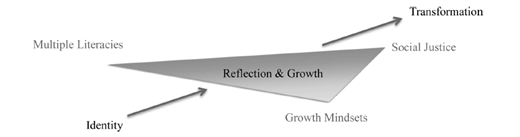
The personal learning model implemented during the present study had two structural dimensions: a learning landscape and an iterative personal learning trajectory (see Figure 1). The elements of the learning landscape provided the foundation for adults acting as facilitators to assist students in creating a personal learning trajectory. The components for the learning landscape become the essential elements of the humanities curriculum. The learning landscape focuses attention on societal issues through social justice (Adams, 2007; Bell, 2007; Gutstein, 2006; Harrison, 2015), teaching of growth mindsets (Dweck & Yeager, 2012), and use of multiple literacies, including digital or new literacies (Alvermann, 2008; Cope & Kalantzis, 2000; Richardson, 2006; Shirky, 2008).
Using social issues as a driver of curriculum to tap into the middle grades students’ psyche of fair play, teachers can cocreate a curriculum that simultaneously addresses students’ interests and goals while pushing students to meet high academic standards and investigate pressing issues affecting society (Harrison, 2015; Wormeli, 2014). At the same, time the curriculum fosters skills in growth mindsets. Dweck and Yeager (2012) spoke to this concept and its relationship to student resiliency: “We have found that what students need the most is not self-esteem boosting or trait labeling; instead, they need mindsets that represent challenges as things that they can take on and overcome over time with effort, new strategies, learning, help from others, and patience” (p. 312). By incorporating a growth mindset philosophy in the curriculum, the middle grades teacher may provide opportunities for students to be challenged and yet persevere to succeed. The social justice focus on society issues also required students to develop what Shirky (2008) called “collective action,” that is, sharing responsibility and outcomes of doing real work for real purposes for real audiences. Within this framework, the middle grades teacher pressed students to use new literacies – technology tools in the classroom to investigate of social issues, gather and collate information, and organize and present that information (Alvermann, 2008).
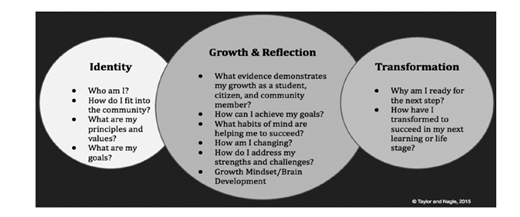
Situated in this learning landscape, the model directs students to move through a process of self-understanding and actualization, what we refer to as a personal learning framework of identity, growth and reflection, and transformation (see Figure 2). This process is an iterative one in which the curriculum leads students through several cycles over time. Each phase is linked to curriculum components that allow students to explore each concept. By answering the questions posed under each phase of the trajectory, students learn to develop an identity of who
they are; create goals of who they want to be in the community; gather and reflect on evidence of meeting those goals; and take the next steps to transform themselves as learners in the community and as individuals ready for the challenges of high school and beyond (Taylor & Nagle, 2015).
Modes of Inquiry—Data Collection and Analysis
Because we equally codeveloped the framework and instruments for data collection, and with the students codesigned the curriculum over the course of this study, we consider this research to be a qualitative self-study. As a methodology, self-study “is used in relation to teaching and researching practice in order to better understand: oneself; teaching; learning; and the development of knowledge about these” (Loughran, 2004, p. 9). We desired through conducting the study to better understand the personal learning model’s practical application and to modify the model for use in future applications at this middle school and for consultation with other middle schools attempting to implement PLPs.
Our data collection consisted of multiple sources that can be conceptualized as investigating a series of Russian matryoshka nesting dolls. At the most intimate level were notes from planning meetings that occurred twice a month. At the next level we took field notes of our observations while in the classroom working with students, and we collected multimedia evidence, including lessons, presentations, parent conferences, and student work samples. At the outer level, we surveyed all students on an ongoing basis (after each unit of study) about their perceptions of achievement on the humanities unit and their progress on their PLP. Parents were surveyed for their responses to the student led PLP conferences (twice per year—once after the fall conference and again after the spring conference).
Analysis of these data sources allowed us to gain a thick description of the teaching and learning over the 2-year period. It also informed our curriculum development (see Appendix A for a table of learning opportunities for the creation of PLP from the 2-year study). As we analyzed our data on a continual basis, we used Corbin and Strauss’s (2008) coding strategies to develop a preliminary coding scheme that we refined over the course of the study. Reviewing the data, we followed a selective coding process by creating broad categories developed in our notes. The categories from these were cross-tabulated with different sets of data to refine the categories. We used this process of developing codes, triangulating the categories with different sets of data, and separately coding the data before discussing it to ensure reliability.
Findings
Three primary findings emerged from our selfstudy. The first finding focused on the change in teacher practice as the humanities teacher integrated the personal learning framework within the context of a seventh- and eighth-grade humanities curriculum. The humanities teacher became more constructivist and integrative in his approach toward understanding how students applied the personal learning framework to their own lives and incidentally how students understood how to deconstruct text and apply it to their learning. The last two findings centered on how the personal learning model and multiple or new literacies afforded opportunities for students to explore, organize, and share their learning in new ways. First, the personal learning framework required students to take the stance of a growth mindset through the iterative process of goal setting, evidence curation, and reflection. Second, the use of the personal learning framework and the digital tools (e.g., Google, Blogger, YouTube) to facilitate the development of PLPs afforded students the opportunities to learn multiple and new literacies.
Teaching Became More Constructivist and Integrated
As the project unfolded over this 2-year period, it became increasing apparent that teaching transformed in a drastic way—it became more constructivist and integrated. For the purpose of this section of the findings, we draw on data from a unit of study in the curriculum. The PLPs and personal learning framework required the humanities teacher to move away from being a “provider of knowledge to becoming a demander of understanding” (humanities teacher, October 24, 2014). That is, the humanities teacher began asking students what they wanted to know – about themselves, their relationships, and society. These questions began to drive the curriculum and followed the personal learning framework of identity, growth and reflection, and transformation. Each phase of the framework became, in essence, a core of the essential questions for units of study in the curriculum.
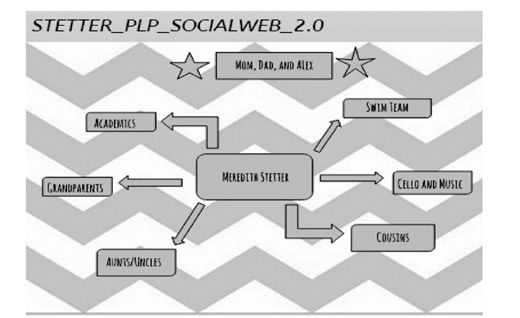
In the school district in which the humanities teacher taught, there were a prescribed progression of standards to follow, based on the Common Core State Standards (National Governors Association Center for Best Practices & Council of Chief State School Officers, 2010), and resources to use to address those standards, but teachers did have discretion in how they taught those standards. Within the districtwide curriculum structure the humanities teacher integrated the personal framework into the curriculum.1 The intention was to introduce one phase of the personal learning framework in a separate unit of study during the first trimester of the course. However, due to time constraints around introducing the concepts within the personal learning framework and time needed to teach the technical skills associated with Google drive and Blogger, each phase of the personal learning framework was introduced in each of the three trimesters during the first year of the study. For example, while teaching character analysis and the hero’s journey in the Odyssey, the humanities teacher also introduced the personal learning framework phase of identity. While identifying their own principles and values, students examined those traits in characters of the Odyssey to analyze and connect with how those principles and values motivated and drove characters’ decisions. As students discussed and analyzed Odysseus’s relationships as the basis for his values and a factor in his quest to return to Ithaca, students were also thinking about how the values, generated by their own relationships with friends, family, and community can shape their values and can influence their own personal goals. Students critically analyzed the character of Odysseus while at the same time critically reflecting on their own identity and what it means to be an individual in society.
Figure 3 illustrates the task progressions that students experienced in working through their identity. First, after a class discussion of Odysseus’ important relationships, students created a relationship web of their meaningful relations using Google drawings. Next, after students examined Odysseus’ relationships to understand how those relationships symbolized his values, student discussed the values illustrated by their relationships and identified their values and shared them in a chart on their PLP Google site. Finally, students selected passages that illustrated Odysseus’ values and they also posted on their Google site an example of how they enact their own values.
My most positive characteristics of any relationship are effort, flexibility, and positive energy. These were all evident in the summer of 2013 when my family and I went to the Outer Banks for a vacation with my cousins. On the 16 hour car ride my relationship with my sister was put to the test. I was desperate to do something and really wanted to play a card game, she wanted to sleep! We decided that we have to compromise with increments of 30 minutes doing what we each wanted to do with each other. We both showed effort in our relationship throughout the trip to impress our parents and by doing this we radiated positive energy! From the beginning of the trip to the moment we pulled into our driveway we were models of my kind of a perfect relationship.
Consequently, while students were learning about character development and the hero’s journey in the Odyssey, they created relationship webs and values charts to assist them in thinking about their own academic and personal journey. These webs and charts served as stepping stones for students to then articulate goals—both academic and personal. For the humanities teacher these learning activities provided significant opportunities for him to learn about the interests, values and aspirations of his students and set the stage for him to develop goals for students and customize the curriculum to address those goals and interests.
In a survey conducted after the completion of the unit on the Odyssey, two thirds of the students agreed that identifying their own relationships and values allowed them to better understand how Odysseus’ principles and values drove his decisions in the story. At the same time, students developed detailed relationship webs of their own lives and identified important values that became the foundation of personal goals in their PLPs and important information for the teacher to integrate into the humanities curriculum.
Personal Learning as Growth Mindset
Main Street Middle School had a trimester marking period schedule in which standards-based grades were reported three times per year in each of seven courses (literacy, mathematics, science, social studies, the arts, modern languages, physical education). During each marking period for each course, students were evaluated on three to six content standards and two personal development standards. Each standard was assigned a 1–4 score with anchor descriptors at each half point. A 1.0 score indicated achievement as “substantially below proficient”; a 2.0 score indicated achievement as “partially proficient”; a 3.0 score indicated achievement as “proficient”; and a 4.0 score indicated achievement as “proficient with distinction.” This standards based grading system was introduced in 2012. One year later, students created a PLP using a Google sites template with Blogger embedded under the evidence tab of the site. The PLP was not graded, but continuous feedback, both verbal and written, was provided by the humanities and science, technology, engineering, and mathematics teachers as well as by other students on Team Summit. Our intention was to have the students complete the iterative cycle of the personal learning framework— identity, growth and reflection, and transformation—during each of the trimesters. In reality, seventh-grade students cycled through the framework once during the first year, and eighth-grade students cycled through the framework twice during the second year of the study. Thus, students who were on Team Summit for both years of the study cycled through the personal learning framework three times before moving on to ninth grade.
Initially, in fall 2013 we anticipated developing the curriculum by aligning one unit of study with each phrase of the personal learning framework, but we soon discovered that use of the new framework required much more than teaching a particular unit of study within a particular discipline (i.e., humanities). The new framework required planning, teaching, and assessing units of study in humanities along with teaching technology skills associated with many technology tools such as Google and Blogger used to investigate, organize, analyze, and communicate learning in humanities. It was also essential to show progress in individual academic goals for the PLP. Adam (a student on the team) developed his principles and values depicted in Figure D. From those four principles and values, Adam turned his attention to the creation of six goals that were a combination of academic and school goals. As shown in Table 2, Adam selected goals that required his use of his values and principles to help attain the goals. Students were asked to select a combination of goals that were short, medium, and long term while at the same time including goals that were personal (e.g., become a better photographer) and academic (e.g., spend more time studying). Once each goal was created, students were asked to develop an action plan—steps to take to achieve the goal. Although this sort of goal setting process may not be difficult for adults, it was developmentally challenging for middle school aged students. Many students initially had difficulty with understanding the parameters of a goal, the time frame, and level of difficulty. In the six goals that Adam selected, some were much more long term and open ended (e.g., become a better photographer), and others were more short term and specific (e.g., spend more time studying). Initially, it was typical for students to choose outcomeorientated goals (e.g., score a goal in soccer, receive a 3 on all my math standards). However, as students learned that outcome oriented goals were actually benchmarks of achieving a process oriented goal, students began to write more process-oriented goals (similar to the goals set by Adam in Table 3).
Once goals were developed, students posted evidence of their work on the evidence page of their PLP Google site. The evidence page included an embedded Blogger application to let students post evidence (e.g., a photo, a document, a video), “tag” or attach the evidence to a goal, and post a rationale (written, audio, or video). The rationale served as a brief analysis of how the evidence relates to the goal and to what extent the evidence demonstrates proficiency of the goal. As evidence accumulates on the evidence page, it can eventually be sorted so that a student can view all the evidence related to one goal, analyze it, and write a reflection. In the reflection below, Adam employed a meta-reflection in which he reflects on how well his video reflection of his goal (Become a better photographer) demonstrated his growth as a photographer.
Adam’s goal reflection video clearly identifies his goal to become a better photographer and learn about middle grey and surfaces that reflect that amount of light. The short clip quickly identifies its topic and the writing seems to fit. This demonstrates that the video had been planned out. Though their is no hook in the beginning nor much of a conclusion, the writing is concise and to the point with a short introduction and evidence to back up his theory. During the video, Blair was speaking clearly and confidently though, unfortunately, he was not looking directly into the camera. As for postproduction: the video was color corrected but could have been brightened as the picture was at least a half stop underexposed. Furthermore, the light sources in the could have been moved as the image looked a bit flat—not much contrast. Conclusively, the goal reflection video was not done poorly, but it could have been improved and in future videos this should be corrected.
I believe it is good to set goals as it will lead you to success. This is because when you set a goal you have organized your thoughts and have a solid plan on how to achieve them.
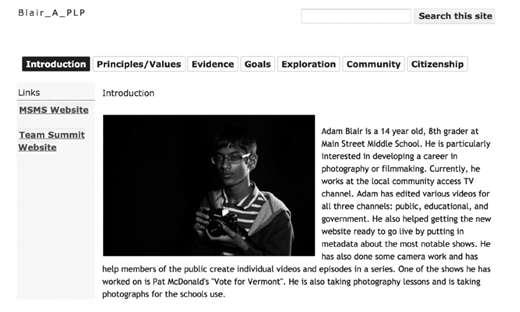
Once a student has completed a reflection, he or she can make a decision whether to revise that goal or move on to a new goal. The decision is made in consultation with the humanities teacher on a trimester basis during preparation for the student-led PLP teacher conference in which students share their progress on their PLPs with their families and/or significant adults. Before each student led PLP teacher conference, students have the opportunity to revise the welcome page of their PLP to more accurately reflect their identity and where they are on their goals. Figure 4 presents an example of Adam’s featuring his work with photography. We found that students at this age revise their profile or “bio” page on a regular basis, and this is reflective of their growth as changing young adolescents.
The demands of the PLPs require students to develop specific, achievable goals through the short, medium, and long term. Within the context of setting goals, students develop a deeper understanding of the critical dispositions for a growth mindset. Technology, such as video, digital photography, podcasting, and blogs, helps students document progress. PLP websites serve three critical functions in developing a growth mindset. First, these tools facilitate ongoing student reflection. Students consistently review their progress toward selfselected goals using different technologies. Second, these tools allow students to select evidence of meeting goals via use of Blogger to “tag” or code a piece of evidence to a specific goal. Third, technology allows for personalization and differentiation. To demonstrate growth and learning, students continually curate and organize work on their digital PLP. This dynamic format allows students to update their progress and growth on a regular basis. Through this continual cycle of review, revision, and refinement, students demonstrate mastery of self-selected goals while developing a growth mindset.
Personal Learning Framework Promoted Multiple Literacies
The creation of PLPs using Google sites and Blogger afforded students new opportunities to use digital tools to investigate, organize, synthesize, and share their PLPs and new learning in literacy. Although students were exposed to multiple literacies over the course of the 2-year study, the discussion in this section is limited to new literacy skills that students developed associated with the personal learning process and digital tools used in creating the PLP. These literacies can be categorized as genre-based literacies using new digital tools. The personal learning process, as outlined by Taylor and Nagle (2015), required students to create an accurate identity, set goals, collect evidence of meeting those goals, reflect on whether and to what extent the evidence demonstrated proficiency in meeting those goals, and then transform those goals to the next level of learning. In each phase of the personal learning process—identity, goals setting, evidence gathering, and reflecting—students learned a new genre of writing and the thought process associated with it. The humanities teacher took a functional approach to language (Halliday, 1978; Scheppegrell, 2004) and borrowed from Derewianka’s (2009) curriculum cycle of preparation, modeling, joint construction, and independent construction of texts. Unlike the more generic texts discussed in Derewianka’s work (recounts, instructions, narrative, informational reports, explanations, and arguments), the texts constructed for the Google site PLPs were biographies, goal setting, and reflective writing. Using Derewianka’s iterative curriculum cycle the humanities teacher walked students through the deconstruction and construction of each PLP genre. For the biographies, students viewed professional biographies of prominent sports and entertainment figures presented on websites. They investigated the structure and elements of the sites: photos used; the voice and tone of the bio description; and even the composition and layout of the site itself. Once they understood the elements, structure, and style of the biography genre as depicted on a website, students jointly constructed their own biographies (usually in small groups), received critical feedback from peers and the teachers, and then independently constructed their biographies that were posted on their Google site PLP. Adam’s profile (Figure 4) is an example.
Another instance, which focused on the sharing or communication aspect of the personal learning process, was the student led PLP conference. Using digital tools (e.g., Google, Blogger, YouTube and Screencast-omatic), students developed screencasts of their Google site PLP to present to their families prior to their student led PLP conferences. The conferences were a 20-minute conversation between the student, the humanities and science, technology, engineering, and mathematics teachers, and the student’s chosen responsible adults. The purpose of the conference was to allow all stakeholders to discuss the student’s progress and revise or set goals for the student for the nest trimester. In order to do so, the responsible adults, often parents, needed to be brought up to speed with the student’s progress. The screencast was a quick and easy way for the students to share their progress while also learning new literacy skills using a multi media digital tool (Screencast-omatic). Again, using the iterative process of Derewianka’s curriculum cycle, students created screencasts of their progress on the PLP.
Implications
The present study’s findings have varied implications for practice. First, as PLPs are implemented, teachers need to become colearners in the new personal learning landscape – synthesizing students’ goals, interests and needs; learning alongside students to adopt new technology; and integrating the personal learning process into the content curriculum (Nagle & Taylor, 2015). Second, teachers need to understand that allowing students to move through the personal learning framework will require students to explore who they are, what they want to pursue as goals, and how to select evidence of making progress toward their goals. This process runs counter to implicit fixed mindsets developed in earlier grades and, in many cases, contradicts models of traditional schooling (Dweck & Yeager, 2012). Third, teachers must be transparent in how they use and teach technology in this new learning landscape by modeling their own use of technology and addressing new digital tools from a functional language perspective (Scheppegrell, 2004; Derewianka, 2009). That is, teachers will need to think about digital tools as new genres of inquiry, expression, and communication. The experience at Main Street Middle School indicates that given the opportunity to develop PLPs using digital tools, students develop a stronger sense of engagement and autonomy of their own learning.
Note
This was a novel approach to incorporate PLPs at the middle or high school level in Vermont in this manner. An informal survey of Vermont middle and high schools, conducted by the Middle Grades Collaborative during the 2014 Middle Grades Collaborative summer institute, found that only 4 of 39 schools intended to integrate PLPs into content specific courses such as a humanities class (Middle Grades Collaborative, 2014).