This mixed-methodological study examined changes in perceptions of teachers (n = 70) engaged in a two-year professional development program designed to meet the unique needs of English Language Learners (ELL), and changes in ELL students’ (n = 235) math and reading achievement scores. The study was conducted in two urban middle schools in Kansas with high percentages of ELLs and students from poverty backgrounds. Paired-samples t-tests of 2006 and 2007 state math and reading assessments for the ELL cohort demonstrated statistically significant differences in achievement levels, and the students’ growth exceeded the gains made in proficiency levels among ELL students statewide. Findings from the qualitative analysis of the teacher surveys include perceptions of the needs of urban middle-level ELLs, pedagogical strategies perceived as effective with ELLs, and recommendations for strengthening relationships among ELL students, their non-ELL peers, and adults. Implications for improved instruction for ELLs include the value of multiculturalism, the need for first language support, and the effectiveness of professional development on elements of the Sheltered Instruction Observation Protocol (SIOP) for all teachers.
Introduction
The United States has seen continuous growth in public school enrollment of English Language Learners (ELL) over the past decade, students who are: (a) from diverse cultural backgrounds, and (b) at different levels of English language proficiency according to state and district assessments. During the 10-year period from 1995 to 2005, ELL enrollment in the U.S. increased 57.17% to nearly five million students, while total student enrollment grew by only 3.66% (NCELA, 2007). Students whose parents immigrated to the U.S. accounted for 20% of children under the age of 18 in the year 2000 and for 25% of students eligible for free or reduced lunch status (Capps, Fix, Murray, Ost, Passel, & Herwantoro, 2005). The Midwestern State of Kansas demonstrated growth exceeding the national average, as ELL enrollment increased during this same time period by 131.7%, while overall student enrollment in Kansas experienced a steady decline of 9.5% (NCELA, 2006).
Research over the past half century has provided evidence of failure for many students of all backgrounds, but especially children of Latino, African American, and Native American families, as well as poor European American families, and, more recently, Asian and Pacific American immigrant students (Nieto, 2002). African American and Hispanic students are less likely than White students to receive a high school diploma (U.S. Census, 2003). A recent study by the Pew Hispanic Center (Fry, 2008) found that the achievement gap between white students and ELL students for state mathematics assessments for elementary and middle schools is quantified in double-digits.
The purpose of this mixed-methodological study was to examine changes in urban middle-level ELL students’ (n = 235) mathematics and reading state assessment scores over a two-year period, and to explore changes in perceptions of teachers (n = 70) of these students who were engaged in professional development designed to improve classroom instruction for English Language Learners. The two urban middle schools in Kansas involved in this study have high percentages of ELL students and students from poverty backgrounds. Professional development to meet the unique needs of ELL students was conducted on-site as part of a three-year program for the majority of teachers.
The research questions for this study were: (1) What are teachers’ perceptions of the needs of urban middle-level English Language Learners? (2) What are teachers’ beliefs regarding effective professional development and instructional strategies that have positive or negative effects on the education of English Language Learners who attend middle school in an urban setting? (3) How do teachers describe relationships among ELL students, their non-ELL peers, and among ELL students and adults in urban middle schools? and (4) Were there significant gains in ELL achievement on state reading and math assessments from sixth- to seventh-grade and from seventh- to eighth-grade during the implementation of the professional development program?
Young Adolescent English Language Learners
Young adolescents experience a variety of physical, intellectual, social, and emotional changes with the onset of puberty. The manner in which schools address the needs of middle-level students has great potential to help or harm the development of healthy and academically successful young adolescents. The Task Force on Education of Young Adolescents determined:
Early adolescence to be a period of enormous opportunity for intellectual and emotional growth, yet one fraught with vulnerability and risk. The pressures facing young adolescents are indeed formidable, but so, too, is the capacity of many young adolescents to negotiate this period of intense biological, psychological, and interpersonal change successfully. (Jackson & Davis, 2000, p. 2)
English language learners have an additional layer of pressure within schools due to expectations for acculturation and language acquisition, yet these students carry with them the inherent strengths of their prior knowledge and experiences from their diverse linguistic and cultural backgrounds. Academic standards may be taught according to the diverse needs of young adolescents by differentiating instruction for students, as instruction must be at the appropriate level of difficulty for individuals so that learning outcomes are attainable for every student. With increased attention focused on improved student achievement on standardized assessments, districts across the United States have been engaged in curricular revisions and professional development to improve pedagogical knowledge and skills among teachers.
Professional development to address the needs of English Language Learners, particularly for schools with increasing numbers of ELLs, is of critical importance in the performance measures for schools as mandated by the No Child Left Behind Act of 2001 (NCLB). Several recent research studies have examined professional development aimed at improving ELL instruction. A study of the discourse among teachers and ELL students in a California middle school found that teachers would benefit from professional development to understand how the patterns of academic language set by the teacher could either encourage or discourage growth in these students. According to Zwiers (2007):
Many of the phrases linked to cognitive skills are figurative, embodying abstract meanings that describe complex relationships among ideas that are difficult to see, point to, touch, or act out. Teachers and academics use such phrases every day without really thinking about them…A salient feature of academic language is that it needs to be modified to meet the needs of a distant audience who do not share common background knowledge or social settings. (p. 109)
The largest percentage of ELLs in the United States and in the State of Kansas are children of Hispanic heritage. Jess, Davis, and Pokorny (2004) conducted a study in nine Texas middle schools and identified elements of schools that encouraged high performance in Latino students living in low-income families. Positive school attributes included, “strong leadership; a clear focus on achievement; positive climate, including supportive relationships among students and teachers; and good communications with parents” (p. 23). The researchers also found that the schools would benefit from strategic planning to bring the “cultural knowledge of home and community” into the instructional process (p. 23). Schwartz (2001) addressed the importance of the educational organization for ELLs:
The school system is one of the first institutions that immigrant children encounter in their new country. Yet, stressors related to migration and acculturation may impede the learning process for children and increase the academic gap between Latinos and other ethnic groups. (p. 2)
If Schwartz’s statement is correct, schools could also be considered one of the first true tastes of American life for the children of immigrants, as well as their most valuable tool to assist in adaptation to life in the United States. In order for school systems to assist ELLs and their families, there has to be a true desire among the staff to do so, and there must be a sense of efficacy among teachers with regard to their instructional efforts.
Assessment of Middle-Level English Language Learners
In accordance with the requirements of NCLB, all middle-level students in Kansas participate in annual state assessments in reading and mathematics. English Language Learners enrolled in a school are considered a “sub-group” for the purposes of calculating a school’s Adequate Yearly Progress (AYP) when there are at least 30 students classified as ELLs. Adequate Yearly Progress is determined by annual proficiency targets and participation rates for state reading and mathematics assessments, and by graduation and attendance rates (KSDE, 2007). Kansas Reading and Mathematics Assessments were revised in 2006, and the AYP targets for middle-level students for 2006, 2007 and 2008 included increasing expectations for the percentage of all students and “sub-groups” achieving at a proficient level or above (KSDE, 2007).
Kansas Assessment results demonstrate significant gaps in achievement between “All Students” enrolled and students identified as “ELLs” in sixth-, seventh-, and eighth-grades during 2006 and 2007. Kansas Reading Assessment results show trends for improvement from 2006 to 2007 annual test results for “All Students” and for “ELLs” for all grade levels. In contrast, there is a trend for the percent of “All Students” and “ELLs” who demonstrate proficiency to decline from sixth-grade to eighth-grade (see Table 1). Trends for the Kansas Math Assessment results also show annual improvement from 2006 to 2007, and a decline in the percent of students who demonstrate proficiency at each grade level (see Table 2).
Methodology
Site Selection
Selection of the two middle school sites for this study involved seeking urban schools: (a) with large percentages of English Language Learners located in close proximity to the researchers, (b) whose teachers were engaged in professional development to improve instruction for ELLs, and (c) whose school and district-level administrators were willing to participate in this research. At the time of this study, the district selected served approximately 18,500 students K-12. Approximately 5,000 of those students were identified as ELLs receiving services. While the district’s total enrollment has witnessed a slow decline over the years, the ELL population has steadily risen, representing an ever increasing percentage of the district’s population and forestalling a rapid decline which likely would have taken place otherwise. The District includes eight middle schools, and the two schools identified for this study have led the district in ELL demographic growth.
Enrollment in Middle School ‘A’ has stayed within a range of 640 to 655 over the last five years. English language learner enrollment has shown a steady increase, and was at approximately 171 students at the time of this study. Enrollment in Middle School ‘B’ has ranged from a high of 708 students to a recent low of 540 students, which follows a district trend of declining enrollment. The percentage of ELL students has also increased at School B, from 25% to 34%, and most recently 47% of the school’s total enrollment. Eleven languages are represented at both middle schools, with English then Spanish as the leading languages and Hmong and Laotian following.
The schools house three grade level small learning communities (SLC) who meet weekly to discuss and plan their lessons in regards to meeting the needs of all of their students. The SLC teachers also act as a student intervention team in that they evaluate individual student needs and create and offer accommodations as needed to students not proving successful in the standard schedule of classes. These SLC’s have been supported over the years by consistent, strong leadership. The previous two principals at Middle School ‘A’ were promoted to central office positions, and the former principal at Middle School ‘B’ is now the Executive Director of Teaching and Learning in Middle Schools in the District. The current principals at both buildings are former teachers from within the schools. Middle School ‘B’ is located towards the center of the original boundaries of the school district, and projections based on the numbers in the feeder elementary schools predict a continued increase in ELL enrollment.
Professional Development Program
Due to the ever increasing number of students requiring ELL services over the years, the district has been implementing and refining ways to better prepare school staff members and teachers for meeting these needs. The most dominant option available before the current program consisted of teachers volunteering their time, money, and effort to enroll in graduate level courses through the Collaborative Intercultural and Multilingual Advocacy Center (CIMA) at Kansas State University. CIMA offers a program for any teacher wishing to enroll to earn an ESL certification to be added to their Kansas teaching certificate. The requirements include enrolling in five graduate level classes, one each semester, and the teacher must pass the associated Praxis II exam in order to add the certification to their license. The courses include videotaped lectures, reflective writing assignments, independent book studies, and practical application at work. Individuals are encouraged to enroll with others from their buildings and districts in order to foster discussion and build resources and capacity to assist ELL students. Many teachers, instructional coaches, and administrators took advantage of this opportunity in past years. Some were able to receive grants, scholarships or reimbursement from the district to cover the costs and expenses related to participating in the program. This program remains available from CIMA for teachers in all of Kansas and can be completed through the mail and e-mail. It is referred to as their CLASSIC Program.
Another program designed more specifically to the needs of two larger urban school districts in Kansas with increasing enrollment of English Language Learners is the APPLi + 1 ESL endorsement program. The purpose of this program is to build on the original program and make it more site-specific to not only create opportunities to increase teachers’ understanding of the needs of ELLs but to also gear the professional development to more immediately and deeply impact teacher practice in their classrooms meeting the needs of their students. Rather than being based on videotaped lectures and independent book study, the courses are led by school district instructional coaches and facilitators specifically trained to deliver the content and guide the learning and implementation of best practices for ELLs in the classrooms. Both Middle School A and Middle School B have been participating in this new program since its inception along with the other two smaller middle school ESL sites, two high school sites and numerous elementary school sites in the district selected for this study.
The new program began during the 2005/2006 school year. Administrators of these sites strongly encouraged all staff to participate. This included those who already possessed an ELL certification for middle grades. The class meetings took place during early release Wednesdays. Only one class was offered at each site each school year. This allowed for the class meetings to be spread over the course of an entire semester or even the entire school year depending on the availability of time. Participants were required to collaborate in small groups or cohorts to dig deeper into the text and classroom experiences before completing the designated assignments.
The focus of this professional development was on better preparing content-based teachers to instruct ELLs. With this in mind, a class focusing on methods and best practices was the first class offered. Each middle school had approximately 20 teachers enrolled with additional individuals auditing the course meetings. The following year, a class focusing on assessment and gauging student understanding of concepts was offered. Again, approximately 20 teachers from each building were enrolled. The third course offered was related to working in an environment of diverse individuals with many languages, cultures, and backgrounds. During the next school year a class focusing on linguistics and second language acquisition will be offered. The fifth and final class is the practicum where teachers create an action research project related to working with ELLs. All of the classes are paid for directly by the school district. The only out of pocket expense for the teachers is the Praxis exam for the subject area of English as a Second Language, and when the teachers receive documentation that they have passed the exam, the school district will reimburse them for that cost.
Research Design - Mixed Methodology
A “mixed methods” study involves “both numeric information as well as text information so that the final database represents both quantitative and qualitative information” (Creswell, 2007, p. 20). Multiple data sources collected for this research study include: (a) school and district enrollment and demographic information for ELL students and the teachers in the two middle schools, (b) state assessment results for reading and mathematics for the ELL students over a two-year period, (c) the district coding for ELL students’ English language proficiency, and (d) teacher surveys with seven open- ended questions and five Likert scale questions. All quantitative data were entered into the statistical analysis program SPSS, and were examined using a paired-analysis t-test to determine whether there were significant differences in the achievement of ELL students from sixth- to seventh-grade and from seventh- to eighth-grade during the implementation of the professional development program. Descriptive statistics (such as frequencies of performance levels) which examined the overall achievement on the assessments for ELLs were also analyzed for the two-year period.
The survey of teacher perceptions was conducted to determine the impact of the professional development process and experiences, including: (a) the quality and effectiveness of professional development, (b) pedagogy that teachers have utilized to contribute to the academic success of ELL students, (c) stories related to the educational context that pertain to instruction and to relationships among ELL students and adults, and (d) memorable events that pertain to academic successes and failures of ELL students. Survey responses were sources of data for qualitative examination of the factors that contributed to improved achievement for ELLs, including analysis of the role of professional development for teachers, and the interaction of race/ethnicity, class, and language on attainment of academic goals for reading and math proficiency. The coding to identify themes and concepts reported in the teachers’ narrative responses to survey questions was conducted independently by two researchers to provide for inter-rater reliability. The coding sequence was conducted through the use of the NVivo analysis software through processes of: (a) coding the content in the narrative data, (b) organizing patterns through creation of a node system, (c) categorizing data for further analysis, and (d) adding notations and explanatory comments to describe common themes and to synthesize information.
Results
Teachers’ Perceptions of ELL Students’ Needs
Research question one: “What are teachers’ perceptions of the needs of urban middle-level English Language Learners?” Teachers were prompted to share needs observed in a variety of settings, from the classroom to common areas such as hallways and the lunchroom. There were three needs identified by the highest percentages of teachers who completed the survey: (a) first language support, (b) comprehensible input through a variety of methods, and (c) basic academic skills instruction.
Twenty-eight percent of teachers stated that ELL students need their first language supported through bilingual paraprofessionals, translators, translations, multilingual texts, and other methods of reinforcing first language along with second language acquisition. One teacher suggested “instruction in the primary language in the form of peer tutoring.” Translation services were valued for both students and families, as one teacher wrote, “Communication with parents is an element that suffers because forms sent home are not always available in all languages represented.”
One-fourth of respondents believed that teachers needed to use other methods of comprehensible input besides vocabulary strategies and first language support. This included methods such as visuals, rate of speech, rate of content, and use of technology. One teacher’s concern was that, “Due to pacing guidelines, ELL students are being rushed through the curriculum at the same pace as their native English speaking peers.” Several teachers also mentioned the value in increasing use of a strategy known as TPR, or Total Physical Response. Originated nearly three decades ago by Dr. James Asher at California State University, TPR as an instructional method for ELLs is grounded in the following principles:
- (1)
understanding the spoken language should be developed far in advance of speaking;
- (2)
comprehension, much of the grammatical structure, and hundreds of vocabulary items can and should be learned through movement of the teacher’s and the student’s body;
- (3)
speech is natural and developmental, and will emerge naturally in its own time; and
- (4)
students should not be rushed into reading and writing before they have had ample listening and speaking experience. (Segal, 1981, p. 1)
Of similar importance among teachers was the need for ELL students to have instruction in basic academic skills such as reading, writing, listening, and speaking in an educational setting. Other basic needs included helping ELL students to understand how to find the restroom, see the school nurse, or open a locker. One mathematics teacher stated that ELL students, “usually can grasp the math content (at a slower pace)… But where they struggle is with the language or the way the test questions are worded.”
Other needs for ELL students that were identified by more than 10% of teachers included improving English-language vocabulary, behavioral support to understand teachers’ expectations and to acculturate to the educational setting, and multiple opportunities to interact with native speakers of English. These could include teacher models, cooperative learning groups, structured support for oral response, scripted responses, and discussion opportunities. Teachers also stated the need for multiculturalism in the middle school program, as evidenced by having students’ cultures and languages respected and accepted in the educational setting.
Professional Development & Instructional Strategies
Research question two: “What are teachers’ beliefs regarding effective professional development and instructional strategies that have positive or negative effects on the education of English Language Learners who attend middle school in an urban setting?” Teachers were asked to share some of the teaching strategies for ELLs that they learned during the professional development sessions. The survey also asked teachers to identify which strategies were utilized on a weekly basis, and then to gauge the effectiveness of instructional strategies in promoting learning and academic achievement for ELL students.
With regard to teaching strategies learned during professional development sessions, 42% of teachers stated that they had learned methods for comprehensible input and vocabulary strategies for ELLs. Responses referred to methods of comprehensible input other than use of visual aids and use of the students’ first language. These included adjusting the rate of speech, pacing of the curriculum, role playing, use of technology, and other forms of comprehensible input. Teachers’ responses related to vocabulary included some specific vocabulary strategies from the professional development activities (such as the Frayer model or use of a bilingual word wall), or referred to learning vocabulary strategies in general. Nearly 40% of teachers included use of visual aids during instruction, scaffolding (or building on students’ prior knowledge), and cooperative learning as strategies learned during professional development.
Twenty percent of teachers referred to aspects of the Sheltered Instruction Observation Protocol (SIOP) other than comprehensible input. Sheltered instruction strategies include:
use of cooperative learning activities with appropriately designed heterogeneous grouping of students;
a focus on academic language as well as key content vocabulary;
judicious use of ELLs’ first language as a tool to provide comprehensibility;
use of hands-on activities using authentic materials, demonstrations, and modeling;
explicit teaching and implementation of learning strategies; and
incorporating students’ background knowledge into classroom lessons. (Hansen-Thomas, 2008, p. 165)
The SIOP strategies mentioned by teachers included language and content objectives, building background, and guiding students to build connections and relate to prior learning. Approximately 17% of teachers referred to differentiation specifically, or making accommodations based on student needs.
Two questions on the teacher survey addressed their perceived quality of professional development using a Likert scale. The scale for responses included: 1=Very Poor; 2=Poor; 3=Average; 4=Good; 5=Very Good. With regard to the quality of the teachers’ most recent ELL professional development session, the majority of teachers rated the session Average (28.6%) or Good (42.9%). Very Poor or Poor ratings were given by 12.8% of teachers, and 7.1% of teachers rated the most recent session as Very Good. When asked to rate the overall quality of the ELL professional development program, 2.9% chose Very Good; 52.9% chose Good; 24.3% chose Average; and 8.6% chose Poor. There were no teacher ratings of Very Poor for the overall quality of the professional development program.
With regard to instructional strategies that teachers perceived to be effective with English Language Learners, methods of comprehensible input were the most frequently identified. Some of these methods were named specifically, such as: (a) visuals (15% of respondents), (b) cooperative learning (32% of respondents), (c) using students’ first languages to support instruction (19% of respondents), (d) multiculturalism through use of texts that reflect different cultures and languages (7% of respondents), and (e) other forms such as adjusting rate of speech or content, technology, and using strategies specific to student needs (40% of respondents).
SIOP strategies besides comprehensible input were mentioned, including preparation, language/content objectives, making connections, and accessing prior knowledge or building on prior experiences. As one ELL-endorsed teacher stated, “I think that utilizing many aspects of SIOP and scaffolding the material for students are most effective because it allows the students to know what the expectations are and for the material to be comprehensible.” Several teachers, especially those who were new to the school during the year of this study, were uncertain which strategies were most effective. As one teacher working toward ELL-endorsement wrote in response to this survey question, “Still trying to figure this one out.”
On the Likert scale question that asked each teacher to rate the level of academic achievement for ELL students in the teacher’s class(es), 50% of teachers selected ‘Average’ to describe ELL achievement. Nearly nine percent of teachers described ELL achievement as ‘Poor’, while 24.3% selected ‘Good’ and 2.9% chose ‘Very Good’ to describe ELL achievement in their classes. These perceptions suggest that the majority of teachers believe that ELL students in their classes exhibit adequate levels of academic achievement.
There was less agreement among teacher responses with regard to instructional strategies that were ineffective with English Language Learners. Twenty-six percent of teachers stated that independent work was not effective, including worksheets, assigned reading, or students working on their own without coaching, facilitation, or guidance. Approximately 14% of teachers believed that lecture or teacher dominated instruction was not effective for ELLs, unstructured classroom practices were cited by 11% of teachers, and 10% stated that English as the only language used or allowed to be used in the classroom regardless of the activity had a negative impact on the achievement of ELLs.
One teacher who was not yet ELL-endorsed stated, “I will be certified next year and I hope I learn some strategies that do help. This strategy is definitely ineffective - to put an ESL in a teacher's room who is not ESL trained.” Frustration was also demonstrated in this teacher’s response to the prompt:
For me, it is not teaching strategies. It is the system. I have kids that came here with no formal education and expected to be at grade level. Students are moved up to the next grade without mastering material. For real learning, students need to learn from where they are at and not move to the next grade until material is mastered.
Moving English Language Learners away from supportive environments was another concern expressed by teachers. Students were frequently described as being homogeneously grouped together, and then moved on to a new class as one group rather than assigned a schedule to meet the needs of the individual ELLs. According to several teachers, the placement of students within certain classes was relevant to the effectiveness of instructional strategies.
Middle-Level English Language Learners & Relationships
Research question three: “How do teachers describe relationships among ELL students, their non-ELL peers, and among ELL students and adults in urban middle schools?” When asked to describe the relationships that teachers observed and/or fostered among ELL students and others, the highest percentage (44%) of respondents said that students tended to socialize and choose to work with other students with the same language and culture. One teacher described efforts within the classroom to foster intercultural student friendships:
I'm trying to get all of my students to be more considerate of other cultures. I want them to be culture pluralists and not ethnocentric. It is important to me that we're kind, caring and respectful of each other, so I demand that we focus on getting along with each other.
Another teacher stated that such efforts might work within the classroom, but that there were no lasting effects, “In my classroom we do a lot of team-building so that students get to know each other. However, at the end of the day, students return to segregated groups.”
Several teachers believed that within the middle schools there was a feeling of acceptance, but not necessarily interaction among the different cultural groups present. Slightly more than 10% of teachers stated that they used cooperative learning groups to influence the interactions among students. At times teachers group students with the same culture for support of learning and content. At other times, the groups are cross-cultural to expand development of relationships and social skills.
Approximately 14% of teachers addressed the ELL-adult relationship component of the open-ended survey question, stating their attempts to reach out to students of diverse cultures and languages to make them feel more comfortable in the classroom as well as more successful. As one teacher described this process, “Relationships are developed when [teachers] show interest in their culture, demonstrate awareness of the dynamics of families, and use their 1st language.” Extracurricular activities and the availability of translators were mentioned by several teachers as being helpful to ELLs building relationships with individuals outside their linguistic and cultural backgrounds.
Two questions on the teacher survey addressed their perceptions of the relationships among ELL students and others. The Likert scale for responses included: 1=Very Poor; 2=Poor; 3=Average; 4=Good; 5=Very Good. Teachers viewed the relationships between ELLs and adults favorably, with ratings of 18.6% Very Good; 54.3% Good; 17.1% Average; 2.9% Poor, and 1.4% Very Poor. With regard to ELLs and their non-ELL peers, the majority of teachers perceived the relationships to be Good (41.4%) or Average (38.6%), with 7.1% rating them Very Good and 7.2% rating relationships Poor. These findings suggest that teachers view the ELL – adult relationships in the school as being more positive than the relationships among ELLs and their non-ELL peers.
Statistical Analysis of Academic Achievement
Research question four: “Were there significant gains in ELL achievement on state reading and math assessments from sixth- to seventh-grade and from seventh- to eighth-grade during the implementation of the professional development program?” involved analysis of 235 English Language Learners’ achievement data in two urban middle schools. Criteria for students selected for this sample included all English Language Learners enrolled in the two middle schools, who remained at the same school for the two years of this study, and who completed the 2006 and 2007 Kansas Reading and Math Assessments. Demographics for this student sample according to gender included 53.7% male (n = 126) and 46.3% female (n = 109). Students began this study as sixth-grade or seventh-grade students, and their achievement on state assessments was collected over a two-year period. There were 53.6% (n = 126) of students in the sample who began in the sixth-grade cohort and completed seventh-grade in the same school, and 46.4% (n = 109) of students who began in the seventh-grade cohort and completed eighth-grade in the same school. Racial categories according to the Kansas Assessment criteria included a majority of Hispanic students at both schools (95.8% of the overall sample). The majority of students (95.7%) qualified for free or reduced lunch (n = 225). See Table 3 for the number and percentages of English Language Learner participants by school, gender, grade level, race, and socio-economic status.
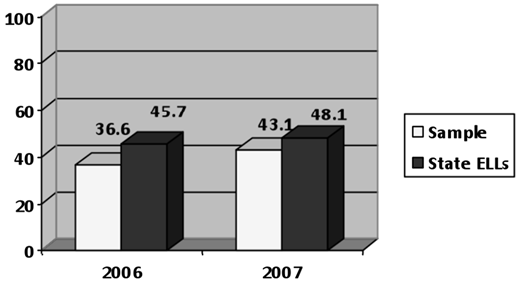
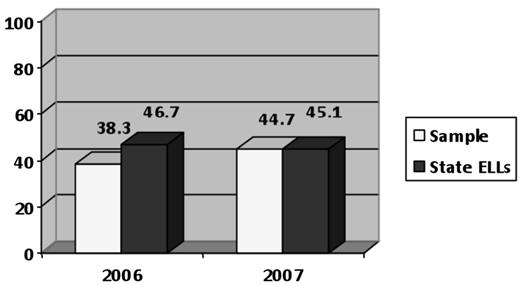
Performance levels for Kansas Reading and Mathematics Assessments include: (1) Academic Warning, (2) Approaches Standard, (3) Meets Standard, (4) Exceeds Standard, and (5) Exemplary. Students who score at a level three or above are considered to meet proficiency in that subject area according to the definitions for Adequate Yearly Progress outlined in the No Child Left Behind Act (2001). The means of performance levels for all students (n = 235) on the reading and math assessments demonstrated growth from the 2006 to the 2007 testing period for both middle schools. When compared to the state-wide performance of middle-level English Language Learners on the reading and math assessments, the percentage of ELLs at the two middle schools who performed at or above the proficient level demonstrated lower levels of performance on each assessment, however there were greater gains over the two-year period when compared to ELL performance at the state level (See Figure 1 and Figure 2).
The means for the performance levels (1 through 5) and the raw scores on the state reading and math assessments increased from 2006 to 2007 for the ELL students in this study. Paired-samples t-tests were conducted using the SPSS program, and significant differences (p < .01) were evident for both the math and reading assessments. The ELLs’ achievement on the Kansas Mathematics Assessment t (234) = - 3.629, p = .000 demonstrates that the mean performance levels after the two-year period that the ELL students were instructed by teachers engaged in the professional development program (M = 2.37) was significantly higher than the mean performance level at the beginning of the ELLs’ sixth- or seventh-grade year (M = 2.17). Similarly, the Kansas Reading Assessment ELL achievement t (234) = -3.085, p = .002 indicated a significant increase in the means of ELLs’ performance levels from 2006 (M = 2.26) to 2007 (M = 2.08). The data were analyzed according to ‘All Students’ in the sample and according to disaggregation of student demographic variables (See Table 4).
Limitations of This Study
The research conducted in this study was limited by several factors. The sample size for analysis was relatively small, comprised of two middle schools in one urban school district in the Midwest. Measurement of ELL student achievement over the two-year period was based on instruments administered annually in the spring, the Kansas Reading Assessment and the Kansas Mathematics Assessment, however the paired-samples t-test did enable a value-added analysis for cohort groups of students. The analysis of student achievement did not include a control group of ELLs in Kansas whose teachers were not engaged in a professional development program designed to improve pedagogical techniques for ELLs, however the means of middle grades ELL performance levels in the State were reported as part of the comparative findings with the ELL participants in this study.
Discussion
Implications and recommendations for improved instruction for ELLs include the value of multiculturalism, the impact of teacher attitudes and expectations, the need for first language support, and the effectiveness of a professional development program for teachers of ELLs that includes elements of the Sheltered Instruction Observation Protocol (SIOP), such as differentiation of instruction. The opportunity for teachers to engage in professional development through the weekly early-release of students, and the district-funded opportunity to add an ESL-endorsement to state teaching certification, were features of the program in these schools that encouraged wide participation in the voluntary sessions. Teacher responses on the open-ended survey questions provided insight into their perceptions of the needs of urban middle-level ELLs both instructionally and socio-culturally within the school.
Multicultural Paradigms
Throughout the teacher responses to the open-ended questions in the survey, the theme of multiculturalism was indicated as important to meeting the academic and social needs of ELLs in the school. In response to the teacher survey question on ineffective instructional strategies, one teacher stated that, “Trying to make them assimilate to the American culture without respect to their native cultures” was detrimental to ELL growth. The ideology of assimilation and related concepts such as the American “melting pot” or “colorblindness” toward diverse students encourages educators to approach instruction of ELLs or minority students from a paradigm of uniformity or a dominant-culture orientation.
Howard (1999) stated that, “the declaration of colorblindness assumes that we can erase our racial categories, ignore differences, and thereby achieve an illusory state of sameness or equality” (p. 53). This ideology is evidenced in ways such as the ‘Americanization’ of the names of students, which one teacher in this study understood quickly to be an oversight, “It was during my first year at my school that I realized how important it was for me to pronounce names correctly.” It is important for educators to examine conscious and unconscious beliefs regarding linguistic and cultural diversity, which may impact instructional practice and expectations for ELLs when teachers approach students, “…from a cultural ‘deficit’ framework in which the perceived emotional, social, or psychological needs of students of color can overrun their academic competencies,” thus impacting student achievement (Atwater, 2008, p. 252).
Value for cultural experiences outside the school and classroom settings was also expressed in the teacher surveys. One teacher described a field trip to the city’s museum of art:
My first year as a teacher at this building we took a group of students to Nelson-Atkins museum and to see the looks on their faces as they wandered and made their way through the museum was wonderful to see. Many of our students, especially the ELL students never get to witness anything outside of [the neighborhood] and to be able to take them somewhere to learn, touch, and see art, sculptures, tools, and other artifacts was a learning experience for them as it was for me.
Another teacher described the school’s music program, and enjoying the cultural diversity of the selections of instrumental music for the band, and Spanish-language songs performed by the choir. One of the eighth-grade teachers described the value of adapting curriculum to address cultural diversity after having a difficult time “getting through” to a class of students with a high percentage of ELLs:
I could never present material that grabbed their attention until I presented a unit on the Toltec, Olmec, Inca, Aztec and Maya. These kids just tore into it and produced a great deal of work. They had finally found material that interested them.
The professional development program in this study included outcomes related to the value of cultural pluralism in the school setting, and activities designed to raise teachers’ cultural awareness and understanding. A student autobiography culminating project was described by one teacher as being very “enlightening” to learn about ELLs through a non-academic lens. Another teacher stated the significance of listening to the students’ stories, “By hearing the experiences of my students being new in the U.S. allowed me to see through a different light and to understand behavior more easily.” Shuman’s (2005) description of storytelling as “an aspect of the ordinary .… touted as a healing art … a means for transforming oppressive conditions by creating opportunity for suppressed voices to be heard or for creating opportunities to listen to those voices” (p. 5) provides a connection to the value of teachers’ openness to diverse multicultural perspectives and a willingness to listen to the voices of English Language Learners as they share their backgrounds and experiences.
Teacher Attitudes & Expectations
Students who are culturally, racially and linguistically diverse are often viewed as having a lower likelihood of academic success than non-minority, English speaking students. When conducting interviews concerning issues experienced by Hispanic immigrant students in public education, Suarez-Orozco & Suarez-Orozco (2001) found many teachers tended to view minority immigrant students as less intelligent and lazy. They felt these students were more likely to get into trouble and less likely to assimilate into the mainstream. These teachers were very verbal about their feelings. One teacher predicted that one of her Hispanic boys would probably end up in prison. She also voiced doubt about the likelihood of any of her Hispanic girls going to college. She stated, “They just don’t have the IQ’s” (p.127). A superintendent in this study said his biggest educational problem was convincing his principals and teachers that minority and immigrant children were teachable. These students are less likely to be enrolled in competitive classes or classes designed for college-bound students. In addition, these lower expectations may translate into instructional practice.
Landsman (2004) found that during her study, “Students in one St. Paul, Minnesota high school talked about a teacher who asked the white kids in an advanced placement class the tough questions, but turned to the few black or Latino students when she had an easy question that [anyone could answer]” (p. 29). When confronted, the teacher admitted to this practice, claiming, “I just assumed you didn’t know the answers and I didn’t want to embarrass you” (p. 29). These views can lead to teachers and policy makers ignoring what they know to be best practices because they feel there is little likelihood that these will make much difference anyway.
At the urban middle schools in this study, one of the first acts of the small learning communities (SLC’s) each year is to review the scheduling of students especially in regards to the ELLs and placement in the appropriate classes. Priority is given to those students needing the most support and ensuring that they are scheduled with as many teachers as possible that have or are working towards an ESL teaching endorsement. One teacher leads a classroom that continues to fill the role of a newcomer’s center. Those students scheduled with that teacher remain with her throughout the day. Only those students in the country for less than a year are placed in that class. Another teacher facilitates a literacy pullout class that takes the place of a student’s language arts credit. Two bilingual aides, both speaking Spanish and English, are also present in the building, and their schedules are based on the greatest amount of contact and need with the ELL students in the general education classrooms, usually with core subject teachers.
Teachers need to be educated as to how to build a cultural context in their classroom. They must understand that for students from poverty and minority backgrounds, the expectations cannot be lowered. Students must be expected to perform regardless of their environmental conditions. Blankenstein (2004) states, “High-performing schools realize that (1) what they do matters to the learning of each of their students, and (2) all children can indeed perform at high levels” (p.101).
First Language Support & Sheltered Instruction Observation Protocol
Throughout the open-ended survey question responses from the teachers in this study, the concepts of providing first language support and utilizing Sheltered Instruction Observation Protocol (SIOP) strategies were evident. Teachers identified effective first language support structures from sources such as peer tutoring during classroom activities, bilingual paraprofessionals, and translators provided by the district. Instructional materials and information communicated to parents were often translated, or multilingual texts were used to reinforce first language along with second language acquisition. One teacher described a memorable story related to the opportunity for bilingual instruction in a language arts class for Spanish-speaking ELLs:
The best experience I had with my ELL kiddos was when I had a para in my classroom that was able to work in bilingual groups. Because of her assistance my kiddos could get the English content from me, Spanish from her, and then when possible [they were] able to complete assignments in Spanish. My students grew more academically that year than any other with that group. It was awesome to be part of it!
Teachers were provided with SIOP strategies throughout the first year of the professional development program, and these were referenced by teachers in the open-ended survey questions related to effective instructional practices for ELLs. Specific mention of the effectiveness of creating language and content objectives to share with the students, building background knowledge, planning differentiated lessons, and guiding students to build connections and relate to prior learning were evident throughout teacher responses. Teachers also described scaffolding practices, and use of visual aids and manipulatives as being effective instructional methods.
Conclusion
Teachers who participated in the professional development program shared their perceptions of the needs of urban middle-level ELLs, and their recommendations for effective instructional techniques and methods to build positive relationships among ELLs and non-ELL peers, and among ELLs and adults. A statistical analysis of the achievement of ELLs during a two-year period demonstrated significant growth in reading and mathematics, and teacher comments on the survey echoed positive achievement, as one teacher stated:
It has been neat to see how the students have grown and become successful at school since they arrived during 6th grade. I've seen several students who started in the Newcomers center in 6th grade become top students this year as an 8th grader. Each of these students has blossomed and will have a very bright future ahead of them.
Recommendations for further research include investigations to examine the relationship between professional development designed to improve instruction for ELLs, and ELL academic achievement with larger sample sizes of ELLs in diverse regions in the United States.