


The purpose of this 18-month case study is to highlight the successes and challenges that an ESL/mathematics teacher encountered as she made a shift from traditional mathematics curriculum to a standards-based curriculum as part of a statewide systemic initiative. The study was conducted in an urban, public middle school in Central Texas that served predominately low-income Latina/o students. The participant of this study was a middle school teacher who taught mathematics to English language learners in a self-contained classroom, which meant that 6th-through 8th-grade students were in the same classroom. Data sources included interviews, participant and nonparticipant classroom observations, fieldnotes, and documents. Three themes emerged from the data: (1) professional development opportunities and collaboration with a mainstream mathematics teacher, (2) change in teaching practices, and (3) equity issues. Findings indicate that this ESL/ mathematics teacher valued the professional development opportunities and collaborations with the mainstream mathematics teacher that supported her implementing a standards-based curriculum. The teacher also reflected on how her teaching changed by implementing units of the Connected Mathematics Project. However, a challenge she encountered with equity issues was the mismatch between the 6th-grade curriculum and the self-contained ESL classroom that consisted of 6th-through 8th-grade students. Other challenges were the lack of resources in the students’ native language and the time needed to translate the curriculum materials. Implications and recommendations are discussed in relation to mathematics reform efforts in ESL classrooms.
INTRODUCTION
In the past 12 years there has been an increase in the number of English language learners (ELLs) enrolled in United States schools, from 3.2 million in 1995-1996 to over 5 million in 2005-2006, approximately a 57% increase (National Clearinghouse of English Language Acquisition [NCELA], 2005-2006). That number is expected to rise in the next few years with Latina/o students being the fastest growing group in our nation’s public schools (Kohler & Lazarin, 2007). In the past 2 decades, the National Council of Teachers of Mathematics (NCTM) has called for a coherent, standards-based curriculum across grade levels (NCTM, 1989, 2000). Although NCTM has placed the equity principle as first on its list of principles, there remains much work to be done in the areas of mathematics education reform efforts and how these impact students who are learning English as a second language and mathematics simultaneously.
An extensive body of studies has investigated how teachers implement and interpret standards-based curriculum in middle schools (Lambdin & Preston, 1995; Manouchehri, 1998; Tarr, Chavez, Reys, & Reys, 2006) and how students taught using a standards-based curriculum versus conventional curriculum perform (Boaler, 1997; Cain, 2002; Huntley, Rasmussen, Villarubi, Sangtong, & Fey, 2000; Tarr et al., 2008). Collectively, these studies have been significant in informing public schools about teachers’ roles in enacting the curriculum in the classroom and which standards-based curricula make a difference on student achievement. What remains a void in the literature are the experiences of English as a second language (ESL) teachers when they implement mathematics reform curriculum. The purpose of this article is to voice the experiences of an ESL/mathematics teacher who implemented units of the Connected Mathematics Project (CMP). Specifically, this study explores the following research question: What are the successes and challenges of an ESL teacher implementing a standards-based mathematics curriculum? This study contributes to understanding the issues that an ESL teacher encountered over an 18-month period in shifting from a traditional curriculum to a standards-based curriculum at the middle school level, where there is a paucity of research that addresses the learning of mathematics with second language learners of English (Gutiérrez, 2002).
In the next section, I focus first on introducing the background literature of this study by providing a historical context of mathematics education reform efforts, including the theoretical perspectives used in professional development. A rationale and description of the CMP follows.
BACKGROUND LITERATURE
Mathematics Education Reform Efforts
The NCTM has played an important role in the past 20 years in reforming mathematics education. In 1989, NCTM published the Curriculum and Evaluation Standards for School Mathematics (CESSM) and in 2000 these standards were revised in the Principles and Standards for School Mathematics (PSSM). These documents are framed using constructivist theoretical perspectives and envision comparable changes in teachers’ practices. According to Stein, Remillard, and Smith (2007), there was an increase in the number of standards-based curricula developed in the 1990s that aligned with the recommended standards. The National Science Foundation funded many projects to develop these new curricula that introduced more rigorous content and that gave more emphasis to critical thinking over computation skills (Lappan, 1997).
In order to support teachers with the implementation of standards-based curricula, there were statewide systemic initiatives that received funding from the National Science Foundation. The Miller Center1 had one of these initiatives to help middle school (6th to 8th grade) teachers across the state of Texas to implement standards-based curricula. Committed to increasing minority student achievement in the areas of mathematics and science, the Miller Center staff helped schools in Rocky Independent School District by implementing the CMP in the mainstream sixthgrade classes during the first year of implementation. The Miller Center added the seventh-grade curriculum during the second year of implementation, then the eighth-grade curriculum during the third year.
The approach used to help teachers implement CMP integrated support at various levels. At the state level, mathematics coordinators from different districts met two or three times per semester with CMP coordinators to discuss progress and concerns. At the district level, mathematics teachers convened every 4 to 6 weeks with mathematics coordinators to preview the CMP units to be covered in their own classrooms. According to Stein et al. (2007), teacher support during the implementation of standards-based curriculum is critical. Teachers view effective professional development as ongoing support that involves them in exploring the same activities that their students experience in the classroom.
Creating professional development opportunities in which teachers can learn with understanding (Franke, Carpenter, Levi, & Fennema, 2001) about students’ mathematical thinking requires “situating” teacher learning in relation to their practice, as an integral part of their teaching lives (Wenger, 1998). Current conceptualizations of professional development emphasize generating communities of practices in which teachers learn in collaboration with others, have opportunities to reflect on their practices, and collegially design teaching approaches that respond to students’ needs. Communities of practice can afford teachers with opportunities to actively participate in their own development and transform their understanding of students’ learning, ultimately changing their practice and themselves (Rogoff, 1995). At the campus level, teachers created a community of practice where they could consult with each other and were encouraged to observe each other’s classes to reflect on their practices and on student learning. The standards-based curriculum that was implemented as part of this initiative is discussed next.
The Connected Mathematics Project
The CMP was developed at Michigan State University. In each CMP lesson manipulatives and a variety of activities are widely used to introduce mathematical concepts which the students explore and discover. Assessments take place through reading, writing, and verbal explanations so that students present evidence
to support their solutions. A concept is not explained and followed by examples. Rather, students are encouraged to ask their peers for help in the discovery process by allowing students to work in cooperative learning groups. Overall, the curriculum is designed to challenge students by encouraging higher levels of thinking and problem solving. Specifically, CMP goals consist of the following:
Number sense: Reasoning with and about numbers;
Geometry: Spatial sense and reasoning with and about shapes and location;
Measurement: A sense of what it means to measure and to reason with measures;
Algebra: Algebraic reasoning;
Statistics: Decision making with data; and
Probability: Decision making under uncertainty (Lappan, Fey, Fitzgerald, Friel, & Phillips, 1996c).
In addition, CMP supports the growth of student understanding by guiding teachers in implementing the curriculum. The five instructional themes consist of the following: (1) teaching for understanding, (2) connections, (3) mathematical investigations, (4) representations, and (5) technology. These themes concur with the goals as described by the National Council of Teachers of Mathematics (NCTM, 1989, 2000). CMP is organized into eight units (see Table 1), each of which is 4-to 6-weeks long. CMP focuses on investigation lessons that are based on three basic elements: (1) launching, (2) exploring, and (3) summarizing.
In order to understand why the CMP had been chosen over other curricula, I interviewed Rebecca, the local director of CMP. She explained that, in the past, middle school students have been bored with the traditional type of curriculum. Rebecca shared Flanders’ Graph (see Figure 1) and explained that, when the graph was published in 1987, no one had paid attention to it, until later. Flanders (1987) analyzed three textbooks that were widely used by schools: Addison Wesley Mathematics; Mathematics Today and HBJ Algebra I; and Invitation to Mathematics and Scott, Foresman Algebra: First Course.
CMP Curriculum for Grades 6, 7, and 8
| Sixth | Seventh | Eighth |
|---|---|---|
| Prime Time | Variables and Patterns | Thinking with Mathematical Models |
| • Number theory; primes; composites, factors and multiples | • Introducing algebra; variables, tables, graphs, and symbols as representations | • Introduction to functions and modeling |
| Data About Us | Stretching and Shrinking | Looking for Pythagoras |
| • Data investigation; formulating questions, gathering data, organizing and analyzing data, making decisions based on data | • Similarity with congruence as a special case | • Pythagorean Theorem, slope, area and irrational numbers |
| Shapes and Designs | Comparing and Scaling | Growing, Growing, Growing … |
| • Reasoning about shapes and shape properties; angle measure | • Rate, ratio, proportion, percent and proportional reasoning | • Exponential growth |
| Bits and Pieces, Part I | Accentuate the Negative | Frogs, Fleas, and Painted Cubes |
| • Understanding rational numbers: Fractions, decimals, and percents | • Understanding and using integers | • Quadratic growth |
| Covering and Surrounding | Moving Straight Ahead | Say It With Symbols |
| • Measurement: Area and perimeter | • Linear relationships expressed in words, tables, graphs, and symbols | • Equivalent expressions and solutions of linear equations |
| How Likely Is It? | Filling and Wrapping | Hubcaps, Kaleidoscopes, and Mirrors! |
| • Probability | • 3-D measurement | • Transformational geometry |
| Bits and Pieces, Part II | What Do you Expect? | Samples and Populations |
| • Using rational numbers: Computation | • Probability (expected value) | • Gathering data from samples to make predictions about populations |
| Ruins of Montarek | Data Around Us | Clever Counting |
| • Spatial visualization and spatial reasoning | • Number sense | • Using trees, lists, and principals to count set: combinatorics |
By observing the graph, Rebecca explained, one can see that Flanders assumed that 100% of the mathematics content kindergarten students experience is new. In first and second grade, she continued, the new mathematics content presented in textbooks is about 75% and 40%, respectively. In other words, there is significant repetition of content in the second grade. When students get to third grade, Rebecca explained, the mathematics content gets more difficult because 65% of it is new. She continued her analysis of the graph:
O.K., now look what happens in 4th, 5th, look at the middle grades, 6th, 7th, and 8th grade. By the time they get to 8th grade, the material in the textbook, only 30% of material is new material. That means 70% of it is just a review from past years. The problem with it is … think about, though, where all the new material is in a textbook. Where do they put the new material? Think about it. It’s in the back. Probability, statistics, those things are sitting in the back, and so what we’re having here … and then now look at 9th grade. In 9th grade, all of a sudden, bang, they’re hit with algebra I, and it’s like shock. It’s like shock to their systems. Can you believe that? It’s incredible. So, by the time they get to 9th grade, and isn’t it any wonder then that we have kids flunking out of algebra I? Because they do not develop concepts that are needed to answer those questions. (Interview with Rebecca, First Year of Study)
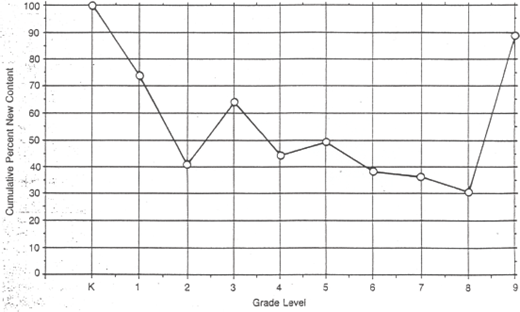
Flander’s Graph
Note: Average percentage of new content in three mathematics text series.
Flander’s Graph
Note: Average percentage of new content in three mathematics text series.
Rebecca explained the entire graph by looking at each grade level and emphasizing how important Flanders’ finding is and its implications for the curriculum that was taught at the middle school level at the time of this study. She stated that what CMP tries to do is to smooth the curve in the middle grades so that students are able to make an easier transition from the middle grades to algebra I. Rebecca expressed this was the reason for choosing CMP. In addition, she described current findings from other middle schools that have been using CMP for several years:
So, the kids probably weren’t even getting that 30% of the new material. It was literally just review. So, what we have tried to do, what we’ve recognized that we need to do first of all is we need to smooth this curve out (the middle grades). We need to instead of having this big gap, what we need to do is increase this; we need a much smoother flow in that 9th grade. So, one of the things CMP does is it gives the kids newer material. It leads them into Algebra I. As a matter of fact, according to the results on this, there is so much Algebra I in it, already embedded in it, that … 90% of the kids were able to read 8th grade CMP and go directly into geometry. (Interview with Rebecca, first year of study)
Overall, there was a strong rationale as to why CMP had been selected over other curricula as part of the statewide systemic initiative. Given the content in the units (see Table 1), CMP exposes students to more rigorous content much earlier than traditional textbooks, and it allows teachers to cover content goes beyond numbers and operations (Stein et al., 2007). Teachers help students move from a passive role of learning to an active role. In the next section I cover the method used to study the experiences of an ESL/mathematics teacher implementing CMP.
METHODOLOGY
Research Design
This 18-month qualitative research study is a case study of an ESL/mathematics teacher. The case study design was selected because it “becomes particularly useful where one needs to understand some special people, particular problem, or unique situation in great depth, and where one can identify cases rich in information” (Merriam, 1998; Patton, 1990, p. 54). According to Patton (1990), the case study seeks to describe a particular situation in great detail, in context, and holistically.
Site
This case study was conducted in an urban, public school, Red Middle School, in Central Texas. According to the Texas Education Agency (1996), there were 1,175 students enrolled at the time of the study. The student population in the school reflected the following demographics: 66.4% Hispanic, 22% African American, 11.4% White, and 0.2% Asian. Of the total population, 78.4% of the students were low income, and 21.2% of the students were English language learners. There were about 4.5% students enrolled in the bilingual/ ESL program. However, the classroom that I observed was self-contained and consisted only of sixth-eighth graders learning English as a second language. The school was on block schedule (90-minute classes).
Participant
The participant selection consisted of a purposive sample (Erlandson, Harris, Skipper, & Allen, 1993). According to Erlandson et al., a purposive sampling involves selecting “sources that will most help to answer the basic research questions and fit the basic purpose of the study” (p. 83). I selected Mrs. Brown as part of the study because she taught mathematics to English language learners.
Mrs. Brown is very fluent in Spanish and is certified to teach Spanish and ESL/bilingual. She considers her responsibilities as a teacher to be twofold: (1) to teach English and (2) to teach mathematics. Mrs. Brown explained that in the past she attended more to the language than to the content areas. This statement points to the priority that ESL teachers gave in earlier decades to developing the English language rather than developing the content areas (Thomas & Collier, 1997). Realizing that students needed to be strong in the content areas as they were transitioned from ESL to regular courses, she decided to focus on both the English and the mathematics. Mrs. Brown provided support for students whose first language was Spanish by using 90% of Spanish in the beginning of the school year and gradually moving toward 50% Spanish and 50% English at the end of the school year.
In addition to her educational experience, Mrs. Brown has traveled to Mexico, Central America, and to Spain. At the time of the study, she had taught almost 5 years.
She saw her role as an advocate for ESL students. Her advocacy was evident in her awareness that students who were enrolled in her classroom were often tracked because of their English language proficiency (Oakes, 1990), but she often encouraged students to move to regular or honors mathematics courses when they showed strong mathematics knowledge. Mrs. Brown was a unique case because during the 18-month period of the study I observed her using a traditional curriculum in the first year and a standards-based curriculum in the second year.
Data Collection and Analysis
Interviews. One source of data consisted of formal and informal interviews (Patton, 1990). Formal interviews were conducted once each semester with the teacher. Informal interviews with the teacher were ongoing; these occurred mainly before or after a lesson. The principal and assistant principal of the school were interviewed once. In addition, the local director of the CMP was interviewed once. The administrators were interviewed to obtain different perspectives on the implementation of this curriculum as part of a statewide systemic initiative.
Classroom Observations. Ongoing participant and nonparticipant classroom observations of lessons made up the second source of data (Patton, 1990). These observations served to document a shift from a traditional teaching approach in the first year of the study to a reform oriented approach during the second year. Participant observations occurred when the teacher provided time for guided practice or when the students worked in groups; nonparticipant observations were conducted when the teacher presented information in front of the classroom. Observations were conducted at least 3 times during the week and lasted 90 minutes each. Selected lessons were audiotaped and transcribed to document teacher-student discourse interaction patterns (Celedon-Pattichis, 2008).
Fieldnotes. Extensive fieldnotes of faculty meetings and professional development meetings that Mrs. Brown and I attended were the third source of data. In addition, I attended district and statewide meetings as part of my job in understanding teachers’ successes and challenges in implementing CMP at both levels of this statewide systemic initiative.
Documents. The fourth source of data consisted of documents such as the teacher’s records and textbooks. The teacher’s records included lesson plans, quizzes and/or exams administered during instruction, and handouts of different activities. I used the teacher’s records to triangulate the data from the classroom observations. The student’s and teacher’s textbook editions were used to triangulate my fieldnotes and the transcriptions.
Data Analysis. Interview transcripts, classroom observations, fieldnotes, and documents were coded according to the principles of grounded theory (Strauss & Corbin, 1998). This process involved chunking the data into meaningful units, and then coding selected statements using words or phrases that addressed the research questions (Erlandson et al., 1993). For instance, teacher interviews and classroom observations were coded with particular attention to successes and challenges related to implementing CMP. Each theme was then triangulated across various data forms (i.e., interviews, classroom observations, field notes, documents) (Erlandson et al., 1993).
Transferability and Limitations of the Study
Erlandson et al. (1993) stated that “the researcher’s major concern is not to generalize the findings of the study to a broad population or universe but to maximize discovery of the heterogeneous patterns and problems that occur in the particular context under study” (p. 82). Furthermore, transferability is the degree to which two contexts are congruent (Lincoln & Guba, 1985). I acknowledge that this study focused on only one teacher. Mrs. Brown was the only one in the unique situation of teaching mathematics to English language learners. As many details as possible about the setting and the participants were provided so that readers may decide for themselves what part of the situation or context might be applicable to their own.
In addition to the ESL/mathematics classroom, I observed a mainstream sixth-grade mathematics class. The teacher, Mrs. Smith, had used the CMP the previous year and, as will be discussed in the next section, she played a major role in helping Mrs. Brown make a link between her pedagogical knowledge of teaching English language learners and the mathematics content needed to teach the CMP. Observing the mainstream mathematics class helped determine the unique aspects of the ESL classroom. Data from my observations of Mrs. Smith’s class were not used for analysis because the purpose of the larger study was to investigate how English and Spanish were used to negotiate mathematical meaning (Celedón, 1998), and Spanish was not used in Mrs. Smith’s class.
In the sections that follow, I discuss the findings. There were three themes that emerged from the data: (1) professional development opportunities and collaboration with a mainstream mathematics teacher, (2) change in teaching practices, and (3) equity issues. I end with a discussion of conclusions and implications of this study and future research.
FINDINGS
Professional Development Opportunities and Collaboration with a Mainstream Mathematics Teacher
Mrs. Brown and I attended three Saturday professional development sessions that provided opportunities for teachers to practice hands-on activities from the units on Prime Time (Lappan et al., 1996d), Bits and Pieces I (Lappan et al., 1996a), and Bits and Pieces II (Lappan et al., 1996b). In these sessions teachers were asked to think about how a student might solve different problems and what mathematical content questions students might raise about the problems in each unit.
By the end of the fifth 6-week period, Mrs. Brown had covered Prime Time, Bits and Pieces I, and Bits and Pieces II, leaving out Shapes and Designs (Lappan et al., 1996e), a geometry unit. As Mrs. Brown explained, she fell behind schedule because she was not provided with all the Saturday CMP professional development sessions. Mrs. Brown recalled that teachers were notified of a summer professional development during the last day of school in the spring, but she did not receive that notification until the fall semester, after they had begun a new school year. Thus, she missed the summer professional development and had to make up those sessions on some Saturdays during the school year. When asked about CMP, Mrs. Brown stated:
I think it’s good. I like the vocabulary, and I like the activities. One concern that I have is that I never got all the training … see the first book was really easy cause I got the training. Actually, I got the first three (Prime Time, Bits and Pieces I, and Bits and Pieces II), but then they never … they dropped the bomb; the district did. And we never finished.. But after that, and you know that is when I started experiencing difficulty was with the fourth book, ironically enough. And coincidentally, that was the one that I hadn’t been trained on yet. So, I think the training is what makes a big difference. So I think it’s a good program, but I felt like I was … it was difficult for me to implement. (Interview with Mrs. Brown, second year of study)
It is clear from this quote that Mrs. Brown valued the professional development experiences and that these sessions made the units easier to implement. However, the lack of continuous professional development made it more difficult for this teacher to implement other units of CMP (Handal & Herrington, 2003). According to Smith (2001), teachers value professional development that provides teachers opportunities to explore the same activities that their students engage in. The professional development she had missed was on Shapes and Designs, the point where she began to fall behind schedule.
During an interview, Mrs. Brown stated that the CMP Saturday sessions were actually the first professional development in mathematics she had ever attended. When I accompanied Mrs. Brown to the first professional development session on Prime Time, I noticed she was excited about implementing the new program. By the end of the third book, however, her excitement was not the same. Mrs. Brown was aware that her attitudes towards CMP also affected her students’ attitudes towards CMP. Mrs. Brown reflected on that experience:
Well, I think in the beginning they liked it more, but I think towards the end they started getting tired of it. But maybe that was a reflection of my attitudes towards it. You know, they may have just been mirroring what they saw in me._ Like maybe they saw that I wasn’t as enthusiastic in the last book as I was in the first book. I mean, I think it all kind of tied back to that lack of training. Because it affected how well I taught it and probably made it, probably made it more frustrating for the students because I wasn’t teaching it as well, and so they probably weren’t getting it as well. But when I started doing TAAS (standardized test) stuff again, they seemed to really get into that. So, I know they probably needed that. But I think that they were getting better at reasoning, thinking, and solving problems, so I think it did help them. (Interview with Mrs. Brown, second year of study)
As is evident in this quote, Mrs. Brown is aware that her students’ attitudes toward the implementation of the different units might have been a direct reflection of her attitudes toward implementing the curriculum. Although Mrs. Brown’s attitudes toward CMP vary, she stated that, in general, she liked CMP because it was helping her students think about mathematics differently. In addition, she stated that CMP also helped her take a different approach to teaching mathematics. In the past, Mrs. Brown explained, she taught mathematics the way it had been taught to her, which was to teach the formula or the algorithm. At the end of the semester, Mrs. Brown returned to teaching students mathematical content that would be presented in the standardized test. These curricular decisions reflect her experiences as a learner and teacher of mathematics (Drake & Sherin, 2006) and also the larger dynamics of the pressures that exist under the No Child Left Behind legislation to have all students tested, especially accountability for ESL students.
An important finding on the implementation of CMP was the collaborations that Mrs. Brown established with Mrs. Smith, the mainstream mathematics teacher in her school. In addition to the support that started with the professional development at the district level in experiencing the units first, Mrs. Brown mentioned that the weekly meetings she had with the mainstream mathematics teacher in her school facilitated her preparation for each unit, and she found these meetings to be “extremely helpful” (Interview with Mrs. Brown, second year of study). She interacted with Mrs. Smith to the extent of planning lessons and writing quizzes and exams. Mrs. Brown often times modified quizzes from the mainstream CMP classes so that the directions were in Spanish for students in her class. Mrs. Smith also provided support on how to engage students to further explore a mathematics concept. In the next section, I discuss a change in Mrs. Brown’s teaching practice.
Change in Teaching Practice
During informal interviews, Mrs. Brown often expressed how different the questions she posed to students had to be. She began to notice that implementing CMP units required that she change her questioning patterns. In the first year of the study Mrs. Brown used more I-R-E type questions, where the teacher initiates a question, the students respond, and the teacher evaluates that response (Cazden, 2001). The example below illustrates how she tended to pose closed type questions2 during the first semester that I observed her class. The lesson dealt with adding fractions and took place in February of the school year. I use T and S in the transcript below to represent teacher and student, respectively.
Example 1
T: What’s one half and one fourth? Umm … ____? What’s one half and one fourth?
One half and one fourth equals .
Do you have an answer? S: Oh, yeah. Three fourths.
Three fourths. Good! ____, what did you get for number two?
(Inaudible)
O.K. Good! You see three goes into nine, right? How many times does three go into nine?
Three.
Example 1 illustrates how Mrs. Brown initiated a question, the students replied with a short phrase response, then the teacher followed with an evaluation of the answer (“Good!”). Thus, most exchanges between the teacher and the students involved closed type questions during the first year that I observed her class.
In the second year, however, when Mrs. Brown implemented units of CMP, she found teaching required more open-ended questions and tasks that would elicit different answers from students. For example, to help students understand fractions conceptually, the teacher gave students a card with a fraction written on it, and the students had to create a human number line to determine where they would be located on the number line. In performing this activity, the students had to justify why they chose their specific location on the number line. Compared to the interactions in Example 1, this task required students provide an expanded answer (i.e., “I knew that my fraction, five eighths, was larger than one half, so I placed myself to the right of ½”) (Fieldnotes, second year of study).
Equity Issues
Quality of Education for ESL Students. Although Mrs. Brown had positive experiences with the initial professional development sessions and the collaboration with the mainstream mathematics teacher, she also encountered some challenges as she implemented units of CMP. The lack of continuous professional development was one challenge, but she also faced difficulties with the quality of mathematics education her ESL students were getting. As Mrs. Brown discussed the courses she taught, she described the ESL/mathematics class as a remedial class because students were not getting the whole sixth, seventh, and eighth grade curriculum. She explained that mathematics was not her area of specialization. Thus, Mrs. Brown felt students were being cheated because she taught mathematics only at their level. In other words, she felt that in order to teach mathematics one needs to know mathematics at a higher level than the students and have the mathematics content knowledge needed to teach the new curriculum. According to Mrs. Brown,
The primary objective is to catch them up, and it’s really like a remedial math course. That’s just the way I see it. It’s like I see where they’re at and what they know how to do and don’t know how to do, and I try to get them…and I don’t know if I’m doing the right thing or not because I know that there is a 6th, 7th, and 8th grade math curriculum, and they’re not getting that with me. They’re not given that whole curriculum. (Mrs. Brown interview, second year of study)
It is evident from this quote that Mrs. Brown was conscious that her students were only getting exposed to the sixth-grade curriculum because this was the grade level used for teachers implementing CMP for the first time. She had not been consulted about which grade level to implement in her classroom. This was a decision that was made at the district level and by the Miller Center, and the teacher followed the implementation model in place. Special education and ESL classrooms were given the same curriculum; however, there were many differences with these specific classrooms. Mrs. Brown added,
See, I’m not … my background is not math, so, I’m like … sometimes I’m at a complete loss as to what to do because it’s really not my background. And I’ve never been very strong in math, either. Sometimes, I feel like the kids are getting cheated, actually. You know. Because, I don’t think that I know math as well as, like a regular math teacher. I know it well, I know it at their level, the level that I’m trying to teach it, but I don’t know it higher; I don’t know it like at a real high level. So, that, I don’t know. It seems like you should know lot higher than the level that you’re trying to teach it. (Mrs. Brown interview, first year of study)
Mrs. Brown made reference to the need to have content knowledge that was above the students’ level to be able to engage students in deeper knowledge of mathematical concepts (Shulman, 1986). She also mentioned that ESL students were getting a different curriculum than that used in the mainstream mathematics classes during the first year of the study when she was using Addison-Wesley mathematics: Grade 6 (Eicholz et al., 1991a, 1991b). Interested in whether Mrs. Brown had changed her mind about students being cheated in her classes, I asked her if she still felt the same now that the students were being taught with CMP. Mrs. Brown stated,
I feel like they’re still being cheated a little because I feel like I can’t keep up with it (CMP) … just too hard for me to keep up with, and these last 6 weeks I gave up trying to keep up with it; I decided to just do some practice stuff from the TAAS (standardized test). And just focus on that for a while, and now that TAAS is over, I’m not sure what to focus on, but I think maybe we’ll just do some geometry since that seems to be where we had the most holes…as far as what I noticed that they had the most lack of when they were doing the practice test was geometry. (Mrs. Brown interview, second year of study)
Indeed, the unit on shapes and designs was the one that Mrs. Brown had not had professional development and was the content which she saw students missing on the practice standardized test. According to Mrs. Brown, the district had “dropped the bomb” and did not provide the necessary professional development that was needed to cover the curriculum adequately (Handal & Herrington, 2003; Manouchehri, 1998).
Resources and Time. In her study of 151 middle school teachers implementing standards-based curricula, Manouchehri (1998) found that one dilemma teachers faced was the extra time required to design lessons, conduct activities, assess student progress, prepare additional activities, and pace lessons for different students. This preparation demanded that teachers spend long hours beyond their planning period at school. Coupled with these concerns was, for Mrs. Brown, the time required to translate materials into Spanish because the first edition of CMP did not provide this support for ESL teachers. This process was even more time consuming for her and caused her to stay behind schedule. In Manouchehri’s study many teachers reported that the suggested timeline for implementing units was inaccurate. Mrs. Brown also expressed how much reading and writing were required, and this was an issue for her students who were learning English as a second language and mathematics concepts simultaneously.
CONCLUSIONS AND IMPLICATIONS
This case study focused on studying the experiences of an ESL/mathematics teacher as she implemented units from the CMP. In the process of shifting from using a traditional curriculum to a standards-based curriculum what Mrs. Brown found to be most valuable were opportunities she had to attend professional development sessions, specifically in mathematics, and collaboration with a mainstream mathematics teacher. These two components were the successes she experienced in the process of implementing the CMP. These findings indicate the need to have long-term professional development go hand-in-hand with the implementation of the curriculum (Kitchen, DePree, Celedon-Pattichis, & Brinkerhoff, 2007; Musanti, Celedon-Pattichis, & Marshall, 2009).
The challenges Mrs. Brown encountered began when the district stopped the professional development, setting the teacher behind schedule and feeling “at a loss” (interview with Mrs. Brown, second year of study) as to what she should cover next, eventually leading her to resort to standardized test mathematics content (Chval, Grouws, Smith, Weiss, & Ziebarth, 2006). Another challenge was the implementation of the sixth-grade CMP units in this self-contained ESL classroom. Because there were sixth, seventh, and eighth graders in her classroom, Mrs. Brown was concerned about equity issues because she felt her students were not getting the appropriate grade-level curriculum. She was also not certified to teach mathematics. These are all valid concerns. Nasir, Hand, and Taylor (2008) discuss similar challenges to equitable implementation of standards-based curricula in schools that serve predominately low-income minority students. With the current No Child Left Behind legislation, it is extremely difficult to find teachers who are qualified to teach ESL students and mathematics, two areas where there is the most shortage of teachers (Darling-Hammond & Sykes, 2003).
This case study’s findings can inform educators, administrators, and policymakers about implementation of mathematics reform curriculum in ESL classrooms. Although the statewide system initiative (SSI) was well intended to introduce standards-based mathematics curriculum in ESL and special education courses, there are different areas that need to be addressed. First, there is a need to link deep content knowledge to professional development or preparation of ESL teachers. Because ESL teachers are often excluded from professional development opportunities that focus on the content areas, continued in-class and longterm support is critical (see Musanti et al., 2009). In-class support can take the form of modeling lessons for the teacher and supporting the teacher with small groups in the classroom. Long-term support can consist of summer institutes, workshops that focus on preparing teachers for mathematics content that they will teach to their students and that teachers can experience themselves ahead of time. Second, teachers who are directly affected by reform efforts need to be included in decision-making plans so that they voice what their students’ needs are. Last, but not least, different alternatives need to be explored to better educate ESL students. Valdes (2001) has documented the experiences of ESL students who are often isolated in educational settings where self-contained classrooms exist. A recent trend includes coteaching experiences between ESL and mainstream teachers so that both can benefit from each other’s areas of expertise and, at the same time, students feel part of a more inclusive educational system.
Future research should continue to explore the kinds of support and opportunities that ESL teachers are provided when they are part of a statewide systemic initiative and are implementing standards-based curricula in the content areas. Especially important to study is the impact that these reforms have on ESL students. Because equity was an important issue in this study regarding the quality of education for ESL students, it would be important to investigate how decisions are made regarding self-contained ESL classes where there are sixth through eighth graders in the same class. Typically, systemic reform efforts begin by working one grade level at a time; however, different options need to be explored for teachers who have multiple grade level classrooms. Thus, it would be critical to investigate what role ESL teachers play in decision making regarding reform efforts. More recently, the second edition of CMP was published in Spanish. Future studies should consider how this resource facilitates ESL teachers’ practice and students’ mathematical understanding.
Acknowledgments:
I am grateful to the reviewers of this manuscript for their thoughtful and helpful comments to strengthen the ideas presented. I offer a special thanks to Mrs. Brown who so graciously allowed me into her busy classroom, and all of the students who provided insights on the challenges they faced daily in learning English and mathematics.
Disclaimer: The writing of this paper was partially supported by NSF grant number ESI-0424983 to CEMELA, The Center for the Mathematics Education of Latinos/as. Any opinions, findings and recommendations expressed here are those of the author and do not necessarily reflect the views of the National Science Foundation.
NOTES
Pseudonyms are used for all sites and participants throughout this paper.
Closed questions are those that can be answered with one word or a short phrase.

