In this article we focus on the widely researched motivational construct, interest, with the aim of identifying the character of positive affect associated with students’ interests. There is a well-documented association between interest and students’ engagement with classroom activities. It is also widely accepted that enjoyment plays a role in the dynamic processes operating when students engage with interesting learning activities. We used an innovative measure (MINE) that invites participants to explore and nominate their interests from a relatively large pool of interests. Young adolescent students (N = 213, mean age 13 years 6 months) explored this interactive space to select interests and then had the opportunity to expand on the selected interests through text comments as well as ratings on affective and experiential scales. On average students chose approximately 5 interests and we describe the distribution of interest content for these choices. As expected there were differences between boys and girls in their patterns of interests. Using the students’ ratings of their interests on 7 affect terms we found that across all of the nominated interests there was a consistent pattern; high ratings of happy, excited, and proud, moderate to high ratings for hopeful, and very low ratings for the negative affect terms, frustrated, anxious, and sad. This pattern was consistent across interest content and gender groups. Individual profiles of the affective responses associated with 2 students’ chosen interests are described and some of the insights these profiles offer to teachers are explored. Knowledge of how specific positive feelings are active when students engage with the content of their interests will assist practitioners to understand how interests might be used to personalize learning activities and curriculum choices in the service of greater student engagement with learning.
Do not train children to learning by force and harshness, but direct them to it by what amuses their minds, so that you may be better able to discover with accuracy the peculiar bent of the genius of each.
—Attributed to Plato (http://thinkexist.com/ quotation/do_not_train_a_child _to_learn_by_force_or/259396.html)
As this reference to Plato shows, the part positive emotion plays in learning and achievement has been recognized since the dawn of organized schooling. In the first decade of this century the “positive psychology” movement (e.g., Seligman, Ernst, Gillham, Reivich, & Linkins, 2009) has brought the importance of happiness in schooling to the attention of talk-back radio and daytime television audiences. Simultaneously, a significant number of education researchers have elevated positive emotion to a central place in their investigations into factors that support school achievement.
So why has there been this resurgence of interest regarding the place of positive feelings in the learning process? For at least two decades educational commentators have highlighted patterns of decreasing motivation (e.g., Eccles & Wigfield, 2002) and increasing levels of disengagement over time among students from developed countries (e.g., Skinner, Furrer, Marchand, & Kindermann, 2008; Willms, 2003). Pintrich and De Groot, summed up the essence of this problem in their admonition: “Students need to have both the “will” and the “skill” to be successful in classrooms” (1990, p. 38).
While the place of skills and abilities are central to educational achievement, turning skills and abilities into actual achievement requires students to exercise “will.” For Pintrich “will” included factors such as selfefficacy, intrinsic value (a combination of interest and value), and self-regulation. Recent educational research presents a variety of motivational constructs: expectancy-value theory (e.g., Eccles, 2005), achievement goals (e.g., Elliot, 1999; Harackiewicz, Barron, Pintrich, Elliot, & Thrash, 2002), interest (e.g., Hidi & Renninger, 2006; Krapp, 2003), selfefficacy (e.g., Pajares & Schunk, 2001), selfregulation (e.g., Schunk & Zimmerman, 2008) and a number of other constructs (see Murphy & Alexander, 2000). Most recently one sector of this literature has turned its lens toward emotions as part of the complex of factors contributing to achievement. While there has always been a strong literature relating negative feelings in the form of anxiety to learning and achievement (Pekrun, Goetz, Titz, & Perry, 2002), what has changed is the attention given to the role of positive emotions, most often researched in the educational literature as positive affect, the feeling component of emotion.
In this article we focus on one widely researched motivational construct—interest. We explore the relation between interest and positive affect to further understand the influence on learning and achievement. Because there is a well-documented association between students’ interest and their engagement with classroom activities (e.g., Renninger & Hidi, 2011; Schiefele & Rheinberg, 1997), the purpose of this research is to identify the character of positive affect associated with students’ interests. This knowledge will assist educational practitioners to understand the dynamics of students’ interests that might be used to personalize learning activities and make curricular choices in the service of greater student engagement and subsequent achievement.
Interest, Learning, and Achievement
The contribution of interest to students’ learning and achievement is a prominent issue in contemporary educational research. For example, recently Thoman, Smith, and Silvia (2011) have shown that one role of interest in learning is to “harness resources needed to engage a task” (p. 1). When students have been working on a task and their cognitive resources are depleted, introducing something that triggers interest can serve to replenish resources increasing the likelihood students will reengage with renewed enthusiasm.
Renninger and Hidi’s (2011) review of the literature on interest describes a consensus on ways that interest operates. Among a number of critical properties of interest they highlight a number of features that directly relate to the influence of interest on learning. First, interest has a specific focus. Potential foci of interest are as broad as experience, objects, ideas, events or activities. In what follows we will use the term “content” to cover this full range. Second, interest is sustained through interaction with the interest content. When attention is focused on interest content exploratory behavior is likely to follow. Whether it is the first encounter with content, or whether there have been frequent interactions with the interest content over time, through exploration the individual acquires new information and knowledge. Finally, interest includes affective components in addition to cognitive components. Because interests generally are associated with previous positive experiences, interest has been identified with positive affect. However, as has been reported from research with students learning from text (e.g., Ainley, Corrigan, & Richardson, 2005), different texts generated combinations of positive feelings raising questions concerning the specific combinations that characterize interest.
Negative feelings may also contribute to the affective components of interest (Iran-Nejad, 1987). For example, students who have chosen to study reptiles for a project are likely to experience positive feelings of excitement and fascination in anticipation of seeing a snake handler with live snakes but may also have some feelings of anxiety knowing that some snakes may be dangerous. Our knowledge of these combinations and how they relate to specific interests, and specific learning opportunities is limited. Before differentiating within the predominantly positive affective component of interest it is important to acknowledge that there are different ways that interest can be described or, as Hidi and Renninger (2006) suggest, different phases of interest development.
Interest is involved in many contexts and the term can be used to either designate a transient psychological state or complex organization of affect, cognition and action that guides behavior. At the level of immediate state or experience, interest represents a positive orientation toward an object or event. When interested, individuals position themselves to increase receptivity to the task demands and affordances. In terms of affect, eyebrows are raised, eyes are open wide, there are feelings of excitement and anticipation and the face expresses openness to take in information from the new event. At a more generalized level, interest represents a complex organization of feelings, cognitions and actions that orient the individual to approach and engage with the object of those feelings, cognitions and actions. Some researchers, for example Silvia (2006), distinguish two levels; interest as the immediate experience and interests as the general orientation (see also Middleton, this volume). Others such as Hidi and Renninger (2006) distinguish four developmental phases from the immediate psychological state of triggered situational interest to the general predisposition of a well-developed interest (Renninger & Hidi, 2011).
On one level the phases of interest development described by Hidi and Renninger (2006) reflect a temporal dimension of experience with interest content. At the first phase, an encounter with a novel or unfamiliar object may trigger focused attention and exploratory behavior. This phase is defined as triggered situational interest. Further encounters may also activate attention, persistence and knowledge seeking, thereby consolidating the second phase, a maintained situational interest. Over time and with repeated interactions an emerging individual interest may develop; the student has acquired a body of knowledge concerning the interest content and interacting with this interest content is personally important. The final phase represents a well-developed individual interest where the student has acquired considerable knowledge of interest content, personally values it and experiences positive affect interacting with the interest content. As Hidi and Renninger (2006) have emphasized, this course of development has implications for learning, most particularly in relation to the level of support teachers may need to offer when students’ interests are at different phases of development. Earlier phases require more support to be maintained than do later phases (Hidi & Renninger, 2006; Renninger & Hidi, 2011). In addition, knowledge of the specific feelings that are part of the interest experience may be used to inform ways that teachers can support interest development to achieve the stronger engagement with content characteristic of later phases of interest development.
Interest and Positive Affect
Simply knowing that positive affect is an important part of engagement with interests does not go far enough to be helpful for educators dealing with low motivation and disengagement among adolescent students. In this article our aim is to look further into the character of students’ interests to define more specifically the range of positive affect associated with those interests. Hence, from an educational practitioner’s perspective, knowledge of patterns of situational interest may be used to direct attention to specific curriculum activities. This awareness may be helpful in personalizing a task so that students engage readily. Knowledge of students’ more enduring individual interests may also be used to trigger a state of positive affect by engaging students’ attention and willingness to explore thereby increasing their knowledge of interest content.
In the emotion literature Carroll Izard (e.g., 1977, 2007) characterizes the feeling aspect of human emotions in terms of labels representing different intensities of the same basic feeling (e.g., enjoyment-joy, surprisestartle, anger-rage). Izard argues that interest-excitement is a positive emotion that underpins a wide variety of approach behavior. He proposed that when the emotion interest occurs individuals report “the feeling of being engaged, caught-up, fascinated, curious. There is a feeling of wanting to investigate, become involved” (Izard, 1977, p. 216). From his work investigating children’s emotional development, Izard proposed that early interest experiences become associated with other positive emotions to produce organized units of feelings and cognitions that he refers to as interest schemas (2007, 2009). Similar emphasis on the development of organized combinations of cognition and feeling also appears in the educational literature. For example, Middleton and Toluk (1999) conceptualized motivation as affective variables organized as cognitions that individuals build from their experience and which regulate and guide action. While Middleton and Toluk (1999) focused on the cognitive character of organized motivation systems, DeBellis and Goldin (2006) focus on the hierarchical structure of combinations of affects. For example, anger and guilt may arise when a student perceives parental rejection following failure in mathematics and this builds a dysfunctional structure around the core love that the student feels for parents. Common to these models is the proposition that students’ individual experiences shape the development of their schemas and structures.
In terms of interest and the development of affective-cognitive schemas that support knowledge acquisition and learning, Izard (1977) proposed that what is referred to as having fun is not simply enjoyment. Rather, fun is generated when interest and enjoyment occur together, suggesting a combination of feelings supporting cognitive engagement and learning. Much earlier the importance for learning of this combination of feelings of interest and of enjoyment, was emphasized in the educational literature by Dewey (1933). Later it was recalled and reinforced in Rathunde and Csikszentmihalyi’s (1993) studies of the role of undivided interest in the development of talent in adolescents. More recently Fredrickson’s (2001) broaden-and-build theory of positive emotions links interest and joy as emotions associated with creativity and problem solving.
Joy, for instance, broadens by creating the urge to play, push the limits, and be creative…. Interest, a phenomenologically distinct positive emotion, broadens by creating the urge to explore, take in new information and experiences, and expand the self in the process. (Fredrickson, 2001, p. 220)
These perspectives clearly point to the significance of feelings of interest and of enjoyment for engagement in curriculum activities (Ainley & Hidi, in press). The aim of the current investigation is to determine whether additional positive affects are also part of the experience when students’ interests are activated. Motivating young adolescents is a dynamic process. Knowledge of the general orientation or predisposition represented by students’ interests needs to be supplemented with information about the particular states that occur when students interact with specific curriculum activities. The current investigation focuses on a group of students and seeks to identify, first, their interests, and second, which positive affects they report feeling when engaging with their interests.
What other positive feelings might be activated when students approach and engage with interesting curriculum activities? If we look to specific classroom experiences with mathematics there is some evidence that pride, indicative of personal investment and self-worth, is an important feeling accompanying interest and enjoyment even in face of failure when students have a positive orientation to learning (Tulis & Ainley, 2011). The study involved fourth and fifth grade students working on individualized problems using an interactive mathematics program and there were strong positive correlations between reporting feeling happy, interested and proud. Of particular note were a small group of students who reported feelings of interest, enjoyment and pride following problem sets where they scored fewer than 60% correct responses (defined by Tulis and Ainley [2011] as failure experiences). These students also indicated that they were likely to view mistakes as an opportunity to improve their learning. Hence, the combination of feelings of interest, enjoyment, and pride may be an important combination for learning. Therefore, in the current investigation we sought to identify patterns of positive affect that students experience when engaging with the content of their interests.
The Present Study
To simultaneously measure students’ interests and to identify patterns of affect associated with those interests we used a new measure (MINE—My Interests Now for Engagement; Ely, Ainley, & Pearce, 2012b) that presents an engaging exploratory environment prompting students to nominate a number of interests.
Historically, interest research has focused upon identifying interest content using interviews, self-report surveys, questionnaires and observations (Renninger & Hidi, 2011; Wigfield & Cambria, 2010). Within educational contexts, obtaining data relating to the content and phase of an individual’s interests may be used to more effectively target and enhance the process of engagement in learning. In many settings students do not want to, or are not able to articulate their interests to the researcher or educator. A student may be lethargic, recalcitrant, disabled or just unwilling to communicate their interests to another party for any number of reasons. The MINE tool is based on iFISH software (Pearce et al., 2011) and was designed to address problems posed by this issue by providing an engaging environment within which students can explore a range of interests. In contrast with other measures, MINE invites students to explore a set of 60 interest cells and select ideas, activities or objects that they are interested in or that they might be interested in, namely interest triggered in the moment. This exploratory process and nomination of interests does not require any responses to direct questions. Students make their selection by dragging interest cells to a selection box in one corner of the screen thereby mitigating problems encountered when a student is reluctant to answer direct questions. After nominating their interests, students respond to a number of rating scales probing the experiential and affective dimensions of their interests. They also have opportunity to make comments using a text box. In this article we report findings concerning the affective dimensions of students’ interests.
METHOD
Participants
Two hundred thirteen secondary students,1 139 boys and 74 girls, participated in this investigation. The mean age of participants was 13 years and 4 months (boys: 13 years and 3 months; girls: 13 years and 6 months). Students were recruited from two schools catering to low socioeconomic (SES) background families in a metropolitan environment within a large Australian city. The SES background of these participants relative to the distribution across the Australian population is shown in Table 1.
Reference to the website (www.myschool.edu.au) profiling schools’ achievements on national assessment tests indicated that achievement levels for both schools were below the national average. A majority of students from each school came from language backgrounds other than English: School 1— 59%; School 2—63%.
Measures and Procedure
The MINE tool is web-based software that may be used on any internet enabled computer and presents each participant with an interactive exploratory environment consisting of 60 interest cells. The content of these cells was generated from two sources. First, as part of their online data collection Ainley, Hidi, and Berndorff (2002) asked approximately 220 Australian and Canadian adolescents to nominate five individual interests. In addition, as part of the development of MINE a focus group of adolescents generated a list that included their own interests and what they thought were the main interests of young people their age. The sets of interests from these two sources were very similar and when combined consisted of 160 interests. By combining some of the interests into more general categories this was reduced to 60 interest cells. For example, football, soccer, cricket, tennis were presented through the general category of “outdoor sport”; girlfriend, boyfriend, and one-on-one relationships were presented through the general category of “relationships.” The general category “languages” was used to cover interest in specific languages.
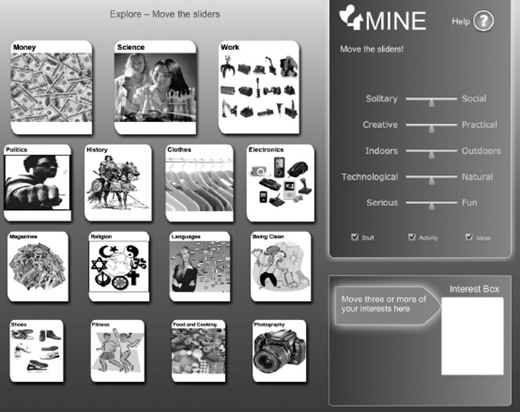
Participants explore their own interests by arranging and rearranging these 60 cells using five sliders. Each slider is labeled with an interest parameter describing a dimension of experience. The five interest parameters are: creative—practical; social—solitary; serious—fun; technological—natural; indoors— outdoors (see Figure 1). The slider labels are not designed to have antithetical qualities but are used to describe bounded dimensions of commonly understood experience. For example, creative and practical are not direct opposites, but are used to create boundaries for the potential preferences of an individual as part of the process of exploration.
Each of the 60 interest cells has embedded values (1-11) that relate to a position on each of the five sliders. When the exploration screen is opened the sliders are all set to the midpoint and the 15 interest cells that most closely match these slider positions are visible. Moving a slider changes the arrangement of the interest cells so that those interest cells most closely matching the slider settings come onto the screen. In this way the sliders control the visual ordering of each interest cell in the exploratory space on the screen. This process creates an environment where interest cells become more or less prominent to the user, depending upon the position of the sliders. The five sliders are an application of the dynamic query process (Pearce et al., 2011; Shneiderman & Plaisant, 2010) that is, each change of a slider setting is a separate query to the set of 60 interest cells which results in a direct reordering of the interest cells. The process is fluid, animated and set in real time.
Students were invited to “explore and select what you are, or might be, interested in”. When ready to select an interest cell, participants dragged the cell and dropped it into their interest box in the lower right hand corner of the display, indicating that the selected object, activity or idea is one of their interests.
The exploratory process embedded within the MINE tool allows participants to nominate what they readily identify as their interests. In addition, the interface and its exploratory engine allow the user to discover objects, activities, or ideas with which they may not have previously engaged, but which might interest them. This provides the possibility that the process of engaging with the MINE tool can trigger an interest.
When a participant has selected no fewer than three and no more than eight interests, they move on to a screen that provides an opportunity for expression of any peculiar or uncommon interests not included in 60 interest cells of the exploration screen. Participants can add their specific interest or interests directly. At this point they confirm their nominated interests.
After confirming their set of interests, a screen presents rating scales designed to gather information on affective and experiential dimensions associated with their interests. Five-point Likert-type rating scales were used to measure affective responses. The instruction was to provide a rating from not at all (0) to all the time (4) to indicate how they feel when engaging with the interest content. Rating scales were applied for seven affects: happy, excited, proud, frustrated, anxious, hopeful and sad. Similar 5-point rating scales were used to indicate aspects of experience associated with interest content: how long they have had the interest; how frequently they engage with the interest content; how much effort is required; and how absorbed they become while engaged. In addition a text box was available allowing students to elaborate on features of their chosen interest. These comments provide additional material to illuminate the context and character of the students’ interaction with their chosen interest content.
Initial analyses suggest that the MINE tool has acceptable reliability and validity (Ely et al., 2012b). For example, as part of a test-retest procedure over 2 months, data from 66 students (40 boys, 26 girls) from the same demographic using the MINE tool demonstrated that there were similar overall distributions of the selected interests for both Time 1 and Time 2. With respect to test-retest stability, there were 115 pairs of responses from the 66 participants where the same interest cell was selected on both occasions and the correlation between these pairs of duration responses (how long they have had the interest) was 0.60 (p < 0.01). In addition, there was a slight but statistically significant increase in the mean for duration of interest consistent with a lag of 2 months.
A key to the validity of the MINE tool is that students explore the pool of interests. If students only choose interests from the 15 that are visible when they open the exploration screen, this would suggest that no exploration had occurred. More than 80% of students selected one or more interest cells that were not on the initial screen indicating that they had gone beyond the content of the initial screen and explored the wider set of interest cells.
All data collection sessions were conducted during class time at individual workstations or laptops after an instructional tutorial by the researcher. The entire process took between 15 and 40 minutes.
RESULTS
An overview of the content of the interests selected by the students is presented first. This establishes what the students are interested in prior to reporting analyses of the affective responses associated with their selected interests.
Interest Content
Participants were asked to “explore and select what you are, or might be, interested in.” The MINE procedure was set to require selection of a minimum of three interests and a maximum of eight, and the mean number of interests selected was 4.86 (boys: 4.72; girls: 5.14). The total number of interests selected by the 213 students was 1,036. All but 3 of the 60 interest cells available through the exploration screen were chosen by at least one participant. Global warming, the environment, and being an individual were the three nonchosen interest cells. The most frequently chosen interest cell, electronics, was chosen by 50% of the participants. Other frequently chosen interests were outdoor sport, fitness, game consoles, and money.
For the purposes of analysis, selections from the 60 interest cells were aggregated into a smaller number of mutually exclusive and collectively exhaustive categories according to whether the set of interests could be considered to be a more generic class. Comments students recorded when given the opportunity to elaborate on their interests were used as an aid in allocation of interests to categories. This process generated seven categories:
Computers and electronics—interests that involved digital media (e.g., computers, game consoles, electronics).
Sport and fitness—all interests that involved physical activity for the purpose of recreation or fitness (e.g., dancing, outdoor sport, fitness).
Stuff—interests that involved collecting objects, or acquiring possessions (e.g., toys, clothes, shoes).
Ideas—interests denoting investigative, expressive or creative pursuits (e.g., science, reading, history).
Social—interests that involved interpersonal interaction and relationships (e.g., friends, family, peers).
Money—a single interest cell category. This was retained as a separate category as this interest made up approximately 8% of all interest nominations.
Hobbies—miscellaneous, low frequency interests. All of the interests grouped in this category were selected by only a small number of respondents and the content did not fit any of the other groupings. This group consisted of the following interests: going to the beach; keeping a pet; song writing; mixing and DJ; eating junk food; playing music; singing; listening to music; food and cooking; movies; photography; sleep; theater; watching television; and, work. Although each of the interests making up this category were selected infrequently (fewer than 3% of the total for each), when grouped together they became a relatively large category.
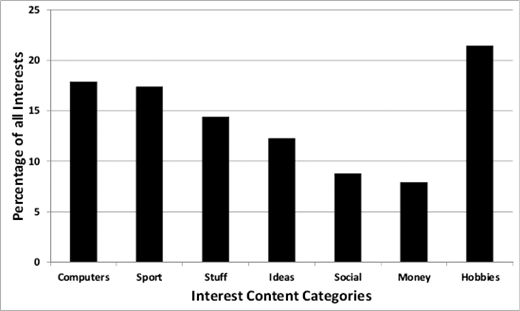
For each of these seven content categories the percentage of the 1,036 interests nominated by the 213 participants is displayed in Figure 2.
The disparate collection making up the hobbies category was the most frequently occurring category suggesting the diversity of adolescents’ interests. Following this the most commonly reported categories were computers and electronics and sport and fitness. Particularly noteworthy from an educational perspective is the less frequent nomination of interest content grouped in the category of Ideas than the more popular computers and sports. The Ideas category of content was closely associated with school subjects and component interest cells were selected by very small numbers of students: science (2%), reading (0.5%), history (0.5%), religion (2.5%), politics (0.5%), space (1%) and languages (1%).
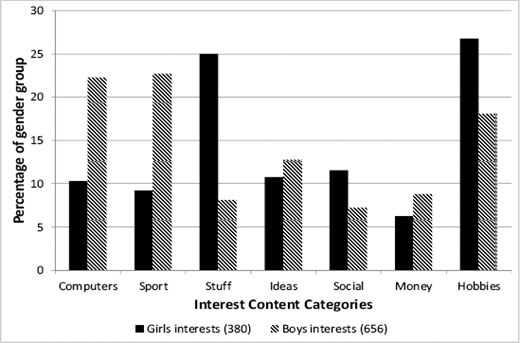
By reducing the large number of interests to seven mutually exclusive and collectively exhaustive categories it was possible to test for contingencies between interest content and gender using chi-square analysis. However, it should be noted that each student selected on average four interests and so although the categories are mutually exclusive, in this analysis there is not complete independence of students and interests. Significant interest category and gender contingencies were observed [χ2 (N = 1036, df= 6) = 108.935, p < .001], with the adjusted standardized residuals indicating that five of the seven content categories showed patterns of association with gender. The results are displayed in Figure 3.
Girls were significantly more likely than boys to nominate interest content categorized as stuff, social, and hobbies, while boys were more likely than girls to nominate sport and fitness, and computers and electronics. These patterns of interest content are consistent with what is generally known about young adolescent gender preferences (Lupart, Cannon, & Telfer, 2004). At the same time it is noteworthy that there was no significant association between nomination of interests grouped in the Ideas category and gender.
Interests and Affect
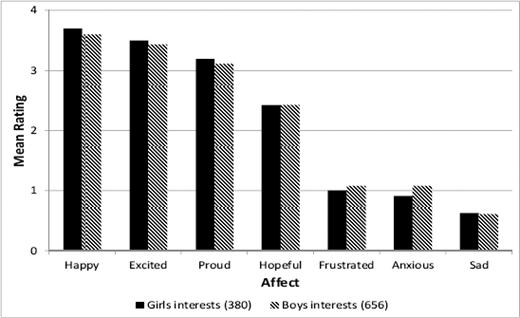
Figure 4 presents the profile of mean affect ratings for the interests nominated by the boys and the interests nominated by the girls. As shown in Figure 4 there was little difference between the mean ratings for the boys and the girls on any of the affect terms and MANOVA confirmed that there was no significant gender effect [F(7, 205) = 1.29, p > .05]. Not surprisingly, the mean ratings for the positive affects happy, excited and proud were high for students’ interests. Mean ratings for the positive affect hopeful were lower than the other positive affects but were still above the midpoint of the scale. This suggests that feeling hopeful is associated with interests but not to the same extent as feeling happy, excited and proud. The mean rating for the three negative affects, frustrated, anxious, and sad were all low indicating that they were unlikely to be a major part of the affective experience generally associated with interests. However, these means do indicate that negative emotions are sometimes associated with students’ interests.
Mean ratings from the seven affect scales were then calculated for each of the seven broad interest content categories and both means and standard deviations are presented in Table 2. The overall affect means and standard deviations for all interests are included for comparison.
Inspection of the mean ratings in each of the columns in Table 2 shows that for all content categories the mean ratings showed a consistent pattern. The pattern is one of high feelings of happiness, excitement and pride, moderate feelings of hopefulness, and minimal feelings of frustration, anxiety and sadness. Mean ratings for happy, excited and proud, the three high positive affect terms, were generally above 3.0 on the 0-4 scale. The only exception to this was the computers and electronics content category with a mean rating of 2.70 for proud. Mean ratings for the positive affect hopeful were all above the midpoint of the scale (2.0) but were not as high as the other three positive affects. Simultaneously, the mean ratings for the negative affects were uniformly low. The highest mean rating for frustrated (1.26) was for the computers and electronics category. For both anxious and sad, the Ideas category had the highest means with mean ratings of 1.32, and 0.70 respectively.
The overall standard deviations and the standard deviations for each content category indicate that the lowest variability within the categories was associated with the positive affects of happy and excited, and with the infrequently experienced negative affect of sad. The largest variability was for hopeful across all of the categories with a particularly large standard deviation for the category concerned with collecting objects or acquiring possessions, stuff.
The low frequency of adolescents nominating interests classified in the Ideas category has already been noted. In addition, it is noteworthy that the mean ratings for positive affects for this category which consisted of investigative, expressive or creative pursuits were all slightly lower than the overall means. In addition, for hopeful, the mean was slightly higher than the overall mean. The negative affects anxious and sad were higher than the overall means, while frustrated was close to the overall mean.
A multivariate analysis of variance was conducted to test for significant differences between the affect ratings for the content categories. Gender was included as a between subjects factor. The results indicated that there was a small but significant multivariate effect of content category [F(42, 6102) = 2.11, p < .001, partial η2 = .01] but no significant gender effect or gender by content category interaction effect. The associated univariate effects yielded small significant effects for happy [F(6, 1018) = 2.35, p = .03, partial η2 = .01] and excited [F(6, 1018) = 2.27, p = .04, partial η2 = .01]. As is to be expected when these main effects, although statistically significant, were very small, the associated Sheffe contrasts did not yield significant differences between any of the pairs of affect terms. The only significant univariate effects were between content categories for proud [F(6,1018) = 4.57, p<.001, partial η2 = .03] where the mean rating was significantly lower for the content category of computers and electronics (M = 2.70) than for the categories of sport and fitness (M = 3.46), hobbies (M = 3.23), and money (M = 3.26). As the partial η2 values indicate all of these significant effects were very small.
In short, the pattern of affective experience ratings was consistent; a combination of high positive affects and low negative affects, irrespective of whether all of the selected interests were considered, whether separated into two sets on gender lines, or whether distinguished by broad content categories. However, within this overall pattern there was individual variability and this was particularly pronounced when students were making ratings of how hopeful they feel when pursuing their interests.
DISCUSSION
The picture that emerges from these results is that the positive affect component of interests consists of feeling happy, excited, proud, and to a lesser extent hopeful. This confirms the propositions advanced by Fredrickson (2001) identifying enjoyment and interest as positive emotions associated with creativity and problem solving, and Rathunde and Csikszentmihalyi’s (1993) finding that undivided interest supports the development of talent in adolescents. The strong levels of happy, excited and proud that were typically associated with most of the nominated interests, and equally likely across gender and content categories, suggests that these feelings are likely to be a core component in the personal organization of knowledge, value and affect components that Hidi and Renninger (2006) propose make up the structure of interest. When these same interests are distinguished in terms of their duration (how long they have had the interest), a similar profile of affect is observed (Ely, Ainley, & Pearce, 2012a). Hence, there may be less differentiation than might be expected in profiles of affect associated with different phases of interest as defined by the Four-Phase Model of interest development (Hidi & Renninger, 2006).
Our findings are consistent with and extend previous findings on positive emotions in academic settings. While interest and enjoyment have often been associated together in relation to learning and achievement (Ainley & Hidi, in press), links with feeling proud and hopeful deserve stronger emphasis. According to Pekrun and colleagues (Elliot & Pekrun, 2007; Pekrun, Frenzel, Goetz, & Perry, 2007) both hope and pride are positive emotions generated when students focus on successful outcomes of learning or achievement activities.
Pride is retrospective and is experienced when students reflect on something that has been completed successfully. Personal agency is critical to feelings of pride so it is important that students are able to attribute their successful achievement to actions they have performed. Success that comes without personal agency, according to Weiner (2007) is not accompanied by feelings of pride. The close association between pride and enjoyment seen in the results of the present study is consistent with definition of pride in achievement settings as “the pleasure of accomplishment and the pleasure of positively evaluating the self” (Elliot & Pekrun, 2007, p. 61). Tulis and Ainley (2011) found that feelings of pride accompanied enjoyment and excitement following experiences of both success and failure with an individualized mathematics program among students who had high mastery achievement goals and a positive orientation to learning from their mistakes. These findings highlight the importance of a sense of personal investment, a sense of self-worth and self-efficacy for learning.
While pride is retrospective, hope involves looking forward and is experienced when students appraise that they are likely to be successful in an endeavor. Like pride, hope involves a sense of personal agency. As Snyder and colleagues (Snyder et al., 2002) have demonstrated in their longitudinal study of college students, hope involves having well-defined learning goals and a sense of control over means to reach those learning goals. Hence, hope is a very constructive emotion for learning. While not reported as frequently as feeling happy, excited and proud, the moderate levels observed in this study and the wider individual variability between interests suggest that this may be an important area for further investigation. Knowledge of how students’ feelings of hope may be encouraged and supported in achievement settings will provide a strong counterpoint in the achievement literature where currently more attention has been given to negative feelings of hopelessness, particularly as they result in the development of learned helplessness (Peterson, Maier, & Seligman, 1995).
Negative affect such as feeling frustrated, anxious and sad were reported infrequently in relation to students’ interests. As with the positive affect hope, there was considerable variability in students’ ratings for two of the negative affects—frustrated and anxious. This pattern suggests that negative affect does not play a major part in the overall structure of interests. However, when negative affect does occur as part of the affective structure of some interests, the usual approach and exploratory behavior is likely to be tempered or constrained and often associated with internal conflict.
Evidence of deviations for individual students from the overall profile can be informative. Earlier it was noted that interests grouped in the Ideas content category (investigative, expressive or creative pursuits), were not nominated frequently and this may reflect the particular sample of students participating in the research. These students came from schools catering predominantly for low socioeconomic areas and these schools had lower than average scores on national literacy and numeracy measures. The slightly higher than average means for the negative affects anxious and sad may well be indicative of negative affects activated in the context of school curriculum. On the other hand, the mean for hopeful with its agency and forward looking characteristics is something teachers can build on. At the same time, the strong positive affect associated with other interest content categories can be used to generate scenarios for learning activities and stimulate productive engagement strategies.
In sum, students’ interests are associated with a complex combination of affects. Positive feelings, happy, excited and proud, are core affects which are highly likely to be supported with feeling hopeful. Negative affect in the form of feeling frustrated, anxious or sad are less likely to be part of the affective structure of students’ interests but when these do occur they are likely to impact students’ engagement with learning activities.
Interest-Based Learning
In the rationale for this research it was argued that knowledge of the dynamic processes that combine when interest is activated might be used by teachers to personalize learning activities and curriculum choices in the service of greater student engagement with learning. Knowledge of the content of students’ interests can be used to individualize students’ learning experiences. Walkington, Sherman, and Petrosino (2012) using an intelligent tutoring system personalized the context for algebra problems to improve understanding of abstract algebraic representations. For example, when students indicated interest in sports, story scenarios incorporating sports content were used. Because interest focuses attention and supports persistence with information-seeking and knowledge acquisition, this interest-based form of presentation of learning in algebra engaged students and was associated with significantly increased learning. If we interpret Walkington et al.’s findings in the light ofthe profile of affect that emerges from our data, the effectiveness of the interest based problem scenarios in part can be attributed to the energy and sense of agency inherent in feeling happy, excited, proud, and often hopeful. The personal agency aspects of pride and hope point to the need to also personalize learning activities to be within a range of competence that students can achieve with persistence.
One common classroom scenario is for students to be given choice over topics for project work. But for some students, especially those who are disengaged, making such choices can be problematic. An exploratory tool such as MINE invites students to explore a range of current and potential interests and can be used to facilitate interest-based topic decisions. For example, in a small, rural school, ninth-grade students were given the opportunity to participate in an individual 12-week project, the topic was based on their own interests. A small group of academically unmotivated and disruptive students were identified by teachers as needing special assistance in generating their project topic. These students were given an opportunity to explore possible interests using the MINE tool. The process of exploring their own interests and the generation of interest profiles allowed for a discussion and brain storming between students and teachers. All students subsequently went on to choose a topic based upon their own interests. Selected project topics ranged from “making a film about dirt bike riding” to “building LEGO for charity.”
For the cohort participating in the present study the profile of affect across gender and content was very consistent. While these findings need to be confirmed with other samples before wider generalization is made, the consistency of the affect profile can be used to explore variations observed for individual students. In addition, knowledge of the content of an individual student’s interests has the potential to provide new and often surprising information to teachers.
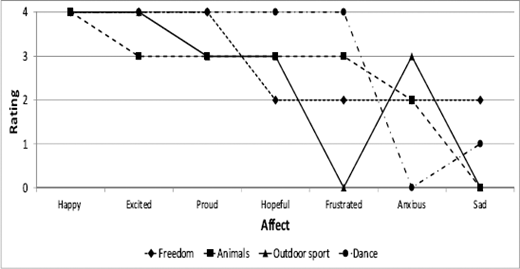
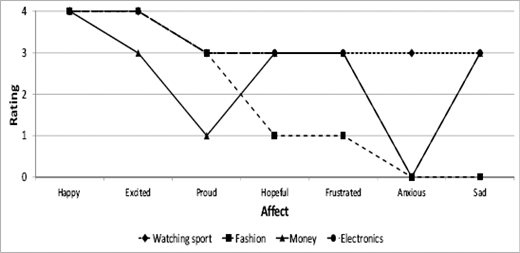
Profiles of the affective responses of two students, Mohammed Nguyen O’Brien and Julia Fatima Lee2 are shown in Figures 5 and 6 allowing comparison of their individual responses with the overall pattern from the total sample.
To illustrate the individuality of affective profiles we compare each profile with those reported by the total sample and identify important features that differ from the overall profile.
All four of the interests nominated by Mohammed were given ratings of 3 or 4 for feelings of happy, excited and proud. All of his interests received ratings for hopeful of 2, 3 or 4, which is consistent with the variability across the sample. On the other hand most of the ratings for the negative affect frustrated are considerably higher than the overall group profile with the exception of outdoor sport. If we examine the profile for his interest in dance, this interest was associated with the highest positive ratings for happy, excited, proud and hopeful suggesting that this is an interest that might be used to personalize a range of curriculum activities. Positive feelings were coupled with the lowest possible rating for anxious and the highest possible rating for frustrated. The brief text comment suggests an interpretation that his opportunities to engage in and develop this interest in dancing are very limited. Limiting factors may be due to his personal circumstances or frustration concerning his competence. These are the sorts of issues that teachers may choose to investigate and pursue further with him.
Julia reports feeling happy and excited when engaged with all of her interests. Her profile also indicates that three of her interests, but not always the same three, had relatively high ratings for proud, frustrated and sad, but no feelings of anxiety. The incidence of her feelings of frustration and sadness are much higher than the overall level in this sample. Particularly informative are the deviations within her profile for specific interests. For example, the feelings of being frustrated, anxious and sad in relation to her interest in watching sport suggest that for Julia, engaging in sports, which is an activity she associates with the company of her father, might not be the most appropriate area to link with learning activities. On the other hand Julia’s positive feelings coupled with very low levels of negative feelings when engaging with her interest in fashion, indicates that a teacher may choose to engage Julia productively in fashion-based learning activities. In this context the low level of hope and the lack of agency this implies may need to be addressed for her to maximize these learning opportunities. Julia’s interest in electronics, which her text comments indicate specifically means digital devices, combines strong positive feelings with being frustrated and sad. Her lack of anxiety may indicate she is receptive to learning activities relating to this domain.
Profiles generated from MINE can provide teachers with new and surprising information concerning their students’ interests. For example, Mohammed’s teachers may not have been aware of his interest in dance while knowledge of this interest might be used to support engagement in a number of areas of the curriculum from investigative writing assignments, project work, creative arts and physical education. The same is true for Julia. Knowledge of her interest in a range of digital forms subsumed under her expressed interest in electronics might be employed to engage her with a range of curriculum areas. Her text comments suggest a number of facets of electronics that may be used by a teacher to engage her and to extend her knowledge into wider topics concerning digital media.
Interests may grow, may diminish or may remain stable over time. Interests profiled as part of the MINE process are reported by individuals like Mohammed and Julia at one point in time, in a classroom environment. The MINE process allows for exploration of potential interests and each time students sit down to explore their interests, the content and some of the affective features of their interest profiles may differ. Patterns of change in interest content categories, or emphasis within categories will be a fruitful avenue for characterizing the development of interests across the middle years and for understanding the resulting pat
terns of engagement and disengagement in academic subject matter.
CONCLUSION
As expected there were differences between boys and girls in the content of their interests. The place of enjoyment and excitement in emotion profiles associated with selected interests was confirmed. The important contribution of these findings has been to identify the place of feeling proud and hopeful, in the combination of positive affects that student experience when engaging with their interests. The profile of affect we identified was consistent across interest content and gender groups. Individual profiles of the affective responses associated with two students’ chosen interests point to some of the directions that this information might be used to inform teachers in their curriculum planning.
School, at its best, is a stimulating environment for students. However, for substantial numbers of students, particularly in the middle grades, this is not always the experience. Knowledge of the range of positive feelings active when students engage with the content of their interests will assist practitioners to understand how interests might be used to personalize learning activities and curriculum choices to provide opportunities for students to develop the knowledge and the understanding that goes with deepening interests.
NOTES
In Australia, secondary education begins roughly at age 12, corresponding to Grade 7 in the United States.
All names have been changed to preserve confidentiality and comments made by these two students are unedited.