


We need a model that can guide middle school educators to implement multiple literacies (multiliteracies) so prevalent in today’s global economy, but how can this be successfully accomplished in today’s schools? As a result of content analyses, regular classroom observations, and interviews, the researchers document a framework for multi-literacies implementation on a schoolwide level that not only engages students in learning, but also in skills that will authentically prepare them for the global economy, regardless of economic background. The results suggest that successful implementation of multiliteracies begins with an in-depth vision statement created, accepted, and reexamined on a regular basis by all stakeholders. The vision is then implemented through research-based best practices like student research supported by teachers as facilitators and extended by community resources and mentors, often as first hand sources. Students are encouraged to think, create and develop their own ideas and follow them through to fruition as mastery learning of required content, including skills to objectively and respectfully critique their work and the work of others. Our model also prescribes what we know to date to be best for those whose lives can actually bring about the change, the students themselves, with the help of teachers, parents and others. If young adolescents are to succeed, they must be free to explore and develop deeper levels of consciousness than those required to recall facts, to perform on uniform tests, and to be quantitatively productive. School environments must be dialogue and literature rich, encouraging students to develop the capacity to question and to recognize the standards of excellence in written, verbal, and visual forms, yet still consent to the having of wonderful ideas.
As we enter Lighthouse Middle School (pseudonym) we see five students from a multiage fifth/sixth grade class huddled in the hallway outside their classroom discussing how to present their research findings on Mayan countries to a multicultural club at the local university. What resources should they include in their presentations? Bill suggests pictures collected from the Internet, while Gail recommends direct quotes from Mayan refugees she interviewed through email. Across the school, another group assists their kindergarten “Buddies” researching the habitats of an endangered bird of prey uniquely chosen by each kindergartener. Young Peter wonders how the red-tailed hawk captures its food while Matt, his older Buddy, uncovers research that answers Peter’s question. The two are then off on another search to differentiate hawk claws from other birds of prey. Though the school’s computers are outdated, they are in use often and for credible research.
Beyond Peter’s and Bill’s groups are many such groups dispersed throughout the school discussing, debating, critiquing, and evaluating the important work of learning. Like Rousseauian romanticism, the atmosphere is thick with reverence for the innate imagination and creativity of children grappling with the construction of their own identity. Interwoven among the groups are teachers, parents, mentors, and first-hand community resources that facilitate student learning within the cocoon of both large and small group communities. Literacy sources are multiple and rarely is learning supported by a textbook. Support from multiple sources results in an explosion of final products celebrated by all stakeholders.
Yet unlike Rousseau, learning is in line with current trends to align curriculum with state standards. When testing time rolls around, these students demonstrate high levels of math, reading, and language arts proficiency. In addition, discourse among the groups is guided by core academic and character principles to produce their best work.
Later in the day, we read through a school document that outlines the use of “claymation” (video animation using clay figures) created by students to demonstrate their research results and we look through a booklet published by another class of students documenting the history of their metropolitan city. The booklet includes articles researched, written, and illustrated by the students. Most of their research sources were first hand and included photographs taken and developed by the students.
The nature of literacy is changing. While lawmakers debate over preferred instructional methods including the potential for narrowing curriculum based on high-stakes testing (Cochran-Smith, 2002), young adolescents outside of the classroom demonstrate high levels of literacy engagement that challenge educators to critically evaluate traditional modes of literacy instruction (Alvermann, 2000; Alvermann, Moon, & Hagood, 1999; Carroll, 2004; Dillon, O’Brien, Wellinski, Springs, & Stith, 1996; Gee, 1996; Hull & Schultz, 2002; Leu, 2000; Luke, 2002; Moje, 2000; O’Brien, 2001; 2003; O’Brien, Springs, & Stith, 2001; Smith & Wilhelm, 2002). We recognize that young adolescents struggle with middle level texts (Smith & Wilhelm, 2002; Tovani, 2000) yet we are challenged to comprehend increased student use of computer-mediated, digital, and visual communications that reach beyond the traditional conventions of linear speech and written text (Alvermann, 2001a; 2001b; Alvermann & Hagood, 2000; Alvermann, Moon, & Hagood, 1999; Bean, Bean, & Bean, 1999; Chandler-Olcott & Mahar, 2003; Gee, 2003; Levin & Arafeh, 2002; Leu, 2000). Advancing technology opens doors to learning that involve literacies far beyond the single textbook classroom. Evidence from a growing number of researchers is suggesting that many students who are failing at literacy in school are highly literate outside of school (Dillon, O’Brien, Wellinski, Springs, & Stith, 1996; Hull & Schultz, 2002; Moje, 2000; O’Brien, 2001; 2003; O’Brien, Springs, & Stith, 2001; Stewart, O’Brien, & Saurino, 2003). This evidence points out the complexity of the literacy issue and undergirds the need for schools and researchers to develop models that encompass the current multi-faceted nature of literacy. “Adolescent literacy, however, does not currently have clear models for implementation in classrooms” (Stewart, O’Brien, & Saurino, 2003, p. 2). This study investigates one middle school in which multiliteracies flourish naturally, and tries to determine what elements of their curriculum and pedagogy might constitute a model that encompasses the multiple forms of literacy in prevalent use today by early adolescents, a Multiliteracies Model for the Middle Grades.
Methodology and Data Sources
Content analysis was the research methodology used to determine the presence of certain terms or concepts within documents obtained from Lighthouse Middle School. We utilized Weber’s (1990) content analysis methodology “that uses a set of procedures to make valid inferences from the text” ( p. 9) to analyze Lighthouse School’s Vision Statement and evaluative 2003-2004 Accountability Study documents supplied by school, based on predetermined categories from a review of multiliteracies literature.
During the initialcontent analysis of the documents, we noticed words, phrases, themes, and concepts that had not appeared in the initial category coding, and began simple coding of these as categories of interest so that we could return to the documents utilizing ethnographic content analysis (ECA) (Altheide, 1987) and explore these emerging categories in more detail. Unlike traditional content analysis in which categories are predetermined, ECA is oriented to construct categories qualitatively in order to develop analytical constructs appropriate to the study (Altheide, 1987). We were most interested in uncovering patterns of social and multiliterate interaction that were not predetermined.
In addition to the analyses of texts, interviews and video tapings were conducted and analyzed. These analyses were beneficial in the descriptive development of all the elements that became the framework for the multiliteracies model. Our guiding research What elements of a coherent multiliteracies model exist in the various practices of Lighthouse Middle School?
The Need for A Multiliteracies Model
According to Luke’s (2002) description of the implementation of classroom multiliteracies practices:
There is a beginning vocabulary for talking about the media, but no conceptual or practical frameworks for guiding the mix or blending of print and nonprint, visual, and non-visual engagements. We were likely to see kids answering questions on worksheets using the web as a library resource, or confused and mixed multimedia projects, such as one that involved looking up different multicultural costumes on the web, making puppets out of pipe cleaners, and then presenting them as a developmental drama exercise to the class. Even among the 36 schools designated last year to implement “multiliteracies,” we have found a lack ofresources. There is simply a vacuum in professional development resources and materials for dealing with the new literacies, beyond the button-pushing, introductions to instructional technology (IT). (p. 197)
Four years after Luke’s account of multiliteracies implemented in public schools as nothing beyond instructional technology, we wonder how much teachers are currently utilizing multiliteracies on their own. We see our pre-service teachers text -messaging, listening to I-pods, surfing the Web, creating multimedia presentations and WebPages, assisting second career pre-service teachers with on-line technologies required for their courses, etc. Have the teens that were proficient with multiliteracies grown up to become today’s young teachers? We think so, and they need models to implement multiliteracies in their classrooms.
Framework for Our Multiliteracies Model
Our research provided us with the basic elements that we developed into a framework for our Multiliteracies Model. Within the framework, literacy becomes an activity that takes advantage of and builds upon the wonder students have for their world. Natural curiosity leads students to investigate their world and words become the means for communicating that wonder. Words are learned within the context of meaningful tasks, and words may take on multiple forms whether text is written or read, digitized or printed, in discourse or graphics, in movement or song. Multiple concrete and complex experiences are essential for meaningful learning (Caine & Caine, 1991). Ideally, learning should be created in which all involved are curious about what they need to know. Experiences should be open to student examination and exciting to pursue. Students should also have a variety of choices about what they read and write about, one text or a conical of texts, in an attempt to lead to authentic learning. Students should also be afforded opportunities to use their literacy skills socially in the wider community. By extending learning out to the community, students share the wonder of learning. Based on this basic philosophy, our Multiliteracies Model developed in the four levels of Vision Statement, School Community, Global Community, and Presentation Galas as illustrated in Figure 1 and described below.
Vision Statement
All fourteen tenets of the “middle school concept” (NMSA, 2003) are a good place to begin any middle school’s vision statement, but must be owned by all stakeholders in the creation of the school’s statement. The middle school concept is a departure from the “separate subject areas” textbook format. Our research continues to support meaning-based brain-compatible instruction that moves from “whole to parts” and is an important area for delineation in a Vision Statement.
Accordingly, curriculum is implemented through thematic-oriented projects that require the use of several disciplines and multiple forms of literacy in an interactive “application.” School-wide and complementary classroom themes, implemented within each classroom, reinforce the interconnected and interdependent nature of school as a community. Exhibitions of student work move beyond work hung in the hallways or student-centered bulletin boards. When students take ownership of their work and determine how that work will be presented, results become exemplary presentations utilizing multiple forms of literacy and celebrated by the school community. Technology is integrated throughout the curriculum at each grade level. Teachers are well prepared in teaching reading and writing, cognitively guided math instruction, inquiry based science as well as integrated curriculum aligned to state standards.
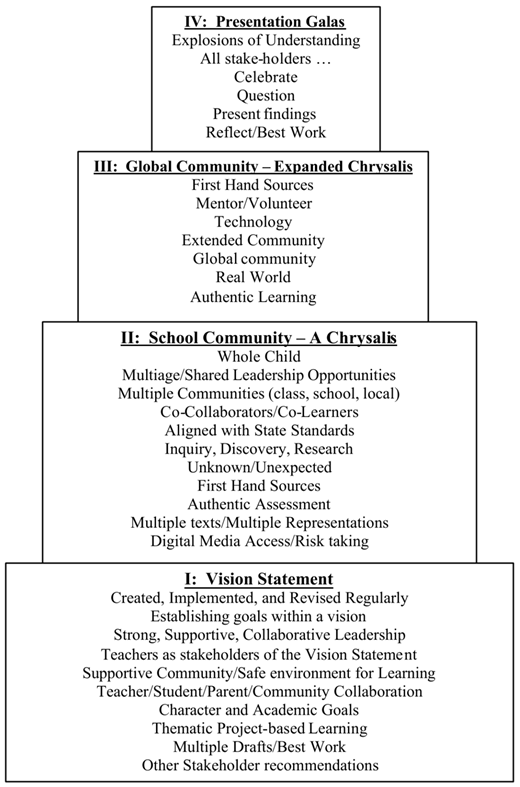
The four levels of a Multiliteracies Model for the Middle Grades
The four levels of a Multiliteracies Model for the Middle Grades
“Rote” learning is replaced with an emphasis on the higher-level cognitive skills of problem identification, information gathering, analysis, solution development, evaluation, revision, and application. This does not mean under-attending to the “basics” in the traditional sense. Well-designed themes and projects provide compelling attraction to the basics and also serve as authentic measures and detailed expressions of what students learn and are able to do, a fundamental concept of performance-based standards.
Establishing goals within a vision. Other elements relevant to a multiliteracies model are goals thoughtfully constructed within the school’s vision. Based on curriculum standards, one goal might be for students to be able to differentiate between criticism that is analytically “objective” and criticism that is “subjective.” They are taught to place appropriate value on each type of criticism through criteria developed by themselves, teachers, peers, parents, and community members, thus incorporating multiple sources of related feedback. An effective tool in attaining this goal might be through conferences.
Other vision statement goals may include multiple and critical revisions of student and teacher work. Students are taught that excellence is an evolutionary process requiring patience, innovation, acceptance of change, and naturally includes multiliteracies. Another multiliteracies goal might be for students to be able to give and follow directions in written, spoken, pictorial, and mathematical symbols. Following directions includes questioning, and evaluating the end result. Giving directions involves thinking in reverse to arrive at strategies for presenting information clearly and concisely for proper execution of the tasks by others. What evolves as these goals are applied to all areas of the curriculum is a philosophy of curriculum implementation and a pedagogy that includes multiliteracies.
School Community - A Chrysalis (Cocoon)
The second category of our Multiliteracies model, and by far the most prevalent concept within the model is the school as a “community.” Community in this sense expands beyond the walls of the school to include the community at large. Individuals from the greater community contribute to the educational programs either by volunteering their time in the classroom, presenting their expertise to students, or by participating in community-based programs. Community within the protective chrysalis of the school involves the establishment of multiple communities that range from small peer editing groups, to classroom communities, to the entire school community. Teachers are challenged to get students out into their communities to investigate real-life issues or problems, and in the process, develop solid academic and life skills. Classroom expeditions and community-based programs are tightly aligned to curriculum standards so students can make authentic connections in their learning. Activities extend beyond the classroom and students serve, learn about, and connect with their community.
The process allows students to experience and learn in real life settings. Adults provide guidance for students modeling care, compassion, and respect for diverse learning styles, backgrounds, and needs. Students collect data inside and outside the school walls that complement their area of study. Data are analyzed and reflected upon. Community specialists are brought into the classroom to complement the curriculum. “Crew” might be a term used to identify classes, staff, or any group working together on a project. The concept places responsibility on everyone to function as part of a crew carrying their own weight in all endeavors.
Collaboration. Student projects include a balance of individual effort and group collaboration to insure mastery of important basic skills, content, and interaction skills. Though projects approximate much of real world experience, individual work should also be highly valued. Students do not work in isolation; sharing ideas, skills, resources, and critiques benefit individual effort and find equal importance in collaborative activities. Community collaboration is based on the concept that as information increases and the world becomes more complex, it is increasingly important to develop multiliteracies skills that meaningfully describe reality and clearly convey thought. Effective use of language is power in the age of information, and as the value of information in isolation diminishes, the learning of language suffers when fragmented into is olated components.
Collaboration is not limited to students; instructional staff should be involved in collaboration with each other and making presentations to other groups of educators. The entire curricular model might be built on a collaborative model, one that encourages continuous professional growth on a continuum of interest, need, and specific criteria. Teachers and leaders model a culture of reflection, critique, revision, and collaboration. Teachers and administrators participate in regular collaboration time that includes such things as discussing curricula, instruction, assessment, and other relevant topics. Decisions are made in a collaborative manner based on the needs of the students and the school.
Curriculum and instruction. Educational programs might be formed around two main themes derived from research in brain theory and the science of systems integration. Brain research validates the concept of “developmentally -appropriate” timing and the requirement for “meaning” to accompany experiences to develop higher thinking skills. “Systems Theory” reverses the historical tendency to view reality as a set of divided and static components in favor of dynamic and interconnected subsystems that are embedded within one another. Together, these themes advance teaching and learning strategies beyond fact-based memorization routines to concept-based critical thinking processes.
These concepts should drive the entire instructional component of educational programs and also provide themes around which the vision of a school’s philosophy, core approaches, educational program, standards, assessment, and governance structures are unified. A major goal of such a program is school averages at or above the school district averages on state and standardized tests. A variety of strategies and integrated thematic instruction allows for seamless compatibility with every component of educational philosophy. The techniques within the strategies are non-prescriptive, attempting to maintain long-term relevance and consistency for students, parents, and teachers. The strategies are comprehensive and meaning-based, emphasizing application of knowledge and skills in creative real world contexts. Each design also seeks to relate the learning experience to contemporary issues important to making meaningful connections that transcend the obvious, a crucial process in the development of “intrinsic reward” as the basis for a lifelong desire and capacity to learn.
Curriculum design begins with the building of basic skills and an awareness of potential sources of creativity. Programs build through exposure to a variety of media and types of performance. Students are encouraged to pursue areas of interest as a function of desire, potential, and achievement. Students might spend their school year designing a yearlong service project with the guidance of a community mentor and a community-based program director. Parents provide opportunities to share their interests and talents with the students, and participate in the learning experience with their child. Each classroom nurtures a culture of reflection, revision, and quality. This journey toward continuous improvement expects that students work hard until they have achieved high quality work products, no matter how much time and effort it may require. Criteria established during class discussions are combined with state achievement standards to define high expectations for student work of all types, with literacy performance expectations among the highest, incorporating a variety of multiliteracies.
The rules of dialogue and respect for differing positions are a reality in the construction of identity and purpose while fostering the virtues of tolerance and respect. Students apply their mastery of the language arts to thematic activities that include all other curriculum areas. Reading, writing, speaking, listening, and viewing activities should include, but are not limited to:
| ♦ Balanced Literacy | ♦ Songs/lyrics | ♦ Comprehension |
| ♦ Phonics Program | ♦ Student publications | ♦ Compare and Contrast |
| ♦ Directed Reading | ♦ Self-evaluation | ♦ Application |
| ♦ Technical Reading | ♦ Current events | ♦ Summarization |
| ♦ Home Reading | ♦ Drama productions | ♦ Learning logs |
| ♦ Reading Aloud | ♦ Sharing experiences | ♦ Research papers |
| ♦ Voluntary Reading | ♦ Prediction | ♦ Expository/creative |
| ♦ Novel Groups | ♦ Setting | ♦ Persuasive/technical |
| ♦ Story Mapping | ♦ Characterization | ♦ Speeches |
| ♦ Vocabulary Reading | ♦ Plot Development | ♦ Project presentations |
| ♦ Journals | ♦ Conflict Identification | ♦ Debates/Discussions |
| ♦ Poetry | ♦ Theme Identification | ♦ Film review |
Assessment. The attainment of school and learner goals is demonstrated through quantifiable measures where required and possible. Other goals are demonstrated through anecdotal documentation gathered throughout the year and during annual programmatic audits. In addition to required standardized testing, multidimensional assessment and evaluation tools suggest the degree to which the school and its learners attain their goals. These goals are a point of beginning and are refined or expanded through parent and community meetings, conferences, surveys, evaluations, and student data. Alternative forms of assessment are utilized frequently including portfolio assessment. Portfolios contain a collection of work that is valuable and assessable to multiple audiences, shows growth and best work, addresses the state achievement standards, represents the uniqueness of the individual student, and shows evidence of revision, reflection, and use of multiliteracies. Teachers, students, and parents use portfolios in curricular decisions as they compile, review, and reflect upon its content.
Another assessment tool involves project-centered, experiential, and inquiry approaches to learning that require a comprehensive way to monitor children’s academic, social, emotional, and physical progress. Students frequently study and discuss exemplars of quality work, from both professional and student sources, as well as reflect on the elements of exemplary projects. From these discussions, students generate, with their teacher’s guidance, standards of excellence against which they measure their own work as well as the work of their peers. Public displays of student work allow families and members of the broader community opportunities to review and assess student work as well as to provide valuable feedback that might be called “Presentation Galas.” Examining and assessing student work allows teachers to discover what students know and how they learn, and provides teachers with information on how to improve instruction and curriculum. Critique and revision become habits of mind for the entire school community.
All of the approaches are designed to promote brain-compatible learning environments as a prerequisite to realizing full academic, social, and personal achievement. Additionally, these approaches expand the educational context to include organizational structures and social environments that reflect the world at large. Therefore, students experience the school environment as an authentic extension of the reality of everyday living with direct applicability to constructive participation in any area of experience.
Individualized instruction. The concept of “developmentally appropriate practice” is inferred throughout the structure of educational programs to be critical to the conditions under which effective learning and personal growth occur. The adaptability of a flexible educational program to the individual student rather than requiring rigid conformity of the student to the program is of central concern. This learning concept requires curriculum to contain a “zone of challenge” for each child’s developmental stage and rate of growth, providing stimulating engagement without being inappropriate or brain antagonistic in relation to individual needs. This concept is embodied in an emphasis on project-based service learning, which allows each student to express understanding in ways that are limited only by individual ability rather than by the design scope of the activity or assessment.
Multi-age classrooms. One philosophical belief is that fragmentation of society is related to the divisions imposed by organizational structures. These divisions are also believed to be pronounced in the grouping of students by age. A single-age classroom was thought to be contrived and unnatural in comparison to the reality of families, neighborhoods, social, and work environments. As a result, our model embraces the organizational concept of multi-age classrooms as a developing continuum of educational experiences and social relationships. The multi-age classroom is compared to that of a family unit; one that lives and learns together over an extended period of time. In their multi-age setting students stay with the same teacher for more that one year allowing time for students to foster trusting relationships with teachers and peers. Like a family, the multi-age classroom is comprised of differing age groups who work and play together, as well as learn from and with one another. The setting also provides a multitude of abilities, gifts, talents, and cultures, as well as different ways of coming to know something. In this type of setting, diversity is recognized and celebrated within the groupings, promoting multiple forms of literacy.
The multi-age grouping is not comprised of children who are at the lower percentile of one group and the upper percentile of another. Nor is it a combination classroom in which students from two or more grade levels are placed together for budgetary purposes and where one teacher teaches separate curriculum for each grade level represented. Rather, it is an organizing principle that allows for heterogeneity with each traditional grade level represented.
Service learning. An extended environment of service- oriented learning includes collaboration between partners enhancing the areas of initial educator preparation, continuing professional development, curriculum development, and research and inquiry. It is a more inclusive view of the range of expertise that can be combined to enrich the teaching and learning process. A more intensive level of involvement is sought from community partners to accommodate a greater range of student learning experiences. Work-based service learning opportunities (e.g., job shadowing, internships) and mentorship relationships are cultivated with area businesses, arts professionals, government, and civic organizations. Such experiences are tailored to individual student’s interests and needs and are included in performance and portfolio components reflecting service learning, work-based learning experiences, and mentorship.
School community partners representative of the breadth of student involvement are also included in the portfolio review and evaluation process. Continuing professional development for teachers and administrators is expanded through a collegial relationship among school community partners. Collaboration with university and other professional partners provide additional opportunities for teachers to strengthen their ability to contribute to their students’ learning. Recent scholarship and research is consistently reviewed, discussed, and selectively incorporated into operating policy and practices. Collaboration among the partners focuses on improvement of the education and school experience of students. Curriculum development and enrichment becomes an integral part of the process of continuous improvement of successful teaching and schooling. Mutual deliberations among partners (including students) concerning problems with student learning and possible solutions strengthen the educational program.
The dynamic learning community created by the interaction of partners raises questions and provides opportunity to conduct research that promotes educational renewal for both the school and its partners. The spirit of inquiry and collaborative research enriches teaching and learning by reinforcing the habit of reflection, especially concerning issues of planning, teaching, assessing, and incorporating multiliteracies.
Development of the whole child. The final element is a culmination of all the other programs and processes. It is a primary goal of the multiliteracies model and emphasizes that learners develop exemplary character traits through whole child approaches and overarching design.
Social responsibility is fostered through the service and community building components, and learners recognize, value, and reflect upon personal character traits. “Whole child” and “community building” approaches demand a deeper connection between students and staff in order to assess needs and integrate the educational program. The multi-age environment offers each student sufficient time in the company of the teacher and other students to allow a more effective “developmentally-appropriate” delivery of education and building of community environments. Students learn to identify the talents and specialized knowledge of themselves and others as a vital part of teamwork in order to accomplish tasks. Cooperation and collaboration with others requires civility and respect for different approaches and abilities. Knowing when to lead and when to follow the lead of others is critical to effective group cooperation.
Good decisions are the result of equally good information and thoughtful consideration that includes weighing the value of some information over other information. Students gather evidence and information relevant to some action, evaluate the “pros and cons” of possible results, and then choose an appropriate course of action. Students learn that their actions have consequences for others and illustrate the importance of conscience. Students also learn the concept of a system as a set of elements so related as to form a unit or organic whole. They distinguish between closed systems as orderly and predictable, and open systems as self organizing and essentially unpredictable because they are sensitive to feedback. Examples of the former include musical composition, games and their rules, procedures designed to solve problems, and mechanical devices. Social systems, weather, ecosystems, and living organisms are examples of open systems. Students learn to understand that closed systems can be accurately described and their behavior predicted with high degrees of certainty while open systems can be described only partially and their behavior predicted only in terms of probability.
Development of the whole child often results in a product or performance. The creative arts, such as acting, performing musical compositions, and orally interpreting literature are examples of multiliteracies that expand the concept of product. This illustrates the multidimensional nature of consciousness, and that each dimension contributes unique meaning to the experience. Students are taught to reflect on an event and respond in ways that are most appropriate to convey the essence of their experience. Points of view sometime take the form of a controversial issue having a social, political, environmental, or economic nature. Students gather and integrate information from a variety of sources and then use that information to create an argument for or against a position, point of view, or issue. Students also assumed the role of opposing views to better understand their own position as well as that of others in order to formulate thorough explanations for both. The rules of dialogue demonstrate the importance of the exchange of ideas in non-threatening forums for the purposes of developing self-confidence and an ability to openly question alternative perspectives. The model inherently requires the presence of more routine values such as honesty and respect within concepts that encompass a broader view of success in life and work as an extension of the school community.
Global Community – Expanded Chrysalis
Through first-hand sources, mentors, volunteers, and technology, the school community can extend to the global community. A benefit of the model is the expanded protective chrysalis provided by the supervision, direction, and assistance of teachers and other stake-holders that allows students to experience the world in the protective environment of the school community.
First-hand sources, mentors and volunteers. Multiliteracies emerge from school communities connected to the world through first hand sources, mentors, volunteers, and internet connections. Projects might provide service to a larger community, and promote a curiosity of learning for the sake of knowing. Teachers are risk takers as well, experimenting with new forms of expression, and struggling with digital media and other technology that might become tools to provide and record interchanges with distant schools or individuals as data for discussion and reflection. Language and multiliteracies become tools for students to understand the world around them while all involved become proficient with multiple ways of knowing and understanding.
Local and global communities. Community in our model may be viewed from various vantage points. In addition to the school community there is the local community and the global community. Through the local community, students utilize first hand sources that share knowledge either in the classroom or in the field, some of whom may become part of the school community. Classroom mentors might include the local game and fish ranger setting up a tank of bass, trout, or other local fish. Students record data that benefits the community and once the fish are large enough, students assist the ranger as the fish are released into a local waterway. A local archeologist might discuss his work, answer student questions, and describe the importance of archeological finds as he places them in students’ hands. Later, the students meet with the archeologist out in the field to experience what it is like to go on a dig.
Businesses and organizations are excellent global authentic sources. Students learning about the Mayan civilization turn a business letter assignment into an opportunity to interview first-hand sources. Such sources may include a Catholic school for Mayan Refugees from Guatemala, or the Foundation for the Advancement of Mesoamerican Studies (FAMSI). In our model students do not learn about the world through pictures in textbooks, but instead go out into the world and experiences it first hand or through multiliterate technology. Learning takes place through multiple texts, field trips, camp outs, online searches, digital media, and expert speakers from various fields. Instruction takes place through discussions, Socratic seminars, group interaction, and utilizes smart boards, computers, interviews, and videotapes. The possibilities seem endless, but one thing you do not often find in a classroom is a single textbook.
Presentation Galas. For schools to implement multiliteracies successfully, students must be successful. For students to be successful, they must be as engaged with multiliteracies inside school as they are outside of school, with consideration for the developmental readiness, needs, and interests of all students. Our model supports multiliteracies as tools used to fulfill learning goals established by collaboration and supported by students, teachers, parents, mentors, and other stakeholders to create high quality products unique to their imaginations. Levels I, II, and III of the model support students in a protective chrysalis as they ascend to the final layer of the model, the Presentation Gala.
Presentation Galas are opportunities for students to present their final products and celebrate academic excellence that is inextricably linked to the continual encouragement of other students, teachers, parents, and the community. Closely connected are multiliteracies embedded into every aspect of the final products. High expectations certainly lead to higher achievement, but beyond higher achievement our model seeks higher engagement.
Explosions of authentic understanding. Final products are molded as student understandings evolve. Integral to the final layer of our model is students’ sense of accomplishment. Multiple drafts and revisions support students as they create their best product(s). Products from our research include presentations to a local multicultural club of knowledge gained regarding the rise and fall of the Mayan Civilization, a scale model of Tikal donated to a local Hispanic Museum, and student-created greeting cards with drawings of endangered birds sold to raise money for the local bird sanctuary. The scale model includes intricately painted Mayan Hieroglyphics and museum quality dioramas that surround the scale model. Other products include Civil War student presentations to other classrooms while remaining in character as a Civil War soldier, and editing and expanding the school’s web page. Whatever the end products are, the end results are student understandings congealed into an authentic product created for and celebrated by an authentic audience.
The Challenge of a Multiliteracy Model
It is our hope that the research results represented in our Multiliteracies Model contribute to our knowledge of how to effectively implement multiliteracies in the middle grades. Though the model is structured with key elements that seem universal, it is important to emphasize that any educational model must be revisited and continually updated as a working document. The nature of multiliteracies is that they are ever changing, and if we are to keep our students on the edge of literacy development, then change becomes the only constant. The “present,” even with its standards and assessment-oriented accountability, demands a level of flexibility that is united with children’s unlimited sense of wonder, and cannot progress with a return to the rigidity of the past nor through strictly prescriptive paths in the future. We must therefore begin with a prescription for a renewed level of trust in, and development of those who dedicate their lives to improving the future for children, teachers and administrators. If education is to move to the call for improvement through action, then teachers and administrators must be free to invest in the future through innovation in the present.
Our model also prescribes what we know to date to be best for those whose lives can actually bring about the change, the students themselves, with the help of teachers, parents and others. If young adolescents are to succeed, they must be free to explore and develop deeper levels of consciousness than those required to recall facts, to perform on uniform tests, and to be quantitatively productive. School environments must be dialogue and literature rich, encouraging students to develop the capacity to question and to recognize the standards of excellence in written, verbal, and visual forms, yet still consent to the having of wonderful ideas.

