


The purpose of this exploratory study was to develop and test a strategy to support middle grade students’ persuasive writing skills. The sample included 52 eighth-grade students who were either proficient or struggling writers. The students were randomly assigned to either receive training on a graphic organizer designed to scaffold effective persuasive writing (experimental group) or receive training on a strategy to scaffold reading comprehension (control group). Students were posttested on relevant writing and reading skills. Results indicated that, regardless of initial writing skill level, students who were trained in the persuasive writing strategy were able to implement the steps with fidelity and constructed higher quality written essays than students in the control group. Implications and application to middle school language arts classes are discussed.
Scaffolding the Persuasive Writing of Middle School Students: An Exploratory Study of the Decide Graphic Organizer
The middle grades are a critical time for students to learn about writing, as a support form of expression. To a far greater degree than the elementary grades, middle school language arts curricula generally introduce students to abstract ideas (e.g., justice, responsibility, persistence through hardship) that can be meaningfully considered from multiple competing and complementary perspectives (Irvin, 1995; Martens, 2007). Further, curricula generally emphasize more complex features of the grammatical structure of English (Chirichello, Eckel, & Pagliaro, 2005). As a consequence, writing emerges as important during these years because these broad learning goals are simultaneously supported by students’ efforts to write in narrative, informative, and persuasive genres. Further, students need to build writing competence so that they are prepared for successful writing in the higher grades and for an information-based economy in which clear, written communication is essential for employment in many positions (Achieve, 2004; Graham & Harris, 2013; Nippold, Ward-Lonergan, & Fanning, 2005).
Unfortunately, many students struggle with writing in middle school. For example, approximately 73% of eighth graders scored below the proficient level on the National Assessment of Educational Progress (National Center for Education Statistics, 2011a). These difficulties have serious consequences. Data from 12th grade are identical (i.e., 73% below proficient), suggesting that difficulties in the middle years are not automatically resolved for students, likely because writing serves as a tool for students to process increasingly challenging ideas as the grades progress, leaving little time for remedial instruction (Graham, Capizzi, Harris, Hebert, & Morphy, 2014; Graham & Perin, 2007). As a result, many students fail writing examinations required for high school graduation, which can occur as early as ninth grade (e.g., Minnesota) (Larson, 2010). Many more (24–29%) need remedial writing courses when matriculating at college, which can delay their progress toward a degree (Appleman & Greene, 1993; Chen, Wu, & Tassoff, 2010). Consequently, middle school has emerged as an essential period for developing writing skills, as students begin to write more frequently to complete a variety of different writing activities such as, writing to understand material that was read, writing to summarize lectures and discussions, as well writing to describe, inform, and persuade (Graham et al., 2014).
Persuasive Writing Difficulties among Middle Grade Students
Of the several genres of writing—including persuasive, narrative, and informative—targeted in the Common Core State Standards adopted by 45 states, persuasive writing appears particularly challenging for students (Gleason, 1999; Graham & Harris, 2013; Nippold, 2000). Indeed, NAEP data reveal that only 14% of eighth-grade students score at the competent or effective level on this aspect of writing, and this figure rises to only 23% among high school students (National Center for Education Statistics, 2011b). Persuasive writing is unique, in that it advances an argument by stating the claim, supporting it with evidence or data, using reasoning to link the evidence with the claim, and anticipating and defending against counterarguments, all with appropriate word choice and grammar (Schen, 2013; Toulmin, 1958). As such, persuasive writing requires substantial critical thinking in order to analyze information (often gleaned from multiple sources), discern and describe the nuances of an issue, develop a cogent but comprehensive argument, and anticipate and respond to relevant counterarguments (Achieve, 2008). There are myriad reasons why persuasive writing might be challenging for middle school students, including issues of low prior knowledge and/or motivation (Hidi & Boscolo, 2006). However, four important factors within this larger constellation of issues are particularly important and have clear implications for how to help students become better persuasive writers.
First, persuasive writing includes constructing not one abstract argument, but a series of related arguments, as well as acknowledging and defending against potential opposing views. Simultaneously considering and integrating these various points creates considerable cognitive load, which adolescents are just beginning to be able to manage (Byrnes, 2007). Indeed, this kind of abstract thinking is a hallmark of Piaget’s formal operational thought stage, which begins in young adolescents and rarely completes until high school (Vatterott, 2007). Thus, there is substantial variation across middle school attendees (typically ages 12-15) in their skills in reasoning about multiple, potentially incongruent abstract ideas, and these variations impact their skills in writing about this content.
Second, metacognitive skills allow writers to consider their own thinking. Writing, and particularly persuasive writing, requires students to use higher level cognitive and metacognitive skills to analyze whether their stepwise sequence of abstract points flows well and is clearly described for the reader, whether they need more or different evidence to support their points, and whether their arguments are organized in ways that others can read (Mason & Graham, 2008; Roth, 2000). Middle school students are still developing metacognitive competence, continually strengthening these skills through experiences at school, home, and with peers (Schneider, 2008).
Third, good writers have sophisticated verbal skills; they know a wide range of words, understand the pragmatics of their use, and are able to combine them in syntactically appropriate ways (Boyd, 1995; Nippold, 2000, Roth, 2000). Yet many adolescents are still building competence in these areas (Uccelli, Dobbs, & Scott, 2013), especially around persuasive rhetorical strategies. For example, Ritter (1979) performed a foundational study in which middle and high school students endeavored to verbally persuade another student to pledge money to a walkathon. Findings revealed that, while many students had difficulty with the task, middle school students used the least sophisticated communication strategies, particularly around making effective requests and using appropriate reasons to support their requests. Similarly, Nippold and Ward-Lonergan (2010) found a significant correlation (i.e., .35) between verbal reasoning and middle school students’ written persuasive essays, as students with stronger verbal reasoning skills generated more reasons to support the central argument in their persuasive essays.
Finally, attention management matters for writing. Writers must sustain and flexibly shift their own attention for significant spans of time, often when working alone without peers to provide helpful models. Specifically, as students write, they must remain focused and direct their attention to pertinent portions of the writing task, consider word choice and sentence structure, monitor their work for errors and typos, manage handwriting, and think ahead and reflect in holistic terms so the paper as a whole is coherent (McCutchen, 2006; Olinghouse, 2009).
In short, middle grade students are building the foundational competencies that underlie effective writing. At least for some of these young writers, relative immaturity in one or more of these areas may make writing more challenging. A key implication is that effective supports around persuasive writing might scaffold students’ skills around crafting, evaluating, organizing and communicating abstract ideas.
Effective Supports for Enhancing Persuasive Writing in Middle School
Because struggling writers use ineffective strategies in part due to cognitive and meta- cognitive limitations (Roth, 2000), supports or scaffolds that help students work around these challenges have the potential to improve persuasive writing. The idea of a scaffold is rooted in Vygotskian theory, although not proposed by Vygotsky himself (see Wood, Bruner, & Ross, 1976). A scaffold helps a learner overcome a challenge or knowledge deficit in order to perform more like an expert. An optimally effective scaffold is tailored to both the task and the individual needs of the learner. Further, it allows the learner to progress in competence so that the scaffold can be removed, or faded away, over time. Where writing is concerned, scaffolds targeting strategy instruction can be highly effective among young adolescents. Troia and Graham (2003) have recommended that students should use strategies to help guide their writing because a strategy “provides children with cognitive routines for managing the complexities of writing tasks” (p. 80). Moreover, scaffolds helping students master strategies can help young writers learn metacognitive skills such as goal setting, self-instructions, and self-monitoring with writing tasks, which in turn, enable them to produce longer and qualitatively better essays (De La Paz & Graham, 2002). For example, in one intervention, middle school students with disabilities were taught how to find the main idea in expository and narrative passages, as well as how to monitor their understanding of the content presented around that main idea (Jitendra, Hoppes, & Xin, 2000). Fading occurred by discontinuing both verbal and visual cues after the second training session. Over the remaining sessions, students continued to make gains from pre- to posttests and outscored students in a control group who were not taught the strategy.
Regarding persuasive writing, an effective support or scaffold would absorb some of the demands related to abstract thinking, metacognition, verbal reasoning, and attention management, and help students use their skills with greater efficiency. Such a scaffold would (a) clarify for students that they need to identify a central argument, provide support for that argument, and then address counterarguments. In addition, it would (b) help students keep track of where they are in the process. Finally, it would serve in this capacity both (c) before a draft is written (i.e., during planning), as well as (d) after the draft is written (i.e., during revision).
Currently, there are a number of tools in the field that middle school teachers could use to support students’ writing. Among these, graphic organizers can be particularly helpful. These tools help students visually represent ideas (rather than just holding them in shortterm or working memory) and organize them prior to and during writing (Gersten & Baker, 2001). According to Baker, Gersten, and Scanlon (2002), when used during writing, graphic organizers serve two purposes: one, they provide students with an action plan that can be used to address the demands of the task; and two, they provide a common language that both the teacher and students can use to enhance the quality of written compositions. When used in conjunction with an effective scaffold or procedure carefully matched to a complex task, graphic organizers can serve as a mediator to provide the needed scaffolds to help struggling writers during the writing process. In this way, they help students carry out critical steps in the writing process.
However, at present, there are no widely available tested scaffolds for supporting persuasive writing, including among middle school students. The field would benefit from a tool designed to suit both the unique demands of persuasive writing tasks and the specific cognitive challenges that middle school students face. In addition, such a tool should be feasible in classroom settings.
The Decide Scaffold for Middle Grades Persuasive Writing
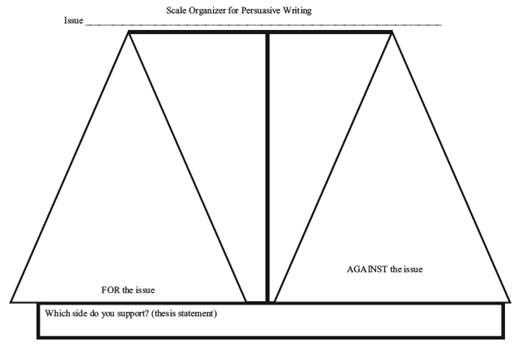
In this study, middle grades students were taught to use a novel persuasive writing strategy: DECIDE (see Figure 1). A graphic organizer guided students in developing a five- paragraph essay that contained: an opening paragraph that discussed the issue and contained the student’s thesis for choosing a side; at least three main reason paragraphs, each of which contained three or more supporting details; and a concluding paragraph (or closing paragraph) that restated the student’s thesis, main reasons to support the student’s thesis, and ended with a recommendation to self, others or the world or described actions that the student planned to take as a result of their position on the issue.
Along with the organizer, the DECIDE scaffold provided students with an action to complete at each step. The first three steps, DEC, focused on generating the basic ideas for the essay. In the first step, D, students were asked to DRAW out at least three reasons for and against an issue by writing those reasons directly on the graphic organizer. In the next step, E, students were asked to EXPLAIN which side they chose as a result of his/her position on the issue on the issue by writing a thesis statement (again, writing directly on the organizer). In the next step, C, CHOOSE, students were requested to choose the order of presentation of ideas from the organizer by placing a number next to each idea to note where they would write it in the essay. In the I step, INK, students were prompted to write their ideas in the form of an essay. Specifically, students wrote an opening paragraph that contained the thesis and three paragraphs that corresponded to each reason listed in the organizer. Next, in the D or DRAFT step, students were to write the concluding paragraph that summarized their thesis, reasons for supporting it, and a suggestion or recommendation for others. Finally, during the last step, E, EDIT, students were to edit their essay carefully and correct any issues related to sentence structure, grammar, punctuation, capitalization, and spelling. Figure 1 represents the graphic organizer that was used in the study to represent the DECIDE strategy.
Current Study Research Aims
The purpose of this exploratory study was to assess the effects of the DECIDE scaffold, including a graphic organizer, on middle school students’ persuasive writing skills. Specifically, this study sought to address two key questions:
To what degree did students who used the persuasive essay strategy produce better organized essays than students using traditional writing skills? We anticipated that the DECIDE graphic organizer would produce better organized essays.
Would students who used the persuasive essay strategy produce longer essays than students using tradition writing skills? We expected that the DECIDE graphic organizer would produce longer essays.
Method
This study incorporated an experimental-control study design to assess the effects of a persuasive writing strategy among middle school students (Kerlinger, 1986). Students were first matched and then randomly assigned to either the treatment or control group. Specifically, 52 eighth-grade students were randomly assigned to either a control or experimental condition, resulting in 26 students in each condition, of whom 15 were proficient writers and 11 were struggling writers.
Access to Classrooms, Participants, and Setting
After obtaining institutional board approval, the researchers received approval from a middle school principal to meet with three Language Arts teachers to see if they would agree to participate in the study. The primary investigator, a university professor, met middle school Language Arts teachers who provided their support and agreed to implement the study in their classes. The primary investigator provided these two teachers with parental consent and student assent forms that were sent home with students to their parents. After 2 weeks, only students who returned both signed forms were permitted to participate in the study.
The study took place in a middle school that serves more than 800 students and is located near a large metropolitan city in the midAtlantic region of the country. All of the students were enrolled in one of three language arts classes, and the research took place in these classes. The composition of the sample was 65.4% European American, 21.2% Hispanic American, 9.6% African American, and 3.8% Asian American.
Procedure
Assignment to Condition. The investigator divided students into two groups. Students with 2010 state scores of 200 or above (the cutoff for proficient level writing) and with a passing grade in English (i.e., A, B, or C) were considered proficient writers. Students with scores below 200 and/or with a nonpassing (i.e., D or F) English grade were considered struggling writers and were verified by their teacher as students who had difficulty with written assignments. Next, within these tiers of writing skill, we employed random assignment to conditions to ensure that students trained in DECIDE were highly similar to peers who did not receive the training, helping to clarify the unique effects of DECIDE apart from child background factors or school demographic variables that can confound research in education.
Student Training. The study took place over four sessions. Over the first three sessions, students were trained in 45-minute sessions on either the persuasive writing strategy or a paraphrasing strategy of similar complexity. All of the training components were kept equivalent in terms of length of training, use of a strategy with a mnemonic (i.e., DECIDE or RAP strategies—see below), and similar rehearsal/practice components. Following the three training sessions, all students were assessed during one 90-minute class session. During this fourth session, students were timed and given 45 minutes to write a persuasive essay about whether junk food should be banned from the school. They were given lined paper and a written prompt about junk food. They were told that they would have 45 minutes to write a five paragraph persuasive essay and that everyone was expected to complete a prewrite (e.g., brainstorm and organize ideas) on the blank space below the writing prompt. After students completed the essay, they were given the remaining 45 minutes to read a short passage and answer 10 comprehension questions about the passage.
Experimental Group Training. Students in the experimental (DECIDE) group were trained in small groups of 8-10 students. During the first training session, the researchers described the rationale for the strategy, strategy steps, and students worked as a group to complete the graphic organizer based upon a training persuasive essay prompt. During the second training session, using the strategy and completed organizer from the previous session, students wrote a persuasive essay. In the third training session, students were given a new prompt, discussed reasons for and against the issue, recorded responses on the organizer, and wrote a practice persuasive essay using the strategy steps and the organizer.
First session. In particular, the first training session entailed the researcher describing the purpose of the persuasive writing strategy, DECIDE, and the organizer. Students discussed why it was important to be able to write persuasive essays and how persuasive skills could be useful in and out of school. Next, the researcher and students discussed the components needed for a well-written persuasive essay. These components included a well-written thesis statement indicating which side of the issue the student intended to support, reasons for and against each side of the issue with examples, and a conclusion which restated the side chosen, reasons to support that side, and elaboration of these reasons. In this discussion, students were reminded that in a persuasive essay students are trying to convince the reader why the student chose a particular position of an issue. Students were also reminded that there is no right answer when writing a persuasive essay, but that their choice must be backed by detailed evidence that includes reasons and examples. Also, during the training, the researcher explained the four types of arguments (i.e., logic, emotion, ethical, and legal) that can be made in support or opposition to an issue.
Next, the researcher provided students with a copy of the strategy steps and a writing prompt (i.e., should teachers require students to do homework?), along with the graphic organizer. The researcher first reviewed the handouts and then demonstrated the strategy steps to students. During the demonstration, the researcher pointed out that the first three steps are used for the prewriting on the graphic organizer and the remaining three steps are used when students construct their persuasive essay. The researcher emphasized the first three prewriting steps because past research has shown importance of prewriting as an effective component of writing strategies and techniques (De la Paz & Graham, 2002).
Beginning with the first strategy step, DRAW, the teacher listed on the board the reasons FOR homework (e.g., it provides students with practice from the day’s learning, helps build confidence, allows students to continue learning over a long break) and the reasons AGAINST homework (e.g., leads to satiation or loss of interest in a topic, may cause physical or emotional fatigue, students are denied “down time” or time to relax, may increase mental or emotional “pressure” on students). As the reasons were being discussed, students wrote them down on their own graphic organizer. In the next step, EXPLAIN, students were shown how to write a thesis statement and given several examples of thesis statements. Students were then asked to explain their side by writing a thesis statement on their graphic organizer. Next, students were told to CHOOSE (i.e., choose the order of ideas to present) by writing numbers next to each reason so they could be presented in a logical order. The investigator next reviewed the remaining three steps of the strategy with students and told that they would complete them the next day. Students handed in their completed graphic organizers, were told to study the strategy steps for homework, and were dismissed from class.
Second session. The second session began with the investigator informing students that would be orally quizzed on the strategy steps and that they had 7 minutes to pair up a classmate and study the strategy steps. Next, the investigator asked students to recall the strategy steps from memory and went around the room asking students to recite individual steps. Once students were able to recite the steps orally, the investigator began the second training session. Students were provided with the graphic organizer that they previously completed and the investigator reviewed the remaining three steps (Ink, Draft, and Edit) with them. Beginning with the INK step, students were told to ink out (i.e., write) their ideas beginning with an opening paragraph that contained the issue, their thesis, and main reasons for choosing their side. Once students wrote the opening paragraph, they then drafted at least three paragraphs (i.e., one per reason) containing examples or supporting details in each paragraph. When they finished the three supporting paragraphs, they were instructed to DRAFT their conclusion. After, the investigator modeled a concluding paragraph, students wrote their own concluding paragraph that included a restatement of their thesis, reasons that supported their thesis, and a suggestion or recommendation to self, others, or the world about the issue (e.g., Now that I know how valuable homework is to my learning, I plan to work more carefully on it to help me learn information from classes). Finally, in the last step, Edit, were told to take a few minutes to edit their essay for errors in sentence structure, grammar, punctuation, capitalization, and spelling errors. When the investigator modeled this portion of the strategy, he provided examples of the different types of errors and asked to students to correct them.
Third session. During the third training session, students reviewed the strategy steps, described what to do in each step, were given lined paper and a new persuasive essay writing prompt (e.g., Should middle school students have a specific time to go to bed at night?), and used the strategy on their own to write a persuasive essay. During this session, feedback was given students to increase their fluency when using the strategy and graphic organizer. Upon completion, individual feedback was given to students in terms of their use of the strategy steps to create a five-paragraph persuasive essay.
Control Group Training. Similar to students in the experimental group, students in the control group were provided a treatment over 3 days via the paraphrasing reading strategy (Schumaker, Denton, & Deschler, 1984) that served as a placebo control (Adair, Sharpe, & Huynh, 1990). There were two main reasons why control group students were provided with a treatment. First, to reduce any Hawthorne effect that might have resulted from strategy training of experimental students, students in the control group were provided with a strategy under similar treatment (or time) conditions (e.g., both groups used a first letter mnemonic strategy, were trained over 3 days, and were required to memorize strategy steps), as others have done (Scheiter, Schubert, Gerjets, & Stalbovs, 2015). The second reason was to control for attention or novelty of the strategy training (Adair, Sharpe, & Huynh, 1989).
The paraphrasing strategy used the acronym RAP, which corresponded to the three components used in the strategy. Several studies have been conducted to assess the effectiveness of the paraphrasing strategy and have validated its benefits with struggling readers to improve their comprehension of text (Ellis & Graves, 1990; Hagaman & Reid, 2008; Lee & Von Colln, 2003). Specifically, students used the following three steps while reading: Read a paragraph; Ask yourself, “What is the main idea and details?” and Put the main idea in your own words (Schumaker et al., 1984). These steps were used with each paragraph of the reading passages. The purpose of the strategy is to aid reading comprehension by helping students find critical information (i.e., main ideas and details) in reading passages. The strategy, developed at the Center for Research on Learning at the University of Kansas, has been used by researchers and found to improve reading comprehension, on average, by 36% (Schumaker et al., 1984). Moreover, it has also been effective for increasing reading skills of students with reading problems in middle school and high school (Ellis & Graves, 1990; Hagaman & Reid, 2008; Lee & Von Colln, 2003).
First session. Similar to the persuasive essay strategy training, the reading strategy instruction took place over three training sessions during which students were trained in small groups of 8-10 students. Training procedures mirrored those of persuasive writing training in that during the first training session, the researchers described the rationale for the strategy and the strategy steps, and students worked as a group to find main ideas and details of paragraphs from reading passages. Like the writing strategy, this group was also asked to memorize the strategy steps and was provided opportunities to practice the strategy and receive feedback. All of the passages were approximately five paragraphs long and four hundred words in length. Prior to the study’s initiation, each passage was analyzed using both Fry graph and Flesh- Kincaid formulae and found to be at the seventh grade readability. This readability was chosen because, according to the classroom teacher, there were some students who struggled with reading.
Subsequent sessions. During the second and third training sessions, students used the strategy with a new reading passage and were verbally quizzed on the main idea and details, as were required to read and provide written responses to 10 multiple-choice questions. Feedback was provided to students when the 10 questions were reviewed in class. During the feedback portion of the training, the researcher had students review the particular portion of the passage that contained the information found in the question and answer.
Measures
Writing speed pretest. Writing speed or fluency was used as a pretreatment measure because of its established link to compositional fluency (Berninger & Rutberg, 1992), particularly among older students (Graham, Berninger, Abbott, Abbott, & Whitaker, 1997). Writing speed was assessed by administering a 90-second writing measure in which students wrote the entire alphabet as quickly as they could, alternating between the entire uppercase alphabet and then entire lowercase alphabet until they were told to stop writing (Berninger et al., 1992; Berninger, Mizokawa, & Bragg, 1991). For students in this study, the average writing speed of the group fell within the range of studies that examined the writing speed of middle school students (Graham, Berninger, & Weintraub, 1998; Hamstra-Bletz, & Blote, 1990; Phelps, Stempel, & Speck, 1985).
Essay Scoring. Students’ essays were scored in terms of quality and quantity. In terms of the quality, essays were scored to determine the quality of the thesis statement, the three supporting paragraphs, and the concluding paragraph (i.e., the three components of the DECIDE strategy). In addition, each essay was scored to determine the organization of ideas in and between paragraphs. The thesis statement was given a score of 0 to 3, where 0 indicated that no position was stated 3 indicated that a position was clearly stated and elaborated upon. Each of the three reasons was given a score of 0 to 2, with 0 indicating that no reason was provided and 2 indicating that the reason was clearly stated and elaborated upon. Similarly, the conclusion was scored on a scale of 0 to 2, with a score of 0 indicating that there was no conclusion provided while 2 indicated that the student restated their position and elaborated on it. Finally, each essay received an organizational score, where 0 indicated few or no logical connections between ideas, whereas 2 indicated a logical sequence of ideas from the opening paragraph through the conclusion.
In addition, students’ essays were scored for length by counting the number of words and sentences in the essays. Similar scales have been used in the past by other researchers, and the measures for this study incorporated various components from their rubrics/scales (Ferretti, MacArthur, & Dowdy, 2000; Jacobson & Reid, 2010; Page-Voth & Graham, 1999). Prior to scoring, two grad students, who were blind to the purposes and conditions of the study, were trained to use the rubric to score the essays. During the training, raters discussed each component of the rubric and practiced scoring persuasive essays that were used in a previous study. Each student scored 20% of each other’s scored essays to determine interrater reliability. Interrater reliability (Pearson’s r) for each component was calculated and found to be .92 for thesis statement, .89 for reasons, .93 for conclusions, .88 for organization, .97 for number of sentences, and .98 for the number of words in each essay.
Results
Experimental-Control Group Equivalency on Writing Speed
A t test was conducted to assure that the randomly assigned intervention and control group were equivalent on this pretest measure. Results found no significant differences between the two groups on writing fluency (i.e., experimental group: M = 109.23, SD = 43.17 and control group: M = 106.15, SD = 43.87).
Research Question 1: Essay Organization
For the first research question, a MANOVA was conducted with two between-subjects factors and three outcome measures for the first analysis. The between-subjects factors were student type (proficient writers versus struggling writers) and experimental condition (experimental/writing strategy vs. control/reading strategy). The four outcome measures were scores for a thesis statement, three supporting paragraphs with reasons, a concluding paragraph, and organization between paragraphs. SPSS for Windows was used for the analyses with the criterion alpha level set at .05 for statistical significance. As reported by SPSS, effect size is determined through the use of partial eta squared () and according to Stevens (2002) is equivalent to eta squared when the total sample size is 50 or more. Moreover, Cohen (1977) has indicated that coefficients of .14 or larger represent a large effect size.
The results from the first MANOVA revealed that experimental group × student type interaction was not significant. However, the overall main effect was found to be significant for both student type, Wilks’s Λ = .74, F(4, 45) = 3.87, p < .01, ; and experimental group, Wilks’s Λ = .62, F(4, 45) = 6.95, p < .001, . Further, follow-up analyses revealed a significant difference between the experimental and control groups on thesis statement scores, F(1, 48) = 4.41, p < .01, ; three supporting paragraphs with reasons, F(1, 48) = 38.61, p < .001, , conclusion, F(1, 48) = 6.45, p = .001, , and organization, F(1, 48) = 1.57, p < 01, . All differences favored the experimental group. See Table 1 for average scores of students in both groups.
Research Question 2: Essay Length
In a second MANOVA, the betweensubjects factors were student type (proficient writers vs. struggling writers) and experimental condition (experimental/writing strategy versus control/reading strategy) and were used across the two outcome measures of number of sentences and number of words per essay. Again, the between-subjects factors were student type (proficient writers versus struggling writers) and the experimental condition (experimental versus control). The results from this MANOVA revealed that experimental group × student type interaction was not significant. However, the overall main effect was found to be significant for both student type, Wilks’s Λ= .76, F(2, 47) = 7.32, p < .01, ; and experimental group, Wilks’s Λ = .83, F(2, 47) = 4.92, p < .05, . Further, follow-up analyses revealed a significant difference between the experimental and control groups on the number of sentences written, F(1, 48) = 9.64, p < .01, and number of words written, F(1, 48) = 6.30, p < .05, . See Table 2 for average scores of students in both groups.
In addition, a t test was conducted to assess differences between the two groups on reading comprehension scores (i.e., the experimental group was taught the persuasive essay strategy, where as the control group was taught the paraphrasing strategy). Despite the fact that the control group, who received the paraphrasing strategy treatment, scored slightly higher on their comprehension score [i.e., the average control group score was 68.46% (SD = 17.59) compared to the average experimental group score of 64.23% (SD = 17.48)], the t test revealed no significant differences between the two groups.
Persuasive Essay Quality Scores of Experimental and Control Groups
| Experimental Students(N = 26) | Control Students(N = 26) | |||
|---|---|---|---|---|
| Measure | M | SD | M | SD |
| Thesis Score | ||||
| Average writers | 2.69* | (.70) | 2.07 | (.83) |
| Struggling writers | 2.90* | (.32) | 2.33 | (.78) |
| Combined groups | 2.77 | (.59) | 2.19 | (.80) |
| Support Paragraph Score | ||||
| Average writers | 5.75* | (.58) | 5.00 | (1.36) |
| Struggling writers | 5.50* | (.85) | 2.75 | (2.14) |
| Combined groups | 5.65 | (.69) | 3.96 | (2.07) |
| Conclusion Score | ||||
| Average writers | 1.94* | (.25) | 1.36 | (.75) |
| Struggling writers | 1.60* | (.70) | .75 | (.96) |
| Combined groups | 1.81 | (.49) | 1.08 | (.89) |
| Organization Score | ||||
| Average writers | 1.94* | (.25) | 1.71 | (.47) |
| Struggling writers | 1.90* | (.32) | 1.42 | (.52) |
| Combined groups | 1.92 | (.27) | 1.58 | (.50) |
Significant at .05 level.
Persuasive Essay Quantity Scores of Experimental and Control Groups
| Experimental Students(N = 26) | Control Students(N = 26) | |||
|---|---|---|---|---|
| Measure | M | SD | M | SD |
| Sentences | ||||
| Average writers | 19.31* | (4.01) | 17.71 | (3.90) |
| Struggling writers | 17.50* | (3.21) | 11.42 | (6.02) |
| Combined groups | 18.62 | (3.76) | 14.81 | (5.82) |
| Words | ||||
| Average writers | 271.06* | (48.07) | 246.14 | (70.41) |
| Struggling writers | 223.30* | (60.37) | 151.25 | (92.32) |
| Combined groups | 252.69 | (57.09) | 202.35 | (93.04) |
Discussion
As reflected from the findings, students whose persuasive writing instruction was scaffolded using the DECIDE graphic organizers wrote better essays than those students who were not taught the strategy. Specifically, students who used the persuasive essay strategy wrote papers that scored higher in terms of the quality of thesis statements (i.e., experimental group average 2.77 versus 2.19 control group thesis scores), scored higher in terms of their supporting paragraphs (i.e., average experimental group score of 5.65 versus 3.96 for students in the control group), and scored higher in terms of their concluding paragraphs (i.e., average experimental group score of 1.81 versus 1.08 for control group students). Moreover, essays of students who were taught the persuasive writing strategy scored higher on organization.
In addition, the analysis found large effect sizes on all four of the aforementioned measures, with the largest effect size on the quality of students’ supporting paragraphs. Among struggling writers, the experimental group earned average scores that were twice as large as control group students (i.e., 5.50 for experimental students versus 2.75 for control group students). Similarly among struggling writers, scores from experimental students were twice as large as students in the control group.
Finally, in terms of quantitative differences, overall students on average wrote about four sentences more and approximately 50 more words in their essays. While the difference between the number of sentences written in essays between the experimental and control groups is not large, it does reflect a significant difference, and among struggling writers, students who were taught the persuasive essay strategy, these students wrote six more sentences than struggling writers in the control group. In terms of total word count, overall, students in the persuasive essay group wrote, on average, 50 more words than students in the control group. Among struggling writers, experimental students wrote, on average, 72 more words than students in the control group. These quantitative differences seem to confirm qualitative differences found between the experimental and control groups. Students not only seemed to write more sentences, but also wrote more details (i.e., words) in their essays.
One interesting finding was that there was no significant difference on the reading measure found between students in the control group (i.e., who received the paraphrasing strategy) and students in the experimental group. Even though students in the control group who were taught the reading strategy scored higher (i.e., 68.46%) than students in the experimental group (i.e., 64.23%), who were not taught a reading strategy, this difference did not reach statistical significance. There are two possible reasons why there was no significant difference found between students who were taught the reading strategy and those who were not taught the strategy. First, it is plausible that middle school students in both groups already had possessed the skills found in the strategy (i.e., the ability to locate the main idea and details in a paragraph and the ability to paraphrase this information). In fact, Williams (1993) found that not only can middle school students identify main ideas in stories, but even younger students (e.g., sixthgrade students) perform well on main idea tasks. However, given that both groups correctly answered just two thirds of items on the assessment, another issue may better explain these effects. It is possible that the measure used (i.e., 10 comprehension questions) was simply not sensitive enough to detect differences between the groups.
One issue raised by these findings is whether a highly structured approach to writing, such as the DECIDE strategy, might be limiting in some ways, particularly around creative organization of information. In recent years, some concern on this point has been raised about the five-paragraph essay, a strategy (much like DECIDE) with highly prescriptive suggestions about what writers should do first, next, and so on. Specifically, some research (see Seo, 2007; Smith, 2006) indicates that five paragraph essay structures may help students express a limited amount of information in a relatively clear way, but that this may come at the cost of an integrated argument across the three body paragraphs or an understanding of how to explicate arguments that demand more than three discrete points. We acknowledge this potential limitation with structured strategies such as DECIDE but agree with the work of Graham and Harris (e.g., Harris, Graham, Friedlander, & Laud, 2013), which suggests that these structured approaches serve as scaffolds onto which more complex variations can be grafted by educators in future. In other words, without this clear blueprint as a starting point, students—especially those with difficulties in writing and other areas—may not be able to cohesively weave arguments together in novel ways. Thus, it may be the case that techniques such as DECIDE are important, but not sufficient, stepping stones along the path to fluent and flexible writing, and that future work should explore ways to help teachers build on children’s competence with these strategies, adapting the approach in novel ways to result in more diverse but still effective approaches to writing. Furthermore, our use of the graphic organizer serves to support student writing by serving as a “mental hold” of sorts as student get their ideas down on paper and then transform these ideas into sentences and paragraphs (Scanlon, Cass, Amtzis, & Sideridis, 2009).
Implications for Practice
In terms of the implications for training students to use the persuasive writing strategy, teachers and others should train students to mastery. Through explicit instruction, individuals working with students should review each step thoroughly by modeling and demonstrating to students what is occurring in each strategy step. Students should understand not only the key words of each strategy step (e.g., draw, explain, choose, ink, draft, edit), but what action to perform in each step. It has been shown that explicit strategy instruction in writing can enhance the writing of students with writing difficulties (GMason & raham, 2008).
Another implication for teachers is to emphasize the importance of planning during training. The persuasive writing strategy was designed so that students spend a sufficient amount of time planning during the three prewriting steps (draw, explain, choose). Past research has shown that struggling writers of devote little attention to advanced planning (MacArthur & Graham, 1987); however, when students refrain from writing immediately after the task is introduced, and instead engage in prewriting (i.e., goal setting, brainstorming, and sequencing ideas), they are more likely to develop better, well-thought-out essays (GMason & raham, 2008; Troia, Graham, & Harris, 1999). Planning represents a critical step for struggling writers because it allows them to generate ideas prior to writing. In fact, Sawyer, Graham, and Harris (1992) found that when struggling writers used a planning strategy that allowed them generate notes prior to writing, these students performed as well as normally achieving peers. Finally, planning before writing may help struggling writers circumvent working memory disruptions associated with complex writing tasks (Kellogg, 1986; Troia, 2011).
A third practical implication for individuals working with struggling writers is to practice oral reasoning skills prior to writing, such as occurred during the training. Discussions centered around debating different sides of an issue allow students to hear different reasons for one side of an issue, counterarguments from the opposing side, and elaborations of different viewpoints. For struggling writers, these discussions will provide them with an opportunity to hear “model statements” (i.e., valid support statements for one side of an issue) and will provide the trainers an opportunity to provide feedback to students on their own ideas. As discussed earlier, verbal reasoning skills have been correlated with students’ scores on written persuasive essays (Nippold & Ward-Lonergan, 2010) and therefore should be a component of strategy training.
Finally during training, teachers and other professionals should encourage students practice reasoning and persuasive skills through journal writing and quick writes. Journal writing and quick writes are nonthreatening approaches that allow students to practice and experiment with writing. Journal activities are unusually centered around a specific topic or issue and are completed within a specific time limit (e.g., 10 minutes) or meet a specific page quota (e.g., six pages within 3 weeks). Journal writing serves as an opportunity for students to write freely without consequences, such as grades, yet allows the teacher to provide input into ways to improve the student’s writing (Greenwood, 1989). A quick write asks students to respond to an open-ended question or prompt posed by the teacher (Fisher & Frey, 2004). These are short writing periods, 5 to 10 minutes in length, in which the student must write quickly, yet think deeply. When used with persuasive writing, open-ended questions or controversial statements are posed to students and they must state their position on the issue and defend their point of view through writing.
Limitations and Directions for Future Research
As with any study, there are limitations to interpreting its data. First, because the assessment of the strategy only took place over one session, the generalization of the technique to future class assignments involving writing remains unknown. Future research should examine the effects of the strategy over a longer period of time and when used by the teacher during actual class assignments. Second, only one persuasive writing prompt was used to assess the effects of the strategy and hence, different writing prompts might evoke different outcomes. Therefore, future research should assess the effects of the strategy with different types of persuasive writing prompts. Third, since the researcher was responsible for the training, students might have responded differently if other people, such as a teacher, taught the strategy to them. Therefore, future research should examine the persuasive strategy when taught by multiple teachers to examine the effects of the intervention on student learning, as well as assess fidelity to ensure that the strategy instruction is robust and adheres to training guidelines.
Conclusion
In conclusion, the present study demonstrated that not only can struggling middle school writers improve their writing skills once taught the persuasive writing strategy, but proficient writers can also improve on written essays. Because persuasive writing poses a challenge for many students, those who work with struggling writers should consider teaching them a procedure or strategy for managing this complex task. The DECIDE strategy is one effective tool. Any strategy should involve using a prewriting activity to establish a thesis, plan out reasons to support the thesis, and have steps to carry out the writing.

