


The pedagogical practice of connecting mathematical content to real world contexts, particularly contexts relevant to students’ knowledge and experiences, can positively impact student motivation as well as promote conceptual understanding. However, little is known about how middle school teachers actually make relevant real world connections, and more specifically, the dilemmas and supports they encounter in this practice. Using a framework of dilemmatic spaces, this case study explored how one middle school teacher navigated the dilemmas that arose in her efforts to root her mathematics instruction in relevant real world contexts. Over 3 years, data collection efforts included beginning, middle, and end of year interviews, classroom observations with pre- and postlesson interviews, and the collection of student work and lesson-related artifacts. Using multiple and iterative data analysis techniques, we identified 3 larger dilemmas related to a lack of resources, finding alignment between student contributions and mathematical content, and leveraging real world contexts to support student learning.
Introduction
Across various stakeholders including researchers, teachers, students, and policy makers, there is broad support for making real world connections in mathematics teaching. Beginning with Dewey’s early writings on the need for curriculum to have “real-life” relevancy (Dewey, 1902, 1938), members of the mathematics education community have repeatedly called for connections between mathematics instruction and real world contexts (Boaler, 1993; Gainsburg, 2008; National Governors Association Center for Best Practices & Council of Chief State School Officers, 2010; National Council of Teachers of Mathematics, 2000). This issue has gained increasing attention in recent years, motivated in part by statements from leading professional associations. For example, the National Council of Teachers of Mathematics (2000) advised that students should be able to “recognize and apply mathematics in contexts outside of mathematics” particularly related to students’ “own interests and experiences” (p. 4). Additionally, the Common Core State Standards for Mathematics (NGACBP & CCSSO, 2010) argued that mathematically proficient students should be able to “apply the mathematics they know to solve problems arising in everyday life, society, and the workplace” (p. 7).
Echoing these standards initiatives, students have asked for an increased understanding of how the mathematics that they learn in school relates to contexts and situation in their lives (Boaler, 2000). Middle grades students have been found to associate “caring teachers” with the practice of connecting mathematics instruction to relevant real world contexts (Jansen & Bartell, 2013). Middle grades teachers also value real world connections in mathematics, arguing that such connections engage and motivate students and help to build relationships between teachers and students (Jansen & Bartell, 2013; Lloyd & Frykholm, 2000). Simic-Muller, Fernandes, and Felton-Koestler (2015) surveyed prospective mathematics teachers and found that almost all planned to make connections to real world situations and to students’ family backgrounds and community practices in delivering their instruction. Yet other research has documented a gap between teachers’ vision for making connections and their ability to enact this vision in practice (Lee, 2012). Some suggest that meaningful, real world connections are infrequent in mathematics teaching, especially at the middle school level, and that when teachers do make these connections, such connections tend to be brief and to require little response from students (e.g., Gainsburg, 2008; Lee, 2012).
In summary, despite widespread support for real world connections in mathematics teaching, little is known about how teachers actually make these connections, and more specifically, about the supports and dilemmas they encounter in this work. In fact, in a recent review of research in the middle grades, Yoon, Malu, Schaefer, Reyes, and Brinegar (2015) highlighted a “noticeable gap” in middle grades research related to teachers’ beliefs and practices when connecting to diverse students, parents, and communities (p. 11). The low-incidence of this broadly supported and potentially high-impact teaching practice suggests the need to better understand how middle grade teachers make real world connections in their mathematics instruction, including the challenges, tensions, and dilemmas they experience, and the supports that they draw upon in response.
Mathematics and Real World Contexts
The mathematics education literature has diverged on the types of instructional strategies that have been classified as real world connections. For example, Gainsburg (2008) identified a range of practices, including analogies, word problems, analysis of real data, exploration of how mathematics is used in society, “hands-on” mathematical representations, and mathematical modeling of real world phenomena. Word problems from standardized curriculum materials have frequently been used as a means of connecting mathematics to real world contexts; however, word problems typically include a narrow range of contexts and rarely reflect the complexity of real world scenarios (Gainsburg, 2008; Lee, 2012). Recently, mathematical modeling has gained more prominence as a way for students to use mathematics to understand, analyze, and model real world phenomena (Asempapa, 2015; Lesh & Fennewald, 2010; NGACBP & CCSSO; 2010). For example, in the middle grades might develop mathematical models to estimate food needed for a school event, or to compare and select among several fundraising options (NGACBP & CCSSO; 2010). Yet the inclusion of mathematical modeling in the middle grades curriculum has been limited. Scholars have also emphasized different understandings of what counts as “real world.” Although simulated experiences are often regarded as real world, some scholars advocate for authentic contexts that reflect actual scenarios from students’ schools and communities (e.g., Civil, 2007; González, Andrade, Civil, & Moll, 2001), whereas others argue that as long as scenarios are imaginable, they can support student learning and engagement (e.g., Van Den Heuvel-Panhuizen, 2003).
In the present study, we conceptualized real world connections to include flexible interconnections between (a) mathematics content (concepts and skills), (b) students’ experiences and understandings (both prior experiences with mathematics and experiences outside of school), and (c) real world contexts, activities and scenarios. As reflected in Figure 1, mathematics content can connect to students through students’ prior knowledge and experiences with the content, and to real world contexts through ways that mathematics is used in the world. Additionally, students’ understandings and experiences intersect with real world contexts when contexts reflect students’ experiences. At the center of this tripart relationship is a nexus of alignment where students engage in mathematics content through real world contexts that reflect their experiential knowledge, interests, and priorities.
Benefits of Relevant Real World Contexts
Scholars have previously outlined various arguments in support of real world connections in mathematics teaching. These arguments include enhanced student motivation, engagement, and achievement (Boaler, 1993, 2001; Pierce & Stacey, 2006); deepened understandings about the role of mathematics in family, community, and cultural practices (Civil, 2007; Nasir, 2002; Turner, Gutiérrez, Simic-Muller, & Díez-Palomar, 2009); and increased opportunities for student collaboration (Asempapa, 2015). Middle grades research has documented how real world connections provide opportunities to use mathematics as a tool to critically examine issues of social justice (Aguirre et al., 2012; Gutstein, 2003, 2006), and to make connections between mathematics and students’ lives outside of school (Stevens, 2000). More generally, scholars have focused on the benefits of connecting instruction to students’ “funds of knowledge” (Moll, Amanti, Neff, & González, 1992; González, Moll, & Amanti, 2005). Funds of knowledge are students’ home and community resources and experience that can be capitalized on to make instruction more engaging and meaningful (Moll et al., 1992). In this article, we use two terms to connect to this work, real world contexts and relevant real world contexts, as the teacher in this study made both types of connections in her mathematics instruction. Specifically, this teacher made both general real world connections as well as real world connections that were particularly relevant to her students’ experiences and funds of knowledge.
Recent research with middle and high school students found that when tasks reflected familiar contexts, students drew on their knowledge of the situation to support successful problem solving (Jansen & Bartell, 2013; Walkington, Petrosino & Sherman, 2013). These benefits were particularly pronounced for challenging tasks and for students who previously struggled with problem solving (Walkington et al., 2013). Jansen and Bartell’s (2013) framework for caring mathematics instruction in the middle grades found that one aspect of a “caring” teacher’s practice was the selection of tasks that were “relevant and interesting” and “related to the real world.” One student reported that he appreciated teachers who used problems that “give you a story in the background … [because] it’s more interesting” (p. 44). In short, the increased cognitive demand and situatedness of relevant, real world tasks benefit students both in mathematics classrooms and outside of school (Gainsburg, 2008).
Challenges for Teachers
Connecting mathematics instruction with real world contexts, particularly contexts relevant to students’ own experiences, can be challenging. However, research related to teachers’ perspectives on these challenges is limited, as studies have tended to focus on students. These studies have established both students’ tendency to ignore real world considerations when solving textbooklike contextualized mathematics tasks (Greer, 1997; Verschaffel, De Corte, & Lasure, 1994), as well as the potential for more authentic, relevant tasks that connect to students’ experiences to support student sense making (Nesher & Hershkovitz, 1997; Verschaffel et al., 1994).
Teachers report they have limited planning and instructional time as well as scarce resources (e.g., curriculum or assessments) for making real world connections (Asempapa, 2015; Depaepe, De Corte, & Verschaffel, 2009; Gainsburg, 2008). The challenges may be particularly pronounced for middle grades teachers who may only see students for one period per day, and have limited opportunities to learn about students’ out-of-school interests and experiences. Moreover, classroom management concerns when implementing real world lessons, as well as high stakes testing constraints have been found to create challenges for teachers (Gainsburg, 2008).
Yet there is a notable gap in the research related to dilemmas that teachers navigate when implementing real world connections in mathematics classrooms. As da Ponte (2009) noted in his discussion of research on teachers’ conceptions of real world connections, “we are lacking refined models that account for the relations of contextual variables and teachers’ conceptions and practice” (p. 289). In an attempt to narrow this gap, the present study was designed to explore this underresearched teacher practice. Specifically, we examined the challenges that one middle grades teacher encountered and the supports she drew upon as she strove to make relevant, real world connections in her mathematics instruction.
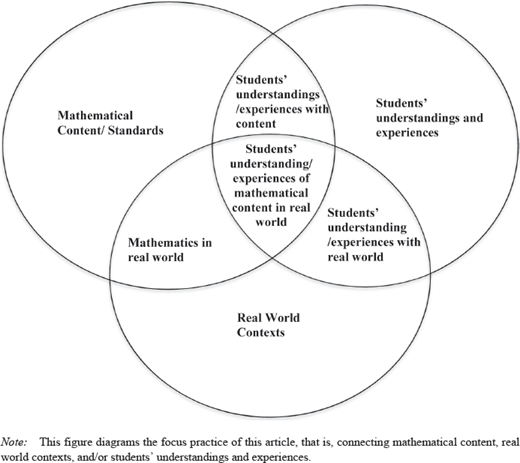
Connecting Mathematics Content With Real World Contexts and Students’ Experiences
Connecting Mathematics Content With Real World Contexts and Students’ Experiences
Conceptual Framework: Dilemmatic Spaces
Individuals negotiate dilemmas on a daily basis. Dilemmas have been conceptualized as instances where “two values, obligations, or commitments conflict and there is no right thing to do” (Honig, 1994, p. 568). These decisions are not always unambiguous; rather individuals make decisions in the “grey zone” where a clear-cut distinction between a right and wrong choice does not exist (Kakabadse, Korac-Kakabadse & Kouzmin, 2003). The nature and construction of ethical dilemmas has been explored in the humanities literature; however, education scholars have begun to recognize that teachers also face dilemmas of practice (e.g., Ehrich, Kimber, Millwater, & Cranston, 2011).
Dilemmas in teaching include those related to high-stakes testing and accountability measures (Singh, Märtsin, & Glasswell, 2015), collaboration among colleagues and mentors (Orland-Barak, 2006; M. Turner, 2016), conflicting policy mandates and pedagogical values (Jonasson, Mäkitalo, & Nielsen, 2015), as well as ethical dilemmas of practice (Shapira-Lishchinsky, 2011). Research has begun to explore how dilemmas are constructed, understood, and navigated by teachers. For example, Ehrich and colleagues (2011) argued that ethical dilemmas are realized as teachers have to make decisions based on identified choices. Multiple forces shape these dilemmas, including political and societal contexts, professional ethics, organizational cultures, institutional contexts, teachers’ beliefs and values, and the beliefs and values of trusted confidants (Ehrich et al., 2011). All of these impinging forces shape how teachers conceptualize dilemmas, as well as the possible choices that are conceived and the ultimate decision that is made.
One particularly illuminating lens for exploring pedagogical dilemmas is Fransson and Grannäs’ (2013) conceptual framework of dilemmatic spaces. Whereas in Ehrich et al.’s model ethical dilemmas stemmed from a “critical incident,” Fransson and Grannäs conceptualized dilemmatic spaces as being “ever present” and not necessarily limited to ethical issues. By including the relational category of space within their framework, Fransson and Grannäs (2013) argued that a dilemmatic space could be conceptualized as occurring within the relationships of “two or more positions.” In other words, the concept of space allows scholars to explore how dilemmas are created in relationships between an individual and larger contextual factors (e.g., policy or school climate), as well as relationships between various individuals (e.g., teachers, parents, students, or colleagues). These relationships often involve positioning, because teachers position themselves in relation to others (Fransson & Grannäs, 2013). Additionally, the negotiation of dilemmatic spaces leads to the constitution and reconstitution of teachers’ identities as they react in relation to ever-present dilemmas. Fransson and Grannäs (2013) argued that the conceptual framework of dilemmatic spaces allows scholars to understand “the complexity and dynamics of teachers’ work and how teachers are defined, positioned, and related to others” (p. 9) as well as how interactions with ever-present dilemmatic spaces influence teachers’ evolving professional identities.
The conceptual framework of dilemmatic spaces is particularly suited to exploring the case of one middle school’s teacher attempts to connect her mathematics instruction to relevant real world contexts. Making these connections involves negotiating multiple dilemmas, such as whether and when to veer from the designated curriculum. In the present study, we sought to unpack the various dilemmas contributing to this larger dilemmatic. Understanding how teachers negotiate dilemmas as they make relevant real world connections has the potential to productively inform teacher education efforts and to support teachers in this practice. With this aim in mind, we addressed the following research questions:
What, if any, dilemmas did this teacher negotiate while connecting her mathematics instruction to relevant real world contexts? and
What, if any, supports did this teacher draw upon when faced with said dilemmas?
Methodology
Overview of Larger Project
The present study is part of a multiuniversity, longitudinal research project called Teachers Empowered to Advance Change in Mathematics (TeachMATH) (Turner et al., 2012, 2014) in which we followed prospective elementary teachers from teacher preparation mathematics methods courses, through student teaching, and into their first years as early career teachers. Our research focused broadly on teachers’ understandings and practices for incorporating children’s mathematical thinking (Carpenter, Fennema, Franke, Levi, & Empson, 1999), and children’s home and community-based funds of knowledge (González et al., 2005) in mathematics instruction.
Case Study Methods
In the present study, we used case study methods (Stake, 2006/2013; Yin, 2013) to investigate one early career teachers’ utilization of real world connections in her mathematics teaching. Case study methods were appropriate for the present study because they facilitated an “extensive and in-depth description” of a phenomenon under study, in this case, the complexities involved in teachers’ making real world connections in mathematics teaching (Yin, 2013, p. 4). We sought to understand how the teacher under study implemented and maintained her commitment to making relevant real world connections in her mathematics instruction despite the presence of evolving dilemmas.
Participant Selection
Ms. K was purposefully selected (Creswell, 2013) as our case study because previous analyses (Turner, Sugimoto, Stoehr, & Kurz, 2016) established that she (more so than other participants in the larger research project) frequently enacted and reflected on real world connections in her instruction. In effect, Ms. K was a case of persistent intent to connect mathematics teaching to relevant, real world contexts. That said, dilemmas often arose, and thus selecting Ms. K as a case provided insight into the complexities of this challenging teaching practice (Stake, 2006/2013). Ms. K identified as a bicultural Latina/White European descent woman in her mid-20s. Ms. K’s mother’s family was originally from Mexico and spoke Spanish. Ms. K’s father was White, of European descent. Although Ms. K could exchange everyday Spanish phrases with family members, she did not consider herself to be a Spanish/English bilingual. Ms. K attended a private catholic school for her K–12 education and noted that her family struggled financially when she was growing up.
Teaching Contexts
For this analysis, we followed Ms. K from student teaching through the end of her second year of full-time teaching. During this time, Ms. K worked at various Title I schools in the same urban public school district. The schools were located in the same region of the city and served similar student communities (i.e., student populations ranged from 80% to 95% Latino/a, and from 74% to 80% free/reduced lunch) (National Center for Education Statistics, 2013, 2014). During her first year of teaching, Ms. K taught in a seventh-grade selfcontained classroom and was responsible for teaching all subjects. The school used a “highly contextualized” mathematics curriculum entitled Investigations in Number, Data, and Space (Technical Education Research Centers, 2014). During her second year, Ms. K moved to a science, technology, engineering, and mathematics focused magnet middle school where she taught seventh grade mathematics and had a grade level mathematics team with whom she collaborated and planned. The school used a traditional mathematics text (Holt McDougal, 2011), which included fewer real world connections.
Data Collection and Analysis
Data Sources
Consistent with case study methodology, there was prolonged contact with Ms. K using various data collection tools, including observations, interviews, artifact analysis (see Table 1) (Creswell, 2013; Stake, 2006/2013; Yin 2013). We conducted beginning, middle, and end of school year interviews (3 interviews per year), or in the case of student teaching, an end of student teaching interview. These interviews focused on various topics, including understandings about children’s home and community experiences, conceptualization and utilization of real world connections, and the supports and challenges that Ms. K. encountered when making connections. Additionally, across the 3-year period, Ms. K was observed teaching 20 mathematics lessons. Each student teaching observation was a single mathematics lesson, whereas each observation during early career teaching included two or three successive lessons. Each set of lessons observed was accompanied by pre- and post-lesson interviews that explored the topics outlined above. During observations, we scripted all interactions, and then used fieldnotes to produce a detailed lesson summary. Photos were taken to document images on the board, handouts, and student work samples. Secondary data collection tools consisted of transcripts of early career teachers’ study group conversations.
Data Analysis
Multiple iterative cycles of analysis (Creswell, 2013) were employed. A preliminary analysis was conducted with first-cycle coding to demarcate segments of data relative to our research foci (Miles, Huberman, & Saldaña, 2013). Specifically, we coded all data sources using the single code “connection to real world and/or children’s experience” in the qualitative data analysis software Hyper-Research (Researchware, 2011). This code was defined as any instance when Ms. K reflected on or made connections to the real world and/or students’ experiences or opened space for her students to make their own connections during instruction. Discrete instances were demarcated from the beginning of the narration about a connection to the end; any time the topic or connection was changed we counted this as a new instance. In all, 338 discrete instances were identified.
Summary of Data Collection Tools
| Data Collection Tool | Total Collected | Focus |
|---|---|---|
| Observational fieldnotes | 20 days of observations | Lesson task, goals, launch, closure, and teacher-student interactions |
| Pre- and postlesson interviews | 22 interviews | Goals and considerations in planning lesson; connecting to children’s mathematical thinking, to children’s home and community knowledge, and real world contexts during lesson |
| Beginning, middle, and end-of-year interviews | 6 interviews | Supports and challenges related to connecting to children’s mathematical thinking, children’s home and community knowledge, and real world contexts in mathematics teaching |
| Transcripts of teacher study group conversations | 11 transcripts | Planning and debriefing lessons with peers |
We completed our second cycle of coding using this refined data set. We began with open coding related to our research questions. First, we coded for any challenges, tensions, or perceived difficulties that arose in our data set because we anticipated that these difficulties would help us better understand the dilemmatic space. Second, we coded for anything that seemed to support the teacher as she negotiated identified challenges in order to better understand how she negotiated the larger dilemmatic space. An initial set of codes was drawn from literature (e.g., curricular challenges and supports, challenges with and support from colleagues); then, through open coding, new codes emerged (e.g., supports and challenges related to personal experiences and interactions with students and parents). This resulted in a set of codes that was then used to code all data instances. To ensure consistency in coding data, two of us independently coded a randomly selected subset of the instances (approximately one third), and then met to discuss and resolve any discrepancies.
In the third cycle of analysis, we created analytic memos (Marshall & Rossman, 2014) for each code. Memos identified themes related to challenges or supports, and included representative examples of Ms. K’s understandings and practices. Themes were established by reviewing all data instances that were assigned the relevant code and noting patterns, contrasts, and consistencies. For example, for the “supports: students” code, themes were identified related to informal conversations with students and eliciting students’ connections during lessons. We met regularly to discuss and refine emerging themes using representative examples from the coded data.
In the fourth cycle of analysis, we looked across the memos to identify larger dilemmas of practice. The dilemmas lifted off the particulars to synthesize discrete challenges into more comprehensive dilemmas of practice. For example, Ms. K repeatedly referred to resource related challenges (e.g., curriculum, grade level team, and personal experience), and these individual challenges were combined into the larger dilemma of how to address her lack of resources. Additionally, we looked across the code memos for specific supports that this teacher drew upon when negotiating identified dilemmas. We then used the analytic memos to select three lessons that represented the patterns of dilemmas and supports established across the larger data set. We reviewed detailed lesson summaries for each of the selected lessons to confirm, refine, and contextualize our interpretations of the dilemmas as they unfolded in practice. In the next section, we use these lesson exemplars to present our findings.
Findings
Ms. K expressed a consistent commitment to making relevant, real world connections in her mathematics teaching. This commitment and her negotiation of multiple dilemmas related to this practice contributed to an ever-present dilemmatic space for Ms. K. Before describing these dilemmas, we discuss Ms. K’s rationale for relevant real world connections.
Commitment to Making Real-World Connections
Ms. K’s commitment to real world connections in her mathematics teaching was rooted in (a) her own schooling experience and (b) her desire to engage students with the content. Ms. K recalled that her own teachers did not connect their mathematics instruction to real world contexts even when prompted by students. She noted, “I think that was always the question I was afraid of the question, ‘When am I ever going to use this?’ I remember hearing that all the time [as a student]. Our teachers never really had good answers.” (Year 2, Middle of the Year Interview). Ms. K explained that she strove to make connections between mathematics and real world contexts explicit so that students understood that mathematics had real meaning in their lives beyond the classroom. Additionally, Ms. K emphasized during the interviews that real world connections, particularly connections related to their own home and community experiences, engaged her middle school students. She explained:
If [the lesson] is not something that they’ve done or that they can connect to … first, they’re not as interested, and second, they’re not trying to learn it. They’re just, “get through this 50 minutes, and then I’ll move on to social studies.”
(Year 2, End of year interview)
Ms. K felt that by connecting to real world contexts that were relevant to her students, she was able to engage and motivate her seventh-grade students even when they preferred other subjects. Ms. K’s commitment to connecting her mathematics instruction to relevant contexts helped sustain her practice even as she negotiated various dilemmas, as shown in the following lesson exemplars.
Lesson Exemplar 1: Creating Real World Inequalities
During her second year of teaching, Ms. K negotiated several challenges as she drew upon real world contexts to deepen her students’ understandings of linear inequalities. The mathematical goals for this set of lessons were: (a) construct linear inequalities to represent real world situations, and (b) accurately solve inequalities using addition and subtraction. During the lessons, students created inequalities to represent a given real world situation as well as situations in their own lives. Ms. K shared that generating relevant examples was challenging because of her own lack of experience with how the content connected to real world scenarios. She reflected, “I hadn’t taught inequalities before, and I was struggling with how am I going to make this relevant to them? I never saw relevance in it either” (Year 2, Postlesson interview). Ms. K explained that she felt more confident teaching equations because “with the equations … I’ve had a lot of context to draw from because I was able to teach it last year with a different curriculum that was a little bit easier to make those connections” (Year 2, Postlesson interview). However, while her previous curriculum included multiple examples of how equations can model real world situations, it lacked examples for inequalities. This led to her first challenge of how to relate the content to a relevant real world example with little curricular support.
Ms. K started planning the lessons with her curriculum, which had a PowerPoint that defined key vocabulary words (i.e., inequality, equal, compound inequality). However, she opted to discard the PowerPoint after talking with her mother about the lesson. She realized that her mother was confused by the terms inequality and equal because she thought that the terms represented complete opposites (i.e., equal or not equal) instead of seeing that inequalities could also represent values that are greater than or less than. Reflecting on how this conversation supported her decision to veer from the text, and the teacher-directed teaching of vocabulary, Ms. K noted:
There’s a whole PowerPoint for me to go through that just tells students [definitions], but I want to… have them generate the definitions first so that it’s more memorable…. [Students] need something where they’re looking at something that isn’t equal … but an inequality is still this greater than, less than type of thing. I need to tie them both [equal and inequality] together.
(Year 2, Pre- and Postlesson interviews)
Ms. K felt that by explicitly contrasting the terms, students would better understand how equal and inequality were related but different. She also planned to elicit definitions that were relevant to the students in an effort to make the terms more understandable.
Ms. K began by eliciting students’ definitions of equal and unequal, and asking students to give an example from “inside and outside of math” (Year 2, Fieldnotes). Students generated various real world contexts including differences in prices of cereals, weights or heights of various objects, and the minimum age required to obtain a job. During this initial discussion, Ms. K encountered a second dilemma of how to honor students’ ideas and also align them with her mathematical goals. For example, one student suggested that an inequality could be written for the “comparison of [the cost of] two different cereals” in order to identify the cheapest brand. This context focused students on direct comparisons of two prices. Ms. K responded by skillfully reframing the student’s idea to expand the conversation to inequalities. She suggested, “we are buying cereal and the Target brand is $3 per box and then everything else is more (i.e., Price of other brands > $3/box), so we know we are going to spend $3 or more” (Year 2, Fieldnotes). Instead of abandoning this student’s suggestion, Ms. K was able to productively rework the example to create an inequality.
Subsequent lesson tasks were designed to relate inequalities to real world contexts. Ms. K shared that the examples in the textbook were “really lame” (e.g., amount of fabric needed to make a quilt), further expanding her dilemma of how to relate the content to relevant contexts. Therefore, Ms. K looked to outside resources as a support. For instance, she had recently received an email about a video news story featuring a 12-year-old youth activist lobbying to reinstate a state law that allowed 16- and 17-year-olds to preregister to vote so that they could vote as soon as they turned 18 (Byler & Park, 2013). Ms. K thought students would be interested in the age-related issue because of their interest in other age-related activities like driving. After showing the video, Ms. K asked students to create inequalities that represented the current voter registration age (i.e., a ≥ 18) and the activist’s desired age (i.e., a ≥ 16), where a refers to the age required to register.
Next, students wrote inequalities related to situations in their own lives that they wanted to change, including reducing the cost of college tuition or single-family homes, reducing homework assignments, increasing the number of chips in a bag, and several examples related to the cost of items like shoes or manicures. However, some cases were challenging to mathematize using inequalities. For example, one student decided to mathematize her current number of homework assignments and her desired number of homework assignments, using two equations to represent the current (H = 4) and desired (H = 2) number of homework assignments. This created a dilemma for Ms. K of whether to disregard this student’s ideas in favor of other examples that aligned with the mathematical goals, or to work with the student’s ideas, pulling them toward the intended content. Eventually, Ms. K decided to guide the student to consider how she could use inequalities instead.
Ms. K: You get four [assignments] every single day?
Student: Well, no, sometimes it’s one.
Ms. K: Okay, well, so it can be less than four. You’re not stuck at four all the time. So you want the most to be two, but are you okay with one assignment?
Student: Yeah.
Ms. K: Then you’re fine with less than 2. It doesn’t have to be equal.
Ms. K focused the students’ attention on the concept of equal and unequal, and whether the number of homework assignments could fluctuate. This discussion prompted the student to create an inequality to more accurately represent the scenario (i.e., H ≤ 2).
Other challenges that students faced during the lesson included accurately writing inequalities to represent current and desired situations and correctly solving inequalities and interpreting the results (Turner et al., 2016). These challenges contributed to a third dilemma of how to respond when the real world contexts added complexity, but did not seem to support students’ conceptual understanding. For example, some students wanted to represent cheaper gas prices using inequalities. They started with the current scenario (e.g., Gas (G) costs $2.99/gallon). To represent their desired scenario (i.e., that gas prices should decrease at least $0.30 per gallon), they wrote an inequality involving subtraction (e.g., G – .30 ≤ 2.99), which would result in an increase not a decrease in price (G ≤ 3.29). In the moment, Ms. K had to decide whether to abandon the context to focus students on symbolic work with inequalities, or to use the context to help facilitate students’ understandings. To support students’ understanding of their own misconceptualization, Ms. K asked students to solve their inequality and to use the context to reason about the result. Students realized that this inequality increased the cost, which was the opposite of their desired change, and revised the inequality accordingly (e.g., G + .30 ≤ 2.99).
Lesson Exemplar 2: Graphing and Scaling Video Game Characters
During her first and second year of teaching, Ms. K taught lessons focused on the following related mathematical concepts: (a) plotting coordinates, (b) scaling plotted figures, and (c) determining if figures were mathematically similar. In the lessons, students graphed points on a coordinate plane to create a figure and scaled said figure in mathematically similar and nonsimilar ways. Specifically, students used simple linear equations or “rules” to multiply or divide the figures’ coordinates in order to enlarge or shrink their figures (i.e., 1.5x, 1.5y or ⅓x, ⅓y).
During her first year, Ms. K used a set of unmodified lessons from the Investigations curriculum (Technical Education Research Centers, 2014) to teach these concepts. The lessons focused on a fictional computer game involving the mathematically similar Wump family whose members were the “same shape” but of “varying sizes” (Technical Education Research Centers, 2014). Students were given the coordinates of the main video game character (Mug Wump) and were asked to enlarge the character using given rules (i.e., 2x, 2y). Next, students determined whether or not the newly scaled figures were mathematically similar to Mug Wump. After the lessons, Ms. K reflected on students’ reactions to the context:
There’s always some storyline there [in the curriculum], and I feel like they’re interested in the video game, but there’s not a whole lot of opening up into their world necessarily or what they’re doing with their parents at home.
(Year 1, Postlesson interview)
Although Ms. K felt that her students were “interested in the video game,” she did not know if the context related to students’ experiences because students did not “open up.” Ms. K explained that she “always tries to think about how they’re connecting [what they’re learning] with their … experiences … but that hasn’t been as apparent in this lesson.” In other words, Ms. K tried to prioritize connections between her mathematical teaching and students’ experiences but was unsure if this prepackaged lesson accomplished this goal. This professional pondering contributed to her first dilemma related to how to use her curriculum to make these connections.
At the end of her second year, Ms. K taught a similar set of lessons focused on coordinate graphing and mathematical similarity; however, her school adopted a new curriculum that lacked contextualized problems. The limited curricular resources added to her dilemma of how to address the mathematics content in ways that were relevant to students’ interests and experience. Ms. K decided to use the Wump lesson as a starting point, but found a real world context she felt would be more relatable to her students, namely characters from popular animated movies. In her words:
I saw this video about how Pixar uses math in movies. He [animator] goes through and it’s coordinate geometry and … he talks about translations and resizing images, and he just uses one of the movie characters. I’m like, that’s such a good idea.
(Year 2, Prelesson interview)
Ms. K felt the animated movie context would be particularly engaging because students often discussed the recently released movie, Frozen (Year 2, Postlesson interview).
Ms. K introduced the lesson by showing students the video clip and then used the movie animation context as a springboard for students to draw and manipulate their own characters through scaling and translations. Ms. K described the lesson’s tasks as:
I’m going to let them [students] draw whatever [character] they want. I’m going to tell them to make simple figures because they’re going to be moving them a lot … [I’m] going to let them play around with it and let them resize them, and eventually they’re going to start moving them around the grid, and working on translations.
(Year 2, Prelesson interview)
Ms. K planned to give students the freedom to draw any character they chose, with the caveat that “simple figures” with a limited number of vertices might be easier to scale and manipulate. This modified set of lessons also incorporated an expanded set of mathematical goals (i.e., translations of figures, compared to the previous year’s lessons).
Ms. K’s concern about students drawing “simple figures” was particularly perceptive as evidenced by how the lesson unfolded. When she introduced the lesson, Ms. K noted that her students “were excited” (Year 2, Postlesson interview). Yet as the lessons progressed, some students were so caught up in designing of their figures that they neglected the mathematics of the task (i.e., determining coordinates, scaling and translating figures). Ms. K shared:
What I’m having a little trouble with is they’re so excited to just get on the design that they’re forgetting the coordinate piece…. I want to give them that freedom to create what they want and to draw something cool to them. At the same time, I don’t want them to have something so detailed that they’re proud of it, and then I tell them, “Okay. Move it,” … and they’re spending hours doing it again.
(Year 2, Postlesson interview)
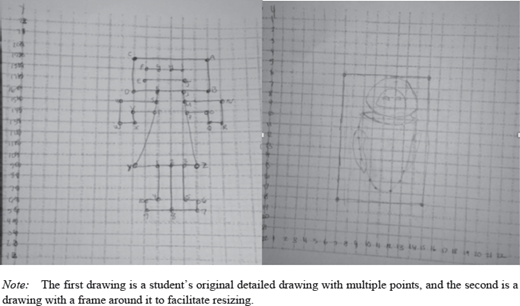
Some students were so focused on making detailed characters (see Figure 2) that several days into the lesson, they were still working on initial drawings instead of plotting the coordinates and scaling and translating the figures. Ms. K anticipated that the detailed figures would be challenging for students to scale and translate because it would take “hours” to redraw the figures. Ms. K was faced with the dilemma of how to honor students’ contributions while advancing her mathematical goals. Ultimately, she decided to have students frame their complex figures with a rectangle, and then use the coordinates of the four corners to resize the frame. Once the frame was redrawn, students could redraw their figures within the new frame so that they would not have to simplify their drawings.
Lesson Exemplar 3: Scaling Recipes to Make Tortilla Soup
During her second year of teaching, Ms. K taught a set of lessons on multiplication of fractions. Following one textbook-based lesson that included decontextualized computation tasks, Ms. K realized many students lacked a conceptual understanding of the meaning of multiplication by a fraction. She explained, “they know what to do, but they’re still not understanding why their product is smaller. They don’t understand the concepts behind it, basically, and so they’re apprehensive about following the procedure” (Year 2, Prelesson interview). At the same time, Ms. K felt pressure from her grade level team to continue moving through the curriculum, noting “my team teachers are moving on to dividing. They’re a lot more, ‘Let’s go by the book and teach them the process, and then if we have time, we’ll bring in all this other stuff’” (Year 2, Postlesson interview). The textbook featured a follow up “hands on activity” in which students drew fractional parts and then split the parts into smaller portions to visually represent multiplying fractions (Year 2, Prelesson interview). Yet the texbook’s tasks lacked a connection to students’ experiences or to relevant contexts, which Ms. K felt was an important component of building understanding.
Thus Ms. K was faced with the dilemma of whether to revisit fraction multiplication via the text’s “hands on activity” or modify the lesson. She opted to veer from the text and designed a set of tasks around scaling a recipe for tortilla soup. Ms. K’s choice of context was informed by a survey in which students reported using mathematics in family cooking activities. She explained,
What’s missing [in the book] is that connection to real life or any relevance to them.… I did a survey toward the beginning of the year about where they see math in their homes, and the majority of it was cooking or baking, so I thought that the recipe would be a good idea—something they’re familiar with and they already see math in.
(Year 2, Prelesson interview)
Ms. K’s hope was that connecting fraction multiplication to scaling down a recipe would help students understand how multiplying by a proper fraction results in a smaller quantity. She noted: “I’m hoping they’ll see—to serve less people, it’s multiplying by a half” (Year 2, Prelesson interview).
Ms. K acknowledged that generating lessons that connected to relevant contexts “completely on my own” was challenging. She found that leveraging her own understanding of the context (i.e., scaling recipes) supported her in making the connection as authentic as possible. She explained:
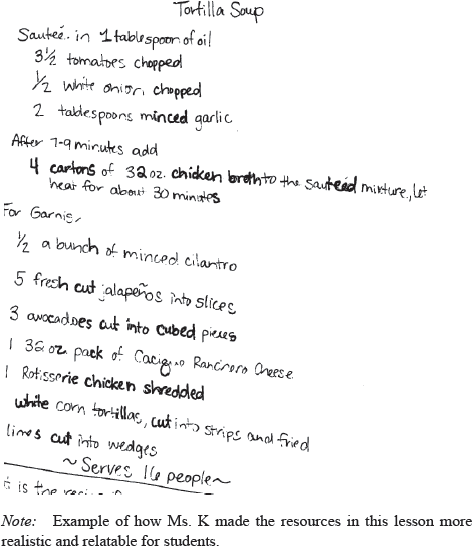
How can I make it the most realistic? I thought about getting one of my nana’s recipes … [and] what her recipes look like, they’re all hand-written, and a lot of them are “to taste” … I wanted it to look familiar.
(Year 2, Postlesson interview)
Not only did Ms. K leverage her own family experience to identify a relevant real world context, but she also decided to make the context as “realistic” as possible by creating a handwritten recipe that would seem more “familiar” to students (see Figure 3).
To launch the lesson, Ms. K shared about her own experience cooking tortilla soup, including how she often had to adjust the recipe for groups of different sizes so that she knew how much of each ingredient to purchase at the store. In response, students discussed food they enjoyed making with their families, and asked Ms. K if the recipe was authentic. Ms. K explained during interviews that she often began lessons by telling relevant stories about herself and her family because this practice invited students to share their own experiences, which helped Ms. K build connections:
I get [to work with students for only] an hour each day, and it’s been a lot harder to make those connections. … When I have something like [my family recipe] that’s sharing a part of me, they’re willing to share a part of themselves. …. Everybody is a little bit more open (Year 2, Postlesson interview).
Next, Ms. K drew students’ attention to the ingredients and servings (16) in the recipe, and said that she “needed help …. to figure out how much of each ingredient to purchase” when she makes the soup for different numbers of people. The task read: Adjust the recipe for smaller and larger groups of family and friends. How much of each ingredient is needed to serve 8, 32, 40, 4 or 82 people?
As students worked, Ms. K probed their thinking with questions such as, “How did you get this number?” or “What happened when you were feeding more people?” Students used multiple strategies to adjust the recipe, envisioning themselves cooking the soup, and questioning if their adjusted ingredients made sense. Some students made connections between multiplying by a fraction and their prior understanding of operations with percents (i.e., multiplying by ½ is taking 50% of a quantity). Ms. K noted that for some students, the lesson enhanced their confidence toward fraction multiplication, because they could connect the procedures to the act of adjusting the amount of each ingredient in the recipe. She stated, “they had this huge experience that they could draw from to help them work with the numbers” (Year 2, Postlesson interview). However, not all students embraced the context as a tool for making sense of the mathematics. Some remained focused on the procedures and determining which operations and quantities to use so they could efficiently complete the calculations. Ms. K reflected on the dilemmas she experienced as she tried to leverage the context to engage these students in the mathematics: “I was trying to explain it to them in the real world context, and they just wanted, “What operation do I use?” They didn’t want to have to think about why they’re using the operations” (Year 2, Postlesson interview).
Other students embraced the real world nature of the task, and used their understandings to argue for answers that while reasonable from a real world perspective, did not align with the mathematical goals of the lesson. For instance, to adjust the original recipe (which served 16) to serve 40 guests, one group decided to triple all the quantities so that the recipe would serve 48, “[the students] were just, like, “Can we just do three times more? … [It will serve] 48; we’ll have enough.” Ms. K acknowledged the reasonableness of the solution, but also wanted to push students toward a more precise answer, because scaling the recipe for 40 servings provided additional opportunities to reason about multiplying by a fraction. She explained, “You’ll have leftovers. I think that could be an option, too … but then what if I don’t want leftovers? How do we cut it back?” (Year 2, Postlesson interview). The students’ solution reflected a tension between realistic, real world solutions (which may not always require precision), and the mathematical goals of a particular lesson (which in this case, benefited from precision).
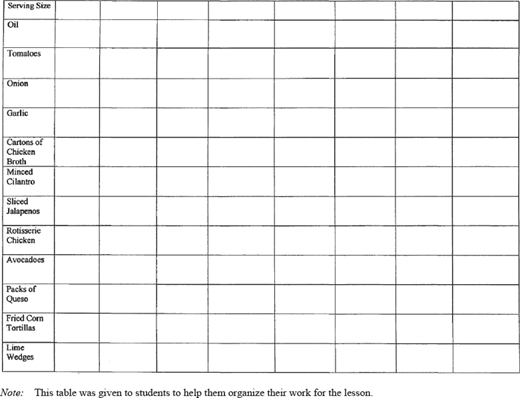
Another dilemma was related to balancing the authenticity of the task presentation with the scaffolding students needed to support understanding. The hand-written recipe, followed by general questions about how to adjust the recipe for different numbers of people resulted in a task that was more open-ended than those students typically encountered in textbooks. For example, recipe scaling tasks in problem solving oriented curricula (Abels, Wijer, Pligge, & Hedges, 2006) often include scaffolds such as ratio tables that help students keep track of quantities and their operations on those quantities. While Ms. K’s task presentation was potentially “more authentic,” the lack of scaffolding was challenging for some students who struggled to keep track of adjustments to ingredients on their own. When Ms. K noticed that students’ challenges organizing their work prevented them from using the results of one adjustment to the recipe to make further adjustments, she decided (based on a suggestion from one of the researchers), to provide students with a blank ratio table (see Figure 4). As she introduced the tool, she again shared about her experiences:
My weakness in math has always been that I’m not organized … I usually get the right answer because I’m really good at math, like you guys are really good at math, but I make little mistakes because my work’s all over the place.… This is going to help you, and it’s going to help me, and we’re going to work on it together.”
(Year 2, Postlesson interview)
Students connected with Ms. K’s experiences, responding, “Oh, that’s me too, miss” (Year 2, Lesson fieldnotes). Ms. K later noted that using the ratio table to adjust the recipe, while potentially less authentic, supported students’ success with the task. “It was so easy for them, all of a sudden, to see how the numbers related because they were lined up” (Year 2, Postlesson interview).
Discussion
In discussing the study’s findings, we focus on three dilemmas that Ms. K negotiated in the larger dilemmatic space of connecting mathematics instruction to relevant real world contexts.
Dilemma 1: Lack of Curricular, Relational, and Personal Resources to Support Connections
Ms. K experienced several resource-related challenges in her effort to connect mathematical content to relevant real world contexts, which contributed to her first dilemma. Specifically, for the inequalities and coordinate graphing lessons, although the curriculum provided real world contexts, the contexts were not relevant to her students’ experiences and understandings. In the multiplying fractions lesson, Ms. K’s curriculum focused more on computational and visual representations rather than connections to real world contexts. In fact, across the lessons observed, Ms. K was challenged by curricular tasks that focused on abstract mathematics content or generic real world connections rather than connections that foregrounded students’ experiences. Ms. K was also challenged by a lack of relational resources from her grade level team. For example, although Ms. K wanted to pause to carefully reflect on how real world connections might deepen her students’ understanding of multiplying fractions, her colleagues wanted to move through the curriculum. Ms. K ultimately chose to create her own lessons, which led to an additional, personal challenge, namely, Ms. K’s limited knowledge of how specific mathematics content (e.g., linear inequalities) connected to real world scenarios. The various components of this resource-related dilemma are represented in Figure 5 by solid arrows that connect the challenges with corresponding circles in the diagram. For instance, Ms. K’s curriculum focused on decontextualized mathematical content (math content/standards) or generalized real world connections (mathematics in the real world), while her grade level team and her own knowledge focused solely on the mathematical content (math content/standards). Taken together, the lack of curricular, relational, and personal resources contributed to the dilemma of whether to follow her curriculum and/or team’s plan or to veer from these plans and look to outside resources for support.
Returning to the framework of dilemmatic spaces, Ms. K faced a dilemma of how to position her curriculum and her team, as well as how to negotiate her developing identity as a teacher. Ultimately, Ms. K positioned herself as a teacher with the authority to veer from the text and her team, but she was sometimes challenged by a limited knowledge of relevant connections. Therefore, she identified outside supports that she could draw upon in her negotiation of this larger dilemma, including looking to her students to generate real world connections (e.g., linear inequalities in their own lives), her experiences with real world applications of content (e.g., cooking), templates from prior lessons (e.g., the Wump lesson), and a broader relational network (e.g., her mother or emailed videos from friends). Ms. K leveraged these supports to move her instruction from the mathematics content and mathematics in the real world spaces into the center of Figure 5 where content connected to relevant real world experiences.
 The venn diagram contains 3 overlapping circles marked mathematical content standards, students understandings and experiences, and real world contexts. The mathematical content standards circle includes own content knowledge, students content knowledge, created lessons, and created curriculum. The students understandings and experiences circle includes students understandings and experiences with content, students understandings and experiences of mathematical content in real world, and students understanding and experiences in real world. The real world contexts circle includes mathematics in real world, students understandings and experiences of mathematical content in real world, and students understanding and experiences in real world. The overlapping area between mathematical content standards and students understandings and experiences is marked students understandings and experiences with content. The overlap between mathematical content standards and real world contexts is marked mathematics in real world. The overlap between students understandings and experiences and real world contexts is marked students understanding and experiences in real world. The central overlap among all 3 circles is marked students understandings and experiences of mathematical content in real world. 3 rectangular boxes at the top are marked dilemma 1 lack of resources, dilemma 2 lack of alignment with student ideas and content, and dilemma 3 how to use real world connections to support students mathematical learning. Arrows connect each dilemma box to specific areas of the diagram. Dilemma 1 connects to mathematical content standards with arrows marked own content knowledge embedded removed from real world contexts and grade level item embedded curriculum as written. Dilemma 2 connects to students understandings and experiences. Dilemma 3 connects to real world contexts with an arrow marked curriculum not connected to students experiences. All arrows are bold and clearly indicate directional relationships.
Dilemmas Encountered While Connecting Mathematics to Relevant Real World Contexts
The venn diagram contains 3 overlapping circles marked mathematical content standards, students understandings and experiences, and real world contexts. The mathematical content standards circle includes own content knowledge, students content knowledge, created lessons, and created curriculum. The students understandings and experiences circle includes students understandings and experiences with content, students understandings and experiences of mathematical content in real world, and students understanding and experiences in real world. The real world contexts circle includes mathematics in real world, students understandings and experiences of mathematical content in real world, and students understanding and experiences in real world. The overlapping area between mathematical content standards and students understandings and experiences is marked students understandings and experiences with content. The overlap between mathematical content standards and real world contexts is marked mathematics in real world. The overlap between students understandings and experiences and real world contexts is marked students understanding and experiences in real world. The central overlap among all 3 circles is marked students understandings and experiences of mathematical content in real world. 3 rectangular boxes at the top are marked dilemma 1 lack of resources, dilemma 2 lack of alignment with student ideas and content, and dilemma 3 how to use real world connections to support students mathematical learning. Arrows connect each dilemma box to specific areas of the diagram. Dilemma 1 connects to mathematical content standards with arrows marked own content knowledge embedded removed from real world contexts and grade level item embedded curriculum as written. Dilemma 2 connects to students understandings and experiences. Dilemma 3 connects to real world contexts with an arrow marked curriculum not connected to students experiences. All arrows are bold and clearly indicate directional relationships.Dilemmas Encountered While Connecting Mathematics to Relevant Real World Contexts
Although broad challenges in planning real world connections have been well documented (Asempapa, 2015; Depaepe, De Corte, & Verschaffel, 2009; Gainsburg, 2008), less understood is how teachers overcome these challenges. Our detailed analysis contributes to our understanding of what a successful negotiation of such challenges might look like and identifies specific supports that teachers may draw upon when negotiating resource-related dilemmas. Specifically, our study shows that Ms. K was able to look outside of traditional resources (i.e., textbook or grade level team), to find support for negotiating this dilemma from her own students, social network, and her own experiences.
Dilemma 2: Aligning Students’ Real World Connections to Mathematical Content
In this second dilemma, Ms. K was challenged when the real world connections students generated based on their own experiences and understandings did not align with her mathematical goals. For example, during the inequalities lesson, students’ examples lent themselves to equations rather than inequalities. During the graphing lesson, students drew complex characters that were difficult to resize and translate. In other words, students contributed ideas that reflected their own interests and real world understandings (represented in Figure 5 by the arrow from Dilemma 2 to the students’ experiences in the real world space), but these ideas did not always align with the mathematical goals of the lesson (i.e., they did not intersect with the mathematical content space).
Ms. K was faced with the dilemma of whether she should (a) dismiss students’ ideas and insert ideas that more explicitly or efficiently addressed her mathematical goals and thereby risking student disengagement, (b) accept students’ ideas against the background of her mathematical goals, or (c) reframe students’ ideas to better align with the intended mathematics. In negotiating this dilemmatic space, Ms. K positioned her students as important contributors to the lessons as she honored and yet guided their ideas so that the ideas connected with her mathematical goals. Ms. K leveraged an in-the-moment support of reframing that allowed her to take students’ contributions and with minor suggestions or task adaptations align them with her content focus (i.e., students drew a frame around their complex characters to make resizing easier.) In other words, Ms. K found ways to pull students’ ideas into the center space (see Figure 5). An important contribution of this finding is that it draws attention to challenges that can occur when students’ ideas do not match the mathematical goals of a lesson, a tension that has not been explicitly noted in prior research. Moreover, this dilemma highlights the import of in-the-moment supports that teachers can draw upon in order to address this dilemma.
Dilemma 3: Using Real World Connections to Efficiently Support Student Understandings
In this final dilemma, the complexity of real world connections contributed to students’ confusion or distraction from the mathematics. For example, in the inequalities lesson, some students found the real world context of gas prices confusing and wrote inequalities that did not accurately reflect the situation. In the multiplying fractions lesson, some students struggled when they were given an authentic recipe card and asked to scale the ingredients without any structure for organizing their work. A few students preferred to ignore the recipe context altogether, and others used real world considerations to argue for solutions that lacked mathematical precision. These challenges led to the larger dilemma of whether Ms. K should consider abandoning real world contexts in instances when they confused students, continue with the contexts even if students resisted or when contexts seemed to detract from mathematical goals, or adapt the contexts and tasks to maintain a dual focus on students’ mathematical understanding and mathematics in the real world. As shown in Figure 5, by the arrow extending from Dilemma 3 to the mathematics in the real world space, real world connections did not always intersect with students’ understandings and experiences with the content. In these instances, Ms. K had to find ways to pull the real world mathematics into the center of the diagram in order to support students’ developing understandings.
In negotiating this dilemmatic space, Ms. K positioned herself as an agentive, resourceful teacher while prioritizing both students’ mathematical understandings and real world connections. To achieve this balance, Ms. K drew upon several in-the-moment supports, including tools to scaffold and organize students’ work (e.g., the ratio table tool). Moreover, instead of abandoning contexts in the face of student confusion or distraction, Ms. K decided to push students deeper into the context to support their understanding. While the potential confusion or distraction that real world contexts can create for students has been noted (Greer, 1997; Verschaffel et al., 1994), our findings move beyond the challenge itself to document potential in-the-moment supports that this teacher leveraged to address student confusion.
Implications
The present study documented the dilemmas that one middle school mathematics teacher faced and the supports she drew upon in her effort to connect her instruction to real world contexts that were relevant to her students’ understandings and experiences. An important contribution of this work is a more nuanced understanding of how these dilemmas and supports manifested in this teacher’s practice. In turn, this work points to new directions for how teachers can be prepared to take up this high-impact practice in middle school mathematics classrooms. Specifically, we found that planning for relevant real world connections is only one piece of this practice even though it is the piece that is often discussed in the teacher preparation literature (e.g., Julie, 2002; Simic-Muller et al., 2015). Another critically important component for this teacher was in-the-moment moves for effectively negotiating the dilemmas that arose in practice, which were quite challenging. Our findings demonstrate that teachers need to be supported not just in planning for real world connections, but also in responding in productive ways to the dilemmas that arise during enactment. We found “in-the-moment” adjustments, like reframing students’ contributions to align with mathematical goals and leveraging the context to help students make sense of the mathematics, to be particularly supportive and efficient strategies. Effective use of these strategies appears to be especially consequential for middle school mathematics teachers as they have limited time to work with multiple groups of students. Ultimately, not preparing teachers for these in-the-moment adaptations risks undermining the practice, as these adaptations are critical for maintaining a tripart focus on student experiences and understandings, real world contexts, and the mathematical content.
Acknowledgment: This study is partially supported by the National Science Foundation under Grant Number 1228034. Any opinions, findings, conclusions, or recommendations expressed are those of the authors and do not necessarily reflect the views of the National Science Foundation.

