


School engagement is important in promoting adolescents’ academic and socioemotional outcomes. We explored whether sixth-grade students’ (N = 571, Mage = 11.27, 52% female, 50% racial/ethnic minority) school engagement at the end of the academic school year was facilitated by their perceptions of teachers’ classroom practices and support. Data were from a longitudinal study on Developmental Designs (DD)—a community-building and engaged-learning teaching approach designed to meet adolescents’ developmental needs for autonomy, belonging, and competence. On average, student-perceived teacher support partially mediated the positive relations between perceptions of teachers’ DD classroom practice use and students’ school engagement. Results highlight the interrelatedness of teachers’ instructional and affective practices in supporting early adolescents’ school engagement, and suggest the potential benefits of school-based socioemotional initiatives focused on such teaching practices.
School engagement is the extent to which a student demonstrates affective, behavioral, and cognitive connection to the core activities of school such as academic learning and peer group socializing (Jimerson, Campos, & Greif, 2003). Students who are more engaged in school attend regularly, adopt and follow norms and rules, are more focused on learning, and as a result, tend to receive higher grades and standardized test scores (Dotterer & Lowe, 2011; Guthrie & Wigfield, 2000; Patrick, Ryan, & Kaplan, 2007; Wang & Holcombe, 2010). Previous research has noted a decline in student engagement during middle school when the structure and nature of school becomes more departmentalized, less personalized, and thus less nurturing relative to elementary school (Cook, MacCoun, Muschkin, & Vigdor, 2008; Eccles & Roeser, 2011). As such, to engage middle school students, it is important to consider pedagogical practices that reflect “stage-environment fit” (Eccles et al., 1993; Eccles & Roeser, 2011)— matching the school environment to adolescents’ developmental needs for autonomy, belonging, and competence (Connell & Wellborn, 1991; Eccles & Roeser, 2011).
Research has identified school-based socioemotional learning (SEL) approaches (Dusenbury, Calin, Domitovich, & Weissberg, 2015) and related teacher professional development programs (Baroody, Rimm-Kaufman, Larsen, & Curby, 2014; Farmer et al., 2013; Gregory, Allen, Mikami, Hefen, & Pianta, 2014) as avenues for facilitating student outcomes such as school engagement (Anderson, Christenson, Sinclair, & Lehr, 2004; Durlak, Weissberg, Dymnicki, Taylor, & Schellinger, 2011). One such SEL approach, Developmental Designs (DD), encourages middle school teachers to employ a set of best practices for supporting adolescents’ developmental needs (Kwame-Ross, Crawford, & Klug, 2011). Consistent with stage-environment fit research on classrooms (Dotterer & Lowe, 2011; Pianta, Hamre, & Allen, 2012), we examined the extent to which adolescents’ school engagement is in part a function of students’ perceptions of their teacher’s classroom support (Hamre & Pianta, 2010). Specifically, using schools that were undergoing adoption of the DD approach as sites of investigation, we examined whether student-perceived DD practices are associated with a greater sense of teacher support, thereby improving sixth graders’ school engagement over the school year.
School Engagement
School engagement reflects students’ thoughts, feelings, and behaviors in regard to school, including attitudes toward the classroom environment and specific learning activities (Fredricks, Blumenfeld, & Paris, 2004). Some construe school engagement to be the outward display of one’s drive or motivation to accomplish school-related tasks (Skinner, Kindermann, Connell, & Wellborn, 2009; Wang & Degol, 2014). Others position school engagement as a match between students’ skills and the demands of the school context (Cavanaugh, 2015). Regardless of the conceptualization, school engagement has been found to relate to behaviors and outcomes such as school attendance (Klem & Connell, 2004), academic performance and achievement (Dotter & Lowe, 2011; Stewart, 2008), and academic aspirations (Wang & Eccles, 2012). In addition, engagement has been linked to lower levels of depression, substance use, and delinquency (Bond et al., 2007; Li & Lerner, 2011). As such, school reform/improvement efforts seeking to positively influence students’ academic and socioemotional well-being often include school engagement as a viable target (Desimone, Smith, & Frisvold, 2010; Harbour, Evanovich, Sweigart & Hughes, 2015).
During middle school, students’ school engagement may decline due to changes in school structures that supported their engagement in elementary school (Akos, 2002; Anderman & Mueller, 2010; Eccles et al., 1993). Midgeley and Edelin (1998) cite a decline in school engagement among middle school students as a consequence of mismatches between school contexts and developmental shifts in students’ relational needs as adolescents (e.g., more peer-focused) (Midgeley & Edelin, 1998). However, some research shows that not all students experience a decline in engagement, and many report having quite positive feelings toward school during the transition (Day, Hamm, Lambert, & Farmer, 2014). Thus, intervention research has employed many classroom and schoolwide strategies to proactively intervene on potential school disengagement (Christenson, Reschly, & Wylie, 2012). In the present study, we explored whether teachers’ DD classroom practices are positively associated with adolescents’ school engagement.
Teaching Practices Associated With Adolescents’ School Engagement
School engagement can be fostered in the broader school, classroom environment, and/or through specific academic learning activities (Marks, 2000; Wang & Degol, 2014). Whether at the class or school level, experiences that meet adolescents’ needs for competence, autonomy, and relatedness are thought to be most conducive to high levels of school engagement among middle school students (Connell & Wellborne, 1991; Eccles & Roeser, 2011; Motoca et al., 2014). For instance, guiding students through setting and achieving goals, involving them in establishing class rules, and providing opportunities to choose and direct aspects of learning experiences with classmates are practices associated with supporting early adolescent students’ developmental needs (Durlak et al., 2011; Jagers, Harris, & Skoog, 2015). Importantly, having teachers who enact such practices in day-to-day classroom activities supports students’ school engagement and socioemotional well-being (Dusenbury et al., 2015). Practices that may support adolescents’ school engagement are becoming increasingly common in schoolwide SEL approaches (Dusenbury et al., 2015). As one such approach, DD is derived from developmental theory and research on best practices for teaching early adolescents (Kwame-Ross et al., 2011). The DD approach emphasizes linking instructional practices to adolescent competencies and interests to make learning developmentally appropriate and personally meaningful for students. Students are afforded choice and autonomy in the learning process to encourage taking responsibility for one’s academic growth and development (Stefanou, Perencevich, DiCintio, & Turner, 2004). Moreover, DD classroom practices focus on relationship-building as the foundational aspect of teaching and learning with this age group. Additionally, teachers use engaged learning strategies for early adolescents to augment the caring classroom community promoted by DD. For example, the daily morning advisory structure—the cornerstone of the DD approach—includes greetings, sharing personal interests and information, and group activities to cultivate trusting teacher-student and student-student relationships. Such practices allow mutually respectful relationships to develop over a school year, and thereby build supportive classroom communities (Battistich, Soloman, Watson, & Schaps, 1997).
Although many individual practices supporting adolescents’ developmental needs (e.g., student choice) have been well-established and widely implemented in SEL approaches, research on whether and how sets of these practices promote adolescents’ school engagement is still in its infancy. For instance, although DD—a compendium of developmentally relevant teaching practices—has been implemented in over 450 middle schools in the United States (The Origins Program, n.d.), there is little research on the impacts of DD practices on teachers and their students. In one mixed-method study, Bedoya-Skoog (2014) found that on average, middle school students reported a higher sense of teacher support (using the same measure as in the current study) in classrooms of teachers she observed implementing DD practices with high fidelity (“high DD-implementers”) over a school year versus students in classrooms of “low DD–implementers.” Consistent with DD’s underlying logic (Kwame-Ross et al., 2011), these results suggest that as their teachers implement DD practices, middle school students may perceive their teachers as more supportive. The current study further investigates teacher support as a mechanism by which teachers’ DD practice implementation might influence sixth graders’ school engagement. We emphasize the importance of students’ perceptions of teachers’ DD practices and support given that students’ perceptions of the learning environment directly impact their academic motivations (e.g., Spearman & Watt, 2013).
Teacher Support and Student Outcomes
Although several sources influence adolescents’ school engagement (e.g., family, friends/peers, mentors, teachers) (Jiang, Huebner, & Siddall, 2013; Malecki & Demaray, 2003), teachers play an instrumental role (Brewster & Bowen, 2004; Klem & Connell, 2004; Woolley & Bowen, 2007). Among middle school students, teacher support is associated with many adaptive socioemotional outcomes including greater sense of well-being (Suldo et al., 2009), pursuits of prosocial and social responsibility goals (Wentzel, 1997), decreased depressive symptoms and higher self-esteem (Reddy, Rhodes, & Mullhall, 2003), increased liking and sense of school belonging (Roeser, Eccles, & Sameroff, 1998), and greater interest and enjoyment in school (Wentzel, 1998). Additionally, teacher support has been shown to facilitate various indicators of adolescents’ school engagement such as mastery goal orientation and intentions to continue schooling (Legault, Green-Demers, & Pellitier, 2006; Song, Bong, Lee, & Kim, 2015; Studsrød & Bru, 2011).
The Current Study
Though scholars have investigated associations between teacher support and student outcomes as reported above, less research has focused on the types of teacher practices that increase adolescents’ perceptions of teacher support. Research supports a key hypothesis examined in this study—that teaching practices which focus on cultivating autonomy, belonging, and competence over the school year like those advocated within the DD approach tend to support adolescents’ school engagement (Day, Hamm, Lambert, & Farmer, 2014; Jagers et al., 2015). Additionally, previous studies have suggested that students perceive teacher support through teachers’ affective displays in the classroom (Suldo et al., 2009; Wentzel, 2007).
The current study examined the impact of teachers’ DD practices on sixth-grade students’ school engagement, testing student-perceived teacher support as a mediator of this relation. We used data from a larger longitudinal study on the impact of the DD approach on middle school students and teachers to examine school engagement over the sixth-grade school year. Importantly, we accounted for students’ incoming perceptions of their teachers’ DD practices and support given the possibility that these incoming perceptions were less founded in students’ actual understandings of their teachers’ practices and support, but nevertheless may have biased student experiences over the school year. In other words, our analyses assumed that students’ end-of-year perceptions of their teachers’ DD practices and support were more indicative of the quality of teacher-student interactions students experienced over the sixth-grade school year. We built on existing school-based SEL intervention research, and tested the hypothesis that teacher support represents a mechanism by which DD practices influence middle school students’ school engagement.
Method
Participants
Data for the present study were drawn from a longitudinal examination of influences and impacts of the Developmental Designs approach conducted by the senior author. Three public middle schools (Grades 6–8) in a large, racial/ethnically diverse public district in a Midwestern urban U.S. city began implementing the DD approach in 2012–2013. Annual surveys were administered to sixth-through eighth-grade students and their teachers at the beginning (fall, Time 1 (T1)) and end (spring, Time 2 (T2)) of each school year. In the current study, we used inaugural year data to examine the role of perceived DD practices and support among sixth-grade students. Data included survey responses from 571 sixth graders across 31 teachers’ classrooms. Fifty-two percent of students were female (n = 297), and average age at the beginning of sixth grade was 11.27 years. Students were: 19% Asian/Pacific Islander; 11% African American/Black; 6% Latino/Hispanic; 1% Native American; 50% White; and 13% other racial/ethnic categorizations.
The majority (66%) of the teachers taught in core subject areas (33% English/language arts, 25% mathematics, 4% science, and 4% social studies/history), and 34% taught electives, including physical education, music, and languages. Thirty-one percent were male, and the majority (97%) were White/European American. No additional teacher demographics were collected.
Procedure
Trained researchers administered hardcopy student surveys at T1 and T2 at each school, and were available to respond to questions during administration. Instructions were read aloud, including reassurance that: (a) the survey is not a test; (b) students should be as honest as possible; (c) responses would not be viewed by anyone at school; and (d) participation was a voluntary opportunity to “help us to figure out if and how things need to be changed to help you be successful in school” (T1) and “how things have gone for you since the beginning of the school year” (T2). The survey instructed students to first write in their subject and teacher’s name for third period on Thursdays before proceeding with answering the questions relative to their experiences in that teacher’s class. Additional questions were asked about students’ overall school experiences.
Measures
Individual scale scores for all measures were computed using the item mean for participants who responded to a minimum of 90% of items within each scale. There were no statistically significant differences on any key study variables (i.e., school engagement, classroom practices, teacher support) for students with any missing data versus students with all data at T1 and T2.
School Engagement. School engagement was assessed at baseline (T1, control variable) and at the end of the school year (T2, dependent variable). We modified items from Fredricks, Blumenfeld, Friedel, and Paris’ (2005) study with middle school students. Participants indicated agreement with 17 engagement items scaled from 1 (strongly disagree) to 5 (strongly agree). An example item is: “In general, when thinking about how I feel, act, and think in school, I pay attention in class.” The Engagement scale yielded scores with internal consistency reliability estimates of .87 at T1 and .88 at T2.
DD Classroom Practices. In partnership with the Origins Program—the developer and sole provider of Developmental Designs—the principal investigator developed the DD classroom practices measure to include ecologically valid manifestations of the DD approach. Students reported the frequency at which their target teacher (third period) used 10 practices, from 1 (never) to 5 (all of the time). For example: “Work on projects or experiments that I plan.” The DD practices measure yielded adequately reliable scores at the beginning and end of the year (T1 α = .73 and T2 α = .75).
Teacher Support. Teacher support was assessed using Patrick et al.’s (2007) version of the Classroom Life Measure (Johnson, Johnson, & Anderson, 1983). Students indicated level of agreement with eight teacher support items on a scale from 1 (strongly disagree) to 5 (strongly agree). An example item is: “In this class, my teacher shows me he/she cares about me.” The teacher support scale produced adequate internal consistency scores; Cronbach alphas were .92 at T1 and .94 at T2.
Analysis Plan
We hypothesized that—after accounting for students’ baseline engagement and T1 perceptions of their teachers’ DD practices and support—end-of-year perceived teacher support would mediate the relation between DD practices and students’ T2 school engagement. The model testing our hypothesis proceeded in four steps to test for mediation (Baron & Kenny, 1986). Figure 1 shows the paths (A, B, C, and C′) tested and referenced in the upcoming models.
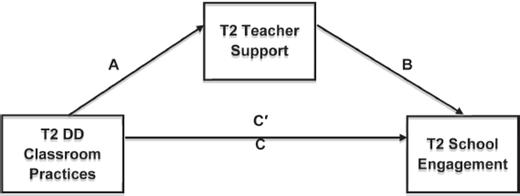
Teacher Support as a Mediator of the Relation Between DD Classroom Practices and Sixth Graders’ End-of-Year School Engagement
Teacher Support as a Mediator of the Relation Between DD Classroom Practices and Sixth Graders’ End-of-Year School Engagement
Given the nested data structure and our interest in students’ within-classroom perceptions of teachers’ DD practices and support, we conducted multilevel regression analyses using hierarchical linear modeling (HLM) (Bryk & Raudenbush, 1992). Whereas much of the research using HLM primarily aims to explain differences between groups, our primary goal was to isolate between-group variance in the dependent variable to obtain precise measures of within-group (teacher/classroom-level) variation in individuals’ end-of-year school engagement. Accordingly, our two-level (student- and teacher/classroom-level) HLM analysis utilized two equations:
(1) a within-classroom model explaining end-of-year school engagement as a function of student-perceived teacher DD practices and support, plus a random student-level effect after accounting for baseline school engagement and perceptions of teacher DD practices and support. And,
(2) an unconditional classroom-level model with a random classroom-level effect.
Data preparation occurred in SPSS Version 22.0, where variables were z scored before importing student- and classroom-level data (i.e., a teacher/classroom identification matching variable) into HLM 7 (Raudenbush, Bryk, Cheong, Congdon, & du Toit, 2011). Prior to conducting multilevel analyses for the previously mentioned equations, we determined the amount of school engagement variance at the individual (Level 1) and teacher/classroom (Level 2) level with a fully unconditional model in which no predictors were entered into the equation predicting school engagement. Then, we executed a series of hierarchical linear models to examine relations between students’ T2 perceptions of DD practices, teacher support, and school engagement, to test teacher support as a mechanism by which DD practices impact school engagement over sixth grade (Figure 1).
Results
Descriptive Findings
On average, school engagement was lower (p < .001) at the end (M = 3.71, SD = .56) versus beginning (M = 3.89, SD = .53) of sixth grade, F(1, 476) = 62.12, p < .001, ηp2 = .12. Similarly, the T2 teacher support mean (M = 3.73, SD = .85) was significantly lower (p < .001) than T1 (M = 3.95, SD = .77), F(1, 484) = 40.23, p < .001, ηp2 = .08. In contrast, the DD practices mean was marginally higher (p < .10) at T2 (M = 3.29, SD = .60) than T1 (M = 3.24, SD = .61), F(1, 486) = 3.03, p = .083, ηp2 = .01. As anticipated, bivariate correlations show that T2 school engagement was significantly (r = .60, p < .001) and positively correlated with T1 school engagement. Additionally, T2 school engagement was also positively and moderately correlated with both DD practices and teacher support at T1 and T2. See Table 1 for descriptives and intercorrelations.
Preliminary Analyses
Fully Unconditional Model. We ran a fully unconditional model in HLM to partition the variance in T2 school engagement into within- and between-classroom components, then calculated the intraclass correlation coefficient to determine the proportion of systematic variance in T2 school engagement between classrooms. A significant proportion (τ00 = .08, p < .001) of the variance in T2 school engagement was due to between-class variation; the majority was due to differences within classrooms. Because the magnitude of reliability estimates is related to within-class sample size (Lee & Smith, 1999), and our average was 18 students per classroom, the lambda (λ = .58) suggests that our outcome measure captures within-class school engagement means with moderate consistency. Combined with the low intraclass correlation coefficient, the moderate lambda suggests that it was appropriate to use HLM with lower level mediation to address our research questions.
Core Analyses
Relation Between T2 DD Practices on T2 School Engagement, Controlling for T1 School Engagement and DD Practices (Path C). The independent variable of interest, T2 DD practices, was moderately, positively associated with T2 school engagement (β3j = 0.36, p < .001). Additionally, there was a strong positive association between students’ T1 and T2 school engagement (γ10 = .49, p < .001). Time 1 DD practices was weakly, negatively related to students’ end-of-year school engagement (γ20 = –11, p < .001).
Relation Between T2 DD Practices and T2 Teacher Support, Controlling for T1 School Engagement and DD Practices (Path A). Time 2 DD practices was positively associated with T2 teacher support. On average, by the end of the school year, sixth graders gained .47 within-class standard deviations on teacher support for each standard deviation increase in DD practices (p < .001). Additionally, as anticipated, T1 teacher support was positively associated with T2 teacher support (β2j = 0.44, p < .001). In contrast, T1 school engagement was not appreciably associated with T2 teacher support (β1j = 0.03, ns).
Relations Between T2 DD Practices, Teacher Support, and School Engagement, Controlling for T1 DD Practices, Teacher Support, and School Engagement (Path B). After accounting for T1 school engagement, T1 DD practices, and T1 teacher support, T2 teacher support showed a significant, positive association with T2 school engagement (β3j = 0.35, p < .001). Additionally, T2 DD practices remained positively, significantly associated with T2 school engagement after accounting for the effect of T2 teacher support on T2 school engagement (β3j = 0.19, p < .001). This final model explained 51% of the individual-level variance in T2 school engagement (out of the initial 92% within-classroom fully unconditional model variance).
Mediating Effect of T2 Teacher Support (Path C’)
Our within-class models met the preliminary requirements for mediation as outlined by Baron and Kenny (1986). First, relations indicated by paths A, B, and C in Figure 1 were significantly different from zero. Second, the coefficient for path C (T2 DD practices predicting T2 school engagement) was reduced from .36 to .19 when the mediator, T2 teacher support, was included in the model (Path C′). Consequently, we conducted a Sobel test (Preacher & Hays, 2004) to examine whether the reduction represented significant partial mediation; the change was statistically significant (z = 5.61, SE = 0.03, p < .001). Thus, sixth graders’ perceptions of teacher support partially explained the effect of DD practices on end-of-year school engagement.
Correlations and Scale Descriptives for Key Study Variables (N = 571)
| Measure | M | SD | Min. | Max. | 1 | 2 | 3 | 4 | 5 | 6 | 7 | 8 |
|---|---|---|---|---|---|---|---|---|---|---|---|---|
| 1. Age (T1) | 11.27 | 0.46 | 10.00 | 13.00 | — | .35*** | .03 | .03 | .08 | .06 | .06 | .01 |
| 2. Age (T2) | 11.77 | 0.45 | 10.00 | 13.00 | — | .00 | –.01 | .02 | –.01 | .05 | –.02 | |
| 3. Classroom practices (T1) | 3.26 | 0.60 | 1.40 | 4.80 | — | .40*** | .40*** | .23*** | .36*** | .25*** | ||
| 4. Classroom practices (T2) | 3.29 | 0.59 | 1.60 | 5.00 | — | .27*** | .46*** | .36*** | .45*** | |||
| 5. Teacher support (T1) | 3.97 | 0.76 | 1.00 | 5.00 | — | .54*** | .56*** | .31*** | ||||
| 6. Teacher support (T2) | 3.70 | 0.86 | 1.00 | 5.00 | — | .40*** | .51*** | |||||
| 7. School engagement (T1) | 3.89 | 0.53 | 1.94 | 5.00 | — | .60*** | ||||||
| 8. School engagement (T2) | 3.70 | 0.56 | 1.35 | 5.00 | — |
p < .001.
Within-Class Model of Sixth Grade End-of-Year School Engagement
| Fixed Effect | Coefficient | se | t ratio | df |
|---|---|---|---|---|
| T2 Mean School Engagement, γ00 | –.06 | .06 | –1.0 | 30 |
| T1 School Engagement, γ10 | .47*** | .03 | 13.73 | 535 |
| T1 Classroom Practices, γ20 | –.06*** | 0.04 | –1.85 | 535 |
| T2 Classroom Practices, γ30 | .19*** | 0.04 | 4.95 | 535 |
| T1 Teacher Support, γ40 | –.14*** | .04 | –3.21 | 535 |
| T2 Teacher Support, γ50 | .35*** | 0.05 | 6.99 | 535 |
| Random Effect | Variance Component | SD | df | χ2 |
| T2 Mean School Engagement, u0 | .05*** | .22 | 32 | 91.74 |
| Level-1 effect, rij | .49 | .70 |
p < .001.
Discussion
The purpose of the present study was to examine student-perceived teacher support as a possible mediator of relations between teachers’ use of DD practices and middle school students’ school engagement. Given documented connections between school engagement and positive adolescent outcomes, we were particularly interested in understanding whether students in schools undergoing DD implementation would report greater school engagement at the end (versus beginning) of sixth grade. We hypothesized that in the context of DD, early adolescent students would feel more supported as they observed and experienced their teachers’ developmentally supportive classroom practices, and therefore would indicate more positive school engagement over the course of the sixth-grade year. Consistent with prior research (Eccles & Midgley, 1989; Turner, Christensen, Kackar-Cam, Trucano, & Fulmer, 2014), our preliminary analyses showed an overall average decline in school engagement over the sixth-grade year. However, inferential results indicated that within sixth-grade classrooms in the sample, the average decline in school engagement was reduced when students reported that their teachers implemented DD practices more frequently. Further, this reduction occurred (in part) as a function of students perceiving that their teachers were more supportive. These findings are noteworthy because they show the promising effects that perceived support from only one teacher could have on important adolescent school outcomes. The cumulative effects of support from multiple teachers may have the potential to eliminate the average decline in school engagement altogether.
The present study makes several important contributions. First, we identified a mechanism by which teachers’ developmentally aligned classroom practices may support middle school students’ school engagement. Few previous studies have empirically shown how teacher support facilitates early adolescents’ school engagement within the context of comprehensive SEL intervention efforts. It is possible that teachers who are already supportive tended to implement DD practices more frequently, or perhaps their implementing DD practices more frequently engendered a sense of support among sixth graders. Considering that teacher support involves both affective and instructional components, one might question whether the DD approach imbues and/or enhances teachers’ existing socioemotional skills in ways that facilitate school engagement.
Consistent with goals of the DD approach, we asserted and found empirical support for the notion that teacher support and DD practices are linked. In the current data, sixth-grade students’ end-of-year perceptions of their teacher’s DD practices and support were moderately correlated (r = .47). Indeed, theoretical models that include teacher support as a part of a caring classroom community suggest that teacher support occurs through approaches that are both affective and instructional, and affective within instruction (Roehrig et al., 2012). To our knowledge, however, scholars have not ascertained whether—from the perspectives of students—teacher support is enhanced after training in SEL approaches like DD. In the present study, we used short-term longitudinal data to account for students’ beginning-of-year perceptions of teacher support no less than a month or two after their teachers completed summer DD approach training. Thus, we were able to estimate the effect of teacher support on students’ school engagement over time, following training to implement DD.
Second, our study highlights the centrality of students’ subjective perceptions of their teacher’s use of DD practices as important in fostering students’ feelings of teacher support. This finding is supported by the results of implementation fidelity studies, which show that intervention efficacy depends on the extent to which participants “receive” the intervention curriculum (Durlak & DuPre, 2008). For instance, as reported in our introduction, in her ethnographic case study in a middle school undergoing schoolwide DD implementation, Bedoya-Skoog (2014) found that students felt more supported in the classrooms of “high implementers” in comparison to students in the classrooms of “low implementers.” In contrast to the present study, which used students’ reports of DD teacher practice, Bedoya-Skoog used a classroom practice observation inventory and classified middle school teachers as “high implementers” and “low implementers” of the DD approach through multiple classroom observations over a school year. Taken together, the results of the present study and Bedoya-Skoog’s suggest that teacher support is likely embodied through implementation of developmentally supportive classroom practices like those aligned with the DD approach—from both the perspectives of students, and the viewpoint of an independent researcher-observer.
Third, results from our fully unconditional model showed that a significant proportion of variation in sixth graders’ end-of-year school engagement occurs at the individual level within classrooms; only 8% of students’ self-reported end-of-year school engagement was attributed to differences between classrooms. On the one hand, this finding is encouraging because it suggests that on average, sixth graders across classrooms are similarly engaged in school. On the other hand, however, the within-class variability raises questions about why and how individual students’ experiences with the same teacher differ from peers in the same class. We controlled for beginning-of-year school engagement, and therefore our end-of-year outcome represents the individual’s average change in school engagement over the school year. Moreover, including beginning-of-year teacher support accounted for potential bias in our T2 teacher support measure that may have occurred as a result of students’ initial, early assessments of their teachers’ support. The final model with baseline controls explained 46% of the individual variance in end-of-year school engagement (49% of the 92% total within-class variance), suggesting that a rather substantial proportion of the within-class variation in school engagement can be attributed to sixth graders’ perceptions of teachers’ practices over the school year and the accompanying support (or the lack thereof) teachers provide through their classroom practices.
Finally, our findings contribute to the body of scholarship showing that student perspectives on teachers’ practices and support represent relevant sources of information about the efficacy of school-based interventions and teaching strategies (Bell & Aldridge, 2014; Howard, 2001; Jiang et al., 2013; Wentzel, 1997). Some existing research has shown differences in how students and teachers report teachers’ practices, with agreement most likely occurring on questions that involve tangible items (e.g., use of mathematics tools, like rulers; Desimone et al., 2010). Consistent with this concept, half of our DD classroom practices items focused on material resources in the classroom. As such, it is possible that significant overlap exists in how students perceived their teachers’ DD practices, and the DD practices teachers themselves would report. Future studies should examine congruence between teacher and student reports of classroom practices, especially to understand the salience of practices designed to impact students during specific developmental periods.
Limitations, Considerations, and Future Directions
Like all research, this study is not without limitations. First, we assessed students’ overall school engagement rather than engagement in one class; we were unable to isolate whether students’ experiences with the target teacher influenced their engagement in specific classes. Although some research focuses on adolescents’ proximal engagement as a function of interest and value in a particular course (Marks, 2000; Sakiz, Pape, & Hoy, 2012), our study shows how students’ affective experiences in a single class relate to their overall feelings about school. Recall that a key goal among middle schools adopting the DD approach is to build a school culture whereby adolescents feel supported and are engaged; achieving this goal depends on individual teachers and other staff providing students with support in and outside of the classroom. Accordingly, we were interested in how students’ experiences within one classroom might influence their overall school engagement. Thus, our findings support the notion that for early adolescents, having a supportive relationship with at least one teacher or other caring adult in school is a key factor in school engagement (Woolley & Bowen, 2007). Future research should examine how individual students’ perceptions of teacher practices and support vary across classes/courses within the same school year. Additionally, future studies may examine how stability and change in individual students’ perceptions of teacher practices and support throughout middle school influences overall school engagement before the critical transition to high school.
Second, we investigated a proximal outcome of positive youth development (Furlong et al., 2003; Shernoff, 2012), school engagement, although from a practical standpoint the DD approach is ultimately aimed at impacting other distal socioemotional (e.g., social competence) and academic (e.g., grades) factors. Nevertheless, our finding that teacher support is a partial mediator of the association between DD practices and school engagement points in the direction of having an impact on other positive adolescent adjustment outcomes. In the future, we hope to examine associations between school engagement and social competence, grades, and disciplinary infractions, among other outcomes. Additionally, future research might examine whether teacher support similarly mediates relations between teachers’ DD practices and other proximal outcomes such as students’ efficacy in interpersonal interactions with their teachers and peers.
Finally, due to the summer timing of teacher training, we were unable to query students’ perceptions of teacher support before teachers received DD training, and it is unclear how reliable such perceptions would be so early in the relationship-building process. Future research should more fully examine the origins of teacher support in middle schools implementing SEL interventions. For example, scholars may assess student perceptions of teacher support prior to teachers participating in professional development during the middle of the school year, and subsequently study the extent to which DD or similar approaches influence teachers’ supportive behaviors over time.
Implications for School-Based Practices
Results of the present study provide emerging support for the DD approach as a means to facilitate adolescent school engagement, particularly when adolescents transition to middle school in sixth grade. More research is needed to understand complex relations between teachers’ practices and students’ perceived support. However, it is important to highlight the growing evidence that supportive teachers are essential to our abilities to provide devel-opmentally aligned classroom environments for adolescents (Danielsen, Wiium, Wilhelmsen, & Wold, 2010; Jiang et al., 2013; Pianta & Allen, 2009). DD and other SEL approaches may offer adolescents the type of comprehensive teacher support that facilitates school engagement and overall positive socioemo-tional development.
Importantly, our results show that students’ perceptions of just one teachers’ support can play an instrumental role in overall school engagement; these results are a reminder to educators of their potential impact beyond their own classes (Eccles & Wigfield, 2002). Supporting positive adolescent development depends on the individual and collective efforts of adults to provide school environments where adolescents’ autonomy, belonging, and competence needs are met. For such approaches to be effective, it is not only adult perspectives on classroom practices and teacher affect that matter; students must also receive and perceive teachers’ actions as such.

