


Despite the success of many drug and alcohol prevention programs, drug and alcohol use by adolescents continues to be a problem. One important factor in preventing drug and alcohol use may be determining, in a non-intrusive manner, which students are most at risk for drug involvement. In the present study, the predictive relationship between adolescent attitudes towards conflict and their attitudes toward drug and alcohol involvement were examined using The Communities that Care Survey (CTC), based on the Hawkins, Catalano & Miller (1992) model of risk and protective factors. Although several items ask about reactions to conflict, the construct of attitude towards conflict has not previously been thoroughly examined in terms of its potentially predictive relationship with drug involvement. Five years of CTC data were collected from 6th, 8th, 10th and 12th graders (n = 11,419) in a medium-sized Midwestern town. A Conflict Attitudes Scale and a Drug Attitudes Index were created from CTC items. Regression results indicate that the Conflict Attitude Scale scores were predictive of Drug Attitude Index scores. The findings suggest that professionals working with middle grade students may consider utilizing assessments of attitudes toward conflict to predict adolescent risk for drug involvement.
Introduction
Research has suggested that the time to concentrate on preventing adolescent and adult involvement with illegal drugs is long before adolescence. Thus, numerous elementary and middle grade prevention programs have been created and implemented in the past twenty years. Yet despite the success of many of these programs, drug use by adolescents continues to be a problem. Influences on risk taking behavior in adolescents such as the influence of family, peers, community, religion, decision making processes, feelings of invulnerability, and more recently brain development are of interest to researchers and practitioners in numerous fields. Although several theories have been suggested as to why adolescents take more risks, no clear consensus seems to have been reached yet (see Reyna & Farley, 2006 for a summary of several current views). Despite the fact that no clear causal theory can currently fully explain the risk behaviors of adolescents, research has provided insight into some of the numerous risk and protective factors associated with adolescents’ involvement in risky behaviors such as drug and alcohol use, dangerous driving, crime and unprotected sex. Although many of these factors have been studied extensively, there are still many relationships between these factors, as well as additional factors, that may be associated with adolescent risk behaviors that have not been thoroughly explored.
Despite increased efforts to create and implement prevention programs for elementary and middle grade students, risky behaviors such as cigarette smoking and alcohol and drug use continue to be problematic for adolescents. The detrimental effects of adolescent smoking due to the addictive nature and long term health consequences of cigarette smoking have been well established. A recent issue of the journal Pediatrics (April 2008) examined the topic of “Underage Drinking: Understanding and Reducing the Risk in the Context of Human Development.” This special issue proposed by the National Institute on Alcohol Abuse and Alcoholism (NIAAA), primarily focuses on issues pertinent to practitioners working with children and adolescents, with the understanding that alcohol consumption during late childhood and adolescence is occurring while brain development is continuing to occur. The implications from that fact alone are both vast and momentous. Research suggests that children who begin drinking alcohol before the age of 15 are four times more likely to become alcoholics. Faden (2006) analyzed data from three national surveys from 1975 through 2003 and found that while the percentage of children beginning to drink alcohol at a very young age (under 13) has declined, many children first try alcohol when they are 13 or 14; 40% of American 8th graders have used alcohol. Thus, the need to identify children at risk for early alcohol use so that interventions can occur with those children continues to be an important challenge for those working with tweens and adolescents.
Studies have also shown that adolescent use of marijuana may have long term negative health implications. Pope et al. (2003) examined the nature of adolescent onset cannabis use and cognitive impairment in adulthood. Their findings suggest that early use of cannabis in adolescence, which occurs while brain development is still happening, is negatively related to cognitive performance on tests such as Verbal IQ tests. However, their results did suggest that the relationship is not a clear cut one. Arseneault, Cannon, Witton and Murray (2004) provided evidence that the adolescent use of cannabis is associated with a higher risk of adult schizophrenia. Although adolescent use of cigarettes, marijuana and alcohol is considered by some to be common place, it is certainly not harmless.
It is important to consider various predictors that might help practitioners identify those adolescents most at risk. The literature has suggested that one predictor of drug and alcohol abuse in adolescents is conflict in families (Hawkins, Catalano & Miller, 1992). Conflict in families has clearly been linked to violent acts, emotional instability and other risk factors in adolescents (Ary et al. 1999; DuRant, Cadenhead, Pendergrast, Slavens & Linder, 1994; Repetti, Taylor, & Seeman, 2002). While it is clear that familial conflict can impact adolescent risk, understanding the relationships between other elements of adolescent involvement in conflict may offer another important avenue for understanding predictors of adolescent drug and alcohol use.
Fothergill and Ensminger (2005) studied the relationship between aggression and risk behaviors in a large longitudinal study of a cohort in first grade, adolescence, and adulthood. They found that first grade aggression was indirectly associated with substance use problems later in life. Fully understanding the potential relationship between behaviors related to conflict, such as aggression, and risk behaviors is clearly a multifaceted challenge. Some of the areas which should be explored involve further investigating how exposure to conflict, attitudes toward conflict, and involvement in conflict are related to risky behaviors.
Recently Michael and Ben-Zur (2007) examined the relationship between social factors (including positive parental relationships and orientation toward peers) and affective factors (including depressive mood and aggressive behavior) with risk-taking behaviors in Israeli adolescents (in the areas of driving, health, drugs, lawbreaking and social daring). They found that the social factor of orientation toward peer relationships was the primary predictor of risk taking behavior for males, while the social factor of positive parental relationships was the primary negative predictive factor for female risk taking. The affective factors, aggressive behaviors and depressive mood, were both correlated with risk taking in males and females. The correlations between those affective factors and risk taking behaviors were not as strong as the correlations between the social factors and the risk taking behaviors.
These studies suggest that behaviors and attitudes that are associated with conflict, perhaps especially as it relates to aggression may be predictive of risk taking behaviors such as cigarette smoking and drug and alcohol use. However, the relationships between attitudes towards conflict and risk factors in adolescence have not been thoroughly studied. The present study examines the relationship between adolescent attitudes towards conflict and attitudes about involvement with cigarettes, marijuana and alcohol.
One important aspect of attitude towards drug involvement is the perception of drug use by peers and other influential people in an adolescent’s life. While Michael and Ben-Zur (2007) found orientation toward peer relationships to be predictive of risk taking behaviors for adolescent males, Prinstein and Wang (2005) found that while adolescents’ perceptions of their peers’ behaviors were predictive of their own similar behaviors, their perceptions were not actually accurate. These studies suggest that the perceptions of adolescents regarding their peers’ access to, and use of illegal drugs should also be predictive of the adolescents’ access to, and use of illegal drugs. Likewise, one might expect that in the presence of their peers’ risk taking behaviors, drug use may indeed increase due to both the presence of the peers, and the perhaps erroneous, perceptions regarding the use of illegal drugs by their peers.
Steinberg (2007) considered the relationship between brain development and risk taking behaviors with or without peer influence in adolescents and adults. He presents a perspective that suggests that the asynchronous development of rational thinking and psychosocial reasoning in adolescents leads adolescents to take risks in the presence of peers more often than adults do, despite being no more likely than adults to take risks when they are alone. Given the fact that adolescents are more likely to take risks in the presence of others, perhaps one should consider how an adolescent’s attitudes toward conflict may relate to risk taking behaviors. If an adolescent indicates that he/she is likely to engage in conflict, that is to have what might be considered a “positive” attitude toward conflict, how might that relate to his or her interactions with others in risk taking situations?
Hawkins, Catalano & Miller (1992) suggested the importance of examining risk factors in understanding and preventing adolescent alcohol and drug abuse. A survey based on the Hawkins and Catalano model, The Communities that Care Survey (CTC), is given annually to numerous students throughout the United States in order to assess their risk and protective factors. The CTC includes 126 questions relating to four types of risk factors: Family, School, Peer/Individual, and Community. Each of these areas is composed of several more specific factors. The survey includes questions regarding drug use, accessibility and perceptions. Harrison (1995) established the validity of self report surveys as valid indicators of drug use. CTC respondents are promised anonymity; therefore it is reasonable to assume that responses to these questions are valid indicators of true access to drugs and drug use. Schmitt, Frey, Dunham, & Carman (2007) recently provided empirical evidence from three studies across different states and years in an effort to support the theoretical factor structure proposed by Hawkins and Catalano. Perhaps most interesting is the analysis of the factor structure across grade levels (i.e. 6th - 12th). Both the Community and School risks and protective factors were determined to hold up to the standards of strong metric invariance, suggesting that while subtle differences between younger and older adolescents may exist these differences are weakly supported. Schmitt et al. conclude that overall model fit for both Community and School domains function similarly for younger and older students.
In this study, a Conflict Scale was created based on CTC items from across the above mentioned risk factor areas. While the CTC was created to look at risk factors such as alienation and rebelliousness, and at anti-social behaviors within the Peer/Individual area, it does not specifically address how drug and alcohol use may be predicted by students’ responses to questions about conflict. Although it has been established in the literature that some forms of conflict in a child’s life are often related to adolescent risk taking, this study sought to establish the relationship between the adolescent views toward conflict and their drug and alcohol risk factors during adolescence. We hypothesized that there would be a significant linear relationship between positive attitudes towards conflict and positive attitudes toward drug and alcohol use. By establishing the presence of that relationship, practitioners might then be able to consider how to obtain adolescent opinions about conflict to predict their likelihood of having favorable attitudes toward drug and alcohol use. This is important because while adolescents may not want to tell an adult about their opinions and behaviors related to drugs and alcohol for fear of punishment, they may be more inclined to provide opinions about their thoughts and reactions to conflict situations without fear of punishment.
Method
Participants
All students in the 6th, 8th, 10th and 12th grades in a medium sized Midwestern school district are given the CTC survey each year. In this school district, 6th graders attend elementary school, while 8th graders attend junior high, and 10th and 12th graders attend senior high. The survey was administered by school faculty members during the school day. Students were given approximately 50 minutes to complete the survey. Data from 2002 through 2006 were analyzed for this paper.
While some of these students may have been the same students (i.e. a 6th grader in 2002 may have completed the survey as an 8th grader in 2004 and as a 10th grader in 2006), they were not asked to give any identifying information on the survey; therefore the data could not be considered as repeated measures across years. Demographic information regarding the distribution of participants by race is presented in Table 1. Chi-square analyses indicate that there were no significant relationships between the distribution of students by ethnic group and year; therefore the presented data are collapsed across 2002 through 2006. There were also no statistically significant relationships between year or grade in the distribution of males (49.5%) and females (50.5%).
Development of the Indices
Validity demands suggest using multiple sources of data to produce an authentic view of complex attitudes, such as attitude towards conflict and attitudes toward drug involvement. Single-item or single indicator measures of subjective concepts are known to be low in reliability. Creating a composite score which combines multiple related indicators will, theoretically, increase precision and reduce random measurement error. Empirically, this is almost always the case. Under classical assumptions, measurement precision will increase and random error will decrease, as the number of observations increases (e.g. Crocker & Algina, 1986; Feldt & Brennan, 1993; Thompson, 2003). In addition to the measurement advantages of combining multiple items into a single index or scale, measures with greater reliability provide greater opportunities to observe true relationships between variables, which is the goal of the present study.
Conflict Attitude Scale
Five evaluators individually selected initial items from the CTC to consider in the creation of a Conflict Attitude Scale. Although the individual selections were made based on face validity, the content validity was established when the evaluators came together and discussed the items within the context of the relevant literature and then as a group created a list of ten agreed upon items to use in the initial exploratory factor analysis. Changes in all ten of these items might be expected to occur with changes in underlying attitudes toward conflict. Therefore, all ten items were considered to be effect indicators for the hypothesized latent variable of Conflict Attitude.
Initial estimates suggested high reliability for the scale (α = .83). An exploratory factor analysis for the 2003 CTC data (n = 3,702) using Principal Axis factoring and Varimax rotation was conducted. The factor analysis for the conflict scale yielded a two factor solution with five items loading on Factor 1 (Eigenvalue = 4.10) and five items loading on Factor 2 (Eigenvalue = 1.13). Thus, those two factors accounted for 52% of the variance. A confirmatory factor analysis was then conducted for the full (2002 through 2006) data set. Again, the same two factor solution resulted, however only 9 items remained. The rotated factor matrix is presented in Table 2. The two factors are labeled as physical aggression and rebelliousness. Because both physical aggression and rebelliousness were considered to be important elements of how students feel and respond to conflict situations, the items for both factors were included in the Conflict Attitude Scale.
The response options for items 1, 2, 3, 4, 5 and 8 in Table 2 were YES! yes no NO!; these responses were then coded using a 4 point scale with YES! responses receiving a 4 and NO! responses receiving a 1 (except for item 5 which was reverse coded). The response options for questions 6 and 7 were: Very Wrong, Wrong, A Little Bit Wrong, Not Wrong at All, which received 4, 3, 2 and 1 points respectively when coded for analyses. The response options for question 9 were: Never, 1 - 2 times, 3 - 5 times, 6 - 9 times, 10 - 19 times, 20 - 29 times, 30 - 39 times, 40 + times. These responses were coded numerically as 0, .5, 1, 1.5, 2, 2.5, 3, 3.5 and 4 respectively. Thus all items on the Conflict Attitude Scale were coded on a four point scale.
Rotated Factor Matrix For The Conflict Attitude Scale Utilizing Principal Axis Factoring & Varimax Rotation (n = 11,419)
| Factor | ||
|---|---|---|
| Rebelliousness | Physical Aggression | |
| 1. I like to see how much I can get away with. | .706 | |
| 2. I ignore rules that get in my way. | .663 | |
| 3. I think it is okay to take something without asking if you can get away with it. | .618 | |
| 4. I do the opposite of what people tell me, just to get them mad. | .523 | |
| 5. It is important to be honest with your parents, even if they become upset or you get punished (reverse coded). | .456 | |
| 6. How wrong do you think it is for someone your age to: attack someone with the idea of seriously hurting them? | .859 | |
| 7. How wrong do you think it is for someone your age to: pick a fight with someone? | .572 | |
| 8. It is all right to beat up people if they start the fight. | .471 | |
| 9. How many times in the past year have you: attacked someone with the idea of seriously hurting them? | .426 | |
Drug Attitude Index
The Drug Attitude Index was developed by initially taking all 55 items from the CTC that asked about drug attitudes, behaviors or perceptions. These items included questions about the drug activity and attitudes of self, peers, and community. An initial factor analysis was conducted for the first four years of data across the four grade levels (n = 9,387). Using a principal components extraction and a Varimax rotation, one factor yielded an Eigenvalue of 18.34 and accounted for approximately 25% of the variance. Although the initial analysis yielded 12 factors with Eigenvalues greater than 1, the other Eigenvalues were much lower than the Eigenvalue for the first factor (all < 4, with all but one below the elbow on the Scree plot). Thus, the fifteen items that contributed most to that initial factor (with factor loadings ranging between .616 and .793) were selected to create the index. All items selected were considered to be cause indicators, such that changes in these items would be likely to lead to changes in the hypothesized latent variable Drug Attitude.
The reliability of the index, based on those 15 items was extremely high (α = .94). Results from a subsequent confirmatory factor analysis conducted on those 15 items with the data from all five years (n = 11, 419), indicate that the factor consisting of the 15 items accounted for 54% of the variance (Eigenvalue = 8.21). The 15 items selected for the Drug Attitude Index are included in Table 3. The items represent questions about three different drugs (cigarettes, alcohol and marijuana), as well as community risk factors.
Considering each grade level separately resulted in slightly different factor analyses results, which would have lead to indices with one less, or one more item at different grade levels. However, for the purposes of this study, an index that is robust across grade levels was preferred. Thus, subsequent index analyses are reported for all four grade levels combined.
Drug Attitude Index Items Selected From Factor Analyses
| Drug Index Items & Response Options |
|---|
| 1. Think of your 4 best friends. In the past year (12 months) how many of your best friends have tried beer, wine or hard liquor when their parents didn’t know about it? None, 1, 2, 3, 4 |
| 2. Think of your 4 best friends. In the past year (12 months) how many of your best friends have smoked cigarettes? None, 1, 2, 3, 4 |
| 3. Think of your 4 best friends. In the past year (12 months) how many of your best friends have used marijuana? None, 1, 2, 3, 4 |
| 4. If you wanted to get some beer, wine or hard liquor, how easy would it be to get some? Very Hard, Sort of Hard, Sort of Easy, Very Easy |
| 5. If you wanted to get some cigarettes, how easy would it be to get some? Very Hard, Sort of Hard, Sort of Easy, Very Easy |
| 6. If you wanted to get some marijuana how easy would it be to get some? Very Hard, Sort of Hard, Sort of Easy, Very Easy |
| 7. On how many occasions (if any) have you had beer, wine or hard liquor in your life? 0 occasions, 1 – 2 occasions, 3 – 5 occasions, 6 – 9 occasions, 10 – 19 occasions, 20 – 29 occasions, 30 – 39 occasions, more than 40 occasions |
| 8. On how many occasions (if any) have you used marijuana in your lifetime? 0 occasions, 1 – 2 occasions, 3 – 5 occasions, 6 – 9 occasions, 10 – 19 occasions, 20 – 29 occasions, 30 – 39 occasions, more than 40 occasions |
| 9. Have you ever smoked cigarettes? Never, Once or twice, Once in a while but not regularly, Regularly in the past, Regularly now |
| 10. How much do you think people risk harming themselves (physically or in other ways) if they try marijuana once or twice? No risk, Slight risk, Moderate risk, Great risk |
| 11. About how many adults have you known personally who in the past year have gotten drunk or high? None, 1 adult, 2 adults, 3 or 4 adults, 5 or more adults |
| 12. If a kid smoked cigarettes in your neighborhood, would they be caught by the police? NO! no yes YES! |
| 13. How wrong do you think it is for someone your age to drink beer, wine or hard liquor? Very Wrong, Wrong, A Little Bit Wrong, Not Wrong at All |
| 14. How wrong do you think it is for someone your age to smoke cigarettes? Very Wrong, Wrong, A Little Bit Wrong, Not Wrong at All |
| 15. How wrong do you think it is for someone your age to use marijuana? Very Wrong, Wrong, A Little Bit Wrong, Not Wrong at All |
Results
After the items for the Conflict Attitude Scale and the Drug Attitude Index were selected, Conflict Attitude Scale and Drug Attitude Index scores were calculated for each student. A regression analysis was conducted with Conflict Attitude Scale scores acting as the predictor and Drug Attitude Index scores as the criterion. In addition, in order to provide more understanding about how these measures may change as children age, as well as to examine the stability of the measures across years, a Multivariate Analyses of Variance (MANOVA) was conducted using both the Conflict Attitude Scale and Drug Attitude Index scores as dependent variables and year (2002 through 2006) and school level (Elementary, Jr. High and Sr. High) as independent variables.
It was hypothesized that the Drug Attitude Index Scores would increase as students aged, while the Conflict Attitude Scale Scores might peak in Jr. High. It was also hypothesized that the Drug Attitude Index Scores may decrease across years because a Safe Schools Healthy Students (SSHS) grant was implemented in the school district from 2003 through 2006. One of the primary goals of the SSHS project was to decrease drug and alcohol use among the adolescents.
Regression
The regression analyses indicated that Conflict Attitude Scale scores could be used to predict the Drug Attitude Index scores, accounting for 35% of the variance (r = .59, p<.001). The regression equation for the data is: Drug Index Score = 5.92 + 1.92(Conflict Attitude Scale Score). A scatter plot of the data suggests that there are more scores in the lower quadrant of the graph than in other areas. Looking at the normal probability plot for the regression standardized residuals in Figure 1, the fit appears to be weakest in the middle of the distribution. This corresponds with the distribution of both the Conflict Attitude Scale and the Drug Attitude Index; they are both slightly positively skewed (skewness for the drug index = .58, conflict index = .75). However, alternative non-linear fits to the data are not superior. The regression equations are slightly, but not significantly, different if each year is treated separately.
Conflict & Drug Attitude by Level & Year
A two-way MANOVA was conducted with Year (2002 through 2006) and School Level (Elementary, Jr. High, and Sr. High) as the factors, and Conflict Attitude Scale and Drug Attitude Index scores as the dependent variables. Significant main effects of both year (see Figure 2) and school level (see Figure 3) were found (F (8, 20630) = 4.68; F (4, 20630) = 1249.58 respectively, p < .001 for both); a significant interaction was also obtained (F (16, 20630) = 2.00, p < .05). It is apparent in Figures 2 and 3 that the scores on both measures are lowest for the Elementary students, and highest for the Sr. High students.
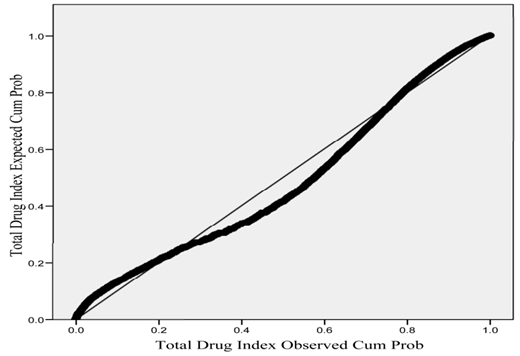
Normal Probability Plot for the Regression Standardized Residuals
Normal Probability Plot for the Regression Standardized Residuals
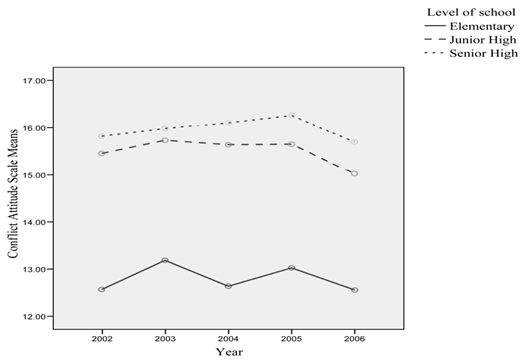
Mean Conflict Attitude Scale Scores by Year & School Level
Mean Conflict Attitude Scale Scores by Year & School Level
The scores on both the scale and index declined significantly from 2002 (before the SSHS Initiative was implemented in the school district) to 2006 (the last year of the SSHS Initiative). Although a main effect of year was found on the scale (ηp2 = .002 ) and index scores (ηp2 = .002), it is apparent that the decline from 2002 to 2006 was not a steady decline from the first to the last year of the SSHS initiative. These small effect sizes indicate that the significant differences between years may be an artifact of the large sample size .Despite the differences between years, the regression results are consistent across years, such that the Conflict Attitude Scale scores remain predictive of Drug Attitude Index scores each year.
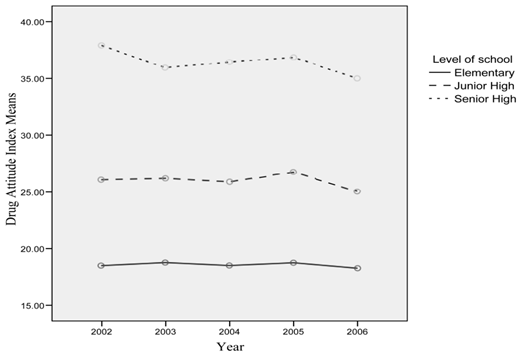
Mean Drug Involvement Attitude Index Scores by Year & School Level
Mean Drug Involvement Attitude Index Scores by Year & School Level
Given the main effect of school level (ηp2 = .233) and the significant interactions, one could choose to consider the data from each level separately. Though the interactions were significant, this is again likely due to the large sample sizes used in the analyses, as the interactions do not appear severe (Conflict Attitudes Scale ηp2 = .001, Drug Attitude Index ηp2 = .002). Consequently, the overall regression fit was examined in order to ascertain the general predictive value of the Conflict Attitude Scale on the Drug Attitude Index for adolescents of all ages. Although the more specified group fits (by school level) are not considered in this paper, it would be worth considering them separately if one is concerned only with one age group in order to attain a more reliable prediction for that age group.
Conclusions
Feelings of conflict and a “positive” attitude toward drug use appear to be related in adolescents. Although these data do not allow us to conclude that the increased positive feelings toward conflict lead to situations in which adolescents may be more likely to encounter positive drug attitudes and availability, it is apparent that we may predict adolescents’ attitudes toward drug use and availability relatively well if we know something about their attitudes toward conflict. While previous studies have established the clear link between alcohol and drug abuse and criminal activity in adolescents (Dawkins, 1997; Ellickson, Saner, & McGuigan, 1997; Yu & Williford, 1994), it is also useful to examine those attitudes which may lead to subsequent criminal activity in adolescents. Those previous studies show that increased alcohol and drug use appear to occur frequently before criminal activity occurs. It also appears that positive feelings about conflict are present in those adolescents that are perhaps most susceptible to becoming involved with drugs and alcohol.
In order to more fully understand the relationship between the scale and index with a robust set of data, the data analyzed for this paper were collapsed across the 6th, 8th, 10th and 12th grades. Although the results suggest that a relatively strong predictive relationship exists between the Conflict Attitude Scale and the Drug Attitude Index, the predictive values may be improved by considering each grade level independently. Additionally, one might examine the risk and protective factors within the school and community domains as potential mediating variables influencing the relationship between students’ conflict and positive attitudes toward drugs among older adolescents compared to younger adolescents (see Schmitt, et al., 2007). Yet, for practitioners working with adolescents of any age, the predictive value of the general regression equation can provide an indication of an adolescent’s potential access to and use of cigarettes, marijuana and alcohol, based on responses from the Conflict Attitude Scale.
While it is not clear whether any type of causal relationship exists between high conflict attitudes and positive attitudes toward drug involvement, a relationship does appear to exist between these variables. It is likely that there are numerous shared causal variables that contribute to the attitudes and behaviors of adolescents with regard to situations involving conflict and drug use. Clearly environmental issues such as family, community and school support, as well as the overall “healthiness” of each of these environments, is likely to contribute to the ability and desire of adolescents to respond to situations involving conflict or drug use. While practitioners may not be able to easily pick apart and resolve each contributing factor that leads to positive attitudes towards conflict and drug use, practitioners can work with those youths that indicate they have developed proconflict attitudes. Certainly the relationship between feelings about conflict and risky behaviors within the context of community and school support is worth investigating further.
Portions of this work were supported by a Safe Schools Healthy Students Grant given to the Lawrence, KS public schools. Portions of this paper were presented at the 19th Annual Convention of the Association of Psychological Science, May 2007, Washington, D.C.

