


Current educational research and articles in the popular press make much of the need to incorporate a technology-rich learning environment into the teaching of the STEM areas (science, technology, engineering, and mathematics), especially in the middle grades. Robotics are used to explore the idea of a technology rich program on students in a sixth-grade mathematics classroom. The purpose was to deepen the students’ understanding of mathematics as well as their ability to solve problems and collaborate productively with peers. This occurred through a unique and innovative collaboration between a middle school and a university technology program that successfully integrated robotics as a pedagogical tool to improve STEM learning for sixth graders and university students. The students were engaged in robot challenges that required them to work together over the course of 1 semester. Analysis of the end of year state-mandated mathematics exam showed that students with the most involvement in the robotics program achieved higher scores on concepts associated with algebra, measurement, and probability, all skills related to the group problem solving with which they were engaged. Textual analyses of student writing via a class blog demonstrated the development of student experiences and perceptions of collaboration in important and interesting ways. This unique approach to using robotics to teach both mathematical and collaborative skills has broad implications for developing technology-rich STEM learning experiences.
Many of the recent calls for education reform from all quarters have insisted that today’s students develop 21st century skills. Included in different versions of inventories of these 21st century skills are typically critical thinking and problem solving. Frequently, science, technology, engineering, and mathematics (STEM) areas are cited as vehicles for the development of these skills in students. The Next Generation Science Standards, for example, focuses on an integrated approach to teaching these STEM areas, as well as asserting that Engineering principles such as the development of powerful models, is essential to learning of science.
These types of educational initiatives are ideal for middle grade students. As Piaget and others have described (Harel & Papert, 1990; Kellough & Kellough, 2008; Piaget & Inhelder, 1972), these students are able to think concretely and creatively. They naturally find these STEM areas, along with inquiry and discovery teaching methods, are completely relevant and challenging. All too often, though, STEM education is invoked as a talisman, a silver bullet that will solve all of the real and perceived problems in our educational system.
Current educational research and articles in the popular press make much of the need to incorporate a technology-rich learning environment into the teaching of the STEM areas. In this study we explore the use of a robotics program in a sixth grade math/science classroom intended to deepen the students’ understanding of mathematics as well as their ability to solve problems and work together productively. This article describes an innovative collaboration between a middle school and a university technology program, which successfully integrated robotics as a pedagogical tool to improve the STEM learning for sixth graders as well as undergraduates. The following research questions are addressed in this study: (1) How can the use of robotics in a 6th grade mathematics/science classroom positively influence the learning of key math concepts? (2) How can the use of robotics in a sixth-grade math/science classroom reshape the learning environment toward collaboration?
Literature Review
Much research has focused on the integration of STEM areas into the classroom, especially in technology rich environments (Capraro & Jones, 2013). Some of this work has focused on specific technological tools (Blauvelt, 2006; Cavallo, Papert, & Stager, 2004; Matson, DeLoach, & Pauly, 2004). Other studies have explored pedagogical methods such as scaffolding (Barbuto, Swaminathan, Trawick-Smith, & Wright, 2003; Rasmussen & Marrongelle, 2006); visual modeling (Deratzou, 2006; Gow, 2007) storytelling (Kelleher & Pausch, 2006; Simkins, 2011); game design (Preston & Morrison, 2009); and project-based learning (Krajcik et al., 1998; Krajcik, Marx, Blumenfeld, Soloway, & Fishman, 2000; Sylvester & McGrath, 2007). This study has its roots in the learning theory of constructionism.
Constructionism
In response to Piaget’s idea of constructivism, Seymour Papert developed the learning theory he called constructionism. Constructionism is both a theory of learning and a strategy for education. It builds on the “constructivist” theories of Jean Piaget, asserting that knowledge is not simply transmitted from teacher to student, but actively constructed by the mind of the learner. “Children don’t get ideas; they make ideas” (Kafai & Resnick, 1996, p. 1.).
Seymour Papert described Constructionism in terms that have been referred to as two layers of making, making understanding and making objects:
Constructionism—the N word as opposed to the V word—shares constructivism’s connotation of learning as “building knowledge structures” irrespective of the circumstances of the learning. It then adds the idea that this happens especially felicitously in a context where the learner is consciously engaged in constructing a public entity, whether it’s a sand castle on the beach or a theory of the universe (Papert I., 1991)
Papert’s ideas formed a theory of learning as well as a set of pedagogy practices, strategies, and tools for creating an environment and providing the tools to allow this double making to happen. Many of these tools and practices involved computer technology (Cavallo, 2004; Jonassen, Carr, & Yueh, 1998; Stager, 2005; Urrea & Papert, 2007).
“Essentially, play provides children the opportunity to transform real-world objects and event. Through transformations children may construct a number of interrelated ideas (ideational fluency) that are not bound to specific categories or names” (Silvern, 1988, p. 220). Many traditional tools could be provided for play (crayons, paper, etc.), but so could nontraditional tools, like computers.
The first of many computer tools was LOGO, a programming language specifically designed with young learners in mind (Jones, 2005). Using LOGO, children played by creating blocks of instructions for a robotic turtle, initially. Later, the turtle became a digital object to be manipulated. In both cases, these programming blocks became the toys with which the children could play (Pea, 1987).
LOGO spawned a family of tools, from Microworlds (Vincent, 2002), to various iterations of LOGO such as Starlogo (Kafai & Resnick, 1996) to more modern successors, Scratch (Resnick et al., 2009), Turtle Art, and Etoys (Freudenberg, Ohshima, & Wallace, 2009). Each retain the original notion of providing digital programming tools with which learners could play and explore (as they can do in the physical world), as well as providing an increasingly media-rich environment.
Distributed Constructionism
Distributed constructionism extends con-structionist theory, focusing specifically on situations in which more than one person is involved in the design and construction activities. Distributed constructionism asserts that a particularly effective way for knowledge-building communities to form and grow is through collaborative activities that involve not just the exchange of information but the design and construction of meaningful artifacts (Kafai & Resnick, 1996, p. 281). Evard discovered that the context of the project itself was important to the study and to the conversations participants engaged in:
The context of the children’s communication was certainly critical to the success of the project. The fact that the game designers were each creating something which was personally important and which they would be able to share with others in the school meant that each one had a personal interest in seeing their communication succeed. (Evard, 1996a, p. 379)
Additionally, she reported that the students’ conversations transcended the individual to the communal: “(the children) demonstrated their interest in successful communication in many ways. Certainly each child had a reason to see his or her own messages understandable, and through clarifications and rewriting most were able to achieve some coherence” (Evard, 1996b, p. 379).
LEGO Mindstorms as a Tool for Learning
LEGO Mindstorms robots were developed by some of Papert’s students and successors, who saw them as part of a progression from the early work with LOGO toward a world of ubiquitous computing and therefore ubiquitous learning through computing (Lehrer, Gucken-berg, & Lee, 1988). In many ways, the LEGO Mindstorms robots were designed as the intersection between Constructionism, Distributed Constructionism, and tools that can be played with. From the beginning, these devices were seen as being used cooperatively with others, a kind of physical implementation of Distributed Constructionism.
In this study, we investigated the use of a robotics program with sixth grade students in order to deepen their understanding of certain mathematical concepts and their ability to collaborate with one another. In order to capture the richness of these learning experiences, I employed a mixed methods approach.
Method
Setting(s)
This study was conducted in the middle school of the Croton Harmon school district in northern Westchester County in New York. There were three schools in the district: one elementary school; one middle school (the site of this study); and one high school. There were approximately 1,600 students in total enrolled in Croton schools in any given school year.
The village has a history of being socially and politically progressive, which contributes to a deep interest by community members in the quality and type of education available through the district schools. Student-centered educational practices were very much present. The teacher (Lauren) was interested in bringing more STEM opportunities into her classroom and settled on teaching computer programming and robotics for this purpose.
The Pace University undergraduates were registered in a course entitled “Problem Solving with LEGO Robotics” at Pace University during the Fall 2011 semester. According to the course description, “Students work on challenges which incorporate the use of unusual hardware, such as light sensors, solar panels and various motors controlled by student-scripted programs.” In addition, the course contained a service-learning component which required that the undergraduate students teach what they have learned to middle school students.
Data Collected
Both quantitative and qualitative data were collected for this mixed-methods study: those that demonstrated the assessment of the students’ mathematical understanding; and those that documented the students’ experiences and practice of problem solving and collaboration.
Student Reflections. As a part of the work for her class, the teacher (Lauren) used a blog with her students, specifically for the purpose of capturing their reflections and impressions on the project as it unfolded. Students were asked to respond to several writing prompts throughout the course of their robotics project. It should also be noted that Lauren used the blog for other student work as well throughout the school year.
This student writing was collected and analyzed using textual analysis methods. Generally, student writing was assessed in terms of the ways in which the students discussed problem solving and collaboration. This student work was then analyzed using two kinds of textual analysis software. The first, the Natural Language Toolkit (Ostrowski, 2010), was used to determine the sentiment of each subcorpus. The second, Voyant tools (Sinclair & Rockwell, 2009), was used to examine relative frequencies of various terms relevant to the research questions, such as “group” “team” “challenge” and “think.” So called “Stop Words,” such as “it,” “the,” “so,” et cetera, were removed from consideration in these textual analyses, so that only the more relevant terms are considered. Sentiment analysis uses the relative frequencies of certain terms that relate to the “mood” of a writing corpus (Ostrowski, 2010). This analysis was performed on the first sub corpus student writing, which correlates to the first blog writing prompt, which asked for student responses to: “Write about the challenges your group has faced. The things you like or love about using LEGO’s. Something you are proud of works too! What you have learned about science using LEGO’s? What you have learned about yourself during our robotics time?”
Teacher Interviews. Several interviews were conducted with Lauren during the course of the study. These interviews took place during each stage of the project: planning, implementation, and program review. Some of these interviews were formal; many were informal. During the course of the study, the researchers and Lauren were in frequent communication about the program and its progress
Teacher Planning Documents. Several teacher planning documents were collected as data for this study. These documents focused on broad curricular goals for STEM education in the sixth grade, the Pace Robotics course curriculum and schedule, and e-mail correspondence between Lauren and her Pace counterpart. Together, these documents described in a rich way the development of the project throughout its various phases.
Classroom Observations. Throughout the study, classroom observations were conducted. Many of these were informal drop-ins of various lengths. During these observations, notes were made about student cooperation and collaboration, and about student-student and student-teacher interactions. Record was also made of how students managed their work and materials.
State Math Test Scores. At the end of the 2011-2012 school year, Lauren’s sixth-grade students took a mandatory New York State Mathematics exam. These exam data were used to investigate how Lauren’s students did across the various mathematical skills assessed, their performance compared to their peers within the school, and their performance compared with their peers throughout New York State. The New York State Education Department established benchmark ranges for each of these five areas of concentration for the exam. Along with reports on student performance the state provided an indicator as to whether the student was above (A), below (B), or within (W) those benchmark ranges, in addition to the amount of the difference between his/her test score and the benchmark range.
Each of the sixth grade teachers had classes with similar demographics: student gender, student ethnicity, special education status, and English language learner status. Each group also had some version of the robotics program described above, although Lauren’s students received the most intensive and concentrated experience. Additionally, her students served as mentors to their sixth-grade peers. Her students also taught the robotics content to the students of another teacher. There was no data available to estimate the comparability of the groups at the start; however, the teachers believed their groups were similar. Simple comparison of means was used to determine differences between Lauren’s students and the other teachers’ students in terms: overall test scores, multiple choice portion scores, and constructed response portion scores.
Intervention
The intervention in this study involved two key components. First, Lauren worked to clearly articulate and organize the key concepts within her state-mandated sixth grade mathematics curriculum. This articulation and reorganization allowed Lauren to teach using a more thematic approach, one which she felt would support the students in seeing the bigger picture as well as to make connections between sets of skills.
The second key component of the intervention was the introduction of robotics into Lauren’s mathematics instruction. In addition to whatever possible direct benefits might have been derived by the teaching of computer programming to the students, it was Lauren’s goal that the robotics component would allow the students to intuitively and organically be able to connect the skills learned in mathematics with their work with their robots. In addition, Lauren was interested in using the robotics project to develop, foster, and promote problem-solving and collaboration skills in her students.
The sixth grade students, for about 14 weeks, worked with LEGO Mindstorms robots. This work included an introduction to computer programming via a graphical tool called Turtle Art; then the students developed the basics of programming the LEGO Mind-storms robotics; lastly, the student teams were given a sequence of challenges, during which Lauren’s students were coached and mentored by groups of the Pace University undergraduate students who were enrolled in an introduction to LEGO robotics course during the same semester.
An Introduction to Programming. Sixth-grade students were exposed to programming by way of Turtle Art. Turtle Art is software designed to teach young students to program and is a successor to LOGO. Turtle Art works by having the user snap together a collection of bricks that together forms a program executed by the turtle.
Turtle Art (like many Constructionist tools) was designed with the principle of “low floor, no ceiling” (Urrea & Bender, 2012). So, students are able to do something interesting pretty easily, but then can be challenged to do projects of increasing complexity and depth (including making their own bricks). Turtle Art was selected as an introductory programming tool for this reason, and because the LEGO Mindstorms programming interface is also graphical in nature.
The sixth-grade students were each given two introductory sessions in which they worked with Turtle Art. The sessions included: an introduction to Turtle Art basics; making more complex programs with Turtle Art; and highlights of specific skills (conditional statements, repeating blocks, and variables) that would be directly related to the future work of programming the robots. These preliminary lessons were taught in an exploratory fashion, where students had time to try things out and to learn from one another. This method was chosen because of its efficacy for this type of project based learning (Gagliardi, 2007; Lowther, Ross, & Morrison, 2003; Mumtaz, 2000; Sylvester & McGrath, 2007). This method was also consistent with Lauren’s planned pedagogy during the robotics class work.
Working With LEGO Mindstorms NXT. After their initial exposure to and practice with programming through Turtle Art, the students were organized into the groups that would form the basis of their work with the LEGO Mindstorms NXT robots. The LEGO Mind-storms curriculum was designed around a set of two challenges of increasing complexity. Lauren’s pedagogical strategy centered around the students learning to work with their robots was consistent with the early strategy of teaching Turtle Art: the students were presented with a challenge and then, as a group, developed a plan to meet it. This strategy was designed to have the students work together toward a goal, rather than being given an explicit set of instructions to follow.
Working With Robots—Pace Students. The Pace University undergraduates were also organized into groups, and the design of their learning also included a series of challenges of increasing complexity. Given the developmental levels of the students and the time frames for an undergraduate course, the Pace students had more time and more challenges in their robotics program than did the middle school students.
Learning Together. The Pace University undergraduates were assigned to the middle school students as mentors. To facilitate this, they were formed into the same number of groups, and Pace robotics groups were paired up with the sixth grade student groups. The mandate for the mentoring was that the Pace undergraduates were coaches and answered specific but general questions about building and programming robots; they could not provide specific help for any specific challenge. For example, as the middle school students were approaching the Dance Off challenge, the Pace students would provide support in various ways: troubleshooting robot design and programming; giving feedback on robot performance; and reinforcing/re-teaching necessary programming skills. Interactions between the two groups were coordinated in several ways: videoconferences, face-to-face meetings, and e-mail.
Findings
Student Performance in Math
One of Lauren’s stated goals for the year was to increase her students’ depth of understanding in mathematics, especially in the areas that had been the most problematic for her students. According to her curriculum map for mathematics, these included: number sense (e.g., estimation and rounding); operations (e.g., ratios and proportions); and formulas (e.g., area and volume of squares, rectangles, and circles).
In conjunction with this mathematics instruction, the robotics program was designed to allow her students to have a much deeper and richer understanding of these key concepts and individual skills that comprise them, as well as to provide a setting in which these skills would be applied.
During several interviews throughout the course of the study, Lauren indicated that one of the key mathematics benefits her students derived from this program was in terms of some of these concepts and skills:
The biggest improvement we saw was in the topics of area and circumference. The students were much better in measuring both area and circumference. Also, they were much more able to see where these two concepts could be used in life.
Lauren attributed this to the increased practice the students had in measurement and circumference as they worked on the various robot activities and challenges. For example, in the first challenge (the Hallway Challenge), groups had to program their robots to move up and down the hallway outside their mathematics classroom. As Lauren reported, and was evidenced in observations of the challenge and the prerequisite planning sessions, the groups took very different approaches, ranging from trial and error to using the robots’ wheel circumference as a unit of measurement. This type of work gave the students an opportunity to practice the relationships between measurement and circumference and between measurement and length, concepts that are generally difficult for students to visualize. All of this practice provided students with additional sets of authentic rehearsals and applications of the concepts of measurement and circumference. Several pieces of data on each student’s test performance were reported by the state. None of these differences were statistically significant. So, the data do not support the idea that Lauren’s students did better than their school peers on the 2012 New York State math test.
However, there were other student performance data reported for that test. The 20112012 mathematics test was divided into five areas of concentration, which the New York State Education Department calls Standard Performance Indices (SPIs): Number Sense and Operations; Algebra; Geometry; Measurement; and Statistics/Probability. Table 1 shows these SPIs and their definitions.
Once again Lauren’s students performed comparably to those of the other sixth-grade math teachers. One area, Statistics/Probability, showed Lauren’s students with a somewhat higher mean difference between their test scores in that area and the New York State Education Department benchmarks, but otherwise these factors are very similar across teachers. Essentially all sixth grade students, independent of teacher, performed about the same on the five SPIs as well. Table 2 displays these data.
If we look at the numbers and percentages of students who were above, within, and below the state SPIs, we can see some interesting differences in the performance of Lauren’s students as compared with her colleagues. Lauren had a greater percentage of students in the “Above” and “Within” categories for each of these five SPI areas than her fellow teachers. Lauren also had the smallest percentage of students in each of the five SPI areas in the “Below” category. This finding can serve as an indicator of proficiency in those SPI areas as compared with both the other sixth grade students in the cohort, as well as compared to other sixth grade students in New York State. ANOVA was performed on these SPI differences. Although these differences are not statistically significant, they can be used to suggest a trend of student performance.
Three of those SPI areas (Algebra, Measurement, and Statistics/Probability) all had equal percentages of Lauren’s students in the “Above” and “Within” categories (92%). These areas are the ones with the highest level of problem-solving and logical thinking involved, and therefore the ones most closely associated with the skills developed during the robotics experiences. These data, therefore, serve to support Lauren’s impressions of her students’ learning.
Student Collaboration and Cooperation
Two sets of data were used to investigate the role of collaboration and cooperation in this sixth-grade mathematics classroom: observations—in the form of field notes, and interviews with the various participants through the various collaborative portions of the program (group work and undergraduate student mentors); and student blog responses. The blog responses were examined for language that describes several related concepts: collaboration; group work; group process; teamwork; and cooperation.
NYSED Mathematics Test SPI Strand Definitions
| Standard Performance Index (SPI) Strand | SPI Description |
|---|---|
| SPI1: Number Sense and Operations | Students will: |
| • understand numbers, multiple ways of representing numbers, relationship among numbers, and number systems; | |
| • understand meanings of operations and procedures, and how they related to one another; | |
| • compute accurately and make reasonable estimates. | |
| SPI2: Algebra | Students will: |
| • represent and analyze algebraically a wide variety of problem solving situations; | |
| • perform algebraic procedures accurately; | |
| • recognize, use, and represent algebraically patterns, relations, and functions. | |
| SPI3: Geometry | Students will: |
| • use visualization and spatial reasoning to analyze characteristics and properties of geometric shapes; | |
| • identify and justify geometric relationships, formally and informally; | |
| • apply transformations and symmetry to analyze problem solving situations; | |
| • apply coordinate geometry to analyze problem solving situations. | |
| SPI4: Measurement | Students will: |
| • determine what can be measured and how, using appropriate measures and formulas; | |
| • use units to give meaning to measurements; | |
| • understand that all measurement contains error and be able to determine its significance; | |
| • develop strategies for estimating measurements | |
| SPI5: Statistics and Probability | Students will: |
| • collect, organize, display, and analyze data; | |
| • make predictions that are based upon data analysis; | |
| • understand and apply concepts of probability. |
Comparison of Above and Within Ranges to Below by SPI Strand
| Teacher | SPI1 | SPI2 | SPI3 | SPI4 | SPI5 |
|---|---|---|---|---|---|
| %A/W* | %A/W | %A/W | %A/W | %A/W | |
| 90%(44) | 92%(45) | 90%(44) | 92%(45) | 92%(45) | |
| %B** | %B | %B | %B | %B | |
| 10%(5) | 8%(4) | 10%(5) | 8%(4) | 8%(4) | |
| Other Teachers | 85% (82) | 88% (85) | 88%(85) | 88%(85) | 82% (80) |
| %B | %B | %B | %B | %B | |
| 15%(15) | 12%(12) | 12%(12) | 12%(12) | 18%(17) |
Throughout this entire LEGO Mindstorms NXT Program, Lauren reported that the biggest effect she had observed in her students was their ability to collaborate:
They have certainly learned math in a really interesting way by working with the robots. But every student has gotten better at being able to cooperate with other students. I would do all this work again just to have this happen.
The classroom observations performed throughout the study correlated strongly with Lauren’s statements. Students were frequently seen huddled around their work spaces or robots or computers working together to meet whatever challenge was at hand. They were typically animated in their conversations and often talked about strategies and work necessary for the task at hand.
Student Discourse About Working Together
Throughout the study, students were asked to respond to a set of five blog posts, each of which asked them to reflect on various aspects of their work with their groups and the various robot challenges.
Based on the relative frequencies of certain terms within this sub corpus, the sentiment of this set of writings was deemed “negative.” This finding is consistent with the classroom observations, and Lauren’s informal reports, during this portion of the project. Each source marks this time as one of high difficulty, as students had to learn how the robots worked, how the software worked, and how their groups worked together.
Similar sentiment analyses were performed on each of the five sub corpuses of student blog writing. These analyses showed one consistent trend. As mentioned above, the sentiment analysis for the first sub corpus was deemed “negative,” and the remaining four were deemed “positive.” These findings also were consistent with the classroom observations and Lauren’s reports. During the time of the blog postings two, three, and four, which ask the students to reflect on the work they did with their Pace mentors, Lauren described the students as being excited to work with their Pace counterparts, as well as deeply engaged by the Hallway Challenge. Classroom observations showed this time to be one of frenetic activity and excitement. The students were generally working well with their groups and stimulated by the robotic tasks. The fifth blog posting asked the students to reflect on their work with the robots and their groups as a whole. Lauren reported them as being generally pleased with and engaged with this robotic program, an assessment echoed in informal conversations with students during the classroom observations.
It makes sense, then, that at the beginning of the robot program the students were more concerned about working with the robots and each other, hence the “negative” sentiment. Later, the excitement of working together and with their Pace mentors, as well as that generated by the robotics tasks themselves were substantiated by the “positive” sentiment rankings. A deeper textual analysis of the student writings using Voyant tools bears out these trends as well.
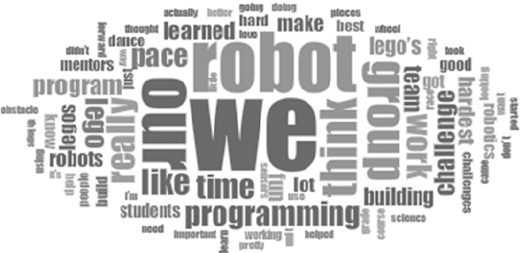
Figure 1 depicts a word cloud of the entire corpus of student reflections across the five-blog writing prompts. Given the nature of the student work, it is perhaps unsurprising that terms like “we,” “our,” “robot,” “group,” “think,” and “programming” would be those most frequently used. However, this snapshot does give us some general insight into the student reflections taken as a whole.
The relative frequencies of certain relevant words and phrases, such as “pace,” “mentors,” “group,” “team,” and “challenge” within each sub corpus of student writing were then analyzed. These more specific textual analyses were used to delve more deeply into the students’ experiences with collaboration and learning as represented by their writings.
Impact of Mentors
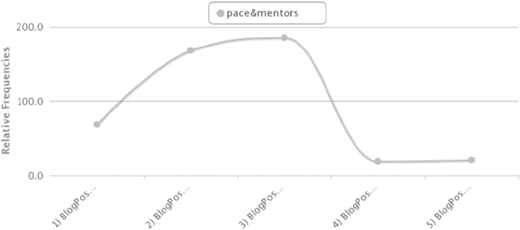
During this middle school robotics program, undergraduate students at Pace University served as mentors to the sixth grade students. We can discover the role that the mentors played by looking at the relative frequencies across the blog comments of the words “pace” and “mentor” (see Figure 2). The students wrote most frequently about their mentors for the two blog postings which asked them to reflect upon their work with undergraduate mentors, and least frequently about them toward the beginning and end of the project.
This response pattern seems to validate that the middle school students clearly understood the role of the mentors, and that the mentors acted consistently in that role during the project. These data also serve as a measure of internal consistency of these textual analyses. The students used the appropriate terms while the mentoring by undergraduates was actually happening and not much at all when it was not actually happening.
Working Together. Lauren frequently described a key benefit of the project being the improvement in the students’ ability to work collaboratively. Textual analyses of sets of terms indicative of collaboration (“group,” “team,” “challenge,” “make,” and “build”) were performed on each of the sub corpuses of students’ blog comments in order to further investigate these observations.
Figures 3 and 4 illustrate a set of textual analyses that examined the students’ writing in order to investigate how the students perceived themselves as groups and how they understood their work together. Figure 3 is a relative frequency analysis of the terms “group” and “team” as they are used within each sub corpus of the student blog responses. This analysis demonstrates that the students tended to refer to themselves as groups rather than teams at the beginning of the project, as evidenced by the relative frequencies of the two terms. Informal conversations with the robot groups throughout the project support this trend. The students talked frequently about themselves as a group at the beginning, especially in the context of having trouble with certain group members. As the project progressed, they began speaking of themselves more as a team, and this transition was mirrored in the more efficient and effective ways in which they worked together. An examination of the keywords in context, which displays the words on either side of the term being analyzed, provides trustworthiness that the students were using the terms interchangeably. Two representative examples to illustrate this finding: (1) “Our LEGO robotics group made (our robot) talk and we came up with the idea for a leash (which helped our group, but I don’t know why!)”; and (2) “Our team did just okay because our robot did not touch the starting line or the finish line so we got a 2 second penalty.” The overall decrease in the relative frequencies of the two terms within the fifth subcorpus was consistent with the fifth blog writing prompt that asked for an individual reflection on the robotics program.
Relative Frequency Analysis of the Words “Pace” and “Mentors” From Student Writing Corpus
Relative Frequency Analysis of the Words “Pace” and “Mentors” From Student Writing Corpus
 A line graph presents relative frequencies for the words group and team across 5 blog posts. The horizontal axis is labeled with truncated text colon 1 right parenthesis BlogPos 3 dots, 2 right parenthesis BlogPos 3 dots, 3 right parenthesis BlogPos 3 dots, 4 right parenthesis BlogPos 3 dots, and 5 right parenthesis BlogPos 3 dots, arranged diagonally from lower left to upper right. The vertical axis on the left is labeled relative frequencies and ranges from 0 point 0 to 150 point 0 with tick marks at 50 point 0, 100 point 0, and 150 point 0. The group data series is shown as a light gray line with circular markers. It begins at approximately 110 point 0 for post 1, dips to 90 point 0 for post 2, rises to 130 point 0 for post 3, drops to slightly above 100 point 0 for post 4, and ends at 70 point 0 for post 5. The team data series is shown as a dark gray line with diamond-shaped markers. It starts at 40 point 0 for post 1, declines to 30 point 0 for post 2, remains at 30 point 0 for post 3, peaks at 80 point 0 for post 4, and falls to 50 point 0 for post 5. A legend at the top center contains a light gray circle labeled group and a dark gray diamond labeled team.
Relative Frequency Analysis of the Words “Group” and “Team” From Student Writing Corpus
A line graph presents relative frequencies for the words group and team across 5 blog posts. The horizontal axis is labeled with truncated text colon 1 right parenthesis BlogPos 3 dots, 2 right parenthesis BlogPos 3 dots, 3 right parenthesis BlogPos 3 dots, 4 right parenthesis BlogPos 3 dots, and 5 right parenthesis BlogPos 3 dots, arranged diagonally from lower left to upper right. The vertical axis on the left is labeled relative frequencies and ranges from 0 point 0 to 150 point 0 with tick marks at 50 point 0, 100 point 0, and 150 point 0. The group data series is shown as a light gray line with circular markers. It begins at approximately 110 point 0 for post 1, dips to 90 point 0 for post 2, rises to 130 point 0 for post 3, drops to slightly above 100 point 0 for post 4, and ends at 70 point 0 for post 5. The team data series is shown as a dark gray line with diamond-shaped markers. It starts at 40 point 0 for post 1, declines to 30 point 0 for post 2, remains at 30 point 0 for post 3, peaks at 80 point 0 for post 4, and falls to 50 point 0 for post 5. A legend at the top center contains a light gray circle labeled group and a dark gray diamond labeled team.Relative Frequency Analysis of the Words “Group” and “Team” From Student Writing Corpus
 The line graph displays relative frequencies of eleven words across 5 age groups. The horizontal axis is labeled with five intervals colon 15 hyphen 19 years, 20 hyphen 24 years, 25 hyphen 29 years, 30 hyphen 34 years, and 35 hyphen 39 years. The vertical axis is labeled relative frequencies and ranges from 0 to 400 in increments of 50. A legend at the top identifies each word make, program, we, our, work, robots, fun, hardest, learned, build, and working using distinct line styles and marker shapes. The word we is represented by a light gray line with circular markers and shows the highest frequency, peaking near 350 at 20 hyphen 24 years and declining to 250 at 35 hyphen 39 years. The word our uses triangular markers and peaks near 175 at 25 hyphen 29 years. The remaining words appear as lines with circular or triangular markers clustered below 100, showing minor fluctuations across age groups. The graph includes horizontal and vertical gridlines.
Relative Frequency Analysis of a Set of Collaboration Words From Student Writing Corpus
The line graph displays relative frequencies of eleven words across 5 age groups. The horizontal axis is labeled with five intervals colon 15 hyphen 19 years, 20 hyphen 24 years, 25 hyphen 29 years, 30 hyphen 34 years, and 35 hyphen 39 years. The vertical axis is labeled relative frequencies and ranges from 0 to 400 in increments of 50. A legend at the top identifies each word make, program, we, our, work, robots, fun, hardest, learned, build, and working using distinct line styles and marker shapes. The word we is represented by a light gray line with circular markers and shows the highest frequency, peaking near 350 at 20 hyphen 24 years and declining to 250 at 35 hyphen 39 years. The word our uses triangular markers and peaks near 175 at 25 hyphen 29 years. The remaining words appear as lines with circular or triangular markers clustered below 100, showing minor fluctuations across age groups. The graph includes horizontal and vertical gridlines.Relative Frequency Analysis of a Set of Collaboration Words From Student Writing Corpus
It should be noted that the term “we” was the most frequently used term within the entire corpus of student writing. In total, it was used 696 times by the students, which was why it figures so prominently in the word cloud in Figure 1. This was certainly not surprising given the focus of this project being group work. Nevertheless, it also indicates that the students saw themselves as part of a group, rather than as individuals unless asked to do so (as in the fifth blog writing prompt).
We can also perform a textual analysis on the corpus of student writing which interrogates the data to discover how the students understood the work they did together regardless of whether they considered themselves to be in “groups” or “teams.” Figure 4 illustrated the results of a combined set of relative frequency analyses across a group of terms that relate to the specifics of the group work conducted by the robot teams: “make,” “program,” “building,” “work,” “robots,” “fun,” “hardest,” and “learned.”
Discussion
Two research questions were investigated:
(1) How can the use of robotics in a sixth grade math/science classroom positively influence the learning of key mathematics concepts?
(2) How can the use of robotics in a sixth-grade math/science classroom reshape the learning environment toward collaboration?
In order to address these questions, an intervention was designed with several components: the redesign of a sixth-grade mathematics curriculum around themes; the introduction of LEGO Mindstorms NXT into the sixth grade mathematics classroom for a sustained period of time (4 months); and mentoring in the learning of robotics by undergraduates.
The teacher used the robotics program in a non-linear fashion. She did not use the robotics challenges to explicitly teach discrete mathematics concepts and skills, as has been done in other settings (Fernandes, Fermé, & Oliveira, 2006; Matson et al., 2004). Rather, she used the robotics work to generate a set of authentic learning experiences in which the students discovered for themselves and applied together core mathematical concepts, such as measurement, area, and circumference.
To a large degree, this method was effective. The first robotics challenge, for example, required the students to build a robot that successfully went up and down a long hallway. To accomplish this task, the students had to work together to devise one of many possible methods to determine the length of the hall. For example, some groups determined the length of the hallway to be a multiple of their robot’s wheel circumference. The teacher then used these authentic discoveries to augment her mathematics lessons. Her general and consistent impressions were that the students had seen the biggest gains from their robotics work in the topics of area and circumference. Clearly, that particular robot challenge contributed directly to these enhanced proficiencies.
Lauren’s larger goal was to the use the robot challenges to enhance her students’ abilities to problem solve and to work together productively. Classroom observations and interviews and informal communications, as suggested by other researchers (Stager, 2007; Thomas, 2000), demonstrated that the groups and their members had improved in the mathematical topics of area, circumference, and measurement, as well as in their improved ability to problem solve.
These two conclusions are borne out in the New York State Mathematics Test data for these students. While they did not demonstrate statistically significant differences in test score when compared to their peers in other classrooms, they showed a larger percentage of students with “Above” or “Within” ranges for the Standard Performance Indices in Algebra, Measurement, and Statistics/Probability (all 92%). This level of performance placed them above both their peers within the building and their county. We did not have access to these students’ New York State Mathematics Test data for the previous year. It would be interesting to compare the students’ performance on these measures across years.
Lauren had reported throughout the study that her students had developed in the area of working effectively in groups. This was also consistently noted during classroom observations. These data related strongly with the textual analyses of the comments made by students in response to a set of writing prompts on the class blog. Two of the most frequently used terms throughout the student writing was “we” and “our.” While certainly these terms are consistent with the writing prompts themselves, they are too prevalent to be found in the students’ writing by sheer coincidence. As this robotics project progressed, the students moved from speaking of themselves as a “group” to referring to themselves as a “team.” This movement too, seems less likely to be coincidental. Throughout the student writing, terms that are correlated with group work, such as “work,” “working,” “make,” “making,” “build,” “program,” and “learned,” occur with similar patterns of relative frequencies. Considered as a whole, this group of terms reflects the student discourse around the work they were doing as groups and provides an interesting insight into the students’ perception of and engagement with the group work.
This study has implications for the use of technology-rich, STEM-based programs with middle grade students. For a deeper understanding about the integration of STEM into mathematics instruction consider STEM Integration in Mathematics Standards (Capraro & Nite, this volume) and Construct Validation of Student Attitude toward Science, Technology, Engineering, and Mathematics Project Based Learning: The Case of Korean Middle Grade Students (Han & Carpenter, this volume). Other research has demonstrated examples of these types of technology-rich experiences enhancing student ownership and independence (Ardito, 2010; Clayton & Ardito, 2009). This study demonstrates how these types of tools and methods can be used to reshape the classroom environment in terms of student collaborative work and problem-solving skills.

