Information-facilitated product recovery system (IFPRS) has captivated industry attention and has developed into a matter of consideration among the researchers because of enhanced climate concerns, jurisdictive logics and societal liabilities. Although IFPRS implementation has become an essential aspect in manufacturing industries functional in the developed nations, still, limited consideration has been given in the literature to analyze the issues to IFPRS implementation for a circular economy (CE) in emerging and developing nations. Therefore, the objective of this study is to recognize issues to implementing IFPRS for a CE in context of select manufacturing industries in India.
In this study, 24 potential issues are established from the literature and from suggestions from the experts. The issues are clubbed under five different perspectives of technical, government, organization, policy and knowledge. Further, fuzzy VIKOR technique is applied on the results obtained to prioritize the identified issues. A sensitivity analysis has been carried out to check the robustness of the framework.
The present study shows that lack of skills and expertise in IFPRS implementation for a CE (I2), deficient capital to implement a CE in IFPRS (I9), inadequate in adopting recent IT technology (I18), feasibility of IFPRS employment for a CE (I6) and no efficient training and program to CE adoption (I21) are the top five potential issues in implementing IFPRS practices for a CE in Indian manufacturing industries.
In literature, limited study has been observed on determining issues to implementation of IFPRS for a CE. A more systematic method and statistical confirmation is necessary to establish further new confronting issues. This study is limited to Indian manufacturing industries.
The main contribution of this study includes identification of issues and later prioritizing them to reflect their severity. This would help the industry practitioners to formulate strategies for handling the issues conveniently.
1. Introduction
Environmental concerns are progressively driving people to compile and recycle products for minimizing the waste and pollution (Kadambala et al., 2017). The stringent government regulations have also impelled organizations to take back the used products (Huang and Wang, 2017). A product recovery system (PRS) is a process where the products used are returned to producers for inclusion of financial worth through reverse channels. This would benefit the organizations to improve their competitive edge and frame their business position by encouraging the consumers to return products. In PRS, the movement of the product starts from the consumer to the producer which results in restoring the conformable worth from the end-of-use products (Dwivedi and Madaan, 2020). The researchers and practitioners adopt PRS to enhance the supply chain performances (Khalili-Damghani et al., 2015). Also, there are financial advantages of PRS that has fascinated administrators toward reuse and recycling. A PRS is successfully enforced in developed nations, but the plot of PRS adoption in developing nations is still scant (Chakraborty et al., 2018). The implementation of PRS is a complex process as it is sometimes hard for the industries to investigate the product recovery processes in actual time. It is sometimes difficult to calculate the impact of product exchanges on consumer trust and profitability in PRSs. Also, product data are required for adequate handling of returns and is hardly accessible. Information and communication technologies (ICTs) came into existence to retrieve this critical data and investigate the necessary information through the systems. ICT such as radio frequency identification device (RFID), sensors etc. support organizations to gather data and investigate the product recovery processes in real time with minimum effort (Trappey et al., 2009). ICT systems for PRS also support in making decisions on different recovery options available and also to cater the product recovery needs of various organizations (Kokkinaki et al., 2004). The adoption of ICTs when combines with the flow of information in PRS results in information-facilitated product recovery system (IFPRS) that helps in decision-making for various recovery strategies available. This further ensures effective return management and better handling of returns.
Implementing IFPRS practices for a circular economy (CE) in industries is an attempt to improve the use of resources over the complete product life cycle through different product recovery processes (Genovese et al., 2017). The word CE refers to an appropriate planning that suggests new ways to revamp the linear system, i.e. utilization at consumers’ end into a circular system (Stahel, 2013). The CE proposes to retain available materials rather than disposing them. This reduces the requirement for energy and resource consumption as the material loop closes within the product life cycle (Ritzén and Sandstörm, 2017). Further, environment conservation and social welfare have been given consideration under the concept of the CE. This concept has become significant for business and organizations as waste management can be done adequately and efficiently (Nasir et al., 2017). Therefore, the CE has gained substantial attention from the researchers and industry professionals (Govindan and Hasanagic, 2018). The transition to a CE requires essential modification across the entire organization also involving its collaborators.
Although CE practices are already adopted by many developed nations, it is somewhat a new term for the developing countries where the centralization of population is a major threat and requires organized mediation (Goyal et al., 2018). Many research has inspected barriers and issues related to a CE (e.g. Westblom, 2015; Mangla et al., 2018; Mahpour, 2018; Kirchherr et al., 2018; Agyemang et al., 2019; Farooque et al., 2019). Yet, to date, studies specific to the identification and ranking of the issues for achieving IFPRS implementation for a CE are insufficient. In order to add to the CE literature, the purpose of this study is to establish the issues of IFPRS implementation for a CE assisted by a multicriteria decision-making (MCDM) method, the fuzzy VIKOR, with a focus on Indian manufacturing industries. VIKOR is a MCDM method which has simple computational steps that permit simultaneous consideration of the proximity to ideal and antiideal alternatives (Kaya and Kahraman, 2011). This method is utilized to solve MCDM problems with conflicting and noncommensurable criteria. The VIKOR method concentrates on categorizing and selecting a set of alternatives and identifies mutual agreement solutions to a problem with conflicting criteria, that further assist the decision-makers reach a final decision (Parkouhi and Ghadikolaei, 2017). Further, multicriteria optimization of the complex systems can be performed adopting this technique. In this study, the fuzzy VIKOR technique is adopted to deal with the conflicting criteria and identify mutual agreement solution that will assist the decision-makers. The study highlights some research questions mentioned below:
What are the issues that hinder the adoption of IFPRS for a CE in Indian industry?
How to segregate the issues on the basis of their analogy pertaining to IFPRS implementation for CE?
How to prioritize the identified issues and suggest recommendations to annihilate them?
The study makes the following improvements. The paper recognizes the most significant issues to IFPRS employment for a CE. The prioritized issues will facilitate the industry practitioners to tackle the identified potential issues in order to frame a blueprint for successful adoption of IFPRS for a CE. The extensive literature review is executed to examine the contributions of various research articles for identification of issues. Later, the fuzzy VIKOR technique is adopted for ranking of the identified issues.
The study is formulated into six sections as follows. Sections 1 gives an introduction to the study. Section 2 discusses the relevant literature to extract issues to IFPRS implementation for a CE. In Section 3, the methodology followed for the current study is explained. Section 4 demonstrates detailed discussions of the obtained results. In Section 5, the conclusion and managerial implications are reflected including the future research directions with limitations.
2. Literature review
Product recovery systems have captivated the consideration of industries and organizations as it tends to raise profits and benefit the environment at the same time. In the past studies, research associated to a CE has escalated between the industry, practitioners and researchers (Lieder and Rashid, 2016). The literature has established and examined the issues or barriers to CE implementation. Zhu and Geng (2013) identified the barriers related to extended supply chain practices. A conceptual model was proposed for drivers and barriers related to extended supply chain practices for energy saving and emission reduction. Westblom (2015) determined barriers for a CE adoption in new business models. The study concentrated on the barriers confronted by the Swedish companies in ascending business models based on the CE approach. Similarly, Kaur et al. (2018) investigated barriers with respect to green supply chain management for Canadian firms. A decision-making trial and evaluation laboratory (DEMATEL)–based approach was employed in the study, and the barriers were examined through causality and prominence relations. Further, barriers related to supply chain performance measurement were analyzed (Katiyar et al., 2018). The mutual relationship among the potential barriers was obtained by employing the interpretive structural modeling (ISM) and fuzzy MICMAC analysis. In addition, Mangla et al. (2018) identified barriers to CE in context to developing countries. The identified barriers were further analyzed adopting ISM and MICMAC approach. Also, a literature review analysis was systematized to determine barriers and drivers to reverse logistics (Govindan and Bouzon, 2018). Similarly, prioritization of the barriers for a CE related to construction and demolition waste management was performed (Mahpour, 2018). The fuzzy technique for order of preference by similarity to ideal solution (TOPSIS) method is adopted in the study to prioritize the identified barriers, and further a framework is suggested to facilitate construction and demolition (C&D) waste management toward the CE. Similarly, Kirchherr et al. (2018) identified the barriers to a CE in context of the European Union, and later the categorization of the barriers (cultural, market, regulatory and technological) was performed. In addition, Moktadir et al. (2018a, b) identified the barriers to sustainable supply chain in leather industries. A gray-based DEMATEL approach was utilized for obtaining the interrelationships among the identified barriers. Similarly, barriers related to smart waste management for a CE were framed and prioritized adopting the fuzzy DEMATEL approach (Zhang et al., 2019). Also, Phochanikorn et al. (2019) analyzed and prioritized the barriers for reverse logistics in the palm oil industry. The fuzzy analytic network process (ANP) methodology was applied to obtain the weightage for each barrier, and later the VIKOR analysis was performed for the ranking of the barriers. Agyemang et al. (2019) identified barriers and drivers to a CE adoption considering the case of an automobile industry. Dwivedi et al. (2019) formulated the key performance indicators for sustainable manufacturing. A total interpretive structural modelling (TISM) approach was considered, and a MICMAC analysis was performed for obtaining the interrelationships among the indicators. Further, Werning and Spinler (2020) performed a study for the identification of potential barriers toward transition to a CE model. A case study of the electronics manufacturing industry is considered, and the barriers are analyzed based on their impact toward the value chain.
The literature review analysis clearly reveals that there exist studies related to identification and examination of the barriers in context of manufacturing industries. Also, a number of studies focused on the barriers related to CE implementation in context of emerging economies. A number of MCDM techniques for obtaining the relationships and ranking of the barriers are also evident in the literature. However, there was no study conducted till date for identifying and ranking the issues to IFPRS for a CE. Therefore, the present study is an effort to identify and evaluate a comprehensive framework of issues pertaining to IFPRS for a CE. Further, the prioritization of the issues is performed by a MCDM method, the fuzzy VIKOR, in some selected Indian manufacturing industries. A thorough literature review was conducted in relation to IFPRS implementation for a CE and 24 potential issues have been extracted as reflected in ( Appendix 1). A brief explanation of the issues has been illustrated below:
1) Inadequate to CE concept in IFPRS (I1)
A lot of industries are not skilled in the domain of CE adoption in IFPRS. Information and communication technologies (ICTs) such as RFID, sensors etc. are comparatively new, and their usage has just been started in few industries (Zhang et al., 2019). A decision-support system (DSS) for the advancement of a CE is established in many parts of the developed nations but still lacks in the developing nation (Sarkis and Zhu, 2008). These industries are also not awake to adopting the concept of ICTs and CE for the advancement of PRSs. Therefore, lack of expertise in CE is an issue to IFPRS implementation for a CE in industries.
2) Lack of skills and expertise in IFPRS implementation for a CE (I2)
The main obstacle perceived for a CE adoption is the requirement of significant existing knowledge and expertise for the transformation from a linear economy to a CE (Shahbazi et al., 2016). The application of product recovery practices and concepts of a CE increases the financial burden on the industries. The industries that are unable to bear the financial burden of such facilities restrict themselves to IFPRS implementation for a CE.
3) Shortage of appropriate product recovery measures (I3)
A large amount of waste is composed from the industries in different forms. Industries and government bodies are concerned toward treatment of this waste produced. Lack of effective product recovery measures can be seen as an issue for waste management. Industry leaders need to shift toward smart technologies in partnership with the technology experts to implement appropriate recovery measures for managing the waste. Product recovery measures such as repair, refurbish, repackaging and replacement can be brought into practice in order to enhance the return on investment in PRS with efficient data management (Andel, 2004).
4) Risk related to IFPRS adoption for a CE (I4)
The literature advocates that the progression of CE employment might be related to risk (Linder and Williander, 2017). In developing nations, CE is still a learning step and will take some time for implementation in the Indian industries. Also, a number of changes in terms of operations and assembly are required in IFPRS adoption for a CE in the industries.
5) Lack of economic incentives for adopting the recovery practices (I5)
To escalate the recovery of more secondary products and to change the attitude of the industries performing business, tax measures and economic incentives are substantial. Support programs can be conducted for encouraging investment and awareness for adoption of IFPRS practices in industries. The government authorities both at the regional and national level must act as a support staff and provide motivation and economic incentives for industries that implement circular concepts and business models (MacArthur, 2014). Also, the top management should encourage the adoption of CE concepts and more usage of reusable parts in industries.
6) Feasibility of IFPRS employment for a CE (I6)
In context of industries operating in the developing nations, there is limited research on the CE. Due to this limited study, it becomes difficult to develop facilities and operating systems for making an industry compatible for CE. This has narrowed down the morale of industries in shifting to CE concepts. The feasibility of adopting a CE will generate employment and bring development as the producers will shift toward repair and maintenance models (MacArthur, 2013).
7) Insufficient information available to customers on product returns (I7)
Insufficient market information might prevent manufacturers from remanufacturing and recycling of products. Also, limited information about the attribute of remanufactured and recycled equipment may hinder a shift in consumer perception (MacArthur et al., 2015). There should be proper distribution of information with respect to the different recovery strategies available to the consumers for returning their products.
8) Lack of administration engagement (I8)
Deficiency in imposing laws for environment regulations is an issue that has emerged due to lack of administration in industries. There are hardly any punishments for those industries that generate waste and tend to contaminate the environment. The administration should introduce instructions and legislations for efficient disposal of waste produced during manufacturing of products (Yacob et al., 2012). The industries are not compelled toward adopting the recent technologies and concept of CE for upgrading their product recovery processes. Because of this lack of administration engagement, industries lean to carry on with the traditional methods of waste regulations.
9) Deficient capital to implement IFPRS for a CE (I9)
Moving in transition from a linear economy to a CE concept in industries require a lot of investment. In order to record and trace the product returns, ICTs are appropriate in the present scenario (Sharma et al., 2011). The implementation of ICTs in the IFPRS requires a large amount of capital. Deficiency in funds creates a hindrance for planning and implementing IFPRS for a CE in Indian industries. This issue can be overruled if there is sufficient allocation of funds from the government's budget for implementing IFPRS for a CE in context to Indian industries.
10) High authorities reluctant to innovate to IFPRS for a CE (I10)
The perception and role of high authorities in implementing latest innovations can revamp the way industries perform and construct their supply chains (Agyemang et al., 2018). The successful application of CE and IFPRS cannot be attained in the industry if any obstruction is created from the high authorities to change their business strategy. Also, there are no rewards and motivations to employees for innovating with regard to CE and IFPRS practices. In order to conquer this issue, high authorities can organize workshop and conferences for their employees and workers for imparting knowledge to them toward CE and IFPRS practices.
11) Deficient business-friendly policies in context of CE progression (I11)
Environment laws and regulations are an essential structure, and the industries must abide by the same (Alkhidir and Zailani, 2009). The integration of CE concept into business has many advantages but also generates issues when adopting a CE at the microlevel (Rizos et al., 2016). The proper functioning of the industries and the business can be achieved if the regulations and legislations are strong enough.
12) Substantial technology and technical ability toward IFPRS implementation for a CE (I12)
The unavailability of convenient technology within an industry is also an issue to IFPRS adoption for a CE. Industries with rich experience in adopting relevant technologies will have a more advanced capacity in technological innovation (Gant, 1996). The technical support operating in the industry must be kept updated in order to cater to the challenges of the changing technological needs. The technology and technical expertise can be utilized in designing the environment-friendly products which can smoothen the implementation of IFPRS practices in industries.
13) Lack of existing recovery techniques (I13)
The different recovery operations (remanufacturing, recycling, reuse, refurbish etc.) available for product recovery in IFPRS have some operational issues. The main reason behind this complexity can be formulated in the form of time and quality of returns and collection, transportation of used products (Jayaraman et al., 2008).
Therefore, it becomes necessary to figure out the status of the returned product and compute the most convenient form of disposition. Organizations that are committed toward IFPRS implementation gain advantages in terms of environment-friendly figure, better customer and supplier relations and financial benefits (Rahman and Subramanian, 2012).
14) Less insight and awareness to CE in IFPRS (I14)
Industries are reluctant to move toward CE because of less insight and knowledge toward CE concepts. Managing the accountability of a CE in the industries is a cumbersome process as it is sometimes difficult to integrate all the processes simultaneously in an industry. Nowadays, customers have the advantage of large variety of products. This results in an increase in amount of product returns (Sharma et al., 2011). If the industries are aware, the product returns could lead to monetary benefits with implementation of IFPRS. Therefore, it is necessary that the decision-makers should be aware of the concept of CE and its benefits.
15) Lack of rewards from government for CE adoption (I15)
Government policies such as the environment regulations, taxes etc. can majorly affect the industries’ decision toward adoption of a CE (Gunasekaran and Ngai, 2004). In context of increased environmental concern and carbon emissions, the governmental bodies must structure strict environmental laws and regulations. Also, lack of rewards and firm regulations can be seen as a major issue to IFPRS implementation for a CE in Indian industries.
16) Uncertain outcomes in moving to a CE in IFPRS (I16)
The industries are always in a dilemma whether shifting toward a CE is beneficial or they should stick to their linear concepts. The shift to CE is also connected with the requirement to adopt contemporary business models (Ruggieri et al., 2016). The implementation of such models in the industries is still far behind (Linder and Williander, 2017). In order to deal with such situations, workshops, research projects, conferences etc. must be conducted to determine the aftermaths of shifting to this move.
17) Information deficiency and lack of technical infrastructure (I17)
The tracking and tracing of the product recovery and returns is very important for industries implementing IFPRS. Efficient information systems are required for individual recording and tracing the product returns and combining them to the initial sale (Jayaraman et al., 2008). This tracking of the returns can be accomplished with the adoption of highly efficient information and technical infrastructure. Roger and Tibben-Lembke (1999) conducted a survey to conclude that manufacturers lag behind the retailers in adoption of technical infrastructure. High costs associated with the adoption of information and technology systems result in requirement for large amount of funds for successfully implementing IFPRS practices for a CE in industries.
18) Inadequate in adopting recent IT technology (I18)
Industries are reluctant to react toward the challenge of enhancing environmental performance because they are inadequate to adopt latest technologies (Massoud et al., 2010). The poor financial status of the industries can be seen as a challenge in implementing the recent technologies and mechanisms (Wang et al., 2008). Also, there is lack of availability of latest technologies for conducting product recovery strategies.
19) Lack of information exchange among suppliers (I19)
The poor commitment among the suppliers and lack of willingness to exchange information are seen as an issue to IFPRS adoption for a CE. Suppliers are mostly reluctant to exchange information related to IFPRS implementation in industries because of a fear of disclosing their shortcomings which might lead to a competitive gain to others (Walker et al., 2008).
20) Concern towards shifting to IFPRS for a CE (I20)
The industries are concerned towards shifting to IFPRS for a CE as they have the fear of financial losses, possibility of loss of competitive advantage etc. There is also a concern among industries that a relaxation in the policymaking and legislative laws with respect to the IFPRS adoption might lead to lower the environmental standards (Calleja et al., 2004).
21) No efficient training and program toward CE adoption (I21)
There is a lack of engagement of industry experts in seminars and training programs associated with a CE. The shift to CE concept will result in conducting training programs for the workers and managers (Muduli and Barve, 2011). This will lead to arrangement of fund by the organization for investing in these training programs (Hilson, 2000). Proposing the efficient education and training might help the employers in adopting the IFPRS practices for a CE.
22) Lack of customer involvement toward CE concepts (I22)
The involvement of consumer is necessary for increasing the buying alternatives and also toward adopting more sustainable products and services. The demand of consumers for environment-friendly products will force industries to consider the environmental impacts while performing their business (Vachon and Klassen, 2006). Customer and industry participation plays an important part in effective implementation of environmental management programs (Kumar et al., 2014). The lack of consumer opinion and unawareness of a CE can hinder the acceptance of IFPRS for a CE in Indian industries.
23) Realizing goal and vision toward a CE in IFPRS (I23)
The efficient management of waste to attain complete recovery of products and zero waste must be the vision of the industries (Li et al., 2015). In order to clarify the goal and vision toward a CE in IFPRS, the government should frame policies and action plans that should be adopted by the industries for its successful implementation. Lack of fabricating policies and framework in context of CE adoption demoralizes the participants and reduces the public pressure to encourage IFPRS implementation for a CE in industries.
24) Lack of government backing toward a CE (I24)
Government backing in terms of rules and regulations can strengthen or weaken the adoption of a CE in industries. The propensity of the government to reassure old exercises is also a major issue (AlKhidir and Zailani, 2009). The different forms of taxes levied by the government that alter the rewards and incentives might intimidate industries to implement a CE.
2.1 Classification of issues related to IFPRS implementation for a CE
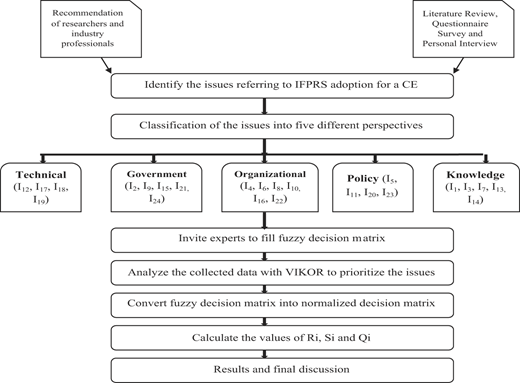
In this paper, the issues to IFPRS implementation for a CE are segregated into five different perspectives namely technical, government, organizational, policy and knowledge, adopting experts’ recommendations as reflected in (Figure 1) below. The different perspectives were considered on the basis of experts' suggestions and literature review performed. These perspectives were encouraged from the past classification arrangements suggested by Bastein et al. (2013), Mahpour (2018) and Govindan and Bouzon (2018). The perspectives are explained below:
1) Technical perspective
This perspective deals with the adoption of latest technologies in IFPRS for smooth flow of information. Substantial technology and technical ability toward IFPRS implementation for a CE (I12), information deficiency and lack of technical infrastructure (I17), lack of information exchange among suppliers (I19) and inadequate in adopting recent IT technology (I18) are the issues with respect to the technical perspective.
2) Government perspective
This perspective consists of issues related to laws and regulations framed by the government bodies for adoption of IFPRS for a CE in industries. Lack of skills and expertise in IFPRS implementation for a CE (I2), deficient capital to implement IFPRS for a CE (I9), lack of government backing toward a CE (I24), no efficient training and program toward CE adoption (I21) and lack of rewards from the government for CE adoption (I15) are the issues in context of the government perspective.
3) Organization perspective
This perspective includes the risk and difficulty faced by the industries in adopting IFPRS practices. Lack of administration engagement (I8), high authorities reluctant to innovate to IFPRS for a CE (I10), feasibility of IFPRS employment for a CE (I6), risk related to IFPRS adoption for a CE (I4), uncertain outcomes in moving to a CE in IFPRS (I16) and lack of customer involvement toward CE concepts (I22) are some issues included under this perspective.
4) Policy perspective
This perspective includes issues related to policy frameworks related to IFPRS implementation. Lack of economic incentives for adopting the recovery practices (I5), deficient business-friendly policies in context to CE progression (I11), realizing goal and vision toward CE in IFPRS (I23) and concern toward shifting to IFPRS for a CE (I20) are the issues that come under this perspective.
5) Knowledge perspective
The purpose of this perspective is to spread knowledge and awareness of the IFPRS practices for a CE in industries. Less insight into and awareness of a CE in IFPRS (I14), shortage of appropriate product recovery measures (I3), lack of existing recovery techniques (I13), inadequate to CE concept in IFPRS (I1) and insufficient information available to customers on product returns (I7) are the issues reflected under this category.
2.2 Questionnaire development and data collection
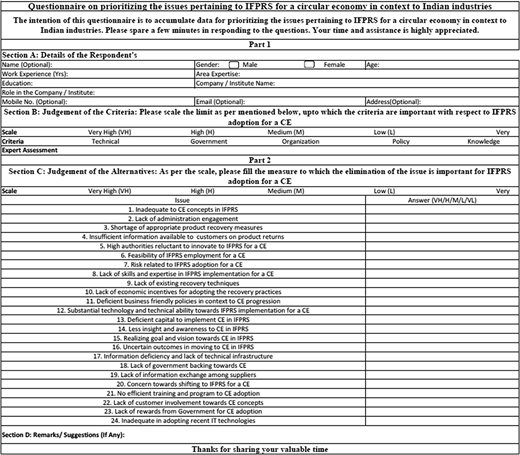
A questionnaire was formulated to expedite the data collection for the VIKOR analysis, arresting the opinion of experts. The questionnaire provided a detailed description of each issue related to IFPRS implementation for a CE to guide the experts ( Appendix 3). It is necessary to determine the decision criteria and the weight vectors for the effective application of the fuzzy VIKOR methodology. Subjective techniques do not require the engagement of a broad quantity of experts (Valmohammadi, 2010). Therefore, decision criteria employed in this study were composed on the suggestions of the eight decision-makers (DM's) belonging to different manufacturing industries in India. The electronic products industry is elected for the survey analysis because it provides tools for extending the life of the equipment. Further, recycling and recovery of the materials employed in the electronic products can be used as a secondary raw material in another system. To enable the CE model, analysis of the repair and recycling processes for electronic equipment will assist in determining their technological abilities (Cordova-Pizarro et al., 2019). For the survey analysis, DMs are also selected from the leather industry. The leather industry is considered as one of the most polluted manufacturing industry. In the process of conversion of raw hides into finished leather products, the leather industry pollutes the environment to a great extent. Therefore, it becomes essential to identify the issues to CE practices in leather industry for eco-friendly leather manufacturing processes. Automotive products are considered as one of the most complex products exercising a large range of materials. Also, a number of efforts are taken to adopt product remanufacturing, material reuse and recycling in the automotive industry (Buruzs and Torma, 2018). The concept of CE shields the issues of waste origination and economic benefits. Therefore, DMs from the automotive industry are introduced in the survey analysis. DMs are also selected for the survey analysis, from the iron and steel industry as the iron and steel industry is an energy- and resource-intensive industry but also generates high emissions and pollution. To enable the CE model, significant reductions in energy consumption and pollutant emissions have been comprehended in this industry (Ma et al., 2014). Chen and Wang (2009) proposed the fuzzy numbers and fuzzy membership function which was adopted by the DMs to judge the potential issues (Table 2). Pairwise comparison was prepared for a single decision-maker adopting the linguistic variables. A brief introduction of the experts along with their industry is presented in (Table 1) below. The detailed survey conducted is reflected in ( Appendix 2).
3. Methodology
The methodology section comprises three parts. The first part comprises the identification of issues for successful implementation of IFPRS for a CE. The second part categorizes the issues into different subjects. The third and the final step involves the prioritization of the issues in adopting the VIKOR (multicriteria optimization and compromise solution) technique. The research framework adopted for the study, with different steps, is illustrated below in (Figure 1).
3.1 VIKOR methodology
The VIKOR technique was coined by Opricovic (1998) and is established on the modified programming of multicriteria decision- making (MCDM). This technique comes up with a compromise solution for resolving problems with inconsistent criteria that further helps the decision-makers to settle on a final judgment (Shemshadi et al., 2011). This methodology classifies the perfect alternative subject to dynamic situations. Alternatives are judged according to the discrete criterion functions, and compromised leveling can be utilized by examining the closeness measure to the ideal alternative (Tzeng et al., 2005). This technique decides the prioritization list and weight stability intervals to stabilize the inclination of the compromise solution employing the provided initial weights. An expansion of VIKOR to find a fuzzy compromise solution for multicriteria is conferred. The fuzzy VIKOR technique resolves the situation in a fuzzy environment. The use of triangular fuzzy numbers (TFN) is done to take care of the inaccurate numerical figures. Fuzzy VIKOR considers linguistic variables as it is sometimes difficult for a decision-maker to designate an accurate performance valuation for an alternative under examination.
With compliance to this methodology, Kabir (2015) suggested a model for the selection of hazardous industrial waste transportation service companies using fuzzy VIKOR. The service performance evaluation of electric vehicle–sharing programs in Beijing adopting fuzzy VIKOR is proposed (Xu et al., 2017). Asees Awan and Ali (2019) adopted fuzzy VIKOR for sustainable modeling in reverse logistics strategies. Jing et al. (2018) used the fuzzy VIKOR methodology for the selection of a design program in context of waste management. A fuzzy VIKOR methodology was adopted for equipment selection (Alpay and Iphar, 2018). Genç and Masca (2018) proposed the fuzzy VIKOR technique on assessment of the students’ choice for preferred Turkish banks. Balin et al. (2019) applied the fuzzy VIKOR method for the selection of a convenient tugboat. Sharaf (2019) prioritized a supplier selection problem using the fuzzy VIKOR technique. A fuzzy VIKOR technique was formulated for a multistakeholder assessment of bike-sharing service quality (Ma et al., 2014). Rahman et al. (2020) assessed barriers to green supply chain management adopting the VIKOR technique.
The advancement of the VIKOR methodology progressed with the arrangement of Lp metric is discussed below:
In the VIKOR technique, L1i (Si in Eqn 6) and L∞i (Ri in Eqn 7) are utilized to form the priority measures. The result achieved by miniSi is related with a maximum group applicability, and the result produced by miniRi is with a minimum individual regret. The steps of fuzzy VIKOR (Opricovic and Tzeng, 2007) are reflected below:
Step 1. Define the problem and determine the objectives of the study: The objectives and structure of the research study is determined and reflected in ( Appendix 1) and (Figure 1) below
Step 2. Define and explain a set of significant criteria: A set of criteria was formulated on the basis of literature review and discussion with the experts. The criteria are explained in detail under Section 2.2 of the study and reflected in (Figure 1).
Step 3. Identify the linguistic variable and the fuzzy numbers: A five-point scale was employed by the experts for determining the relevance of each criteria and advocate rating to the alternatives (Chen and Wang, 2009). This would help to find the fuzzy severity related to each criterion. A set of linguistic variables and their corresponding triangular fuzzy number (TFN) employed for the present study are reflected in (Table 2).
Step 4. Construct a fuzzy decision matrix: The fuzzy evaluation matrix is formulated from the aggregated fuzzy weights of criteria and alternatives based on the suggestions from decision-makers (DMs). The fuzzy evaluation matrix is reflected below in (Table 3):
Step 5. Develop a fuzzy decision matrix to get the aggregated fuzzy weight of criteria: In discussion with the experts, the fuzzy evaluation matrix for the criteria weights is produced below in (Table 4).
Step 6. Identify the best and worst values: The best fj*= (li*, mi*, ri*) value and worst fj−= (li−, mi−, ri−) value among all the dedicated values for criteria functions are derived from Eqs (2) and (3), The aggregated fuzzy values are determined and reflected in (Table 5).
Step 7. Compute the normalized fuzzy difference (dij) values: The aggregated fuzzy values of alternatives rates are defuzzified values under this step (Opricovic, 2011). The results are presented in (Table 6).
where (wj) is the weight of jth criteria, (v) is the weight for the majority of the criteria and usually equal to 0.5.
where Si* = miniSi, Si− = maxiSi, Ri* = min Ri, Ri− = max Ri and “v” is equal to weight for the majority of the where as (1 – v) is the weight for the individual regret.
Step 10. Defuzzification of Si, Ri, Qi and sorting them by the crisp values: Crisp values are calculated by the center of gravity, and the values are sorted from low scores to high scores (Opricovic and Tzeng, 2007). The alternative with the lowest score of Qi will be suggested as a compromise solution if the following two conditions are satisfied. The alternatives are finally ranked on the basis of descending values of S, R and Q. The ranking of the alternatives (issues) with respect to the present study has been given below in (Table 8).
In this study, the ranking of the alternatives (issues) is reflected as I2 > I9 > I18 > I6 > I21 > I20 > I4 > I23 > I14 > I1 > I12 > I7 > I17 > I24>I10 > I3 > I5 > I16 > I15 > I19 > I8 > I13 > I11 and I22.
The alternative Q(A(1)) has an acceptable benefit if Q(A(2)) – Q(A(1)) ≥ 1/n−1. “n” refers to number of alternatives, and A(2) refers to the alternative that has the second rank in the list.
The alternative Q(A(1)) is stable if it is also best ranked in S and R.
In the present study, both Condition 1 and Condition 2 mentioned above are satisfied, QI2–QI9 ≥ 1/24–1 and similarly I2 is best ranked by R and S (Table 8).
Step 11. Determine the best alternative: The best alternative is determined by considering the abovementioned conditions and choosing Q(A(M)) as a best compromise solution with minimum Qi value. In the present study, lack of skills and expertise in IFPRS implementation for a CE (I2) is the best selected potential issue with minimum Qi value i.e. 0.0323.
3.2 Sensitivity analysis
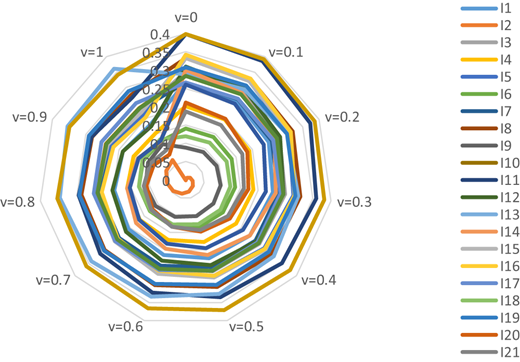
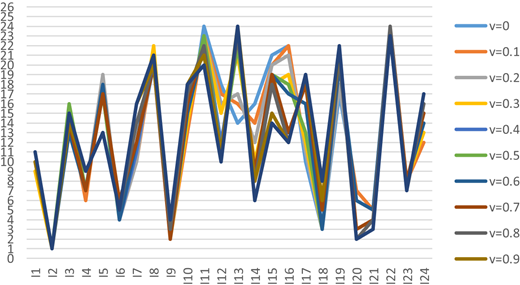
In this study, a sensitivity analysis is carried out to judge the robustness of the suggested methodology. As we have taken the value of “v” as 0.5 in the method, considering different values of “v” elaborates its effect on the outcome of final ranking. Therefore, the value “v” adopted to create “Q” is the weight value that will build the maximum advantage for the organization. It is suggested to carry out the sensitivity analysis with a 0.1 increase between 0 and 1. 11 experiments were performed that are reflected in Tables 9 and 10) with their corresponding graphs presented in Figures 2 and 3. In the sensitivity analysis run 1 i.e. (v = 0 to 0.1), the results of the ranking orders of best five issues, i.e. lack of skills and expertise in IFPRS implementation for a CE (I2), deficient capital to implement IFPRS for a CE (I9), inadequate in adopting recent IT technology (I18), feasibility of IFPRS employment for a CE (I6) and no efficient training and program to CE adoption (I21) obtained using the proposed technique, are consistent. However, a slight variation has been noticed in the ranking order of the issues I7, I8, I11, I12, I13, I14, I15, I17 and I22. Similarly, in the sensitivity analysis run 2, i.e. (v = 0.1 to 0.2), the result of the best five ranked issues is again consistent. A small variation is observed in the rank order of the issues I4, I8, I10, I12, I13, I14, I16, I20 and I24. This study speculates that when the “v” value conforms to 0.5, the Qi values of each issue I1 to I24 are 0.223, 0.032, 0.260, 0.176, 0.273, 0.133, 0.248, 0.304, 0.102, 0.259, 0.334, 0.242, 0.325, 0.213, 0.277, 0.273, 0.258, 0.125, 0.298, 0.147, 0.142, 0.370, 0.194 and 0.258 respectively. The ranking order of the 24 issues is I2 > I9 > I18 > I6 > I21 > I20>I4 > I23 > I14 > I1 > I12>I7 > I17 > I24 > I10 > I3 > I5 > I16 > I15 > I19 > I8 > I13 > I11 and I22. When “v” value in (Table 9) is equivalent to 0.0, the Qi values of each issue I1 to I24 are 0.266, 0.000, 0.295, 0.201, 0.333, 0.141, 0.266, 0.333, 0.088, 0.284, 0.399, 0.310, 0.288, 0.301, 0.333, 0.342, 0.266, 0.119, 0.308, 0.211, 0.187, 0.399, 0.261 and 0.284. The ranking list in Table 10 of the 24 issues is I2 > I9 > I18 > I6 > I21 > I4 > I20 > I23 > I1 > I17 > I7 > I24 > I10 > I13 > I21 > I14>I19 > I12 > I5 > I8>I15 > I16 > I22 and I11. The ranking of the issues is also reflected in (Figure 2). The present study establishes that the results for the ranking list of best five issues are again found to be constant. However, a slight variation has been noticed in ranking order of the remaining issues (Figure 3). In the same way, the other experiments are performed by varying the value of “v”.
4. Results and discussions
IFPRS and CE are important subjects of discussion in context of modern supply chain research. This study has made an effort to identify, categorize and prioritize different issues to IFPRS implementation for a CE in context of Indian manufacturing industries. 24 potential issues were established in this study for effective management of issues to IFPRS implementation for a CE. The issues were segregated into five different perspectives (technical, government, organization, policy and knowledge) based on the literature and in discussion with the domain experts'. Further, the issues were ranked employing the compromise ranking method of fuzzy VIKOR. The VIKOR approach was adopted for this study as it can resolve decision problems by conflicting and irreplaceable criteria, assuming that the compromise is acceptable to resolve the dispute. It is very difficult to implicate the severity of the issues to IFPRS implementation, but prioritizing the issues by employing this technique makes it more reasonable and beneficial for the decision-makers. The results reveal broad implications for managers in practice. The managers are advised to pay decisive attention to the issues found to be the most important in this study. Also, managers can possibly prevent the outcomes of those potential issues by deliberately evaluating and regulating them. By adopting the proposed methodology, the following issues were identified to be most important by considering their weightage value: lack of skills and expertise in IFPRS implementation for a CE (I2), deficient capital to implement a CE in IFPRS (I9), inadequate in adopting recent IT technology (I18), feasibility of IFPRS employment for a CE (I6) and no efficient training and program to CE adoption (I21). However, the other issues are ranked and organized in declining order I2 > I9 > I18 > I6 > I21>I20 > I4 > I23 > I14 > I1 > I12 > I7 > I17 > I24 > I10 > I3 > I5 > I16 > I15 > I19 > I8 > I13 > I11 and I22 (Table 8). Industries must examine these issues based on their rank and severity on a preference basis. Issues to IFPRS implementation for a CE can be assessed by adopting this study. The sensitivity analysis is carried out to highlight the impact on the issues to IFPRS by varying the “v” value with 0.1 increase between 0 and 1. 11 experiments were performed that are reflected in Table 9 and Table 10. The result of the sensitivity analysis revealed that the best five issues, i.e. lack of skills and expertise in IFPRS implementation for a CE (I2), deficient capital to implement IFPRS for a CE (I9), inadequate in adopting recent IT technology (I18), feasibility of IFPRS employment for a CE (I6) and no efficient training and program to CE adoption (I21), obtained using the proposed technique, are consistent. However, a small variation in the ranking order of the remaining issues was noticed in almost every experiment. This study confirms that the suggested framework is robust and minor sensitive to the criteria weights.
The implementation of IFPRS practices for a CE in Indian manufacturing industries is not a smooth exercise. In accordance with the results of ranking by fuzzy VIKOR technique, lack of skills and expertise in IFPRS implementation for a CE has developed as a critical issue that Indian manufacturing industries are facing. This issue has attained the minimum Qi value. Industries need to organize workshops and conferences for their workers in order to impart knowledge and skill toward IFPRS practices and CE. Also, Indian manufacturing industries need to maintain proper funds for organizing these facilities. The second issue identified is deficient capital to implement IFPRS for a CE from the 24 issues identified from the literature. In order to conquer this issue, manufacturing industries in India need to be economically sound to meet out the expenses of latest automations necessary for successful IFPRS implementation. This issue can be overruled if there is sufficient allocation of funds from the government budget for implementing IFPRS for a CE in context to Indian industries. Also, government should allocate funds to the industries for implementing the sustainable practices. Inadequate in adopting recent IT technology is ranked as the third issue from the VIKOR method. To overcome this issue, industries must be flexible to shoulder the recent advancements linked with technology adoption. The fourth ranked issue is feasibility of IFPRS employment for a CE. There must be availability of ample facilities and operating skills for making Indian manufacturing industries adaptable to CE concepts. No efficient training and program to CE adoption is ranked as the fifth issue. Industries must arrange facilities for training and education program toward IFPRS and CE adoption. This would help the employees to become comfortable with these practices. Also, short visits can be arranged for the employees to those industries that are successfully running these practices. The study suggests that the abovementioned are the five high priority issues that should be eliminated before transforming from a linear economy to a circular economy in Indian manufacturing industries.
Additionally, the issues named as concern toward shifting to IFPRS for a CE, risk related to IFPRS adoption for a CE, realizing goal and vision toward CE in IFPRS, less insight into and awareness of CE in IFPRS, inadequate to CE concepts in IFPRS, substantial technology and technical ability toward IFPRS implementation for a CE, insufficient information available to customer on product returns, information deficiency and lack of technical infrastructure, lack of government backing toward a CE, high authorities reluctant to innovate to IFPRS for a CE, shortage of appropriate product recovery measures, lack of economic incentives for adopting the recovery practices, uncertain outcomes in moving to CE in IFPRS, lack of rewards from government for CE adoption, lack of information exchange among suppliers, lack of administration engagement, lack of existing recovery techniques, deficient business-friendly policies in context to CE progression and lack of customer involvement toward CE concepts are ranked from six to 24 based on the increasing Qi value. The prioritization of the issues will facilitate the industry practitioners in making judgment about IFPRS implementation for CE.
5. Conclusions
The manufacturing industries often implement IFPRS practices and waste management techniques that have been developed to acquire a competitive edge in order to meet the escalating demands toward environment preservation. The contributions and future research directions from the study are illustrated in the sections below:
5.1 Contributions and managerial implications
IFPRS practices are attaining acceptance extensively in different manufacturing industries. The manufacturing industries have initiated to adopt product recovery strategies in their supply chains because of the increasing pressure from various organizations. IFPRS practices are broadly practiced in developed nations, but still it has limited scope in the developing and emerging nations. The manufacturing industries in India are taking actions to absorb information-facilitated product recovery strategies in their supply chains. Due to the lack of research on various aspects and issues that can constrain the smooth implementation of IFPRS practices, the manufacturing industries of India are facing various problems when implementing IFPRS for a CE. The study started with identification of the potential issues to IFPRS implementation for a CE. The contributions of this study are compiled below:
The present study suggests that lack of skills and expertise in IFPRS implementation for a CE (I2), deficient capital to implement CE in IFPRS (I9), inadequate in adopting recent IT technology (I18), feasibility of IFPRS employment for a CE (I6) and no efficient training and program to CE adoption (I21) are the top five potential issues in implementing IFPRS practices for a CE in context of Indian manufacturing industries.
The identified issues in implementation of IFPRS practices for a CE are further classified into five different perspectives (technical, government, organization, policy and knowledge) based on experts' recommendations.
In the present study, fuzzy VIKOR is employed for the ranking of the issues. This would take care of ambiguity and inaccuracy by incorporating fuzziness in the analysis.
In the present study, a sensitivity analysis is carried out to highlight the impact on the issues to IFPRS implementation for a CE.
The findings from the study will provide significant direction to those manufacturing industries that are attempting to employ IFPRS practices for a CE in their organizations. If the issues are dealt in an efficient manner, the manufacturing industries in India will be able to gain economic benefits. The severity of the issues carries a direct influence on the successful implementation of IFPRS practices. The observations of the identified issues will help the decision-makers to tackle the issue for the smooth implementation of IFPRS practices. The results from the study will assist the policymakers to develop strategies toward implementing IFPRS practices for a CE. Thus, the observation of the issues will help the policymakers to employ product recovery strategies in their supply chain and make optimal utilization of resources, which will result in increased profitability.
5.2 Limitations and future research directions
The main purpose of this study was to figure out issues to implementation of IFPRS for a CE. The fuzzy VIKOR methodology was practiced in this study for prioritization and selection of the best issue. This study has few limitations. In order to overcome these limitations, a statistical analysis and future research directions are required. In this study, a number of issues were identified using an extant literature review and experts’ suggestions. This acknowledges us to have a clear understanding about the issues affecting IFPRS practices for a CE. In future studies, many new confronting issues can be identified from the literature that might prevent the implementation of IFPRS practices for a CE. It paves the way for further inspection and practical application of strategies to alleviate these challenging issues. Given that only a few experts have been asked for their views, a more vigorous assessment involving a wider range of industries is essential to confirm how much of these issues really hamper the IFPRS implementation for a CE. Future studies must include more experts in the decision-making procedure. This would improve the authenticity of the suggested framework. The VIKOR methodology was employed in a fuzzy situation for this study because no preceding research has employed this method to prioritize issues to IFPRS implementation. It would be beneficial to recognize other methodological studies for ranking the issues. In this case, other MCDM techniques such as interpretive structural modeling (ISM), analytic hierarchy process (AHP), elimination and choice expressing reality (ELECTRE), structural equation modeling (SEM) etc. could be practiced in future to rank the issues. The results acquired from these techniques could be compared with the results from this study, which can be a layout for future research. Certainly, further work in this domain is required with respect to current economic and technological context of the country.
References
Further reading
Appendix 1 Issues to implementation of IFPRS for a CE
Appendix 2 Linguistic variable assigned by the eight decision-makers (DMs)
Appendix 3 Questionnaire for conducting survey