The managerial questions of this paper are as follows: What are the equilibrium conditions of transfer price, quantity and profits when considering dynamic subsidies from the government? Which collection channel is better for a manufacturer, direct collection by itself or through an online platform?
This research investigates the three collection models: the manufacturer-driven model, the online platform-driven model and the competitive model. Based on the differential game, this research explores the transfer price, collection cost, subsidy and manufacturer and online platform profit in different models when considering the dynamic subsidy.
The results show that the collection strategy for the manufacturer depends on its collection cost. If the collection cost is lower, then the manufacturer may prefer to collect by itself. When the collection cost meets a certain range, the manufacturer may collect the used product through an online platform. The online platform-driven model is the most efficient because both the manufacturer and the online platform can make a higher profit.
This research bridges the gap between waste electrical and electronic equipment collection and government subsidies by demonstrating the dynamic condition of subsidies. It offers an approach to address the influence of dynamic subsidy, which can provide practical insights for the government implementing the subsidy policy.
1. Introduction
The rapid development of information technology and the social economy promoted the upgrading of electrical and electronic equipment (EEE), resulting in a huge quantity of waste electrical and electronic equipment (WEEE) (Nowakowski et al., 2017; Islam and Huda, 2018; Qiao and Su, 2021; Ardolino et al., 2021). The generation volume of WEEE in China is forecasted to be 28.4 m tons by 2030, increasing dramatically by 25.7% each year. The generation of WEEE is accompanied by an environmental pollution problem, since WEEE contains various toxic substances, such as gold, mercury and arsenic. The legislation makes manufacturers recycle and remanufacture used WEEE products, which can not only save resources by recovering recyclable materials but also mitigate environmental pollution. Driven by economic incentives, social pressure and legislation, a large number of firms, such as Xerox, HP and Huawei, are engaged in remanufacturing operations.
In May 2017, China’s government proposed to support “Internet + recycling.” Since then, some professional online recyclers have emerged in China, such as Aihuishou and Taolv365. With the emergence of platform manufacturers can collect used products through online platforms. For instance, Huawei cooperates with Aihuishou, which is an online platform. Their cooperation covers not only the collection market but also the sales market. Huawei collects second product via online platform, and Huawei sells remanufactured product via online platform. In 2024, consumers can choose to replace used Huawei phones through trade-ins, in which the consumers can get a trade-in rebate. Therefore, the structure of Huawei’s collection channels is divided into two types: (1) the single collection channel, including manufacturer collection and online platform collection and (2) the hybrid collection channel, including manufacturer and platform hybrid collection. Hence, an unaddressed question in literature and practice is how to choose a proper collection model for manufacturers.
To encourage the online platform to be engaged in WEEE recycling management, the government grants certain subsidies to them (Huang and Wang, 2017; Wang et al., 2020). For instance, the budget in the second electronic products subsidy of the Chinese Ministry of Ecological Environment was 3.3 bn Yuan in 2022. The impact of subsidy on remanufacturing has been investigated, but previous research focused on the static view. In reality, the government will adjust the amount of subsidy dynamically. Therefore, in this paper, we consider the dynamic change of subsidy.
Based on current practice and the literature, it is necessary to conduct a deeper study on how the manufacturer makes collection strategy when the subsidy is dynamic. More specifically, we address the following research question: (1) What are the equilibrium conditions of transfer price, quantity and profits when considering the dynamic subsidy of the government? (2) Which collection model is better for a manufacturer, directly collecting by itself or through an online platform?
To answer the above questions, we aim at investigating channel structure selection and pricing decisions of a manufacturer who has dual collection channels. Furthermore, we analyze the equilibrium results of different collection modes when government subsidies change with collection quantity. We investigate collection modes in a three-echelon closed-loop supply chain (CLSC) consisting of a manufacturer and an online platform, which includes three possible channel structures for the manufacturer: (1) manufacturer-driven collection, sells through an online platform; (2) online platform-driven collection, sells through an online platform and (3) both manufacturer-driven and online platform-driven collection, sells through an online platform.
The main contribution of this research is twofold. First, different from the earlier papers on static condition, the dynamics of subsidy are investigated. And the equilibriums of different models are investigated when considering dynamic subsidy. Second, considering the dynamic subsidy, this paper puts forward the collection models: manufacturer-driven collection, online platform-driven collection and competitive collection. The collection choice of the manufacturer depends on the collection cost. When collection cost is higher, the manufacturer would collect used products through an online platform. Otherwise, collecting used products by itself is better.
The remainder of this article is organized as follows. Section 2 reviews the representative studies closely related to our investigation. Section 3 describes the model assumptions and notation. The optimal outcomes under different models are investigated in section 4. In section 5, we use numerical analysis to verify and support the conclusions in section 4. Section 6 concludes this paper and proposes policy recommendations.
2. Literature review
There are three main streams of research that closely relate to our work. The first stream focuses on the traditional collection channel. The second stream concentrates on online collection channels. The last stream is related to static and dynamic subsidy of remanufacturing management.
2.1 Traditional collection channel for WEEE
Much work has been done on traditional collection channels, that is to say, the offline collection. Savaskan et al. (2004) investigated three collection channels (remanufacturer collection directly, retailer collection and third-party collection), and results showed that retailer collection was the most suitable channel. De Giovanni (2018) also investigated the remanufacturing supply chain structure, he also considered the collecting channel design for used products in a two-period scenario. Gonda et al. (2019) compared the collection flows of end-of-life desktop computers in two neighboring regions and linked the differences in collection rates with spatial ones. The paper of Gonda et al. (2019) organized the collection in a way that takes into account the local context, waste management systems should evolve. Huang and Wang (2017) have examined the competition among retailers collecting and TPC (third-party collecting). Liu et al. (2016) simultaneously developed a quality-based price competition model for the WEEE recycling market in a dual-channel environment comprising both formal and informal sectors. The equilibrium acquisition prices and effects of government subsidy in the two channels are examined under four competitive scenarios. Yang et al. (2021) constructed a multi-agent express packaging waste recycling system that includes governments, individuals and enterprises, based on the differential game theory, this study explores that under the cooperation-driven recycling model, they are both more concerned about improved benefits.
2.2 Online collection channel
Online recyclable resources recycling is a new recycling program which has been developing rapidly in China over the last three years (Xiong et al., 2016; Feng et al., 2017; Chen et al., 2021). This online recycling program is a revolution of the traditional (offline) recycling method, which implements the Internet idea, technology and mode into the way of recyclable resource recycling.
There are so many online platforms in different cities across China, such as Shanghai “Aihuishou,” Xiamen “Waste Uncle,” Beijing “Incom” and so on. The business model of the platform is that it receives orders from online channels and picks up the used products offline (Govindan and Malomfalean, 2019; Yan et al., 2019; Zuo et al., 2020). Huishoubao, for example, has established an online recycling channel and offered door-to-door collection services with on-the-spot valuations and transactions, effectively eliminating geographical constraints and reducing inconvenience for customers (Guo et al., 2022).
Platforms are able to conveniently offer the collection service, but they cannot deal with the used products. Actually, the used products need to be remanufactured by manufacturers or professional disposing firms. After online application, consumers either drop off the used products to the collection site or mail them back in prepaid mailboxes provided by the platforms. From related literature and managerial practice, the structure of the collection channel is divided into two major types: (1) the single collection channel, including manufacturer collection, retailer collection, third-party collection and online platform collection and (2) the hybrid collection channel, where the manufacturer can choose one, two or all collections, such as manufacturer and retailer hybrid collection, manufacturer, online and third-party hybrid collection as well as manufacturer, retailer, third-party and online platform hybrid collection.
The collection strategy of manufacturers depends on the collection cost. With the advantage of gathering a large amount of information, it is easier for platforms to match supply and demand information than offline collection channels. With the advantage of gathering a large amount of information, it is easier for platforms to match supply and demand information than offline collection channels. However, high investments in online platforms also put them at a cost disadvantage. The realization of the economies of scale in the total collection volume is the key to successful collection.
Different manufacturers may have different collection channels. Kodak collects the returned products through its retailers. Hewlett–Packard and Xerox encourage consumers to return their used computers and peripherals directly to them (Miao et al., 2017). In China, Huawei and Haier provide trade-in rebates for consumers to encourage them to repurchase. This is similar to the manufacturer collection. At the same time, Huawei and Haier collect the returned products through an online platform (Qu et al., 2022). Motlagh et al. (2023) considered the collection competition between the remanufacturer and the third-party collector and studied the impact of collection disruptions on the acquisition prices. Shu et al. (2025) investigate the competitive collection model. When the collection cost is high enough, the collection investment of the manufacturer is much greater than that of the retailer, forcing the retailer to abandon collecting. There is limited analysis that focuses on manufacturer collection and online platform collection (Savaskan et al., 2004; Yan et al., 2019). Hence, this paper tries to investigate the manufacturer’s decision when facing dual collection channels.
2.3 The government subsidy in WEEE collection
The Chinese government is paying attention to online recycling. The online recycling has been discussed in the government documents since 2015. As for the last relevant research stream, there is much research on the effects of government subsidy in a CLSC (Ma et al., 2013; Zhao et al., 2018; Li et al., 2018). Ma et al. (2013) studied the government subsidy in a dual-channel CLSC. They conducted a comparative analysis of the channel members’ decisions before and after the subsidies and found that both the manufacturer and the retailer can benefit from the subsidy, while the e-retailer is uncertain. Zhao et al. (2018) examined a joint decision problem for price determination of a remanufactured product and share of the subsidy between the remanufacturer and consumers. Li et al. (2018) study the roles of government financial policy in a green supply chain. This result indicated that the government financial intervention can essentially affect the energy-saving efforts and products retail prices. The conclusion of Wang et al. (2025) indicates that government subsidies can improve the collection rate. Specifically, WEEE policies prioritize the standardized and safe operations of WEEE firms.
This paper concludes that the government subsidy can essentially affect the WEEE collection. The previous research indicated that the total subsidy amount may increase with the increasement of collection quantity (Liu et al., 2022; Liu et al., 2024). In fact, the government’s subsidy is not always static. For instance, dynamic subsidies have been successfully practiced in the field of WEEE collection in China (Liu et al., 2024). The Chinese Yuan (CNY) 26.8 bn government subsidies for WEEE collection were invested from 2012 to 2021. In 2024, the Chinese central government invested CNY 7.5bn to support the WEEE collection. In July, the Chinese National Development and Reform Commission made further efforts to investigate the WEEE subsidy implementation. In addition, the existing application of dynamic subsidy in game models is mainly concentrated in public management (Fan et al., 2021; Shan et al., 2021), green development (Zheng et al., 2023) and electronics vehicles (Liu et al., 2024). Therefore, the effect of dynamic subsidy in the WEEE research remains to be explored. The subsidy of government may adjust according to the collection quantity, so different from the previous literature, in this paper, to describe the dynamic process of government subsidy, we use the differential equation to the relationship between subsidy and collection quantity.
3. Model assumptions and notations
3.1 Problem description
In this paper, we consider CLSC formed by a manufacturer (firm M) and an online platform (firm O). In the forward channel, the manufacturer wholesales new products processed from raw materials or used products to the online platform, who sells new product to the customers. In the reverse channel, the manufacturer may directly collect WEEE from the customers. And the platform collects WEEE, and the manufacturer transfers it. Therefore, the manufacturer has three options for collection: (1) the manufacturer directly collects from the customers; (2) the platform collects from the customers, the manufacturer collects from the platform and (3) the manufacturer and the platform simultaneously collect from the customers. The subsidy means that the government compensates the manufacturer or the platform based on the collection quantity.
Superscripts: , and , respectively, represent manufacturer-driven collection model, online platform-driven collection model and competitive collection model. Subscripts: , , respectively, represent manufacturer and online platform.
The proposed models are formulated by using the following notations (see Table 1).
Without loss of generality, the proposed models are developed by using the following assumptions. In order to establish our models and obtain some interesting insights, we make the following assumptions in our models.
3.2 Assumption
All the collected products can be remanufactured and resold successfully.
Without loss of generality, it is assumed that all the collected products can be remanufactured and resold. This assumption is very common in the previous literature, such as Liu et al. (2016) and Wan et al., (2023).
We assume there is no difference between the remanufactured and new products.
Remanufactured products provide the same quality, reliability and durability as new ones do. Thus, the new and remanufactured products can be considered as perfect substitutes and sold at the same price (Wan et al., 2023). Similar to Liu et al. (2016) and so on, it is assumed that the demand function is downward sloping linear given by , is the initial market scale and is the price elasticity coefficient.
The unit cost of remanufacturing a used product is lower than the unit cost of manufacturing a new product.
When the manufacturer collects the used product, the collection quantity is . When the online platform collects the used product, the collection quantity is . When both the manufacturer and online platform collect the used product, which is the hybrid collection models. The collection quantity of the manufacturer and online platform, respectively, is and
The government provides the same recycling subsidy for manufacturers or online platform. The amount of subsidy is related to collection quantity (Liu et al., 2022), this function is , is the accumulated amount of subsidy. is the initial amount.
In model M, the manufacturer gets the subsidy from the government. And in model O and C, online platform gets the subsidy from the government.
4. Model development
We establish three differential game models corresponding to the above three collection scenarios in the following sections. Specifically, (1) the manufacturer-driven model indicates the manufacturer collects used products; (2) the online platform-driven model indicates that the online platform collects used products and (3) the competitive model means that the manufacturer and the online platform collect used products simultaneously.
4.1 Manufacturer-driven collection model
This model characterizes the following scenario: the manufacturer directly collects the used product from the consumer, and the manufacturer sells the products to the online platform, who then sells them to consumers. In this scenario, the manufacturer needs to decide the wholesale price and transfer price from the manufacturer to consumer . The online platform needs to set the retail price . According to the above description, we can formulate the members’ profit functions as follows.
The profit of a manufacturer consists of three parts: product sales, saving costs and subsidies. The profit of the platform is product sales.
Subject to
When is satisfied, the equilibrium is
The proof of Proposition 1 as well as the proofs of the other propositions, are given in the Appendix.
Proposition 1 indicates that the steady-state subsidy is proportional to the green consciousness of consumer. The higher green consciousness of consumer is, the higher collection quantity is.
The subsidy and transfer price from the manufacturer to the consumer are increasing with time. The equilibrium of the subsidy and transfer price from the manufacturer to the consumer is given by
is the initial value, , .
The subsidy level trajectory is monotonously increasing. The trajectory of transfer price from the manufacturer to consumer is also monotonously increasing.
4.2 Online platform-driven collection model
This model characterizes the following scenario: the manufacturer collects the used product through the platform, and the platform collects the product from the consumer. The manufacturer sells the products to the online platform, who then sells them to consumers. In this scenario, the manufacturer decides the wholesale price and the transfer price to platform . The platform decides the and transfer price from the online platform to consumer . The profit of a manufacturer consists of two parts: product sales and saving costs. The profit of the platform consists of three parts: product sales, collection cost and subsidy. According to the above description, we can formulate the channel members’ profit functions as follows.
The profits of manufacturer and platform are
Subject to .
When is satisfied, the equilibrium is
The profit of total supply chain is:
The subsidy and transfer price are increasing with time. However, the transfer price from manufacturer to platform is decreasing.
is the initial value , . And the optimal transfer price and the price manufacturer paid to online platform are respectively.
, Therefore , ,
4.3 Competitive collection model
The manufacturer and online platform both collect the used products. When the manufacturer and the online platform control different collection channels, there is competition between them. The manufacturer decides the wholesale price and the transfer price to platform and transfer price to consumer . The profit of a manufacturer consists of three parts: product sales, saving cost and collection cost. The platform decides the retail price and the transfer price . The profit of the platform consists of three parts: product sales, subsidy and collection cost.
Subject to
When is satisfied, the equilibrium is
The dynamic trajectories of transfer price of online platform and the price manufacturer paid to online platform are, respectively,
is the initial value. , .
4.4 Comparative analysis of optimal strategies in different models
Besides the collection price, the collection cost also has an impact on the collection strategy. The manufacturer collects by itself when is satisfied. Otherwise, the manufacturer will collect via platform.
When is satisfied.
This proposition shows the collection strategy of the manufacturer is also dependent on the collection cost. When the collection cost is below the threshold value, the manufacturer will choose to directly collect from the customers by itself. Otherwise, the manufacturer will choose the platform collection. This finding supports the conclusion of Matsui (2023) that only one collection channel is better. If the platform does not have the cost advantage, it will miss the collection authorization. This also supports the evidence that so many platforms had rapidly disappeared from the market.
When is satisfied, there is always equilibrium. And there exists .
If is satisfied, the transfer price has the following relationships: . The transfer price from manufacturer to consumer is higher than that from platform to consumer. The proposition indicates that the transfer price and quantity in the manufacturer-driven model are higher than those of the online platform-driven model. When the manufacturer collects itself. The government should encourage the manufacturer, not the platform to collect the used products.
The subsidy is in the following order: .
Proof:
The subsidy depends on the collection quantity, so the subsidy is higher in the model M. The higher the collection quantity is, the higher the subsidy is. Hence, the manufacturer has the motivation to collect more used products. Then the government will encourage the manufacturer to collect more used products.
5. Numerical analysis
To verify the comparison results and directly show the manufacturer and online platform decision strategies under the different models, we conducted numerical analysis.
The above assumptions depend on the parameter values; we carry out simulation analysis to display the findings. Specifically, , , , , , , , , , , .
5.1 Numerical analysis of transfer price
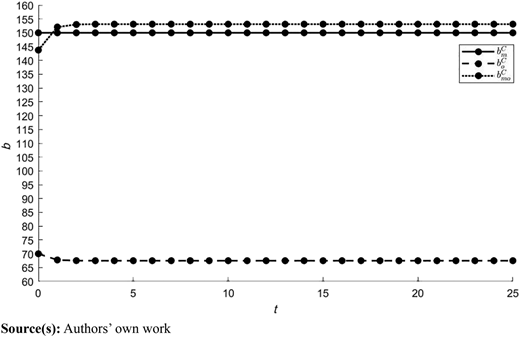
From Figure 1 it can be seen that in the competitive model, the transfer price from the manufacturer to the online platform is highest. And the transfer price from the manufacturer to the consumer is higher than that from the online platform to the consumer.
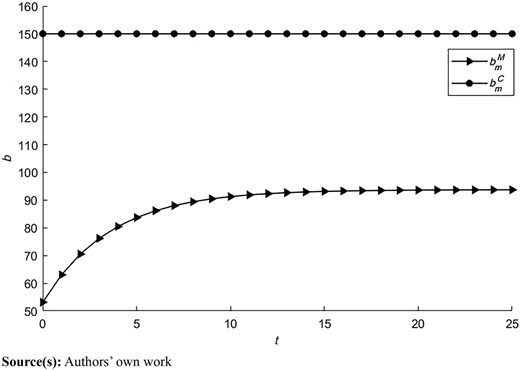
In Figure 2, the transfer price from the manufacturer to the consumer in the manufacturer-driven model is higher than that in the competitive model.
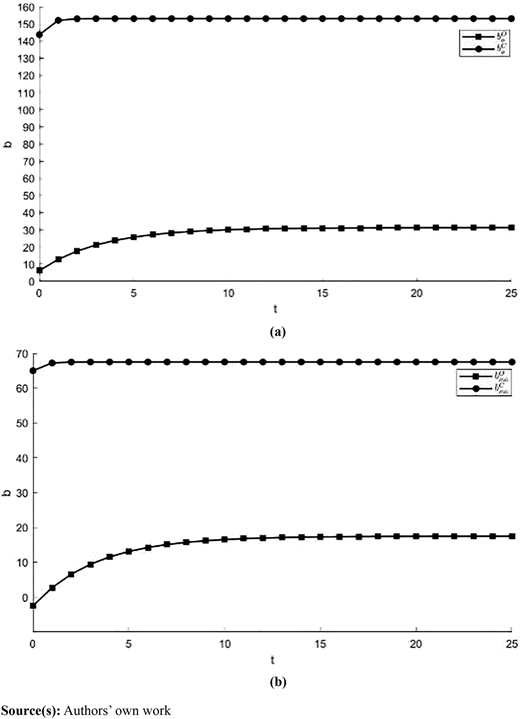
As can be seen from Figure 3, the transfer price from the online platform to the consumer and the transfer price from the manufacturer to the online platform in the competitive model is higher than that in the online platform-driven model. Overall, the transfer price in a competitive model is higher than that of a single channel. When competition is fierce, manufacturers and platforms have to improve the price to attract consumers.
5.2 Numerical analysis of the collection quantity
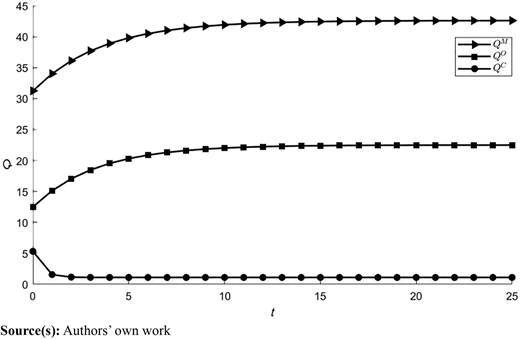
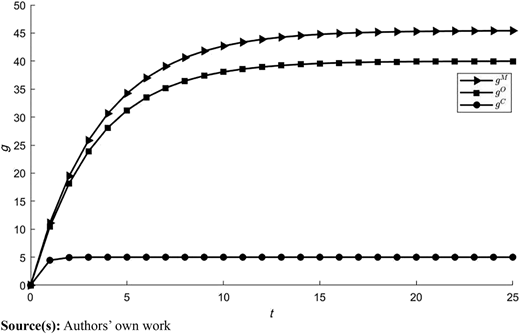
To demonstrate the collection quantity of the manufacturer and online platform under the manufacturer-driven model, online platform-driven model and competitive model, the figure depicts the collection quantity in three models.
Figure 4 displays that the collection quantity increases over time and reaches a steady-state value. In the early stage, consumer is sensitive to transfer price, so the collection quantity increases quickly. Finally, the collection quantity reaches to the threshold value.
In the manufacturer-driven model, the increase is the highest. Compared with the online platform, the manufacturer has a higher transfer price. Although the transfer price in the competitive model is higher, the collection quantity is lower than that in the manufacturer-driven or online platform-driven model. The fierce competition leads to the higher transfer price to the consumer, but the price war brings about the lower collection quantity.
5.3 Numerical analysis of the subsidy
Figure 5 displays that the amount of subsidy increases over time and reaches a steady-state value. In the early stage, the collection quantity increases quickly, so the amount of subsidy increases. When the amount of subsidy increases to a certain extent, the amount of subsidy will also become stable. Compared with the online platform-driven and competitive model, the manufacturer has the highest collection quantity. Due to the positive relationship between the subsidy and collection quantity. In a manufacturer-driven model, the amount of subsidy is the highest.
5.4 Numerical analysis of profit
To demonstrate the profits of the manufacturer and online platform under the manufacturer-driven model and online platform-driven model.
5.4.1 The profits of manufacturer
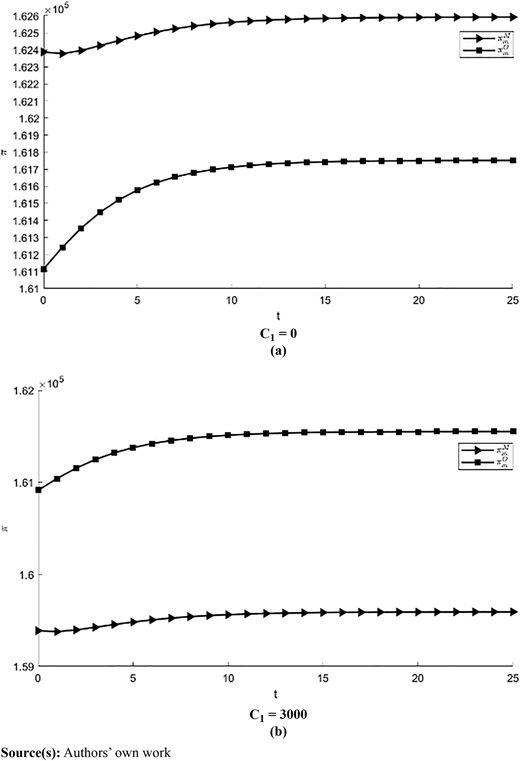
As the manufacturer may be in charge of the collection activity, we need to analyze whether and how the manufacturer’s collection cost will affect collection strategy decisions. Figure 6(a) and 6(b), respectively, demonstrate the profits of manufacturers in two models of manufacturer-driven and online platform-driven when collection costs are different. When the cost of collection by itself is smaller, the profits of the manufacturer are higher, so it prefers to collect by itself. On the contrary, if the cost is higher, the profit of the manufacturer is lower, so it will give up to collect by itself.
5.4.2 The profits of online platform
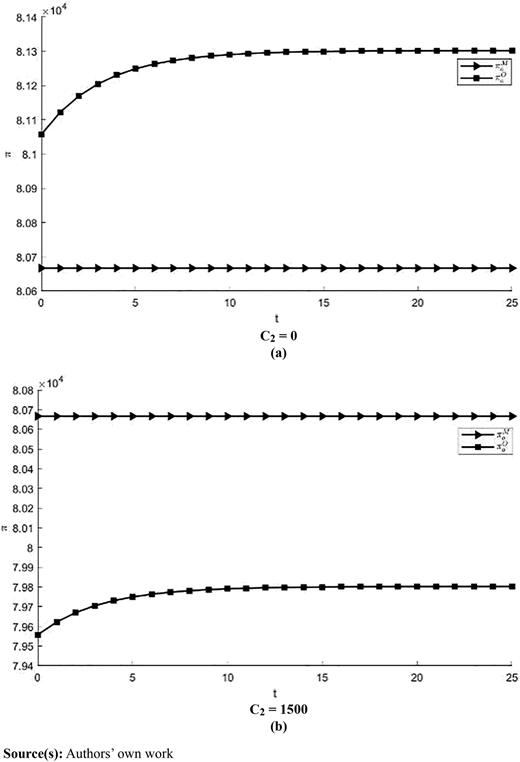
Figure 7(a) and (b), respectively, demonstrate the profits of online platforms in two models of manufacturer-driven and online platform-driven when collection costs are different. When the cost of collection is smaller, the profits of online platforms are higher, so they prefer to collect. On the contrary, if the cost is higher, the profit of the online platform is lower, so it will give up to collect.
5.4.3 The profits of manufacturer, online platform and total profits
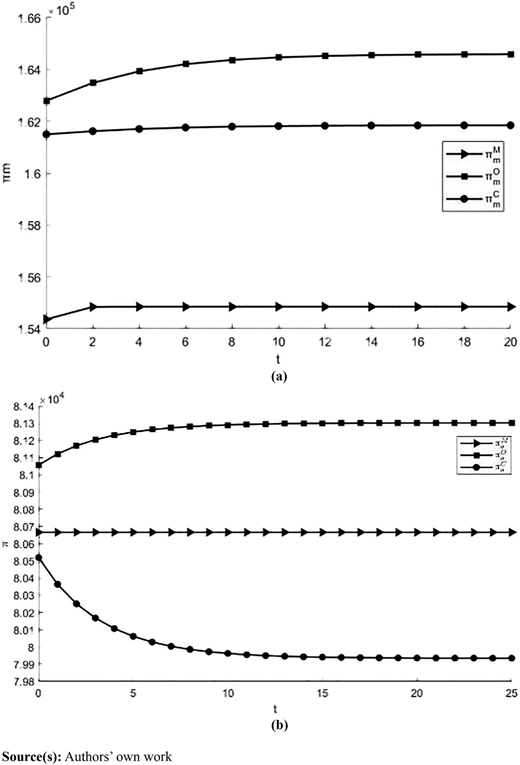
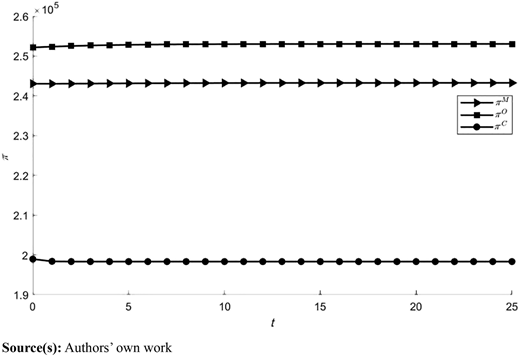
Figure 8(a) demonstrates the profits of manufacturers in three models of manufacturer-driven, online platform-driven and competitive model. In different models, the profit of the manufacturer starts from an initial value and then increases as time increases. In an online platform-driven model, a manufacturer can make more profit.
Figure 8(b) demonstrates the profits of online platforms in three models of manufacturer-driven, online platform-driven and competitive models. In a manufacturer-driven model, the profit of an online platform keeps stable. When it collects, the profit of the platform starts from the initial value and then increases as time increases. In a platform-driven model, a platform makes more profit.
Figure 9 demonstrates the total profits in three models of manufacturer-driven, online platform-driven and competitive models. In three models, the total profit in online platform-driven is highest. In a competitive model, the total profit of the supply chain is lowest.
6. Conclusions and policy recommendations
6.1 Conclusion
With the increasing growth of e-waste collection, the development of the online platform is very popular for WEEE collection. In this paper, based on the differential game, the manufacturer-driven collection, the online platform-driven collection and the competitive model are investigated. We derive the equilibrium solutions of the different models and provide comparison results on the effects of the manufacturer-driver model and online platform-driven model in contrast with the competitive model.
The main findings are the following: firstly, the collection strategy for the manufacturer depends on its collection cost. If the collection cost is lower, then the manufacturer may prefer to collect by itself. When the collection cost meets a certain range, the manufacturer may collect the used product through an online platform. Secondly, comparison of transfer price is investigated. Particularly, in the manufacturer-driven model, the transfer price from the manufacturer to the consumer is higher than that from the online platform to the consumer in the online platform-driven model. In a competitive model, the transfer price from the manufacturer to the consumer, the transfer price from the online platform to the consumer and the transfer price from the manufacturer to the online platform are higher than those in the manufacturer-driven model or online platform-driven model. Thirdly, collection quantity in the manufacturer-driven model is highest. The collection quantity in the manufacturer-driven model is higher than that in the online platform-driven model. However, in a competitive model, the total collection quantity is lower than that of a manufacturer-driven model or platform-driven model. Finally, the online platform-driven model is the most efficient, both the manufacturer and online platform can make higher profits. To conclude, manufacturers should give priority to online platform collection, which is good for both manufacturers and online platform making more profits.
6.2 Managerial implications
There are some managerial implications worth attention. The manufacturer should consider its actual situation to carefully weigh the benefits and collection cost. From the perspective of costs, outsourcing the collection may be an option to control the cost. The manufacturer can entrust the collection operations to the online platform. This collaborative approach leverages the remanufacturing advantages of the manufacturer alongside the collection strengths of the retailer, effectively enhancing supply chain performance.
For online platforms, the practical implications of this study are the following aspects: First of all, the collection and benefit will affect the collection quantity. Therefore, online platforms should actively improve their technical level, establish an information sharing mechanism and strive to obtain more benefits. Second, the online platform needs to pay attention to environmental benefits. The online platform should actively use government subsidies to upgrade technology to reduce environmental pollution in business operations and improve resource utilization efficiency.
The external incentives are needed for online platform such as government subsidies. When the online platform collects used products, the manufacturer can directly subsidize the online platform to promote the collection rate, which is also beneficial to the manufacturer. If the government tries to encourage the development of online platform collection, the government should design policy and standards in recycling, which would regulate the online platform and reduce the collection cost for online platforms. Therefore, the online platform will take an active part in WEEE collection. Actually, in an online platform-driven model, manufacturers and online platforms can make higher profits while the government sets a lower degree of subsidy. When the government sets appropriate subsidies, which are beneficial for supply chain members, consumers and society.
Funding: This research was supported by the Shaanxi Social Science Foundation (No. 2024HZ1181).
Declaration of conflict of interest: The authors declare that there is no conflict of interest with this manuscript.
References
Further reading
The supplementary material for this article can be found online.