The purpose of this paper is to investigate the relationships between technology orientations and export performance of small and medium-sized enterprises (SMEs).
A quantitative research design was adopted for this study. The paper formulates hypotheses from the literature review. These hypotheses are tested using structural equation modeling with data collected from 231 SMEs in Uganda. Data were analyzed using SPSS version 23 and AMOS.
The findings of this study showed technology orientation has a positive and significant relationship with the performance of Ugandan SMEs and that supply chain agility moderates technology orientation and export performance.
The study discusses the findings, advances limitations and managerial implications. It also suggests future research avenues. It proposes some recommendations to help Ugandan SMEs to form flexible supply chains, use the latest technology and create strong relationship ties with their partners in the supply chain.
The study suggests that managers of Ugandan SMEs should use the latest technology in production, marketing, logistics and supply chain management which will enable them to respond quickly to customer tastes and preferences leading to higher levels of export performance.
This study contributes to the literature on strategic management showing the reliability of scales used and the confirmatory of the factor structure. This study shows that in strategic management technology, orientation is critical in increasing export performance. This study has extended the resource-based view (RBV) and dynamic capabilities theories.
1. Introduction
The export performance of firms in today's volatile and ambiguous international market has attracted the attention of practitioners, researchers and policymakers across the globe. Export performance presents the level to which an organization's objectives, both financial and strategic are achieved through the implementation of the organization's export marketing strategy (Birru, 2016). This enhances the organizational survival of business firms and increased income (Olyanga et al., 2022). Some firms consider export activities as prerequisites for future growth and profitability (Ecel et al., 2013). The relevance of export performance motivated the government of Uganda to envisage its development based on an inclusive private sector-led and export-oriented economy (National Strategy for private sector development NSPSD, 2017/18-2021/22). In realizing this, the government created export-free zones as a strategic pathway for unlocking the potential of exporters to produce specifically for the external market. In addition, the government of Uganda through its agencies like the Uganda Export Promotion Board (UEPB) provides public trade support to exporters and harmonizes the development and promotion of Uganda's exports. Moreover, the government established by a Statute of Parliament, UEPB Statute No. 2 of 1996, which repealed the Uganda Export Promotion Council (UEPC) Act No. 7 of 1983. In the same statute, the Uganda investment authority (UIA) was created to further support investors in Uganda. The establishment of the one-stop center by the Uganda Investment Authority through the amendment of the Investment Act, 2019 created a single access point for information and service transactions for investors.
Despite these interventions, the export performance of SMEs and Uganda, in general, is still below average. In Uganda export performance is still low and hence the low level of development of the country (Olyanga et al., 2022). Exports decreased by 29.9% to US$289.8m in February 2022 in comparison to US$413.1m registered in February 2021. Additionally, SMEs in Uganda have generally registered low levels of international engagement. Extant literature attributes this poor performance to factors such as poor quality of exports, poor packaging, limited skilled labor and inconsistent supply (Ahimbisibwe et al., 2013). Additionally, Uganda's SMEs that are involved in exporting are characterized by low value-added nature, lack of modern technology, rarely search for information and face difficulty in establishing long-term relationships in international markets (Ahimbisibwe et al., 2016). Similarly, the poor attitudes of small and medium-sized enterprises (SMEs) towards technology and ICT use in Uganda have a role in poor firm performance (Kyakulumbye and Pather, 2022). Lastly, supply-related constraints appear on the top of the list for export impediments in Africa and Uganda is no exception (Ecel et al., 2013). Common among these are the unreliable domestic supply of raw materials and products, delays and poor quality materials and high transaction costs. However, even with this literature, there is still poor export performance in Uganda.
In the quest for high export performance of SMEs, the resource-based view (RBV) theory suggests that they should have resources that hold potential as sources of sustainable competitive advantage, they should be valuable, rare, imperfectly imitable and not substitutable (now generally known as VRIN criteria). This leads to efficiency advantages and entrepreneurial rents. The RBV is complemented by the dynamic capabilities theory in catalyzing the export performance of SMEs. Dynamic capabilities theory postulates that dynamic capabilities are the firm's ability to integrate, build and reconfigure internal and external competencies to address rapidly changing environments Barreto et al. (2017). They emphasize a special kind of ability or capacity that is to say a special kind of dynamic capability. The capabilities emphasized in this theory include technology orientation which is the process of an organization implementing new ideas, products and processes through coordinating the organization's structure, system and resources with technology and utilizing this technology as a competency (Al-Henzab et al., 2018). Another capability is supply chain agility which is referred to as “the ability to cope with unexpected challenges, to survive extraordinary threats of the business environment and to take advantage of changes as opportunities” (Jermsittipersert and Wajeetongratana, 2019).
Engagement with extant literature shows that scholars that have explicated export performance, have focused on determinants (Zou and Stan, 1998); trade facilitation (Portugal-Perez and Wilson, 2012), diaspora investments (Boly et al., 2014), learning orientation (Uysal and Sultan, 2019), factors impacting (Karedza and Govender, 2019), strategic orientation (Imran and Abbas, 2020), entrepreneurial orientation (Kalinic and Brouthers, 2022; İpek et al., 2023) and marketing Orientation (He et al., 2016; İpek et al., 2023). However, they have not looked at the relationship between technology orientation and export performance and the moderating role of supply chain agility. Furthermore, studies like Pyper et al. (2022) looked at international strategic brand management and export performance more so in the business-to-business sector however they did not consider the technologies that facilitate B2B transactions. Kalinic and Brouthers (2022) highlighted that entrepreneurial orientation embodies decision-making practices and processes that firm managers use to enact firm strategies and this represents the willingness to innovate. And yet, innovations move hand in hand with technology which their study missed out.
As such, we know little about Technology orientation and supply chain agility as antecedents of export performance. Moreover, the moderating role of supply chain agility in the association between technology orientation and export performance has received less attention in the scholarship work. We further note that most studies on export performance have focused on large organizations, paying less attention to SMEs yet they are the majority and make significant contributions to the social economic transformation of Uganda's economy. Therefore, the purpose of this study was to investigate the relationship between technology orientation and export performance and the moderating role of supply chain agility.
Research shows technology and logistics together can transform some static service operations (Choi, 2020). Organizations with high technology orientation attain better organization performance since their operations are usually aligned with research and development (R&D) resulting in new unique products (Yousaf et al., 2020). It is through technology, organizations attain an added value of products that consumers perceive as product performance in terms of newness, uniqueness and authenticity (Arifin and Komaryatin, 2020). Therefore, exporting firms ought to look at the technology used in their operation as well as their orientation (Sultanuzzaman et al., 2019).
According to Imran (2017), export performance comprises export effectiveness, export efficiency and continuous export engagement in exporting. Accomplishing effective export performance is at the core of the tactical legislative procedure for both businesses and other entities (Safari and Saleh, 2020). These tactical procedures have to be done promptly according to the demand for goods and services by the customers in the supply chain which is termed supply chain agility (Al-Omoush et al., 2022). This is due to the constant change in the environment in terms of technology, untimely market pressures and globalization (Jermsittipersert and Wajeetongratana, 2019). Hence, to stay competitive globally in the present circumstances, supply chain agility has become an essential component of a firm's performance (Khan et al., 2022).
However, in Uganda (an emerging market) SMEs face difficulties in exporting to foreign markets due to supply chain-related difficulties, such as a lack of agility across the supply chain, the inability to innovate and the incompetence to flexibly respond to various demands. Supply chain agility has gained popularity because of the increased changes in the market since it is the only path to quickly respond to these changes to fulfill customer demands (Ganguly et al., 2017; Jermsittipersert and Wajeetongratana, 2019). Supply chain agility refers to the ability of a firm to respond quickly and flourish in competitive markets, which are characterized by unpredictable and constant change (Khan et al., 2022). Previous literature showed that supply chain agility is generally expected to improve performance (Chan et al., 2017).
Nonetheless, a gap exists in the existing literature concerning the moderating role of supply chain agility (Khan et al., 2022). Past scholars have investigated the technology and the supply chain performance relationship. For example, Gunasekaran et al. (2017) studied Information technology for competitive advantage within logistics and supply chains, Dmitry (2018) studied the impact of digital technology and Industry 4.0 on the ripple effect and supply chain risk analytics, Xu et al. (2021) studied the coordination of a supply chain with an online platform considering green technology in the blockchain era, Xu et al. (2022) studied leveraging digital and relational governance mechanisms in developing trusting supply chain relationships, Bai et al. (2020) studied supply chain transparency and sustainability technology appraisal model for blockchain technology. Zhou et al. (2015) looked at supply chain management in the era of the internet of Things. Li et al. (2014) studied the governance of sustainable supply chains in the fast fashion industry, Qrunfleh and Tarafdar (2013) examined the mediating effect of supply chain responsiveness in the supply chain agility–firm performance relationship and (Gligor et al. (2015) explored customer effectiveness and cost efficiency as mediators in the relationship between supply chain agility and financial performance. Tarafdar and Qrunfleh (2017) proposed strategic supplier management, customer relationships and postponement as mediators between supply chain agility and supply chain performance. Ayoub and Abdallah (2019) looked at the effect of supply chain agility on export performance and Khan et al. (2022) studied factors influencing supply chain agility to enhance export performance.
However, as seen above no previous studies attempted to examine the moderating role of supply chain agility between technology orientation and export performance. Therefore, the authors were motivated to find this out. Furthermore, this research sought to answer the call for more research about firm capabilities that conciliate strategic orientations to enhance firm performance (Aloulou, 2018a, b) and the call for research on digitization and supply chain (Saberi et al., 2019). This paper therefore contributes to the body of knowledge from the new hypotheses of technology orientation, supply chain agility and their contribution to export performance. This study further contributes to the RBV theory and dynamic capabilities theories in explaining export performance in an Ugandan context.
The RBV theory was first introduced by Barney (1991). RBV focuses attention on an organization's internal resources as a means of organizing processes and obtaining a competitive advantage. It states that for resources to hold potential as sources of sustainable competitive advantage, they should be valuable, rare, imperfectly imitable and not substitutable (now generally known as VRIN criteria). The resource-based view suggests that organizations must develop unique, firm-specific core competencies that will allow them to outperform competitors by doing things differently.
Export performance is grounded and explained by the resource-based view (Kumlu, 2014). According to Safari and Saleh (2020), empirical literature investigating the internal determinants tends to focus on the RBV and supports the concept of an organization's export performance. Resource-based view is applicable and effective for understanding the concept of export performance and SMEs' export barriers (Beleska-Spasova, 2014). Furthermore, Sousa et al. (2008) state that the resource-based view focuses on establishing a competitive edge through gathering resources, such as knowledge, assets, proficiencies, organizational procedures, corporate attributes and data. This resource-based view theory relies on key determinants namely, organizational determinants, managerial determinants, external factors and control factors (i.e. mediators and moderators), such as export strategies, business strategies and innovation strategies.
According to Liu et al. (2018), the resource-based view is a relatively traditional supply chain theory. In the resource-based view, supply chain agility is also attained by synergizing diverse forms of flexibility in firms, which then results in a competitive advantage. Resource-based view deliberates supply chain agility as a core competency that is realized by many forms of flexibility (Haq et al., 2020). Additionally, the knowledge-based view is an extension of RBV, which suggests that knowledge is the most valuable asset of a firm to achieve competitive advantage and it can be shared without losing it, unlike other resources (Koh et al., 2017). Knowledge management improves the capability to be agile and facilitates firms to adapt and respond to the changes in the environment (Haq et al., 2020).
Supply chain agility and technology orientation are also grounded in the dynamic capabilities theory. The dynamic capabilities theory was introduced by Teece et al. (1997). And it states that dynamic capabilities are the firm's ability to integrate, build and reconfigure internal and external competencies to address rapidly changing environments. This theory highlights the role of this special capability as being able to integrate, build and reconfigure their internal and external competencies. This special capability like technology is integrated, built and reconfigured to suit the ever-changing environment. Dynamic capabilities are meticulously tied with the consolidation of three elements - processes, positions and paths (Haq et al., 2020). The three factors (processes, positions and path) help in developing supply chain agility to adapt and capitalize on the change in the external environment. Some empirical studies have also emphasized the use of dynamic capabilities in enhancing supply chain performance. For instance, Fawcett et al. (2011), Chiang et al. (2012), Aslam et al. (2018) and Haq et al. (2020).
2. Literature review
2.1 Export performance
Export performance is defined as “the degree to which a firm's objectives, both economic and strategic, concerning exporting a product into a foreign market are achieved through planning and execution of an export marketing strategy” (Al-Ghwayeen and Abdallah, 2018). Studies have recognized the significance of exporting in the global economy as one of the fundamental gauges of a firm's ability to effectively leverage its resources and capabilities internationally (Boehe and Jiménez, 2016; Cadogan et al., 2016; Azar and Ciabuschi, 2017). Exporting is the first step in the internationalization of firms and is the most commonly used method for international operations. Businesses consider exporting as a tool for improving corporate growth and financial performance, and for strengthening competitiveness and company survival (Hasaballah et al., 2019).
A review of existing literature presents several factors that affect export performance. These include; managerial characteristics (Cavusgil and Zou, 1994), firm strategy (Dikova et al., 2016; He et al., 2016), firm size (Zou and Stan, 1998) and environmental factors (Kahiya and Dean, 2014). Nevertheless, even though several factors have been studied, there are still calls for new studies to investigate export performance more intensively due to changes in the global business market (e.g. Khalid and Bhatti, 2015; Al-Ghwayeen and Abdallah, 2018). The factors that explain export performance could be strategic management factors like entrepreneurial orientation, learning orientation, market orientation and technology orientation (Quinton et al., 2018).
2.2 Technology orientation
Technological orientation is an organization's value system that promotes technology in new products at the expense of customer news or market orientation (Kocak et al., 2017). Organizations with a technology orientation are always reserving their resource to apply the latest technology to develop a new process, new product and new service, which is targeted to produce higher performance (Idrus et al., 2020). Companies use technology orientation to obtain substantial technological background, which they can use it to produce new solutions in responding to consumer demands (Lo et al., 2016). Organizations usually focus on the latest technology that can offer ultimate products that are hard for competitors to imitate. Therefore, technology orientation can increase the success and profitability of new innovative products (Lo et al., 2016). Technology-oriented organizations are thus proactive in acquiring new technologies and applying the newest technology to develop their products (Masa'deh et al., 2018).
Rezazadeh et al. (2016) cite that technology orientation is a basic organizational capability in crafting new products and dynamic capabilities have been recommended as a strategy to build, integrate and reconfigure resources in a fast-changing environment. Consequently, a combination of technological behaviors and dynamic capabilities constitutes a potential source of competitive advantage in SMEs, especially in highly volatile environments (Rezazadeh et al., 2016). Hence the development of technological capability by SMEs is crucial for them to overcome the fast-changing and fiercely competitive global markets (Karedza and Govender, 2019).
According to Yousaf et al. (2020), an organization that is extremely reliant on technological capability needs to have the skill to predict as well as ensure technological advancement for application in its products and services to gain the benefits of high business performance. This enables a firm the ability to identify emerging technological trends and to manage resources toward capitalizing on such opportunities (Haug et al. (2020). Consequently, technology orientation makes organizations act in anticipation of future demands through experimentation with and exploitation of technological opportunities and the application of the latest technology in their products (Zhou et al., 2005). The quick response to the latest technology and producing unique products is perhaps geared by supply chain agility (Liu et al., 2013).
2.3 Supply chain agility
Supply chain agility has been viewed as one of the most significant topics of present-day supply chain management (Gunessee et al., 2018). Agility is further renowned as an essential element that enables organizations to launch a competitive advantage in dynamic marketplaces (Tan et al., 2019). Supply chain agility is the capability of the supply chain members to rearrange the supply chain network and its procedures to meet changing customer requirements (Chan et al., 2017). According to Al-Zabidi et al. (2021), agility is the ability of an organization to respond rapidly to changes in demand, both in terms of variety and volume and is all about customer responsiveness and market turbulence and the need for specific capabilities. Firms are therefore required to be fast and flexible as supply chain partners thereby eradicating disruptions and ensuring the smooth flow of goods and services to end customers (Khan et al., 2019).
Supply chain management plays a critical role in the improvement and implementation of a firm's competitive advantage (Govindan et al., 2014). The agility of the supply chain is considered one of the indispensable factors in the modern administration of supply chains (Abdallah and Nabass, 2018). In the current competitive world, supply chain agility is emphasized as the most critical success factor owing to its role in helping companies to sense market changes, as well as concurrent supply and demand, and to minimize lead times (Bidhandi and Valmohammadi, 2017). Supply chain agility is a very comprehensive, multidimensional concept that comprises; operational agility (Chan et al., 2017).
Agility also entails the characteristic of an enterprise that performs and adapts well to rapidly changing environments (Ayoub and Abdallah, 2019). It consists of the ability to promptly sense and respond to dynamics in the market (Dubey et al., 2018). Agile organizations are market-driven, with more product research and short development and introduction cycles (Maina and Mwangangi, 2020). This is done through faster materials, information and decisions flow through an organization in response to the demands of the market (Maina and Mwangangi, 2020). Timely delivery is achieved especially when an organization employs digital technologies for communication and delivery of goods (Jermsittiparsert and Wajeetongratana, 2019).
2.4 Technology orientation and export performance
Organizations that have a high technology orientation get superior business performance when technology changes fast because they can introduce new processes, products and services to satisfy customer needs (Kovac, 2020). Technologically-oriented organizations that conglomerate technological innovation with customer-value innovation end up having an increased chance of enjoying sustainable profit and performance (Al-Ansari et al., 2013). More studies verify the positive relation technology orientation has on organization performance (Masa'deh et al., 2018; Yousaf et al., 2020). According to Masa'deh et al. (2018) an organization that invests in new technologies, increases R&D resources, monitors clients and suppliers, files patents and produces innovative products increase its performance. In the manufacturing sector, in principle, a relationship between technology orientation and organizational performance is normal due to its more intensive use of IT than in other industries Masa'deh et al. (2018).
According to Yousaf et al. (2020), organizations with high technology orientation invest a lot of funds to enjoy the fruits of innovation and thus make them trendsetters. Organizations with high technology orientation along with technology advancement and maintaining customer satisfaction most probably have an upward growth in performance, profit and sustainability (Tajeddini et al., 2017). Regardless of the existence of literature in this respect, there is not enough evidence to categorically state that technological orientation influences organizational performance (Rezazadeh et al., 2016; Yousaf et al., 2020). Either individually or by combining technology orientation and other strategic orientations (Narsa, 2019), studies have failed to establish this relation (Tahir et al., 2018). This reveals that theoretical approaches still have a substantial gap regarding the facts, making it necessary to define if technological orientation positively influences firm performance. One possible explanation lies in the fact that many studies focus on innovation rather than technology (Ibarra-Cisneros et al., 2021).
Earlier studies have established positive relationships between technology orientation and business performance (Al-Ansari et al., 2013; Ali et al., 2016; Yousaf et al., 2020; Nugroho et al., 2022). On the contrary, some studies have found no relationship between technology orientation and organizational performance, other studies have established that technology has no effect (Kocak et al., 2017; Zhani et al., 2021; Ibarra-Cisneros et al., 2021) and others found negative effects of technology orientation on performance (Gao et al., 2007). Hence the need to investigate whether technology orientation predicts export performance and as such, it is hypothesized that:
Technology orientation has a positive relationship with export performance.
2.5 Supply chain agility and export performance
Due to the rising dynamics in export markets, the company's capabilities and resources, such as supply chain agility, are essential sources of sustainable competitive performance; thus, the growth of these resources and capabilities is a facilitator for export performance (Freeman and Styles, 2014). Numerous firms are not able to sustain competition in the export markets because of a lack of agility in their supply chains to respond to and meet dynamic market requirements (Ayoub and Abdallah, 2019). The core goal of supply chain agility is to offer the right product to the right location at the required time for customers (Hum et al., 2018). This is because supply chain agility allows businesses to respond swiftly to market dynamics, meet customer needs and face current and future disturbances in export markets (DeGroote and Marx, 2013; Carvalho et al. (2012). Also, the significance of agility emanates from its ability to enrich the capability of the supply chain to respond quicker to customer demand changes. This facilitates the quick handling of market uncertainty and changes (Samdantsoodol et al., 2017).
An agile supply chain is made up of two main capabilities: responsiveness and innovativeness (Ayoub and Abdallah, 2019). Responsiveness refers to the capability of the firms in the supply chain to respond to these changes (Chan et al., 2017). Innovativeness refers to the ability of the firms in the supply chain to feel and sense the changes in the environment (Agarwal et al., 2007). Innovativeness is accomplished by pursuing and exploiting market opportunities and by improving the capability of the firms in the supply chain to supply customers with innovative s products and services on time and cost-effectively (Samdantsoodol et al., 2017). The ultimate objective of an agile supply chain is to find innovative solutions to enhance the performance of the entire supply chain.
Supply chain agility enables firms to sense market dynamics quickly and to generate innovative and timely responses to them (Ayoub and Abdallah, 2019). Specifically, supply chain agility improves the commitment and trust between supply chain parties, and thus reinforces their relationships and increases their joint ability to innovate (Kim and Chai, 2017). In the export markets, there are high levels of uncertainty, unpredictable and continuous changes, complexity and global competition (Singh Patel et al., 2017). Therefore, supply chain responsiveness and innovativeness are critical elements for companies exporting their products and services, since businesses that lack a responsive supply chain cannot meet the varying requirements of the global market and cannot resist global competition (Singh, 2014). Based on the foregoing discussion, we hypothesized that:
Supply chain agility has a positive relationship with export performance.
2.6 The moderating effect of supply chain agility
Aslam et al. (2020) define supply chain agility as the ability to quickly adjust its tactics and operations. This ability is embedded in an organization's (in terms of) reactivity and pro-activity (Gligor et al., 2020). Agility helps match the organization's response to environmental uncertainty accurately (Najafi Tavani et al., 2013). Several studies have looked at the mediating role of supply chain agility for example Dhaigude and Kapoor (2017), Martinez-Sanchez and Lahoz-Leo (2018), Panichayakorn and Jermsittiparsert (2019), Mukhsin et al. (2022) but not its moderation. The moderating role of supply chain agility on organizational performance has been documented by a few like Basuki et al. (2020) found that supply chain agility did not have a moderating role on organizational performance supply chain and learning, hence the motivation for this study. The relevant literature to this study is highlighted in table one below.
Supply chain agility requires enhanced cooperation and dependability between the supply chain partners so the overall cost of responsiveness and receptiveness to fulfill the changing customer requirements can be minimized (Aslam et al., 2020). The supply chain agility of a firm can sense the environmental threats (likelihood of disruptions) in a better way and respond to them using their collective supplier network, redundant resources and their collaborative infrastructure for risk response (Aslam et al., 2020). When technology in communication and manufacturing is aligned with an agile supply chain this enhances performance (Gunasekaran et al., 2017). All these activities enable the firm to perform well in its exports therefore this study proposes that supply chain agility positively moderates technology orientation and export performance. Hence we hypothesize;
Supply chain agility significantly moderates the relationship between technology orientation and export performance.
3. Methodology
3.1 Research design
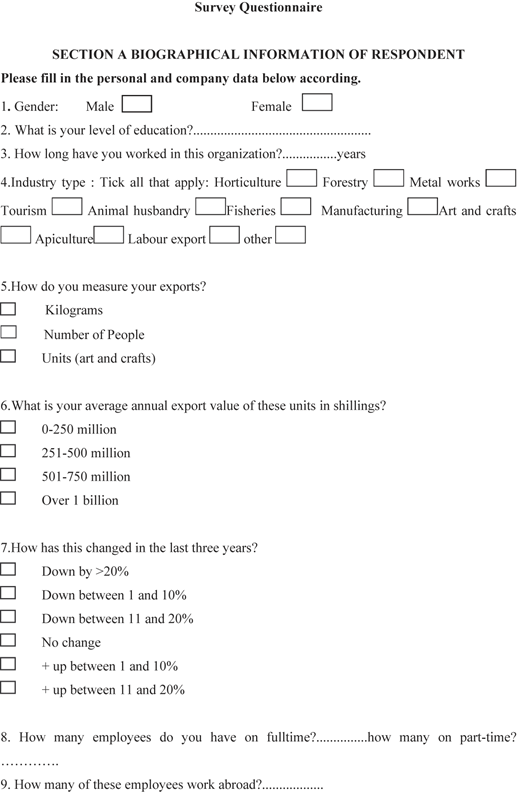
This study is quantitative since a survey was conducted through questionnaires. The element of investigation for this study was exporting SMEs in Uganda.
3.2 Sample size and data collection
For this research data was collected from SME exporting firms in Uganda that are mainly located in Wakiso and Kampala districts since these are the biggest and main business centers in Uganda. These firms have between 5 and 49 employees for small and 50 to 100 employees for medium enterprises (Uganda investment authority annual report 2019/2020). Export managers were contacted for participation in the survey. Systematic sampling was used. From a population of 937 (Uganda export promotion Board, 2020 population list), a sample of 300 was attained. Systematic sampling is a type of probability sampling method in which sample members from a larger population are selected according to a random starting point but with a fixed, periodic interval. This interval called the sampling interval, was calculated by dividing the population size by the desired sample size. In this case, 937 is divided by 273 giving 3 as the answer. Hence from the population list (from UEPB), every third SME was given questionnaires. And hence a self-administered questionnaire was used. The sample size of 300 was attained using a formula from Hair et al. (2010). According to Hair et al. (2010) the minimum sample size is 100 when considering models containing five or fewer constructs, each with more than three items with high item communalities (0.6 or higher); 150 when models contain seven or fewer constructs and modest commonalities (0.5); 300 when models contain seven or fewer constructs and low communalities (0.45), and/or multiple under-identified (fewer than three items) constructs; and 500 when models contain a large number of constructs, some with lower commonalities and/or having fewer than three measured items. In line with the best rule of thumb, a sample of 300 was considered appropriate to generate acceptable results for this study. Three hundred (300) questionnaires were distributed and 245 questionnaires were returned, after checking the missing data and incomplete questionnaires only 231 useable questionnaires were included for analysis giving a response rate of 77%.
The demographic characteristics going by exception, the majority were male (62.3%) and female (37.7%). This implies that the export business is male dominated in Uganda. The participant's levels of education ranged from certificate level to Ph.D. level. The largest number was of bachelor's holders at 64.9% and the least were PhD holders at 5%. The average age of participants ranged from 40 to 49 at 58.4% followed by those between 30 and 39 years at 18.6% and lastly by those above 50 years at 23%. The majority of the exporters were between the age of 40–49 followed by those between 30 and 39. This implied that these individuals are mature enough to take informed decisions and hence can handle the complex exporting business. The results of the study indicate that the majority of the SME exporting firms in Uganda were in business for two years at 68.8% followed by those of one year at 14.3% and the least being those four years at 1.3% and those above five years at 3%. The observed data were summarized using means and standard deviations. Where the means represent a summary of the data while standard deviations show how well the means represent the data. The objective of computing the descriptive statistics was to establish whether the statistical means provided a good fit for the observed data (Field, 2005). Table 1 presents the results of the descriptive statistics of the latent variables.
Relevant literature to this study
| Author | Title | Focus | Gap |
|---|---|---|---|
| Manzoor et al. (2022) | Lean manufacturing and agile supply chain; A cost effective approach to enhance the export performance of textile industries | Mediating effect of competitive advantage between supply chain agility, lean practice and export performance using evidence from Pakistan | Paid less attention on technology orientation in explaining export performance The study was conducted in Pakistan not a least developing country like Uganda |
| Filatotchev et al. (2009) | The export orientation and export performance of high-technology SMEs in emerging markets; The effects of knowledge transfer by returnee entrepreneurs | Examines factors affecting the export orientation and export performance of high technology SMEs in an emerging economy Combining international business research with the knowledge based view | Examined export oriented paid less attention to technology orientation |
| Ashaba et al. (2019) | Analysis of determinants of export performance in Uganda (1987–2017) | Determinants of export performance | Paid less attention to technology orientation and supply chain agility |
| Ayoub et al. (2019) | The effects of supply chain agility on export performance | Examined the effect of supply chain agility on supply chain responsiveness, supply chain innovativeness and export performance. It also investigates the mediating effects of supply chain responsiveness and supply chain innovativeness on the relationship between supply chain agility and export performance | Less attention was paid to the moderating role of supply chain agility |
| Ngo-Thi-Ngoc and Nguyen-Viet (2021) | Export performance; evidence from agricultural product firms in Vietnam | Marketing strategies, Firm capabilities, firm characteristics and export barrier | Less attention was given to strategic orientations like technology orientation |
| Ahimbisibwe et al. (2013) | Export market orientation, innovation and performance of fruit exporting firms in Uganda | Investigated the impact of market orientation, innovation on export performance | More attention was on export market orientation not technology orientation |
| Assadinia et al. (2019) | The effects of learning orientation and marketing program planning on export performance paradoxical moderating role of psychic distance | Examines the role of marketing program planning and host country psychic distance in linking export learning orientation and marketing program planning are associated with increase in export performance | Concentrated more on learning orientation and less attention on technology orientation |
| Sadeghi et al. (2021) | Perceived export performance; A contingent measurement approach | Incorporating managers' perspectives into operationalizing export performance | Less attention was given to the moderating role of supply chain agility |
| Hortinha et al. (2011) | The tradeoff between customer and technology orientations; Impact on innovation capabilities and export performance | Comparison between customer orientation and technology orientation and export performance, mediating effect of exploratory and exploitative innovation | Less attention was given to supply chain factors like agility Study was done in Portugal a developed country |
| Kalinic et al. (2022) | Entrepreneurial orientation, export channel selection and export performance | Models of export channel choice tend to concentrate on transaction cost efficiencies', ignoring values adding orientations that entrepreneurial firms may poses In addition to transaction cost, difference in entrepreneurial orientation influence export channel choice and as a consequence export performance | Concentrated more on channel choice and entrepreneurial orientation leaving out supply chain agility Research done on Dutch and Italian exporting firms not a developing country like Uganda |
| Nouri et al. (2022) | Determinants of the export performance of Tunisian SMEs; Analysis trough the MICMAC method | MICMAC method was used to identify the determining factors that can influence the performance of companies in exporting | Study was done in Tunisia Less attention was given to supply chain factors and technology orientation |
| Edeh et al. (2020) | Effects of innovation strategies on export performance; New empirical evidence from developing market firms | Heterogeneous impacts of innovation types on SMEs performance. Individual and joint impact of technological and non-technological innovations on the performance of SMEs | Done in Nigeria a middle income country. More attention was given to innovation not technology orientation |
| Easmon et al. (2019) | Social capital and export performance of SMEs in Ghana; the role of firm capabilities | Direct impact of social and the influence of market-based capabilities as intervening variable on the export performance of SMEs in Ghana. Reinforcing DC, RBV and Supply chain theories | Concentrated on market based capabilities not firm capabilities like technology orientation |
| Machado et al. (2018) | Influences of international orientation and export commitment on the export performance of emerging market SMEs | Role of international orientation and export countries in export performance | Concentrated on international orientation and less attention to technology |
| Imran et al. (2017) | The relationship between entrepreneurial orientation business networks orientation, export market orientation and SME export performance. A proposed research framework | A research framework of the relationship between entrepreneurial orientation, export market orientation, business network orientation and SME export performance | Left out learning and technology orientations |
| Khan et al. (2022) | Factors influencing supply chain agility on export performance | International entrepreneurial orientation and domestic competition are the crucial drivers for a firm's agility | Left out technology aspects like technology orientation |
| Martos-Pedrero et al. (2023) | Corporate social responsibility and export performance under stakeholder view | Mediation of innovation and moderation of the legal form. To determine the impact of firms corporate social responsibility efforts on their export performance | More attention was on corporate social responsibility |
| Zahoor et al. (2023) | Enhancing international marketing capability and export performance of emerging market SMEs in crisis strategic flexibility and digital technologies | Investigates to what extent strategic flexibility of international alliances affects export performance of emerging market SMEs | Left out supply chain factors |
| İpek et al. (2023) | A meta-analytic synthesis of how market and entrepreneurial orientation contribute to export performance; Do home country institutions matter? | Entrepreneurial orientation and export performance, the moderation of formal and informal institutions | Left out other strategic orientations |
| Barbosa et al. (2023) | The role of informal institutions in the relationship between innovation and organizational learning in export performance: A bidirectional relation | Learning, innovation and export performance between two countries | Done in Colombia and Vietnam |
| Taghavi et al. (2023) | The implementation of innovative management and strategic marketing for export performance; mixed method research | Strategic marketing, innovative management and export performance | Less attention to strategic orientations, concentrated on the developed countries statistics overtime |
| Navaia et al. (2023) | Differentiation strategy and export performance in emerging countries; mediating effects of positional advantage among Mozambican firms | Strategies on the export performance of Mozambican SMEs, the differentiation strategy and export performance of SMEs | Less attention to strategic orientations |
| Filep et al. (2023) | Comparing the innovation and export performance of Hungarian family and non-family enterprises; experiences drawn from empirical survey | The presence or absence of a performance gap between the export activity of family firms. The mixed results concerning the comparison of innovation and export performance | Done in Hungary, More attention on innovation and less of supply chain or technology factors |
| Pastelakos et al. (2023) | The role of innovation and internationalization support in small and medium sized enterprises' export performance | Innovation and Internationalization, SMEs | Paid less attention to moderators of export performance |
| Ortigueira-Sánchez et al. (2022) | Innovation drivers for export performance | Tested the effect of innovation on export performance | |
| Añón Higón and Bonvin (2022) | Information and communication technologies and firms' export performance | It focuses on information on firms export activities, direct effect of ICT on export performance, Analyze link between productivity and export performance | Concentrated on ICT not technology orientation |
| Imran et al. (2017) | The role of strategic orientation in export performance of China automobile industry | Total quality management, entrepreneurial orientation, export market orientation, brand orientation and resource based view | Done in China, left out technology orientation |
| Malca et al. (2023) | Export market orientation and export performance in emerging markets; insights from Pakistan agric-export sector | Role of export proactivity between export market orientation and export performance and the impact of relational norms as antecedents of export market orientation | Less attention was given to technology orientation |
| Al-Khatib (2023) | The determinants of export performance in the digital transformation era; empirical evidence from manufacturing firms | Impact of data analytics capabilities on export performance, Mediating effect of supply chain innovation and moderating role of supply chain agility | Concentrated on data analytics capabilities and left out technology orientation |
| Acikidilli et al. (2022) | Export market orientation, marketing capabilities and export performance of SMEs in emerging markets; a resource base approach | Uses resource advantage theory as a platform to understand why export firms perform better than others | Concentrated on export market orientation and left out technology orientation |
| Gupta et al. (2021) | Firm capabilities and export performance of small firms, a meta-analytic review | 74 recent empirical studies to find out the determinants of export performance. Found out innovation, marketing and networking capabilities as positively influencing export performance | Concentrated on innovation leaving out technology orientation that facilitates innovation |
| Hadoud et al. (2019) | Internal and external determinants of export performance, insight from Algeria | On the importance of internal and external resources for firm's export performance | Left out some internal factors like supply chain agility and technology orientation |
| Barbosa et al. (2023) | Born global; the influence of international orientation on export performance | International orientation and its relationship on export performance, moderation of innovative capacity and dynamism and favorability of the environment | Less attention was given to the impact of institutional environment on export performance thereby leaving out technology orientation and supply chain agility Study was done in Colombia (South America) |
| Hoque et al. (2021) | Dimensions of dynamic marketing capability and export performance | Dynamic marketing capability, mediating role of competitive hybrid strategy and moderating role of environmental responsiveness between dynamic marketing capability and export performance | More moderators need to be researched |
| Ringo et al. (2022) | The effect of entrepreneurial orientation on export performance; evidence of manufacturing SMEs in Tanzania | Relationship between entrepreneurial orientation and export performance, interplay effect between entrepreneurial orientation dimensions in enhancing export performance | Paid more attention to entrepreneurial orientation and left out technology orientation |
Source(s): Authors’ own literature review
3.3 Descriptive statistics
A small standard deviation means that the values in a statistical data set are close to the mean of the data set, on average, and a large standard deviation means that the values in the data set are farther away from the mean, on average (Field, 2005). The results presented in Table 1 show that the mean scores of the latent variables range between 4.59 and 4.80 on a 5-point Likert scale, while the standard deviation ranges between 0.72 and 0.94. The standard deviation values are small and thus close to the mean, implying that the statistical mean provides a good fit of the observed data. Further support is provided by the small standard error values indicating that most sample means are similar to the population mean. Therefore, confirming that the study sample is an accurate reflection of the population.
3.4 Measurement of variables
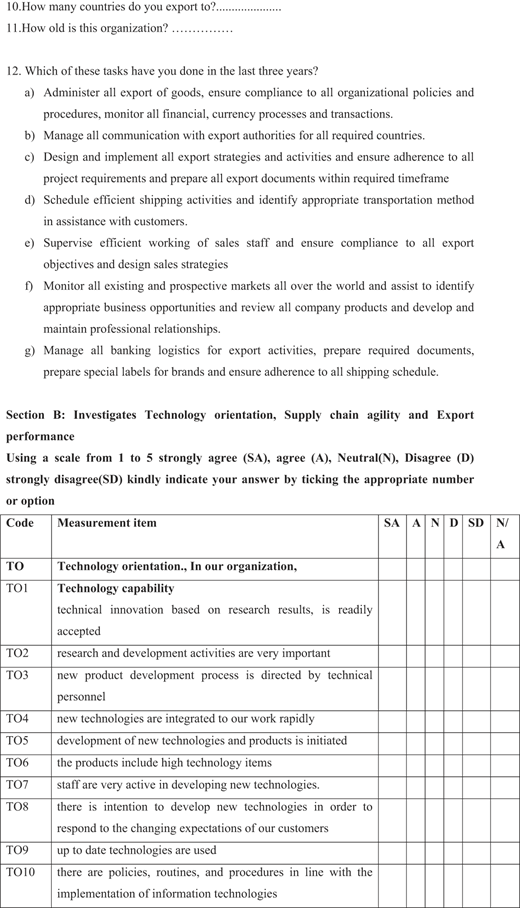
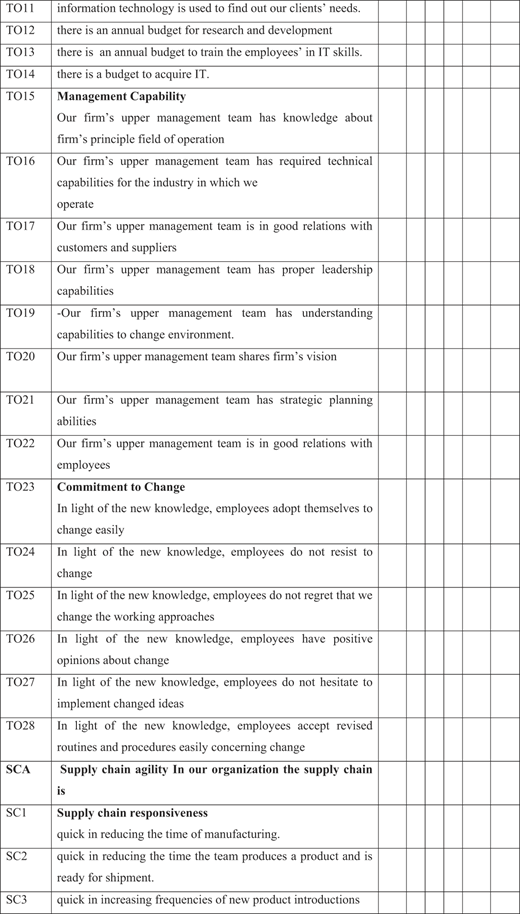
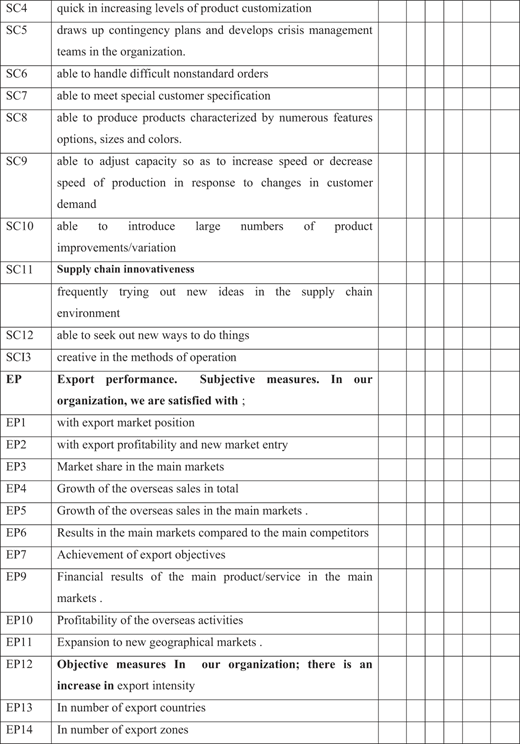
All variables were measured using a 5-point Likert scale response ranging from 1 for strongly disagree and 5 for strongly agree. The scale for export performance had items adapted from the work of questions from Stoian et al. (2011). Export performance was measured in terms of sales volumes, sales growth and market share. The scale of technology orientation was measured with items adapted from the work of Zhani et al. (2021) and Halaç (2015). The technology orientation scale included measures of top management capability, technology capability, commitment to learning and commitment to change. Cronbach's alpha value was satisfactory for this construct at 0.817. The scale for supply chain agility was measured with items adapted from the work of Ayoub and Abdallah (2019). These items included supply chain innovativeness and supply chain responsiveness. Cronbach's alpha value was satisfactory for moderating variable 0.889. The control variables for this research study are the respondent's age, education and experience.
3.5 Analysis and results
SPSS 22 and AMOS software were used to analyze the data. Construct validity was checked through confirmatory factor analysis and data fitness was confirmed through structural equation modeling (SEM).
Both convergent and discriminant validity were checked. Results proved that convergent and discriminant validity was not an issue in this study. Table 2 shows composite reliability (CR). Table 2 shows values of correlation, mean and SD.
Descriptive statistics
| N | Mean | Std. deviation | ||
|---|---|---|---|---|
| Statistic | Statistic | Std. error | Statistic | |
| Technology orientation | 231 | 4.7965 | 0.04747 | 0.72146 |
| Knowledge absorptive capacity | 231 | 4.8038 | 0.05015 | 0.76216 |
| Supply chain agility | 231 | 4.3913 | 0.06210 | 0.94377 |
| Export performance | 231 | 4.4476 | 0.06906 | 0.84955 |
| Valid N (listwise) | 231 | |||
Source(s): Authors' own work
Cronbach's alpha value was satisfactory for this construct 0.923. As seen above the Cronbach alpha was above 0.7 recommended by (Nunally, 1978) meaning the tool was reliable and the AVE was all above 0.5.
4. Findings
4.1 Correlational analysis results
We present our Pearson correlation coefficients in Table 3. Results indicate that there is a significant relationship between technology orientation and export performance (r = 0.192**, p < 0.01). This means that a positive change in technology orientation will lead to a positive change in the export performance of SMEs and therefore H1 is preliminarily supported. Results further indicate a significant relationship between supply chain agility and the export performance of SMEs (r = 0.568**, p < 0.01). This means that a positive change in supply chain agility will lead to a positive change in the export performance of SMEs and thus provide initial support for H2. Technology orientation is significantly associated with supply chain agility (r = 0.226**, p < 0.01) implying that SMEs with high technology orientation have high supply chain agility. So, these results imply that the effect of technology orientation on export performance is stronger with high supply chain agility and weaker with low supply chain agility. This further supports the idea that supply chain agility moderates the relationship between technology orientation and the export performance of SMEs as seen below in figure one. As it is, for now, H3 is preliminarily supported (see Table 4).
Composite reliability and validity
| Variable | Composite reliability | Average variance extracted (AVE) |
|---|---|---|
| Technology orientation | 0.817 | 0.50 |
| Knowledge absorptive capacity | 0.838 | 0.61 |
| Supply chain agility | 0.889 | 0.51 |
| Export performance | 0.923 | 0.70 |
Source(s): Authors' own work
Correlation
| Correlations | |||
|---|---|---|---|
| 1 | 2 | 3 | |
| Technology orientation (1) | 1 | ||
| Supply chain agility (2) | 0.226** | 1 | |
| Export performance (3) | 0.192** | 0.568** | 1 |
Note(s): **. Correlation is significant at the 0.01 level (2-tailed)
Source(s): Authors' own work
Structural equation modeling was also done with the help of AMOS and the results are seen below in Table 5.
Summary of findings
| Hypotheses | Results | Status |
|---|---|---|
| H1. There is a positive relationship between technology orientation and export performance | (β = −0.727, t-value = −2.148, p < 0.05) | Supported |
| H2. There is a positive relationship between supply chain agility and export performance | (β = 0.570, t-value = 10.251, p < 0.05) | Supported |
| H3. There is a positive moderation of supply chain agility between technology orientation and export performance | (β = 0.33, t-value = 2.138, p < 0.05) | Supported |
Source(s): Authors' own work
4.2 Interpretation of moderation analysis results
The results also indicate that Technological orientation affects export performance at (β = −0.727, t-value = −2.148, p < 0.05) therefore statistically significant. This means that there is a positive and significant association between technological orientation and export performance.
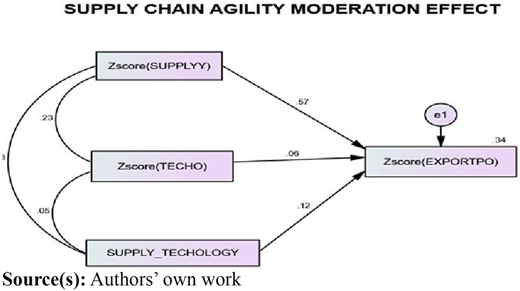
The findings of the study also indicated that the relationship between the interaction and export performance is statistically significant (β = 0.570, t-value = 10.251, p < 0.05), implying that the interaction effect of supply chain agility on export performance is statistically significant.
The hypothesis sought to ascertain the moderating role of supply chain agility on the relationship between technology orientation and export performance. The results revealed that supply chain agility moderates the relationship between technology orientation and export performance (β = 0.33, t-value = 2.138, p < 0.05). The output in Figure 1: proves that supply chain agility interacts with technology orientation since the effect is higher at a high level than it is at a lower level.
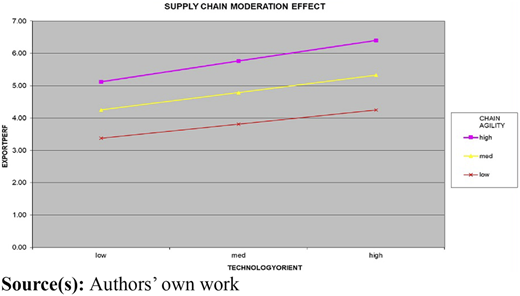
To confirm the existence of moderation a ModGraph version 3.0 was used as per the recommendations of Jose (2013) was used Figure 1.
ModGraph shows the interaction effect between technology orientation and export performance. The output in Figure 2 proves that supply chain agility interacts with Technology orientation since the effect is higher at a high level than it is at a lower level. The rule of thumb of interaction shows that the graph should have different gradients, a slope and the lines should not be parallel. The figure conforms to the rule of thumb meaning that there is a moderation of supply chain agility between technology orientation and export performance.
5. Discussion
The result of testing hypothesis 1 (H1) revealed that there is a positive relationship between technology orientation and export performance. This implies that firms that are committed to R&D and acquisition of new technologies will attain better export sales and hence performance. The findings also imply that SME exporting firms need to develop a habit to increase their gamut of skills and use technology-based resources and programs in their day-to-day activities to boost performance. Additionally, these imply that SMEs that deal in the export business and intensify their technology orientation can switch agricultural exports to industrial products thereby reducing the dependence on import inputs. Similarly, the findings above imply that firms that take R&D activities very seriously are satisfied with their profitability and sales in the export markets. Moreover, these firms with new technologies integrated into their operations rapidly are satisfied with the growth of sales in overseas markets. The findings further imply that SMEs with the latest technologies are satisfied with results in the export markets compared to their competitors. Furthermore, firms with an annual budget for R&D are satisfied with the achievement of their exports like sales and volumes Correspondingly, Firms with products that include technological items are satisfied with their market share in overseas markets. Much as exporting firms face the challenge of allocating their resources between strategic orientations like technology, market, customer and others, this research confirms that technology orientation is crucial for export performance.
The study findings imply that technology competence provides access to unserved markets as highlighted. This is true since customers prefer technologically superior goods and services. This is also in line with the findings of Hortinha et al. (2011) who found that exporters may attain higher export performance if they look at technology in high regard. When SMEs exporters use the latest applications in business, they stand to attain high export sales. Furthermore, these findings mean that SME exporting firms need to develop a habit to increase their range of skills and use technology-based resources like new digital machinery, flexible supply chains, organized procedures and programs to boost export volumes. Therefore, SMEs that deal in the export business and intensify their technology orientation will be able to switch agricultural exports to industrial products which reduces their dependence on import inputs, this is in agreement with the findings of Uysal and Sultan (2019). Technology orientation is crucial for performance to boost capital finances, productivity, growth and later development. This is further supported by Isayomi and Akintunde (2021) who state that technology adaptation and capital formation are imperative for intra-Africa export performance. The findings imply that SMEs in the export business that possess unique and advanced technology, as well as their patents, have enhanced performance. This is in agreement with the findings of Haddoud et al., (2019). This uniqueness is highlighted in the RBV theory that states that valuable, rare, inimitable and non-substitutable resources fetch firms a competitive advantage and hence better performance.
The result of testing hypothesis 2 (H2) revealed a positive relationship between supply chain agility and export performance. The results of the current study suggest that supply chain agility can be improved by training employees in supply chain responsiveness and hiring the ones who show little resistance to change. SMEs are obliged to cultivate close ties with their customers and invest in activities to make the supply chain more agile and flexible. These findings imply that managers of SME exporting firms have to pay great attention to the critical role of supply chain agility and its outcomes. These are recommended to adapt their supply chains to become flexible and exploit the advantages of their implementation to improve export performance (Khan et al., 2022). This means that SME exporting firm managers should further focus on enhancing the integration, coordination and collaboration with the main suppliers and customers to achieve a fluid/flexible supply chain. And then from here, they can expect it to result in boosting the ability of the supply chain to meet unusual orders and special customer specifications, producing products characterized by many options and features thereby shortening the lead and cycle times.
Furthermore, these findings mean that when managers make supply chains fast and are quick to respond this would increase responsiveness of the supply chain to enhance the ability to serve the market dynamics and customers faster. This means that if exporters are fast in giving the customers what they want, their sales will increase. Besides supply chain responsiveness plays a vital role in improving innovation along the supply chain. This is because of the information sharing along the flexible supply chain, improving coordination and integration, increasing formal and informal communication, boosting the decision-making process and encouraging openness to new innovative ideas. Since Supply chain agility refers to how quickly and efficiently an e-commerce supply chain can react to changes in the market and customers' demands, this leads to increased sales in the export market. Also, the findings imply that those SMEs that are speedy in reducing the time the team produces a product and is ready for shipment are satisfied with the market share in the export market.
Additionally, those that are quick to increase levels of product customization are satisfied with the sales growth. Likewise, exporters' supply chains that draw up contingency plans and develop crisis management teams in the organization perform increased profitability in their export markets. Similarly, SMEs that can handle difficult nonstandard orders are satisfied with the achievement of their objectives. Additionally, SMEs that can introduce large numbers of product improvements are satisfied with the financial results of the main product or services in the main markets. Moreover, those that have creative methods of operation will be satisfied with the market share in the export market.
The results mean that SMEs need to allocate resources to activities that build flexible supply chains and enhance the relationship with customers. This is supported by Haq et al. (2020). Furthermore, it is necessary to invest in activities that create strong ties among downstream supply chain partners (Pal et al., 2019). It means that firms need to develop policies and offer programs to enhance employees' behavioral flexibility as it has been found as an important element to achieve agility and technology orientation (Thani et al., 2021).
Managers, especially in the context of developing countries, have to pay significant attention to the critical role of supply chain agility and its outcomes. Thus, managers in SMEs are advised to adjust their supply chains to become agile and exploit the advantages of its implementation to improve their export performance. This requires managers to focus on enhancing the integration, coordination and collaboration with main customers and suppliers to achieve an agile supply chain (Alzoubi et al., 2022) All in all, by making their supply chains more agile, managers can increase the responsiveness of their supply chain to improve the ability to respond faster to market dynamics and customer demand.
Results of Hypothesis 3 (H3) to explore whether the relationship between technology orientation and export performance is moderated by supply chain agility. The findings show that there is a positive moderation of supply chain agility between technology orientation and export performance. These findings imply that firms that invest in new production processes to increase quick product customization are satisfied with the market share in the main markets. This is supported by extant literature by Chatterjee et al. (2022) who found a positive moderating role of supply chain resilience between emerging technology and firm performance. These findings imply that firms that are very creative and produce high-technology items will be satisfied with the growth in overseas sales. This is supported by Pan et al. (2022).
Likewise, firms that are quick in reducing manufacturing time through the use of outdated technology will gain more export intensity. Also, firms that have employees who don't regret change and embrace new working approaches due to the quickly increasing frequencies of new product introductions will have increased export intensity. Similarly, firms that have upper management that has technical capabilities and are quick in drawing up contingency plans and developing crisis management teams in the organization will be satisfied with the achievement of their export objectives in new geographical markets. Moreover, those with an annual budget to train employees in IT skills and staff who are hence able to handle difficult non-standard orders or special customer specifications will be satisfied with the profitability of sales in the foreign market. Besides, firms that are into trading large numbers of product improvements or variations and the employees accept change easily will be satisfied with market share in the main overseas markets.
The findings further imply that since agility emphasizes collaboration among supply chain partners, sharing of knowledge and information and cooperation in customization and new product development should be done (Alzoubi et al., 2020). These and other agile practices will promote an innovative group culture (through technology), encourage the adoption of new managerial approaches and enhance the development of new sources of creativity along the supply chain (Ragazou et al., 2022). Managers can then expect this to result in boosting the ability of the supply chain to meet unusual orders and special customer specifications, producing products characterized by many options and features, and shortening the lead and cycle times. Furthermore, the study is also in line with Ayoub and Abdallah (2019) who found positive mediating effects of supply chain responsiveness and supply chain innovativeness on supply chain agility and export performance.
6. Summary and conclusion
The contribution of this study is to examine the effect of technology orientation on export performance and the moderating role of supply chain agility between technology orientation and the export performance of SMEs in Uganda. Drawing from the RBV and DC theories, it can be concluded that both technology orientation and supply chain agility contribute positively to the export performance of SMEs in Uganda. We further conclude that supply chain agility can enable technology orientation into export performance. Thus we extend existing literature involving export performance and technology orientation by providing evidence about one enabler of technology orientation to increase export performance.
6.1 Theoretical contribution
This study has extended the RBV and dynamic capabilities theories. We suggest that the VRIN resources of RBV should be considered valuable when they complement the firm with the capability to adopt new technology. Additionally, supply chain agility was also created by synergizing diverse forms of flexibility in firms, which then leads to competitive advantage as suggested by the RBV. This study further extends the dynamic capabilities theory by broadening its applicability to conceptualize its internal resources like technology orientation which is key in determining a firm's strategy towards the production of innovative and quality products. The dynamic capabilities theory is further extended where we explain that in case of change in customer orders in quantities or specifications, the firm through supply chain agility should be flexible and swift to change and serve the customer the new product quantities and specifications. Thereby exercising supply chain responsiveness and innovativeness.
In a study by Chatterjee et al. (2021) they analyzed 318 respondents from the Bombay stock exchange (India), examining the impact of emerging technology and supply chain resilience on firm performance. The same idea has been extended in this study to highlight that supply chain agility and the use of new technology could ensure better firm performance. It also extends the findings of Yousaf et al. (2020) who found that when firms apply the latest technology, it enhances overall firm performance.
6.2 Managerial implications
This study indicates that SME exporting firms in Uganda ought to have modern technological applications for enhancing their export performance. Technology advancement should be supplemented with a flexible supply chain. The use of the latest technology inclusive of artificial intelligence should be used by SMEs in Uganda to keep up with the international customers. SMEs in Uganda should also have good relationship ties with their customers and suppliers within the value chain which will in turn improve their supply chain creativity and quick response to customers' needs.
Firm managers of SMEs in Uganda ought to be very flexible in their dealings to ease trade that can change quantities of orders, change specifications of products and change destinations as stipulated by the customers and other market demands. Once orders are placed by customers SMEs should make sure they are swiftly served and in case of changes these ought to be handled fast for them to reduce lead time. Managers should be able to sense changes in the market and create unique products that will thrive amidst the changes. This will assist them remain relevant in the international market. SME owners should also hire experienced managers in supply chain agility practices.
The findings provide specific operations strategies such as good communication between employees and their superiors regarding new ideas of doing tasks as well as periodic training by managers to ensure that the employees obtain knowledge on current technologies and supply chain practices. Lastly, SME owners and managers should be committed to advancement in technology and hire employees that are willing to learn new technology and change where need be.
6.3 Policy implications
This study's findings recommend to the policy-makers like UEPB (Uganda export promotion board) and the Parliament of Uganda who need to revise their export policies and take initiatives on technology to enhance the industry's innovative capability to exploit market opportunities abroad. Uganda export promotion board (UEPB) is also training exporters on how to tap into large markets like the European Union and North America, however, the exporters need more support in getting machines that produce more efficiently and quality products that can compete favorably in these markets. UEPB as a government institution should invest in these machines and get groups of exporters dealing in a commodity to share the machinery in a certain location periodically. This is because SMEs have limited capacity and might need to use the machine once a week or fortnight. Therefore, a chain of machines could be shared by over twenty or more SMEs. The policy of no import duty on machinery meant for production should further be publicized to enable SMEs to utilize it.
The export zones should not be earmarked for those who have connections or family ties with politicians but for all exporters and potential exporters. The tax holidays of up to ten years should be availed to even the local investors not only the foreigners. This is because so many SMEs close shop when the Uganda revenue authority starts to harass them over unpaid taxes. Some that are dishonest change their business names and start fresh which is a disadvantage to both the country and the SMEs since they lose credibility in the eyes of their customers.
Government institutions like Uganda's national chamber of commerce are training SMEs on how to tap into the wide AFCTA market and having business people from countries like Nigeria and Egypt collaborate with Ugandan SMEs in the different forums which is bound to reap some fruits. However, this is not enough because the SMEs require a helping hand in acquiring the standards marks (Q-mark) from the Uganda national bureau of Standards as well as other licenses to enable them to export. They also need the link to the right customers in those countries to protect them from fraud through non-payment.
Furthermore, the government of Uganda should increase the support for innovation (R&D) to enhance the country of origin's effect to reduce business risk and liability of foreignness. Uganda investment authority (UIA) as a government institution should do detailed R&D for a certain group of SMEs for example in the coffee export sector. In this research, they should be able to highlight the latest information and technology required, the supply chain partners and the potential customers and then disseminate this information to the SMEs in the coffee sector. Thereafter follow up with them and link them to the most authentic, credible and lucrative networks or supply chains. UIA should assist these firms until they send consignments and receive payments for them to be sure their efforts pay off. Currently, these institutions bring experts to train the SMEs on different aspects but they do not follow up.
6.4 Limitations and future research
This study was mainly quantitative, and this limited the respondents' potential to share comprehensive information about the study phenomenon, as such future studies can employ either a qualitative or mixed methods approach that allows respondents to unearth strategies and approaches that SME owners or managers can undertake to foster the export performance of their businesses.
6.5 Contribution of the study
Despite the limitations, the study has made several contributions to the existing body of knowledge, specifically, to the academicians, policymakers and the business community. The study contributes to the existing literature by providing initial empirical evidence on the contribution of technology orientation and supply chain agility to the export performance of SMEs. Policymakers and management of SMEs may have to promote the use of new machines and processes in their firms to improve their export volumes.
References
Further reading
Appendix Data collection tool