


The fragmented nature of the construction industry makes supply chain management even more challenging. Even though Mechanical and Engineering work can represent a significant part of a typical construction project and have a significant impact on the overall project's success, strategies for managing these unique supply chains remain under-researched. This research explored how generic construction supply chain management strategies could be used to leverage the performance of the Mechanical and Engineering supply chains.
A questionnaire survey was conducted to obtain the views of construction professionals on the importance of seven key construction supply chain management strategies for the Mechanical and Engineering supply chain performance and the extent to which those strategies are visible within Mechanical and Engineering projects.
Selection Strategy, Communication, Site Coordination, Trust and Partnering agreements are the key generic strategies currently driving the performance of the M&E supply chain projects. Risk allocation and early design involvement strategies could be used to further improve M&E supply chain performance.
The results identified several factors considered critical to M&E supply chain performance but not currently being utilised to their full potential. This highlights opportunities for practitioners to implement targeted strategies to address these gaps in practice, thereby enhancing the overall performance of M&E supply chains.
This research contributed to the knowledge by investigating how to improve supply chain performance for an under-researched and important segment of the construction industry.
Introduction
The modern business environments demand effective management of the supply chain to achieve corporate, organisational and project objectives. Recognising its importance, the UK government's guidance on sourcing and procuring public works acknowledges that acting together, working with suppliers, drives mutual understanding, improves delivery and helps to solve problems more effectively (HM Government, 2020). Effective management of the supply chain is particularly important in the construction sector, as the products and services provided by the companies in a construction project supply chain can typically account for about 80% of the cost of a project (Constructing Excellence, 2015). The network of supply chain members involved in a construction project can often be extremely complex, particularly on larger projects where the number of separate supplying organisations can run into hundreds, if not thousands (Briscoe et al., 2001). This requires significant efforts from the construction industry to manage the project supply chain, leading to successful project delivery.
Evidencing the relevance of supply chain performance to project success in construction, Kim and Nguyen (2018) concluded that the supply chain relationship traits have a significant positive impact on project performance. There have been some good efforts to improve supply chain performance at the sector level. For example, issues such as conventional procurement methods used in the industry and the adversarial culture were identified as key challenges to improving supply chain performance (Eke et al., 2019; Bolton et al., 2022), and various initiatives have attempted to eliminate those issues and improve supply chain practices and performance in the industry. For instance, supply chain collaboration is given significant prominence in the new procurement models (Cost-Led Procurement, Two-Stage Open Book, and Integrated Project Insurance) introduced to the industry by the UK government in 2011 (Atkinson et al., 2022).
Despite such interventions, supply chain management remains a relatively new concept in construction (Kim and Nguyen, 2020). The fragmented nature of the construction industry makes supply chain management even more challenging. The construction industry is generally driven by single unique projects, each creating and disbanding project teams comprising varying combinations of large and small firms from across the supply chain spectrum (Sexton and Barrett, 2003). Because of this, supply chains are often temporary and are formed on a one-off basis to deliver a particular project. The fragmented and temporary nature of complex supply chains is particularly reflected in the Mechanical and Electrical (M&E) work completed during construction and civil engineering projects.
Given that around 70–100% of all M&E equipment is manufactured offsite (Cartlidge, 2020), one can argue that supply chain issues are likely to have a more profound impact on project success in M&E work. Isaac and Shimanovich (2021) recognised that M&E works are often complex due to the simultaneous involvement of multiple subcontractors/suppliers on-site, pointing to the relevance of supply chain performance. M&E work typically accounts for up to 10%–70% of the construction cost of a project (McCaffrey, 2011), and therefore the performance of the M&E supply chain can have a significant impact on the success of the overall project. For instance, London's Crossrail project required significant M&E services and over 700 UK suppliers were involved in completing more than 100 km of the railway (Penzes et al., 2018). Evidencing the potential for cost and time overruns in such complex projects, the project completion has been delayed by over 3 years with significant cost overruns (Edwards, 2022). Isaac and Shimanovich (2021) highlighted the issue of M&E work being characterised by productivity and health and safety issues, on-site congestion, and trade relationships that create conflicts and delays in the completion of projects. These characteristics are linked to supply chains either directly (e.g. on-site congestion and trade relationships) or indirectly (e.g. productivity).
Whilst research has shed light on supply chain performance in construction projects, the supply chain management strategies that could leverage the performance in the M&E sector have not been investigated adequately within the existing literature. Ireland (2004), comparing an M&E supply chain with a supply chain of prefabricated restaurant subunits, demonstrated that what is appropriate in one context may not be the appropriate sourcing or business relationship choice in the other. Despite both being construction project supply chains, Ireland (2004) noted differences in the operationalisation of supply chain management. This highlights the diverse nature of construction supply chains and the need for a specific focus on the type of work, such as M&E, to obtain a better understanding of supply chain performance issues. Addressing the above-mentioned research gap and the need for research, this study seeks to investigate supply chain performance in M&E work. The primary objective of the research was to investigate the factors affecting the supply chain performance of M&E sub-projects in the construction sector and to identify strategies to drive better performance thereof. The main research question was “What are the key strategies to drive supply chain performance in M&E sub-projects in construction?”
The rest of the paper is organised as follows. The first part of the paper discusses M&E supply chains in construction and their performance. The research method adopted is then introduced. The findings of the primary research undertaken are then presented and analysed before conclusions are drawn and implications are identified.
Literature review
Supply chain management and performance improvement strategies
A supply chain is defined as “the network of entities including suppliers, designers, manufacturers, retailers, distributors, transporters, storage facilities providers, that participate in the production, delivery and sale of a product or service or the undertaking of works, to the specification of and on instruction from, a buyer” (BSI, 2014). Traditionally, the ultimate aim of supply chain management is to manage upstream and downstream relationships with suppliers and customers to deliver greater customer value at lower cost (Christopher, 1992; Meng et al., 2011). The performance measurement thinking has now shifted (in general) towards value-based criteria as opposed to traditional cost and efficiency-based criteria, such as efficiency and reduction of errors. This shift is now visible within supply chain management as well. Businesses now increasingly consider a range of non-financial attributes such as reliability, responsiveness and long-term attributes such as flexibility, sustainability, and innovation within supply chain performance measurement as well (Yildiz and Ahi, 2022; Behera et al., 2015; McCormack et al., 2008; Wood, 2005; De Toni and Tonchia, 2001). Further, contemporary performance measurement systems consider the performance of intermediate processes (such as reduction in waiting times) in addition to the performance of the end product.
Theoretical models of supply chain management
The literature reveals two types of supply chain management models to manage supply chains in order to meet organisational objectives and create value. They are reference models and maturity models. Reference models provide descriptive frameworks or abstracts of a best practice for supply chain management. On the other hand, maturity models describe and explain the levels of progress of an organisation towards achieving highly performing supply chain management practices. The Supply Chain Operations Reference (SCOR) Model is a widely known reference model from the Association for Supply Chain Management that provides a systemic approach for identifying, evaluating and monitoring supply chain performance (ASCM, 2020). This model, originally developed in 1996 by management consulting firm PRTM, has been vetted by large-scale business organisations. At its current version, SCOR provides guidance on configuring supply chains using standardised terminology for five management processes within supply chains: plan, source, make, deliver and return. A similar reference model is presented by the Global Supply Chain Forum (GSCF) with the intention of integrating key business processes from an ultimate client through to the starting points of the supply chain (Lambert et al., 1998). GSCF model provides guidance on 8 core functions for supply chain management: customer relationship management, customer service management, demand management, order fulfilment, manufacturing flow management, supplier relationship management (procurement), product development and commercialisation, and returns management Behera et al. (2015). Reference models, including the two explained above, help organisations define supply chain activities linked to cross-functional processes using standard terminology, which ultimately support organisations to benchmark their practices (McCormack et al., 2008). They could be used together with other SCM strategies to drive improvements (see ASCM, 2020; Yildiz and Ahi, 2022). Yet, their primary intention is not to provide guidance on continuance improvement (Behera et al., 2015). Supply chain maturity models, on the other hand, help organisations benchmark existing performance and set defined goals for maturity and improvement (Lockamy and McCormack, 2004). McCormack et al. (2008) provided a comprehensive review of supply chain maturity models and the evolution of supply chain performance measurement systems. The least mature supply chains are often termed Ad Hoc (McCormack et al., 2008; Lockamy and McCormack, 2004) and are characterised by poorly defined unstructured practices with no process measurement systems, limited horizontal processes within the organisational structure and operate with unpredictable performance. According to McCormack et al. (2008), the supply chains’ best maturity is achieved when they are “Extended” to compete at a multi-organisational level and built on trust and interdependence. These supply chain management processes are integrated with mechanisms to measure performance and trust. There is a strong and positive statistical relationship between supply chain maturity and supply chain performance (McCormack et al., 2008). Previous researchers have explained how these generic supply chain reference models and maturity models could be successfully applied to the construction sector (see Cheng et al., 2010; Meng et al., 2011; Sabbaghi and Vaidyanathan, 2007). For example, Meng et al. (2011) have critically discussed six existing construction supply chain relationship models. Maturity attributes presented within the existing models were then used to develop a new model capable of assessing maturity at different levels. This paper will not present further details on these works, as we focus primarily on supply chain management strategies related to both types of models.
Due to the complexity of the supply chain, associated with a large number of dispersed parties and their interdependencies, management of supply chains (SCM) is critical for the performance of both service and product-based sectors (Sengupta et al., 2006; Ellram et al., 2004; Meng et al., 2011). Whilst performance management models provide an overall approach to improve performance, strategies set out actions to achieve improved performance. Performance improvement induced by strategies is then tracked using the reference models or the maturity models as applicable. Some key SCM strategies have been used successfully for decades in other sectors such as retailing, food and manufacturing (Morledge et al., 2009; Meng et al., 2011). Considering their success in other sectors, they are increasingly being adopted in construction as well (Akintoye et al., 2000 cited in Meng et al., 2011). However, research into the applicability of generic supply chain management approaches and strategies to substantially extended and complex M&E supply chains remains limited within the literature. This research intends to review generic construction supply chain management strategies and test their applicability to M&E supply chain performance.
Mechanical and engineering supply chain management strategies
In the construction sector, several parties are involved in accomplishing construction projects. Whilst contractors, designers and other consultants frequently work together, the rest of the supply chain is often located distant from the construction site and the main project team (Dallasega et al., 2018). They facilitate a series of steps to turn raw materials into the final products used at the construction site (Hayes, 2023). Whilst some parties have a direct relationship with the ultimate client, parties further down the line (e.g. raw material producers, processors) have limited or no relationship or communication with the ultimate client they serve. In the UK, these parties are often identified by a Tier number attached to them. Within this classification, main contractors with a direct commercial relationship with the ultimate client are identified as Tier 1 and Subcontractors and suppliers with a direct contract with the Tier 1 main contractor are identified as Tier 2 contractors (BIS, 2013). Firms farther from the ultimate projects are identified as third, fourth, or fifth-tier firms. Whilst it is accepted that there is a fourth or even fifth tier involved in the construction supply chain (BIS, 2013) attached to a network of hundreds of different firms supplying materials, components and construction services (Love et al., 2005; Dainty et al., 2001; Papadonikolaki and Wamelink, 2017), these parties are often under recognised within the administration or research into the supply chain. This is particularly true for Mechanical and Electrical (M & E) works in construction projects. M&E in construction is predominantly a component assembly task and hence has a substantially extended supply chain than some in situ or site craft works such as brickworks or concrete works (see Figure 1).
 The top flowchart, Panel A, shows the supply chain for site crafted work. It starts with the Raw Material Producer, followed by the Material Processor, Wholesale Distributor, Subcontractor, Main Contractor, and finally the Client. The bottom flowchart, Panel B, illustrates the supply chain for component assembly work. It begins with the Raw Material Producer, then moves to Material Fabrication, Component Part Producer, Manufacturer, Wholesale Distributor, and Retailer. Additionally, there is a path from the Raw Material Producer to Specialist Subcontractor, then to Main Contractor, and finally to the Client.
Extended nature of M&E supply chains in construction (Adapted from Pryke (2009), p. 4)
The top flowchart, Panel A, shows the supply chain for site crafted work. It starts with the Raw Material Producer, followed by the Material Processor, Wholesale Distributor, Subcontractor, Main Contractor, and finally the Client. The bottom flowchart, Panel B, illustrates the supply chain for component assembly work. It begins with the Raw Material Producer, then moves to Material Fabrication, Component Part Producer, Manufacturer, Wholesale Distributor, and Retailer. Additionally, there is a path from the Raw Material Producer to Specialist Subcontractor, then to Main Contractor, and finally to the Client.Extended nature of M&E supply chains in construction (Adapted from Pryke (2009), p. 4)
The following is a summary of 7 key supply chain management strategies identified by previous researchers for improving construction supply chain performance.
Supplier and sub-contractor selection strategy - This strategy has a significant impact on construction supply chain performance. Competitive tendering strategies could negatively impact on supply chain relationships and pose a risk of relationship breakdowns (Department for Business, Innovation & Skills, 2013). The Rethinking Construction report (Egan, 1998) recommended reducing reliance on competitive tendering and evaluating suppliers on criteria other than the lowest price. This commercial pressure on the supply chain was still visible after the economic downturn in 2008 (Department for Business, Innovation & Skills, 2013). Gosling et al. (2015) presented how recording performance against a set of KPIs from completed projects can help the selection of organisations for subsequent projects.
Early engagement of the supply chain – Early engagement is considered critical to achieving greater efficiencies (Klein, 2014), and it is recommended that the supply chain is involved in M&E projects at the earliest stages possible (Knights, 2014). Procurement strategies (such as two-stage tendering) and other consultancy mechanisms could enable contractors and supply chains to have early design involvements and improve supply chain performance. This is particularly important on M&E projects where firms are required to meet precise design specifications that involve considerable product knowledge (Briscoe et al., 2001). Stakeholder interaction within the supply chain can provide several benefits. Grenzfurtner and Gronalt (2021) provided a detailed analysis of the importance of engagement between five types of stakeholders and their specific contribution to improving supply chain performance. This is an opportunity for the parties in the supply chain to provide value engineering ideas, improve buildability, and reduce the number of design changes (Department for Business, Innovation & Skills, 2013). Most of the benefits highlighted here can only be yielded if they engage early in the project.
Partnering – Gosling et al. (2015) provided details on diverse types of relationships within the construction sector, ranging from temporary relationships to strategic partnerships and highlighted how different types of partnerships could provide benefits ranging from competitiveness to direct control. However, in the construction procurement literature, partneringcommonly refers to long-term strategic partnering. The literature reveals mixed opinions on the impact of partnering on construction supply chain performance. Some scholars (e.g. Bresnen and Marshall, 2000) claim that partnering may not deliver the expected performance. Yet, there was good faith among scholars that partnering could improve supply chain performance when they are properly functioning. Gosling et al. (2015) in their study found that organisations from temporary relationships, such as approved partner lists, have performed better than those on strategic partnerships. In a later work, Gosling et al. (2019) identified intensive training and joint innovation as strategies/initiatives within strategic partnerships. On the positive side, partnering could mitigate the risks associated with competitive tendering strategies by promoting work towards mutual objectives and collaboration to reduce adversarial attitudes, which are critical to success (Akintoye et al., 2000). Partnering fosters positive relationships using future work as an incentive to suppliers and sub-contractors. The opportunities for future assignments can restrain misbehaviours, reduce uncertainty and encourage more flexible and cooperative attitudes (Doree, 1997). The applicability of this strategy in certain situations may be questionable when working towards one-off project and when construction demand fluctuates with countries' economies. More recently, Grenzfurtner and Gronalt (2021) found that sub-contractors in short-term contracts tend to improve their own process, whilst, in strategic long-term partnerships, they are interested in mutual performance improvement.
Trust - Fostering trust is recognised as a fundamental aspect of successful supply chain relationships (Thompson and Sanders, 1998). Ngowi (2007) and Phua (2006) have shown that project performance may be jeopardised by a lack of trust between parties. Trust is particularly important in M&E projects because the greater the level of complexity, the greater the need for trust (Khalfan et al., 2007). Lack of communication and trust together causes low efficiency in supply chains (Thunberg and Fredriksson, 2018). In the absence of trust, contractors tend to withhold information for their own benefit. Contractors feel that they must be secretive with their costs to protect their profit margins (Wood, 2005). Consequently, lack of trust can also lead to a lack of communication and adversarial relationships due to parties' suspicions of each other (Larson, 1997). Researchers have identified that trust can be improved as suppliers and subcontractors are engaged early in the planning process (Thunberg et al., 2017).
Communication – communication is important for the construction supply chain for two key reasons. Firstly, the majority of the construction supply chain is often located distant from the construction site and the main project team (Dallasega et al., 2018) and may have limited or no communication with the ultimate client. Information could be held up, delayed or misplaced whilst they are passed through the intermediate parties, negatively impacting the overall performance of the project (Bäckstrand and Fredriksson, 2022). Secondly, construction information is vastly technical in nature and specialist information may not be understood by all parties within the supply chain (Khalfan et al., 2007). These could be further aggravated by the large volumes of classified and unclassified information related to construction work (Khalfan et al., 2007). Thunberg et al. (2017) provide a detailed review of problems affecting supply-chain performance. The majority of the problems they found were categorised as internal and external communication weaknesses related problems. Finally, communication improvement strategies could also help facilitate the exchange of ideas and solutions, and this can further stimulate mutual trust (Chen and Chen, 2007). Recent advancements in ICE and Industry 4.0 technologies have promising advantages to companies through established connectivity and uninterrupted data exchange (Dallasega et al., 2018). Whilst the Industry 4.0 concepts have a significant influence on technological, organisational, geographical and cognitive dimensions of proximity, more efforts and strategies are required to improve cultural, institutional and social proximity (Dallasega et al., 2018). Papadonikolaki et al. (2017) explain how Building Information Modelling can be used to improve communication between parties by utilising formal and informal relationships between parties.
Site coordination – Effective coordination and collaboration between contractors, designers, suppliers and other project stakeholders is critical for construction project success (Chen et al., 2021; Department for Business, Innovation & Skills, 2013). A lack of coordination among project stakeholders across different functions and organisations results in unpredictable schedules and costs for construction projects (Arshinder et al., 2008). Chen et al. (2022) identified three types of supply chain coordination enablers: contractual enablers (such as incentive models), procedural enablers (such as the last planner system) and technological enablers (such as monitoring technologies). Investigating a case study, Grenzfurtner and Gronalt (2021) have highlighted the importance of good coordination between sub-contractors and main contractors to ensure the profitability of both parties.
Risk management – Risks could arise in construction projects and procurement activities through the supply chain due to various reasons, including working towards unique projects/products based on customised client requirements (Gosling and Naim, 2009), project-based environments and sector-unique structural issues (Gosling et al., 2015). Joint risk management was investigated by Rahman and Kumaraswamy (2004), and they found a growing realisation of its benefits. More balanced risk allocation reduces the number of adversaries and encourages a more integrated supply chain (Rahman and Kumaraswamy, 2004). Gosling et al. (2015) reported that risk analysis of supply chain partners, particularly looking at financial indicators related to risk as a preferred strategy used in the sector. Trust and good communication are important elements in achieving an effective joint risk management approach, which could ultimately improve the project's success (Doloi, 2009). Having high-quality information and utilising them effectively is key to risk management. It is reported that in construction, most organisations have good information on the top 15% of their suppliers and very often have little or no knowledge of the factory, people and machinery providing the product, service or works which are being sourced (BSI, 2014). Masood et al. (2021) identified a range of factors that impact supply chain performance in off-site manufactured buildings. These have been categorised as factors that risk cost, quality, delivery, feature and innovativeness of projects.
The M&E supply chain within the UK construction sector is often geographically dispersed from both the construction site and the core project team, with many suppliers operating nationally or internationally and forming part of extensive networks involving numerous organisations that provide materials, components, and specialist construction services. As a result, generic supply chain performance strategies developed and applied in broader construction or international contexts may not necessarily translate into improved performance within the UK M&E supply chain environment. Despite the recognised importance of supply chain performance, there is a lack of quantitative research examining the applicability and effectiveness of these strategies within the UK construction sector's M&E supply chains. Furthermore, limited evidence exists regarding the extent to which such strategies are currently adopted in practice. Addressing this gap would not only provide insights into the relevance and implementation of established supply chain performance strategies but also enhance understanding of the level of awareness and perceptions of these strategies among the diverse stakeholders involved in UK construction projects.
Research method
Following the literature review, which helped to achieve the objective of establishing key factors to assess current supply chain performance on M&E projects, primary research was undertaken to help achieve the rest of the objectives. The research approach adopted therein was quantitative, as it enabled the collection and analysis of data from a relatively large sample to better understand consensus within the industry regarding the issues being explored. Considering the quantitative approach adopted, a questionnaire survey was identified as the best method to obtain the views of construction professionals as opposed to other common data collection methods such as semi-structured interviews. Hoxley (2008) and Holt (2014) maintain that questionnaires are intended for the measurement of respondents' attitudes, meaning that this method is appropriate for gathering/surveying the views of industry professionals. The questionnaire survey method has been widely used in similar studies investigating supply chain-related issues in construction projects, for example, Kim and Nguyen (2020) and Atkinson et al. (2022).
Respondents for the questionnaire survey were recruited purposively through the industry contacts of the first author of this paper. Specialist M&E contractors and suppliers known to the company where the first author works, were approached to nominate respondents to the survey. The respondents were all involved in managing/working with the supply chains of projects undertaken by their respective companies, mostly in the East of England. The questionnaire survey was first distributed electronically to known contacts, and the snowballing sampling technique was used to identify additional contacts to gather responses from three key types of representatives: contractors, clients, and consultants. Whilst there could be some sampling bias, this sampling method allowed reliable responses to be obtained, unlike other participant recruitment methods such as advertising on social media platforms etc. While such methods would facilitate a larger sample size, the data would be less reliable because the suitability to respond is self-determined by the respondents. Given that respondents approached were largely known to the first author, non-response rate was minimised. The participants were notified of the research and its expected contribution ahead of the survey being sent, which is recognised as a way of boosting the response rate by Denscombe (2017). A target response number of 30+ responses was set, following Ruparathna and Hewage (2015), who argued that the sample size should be at least 30 for a questionnaire survey if the sampling distribution is approximately normal (as per Levine et al., 2011). 35 valid responses were received and used for the analysis. The sample consisted of (8Nr, 24%) M&E contractors, (7Nr, 21%) M&E consultants, (8Nr, 24%) M&E suppliers, and (11Nr, 32%) main contractors. The survey was conducted between January and March 2022.
The questionnaire featured a series of statements using a Likert scale to determine respondents' level of agreement. The statements were formed based on the factors identified in the literature review. The literature review identified 7 key strategies to drive supply chain performance in construction projects; these were supplier and sub-contractor selection strategy, site coordination, early design involvement, partnering agreements, trust, communication, and risk allocation. The first two sections of the survey template included seven statements each, allowing respondents to identify how significant each factor is in achieving a successful supply chain on an M&E project and how often each strategy is implemented in practice. The statements are identified in Table 1.
Statements developed to assess the perceptions of respondents regarding each strategy to drive supply chain performance
| Strategy | Significance of each strategy to achieving a successful supply chain on an M&E project | Implementation of each strategy in practice | |
|---|---|---|---|
| 1 | Supplier and subcontractor selection strategy | Selecting M&E subcontractors and suppliers based on factors other than the lowest price is key to success | The selection strategy for M&E supply chains often considers factors other than price, such as relationship and experience |
| 2 | Early engagement of the supply chain | Early appointment of the main contractor and early design involvement from the supply chain are key to a successful M&E project | Main contractors are often appointed early, and the supply chain is contacted early to contribute to the design of M&E projects |
| 3 | Partnering | Partnering agreements in the supply chain are key to successful M&E projects | Partnering agreements with M&E supply chains are common |
| 4 | Trust | Trustworthy supply chain members are key to successful M&E projects | Most M&E supply chain members are trustworthy |
| 5 | Communication | Open and effective communication between supply chain members is key to a successful M&E project | Communication between supply chain members on M&E projects is often open and effective |
| 6 | Site coordination | Effective coordination of M&E services on site is key to success | Construction sites for M&E projects are often well coordinated |
| 7 | Risk management | Fair risk allocation throughout the supply chain is key to successful M&E projects | Risk is often fairly shared among supply chain members on M&E projects |
For these statements, the participants were provided with the option to indicate their level of agreement on a 5-point Likert Scale (ranging from “strongly agree” to “strongly disagree”). Pescaroli et al. (2020) identify Likert scales as a common methodological tool for data collection used in quantitative approaches in multiple domains, often employed in surveys or questionnaires. Either a 5-point or 7-point Likert scale is commonly used in attitudinal research (Dolnicar et al., 2011). 7-point Likert-scale was avoided in this research due to potential response style bias and reduced stability (Dolnicar et al., 2011). A 5-point scale was considered suitable for the level of agreement measured in the research. The 5-point scale used is also one of the most used scales (Denscombe, 2017) – meaning this will be familiar to the respondents, providing clarity and aiding ease of completion. The Likert Scale options were allocated scores as Strongly Disagree (1), Disagree (2), Neutral (3), Agree (4) and Strongly Agree (5). Questionnaire survey data were analysed using descriptive statistics. Simple descriptive statistical measures of Mean, Standard Deviation (SD) and Coefficient of Variation (CV) were used for the analysis. The final section of the survey contained open-ended questions, allowing participants to expand on issues addressed in the previous sections. Measures were taken to minimise common method bias through the survey design. These included providing clear instructions to respondents, ensuring anonymity, keeping the survey concise and simple, and avoiding complex and ambiguous items as proposed by Kock et al. (2021).
Findings
As discussed in the research method section, the survey was based on 7 factors affecting M&E supply chain performance, which were identified through the literature review. The 7 factors for assessment were: Selection strategy, Site coordination, Early design involvement, Partnering agreements, Trust, Communication, and Risk allocation. The survey design consisted of 2 main sections.
The first section of the survey was designed to investigate the importance of each factor. The second section addressed the prevalence of the factor in practice. The results of Sections 1 and 2 were analysed in conjunction. Following the completion of the survey, the data were statistically analysed using the mean, Standard Deviation (SD), and Coefficient of Variation (CV). Results are presented in Table 2. A disparity between a factor's importance and its prevalence in practice indicates whether a change is needed.
Mean scores of each factor for their significance and occurrence
| Section 1: How important is each factor to achieving a successful supply chain on an M&E project? | Section 2: How often does each factor occur in practice? | |||||
|---|---|---|---|---|---|---|
| Mean | SD | CV | Mean | SD | CV | |
| Supplier and subcontractor selection strategy | 4.57 | 0.55 | 12.02% | 3.57 | 0.99 | 27.83% |
| Early engagement of the supply chain | 4.43 | 0.77 | 17.31% | 2.71 | 0.97 | 35.85% |
| Partnering | 3.74 | 0.94 | 25.05% | 3.11 | 0.78 | 25.19% |
| Trust | 4.26 | 0.73 | 17.16% | 3.31 | 0.78 | 23.67% |
| Communication | 4.54 | 0.6 | 13.25% | 3.31 | 0.75 | 22.55% |
| Site coordination | 4.66 | 0.58 | 12.51% | 3.29 | 0.94 | 28.71% |
| Risk Allocation | 4.06 | 0.67 | 16.61% | 2.74 | 0.87 | 31.83% |
| Mean | 4.32 | 0.69 | 0.16 | 3.15 | 0.87 | 27.95 |
Selection Strategy and M&E Supply Chain Performance: The results on the tender selection strategy's contribution to a successful M&E project tend to agree that the selection strategy has strong importance. 37.1% of participants agreed that the selection strategy is important, a 60% strongly agreed. Only 2.9% of participants were neutral on the subject, and 0 participants neither disagreed nor strongly disagreed. However, results regarding the adoption of supply chain selection strategies other than price were less consistent. A much lower proportion of participants strongly agreed, and a total of 40% either neutral or in disagreement. The mean fell between the neutral and agree options with a value of 3.57 (Table 1). However, Section 2 had a high response distribution, as evidenced by the SD and CV values of 0.99 and 27.83%. Therefore, it is difficult to reliably comment on the extent to which factors other than price influence selection decisions.
Site Coordination and M&E Supply Chain Performance: The influence of effective site coordination on the success of M&E projects was strongly agreed by 71.4% of participants, the highest percentage in the whole study. This raised the mean up to 4.66 (Table 2), which demonstrates strong perceptions of the importance of site coordination. The results do not show a consistent agreement that well-coordinated sites are common in practice. With SD and CV values of 0.94 and 28.71%, the results are far more spread. The mean of 3.29 indicated that participants were neutral in their responses.
Early Design Involvement and M&E Supply Chain Performance: The mean of 4.43 (Table 2) indicates strong perceptions that early design involvement from the supply chain is key to successful M&E projects. Over half of the participants strongly agreed that early supply chain involvement improves supply chain performance, while 2.9% disagreed and 8.6% were neutral. On average, more participants disagreed with the frequency of early design contributions from the supply chain, with a mean of 2.71. The results also show that most participants (37.1%) disagreed in Section 2 regarding the use of this strategy in practice. The results were highly spread out with SD and CV values of 0.947 and 35.85%. These results had the highest CV of all, indicating a high dispersion of data from the mean. While the average agrees with the importance of early design involvement, on average, there is disagreement that this strategy is effectively used in practice. Therefore, the extent of early supply chain involvement could be considered an area for improvement in the M&E industry.
Partnering Agreements and M&E Supply Chain Performance: On average, fewer participants agreed that the partnering agreements on M&E projects are important. While the mean value of 3.74 (Table 2) leans towards agreement, participants seem to be less confident about the benefits of partnering than about other factors. 34.3% were neutral about the impact of partnering agreements on M&E project success. The results related to the importance of this factor, were highly spread as demonstrated by the SD and CV. Participants selected responses across the full spectrum of available options, from strongly agree to strongly disagree, suggesting a diversity of views and perceptions among respondents. There is a similar level of uncertainty in the responses to Section 2 regarding the use of this strategy in practice. The mean of 3.11 reveals that participants are generally neutral about the prevalence of partnering agreements in practice. An SD of 0.78 indicates that the responses were distributed closer to the mean. However, there is insufficient evidence to conclude that partnering agreements are perceived as a common practice. The CV values showed similar dispersion around the mean, but different levels of central tendency were evident in the SD. With a significant proportion of participants remaining neutral, the results suggest that there is hesitancy about the use of partnering.
Trust and M&E Supply Chain Performance: The results on trust in supply chain relationships reveal that the vast majority of participants believe that they contribute to the success of M&E projects. 88.6% agreed or strongly agreed, with a mean of 4.26 for agreement (Table 2). The majority of participants (54.3%) were neutral about the trustworthiness of most M&E supply chain members. The mean value of 3.31 indicates the neutrality of most participants. The SD and CV values of 0.78 and 23.67% show some variation, but there is also some consistency to the results. Overall, the high neutrality of responses in Section 2 does not show strong support that trust occurs in M& E supply chain contracts.
Communication and M&E Supply Chain Performance: It was generally agreed that effective communication is a key aspect of a successful M&E supply chain. This is indicated by the mean of 4.54 (Table 2). 60% of participants strongly agreed with the importance of effective communication, while 34.3% agreed and 5.7% were neutral. 0 participants disagreed with communication's contribution to supply chain success. The SD and CV of 0.60 and 13.25%, respectively, demonstrate that there was a tight spread of responses. Nearly half of the participants also agree that there is satisfactory communication between supply chain members in practice. However, statistical analysis does not support that communication between supply chain members on M&E projects is often open and effective. The mean of 3.31 demonstrates this, along with a higher spread of responses that have an SD and CV of 0.75 and 22.55%. Although 48.6% agreed, no participants strongly agreed. 34.3% were neutral and 17.1% disagreed.
Risk Allocation and M&E Supply Chain Performance: The majority of participants agreed with the importance of fair risk allocation. This is evident because 54.3% agreed, 25.7% strongly agreed, and 20% were neutral. This resulted in a mean of 4.06 (Table 2). The SD and CV of 0.67 and 16.61%, respectively, reveal a small spread of responses. There was considerable variation in responses regarding the extent to which risk is shared fairly on M&E projects. An SD and CV of 0.87 and 31.83% indicate that there was less of a consensus. This is demonstrated further by the 42.9% of participants who remained neutral. 2.9% strongly agreed, and 5.7% strongly disagreed, showing conflicting viewpoints. The mean of 2.74 indicates that, on average, participants disagreed that risk is often allocated fairly.
Figure 2 below summarises the results into a matrix of importance and occurrence. The 4 factors located in the top-right quadrant (Selection Strategy, Communication, Site Coordination, Trust and Partnering agreements) are the key strategies currently driving the performance of the M&E supply chain projects. Strategies in the bottom-right quadrant (Risk allocation and Early design involvement) could be used to further improve M&E supply chain performance.
 The scatterplot measures the importance and occurrence of strategies to drive supply chain performance in M&E projects. The x-axis ranges from 2 to 5 and measures importance, while the y-axis ranges from 2 to 4 and measures occurrence. Strategies are plotted in four quadrants: top-right for higher significance and higher occurrence, top-left for lower significance but higher occurrence, bottom-right for higher significance but lower occurrence, and bottom-left for lower significance and lower occurrence. Key strategies in the top-right quadrant include Selection Strategy, Communication, Site Coordination, Trust, and Partnering Agreements. Strategies in the bottom-right quadrant include Risk Allocation and Early Design Involvement.
Impact matrix for supply chain management strategies for M&E contracts
The scatterplot measures the importance and occurrence of strategies to drive supply chain performance in M&E projects. The x-axis ranges from 2 to 5 and measures importance, while the y-axis ranges from 2 to 4 and measures occurrence. Strategies are plotted in four quadrants: top-right for higher significance and higher occurrence, top-left for lower significance but higher occurrence, bottom-right for higher significance but lower occurrence, and bottom-left for lower significance and lower occurrence. Key strategies in the top-right quadrant include Selection Strategy, Communication, Site Coordination, Trust, and Partnering Agreements. Strategies in the bottom-right quadrant include Risk Allocation and Early Design Involvement.Impact matrix for supply chain management strategies for M&E contracts
The mean value for the importance of the 7 factors is 4.32 (out of 5). This demonstrates that, on average, participants agreed that all factors are important to the success of M&E supply chains. The mean response for the frequency of occurrence of these factors was 3.15. This demonstrates more neutral agreement in response to the frequency of the 7 strategies being practised. The Standard Deviation and CV were higher in Section 2 (occurrence), hence indicating that participants' opinions on the existence of factors in practice were less consistent. The matrix shown in Figure 2 presents the mean values of each factor in relation to importance (Section 1) and occurrence (Section 2). As evident from the scatter diagram, all the factors are scored “important”, but “occurrence” has scored below neutral for risk allocation and early design involvement. However, it should be noted that the factors are scattered across a limited area within the quadrant.
Early design involvement was ranked as the least common factor in practice, while the respondents agreed with its importance. When ranking factors on the difference in means from Sections 1 and 2 (i.e. importance and occurrence) is considered, Early Design Involvement of the supply chain members has the largest perceived difference between the importance and occurrence (see Table 3).
Mean scores of each factor for their significance and occurrence
| Factor name | Mean value of Section 1 | Mean value of Section 2 | Difference between mean values of Section 1 and 2 |
|---|---|---|---|
| Supplier and subcontractor selection strategy | 4.57 | 3.57 | 1.00 |
| Early engagement of the supply chain | 4.43 | 2.71 | 1.72 |
| Partnering | 3.74 | 3.11 | 0.63 |
| Trust | 4.26 | 3.31 | 0.95 |
| Communication | 4.54 | 3.31 | 1.23 |
| Site coordination | 4.66 | 3.29 | 1.37 |
| Risk allocation | 4.06 | 2.74 | 1.32 |
Early design involvement had the highest difference between its mean importance and regularity in practice. Therefore, this suggests that early design involvement is the most significant area for improvement because, while it was perceived as important, it was not perceived to occur often on average. In contrast, the average neutrality of responses regarding partnering agreements resulted in the smallest difference. These results suggest that partnering agreements are perceived to be the least significant area for improvement.
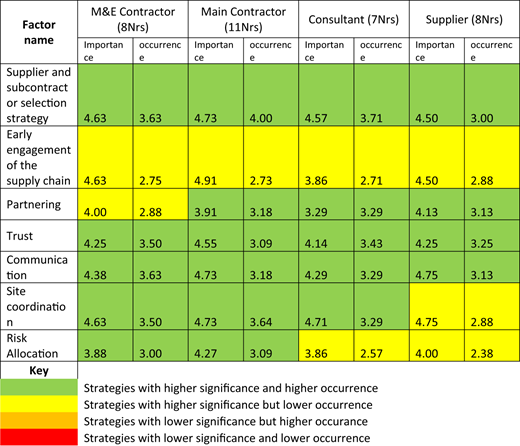
The sample of respondents in the questionnaire survey included different types of organisations involved in M&E supply chains. This included those representing M&E contractors, consultants, main contractors and suppliers. Their perceptions were further analysed to examine whether there is any difference in opinions depending on the type of supply chain partner. Whilst the sample size representing each type of organisation is relatively small, the findings provide some interesting insights. All four groups perceived all of the factors as significant for achieving a successful supply chain on M&E projects. However, they had varying views about the frequency of the factors being applied in practice. All four groups ranked the selection strategy, communication, and trust as issues with a higher significance and higher occurrence (Table 4). All 4 groups also ranked early design involvement as a factor that is high in significance, but lower in occurrence. There were differences between the opinions regarding site coordination, risk allocation and partnering agreements. Suppliers have perceived that M&E sites are less well coordinated compared to the other 3 groups. This could be due to suppliers not being integrated into the project organisation as much as the contractors and consultants. Suppliers and consultants viewed fair risk allocation as less frequent than M&E contractors and Main contractors. These findings suggest that whilst all 4 groups of M&E supply chain partners were generally aligned in their views, there were minor differences in their opinions regarding several issues as discussed above.
Discussion
Selection Strategy and M&E Supply Chain Performance: As explained in the previous section, the results of the survey tend to strongly agree that the selection strategy is a very important factor for M&E supply chain performance. However, it is difficult to reliably comment on the extent to which factors other than price influence selection decisions. It also emerged e that “experience of similar projects” is key to success, and it is “essential to select a contractor suited to the project”. This result agrees with Lavelle et al. (2007), who highlighted the importance of health and safety, past performance, and insurance coverage and ranked them equally or more important than price. Another noted that their relationship with the subcontractor is an important factor influencing selection. Another participant mentioned the influence of price in relation to supplier selection. They warned that “cheaper M&E components are not suitable if the products do not meet the performance specification.” For M&E projects with precise product specifications, searching for cheaper options may result in comparing products that are not like-for-like. Contractors selecting cheaper alternatives to specified products can compromise the employer's desired quality if the alternative does not achieve the specified performance. The results suggest that while participants tend to believe that price should not always be the most important factor, there is no conclusive evidence about price's influence on supply chain selections. This agrees with the literature (e.g. Latham, 1994; Egan, 1998; Lavelle et al., 2007) that price is no longer considered the only important factor in subcontractor selection. Notwithstanding, research suggests that competitive pricing remains crucial due to financial pressures (Department for Business, Innovation & Skills, 2013). Particularly in times of economic downturn, price is often the most decisive factor influencing supply chain selection.
Site Coordination and M&E Supply Chain Performance: The results of the survey demonstrate a strong perception of the importance of site coordination. Poor planning and coordination of the main contractor can directly influence the resource planning of subcontractors (Love et al., 2005; Dainty et al., 2001). There is clear agreement in the literature (Chen et al., 2021; Department for Business, Innovation & Skills, 2013) and the results that effectively coordinated sites can be key to successful M&E projects The fragmented nature of the construction industry due to the dominant approach of subcontracting, demands diligent management of work packages, particularly on complex M&E projects that involve the convergence of many specialist subcontractors. The results are unclear about how well M&E work packages are coordinated in practice. This is because the topic is very subjective and the effectiveness of site coordination can vary from project to project. The high distribution suggests that the results depend on the main contractors' competencies. Some participants suggested possibilities for improvement. It was recommended to “build project programmes around the M&E elements rather than trying to squeeze the M&E between other trades”. However, the reliability of this suggestion can be criticised. This viewpoint can be interpreted as being self-centred because each participant works in the M&E sector.
Early Design Involvement and M&E Supply Chain Performance: The survey results indicate a strong perception that early design involvement by the supply chain is key to successful M&E projects. While the average agrees with the importance of early design involvement, there is disagreement that it is a common occurrence. Therefore, the extent of early supply chain involvement could be considered an area for improvement in the M&E industry. An abundance of literature also agrees that early design involvement can improve efficiency and contribute to successful M&E projects (Klein, 2014; Knights, 2014). A lack of early design involvement could also be attributed to working under tight timescales. One of the participants who supported early design involvement highlighted the wariness of time pressures and recommended ensuring “an adequate period of time for the contractor design and planning (typically this is insufficient, so it overlaps the installation period, resulting in inefficiency and ultimately a longer programme and more cost/less profit).”
Furthermore, according to Kassem and Mitchell (2015), the complexity of specification in the early design phases is exacerbated by the late involvement of specialist subcontractors. Respondents also mentioned the impact that it caused on product lead times, “especially at this moment in time when motors, steel etc. are in such high demand.” If suppliers are involved early, there will likely be more awareness of lead times, which can facilitate more effective programming. Delays in material supply are among the most important factors leading to delays in construction project delivery (Rahman et al., 2017). Therefore, early supply chain involvement in design can improve M&E supply chain performance and minimise delays in project delivery. One of the participants recommends using “BIM for clash detection”. The integrated and dynamic data in BIM systems can improve the spatial coordination of work packages by detecting clashes. The use of BIM and effective collaboration between design teams in early design phases would avoid clashes.
Partnering Agreements and M&E Supply Chain Performance: On average, fewer participants agree that partnering agreements are important for M&E projects. Participants seem less confident about the benefits of partnering than about other factors. The survey also reveals that participants are generally neutral about the prevalence of partnering agreements in practice. However, there is insufficient evidence to conclude that partnering agreements are perceived to be common. The CV values showed similar dispersion around the mean, but different levels of central tendency were evident in the SD. With a significant proportion of participants remaining neutral, the results suggest that there is hesitancy about the use of partnering. This result is therefore not consistent with the literature, which tends to agree with the benefits of partnering. Based on a European case study, Kumaraswamy and Matthews (2000) demonstrated how employing partnering principles can improve subcontractor selection. Authors such as Berntsson and Lindell (2016), Matthews et al. (1996), Latham (1994) and Egan (1998) also supported partnering, while others were critical of its benefits. For example, Holloway and Parmigiani (2016) highlighted the performance implications of repeated partnerships. The majority of survey participants agreed that partnering is important. However, the 34.3% of participants who were neutral suggests that there is still some uncertainty about the benefits of partnering. This could be attributed to a lack of experience. Not all participants may have been involved in partnering agreements. Therefore, they may not be aware of the potential benefits.
Trust and M&E Supply Chain Performance: The results of this survey showed that trust is important, yet revealed strong consensus that trust is less common in M&E for the trustworthiness of supply chain members' contracts. As evidenced by the literature, the general fragmented nature of the construction industry can limit trust. Also, trust can be compromised when there is an imbalance in sharing information. Particularly on M&E projects with increased complexity, subcontractors and suppliers can have expert knowledge of areas that others are not competent in (Khalfan et al., 2007). This puts some parties at risk of being taken advantage of. Two participants offered similar suggestions for improvement in relation to trust, highlighting that clients and contractors should know net costs and be aware of the “need to make a reasonable mark-up on the work through the use of “open book tendering”. Another recommended that “more detailed quotations” should be provided that “clearly state what is included”. These comments imply a lack of trust. Although there are more responses agreeing than disagreeing that supply chain members are trustworthy, responses to the optional questions seem to indicate a different view. This is evident from a comment mentioning how subcontractors may try to take advantage of inexperienced parties. The participant notes how subcontractors are “likely to be more open and honest with somebody experienced” and someone who speaks the “same language”. They indicate that the “subcontractor may see an opportunity to manipulate situations to their advantage” if the site co-ordinator is not just “construction-based” and not from an “M&E background”. These results provide examples of how project performance could be jeopardised when the trust is limited, as suggested by Phua (2006). Confirming Wood (2005)'s suggestion, we also found that contractors tend to withhold information for their benefit when trust is lacking. Project performance could be indirectly impacted by abstract quotations provided by suppliers and sub-contractors. These may result in making wrong assumptions and subsequent weaknesses in project budgets, leading to project financial issues. Further, manipulating situations for the site co-ordinator could jeopardise project performance and limit the opportunity to learn from mistakes or situations influencing the performance of future projects or alliances. These results are not just disappointing at the project level but at the sector level. Overall results suggest that construction M&E supply chains are far from achieving optimal performance level, as best maturity is achieved when organisations are built based on trust and interdependence amongst supply chain partners (McCormack et al., 2008). However, it is encouraging to see a strong agreement among all the stakeholder types that trust is crucial. This suggests that deploying effective trust-building strategies would be well-received and would help in improving supply chain performance.
Communication and M&E Supply Chain Performance: It was generally agreed that effective communication is a key aspect of a successful M&E supply chain. Most participants also agree that there is satisfactory communication between supply chain members in practice. However, they did not necessarily agree that communication between supply chain members on M&E projects is often open and effective. The results show that participants tend to agree that effective communication is both important and practised. However, the lower level of agreement in relation to the practice suggests that there is still room for improvement. The literature review explored the potential of applying SCM theory in the construction industry. SCM emphasises the importance of communication between supply chain members and stakeholders but does not give specific details. In response to the optional questions, a participant recommended “clear avenues of communication to sub-subs”. This refers to the fragmented nature of M&E projects where “sub-subs” are common due to the dominant approach of subcontracting. Another suggests the use of clear and “unambiguous order documentation” to avoid miscommunications with suppliers.
Effective communication with suppliers is particularly important on M&E projects, where buyers may have limited product knowledge or when specific delivery requirements must be met. It was commented that “more effective information sharing” is required, such as changes to specifications. This suggests that increasing the use of Industry 4.0 technologies such as BIM is a potential solution for effective information exchange because they facilitate data sharing and bring distant parties closer (Dallasega et al., 2018). These results confirm previous findings that explain the importance of communication when supply chains are located distant from the main site (Dallasega et al., 2018). Respondents suggests that M&E suppliers and sub-contractors belong to Tier 3 contractors in the hierarchy (BIS, 2013), possibly distant from the main project partners and the ultimate client. Hence, communication could be a struggle and a decisive factor in supply chain performance. Interestingly, participants did not reveal any specific struggles related to vast technical information coming in large volumes, as suggested by Khalfan et al. (2007). Yet their call for “clear avenues of communication” reveals a lack of standard paths for communication and the possibility of miscommunication or misplacement of information, affecting project performance, as suggested by Bäckstrand and Fredriksson (2022). Industry 4.0 technologies such as BIM will eventually create these clear avenues. Overall, these results suggest that effective communication could be an easy-win critical success factor for improving the success of construction M&E supply chains, as there is an abundance of support for implementing Industry 4.0 technologies within the construction sector, which would ease most struggles mentioned in this research.
Risk Allocation and M&E Supply Chain Performance: The majority of participants agreed with the importance of fair risk allocation. However, on average, participants disagreed that risk is often allocated fairly. While there was a general concurrence that fair risk allocation is important in M&E projects, there was ambiguity about how often risk is shared fairly in practice. There were no comments regarding risk in responses to the optional questions, making it difficult to draw conclusions. Response to a previous question on trust suggested that contractors may allow for unnecessarily large sums as risk allowance, induced by a lack of “more detailed quotations” to “clearly state what is included” in the price. It was not clear to what extent these risk allowances are used by M&E suppliers and sub-contractors when a risk materialises. The literature suggests that contractors may unfairly transfer risk down the supply chain to limit their own exposure to risk (Pryke, 2009). The results hint that this may be the case. However, with a high proportion of participants neutral or agreeing that risk is shared fairly, the literature cannot be backed up with certainty.
Conclusion
Construction project performance is heavily influenced by the effectiveness of its supply chain, which comprises a diverse range of stakeholders. The complexity and fragmented nature of Mechanical and Electrical (M&E) works present unique challenges and opportunities in managing supply chain performance in construction projects. Although substantial research has examined construction supply chains more broadly, limited attention has been paid specifically to M&E supply chains. To address this gap, this study investigated the factors affecting supply chain performance in M&E sub-projects and explored strategies to enhance performance within this specialist area. The research was guided by the central question: What are the key strategies for improving supply chain performance in M&E sub-projects in construction?
The study identified seven key factors influencing supply chain performance in construction and confirmed their relevance to the M&E context. The findings indicated that all seven factors were perceived as significant contributors to M&E supply chain performance. However, respondents also reported that the extent to which these factors are currently implemented in practice falls short of their perceived importance. In particular, early design involvement and risk allocation emerged as highly significant factors with comparatively low levels of implementation. Early design involvement demonstrated the largest gap between perceived importance and actual implementation, followed by site coordination and risk allocation. These findings suggest considerable opportunities for improving M&E supply chain performance through greater adoption and integration of these practices.
A key contribution of this research lies in extending existing construction supply chain performance literature to the specific context of M&E supply chains, which represent a distinctive and often complex trade within the construction industry. The findings highlight several characteristics unique to M&E supply chains and identify priority areas where implementation efforts should be strengthened. By revealing discrepancies between the perceived importance of performance drivers and their practical adoption, the study provides valuable insights for both practitioners and researchers seeking to improve supply chain outcomes in M&E projects.
The results should be interpreted with caution due to the relatively small sample size of respondents to the questionnaire survey. In addition, because a convenience sampling approach was used, the majority of respondents were located in the East of England. Consequently, care should be taken when generalising these findings to other geographical areas, as regional differences in the construction sector may influence their applicability. Therefore, it is advisable to consider local industry characteristics and regional variations when applying these findings beyond the study area.
Future research should seek to involve a larger and more geographically diverse sample, with broader representation from the various stakeholders engaged in M&E supply chains. While this study identified the key factors affecting M&E supply chain performance, further investigation is required to establish the extent to which each factor contributes to individual performance outcomes and overall supply chain effectiveness. Given that early design involvement was identified as the area with the greatest potential for improvement, further research on the mechanisms by which it enhances supply chain performance would be particularly valuable. In addition, while this study highlighted potential improvement strategies, including the adoption of Building Information Modelling (BIM) and open-book working practices, further research is needed to evaluate the effectiveness of these and other specific interventions in improving M&E supply chain performance. Ultimately, a deeper understanding of how these factors and strategies influence performance will support the development of more effective and resilient M&E supply chains within the construction sector.

