This study aims to investigate the synergistic potential of human mentors and generative artificial intelligence (GenAI) in supporting venture firms across various growth stages. By examining the evolving resource needs of startups, the research develops a hybrid mentoring model designed to address these requirements within the distinctive institutional framework of the Japanese venture support ecosystem.
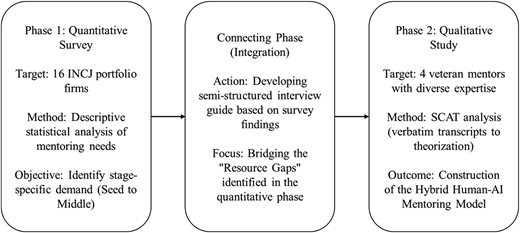
Adopting an exploratory sequential mixed-methods design, this study provides nuanced insights into this emerging phenomenon. The first phase consisted of a quantitative survey with 16 portfolio firms of a government-backed investment fund in Japan to identify shifting mentoring needs. This was followed by a qualitative phase involving semi-structured interviews with four veteran mentors, analyzed through the steps for coding and theorization method. The conceptual framework integrates the resource-based view, social capital theory and mentoring theory to articulate the complex interplay between artificial intelligence (AI)-driven analytical support and human-centric guidance.
Quantitative results reveal a significant shift from technology-focused needs in the seed stages to governance and human resource priorities during growth phases. Qualitative findings indicate that while GenAI enhances information processing and structural social capital, human mentors provide inimitable experiential knowledge and relational social capital, specifically by fostering affective trust. The evidence suggests that AI acts as a resource optimizer rather than a substitute for human intuition, establishing a foundational perspective for validating these dynamics across diverse institutional settings.
The study proposes a pioneering “hybrid human–AI mentoring model” tailored to the Japanese context, where long-term trust and government-led coordination play a pivotal role. It contributes to the entrepreneurship literature by defining the critical boundary between AI's analytical efficiency and human empathy, thereby providing a strategic roadmap for venture capital firms and incubators to optimize their support systems in similar institutional settings.
1. Introduction
Mentoring has long been recognized as a critical driver for the survival and growth of venture firms (St‑Jean and Audet, 2012; Eesley and Wang, 2017). Beyond traditional frameworks, recent scholarship in the New England Journal of Entrepreneurship has emphasized the mediating role of social capital in the efficacy of such support mechanisms (Seshadri and Elangovan, 2019). However, as the complexity of the global technology landscape increases, traditional human-only mentoring faces limitations in scalability and information processing capacity. The rapid emergence of generative artificial intelligence (GenAI) aligns with the broader digitalization of the entrepreneurial process, a transformative shift that is fundamentally reshaping how resources are mobilized and managed (Bhavsar and Sangle, 2023). While various strategic frameworks, such as the integration of formal planning and lean methodologies, have been proposed to navigate the path to success (Welter et al., 2021), research on the strategic integration of AI within mentoring remains nascent. There remains a significant gap in understanding how human and AI capabilities can be strategically integrated – not as rivals, but as complements – across the specific growth stages of a venture.
This study addresses this gap by investigating the mentoring needs within the unique institutional context of the Japanese venture ecosystem, specifically focusing on ventures supported by a government-backed investment fund. Unlike ecosystems driven primarily by market-based venture capital, the Japanese context is characterized by a “corporate-led” innovation structure where large established firms and coordinated credit markets play a dominant role in resource allocation (Witt, 2014). Recent inquiries into the paradox of resource access suggest that strategic decision-making is heavily influenced by the availability and type of support resources (Simarasl et al., 2023). By integrating the resource-based view (RBV), social capital theory and mentoring theory, this research investigates how mentoring demands evolve as ventures scale – a progression deeply influenced by the entrepreneur's experience and education (Marvel et al., 2019) – and how the unique “inimitable resources” of human mentors synergize with the “computational efficiency” of GenAI.
The contribution is twofold. First, this study advances the discourse on mentoring processes by framing them as a hybrid resource allocation problem, moving beyond the binary “human vs. AI” debate. This perspective contributes to the emerging conversation on entrepreneurial resourcefulness by exploring how founders creatively combine disparate resources to overcome constraints (Lange et al., 2024). Second, it provides exploratory empirical evidence from the Japanese context to identify boundary conditions where human intervention remains indispensable. Given that personal traits are closely linked to the formalization of ventures (Sendawula et al., 2024) and that social costs of failure significantly impact early-stage activity (Simmons et al., 2024), the role of the human mentor in providing affective trust and navigating cultural nuances remains paramount. This study thus provides a framework for understanding how such institutional and psychological nuances dictate the optimal mix of human and AI-driven support.
2. Literature review
2.1 Entrepreneurial mentoring and growth stages
Mentoring is a vital resource for startups, providing not only business knowledge but also cognitive and emotional support (St‑Jean and Audet, 2012). Previous research suggests that venture needs are dynamic and evolve according to growth stages – from product development in the seed stage to organizational professionalization in the growth stage (Kazanjian, 1988). In this developmental trajectory, the road to success often requires a strategic hybrid of formal planning and iterative learning methodologies (Welter et al., 2021). More recent scholarship emphasizes that these transitions are increasingly shaped by “digital affordances,” where the timing and nature of support are dictated by the rapid scaling enabled by digital platforms (Autio et al., 2018; Nambisan et al., 2019). This shift underscores the central role of digitalization within the modern entrepreneurial process, necessitating a re-evaluation of how founders access and utilize supportive resources (Bhavsar and Sangle, 2023). As contemporary ecosystems become increasingly digitized, the reliance on AI for real-time decision support has grown, prompting a shift in how founders utilize human networks versus computational tools to overcome growth hurdles.
2.2 Theoretical framework 1: resource-based view (RBV)
According to the RBV, firms achieve competitive advantage through resources that are valuable, rare, inimitable and non-substitutable (VRIN) (Barney, 1991). In the era of ubiquitous AI, the VRIN framework must be re-evaluated to distinguish between codified and tacit assets. Human mentors possess “tacit knowledge” derived from years of experiential learning. Such experiential wisdom remains a critical driver of venture performance, as it provides context-sensitive guidance that formal education alone cannot replicate (Marvel et al., 2019). This knowledge is characterized by social complexity and causal ambiguity, making it highly inimitable. Conversely, GenAI provides vast “explicit knowledge”, which is highly scalable. The strategic contribution of this research is the conceptualization of a “hybrid mentoring capability,” wherein the synergy between AI-driven analytical speed and mentor-driven experiential wisdom creates a unique and inimitable firm resource. This perspective aligns with the broader concept of “entrepreneurial resourcefulness,” which suggests that the creative combination of disparate tools – both human and technological – is essential for navigating resource-constrained environments (Lange et al., 2024).
2.3 Theoretical framework 2: social capital theory
Social capital theory distinguishes between structural and relational dimensions (Nahapiet and Ghoshal, 1998; Scuotto et al., 2022). Empirical evidence has confirmed that social capital serves as a vital mediator between mentoring interventions and actual startup success (Seshadri and Elangovan, 2019). While GenAI can augment structural capital by rapidly identifying market trends and connecting disparate data points, relational capital – specifically affective trust – requires repeated human interaction, shared identity and ethical accountability. Furthermore, the strategic decision to seek and utilize these resources is a complex process, where the paradox of resource access can significantly influence the comprehensiveness of an entrepreneur's choices (Simarasl et al., 2023). In the Japanese ecosystem, where corporate–startup relationships are often mediated by long-term social ties and implicit norms inherent in a “corporate-led” structure (Witt, 2014), this relational dimension remains an indispensable barrier to entry for purely algorithmic support.
2.4 Theoretical framework 3: mentoring theory
Kram (1985) categorized mentoring into career functions (sponsorship and coaching) and psychosocial functions (role modeling and counseling). Recent scholarship on AI-mediated coaching (e.g. Terblanche et al., 2022; Glikson and Woolley, 2020) indicates that AI is highly effective at managing career functions related to information retrieval and goal attainment. However, psychosocial functions, which require context-sensitive empathy and normative judgment, remain the domain of human mentors. This distinction is critical given that an entrepreneur's personal traits are closely linked to the formalization and performance of their ventures (Sendawula et al., 2024). By mapping these functions onto the Japanese institutional support structure, this research argues that the hybrid model is not merely a technical upgrade but a structural realignment of support delivery. Moreover, considering that the social costs of failure can deter early-stage entrepreneurial activity (Simmons et al., 2024), the psychological safety provided by a human mentor's empathy remains a critical, non-substitutable component of the support ecosystem.
3. Methodology
3.1 Research design
This study employs an exploratory sequential mixed-methods design, which is particularly suited for investigating emerging phenomena such as AI-human collaboration where existing theoretical precedents are limited. As shown in Figure 1, the research was conducted in two phases: an initial quantitative mapping to identify mentoring needs, followed by a qualitative phase to derive theoretical mechanisms. This sequential approach ensures that the qualitative insights are grounded in the empirical patterns observed in the venture portfolio, providing a robust, albeit preliminary, foundation for the proposed hybrid mentoring model. Crucially, the qualitative phase was designed specifically to explain the “resource gaps” identified in the survey results, ensuring a tight integration between the two methods.
3.2 Quantitative sample and data collection
A descriptive survey was conducted among 61 firms within “a government-backed investment fund in Japan,” yielding 16 valid responses (26% response rate). While the sample size is constrained, it represents a substantial portion of the target fund's specific portfolio, providing critical visibility into the needs of ventures operating under similar government-backed support. “Similar support” in this context refers to institutional environments where ventures receive long-term, low-interest capital alongside governance-heavy monitoring from state-affiliated entities – a common configuration in the Japanese “corporate-led” ecosystem (Witt, 2014). Given the exploratory nature of this study, the survey results were primarily used to map descriptive patterns across venture growth stages and to inform the thematic focus of the subsequent qualitative interviews rather than for hypothesis testing. The industrial composition and growth stages of these firms are summarized in Table 1.
3.3 Qualitative sample and analysis
To deepen theoretical insights, semi-structured interviews were conducted with four veteran mentors (Table 2). These participants were selected specifically for their extensive experience in navigating the nuances of the Japanese venture ecosystem, making them “information-rich” cases. The data were analyzed using the steps for coding and theorization (SCAT) method, which allows for systematic deconstruction of transcripts into theoretical themes. Reliability was ensured through collaborative peer debriefing and cross-checking to mitigate individual researcher bias.
3.4 Data analysis method: the SCAT method
To maintain analytical rigor, this study employed the SCAT method through four iterative stages. The process began with the identification of key phrases from the raw transcripts, followed by their translation into meta-languages to extract essential meanings. Subsequently, the analysis accounted for contextual influences before moving toward progressive abstraction. This structured approach facilitates the transformation of idiosyncratic mentor insights into more generalizable theoretical constructs. By triangulating the quantitative survey data, which addresses the “what” of mentoring needs, with the qualitative interview insights that explore the “why” and “how,” the research constructed a hybrid model that explains the synergy between computational efficiency and human-centric experiential knowledge.
3.5 Ethical considerations
This study strictly adhered to institutional ethical standards to ensure the protection of all parties involved. All participants provided informed consent prior to data collection, and all research materials were anonymized to protect the identities of individuals and firms within the relatively small Japanese venture community. This commitment to confidentiality was particularly important given the sensitive nature of discussing internal governance and mentoring dynamics within government-linked investment structures.
4. Quantitative survey results
4.1 Descriptive analysis of mentoring need
The survey results indicate that mentoring needs are inherently dynamic and highly dependent on the firm's growth stage. Empirical data suggest a distinct lifecycle shift where technical requirements, such as patents and intellectual property, peak during the founding and seed stages as firms prioritize technical viability. As ventures scale toward the middle stage, there is a progressive transition toward governance and human resource management. Notably, management expertise from experienced entrepreneurs and support in finance and governance remain consistently in high-demand areas across all stages, reflecting the ongoing need for strategic oversight in a government-backed investment environment. The specific breakdown of mentoring received across various categories and growth stages is presented in Table 3. The data show that while some categories, such as specific technological seeds or new business development, received minimal external mentoring, the overall breadth of support received broadens as the firm matures, with the number of firms receiving no mentoring decreasing significantly by the middle stage.
4.2 Gaps between received and desired support
The analysis further highlights critical “resource gaps” – areas where ventures expressed a desire for support that was not adequately met by existing mechanisms. A detailed comparison of these desired but unmet needs is summarized in Table 4. A significant discrepancy was observed in marketing support, particularly during the middle stage, suggesting that while the institutional support from government-backed funds is robust in providing governance, it may lack the agility required for real-time market-entry insights. This empirical gap provides a compelling justification for the integration of GenAI into the mentoring ecosystem. Specifically, GenAI could bridge these information-heavy voids by providing rapid competitive benchmarking and market analysis, tasks that are often difficult to satisfy through traditional and intermittent human interactions. The persistent desire for management and financial guidance, even when some support is already provided, underscores the perceived scarcity of these high-level strategic resources within the current ecosystem.
4.3 Exploratory factor patterns (PCA refinement)
While acknowledging the statistical limitations due to the sample size (n = 16), principal component analysis (PCA) was employed as an exploratory tool to visualize relational patterns rather than to establish definitive factor structures. The PCA results delineate two distinct trajectories of mentoring requirements: the first centering on managerial and financial needs and the second focusing on technological and intellectual property hurdles. These clusters indicate that mentoring needs are not monolithic but are segmented by specific growth challenges. By identifying these distinct patterns, the research provides a conceptual roadmap for determining where AI-driven informational support can effectively offload traditional human-centric tasks. This allows human mentors to reallocate their limited time and cognitive resources toward more complex, relational and context-dependent challenges that require high levels of affective trust and nuanced judgment.
5. Qualitative interview findings
5.1 SCAT analysis and process transparency
Qualitative data derived from interviews with four veteran mentors were analyzed using the SCAT method to ensure that the resulting theoretical themes were firmly grounded in empirical evidence. The analysis transformed raw interview excerpts into meta-languages, facilitating a progressive abstraction toward core theoretical constructs. An illustrative example of this iterative analysis process, showing the transformation from raw data to theoretical themes, is provided in Table 5. For instance, when a mentor noted that AI could provide a business plan but failed to alleviate a founder's professional isolation, this was conceptualized as the distinction between functional efficiency and the emotional void, eventually aligning with the psychosocial functions identified in mentoring theory. Similarly, the mentor's role in navigating the intricacies of Japanese corporate politics was identified as an inimitable resource, while the use of AI for objective benchmarking was categorized as a contribution to structural social capital. This rigorous process clarifies how the final hybrid model was derived from the lived experiences of mentors navigating the complexities of the Japanese venture ecosystem.
5.2 Themes of human mentorship: inimitability and trust
The interviews confirmed that human mentors fulfill critical roles that generative AI currently cannot replicate, particularly in areas requiring high levels of relational capital. Two primary dimensions emerged where human intervention remains indispensable: context-sensitive socio-emotional support and the leveraging of tacit knowledge within local networks. Mentors play a vital role in fostering emotional resilience during high-stakes strategic pivots, providing nuanced guidance on managing internal resistance from traditional corporate stakeholders. This task requires an intuitive understanding of founder's psychological state and specific organizational cultures – capabilities that exceed current algorithmic processing. Furthermore, in the Japanese context, success often depends on navigating informal networks and interpreting implicit cues, a process colloquially known as “reading the air”. Unlike AI, which synthesizes existing explicit data, the human mentor utilizes tacit, real-time knowledge to facilitate trust-building in multi-party negotiations where interests are frequently misaligned. This confirms that relational capital requires the kind of repeated, identity-based interaction that remains a human prerogative.
5.3 Themes of AI mentorship: efficiency and objectivity
Conversely, the participants viewed GenAI as an essential “co-pilot” for career-related mentoring functions, particularly those involving information retrieval and structural organization. The findings indicate that AI excels at exhaustive market research and the generation of initial business model drafts, which significantly reduces the entrepreneur's cognitive load and enhances structural social capital through rapid access to codified information. One mentor specifically highlighted that AI acts as an objective mirror, reflecting the entrepreneur's thoughts without the subjective bias that can sometimes affect human advice. However, the mentors also cautioned against a total reliance on technology, citing the risk of AI-generated hallucinations and inaccuracies. Consequently, the prevailing view among experts is that AI outputs must be filtered through a human mentor's context-specific judgment. This balanced perspective suggests that AI serves as a resource optimizer, allowing the human–AI dyad to achieve a level of analytical depth and objective benchmarking that supports, rather than replaces, the mentor's experiential wisdom.
6. Discussion and theoretical contribution
6.1 Reinterpreting mentor resources through VRIO (RBV)
The findings provide a nuanced extension of the RBV by redefining the source of the competitive advantage in the digital age. While prior literature often contrasts AI with human labor, the VRIO analysis conducted in this study suggests that the true advantage of a venture is derived not from either resource in isolation, but from a “hybrid mentoring capability.” This capability represents the unique ability to integrate GenAI's computational speed with human experiential judgment. Inimitability is particularly evident in the path-dependent wisdom of veteran mentors, whose tacit insights are derived from decades of navigating Japanese market cycles and organizational failures. This experiential filter acts as a necessary safeguard for AI outputs, which lack the historical and cultural context. Furthermore, the hybrid model redefines “organization” as the dynamic orchestration of AI-driven structural capital and human-driven relational capital. Without the human mentor to contextualize AI findings within the complex Japanese corporate hierarchy (Witt, 2014), such outputs remain “disembodied” and inherently less effective. This orchestration capability is socially complex and, by definition, inimitable.
6.2 Social capital: from information to trust
This research extends social capital theory by operationalizing the divide between its structural and relational dimensions within the mentoring process. The findings demonstrate that Generative AI significantly lowers the barriers to acquiring structural social capital – specifically the ability to rapidly access, synthesize and benchmark market data. However, in the Japanese “corporate-led” innovation structure, relational social capital, characterized by affective trust, remains a prerequisite for navigating high-stakes negotiations. The study argues that while AI can efficiently identify potential partners and market opportunities, the mediation of implicit trust-building rituals remains a human-centric necessity. Long-term corporate-up commitments in this ecosystem require a level of shared identity and ethical accountability that purely algorithmic support cannot facilitate.
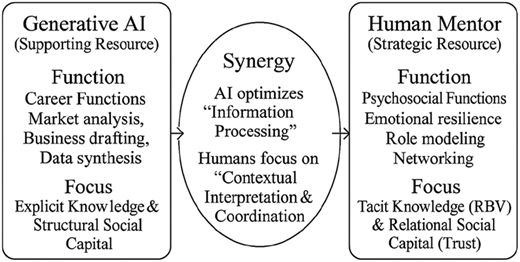
6.3 The hybrid model: career vs. psychosocial functions
Mapping these empirical findings to mentoring theory (Kram, 1985), this study proposes a functional division of labor designed to optimize support capacity. As illustrated in the proposed hybrid model (Figure 2), this synergy prevents mentor burnout and scales the reach of support systems without sacrificing the essential “human touch.” This is not a simple delegation of tasks but a strategic “human-in-the-loop” governance model, where human mentors elevate their value-add by shifting from basic coaching toward high-level strategic mediation and moral arbitration. By offloading information-heavy career functions to AI, mentors can focus their limited cognitive resources on psychosocial functions, such as role modeling and counseling, which are critical for the founder's emotional resilience during periods of extreme uncertainty.
6.4 Addressing risks: ethics and governance
A critical contribution of this research is the call for “responsible mentoring” within the evolving technological landscape. Given the inherent risks of AI hallucinations and data privacy concerns, particularly within the sensitive environment of government-backed innovation funds, this study proposes that human mentors function as “contextual gatekeepers.” In this role, mentors ensure that AI-generated insights are rigorously validated against institutional ethics and cultural norms, thereby mitigating the risks of algorithmic bias in decision-making. This ethical oversight is indispensable for maintaining the integrity of the mentoring relationship and ensuring that technology serves as a robust support tool rather than a source of strategic error.
6.5 Theoretical propositions
Based on the exploratory patterns identified throughout this study, two primary propositions are offered for future large-scale validation. First, it is proposed that the utility of GenAI in mentoring is negatively correlated with the degree of “causal ambiguity” inherent in a venture's tasks. While AI effectively supports explicit career functions related to information processing, human mentors remain indispensable for tasks requiring high levels of relational social capital and nuanced judgment. Second, as ventures progress from the seed to growth stages, the mentor's primary role shifts from that of a technical advisor to that of a governance mediator. In this transition, the value of the hybrid model peaks when the mentor utilizes AI to manage the increasing informational load while concentrating on human capacity in high-stakes stakeholder negotiations and complex social coordination.
7. Conclusion
7.1 Summary of findings
This study investigated the synergistic potential between human mentors and GenAI within the venture support ecosystem. By employing an exploratory sequential mixed-methods design, the research identified that while AI serves as an efficient tool for managing career functions and enhancing structural social capital, human mentors remain irreplaceable for providing psychosocial functions and fostering relational social capital. The findings reveal that the primary value of a hybrid model lies in the “contextual filtering” of AI-generated outputs by human experts. This process is critical for maintaining venture stability and strategic alignment, particularly within the nuanced institutional landscape of the Japanese venture ecosystem.
7.2 Practical implications
The findings offer a concrete strategic roadmap for venture capitalists, incubators, and policymakers. First, support organizations should explicitly adopt a “bifurcated support strategy” where GenAI handles high-volume information tasks, such as market research and initial business modeling. This allows the scarce and valuable resource of veteran mentor time to be re-prioritized for high-stakes psychosocial support and complex conflict mediation. Second, to mitigate the risks of AI hallucinations and strategic errors, institutions should formalize a “contextual filter protocol.” Under this protocol, AI-generated recommendations are systematically audited by human mentors to ensure alignment with cultural, organizational and ethical norms.
Furthermore, the data suggest the necessity of stage-specific mentoring design, where human intervention is scaled proportionally as ventures move from product-market fit toward organizational professionalization. As governance needs intensify during the growth phase, the hybrid model ensures that informational loads are managed by AI while human capacity remains focused on critical stakeholder negotiations. Finally, for public-private funds, it is recommended that standardized auditing and reporting processes be automated through AI. Such a transition enables a structural realignment of the support ecosystem, ensuring that the human element of mentorship remains impactful and focused on deep, trust-based relational development in an increasingly automated era.
7.3 Contributions to theory and practice
Theoretically, this research extends the RBV and social capital theory by operationalizing the “hybrid mentoring capability.” This capability is framed as an inimitable organizational asset created through the strategic integration of computational efficiency and human relational intuition. Practically, the study provides a roadmap for accelerators to transition from traditional, labor-intensive mentoring to a technology-augmented, high-touch support model. By articulating the boundary between AI's analytical speed and human empathy, this research ensures that the essential psychosocial foundations of mentorship are preserved and enhanced by technological progress.
7.4 Limitations and future research
The exploratory nature of this study is acknowledged. The sample size (n = 16, n = 4) necessitates cautious interpretation; these results should be viewed as a foundational conceptualization rather than universal empirical laws. Future research should build upon these findings by expanding the scope to include the founder's perspective, thereby validating the efficacy of AI-augmented support from the recipient’s side. Additionally, longitudinal studies are required to track how these hybrid models influence long-term venture survival rates across diverse institutional settings. Further investigation into the ethical governance of AI–mentor collaboration will also be essential to ensure that algorithmic biases do not undermine the trust-based foundations of the entrepreneurial ecosystem.