

The purpose of this paper we present a case study where the Swedish planning support system Citylab is applied to a Chinese case in Changzhou's Tianning District.
China's planning system is a vertical system based on policy development on the national level, policies which are to be implemented on local level. There is a gap between the ambitious central policies and the implementations on local levels. China is now exporting its planning model to other developing countries which makes it urgent to show examples of other strategies including more horizontal planning involving the public. The planning system in Sweden is based on a much more horizontal process. Therefore, the authors try to learn from Sweden's vertical planning system in the urban development environment of China.
A key message for policy makers in China is that systems like Citylab can play an important role in developing practical and scalable examples of more sustainable city districts. The paper concludes that a barrier for local sustainability planning in China is still lack of effective communication between local actors including the public.
The authors exemplified Changzhou Tianning District's practical exploration, thus proving the adapted Citylab method's practical operability. Based on the common problems faced by eco-city development in developing countries, the method framework of Citylab is applicable to other developing countries, with strong room for deduction and development.
1. Introduction
As one of humankind's greatest challenges today, urban planning will play a key role in the development of more sustainable cities (Zheng et al., 2014). Sustainable development involves complex and often conflicting goals, e.g. erasing poverty; food production; gender equity; competition for resources such as energy, water and materials; and environmental degradation, including climate change and loss of biodiversity. Many of these challenges are expressed in the United Nations 2030 Sustainable Development Goals (United Nations, 2016), which comprise 17 goals with indicators. The UN goals are based on the expectation that in comparison to the developed countries, developing countries can reach a reasonable living standard by achieving an annual GDP growth of 7%. These goals place much reliance on urbanization, along with the development of clean technologies and renewable energy. China has been extremely successful in achieving rapid economic growth, raising its population's living standards and rapidly developing its infrastructure. However, China's growth has been accompanied by huge increases in the use of resources and the effects of environmental problems at local and global levels (Wang et al., 2012). Complex urban systems are often chaotic systems without clear causal relationships. This makes it difficult to apply general planning theories. However, a city's functions depend to some extent on its physical structure but also, to a large degree, on its inhabitants' behaviours. National policies are important, but local understanding is also essential in order to create real change. This is why participatory planning tools and processes will be needed to create effective changes towards more sustainable urban development. It is often more meaningful to develop national policies based on practical experiences at local levels. What is needed are scalable, practical examples from Chinese cities.
2. Outline of the relevance, aims and objectives
Sustainable urbanization involves many conflicting goals, such as reducing the use of resources, minimizing environmental impacts and building liveable urban areas with high quality of life. Prioritizing goals involves values that differ between stakeholders in cities. It is therefore highly relevant to investigate future models for the local implementation of sustainable development at the urban level. China still relies on a vertical model of urban planning (Wennersten and Yasar, 2018). In contrast, Sweden has a long tradition of more horizontal planning models involving many actors at the local level (Green, 2016). Based on this background, a new research project was launched in Changzhou, one of the most developed cities in China. The project was carried out 2017–2018 and is described in detail elsewhere (Zhang et al., 2019). The aim of this project was to start a discussion among urban planners how more horizontal models for more sustainable urban development could be developed.
This project, described in this paper, had the overall research objective to outline and test support for comprehensive sustainable urban development at the local level based on the Citylab Guide (Sweden Green Building Cou, 2019) developed by the Swedish Green Building Council. The guide supports the management of extremely complex issues in sustainable urban and local planning that involve conflicting goals at different levels. The project was a test of the Citylab Guide in a Chinese context. The case study was located in Changzhou, China, and its validity for other Chinese cities is also discussed below.
Based on the aims and questions above, this paper has the following objectives:
To briefly analyse and discuss recent approaches and barriers to sustainable urban development in China.
To compare the sustainable urban models in China with those in Sweden.
To conduct a case study in a Chinese context based on a comprehensive comparison with new sustainable urban development models in Sweden.
To evaluate the Swedish planning model Citylab and discuss, in principle, role models for sustainable urban planning in China.
Using the methods described below, the objectives are connected to the results described in section 8.
3. Comparison of Chinese and Swedish urban planning models
The Chinese government is aware of imbalances in different sustainability goals; thus, since the 1990s, China has begun exploring sustainable development. Through government policy guidance, local initiatives, cooperation with international partners and other approaches, China has become one of the most active fields globally for experiments in sustainable city development. The development of China's sustainable urban planning is continuously being explored, but certain problems still tend to be common:
The applicable theory is confused, and urban design based on more complex environmental issues has not yet developed. Nevertheless, more poorly defined concepts, such as environmental friendliness and green approaches, are common.
In building an eco-city, forming a chain effect in spatial planning, resource management and ecological construction are difficult, and the benefits of eco-city development cases are not prominent.
It is difficult to apply central government-oriented sustainable development policies and related goals to local conditions. There is a gap between national policies and the implementation and understanding of those policies at local levels (Jong et al., 2013).
Compared with Sweden, China manifests significant differences in policy promotion and acceptance of building eco-cities. The theoretical system of China's sustainable urban development is relatively vague, and central-to-local spontaneous awareness of sustainable development is weak. At the specific implementation level, first, from the perspective of resources, Sweden pays close attention to integration and cooperation among various urban subsystems. Second, regarding policy-driven and enforcement systems, Sweden has a Ministry of Sustainable Development, and the state has issued directives to the Housing, Building and Planning Agency through the Ministry of Sustainable Development. Given the complexity of urban development and spatial planning, the Housing, Building and Planning Agency also cooperates with other government departments and works closely with local governments and communities to form a multi-directional communication management control system (Zhang, 2007). Currently, China is guided mainly by the central government. Local governments cooperate passively by adopting methods and implementing policies. Therefore, no means of control and management are based on two-way communication.
In summary, the Chinese model of sustainable urban development is solidly based on a vertical policy-oriented approach. The Swedish model, on the other hand, is much more hierarchical, involving more participatory planning at the local level. This is possible partly because Swedish municipalities are much more independent from national governmental control. It is important to stress that many imported “ready-made” urban models from Western countries have to a large degree failed in China. In this paper, the intention is not to import a successful case from the West but rather to apply a more holistic modelling concept to be used by actors in China. Successful urban cases can be developed only by local actors in China.
4. Material and methods
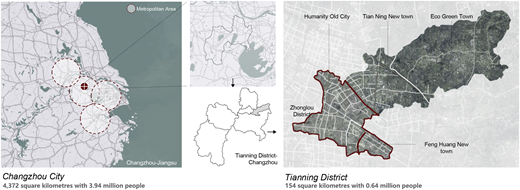
The case for this study is located in Changzhou, one of the most developed cities in China. Changzhou has a long history and a charming river city culture (Changzhou City Planning B, 2019a). Geographically, this city lies at the absolute centre of the Yangtze River Delta. Historically, it has experienced an era of development along canals and railways. With a population of 4.72 million in 2017, Changzhou consists of six urban districts: Tianning, Zhonglou, Xinbei, Wujin, Jintan and Liyang. Tianning District, covering 154 square kilometres (Changzhou City Planning B, 2019b), is in northeastern Changzhou city near the junction of Changzhou and Wuxi. Tianning District has many water networks: seven rivers and eight branch rivers with a total length of 52.5 km. The rivers function mainly for water diversion, drainage, flood discharge and green areas. The geographical relationship between Changzhou and Tianning District is shown in Figure 1.
In addition to a long history and culture, Changzhou has unique water and railway resources in terms of its geographical conditions. Resources that urban development can rely on are abundant, and the contradictions and conflicts that sustainable development faces are also concentrated. Therefore, at the level of method exploration, Changzhou can be regarded as a typical example of sustainable urban planning practice in developing countries.
The case study's overall aims were, based on existing urban planning methods, to develop and test a new supplementary method to guide urban planners in responding to China's problems in formulating a master plan for a sustainable city. Research and analysis were conducted by reviewing current problems, holding qualitative investigative discussions and reviewing the literature. Data and information were acquired from both local government and national government sources in China. Some material was also obtained from the workshop organized by Southeast University, the Sweden Green Building Council and the Urbanization and Urban Rural Planning Research Centre of Jiangsu. The workshop consisted of five groups and lasted for two months to conduct research on the whole Tianning District and different plots. Meanwhile, targeted interviews were conducted with leaders of the Changzhou planning bureau and staff from the Changzhou planning and design institute, all of whom have acquired a deep understanding of Changzhou's urban development through years of experience.
5. Citylab
5.1 What is Citylab?
Citylab is a planning tool developed to support existing planning systems, not to replace them (Sweden Green Building Cou, 2018). It is also used in Sweden to certify city areas. The Swedish industry wanted a system that engages actors in the planning process and is not as rigid as existing certification systems. Based on the collective experience of Swedish sustainable urban development involving thousands of actors, the Sweden Green Building Council developed Citylab – a toolbox for sustainable cities during 2010–2020. The actors involved in the development were developers, building construction companies, authorities, institutes and universities. Up till 2020, the system has been used in many cases in Sweden (Sweden Green Building Cou, 2012, 2014). A thorough description of the development of Citylab can be found elsewhere (Lind, 2020).
5.2 Principles for Citylab guide
Citylab Guide for Planning and Implementation 3.0 (launched in June 2019) contains three certifications and guide points that can inspire and guide. What is certified is a sustainability program, an action plan with measures and an action plan for implementation. In this paper the preliminary work is to developing a sustainability program for Changzhou's Tianning District.
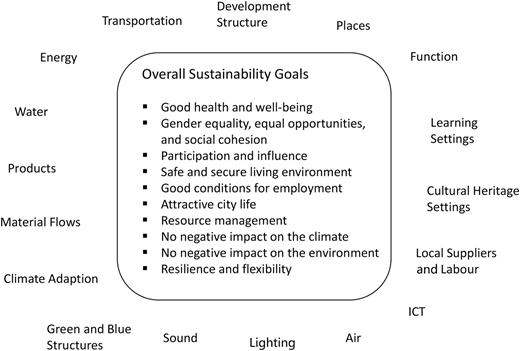
The Citylab Guide specifies 10 overall sustainability goals for sustainable urban development. The Citylab Guide also specifies 17 focus areas to guide work in addressing sustainability within an urban development project. The sustainability goals and focus areas should be regarded as a comprehensive platform for participatory planning of more sustainable urban areas. As the sustainability goals involve value-based decisions, broad stakeholder involvement is central in the initial stages of project planning (see Figure 2).
In practice, the development of a sustainability programme can easily take several years, but here, the project time was very limited, so only the basic principles could be applied. The objective was to test the system in a Chinese context. Citylab uses a qualitative planning approach to link urban morphology with sustainability indicators, a problem that has been examined by many researchers.
6. Proposal for planning workflow in Tianning District based on Citylab principles
This section introduces the development model adopted in the specific practice stage, based on China's current sustainable urban situation, and proposes a specific workflow shown in Figure 3.
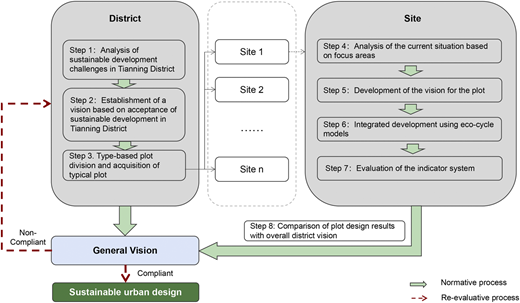
Sustainable urban planning workflow in Tianning District based on Citylab principles
Sustainable urban planning workflow in Tianning District based on Citylab principles
6.1 Development mode
The urban catalyst theory holds that urban design projects are not only a final product but also an important element that can stimulate and guide subsequent development. In the process of urban planning and construction, planners pay attention to the protection of urban structure and characteristics, emphasize bottom-up mobilization and residents' participation (Dubbeling, 2009), respect the inner order and laws of the city and grasp the core issues of regional systems (Wennersten et al., 2019). Tianning District of Changzhou City has great potential to generate catalyst points through its characteristic “three rivers and four cities” urban form and may become a booming district due to its ecological network and active lifestyle.
6.2 Thinking logic of the holistic approach
As shown in Figure 3, the chosen framework covers eco-city development guidelines for districts and smaller plots. The framework is based on the principles described in the Citylab Guide. It fully embodies a method and concept that have practical development value and significance and that differ from traditional Chinese vertical planning.
Starting from urban metabolism, the framework analyses the macroscopic urban development context and the microscopic composition of urban organisms to construct a two-way complementary design research process divided into three main parts: district, plot and integration. First, at the district level, planners analyse the city's environment, social factors, governmental composition, economic development, and so on, to form a general vision for current development. For the treatment of typical plots, local planning processes are organized to achieve established cross-disciplinary sustainable development goals, and these small-scale plots are used as singularities for regional planning development based on similarity and continuity between plots, thus forming a series of urban renewal and chemical-reaction sources and activating the district's sustainable development plan. In these processes, master plan results should be further compared and reassessed according to the district's overall development vision. This backtracking method re-verifies the overall deductive logic and constitutes the normative and re-evaluative processes.
7. Overall case for Tianning District
This section specifically introduces steps to implement sustainable planning in Tianning District based on the Citylab methods and workflow mentioned above (compared with the workflow in Figure 3). Steps 1–3 concern district planning, steps 4–7 concern urban design at the plot level, and step 8 integrates the two design parts through inspection.
7.1 At the district level: acquisition of core issue
Step 1: Analysis of sustainable development challenges in Tianning District
According to the development of Tianning District on the timeline and the change in its functional orientation, we analyse four aspects of the current challenges faced by Tianning District: land-use structure, housing and public services, cultural characteristics and economy. To do so, we conducted field research, data collection and discussions with local authorities. Relevant data came from the survey sample, and the latest local information was provided by local departments. According to the discussion and review, the basic challenges that Tianning District faces in sustainable urban planning are shown in Table 1.
Step 2: Establishment of a vision based on acceptance of sustainable development in Tianning District
Urban planning challenges faced by Tianning District
| Perspective | Basic problems | Effects |
|---|---|---|
| Land-use structure | Uneven distribution of urban construction land | The proportion of land for citizens' livelihoods, such as green space, housing and public services, is low |
| Urban construction land covers 901.36 square kilometres, and development intensity reaches 31.76% | ||
| Green land and square land account for 9.17% of the total urban land use, lower than the international standard of 10–15% | ||
| Housing and public services | Low-quality city services | In the old city, the quality of street facilities needs upgrading |
| Centralized distribution of urban facilities | ||
| Cultural characteristics | Insufficient use of the waterfront for public activities Characteristics of Jiangnan water towns are bland | There are many water systems, but the network is poor |
| Economy | Economic development cannot support central regional status | Economic ranking is in the middle. There is an urgent need to speed conversion from old to new kinetic energy |
To formulate the vision and goals for the development of Tianning District, it is very important to develop local interpretations of sustainability based on the Citylab Guide principles and a more concrete conception of what an eco-city is. This interpretation must be relevant for the actual municipality and the actual planning assignment.
On this basis, we use the concept map to create a graphic representation to further capture the more intuitive issues for the current sustainable development of Tianning District (Segalàs et al., 2008). The focus question was “What are the advantages and limitations of sustainable development in Tianning District?” By collecting the results of the feedback, we focus on the unsustainable status of the four aspects of land-use structure, cultural characteristics, public services and energy related to government strategies and draw lines to show the interactions between different nodes in the map.
Ultimately, after considering the historical evolution of the relationship between Changzhou and the river to construct a historical and cultural protection framework, we put forward this characteristically Chinese general vision:
All-around development: Creating a green, low-carbon and liveable environment.
Leading characteristics: Reinventing the charming, leisurely and traditional Jiangnan water town.
Step 3: Type-based plot division and selection of typical plots
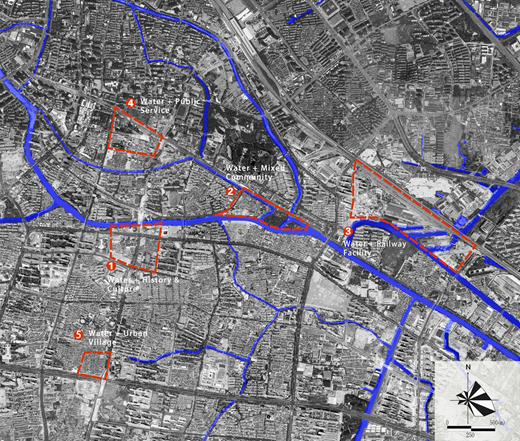
Based on “bottom-up” topographical thinking, this study intended to lead and promote the overall improvement of segment-level cities through small-scale urban design with a gradual impact on the urban structure. According to the classification of the challenges faced by Tianning District in sustainable urban design and the urban river system characteristics, the classification of plots was based on waterfront and water network. According to different points of land-use structure, cultural characteristics and public service, five sections were selected as typical examples of different types of plots in Tianning District. Eventually, there were five different types of plots: “Water + History and Culture”, “Water + Mixed Community”, “Water + Railway Facility”, “Water + Public Service” and “Water + Urban Village”, as shown in Figure 4.
7.2 At the plot level: small-scale design activation strategy
For sustainable planning in the block stage, this paper chose the No. 2 Plot, “Yizhou Pavilion Plot of Tianning District”, as an example (Figure 5), which has the characteristics of “Water + Mixed Community”.
Step 4: Analysis of the current situation based on focus areas
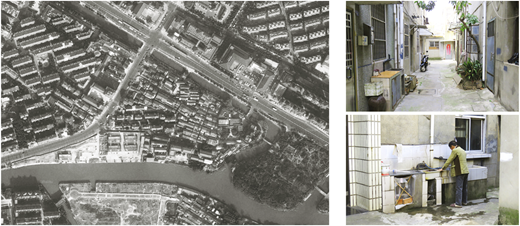
Description and analysis of the plot's current situation form the basis of sustainable urban planning. This differs from the traditional method of generalizing the subjective researcher's definition of the problem. Instead, this study uses Citylab's 17 focus areas to consider each area affecting the plot's development, describe the current situation and summarize the problems. This research perspective covers the plot's intuitive space construction, material systems and hidden energy. Each area was analysed linearly through many field visits and surveys, supplemented by analytical graphs.
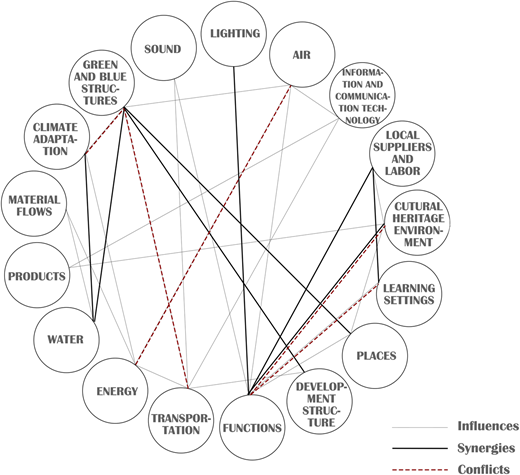
The results of the analysis show that the mutual effects among focus areas are broad; in fact, some focus areas might be more directly expressed as a relationship between synergy and conflict, for instance, the synergy between “lighting” and “functions”. Another example is the contradiction between “green and blue structure” and “transportation”. The influence between and among areas forms clearer corresponding relationships, the plot characteristics are further highlighted and the plot problem directivity is further clarified (Figure 6).
Step 5: Development of the general vision for the plot
To enable various departments to coordinate construction and enhance public participation, a common concept at the ideological level needs to be put forward. Here, we call it the general vision of the land. It must be intuitive and fit the most important lifeline of development. It will lead the sustainable development of all areas in the overall period of time and serve as the main basis for resolving contradictions and conflicts among different stakeholders in different links.
According to the analysis of the focus areas mentioned above, the sustainable planning goals focused on the construction of eco-friendly communities and sustainable circular economy models. We constructed a sustainable development vision for the plot: “Future community: Equal opportunities, beautiful environment and high-quality life”. This vision highlights the ambitious development of the plot and is a major driving force in the general vision of Changzhou Tianning District.
Step 6: Integrated development using eco-cycle models
To understand and visualize the plot's urban metabolic system, we propose sets of related eco-cycle models based on the analysis of focus areas and corresponding strategic measures. The idea behind eco-cycle planning is that what comes out of the city or city area in the form of waste should be returned to the city or city area as recycled or reused material or in the form of energy. It is a way to map upstream and downstream issues and solutions and to ensure that improvements are applied at the right points to lead to feasible, sustainable solutions (Thabrew and Ries, 2009).
One of the eco-cycle models related to “blue-green structure, material flow, water and energy”, as shown in Figure 7, based on the characteristics of the plot and its cooperation with other urban subsystems, integrates the daily life of residents and the operation of public facilities. The optimization of the conversion mechanism of energy and material flow strongly reflects the multi-layer effect of the garbage collection system and the rainwater treatment system and further stimulates and influences the spontaneous behaviour of residents, forming a good effect of sustainable development.
Step 7: Evaluation of the indicator system
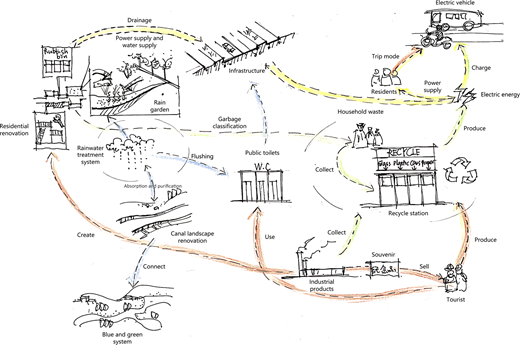
Eco-cycle model based on focus areas of lighting, green and blue structure, material flow, products, water and energy
Eco-cycle model based on focus areas of lighting, green and blue structure, material flow, products, water and energy
The preliminary evaluation of the design was conducted through the index system, and the Citylab evaluation system was used as a selective reference. The Citylab evaluation system corresponds to key areas based on the specific-data comparison method. The index system differs from other index systems because it is more open and dispersed. By evaluating the impact on cities and people's lives, it measures different urban sectors' sustainability and avoids design errors caused by the one-sidedness of extremely specific data indicators in the general plan stage. Indicator systems can be further refined and disassembled through planning and follow-up actions. This should be communicated to stakeholders and the public involved in project implementation to form a more effective and direct project assessment.
7.3 Integration of two design parts
Step 8: Comparison of plot design results with overall district vision
The sustainable development of the Yizhou Pavilion Plot, as a characteristic plot in Tianning District, is integrated into the vision of district sustainable development. Its catalytic significance for the overall sustainable development goals of the district is reflected in the following two aspects:
Stimulate regional space vitality: The design of the plot transforms boring and negative community space into an efficient and active venue.
Cultivate regional renewal potential: The update of the plot encourages citizens to organize activities spontaneously and carry out micro-environmental renewal, which will lead to deeper levels of change, nurturing and strengthening the regional renewal potential (Islam, 2011).
The design of the Yizhou Pavilion Plot has played an active role in the urban development of Tianning District, so the sustainable development of the Yizhou Pavilion Plot has formed an effective link in the sustainable development planning process throughout Tianning District.
8. Results and discussion
China's sustainable development is facing serious problems, namely, clear vision positioning, extensive public participation and synergy between urban subsystems. Based on these challenges, the feasibility of applying the Swedish system Citylab Guidelines in the Chinese context has been tested. This paper shows how, according to the current urban construction regulations in China, that the Citylab method can be adaptively applied, the district general development vision can be constructed and the eco-cycle model can be adopted to guide further planning. To further improve the practicality of this approach, the study innovatively combines the theory of urban catalysts, extracts typical plots in the district and implements the “catalyst points” that drive the overall district renewal development by implementing specific eco-city construction schemes for the plots.
Taking Tianning District of Changzhou as a typical case, the framework is used for the corresponding deduction and planning application. At the same time, it forms the planning guidelines of five typical sites. The construction guidelines are used as a reference basis to form a concrete implementation plan for the sustainable development of the entire district.
The five ecological urban planning experiments with typical plots described in this paper are a strong testament to the applicability of sustainable urban development planning based on the Citylab method. Nevertheless, in practice, some Swedish Citylab points were difficult to integrate into sustainable urban planning in China; thus, the following issues arose during implementation:
How can Citylab's support proposals for urban project planning be integrated into China's existing urban and rural planning system, and how can Citylab participate in the urban decision-making system?
In addition to cooperating with local government and professional planning agencies, how can the Citylab platform attract more local public participation and promote the local “bottom-up” urban mechanism?
As a system platform covering the whole process of urban planning, construction, use and maintenance, Citylab had certain difficulties intervening in local urban and rural construction in a short period and providing corresponding technical support for planning, construction and management.
9. Conclusions and further work
China is trying to become a role model for sustainable urban development, but the Chinese model's downside is obvious. Generating support models for urban development on a local scale seems increasingly urgent. Based on China's current situation and on Sweden's sustainable urban planning and design, we chose the Citylab Guide implemented by the Swedish Green Building Council as the guidance basis for China. Moreover, we exemplified the practical exploration of Tianning District of Changzhou, thus proving the practical operability of the adapted Citylab method.
The application time of the Citylab framework method in Changzhou was very short, and the implementation faced many uncertain factors. In the follow-up, we intend to combine the Citylab framework method with planning compilation and planning management regulations through eco-city development in Tianning District, formulate relevant plans, set targets for different time periods and gradually implement them to truly involve them in urban construction and provide government decision makers and developers with a full range of solutions.
The fundamental crux of eco-city development in China is the establishment of a correct development concept that can be applied at the local level. The conceptual transformation and the ultimate substantive improvement of the environment are long term and arduous tasks. In the initial stage of practice, one should start from typical cases, and the theoretical framework system should be combined with practice in a complementary manner. The sustainable development of cities should be based on scientific and reasonable standards. Planners should insist on leaving room for development and involve local actors in the process of seeking sustainable urban development and redevelopment.
Citylab was developed in Sweden and aimed at Swedish situations. China has its own special characteristics that are quite different from those of Sweden. How can Citylab be helpful in Changzhou, and will it be replicable in other Chinese cities? City development is a complicated process that affects the interests of many stakeholders who all try to choose different actions in an attempt to maximize their returns. In Sweden, the planning vision is rather long term, and many institutions are engaged in the process. Everyone's interests should be considered before construction. Here, a systematic development strategy is essential, and Citylab responds to these requirements. In China, it appears that the government has absolute power. However, if government leaders' proposals are not consistent with the interests of other stakeholders, they will have little chance of being applied in real projects. Although government leaders have good intentions in desiring sustainable development, they do not know how to achieve it in most cases. Citylab presents a new perspective, at least as a technical roadmap to sustainable city development.
The current Chinese urban planning system has a tree structure, which is a vertical system. Each stage of urban planning is responsible for the superior stage, despite parallel planning and requirements at lower levels. This phenomenon is caused not only by the system but also by the lack of consciousness of planners and their leaders. Citylab can hardly change the Chinese urban planning system, but it can influence planners' working habits. Urban planning could be an interactive and two-way process rather than a single one-way process. The Changzhou case proves the feasibility of applying a systematic method to sustainable urban planning in China. However, the reform of the planning administration system is still necessary before comprehensive and thorough sustainable urban planning can be achieved. For further work, it is suggested that implementation of Citylab should start earlier in a Chinese planning context where planning department are involved. This should be done in a defined local context and also involve a study of main barriers for a more horizontal planning approach for sustainable urban development.

