Storytelling is considered an effective leadership behavior. However, research on storytelling’s effects on followers is scarce and disconnected from leadership theory. This paper aims to explore the perspectives of both leaders and followers with a focus on interaction-based moderators and affective mediators of storytelling effects, building on transformational leadership and leader-member exchange theory.
Data from semi-structured interviews (N = 27 independent leaders and followers) were analyzed with a combined content-analytic and grounded theory approach.
Leaders’ intended effects of storytelling (transformation, relationship and information) evoked either positive or negative affective reactions in followers depending on how well the story met followers’ needs (need-supply fit), the adequacy of the input load transported by the story (story load) and how followers interpreted their leaders’ story (story appraisal). Followers’ positive or negative affective reactions translated into positive effects (corresponding to leaders’ intended effects) or negative effects (contradicting leaders’ intended effects), respectively. Results were integrated into an intention-perception model of storytelling.
Proposing an intention-perception model of storytelling, this paper explains when and why unintended effects of storytelling happen, and thus provides an alternative view to the one-fits-all approach on leaders’ storytelling advocated by popular management literature.
1. Introduction
Storytelling in organizations is a particular form of leader-follower interaction in which past and future human experiences are shared (Boje, 1991). Stories, including analogies, metaphors, anecdotes, or even jokes (Buchanan & Dawson, 2007), told by leaders in daily interactions can have beneficial effects on followers, such as facilitating understanding and enhancing loyalty (Gill, 2011). However, storytelling sometimes fails to achieve the intended effects (Randall & Harms, 2012), for example, if stories lack factual information and do not meet the expectations of the audience (Gill, 2011).
In fact, the interaction between narrator and recipient, and the recipient’s affective arousal in response to the story explain the effects of storytelling (Boje, 1991; Gabriel, 2000). However, existing literature falls short of taking into account characteristics of leader-follower interactions and followers’ affective responses when explaining effects of leaders’ storytelling. This may be due to the fact that previous research has mainly analyzed leaders’ storytelling from the viewpoint of a neutral observer (Flory & Iglesias, 2010) and has mostly focused on specific contexts in which leaders told stories, e.g. during organizational change (Boje, 1991), leaving out far more common “everyday” leadership settings.
In this study, we, therefore, explored the perspectives of both leaders and followers on storytelling in a broad range of storytelling contexts with a focus on interaction-based moderators and affective mediators of storytelling effects. Building on transformational leadership (TFL), leader-member exchange (LMX) theory, and empirical data, we developed a theoretical model that describes the effects of leaders’ storytelling, integrating both leaders’ intentions and followers’ perceptions. Thereby, we link storytelling and leadership theory and aim to systematically explain when and why unintended effects of storytelling (which we will refer to as intention-perception shifts) happen.
In the following, parallels of storytelling theory and leadership theory are summarized in a brief literature review and research questions are formulated. Then, the results of our qualitative study are presented. Finally, an intention-perception model of storytelling is suggested and discussed in light of its theoretical and practical implications.
1.1 Storytelling and leadership theory
To bridge the gap between leadership theory and leaders’ storytelling, two leadership theories provide particularly rich models: LMX (Graen & Uhl-Bien, 1995) and TFL (Bass & Avolio, 1993). LMX theory provides a framework for explaining followers’ affective and behavioral responses to leader-follower interactions (Graen & Uhl-Bien, 1995) and TFL offers a characterization of leader-follower interactions. Within the full-range leadership framework, it is TFL rather than transactional leadership that is associated with forms of storytelling (Bass & Avolio, 1993), which is why we primarily focused on TFL in our work.
LMX theory defines leadership as relationship management and describes prerequisites and consequences of high-quality leader-follower interactions: Managers’ constructive interpersonal behavior evokes positive emotions in their followers and stimulates constructive behavior (Graen & Uhl-Bien, 1995). A high quality leader-follower relationship is associated with high follower work performance and satisfaction (Dulebohn, Bommer, Liden, Brouer, & Ferris, 2012; Martin, Guillaume, Thomas, Lee, & Epitropaki, 2016). Storytelling might contribute to a high-quality LMX, as leaders can express vigor and enthusiasm through their stories (Gutermann, Lehmann-Willenbrock, Boer, Born, & Voelpel, 2017). Thereby, leaders’ storytelling induces positive affect in followers strengthening mutual trust and commitment (Auvinen, Aaltio, & Blomqvist, 2013). Integrating storytelling and LMX theory might thus help to better understand how leaders manage their followers’ emotions (Little, Gooty, & Williams, 2016).
TFL is defined as transforming individuals and organizations by considering followers individually, inspiring and encouraging them to think for themselves and behaving as a role model to ideally influence followers (Bass & Avolio, 1993), which is associated with follower performance (Wang, Oh, Courtright, & Colbert, 2011). TFL is also concerned with emotion management (Bass & Avolio, 1993; Ng, 2017). For instance, transformational leaders stimulate sense-making and followers’ identification with the organization by telling them about the purpose of their work, shared values and their company’s vision (Hoffman, Bynum, Piccolo, & Sutton, 2011). Transformational leaders’ communication of corporate vision can itself be regarded as an act of storytelling (Parry & Hansen, 2007). Also, in day-to-day interactions, leaders’ stories evoke emotional responses and influence followers’ perception and behavior (Snyder, Hedlund, Ingelsson, & Bäckström, 2017).
1.2 Leaders’ intended effects of storytelling
To describe the effects of leaders’ storytelling in everyday business and to link storytelling practice to leadership theory (i.e. TFL and LMX), it is necessary to gain an overview of why and how leaders from different industries, departments and management levels apply storytelling for transformational and relationship-building purposes. To this end, we formulated our first research question as follows:
What transformational and relationship-building effects do leaders intend when telling stories to their followers?
1.3 Followers’ perceived effects of storytelling
A story cannot be fully understood without the subjective perspectives of both narrator and recipient (Gabriel, 2000), as the followers’ perception of leadership often differs from the managers’ viewpoint (Ford & Harding, 2018). We, therefore, addressed followers’ subjective perceptions of leaders’ stories formulating our second research question as follows:
What transformational and relationship-building effects of leaders’ stories do followers perceive?
1.4 Intention-perception shifts in leaders’ storytelling
Popular management literature implies that a good story always has positive effects on follower behavior and that storytelling is generally superior to non-story forms of communication (Denning, 2011). However, stories sometimes fail to achieve their intended effects (Randall & Harms, 2012). Storytelling is only one of several communication strategies and might not be equally effective for all managerial purposes and target audiences (Gill, 2011). In particular, a prerequisite for effective storytelling seems to be that leaders’ stories “resonate positively with the audience” (Gill, 2011, p. 28), meaning that storytelling effects depend on followers’ perceptions, expectations and needs.
Similarly, an idealized concept of TFL cannot be simply reproduced in everyday leadership practice, where follower reactions to transformational behaviors can be ambiguous and sometimes even negative (van Knippenberg & Sitkin, 2013). Followers also react differently to their leaders’ relationship-building behavior (Xu, Loi, Cai, & Liden, 2019), which explains why leader-member relationships do not develop equally quickly and strongly, not all followers belong to their leader’s ingroup (Graen & Uhl-Bien, 1995), and relationship-building behavior not always leads to positive outcomes (Gottfredson, Wright, & Heaphy, 2020). To shed light on the variability of storytelling effects, we formulate our third research question as follows:
When and why do stories told by leaders have (un)intended effects on followers, that is, when and why do intention-perception shifts happen?
2. Method
2.1 Sample
We conducted semi-structured interviews lasting 30 min on average with 27 interviewees (16 managers and 11 employees, 52% female, mean age = 31 years) in 11 organizations in Germany (Table 1). Leaders and followers were independent individuals reporting about their respective followers and leaders. We chose the strategy of purposive sampling (Flick, 2018) to cover a variety of different working environments, departments, industries and everyday situations of storytelling.
2.2 Procedure
Interviewees were first asked about what they associated with “story” and “storytelling.” Afterwards, the definition of “storytelling” adapted from Boje (1991, p. 107) was read out aloud to ensure a shared understanding. We then asked leaders what effects they expected their stories to have on their followers (RQ1) and followers how they perceived their leaders’ stories and what effects they had on them (RQ2)[1].
2.3 Data analysis
Each interview was audio recorded and transcribed with the interviewee’s consent, and analyzed using combined content-analytic and grounded theory approach (Eriksson & Kovalainen, 2015; Forman & Damschroder, 2007). One author split the text into small units of meaning that could be distinctly and unambiguously coded. The results of the open coding were inductively aggregated into categories. The coder continued to build new categories until no new topics could be identified. After 14 interviews, saturation was reached. We conducted 13 more interviews to elaborate on our categories and argumentation structures. The coder iteratively refined the categories until he had a stable set of categories (Eriksson & Kovalainen, 2015; Forman & Damschroder, 2007). Then, we deductively matched our categories with the theoretical concepts of TFL and LMX, slightly adjusting category names and scope.
To detect intention-perception shifts (RQ3), we analyzed argumentation structures and statements about the context of the stories comparing leaders’ intentions and followers’ perceptions, affective responses and subjective effects.
To check for interrater reliability, one co-author double-coded seven interviews comprising 144 text units. Initial discrepancies were discussed and resolved. The final interrater agreement was 97%. Subsequently to the coding, another author developed a preliminary model using a grounded theory approach building on the category system (Locke, 2002). The model was iteratively refined in further examination of the data.
3. Results
3.1 Intended and perceived effects of storytelling
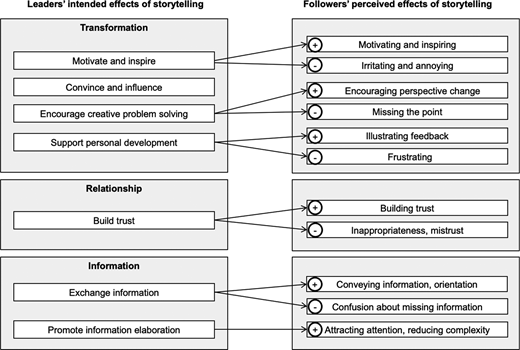
We condensed leaders’ and followers’ reports on the intended and perceived effects of storytelling into seven categories, and further summarized leaders’ intended effects into three higher-order themes, namely, transformation, relationship and information (Table 2, Figure 1).
A comparison of leaders’ intended effects with followers’ perceived effects showed that leaders reached their intended effects in some cases: Followers described perceived transformation (motivation, inspiration, change of perspective, illustrative feedback), relationship building (trust) and positive effects on information (information, orientation, attention, reduced complexity) through listening to their leaders’ stories. However, in other cases, leaders failed to achieve the intended effects and even caused negative consequences: Followers perceived a “negative transformation” (being irritated and annoyed, feeling misunderstood or frustrated) and negative effects on their relationship: They devalued their leaders (perceived leaders’ behavior as inappropriate, arrogant or braggadocios) and developed mistrust (felt that their leaders deliberately distorted information in their stories). Moreover, followers were confused about missing factual information. We refer to this phenomenon as “intention-perception shift”.
3.2 Interaction-based moderators of intention-perception shifts
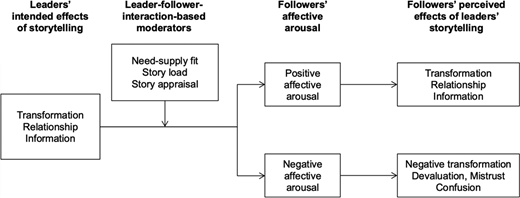
To investigate when intention-perception shifts happed, we qualitatively analyzed characteristics of leaders’ stories associated with negative perceptions by followers. We identified the following three interaction-based conditions for intention-perception shifts.
3.2.1 Need-supply fit.
First, negative effects occurred if there was a misfit between the follower’s need and what the leader offered. For instance, the leader wanted to inspire by telling stories of success while the follower primarily required factual information to proceed with a specific task. In such cases, followers reported being annoyed rather than inspired by their leaders’ stories (Table 3).
3.2.2 Story load.
Second, stories had negative effects if the story was overloaded with (inappropriate) information, or too many stories were told. For example, if leaders disclosed too much private information in their stories, followers reacted with sarcasm and no longer took their leaders seriously.
3.2.3 Story appraisal.
Third, negative effects were caused by followers misinterpreting a leader’s good intentions. For instance, followers appraised a leader sharing an inspiring success story as a boastful poser. Moreover, leaders who wanted to provide a broad overview of an expected future development were suspected of concealing more detailed information.
By contrast, if a leader’s story fitted the followers’ needs, if the story load was perceived as adequate by the followers and if followers appraised the story in the intended way, the story resulted in the intended effects.
3.3 Affective mechanisms explaining intention-perception shifts
Further analysis revealed that followers explained negative perceptions of storytelling with negative affective arousal, such as annoyance, irritation, unease, frustration, demotivation, disappointment, pity or feeling upset and not being taken seriously (Table 3). By contrast, followers described perceived positive perceptions of storytelling in more positive affective terms, such as understanding, amazement, encouragement, optimism, inspiration, excitement, joy, passion, pride, trust and a feeling of belonging.
3.4 An intention-perception model of storytelling
Integrating our results, we propose an intention-perception model of storytelling (Figure 2). Based on LMX and TFL theory, the model explains how leaders’ intended effects of storytelling (transformation, relationship and information) evoke affective arousal in followers. The quality of the arousal (i.e. positive or negative affect) depends on three interaction-based moderators. In line with both TFL theory and LMX theory, positive and negative affect explain either positive effects of leaders’ storytelling (transformation, positive relationship-building and information) or negative effects (negative transformation, devaluation of the leader, mistrust and confusion) on followers.
4. Discussion
We established a link between storytelling and leadership theory, building on TFL, LMX theory and empirical data. We found that leaders used storytelling for “transformation,” “relationship” and “information” purposes. We developed an intention-perception model of storytelling, which suggests fit-related (need-supply fit), contextual (story load) and cognitive (story appraisal) moderators of intention-perception shifts and explains why (un)intended effects of storytelling happen. In this way, we provide a theoretical framework for theory-driven research on storytelling in leadership.
4.1 Summary of theoretical implications
With the intention-perception model of storytelling, we link storytelling research with TFL (Bass & Avolio, 1993) and LMX (Graen & Uhl-Bien, 1995). All four behavioral dimensions of TFL (individual consideration, intellectual stimulation, inspirational motivation and idealized influence) were associated with storytelling effects in our study. At the same time, the “trust-building” category encompasses storytelling effects that contribute to high-quality LMX (Graen & Uhl-Bien, 1995).
However, just as followers’ need for TFL varies across situations (Tepper et al., 2018), and leaders applying “too much” of transformational and relationship-building behavior may do more harm than good (Kaiser & Overfield, 2010), storytelling seems to be helpful in some situations and inappropriate in others and leaders need to find a right dose of storytelling. Finally, as leaders and followers fundamentally differ in how they evaluate TFL and LMX (Lin, Huang, Chen, & Huang, 2017), storytelling carries a risk of misunderstanding. Thus, our findings challenge the one-fits-all concept of storytelling in leadership indicating that a common problem in leadership theory also applies to the storytelling construct: Even though storytelling is portrayed as positively effective and used in best intentions, it can also be ineffective, have negative consequences or be used with malicious intent.
4.2 Limitations and future research
Although findings from German samples are treated as generalizable in leadership research (Hentschel, Braun, Peus, & Frey, 2018), the German context in which this study was conducted, should be considered when interpreting our results. Furthermore, participants’ mean age (31 years) was approximately 13 years below the average working age in Germany (44 years; Destatis, 2018). Following studies that found evidence of a u-shaped relationship between age and job satisfaction (Clark, Oswald, & Warr, 1996; Hochwarter, Ferris, Perrewé, Witt, & Kiewitz, 2001), one might assume that our participants exhibited higher job satisfaction and responded in a more positive manner when compared to people of average working age.
Besides, examinations of the reciprocal relationship between the intention-perception fit and leader-follower relationship (or follower transformation) are still pending. For instance, our results imply that a mismatch between a leader’s intention and a follower’s perception of a story may lead to mistrust. However, a quantitative, longitudinal, dyadic validation of our exploratory findings regarding the transformational, relationship-building and informational effects of effective storytelling, its affective mechanisms and fit-related, contextual and cognitive boundary conditions, is yet to be done.
4.3 Practical implications
When telling stories, leaders should consider three circumstances that moderate the impact of storytelling. First, leaders should be attentive to what their employees need. If followers require factual information more than inspiration, telling stories might represent a need-supply misfit and lead to negative follower reactions. For instance, justification literature implies that employees expect explanations for averse organizational events (Shaw, Wild, & Colquitt, 2003). Stories lacking such explanations might then be perceived negatively by followers. Second, leaders should pay attention to the right dosage of storytelling. In particular, leaders should be cautious about sharing stories with private, non-work-related content, as followers who do not already have very trusting relationships to their leader might view these private stories as inappropriate. Third, leaders should be aware that employees will interpret (and possibly misinterpret) their stories. Leaders should reflect on the different potential effects of their stories in advance and frame the story in a way that increases the likelihood of appropriate interpretation.
Followers should be aware that their leaders’ intentions when telling stories may differ from the perceived effects. They may give their leaders feedback on storytelling effects in an appropriate manner to promote their leaders’ personal development.
5. Conclusion
Suggesting an intention-perception model of storytelling to describe the effects of leaders’ storytelling on their followers in daily business in the context of leadership theory (TFL and LMX) this article provides an alternative view to the one-fits-all approach on leaders’ storytelling advocated by popular management literature: Storytelling can be an effective leadership tool, but only if used in the right way and under the right conditions.
Julia A.M. Reif was funded by a postdoctoral research fellowship of the “Bayerische Gleichstellungsfoerderung” while writing the manuscript. Data were collected as part of a bachelor’s thesis completed by Johannes Stark at the Ludwig-Maximilians-Universität München, Munich. The authors thank Kirsten Schrick and Ruppert Roth for supporting the recruitment of their participants and Keri Hartman for proofreading their manuscript. They thank the Reviewers and the Editor for their helpful comments.
Note
We also asked leaders whether they told stories intentionally, how often and what kind of stories they told. Answers to these questions were not considered in this article.