


This paper aims to study followers' proactive personality (PP) as a personal resource in moderating the hindering impact of exploitative leadership (EL) on followers' job strain (JS).
Self-report data on EL, JS and PP were obtained from 113 working students in the USA, and a cross-sectional design was used. The data was analyzed using SPSS 27 through hierarchal multiple regression and the PROCESS macro.
The findings support the buffering role of PP on the hindering impact of EL on JS, such that followers with higher PP tend to buffer the positive relationship between EL and followers' JS.
This study recommends practitioners to hire proactive individuals and/or enable existing employees to engage in proactivity in the presence of exploitative leaders to better cope with their self-serving behaviors.
Using the conservation of resources (COR) theory, this study is the first to use PP as a personal resource that protects against and mitigates the negative impact of EL.
Introduction
One of the most noticeable trends within the leadership literature is the focus on the dark side of leadership and its destructive effects (for a review, see Mackey, Frieder, Brees, & Martinko, 2017; Schyns and Schilling, 2013). Destructive leaders tend to harm their organization and/or their followers by pursuing goals that are in conflict with the organization's interests or employing a leadership style that is harmful to their followers (Krasikova et al., 2013, p. 1310). Sustained exposure to these dark forms of leadership is associated with adverse outcomes for employees, including lower job and life satisfaction, lower normative and affective commitment, work-balance issues and psychological distress (Diebig & Bormann, 2020; Tepper, 2000).
Despite the evidence linking destructive leadership with negative outcomes for followers, an important part of the conceptual core of destructive leadership is poorly understood – self-interested goal pursuit at others' expense. Schmid and colleagues (2019) recently introduced a distinct new form of dark leadership they call exploitative leadership (EL). It is unique among destructive leadership constructs in that it focuses on “leadership with the primary intention to further the leader's self-interest by exploiting others” (Schmid, Pircher Verdorfer, & Peus, 2019; p. 1426). Although less aggressive and hostile than abusive supervision due to its manipulative nature, preliminary evidence indicates that EL can be more destructive than abusive supervision (Schmid et al., 2019). Accordingly, early indications are that EL's pernicious nature has the potential to offer new insight on destructive leadership.
Because of the harmful effects that destructive leadership has on employee well-being, it is critical to better understand how and when these effects can be alleviated (Skogstad, Nielsen, & Einarsen, 2017). Indeed, organizations must reduce or eliminate employee exploitation and its negative effects an initial step (Livne-Ofer, Coyle-Shapiro, & Pearce, 2019). Consequently, in this study, we examine the impact of exploitative leaders on followers' psychological well-being and the means of mitigating this adverse effect; one such means involves the follower's personal characteristics. Research suggests that although negative forms of leadership are presumed to be harmful to all employees, some employees react differently to such behaviors due to their unique character traits (Krasikova, Green, & LeBreton, 2013; Martinko, Harvey, Sikora, & Douglas, 2011). In this paper, we use the conservation of resources (COR) theory to examine the role of followers' personal characteristics when associated with destructive leadership by examining the buffering role of followers' proactive personality (PP) in mitigating the impact EL has upon job strain (JS).
To our knowledge, research has yet to explore the impact of exploitative leadership on follower JS nor investigate the moderating role of PP in such a relationship. Therefore, this paper contributes to the literature by expanding the nomological network of EL and examining the role of follower personality traits in mitigating the negative impact of such destructive leadership style (Krasikova, Green, & LeBreton, 2013; Schmid et al., 2019).
Theoretical background
By definition, exploitative leaders intend to further their self-interest and “exploit others by acting egoistically, exerting pressure and manipulating followers, overburdening followers, or, on the other hand, consistently underchallenging followers, allowing no development” (Schmid et al., 2019, p. 1404). To illustrate, exploitative leaders tend to prioritize their goals over others' goals such that they are more likely to see the followers as means to reach their personal gains, which could be reflected in social recognition, compensation and/or power (Schmid et al., 2019). This emphasis on exploitative leaders' self-interested goals might be the result of perceived goal blockage from their perspectives. In other words, leaders are more likely to pursue self-interested goals through exploitative behaviors when they are thwarted by contextual and dispositional factors such as limited resources (e.g. budget, information, time), lack of capabilities and motivation and possession of self-enhancement values (e.g. narcissism, Machiavellianism; Krasikova et al., 2013; Schmid et al., 2019). Such egotistical behaviors can even lead to exploitative leaders taking credit for a project's success to get noticed at work when, for instance, most of the contribution was made by their followers (Schmid et al., 2019). To reach their personal goals, exploitative leaders tend to put exceeding amounts of pressure on the followers or even engage in manipulative tactics to influence the followers to accomplish his/her self-interested aspirations (Schmid et al., 2019). Moreover, even if the followers are already overloaded, exploitative leaders are more likely to delegate additional tasks to the followers if it brings them one step closer to achieve their self-interested goals regardless of whether they benefit the followers themselves, which can result in underdeveloped followers (Schmid et al., 2019).
EL was found to be negatively associated with job satisfaction and affective commitment, whereas it was found to be positively associated with burnout and workplace deviance due to the exploitative nature of the leader in treating the followers, resulting in a spiral of resource loss without proper compensation (Hobfoll, Halbesleben, Neveu, & Westman, 2018; Schmid et al., 2019). Although EL shares some characteristics with other types of destructive leadership, Schmid et al. (2019) suggest that it is a valuable addition to such an area due to its emphasis on fulfilling the leader’s self-interested goals. For instance, one of the most commonly cited approaches to destructive leadership is the model of constructive and destructive leadership behavior by Einarsen, Aasland and Skogstad (2007), which states that destructive leadership can be classified based on two dimensions – whether the leader engages in subordinate- and/or organization-oriented behaviors or goes against them. Schmid et al. (2019) propose a third dimension involving leader-directed behavior ranging from “genuinely altruistic and self-sacrificing” leader behavior (anti leader) to “genuinely self-interested” (pro leader; p. 1429). Accordingly, exploitative leaders tend to occupy the pro leader side as a core element regardless of whether his/her personal goals align with those of the organization or the followers, thus, distinguishing itself from other types of destructive leadership, such as supportive-disloyal, derailed leadership and tyrannical leadership (Einarsen et al., 2007).
According to the COR theory, individuals tend to obtain and retain resources to overcome experienced stressful challenges. Examples of such resources include material resources (e.g. tools for work), condition resources (e.g. employment), personal resources (e.g. skills, personality traits) and energy resources (e.g. knowledge, money; Hobfoll et al., 2018, p. 105). However, resources are limited, and thus, individuals are motivated to retain and enhance these resources (Greenhaus & Powell, 2006). Accordingly, the theory argues that resource loss is disproportionately more salient than resource gain. More specifically, resource loss is proposed to be greater in magnitude than resource gain and tends to affect individuals more rapidly at an increasing speed over time. Due our evolutionary nature, even small losses tend to be tied to failure to survive. Therefore, individuals tend to invest in various resources to protect their current resources and recover them in the case of a loss (Hobfoll et al., 2018).
Exploitative leadership and job strain
Due to our tendency to magnify resource loss and get affected by it much more than resource gain, when our resources are exhausted or stretched beyond their limits, we tend to enter a defensive state to preserve the self and what is left of our resources (Hobfoll et al., 2018). In other words, individuals are more likely to experience JS due to the resource loss resulting from constant stress/demands depleting their resources; one such cause of stress or excessive demands can be attributed to leaders at work. Previous literature argued for the role leaders play in employee outcomes, including their psychological well-being (Schyns and Schilling, 2013; Tepper, 2000). In the case of exploitative leaders, they tend to take credit for the follower’s efforts, hence, possibly stealing any job or personal resources they could have been rewarded with; overdelegate mundane, tedious tasks that consume their job and personal resources without compensation; design self-interested goals that benefit only the leader him/herself; lastly, overload the follower with job demands that outweigh their job or personal resources (Schmid et al., 2019). Such exploitative behaviors do lead to not only resource loss in general but also resource loss spirals (Hobfoll et al., 2018). Simply put, when followers experience resource loss, they are more likely to have fewer resources to meet upcoming stressful challenges and work demands, rendering them more vulnerable to more resource loss, and hence, more strain. Therefore, we argue that EL tends to increase followers’ JS due to the increased number of imposed, hindering, leader-centric demands that strip followers of their resources through either excessiveness and/or lack of compensation, resulting in limited available resources for followers working under such leaders. Therefore, we hypothesize the following:
Exploitative leadership will be positively related to job strain.
The buffering role of proactive personality
Although resource loss is more salient than resource gain overall, resource gain becomes increasingly more salient in the context of resource loss (Hobfoll et al., 2018), namely, resource gain becomes more valuable as a means to counteract the incurred resource loss. Furthermore, such resource gain can lead to resource gain spirals due to the increased motivation. Consequently, individuals who possess resources are considered less vulnerable to resource loss in general due to their ability to bounce back from the stress associated with resource loss or even prevent it from the start (Hobfoll et al., 2018). We argue that one such personal resource takes the form of PP, which refers to the individuals' disposition toward engaging in active role orientation, such as initiating change and influencing their environment (Bateman & Crant, 1993). Proactive people start changes, take action and persevere until meaningful change occurs in achieving their goals, which is in contrast to passive people who are shaped by their undesirable circumstances (Crant, 2000).
Proactive individuals are more likely to be less vulnerable toward the high job demands in the workplace due to their positive beliefs (e.g. optimism and self-efficacy) and capabilities to handle unforeseen circumstances. Those individuals with proactive personalities tend to have coping resources that mitigate stressful events (Parker & Sprigg, 1999). For instance, individuals with high PP actively work to manipulate their environment and seek new ideas (Ng & Feldman, 2013), new information, and practices to improve their performance (Bateman & Crant, 1993). They tend to experience satisfaction resulting from the tendency to create conditions more conducive to their personal success at work (Li et al., 2010). Moreover, they are more inclined to change their circumstances by individual means rather than let themselves be shaped by their environment (Bakker et al., 2012). Therefore, we argue that proactive individuals are more likely to engage in behaviors that reduce the impact of their leaders' self-serving behaviors on their JS, whether by engaging in voice behavior or developing high tolerance capability. Thus, we hypothesize the following:
Proactive personality will moderate the relationship between exploitative leadership and job strain, such that when proactive personality is high, the relationship becomes weaker.
Methods
Sample
Surveys have been distributed among working students at a university in the southern part of the USA and an initial total sample size of 142 was collected. The final sample size was 113 after all the invalid observations were removed using the listwise deletion method. This method was used because the data have sufficient statistical power, and we expect the missing data to be missing completely at random (Newman, 2014). The sample size adheres to the recommended ratio of 15 observations per variable and the preferred minimum sample size of 105 observations to run the analysis in this study, as suggested by Hair et al. (2018). The participants were 44% female, had a mean age of 23 (youngest was 18; oldest was 43), and had a mean work experience of 59 weeks (lowest was 4 weeks; highest was 468 weeks).
Measures
Exploitative leadership was measured with the 15-item EL scale of Schmid et al. (2019). The participants were asked to rate their immediate supervisor (1 = not at all to 5 = frequently, if not always) based on a number of criteria (e.g. “my supervisor values the achievement of his or her own goals over the needs of the employees”). Proactive personality was measured with the six-item short version of the PP scale of Bateman and Crant (1993). The participants were asked to indicate the extent to which they disagree or agree (1 = strongly disagree to 5 = strongly agree) with a set of statements about themselves (e.g. “I am constantly on the lookout for new ways to improve my life”). Job strain was measured with the four-item scale developed by Warr (1990). The participants were asked about how much of the time during the past few weeks (1 = never to 6 = all of the time) has their job made them feel a certain way (e.g. tense, depressed). Gender, age and work experience were used as control variables as previous meta-analytic findings found that burnout, a form of strain (Bliese et al., 2017; Maslach et al., 2001), is significantly related to all of them (Purvanova & Muros, 2010).
Analytical tools
The present study used SmartPLS 3 (Ringle et al., 2015) to assess the measurement model. Hierarchical multiple regression analysis was used to test the hypotheses using the Statistical Package for Social Science (SPSS) 27. Furthermore, a test was conducted via the PROCESS macro (v3.4) with the bootstrap sampling method (sample size = 5,000) to assess the interaction effect; in addition, we generated asymmetric 95% confidence intervals (CIs) for the interaction effect as proposed by Hayes (2013). The simple slopes of EL and JS at one standard deviation below and above the mean of PP were plotted, and the statistical significance of each slope was analyzed (Aiken & West, 1991).
Results
This study used a self-report survey, which might raise concerns relating to common method variance (CMV). Therefore, the correlations among the variables were examined to detect if they were inflated (Spector, 2006). The correlations among the observable variables were within the acceptable range. Second, Harman's single factor test was conducted to assess any CMV, and the results indicate no dominant factor emerging from the factor analysis (Podsakoff et al., 2003). This empirical evidence, together with the present findings' consistency, theoretical argument and previous research, should alleviate any concerns related to CMV.
The measurement model was validated by evaluating the standard criteria in Hair et al. (2018), including the factor loadings, internal consistency reliability and convergent and discriminant validity. EL item loadings ranged from 0.66 to 0.87, PP item loadings ranged from 0.56 to 0.77, and JS item loadings ranged from 0.66 to 0.90. Table 1 provides the means, standard deviations, correlations, reliabilities and validity estimates of the study variables. All the variables' internal consistency reliabilities were acceptable for research purposes (above 0.70; Hair et al., 2018). Likewise, the composite reliabilities were above the minimum threshold value of ≥ 0.70, indicating convergent validity of all latent constructs (Hair et al., 2018). As for discriminant validity, the results of the latent variables showed that the square root of each AVE was higher than its correlation with the other variables indicating that there was discriminant validity among the latent variables (Fornell & Larcker, 1981). The heterotrait-monotrait ratios, above the diagonal, were within the acceptable range (Hair et al., 2018). Regarding the goodness of fit indices produced by the three-factor model, the standardized root mean square residual (SRMR) had a value of 0.075, indicating no discrepancy between the implied and observed models (Hair et al., 2018). Moreover, the correlation analysis between the study variables shows that EL was positively correlated with JS (r = 0.44, p < 0.01), providing initial support for H1.
Means, standard deviations, correlations, reliabilities and validity estimates
| Variables | M | SD | CA | CR | AVE | 1 | 2 | 3 | 4 | 5 | 6 |
|---|---|---|---|---|---|---|---|---|---|---|---|
| 1. Exploitative leadership | 1.95 | 0.99 | 0.96 | 0.96 | 0.62 | 0.79 | 0.22 | 0.48 | 0.12 | 0.09 | 0.07 |
| 2. Proactive personality | 3.86 | 0.58 | 0.78 | 0.82 | 0.43 | 0.17 | 0.66 | 0.18 | 0.17 | 0.08 | 0.09 |
| 3. Job strain | 1.94 | 0.98 | 0.86 | 0.91 | 0.71 | 0.44** | −0.11 | 0.84 | 0.13 | 0.14 | 0.09 |
| 4. Gender | 0.56 | 0.50 | − | − | − | 0.11 | −0.11 | 0.12 | 1 | 0.09 | 0.02 |
| 5. Age | 22.87 | 4.65 | − | − | − | −0.07 | 0.02 | 0.06 | 0.09 | 1 | 0.55 |
| 6. Work experience | 58.63 | 78.15 | − | − | − | −0.05 | 0.01 | 0.08 | 0.02 | 0.55** | 1 |
Notes:
N =113. M = Mean; SD = Standard Deviation; CA = Cronbach’s alpha; CR = Composite Reliability; AVE = Average Variance Extracted. Boldfaced diagonal elements are the square roots of the AVE statistics for discriminant validity by Fornell–Larcker criterion; Below the diagonal elements are the correlations between the constructs. Above the diagonal elements are the heterotrait-monotrait ratios; Gender: Male = 1, Female = 0; Age (in years); Work Experience (in weeks).
p < 0.05 (two-tailed);
p < 0.01 (two-tailed)
Hypothesis testing
Table 2 summarizes the regression results for all the hypotheses. All of the models were not susceptible to multicollinearity as they had tolerance values well above 0.2 and variance inflation factors (VIF) well below 5 (Bowerman and O'Connell, 1990). H1 was supported such that EL positively predicted JS in Model 2 (b = 0.43, p < 0.01, R2 = 0.21).
Summary of the hierarchical regression results (unstandardized coefficients)
| Job strain | ||||
|---|---|---|---|---|
| Variables | Model 1 | Model 2 | Model 3 | Model 4 |
| Intercept | 1.69** | 0.74 | 1.87** | 1.65** |
| Gender | 0.24 | 0.14 | 0.09 | 0.11 |
| Age | 0.01 | 0.01 | 0.01 | 0.01 |
| Work experience | 0.01 | 0.01 | 0.01 | 0.01 |
| Exploitative leadership | 0.43** | 0.47** | 0.53** | |
| Proactive personality | −0.31* | −0.27 | ||
| Exploitative leadership*Proactive personality | −0.31* | |||
| R2 | 0.02 | 0.21** | 0.24* | 0.27** |
| ΔR2 | 0.02 | 0.19** | 0.03* | 0.03* |
| df | 109 | 108 | 107 | 106 |
Notes:
N =113. Gender: 0 = Male, 1 = Female.
p < 0.05 (two-tailed).
p < 0.01 (two-tailed)
Regarding the moderating role of PP, the interaction term of EL and PP significantly predicted JS (b = −0.31, p < 0.05, R2 = 0.27; ΔR2 = 0.03, p < 0.05) in Model 4. The additional 3% of the variance for JS accounted for by the interaction term falls around the 1–3% interaction effect of most field studies (Champoux & Peters, 1987; Chaplin, 1991; McClelland & Judd, 1993). Moreover, two simple slopes were tested and the positive relationship between EL and JS was stronger when PP was low (simple slope = 0.71, SE = 0.14, CI [0.43, 0.98], p < 0.001) than when it was high (simple slope = 0.36, SE = 0.10, CI [0.16, 0.55], p < 0.01). This significant interaction effect and the interaction pattern support H2.
Discussion
This study found that exploitative leaders tend to increase followers' JS in the workplace. This finding expands on the current literature on destructive leadership (Mackey et al., 2017) by highlighting the negative outcomes of a new destructive leadership type where leaders' self-serving behaviors negatively influence their followers' psychological well-being. For instance, a meta-analysis by Schyns and Schilling (2013) found significant negative correlations between abusive supervision (and other forms of destructive leadership) and followers’ stress and well-being. This study also found that followers' PP acts as a personal resource that moderates the impact of EL on JS. More specifically, the relationship between EL and JS was weakened when followers had high levels of PP, and the relationship was strengthened when they had lower levels of PP. This finding supports the buffering role of proactive personality in stress-related relationships as discussed previously in the literature (Tiwari, 2021; Zhu et al., 2017). In sum, the findings in this study highlight that followers with PP are more likely to better cope with the hindering behaviors of the exploitative leaders.
Theoretical implications
The present research has several theoretical implications. First, this study adds to the psychological well-being literature by examining the COR theory through a new type of destructive leadership: EL (Schmid et al., 2019). The findings indicate that exploitative leaders act as a resource loss source for the followers, thus increasing their JS. More specifically, exploitative leaders tend to engage in self-serving behaviors resulting in undercompensating their followers through underchallenging, tediouss and unrewarding tasks (Schmid et al., 2019); furthermore, such resource loss can lead to resource loss spirals, which can make an impact even more detrimental on the well-being of the followers (Hobfoll et al., 2018). Although exploitative leaders might believe in the personal benefits associated with their self-serving behaviors, a point of discussion can include whether such behaviors can benefit them in the long run when their employees' well-being and performance are hindered. This finding supports the existing trend in the literature associated with the negative effects of the destructive forms of leadership (Mackey et al., 2017; Schyns & Schilling, 2013; Schmid et al., 2019) through a new lens: self-interest.
Second, this paper also contributes to the literature on stress coping by extending the already established benefits of PP (Bajaba, Alajhar, et al., 2021; Bajaba, Fuller, et al., 2021; Fuller & Marler, 2009; Spitzmuller et al., 2015) through illustrating it a personal resource that tends to buffer the relationship between EL and JS (Howell et al., 1986). Based on the COR theory premise that individuals tend to use available resources to protect against and recover from resource loss (Hobfoll et al., 2018), proactive individuals are expected to use their positive beliefs and capabilities to better cope with the exploitative nature of their leaders. Future research can investigate potential mediators or explanatory mechanisms through which PP tends to buffer exploitative leadership's negative impact on JS. For instance, previous literature found that PP tends to be positively correlated with quantity and quality of voice behaviors (Detert & Burris, 2007; Parker & Collins, 2010). Accordingly, proactive individuals may engage in voice behaviors that limit the exploitative leaders' self-serving behaviors, thus limiting resource loss. Second, proactive individuals are more likely to possess high levels of self-efficacy (Fuller & Marler, 2009), making them more likely to believe in their capacity to execute behaviors necessary to produce specific performance attainments (Bandura, 1986, 1997). Therefore, voice behaviors and self-efficacy might be two potential mediators through which the buffering role of PP can be explained.
Another recommendation for future research includes investigating other moderators that can further limit the hindering effects of exploitative leaders. For instance, adaptive personality might be a different personal resource that can help individuals cope with workplace strain. Although both proactive and adaptive individuals welcome and promote constructive change, adaptive individuals differ from proactive individuals in that they tend to demonstrate secondary control rather than primary control, meaning that they are more likely to adapt to the environment rather than proactively changing it (Fuller et al., 2018). As a result, adaptive individuals might use different strategies to cope with exploitative leaders that rely less on changing the exploitative environment and more on self-adaptation strategies (Savickas & Porfeli, 2012; Zhu et al., 2014). Whether these different strategies yield better coping potential or not is an interesting question for future research to pursue. Furthermore, other factors beyond the individual-level can also be explored to mitigate the impact of EL on JS. For instance, future research can examine the mitigating role of perceived organizational support (Eisenberger & Stinglhamber, 2011; Shanock & Eisenberger, 2006) through factors such as job security, training, high autonomy, and reward expectations. Such factors may not only mitigate the impact directly, but can also enhance the followers’ perceptions of fairness, inclusion and recognition, thereby reducing JS (Kim et al., 2015).
Practical implications
This paper also provides practical implications that provide a new basis for the selection process in today’s business world and training goals. This study recommends that practitioners should look for and hire proactive individuals in the presence of exploitative leaders to better cope with their self-serving behavior, especially when it is hard to let go of such leaders due to their influence or expertise. On the other hand, existing employees working under exploitative supervision would benefit from training programs that enable them to engage in more proactive tendencies at work (e.g. taking charge, voice, problem prevention, strategic scanning, issue selling, job change negotiation, feedback inquiry; Fuller & Marler, 2009; Parker & Collins, 2010). That being said, it would be best if exploitative leaders are replaced with ones that are not, thereby removing one potential source of JS for the employees. Furthermore, it would be worthy of being on the lookout for undesirable qualities such as excessive self-interest when selecting leaders to prevent the possibility of followers being exploited (Judge & LePine, 2007). For instance, Chief Human Resources managers and employees working in the Human Resources department can include behavioral indicators of exploitative leadership in the structured interviews, reference checks, situational judgment and/or 360-degree feedback sessions (Peus et al., 2013; Taylor et al., 2004).
Study limitations
This study has a couple of limitations. First, the sample data was collected from university working students (i.e. convenient sample). However, this does not necessarily invalidate this study's findings, as scholars argue that convenient samples are considered efficient, homogenous, generalizable and adequate (Highhouse & Gillespie, 2009). Furthermore, this study's sample had a mean work experience of 59 weeks and a minimum of 4 weeks, suggesting a generalizable context for the theory under which the hypothesized relationships are examined. Future studies may replicate the study using full-time workers to further assess the examined relationships as the longer work experience can provide other means or opportunities to lessen, prevent or avoid the hindering demands of exploitative leaders. Another potential variable of interest to examine in future studies is the interaction frequency with the supervisor as it may influence the followers' JS levels by examining the amount of resource loss exposure created by exploitative leaders (Shi et al., 2013). Another potential limitation of this study involves its cross-sectional design as the data was collected at a specific point in time, which neglects the temporal precedence in the hypothesized relationships (Bowen & Wiersema, 1999). That being said, the outcome of the study, JS, is defined as a state, indicating its malleability (i.e. short time span) and the need for it to be measured simultaneously with its antecedents.
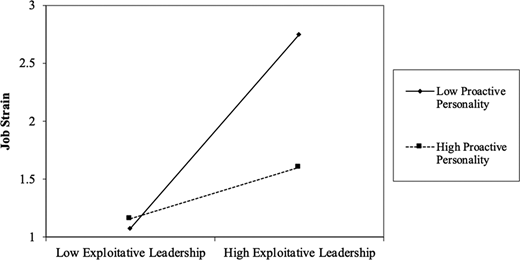
Plot of the interaction between exploitative leadership and proactive personality on job strain
Plot of the interaction between exploitative leadership and proactive personality on job strain

