


Based on the job demands–resources (JD-R) model, this study aims to answer a key research question, i.e. can the job characteristics (i.e. job demands and resources) affect intention to retire early? Additionally, a mediating effect of emotional exhaustion and organizational commitment on the relationships of job demands and job resources, respectively, with early retirement intentions has been explored in the study.
The data has been collected from survey of 450 employees from the banking sector in the state of Punjab (India). A structured questionnaire adapted from past literature has been used as survey instrument for the study. Partial least squares structural equation modelling has been applied in the study using latest version of SmartPLS (version 3.2.8) software.
Both job resources and job demands have a direct significant impact on early retirement intentions. Moreover, a significant partial mediation effect of emotional exhaustion and affective organizational commitment has also been found out on the relationship of job demands and job resources with early retirement intentions, respectively.
The study makes incremental contribution by highlighting the role of both deterrent and motivational factors that either instigate or discourage early retirement intentions among employees. It offers valuable insights for the organizations to use efforts for curtailing the excessive job demands that lead to emotional exhaustion and further result in early retirement intentions. Besides this, adequate job resources should be provided to the employees that lead to the development of affective organizational commitment, which further helps in sustaining the workforce until their actual retirement age.
1. Introduction
Retirement decision is plausibly one of the critical decisions in one’s life, as it leads to complete transition in the way of leading life. Nevertheless, literature on organizational psychology witnesses a substantial upsurge in the early retirement intentions amongst workforce. Similar trend has been reported by Groww, an Indian investment app, in August 2019, which states that around 40% Indians, falling within the age groups of 24–45 years intend to retire early (Gurung, 2019). Global HSBC bank also reported in 2016 that in India, 61% working population ageing 45 years and above, wish to retire earlier than their actual retirement age. Additionally, job-related factors have been found to be majorly responsible for early retirement intentions by 59% respondents (Sengupta, 2016). Hence, it is important to understand the role played by various job factors in determining early retirement intentions of employees.
Besides affecting the personal lives of early retirees, untimely retirement has a fundamental impact on the employing organizations as well. This is due to the fact that such employees have already spent a number of years in the organization and are well versed with various organizational tasks and environment. Such premature retirement leads to erosion of knowledge capital of the organization. Therefore, organizations facing challenge of high rates of early retirement may encounter problems relating to uncertain and unstable organizational environments. This study is an attempt to examine the underlying job factors affecting early retirement intentions of employees so that the managers can understand the reasons behind employees leaving the organization early and can take corrective measures proactively. The researchers can also take insights from the findings of the study for carrying out research on various dimensions of organizational change.
The study uses the job demands–resources (JD-R) model (Bakker & Demerouti, 2007; Demerouti, Bakker, Nachreiner & Schaufeli, 2001) for scrutinizing the impact of job demands and job resources on early retirement intentions of employees. More specifically, the study aims at resolving if it is the challenging job demands that push the employees towards early retirement due to emotional exhaustion or is it the resourceful job characteristics that makes them committed towards organization and staying with the job until their actual retirement age.
Retirement is a natural phenomenon that is faced by everyone due to the age factor, which makes employees physically weak. However, there may be a situation that the employees start feeling emotionally worn-out due to job stress and start developing tendencies for retiring earlier than actual retirement age. Hence, the study aims at exploring the mediating role of emotional exhaustion on the relationship of job demands with early retirement intentions.
The psychological attachment to the organization has been termed as organizational commitment, which is an outcome of motivational process arising due to the presence of job resources (Gauche, de Beer & Brink, 2017; De Beer, Rothmann & Pienaar, 2012). Out of three types of commitments, namely, affective (a desire), continuance (a need), and normative (an obligation) (Meyer & Allen, 1991; Somers, 1995), affective commitment portrays an inner sense of motivation to stay in the organization (Masud, Daud, Zainol, Rashid & Asyraf, 2018; Meyer & Parfyonova, 2010). Such desire results into positive work-related outcomes (Allen, Evans & White, 2011) in the form of decreased turnover and absenteeism. Contrary to this, continuance and normative commitments are rather not able to bring positive work outcomes, as these are the results of external factors, and do not originate from inner feelings of motivation (Meyer, Stanley, Herscovitch & Topolnytsky, 2002). Therefore, the study attempts to explore the mediating role of affective organizational commitment on the relationship of job resources with early retirement intentions.
The structure of present study is as per the following. The study starts with the discussion of theoretical framework, literature review, hypotheses formulation and model specification. Further, it moves towards explanation of research methodology, followed by an elaboration on analysis of data and research findings. The concluding portions of the paper highlight the discussion, implications, limitations and the scope for future research.
2. Theoretical framework – the job demands–resource (JD-R) model
The present study is based on the theoretical framework of the JD-R model (Bakker, Demerouti, De Boer & Schaufeli, 2003a; Demerouti et al., 2001). The JD-R model provides an understanding about the role played by various job factors in catalyzing work-related outcomes. This model is used as an approach to understand as to how the work environments affect employees’ morale to serve the organizations in long run. More specifically, JD-R explains job demands and resources as initiators of health impairment and motivational process, respectively. Previous literature evidences that when employees receive adequate support in the form of job resources, their turnover intention levels decrease (Kumar, Channa & Bhutto, 2017). At the same time, a reverse role is played by the presence of excessive job demands leading to burnout and depersonalization, and eventually, the turnover intentions among employees increase (Choi, Cheong & Feinberg, 2012). As early retirement is one of the means of voluntary turnover (Vance, 2015; Eun Kim & Weon Chang, 2007), therefore, the study applies the JD-R model for examining the impact of job demands and resources on early retirement intentions of employees.
2.1 Job demands
Job demands refer to the physical, psychological, social or organizational aspects of the job that require sustained physical and/or psychological (cognitive and emotional) effort or skills on the part of employees. This is evident in the form of excessive work overload, long working hours, emotional strain, unhealthy physical working environment, etc. Past literature classifies job demands into quantitative (workload, pace of change) and qualitative demands (emotional, mental, physical) (Schaufeli & Bakker, 2004). The present study measures quantitative demands through workload, as the same has been found to contribute towards employees’ decisions to retire early from their jobs (Schreurs, Cuyper, Emmerik, Notelaers & Witte, 2011a; Schreurs, Van Emmerik, De Cuyper, Notelaers & De Witte, 2011b). From among qualitative demands, the study uses emotional demands, i.e. those aspects of a job that require persistent emotional expression (even if the same is not genuinely felt) to deal with the clients by managing inner feelings of anger or frustration (Alaybek, Green, Dalal, Zeigler-Hill & Shackelford, 2018; Tahir & Hussein, 2018; Gabel-Shemueli, Dolan & Ceretti, 2014) arising out of over expectations from the job. Maxwell & Riley (2017) found that emotional demands further predict the elevated use of emotional labor strategies, namely, surface and deep acting. The emotional demands have been found to be most important for jobs that include social interactions with clients (Ybema & Smulders, 2001). Similarly, jobs that include direct human interactions are found to score higher on emotional demands than on other qualitative demands (Vegchel, Jonge, Söderfeldt, Dormann & Schaufeli, 2004; Bakker, Van Veldhoven & Xanthopoulou, 2010). As the present study pertains to employees of the banking sector, where a direct social dealing with clients is a regular affair, emotional demands are assumed to capture the true essence of the qualitative demands.
2.2 Job resources
Job resources refer to those physical, psychological, social or organizational aspects of the job that are motivation-driven in nature and stimulate personal growth, learning and development of employees. Examples of job resources include adequate financial incentives, career advancement opportunities, conducive interpersonal relations, supervisor and peer support, task identity, task significance, autonomy and performance feedback (Bakker, Demerouti, Taris, Schaufeli & Schreurs, 2003b). Availability of adequate job resources results into increased levels of job engagement (Roslan, Ho, Ng & Sambasivan, 2015; Alzyoud, Othman & Isa, 2015; Lee, Kim, Faulkner, Gerstenblatt & Travis, 2019), less exhaustion (Kattenbach & Fietze, 2018) and higher employee well-being (Becker and Tews, 2016). The present study accounts for three aspects of job resources, namely, autonomy, social support and opportunities for professional development for examining their impact on early retirement intentions. Xanthopoulou, Bakker, Demerouti and Schaufeli (2009) acclaim that when the employees experience autonomy at workplace, receive adequate support and development opportunities, they tend to develop higher level of engagement in their job. The idea of autonomy refers to the degree of freedom and liberty enjoyed by the employees within the organization, particularly with respect to their working style and procedures to be followed (Richard & Oldham, 1976). Social support implies an interpersonal transaction involving the amount of help or care received, felt or noticed by the employees at their workplace. Lastly, opportunities for professional development refer to the efforts employed by the organizations for enhancing the professional competencies, knowledge and skills of its employees by organizing training programmes or workshops from time to time (Hardré, 2012; Tauhed, Rasdi, Samah & Ibrahim, 2018).
3. Hypotheses formulation
3.1 Role of emotional exhaustion
The presence of excessive job demands may build the tendencies of permanent withdrawal from work in the form of early retirement amongst employees. At the same time, the employees may also think of not retiring early, only because of the presence of job demands. Hence, there might be a direct effect of job demands on early retirement intentions. However, there could be some other factors also that might result in reinforcing early retirement intentions of employees. The JD-R model suggests that excessive job demands lead to a health impairment process through physical and mental exhaustion of employees. Demerouti et al. (2001) explained this phenomenon and asserted that the stress that originates from chronic job demands leads further to job burnout in the form of emotional exhaustion. Thus, emotional exhaustion has been considered as a key to understand the burnout phenomenon in past literature (Kyei-Poku, 2014). The concept of emotional exhaustion has been explained as a chronic condition of emotional and physical depletion that happens as a consequence of excessive job demands (Shirom, 1989; Zohar, 1997; Wright & Cropanzano, 1998).
Owing to the feeling of emotional exhaustion, workers are found to develop a state of higher job dissatisfaction (Mulki, Jaramillo & Locander, 2006), lower organizational commitment (Rathi, Bhatnagar & Mishra, 2013), counterproductive work behavior (Lebrón, Tabak, Shkoler & Rabenu, 2018), withdrawal from work (Hu, Schaufeli & Taris, 2011) and high levels of intention to permanently leave the organization (Karatepe & Uludag, 2007; Hanisch & Hulin, 1991). Schreurs et al. (2011a, 2011b) argued that such withdrawal behavior from work may even lead to early retirement as an escape route from these job-related negative outcomes. Hence, it is expected that the impact of job demands on early retirement intentions should pass through emotional exhaustion. More specifically:
The relationship between job demands and early retirement intention is mediated by emotional exhaustion.
3.2 Role of affective organizational commitment
The availability of adequate job resources for employees can lead to positive work-related outcomes. This is so because when employees are given full autonomy, social support and opportunities for professional development, their satisfaction level increases, and they remain attached to the organization for a longer period of time. Hence, there might be a direct influence of job resources on decreasing early retirement intentions among employees. However, there might be some other factors also that intervene in this relationship.
The JD-R model proposed that job resources are drivers of intrinsic motivation (Quiñones, Van den Broeck & De Witte, 2013) that lead to positive outcomes in terms of high work engagement (Demerouti & Bakker, 2011 and Schreurs et al., 2011a, 2011b). This high work engagement further enhances organizational commitment (Nguyen, Teo, Grover & Nguyen, 2019) and acts as a means of achieving work goals (Abrahams, 2014). Job resources have been found to be distinctive predictors of organizational commitment (Bakker, Demerouti & Schaufeli, 2003c) through high work engagement (De Beer et al., 2012). For instance, Crowne, Cochran, and Carpenter (2014) found that the employees of the organizations following robust older worker-friendly policies are more satisfied and have lesser work/family conflict, which ultimately lead to higher levels of affective organizational commitment.
The concept of organizational commitment has been explained as an affective response to the organization as a whole (Mowday, Steers & Porter, 1979 and Bakker et al., 2003c). Affective organizational commitment refers to the emotional attachment that employees feel with the organization that enhances their willingness to remain employed with the organization (Meyer, Allen & Smith, 1993). Accordingly, a negative relationship has been found between affective organizational commitment and early retirement intention (Riaz, Anjum & Anwar, 2016; Adams, Prescher, Beehr & Lepisto, 2002). Hence, it is expected that the impact of job resources on early retirement intentions should pass through affective organizational commitment. Particularly:
The relationship between job resources and early retirement intention is mediated by affective organizational commitment.
4. Measurement model specification
The measurement model has been specified as per the guidelines given by Jarvis, MacKenzie and Podsakoff (2003). The latent variables were measured either formatively or reflectively on the basis of direction of causality of indicators; interchangeability of the indicators and the correlation among indicators.
4.1 Job demands (JD) and job resources (JR) as second-order reflective–formative latent variables
The criteria given by Jarvis et al. (2003) were used for specifying the JD measurement model. The two dimensions of JD, i.e. emotional demands (ED) and quantitative demands (QD), were referred to as lower-order latent variable, whereas JD was regarded as a second-order latent variable.
For lower-order latent variables (i.e. ED and QD), the causality was observed from the latent variable to the indicators where the indicators were mere reflection of the latent variable. As the indicators shared identical theme, they were also interchangeable. For example, for ED, indicators like “My work puts me in emotionally disturbing situations” and “My work is emotionally demanding” necessarily co-vary, and dropping one of the statement will not change the meaning of the latent variable. Hence, ED and QD were measured reflectively.
However, the conceptual context of ED and QD is different. Where ED is related to the management of inner feelings at workplace (Alaybek et al., 2018), QD refers to the overload or physical work pressure (Livne & Rashkovits, 2018). Therefore, JD was specified as a second-order formative latent variable defined by two lower-order reflectively measured latent variables (Jarvis et al., 2003).
Similar reasoning can be given for the measurement specification of job resources (JR) latent variable having three lower-order dimensions, i.e. autonomy (Atnmy), opportunities for professional development (OPD) and social support (SS), which differed in their context. Atnmy, OPD and SS were measured reflectively as their corresponding indicators were alike. Following this, JR was specified as a second-order formative latent variable defined by three reflectively measured dimensions.
4.2 Emotional exhaustion (EE), affective organizational commitment (AOC) and early retirement intention (INT) as lower-order reflective latent variables
Following the rules given by Jarvis et al. (2003), emotional exhaustion (EE), affective organizational commitment (AOC) and early retirement intention (INT) were specified as reflective variables, as their corresponding indicators were similar in notion and necessarily co-varied with each other. Even if an indicator is left, the essence of the latent variable did not alter.
5. Method
5.1 Participants and procedure
With the objective of investigating the hypothesized relationships among variables under study, a non-probability sample survey of 450 employees from the banking sector in the state of Punjab has been used. Based on the findings of Hulland, Baumgartner and Smith (2018), Memon, Ting, Ramayah, Chuah and Cheah (2017) stated that if the objective of a study is to test the hypothesized relations and selection of sampling strategy that suits the scope of research, then non-probability sampling is more suitable than probability sampling. Also, the use of probability sampling requires a complete picture of the population to design a good sampling frame (Rowley, 2014). Although various published sources might help in framing sample, yet, non-response from respondents would affect representativeness of the sample (Sarstedt, Bengart, Shaltoni & Lehmann, 2018). Moreover, in the absence of proper sampling frame, probability sampling techniques and formulae are not justified (Memon et al., 2017).
Further, Sarstedt et al. (2018) stated that non-probability purposive sampling helps the researchers to include only those participants who are fit for the study. As the researchers intended to include only the best fitted respondents aligned to the objectives of the study, purposive sampling technique was applied, and the employees with age group of 45 years or more were selected. This was mainly done because of the reason that presumably, on achieving a minimum age of 45 years, a person is supposed to have fulfilled his major family responsibilities. The health might also deteriorate due to ageing or excessive ED at workplace.
Hence, the data for the study has been collected from the bank employees with age group of 45 years or more by using non-probability purposive sampling. Originally, 650 bank employees were approached and sent a Google Forms link of the questionnaires with a request to fill the survey form. This method of personally delivering the questionnaire is helpful in achieving high response rate (Rowley, 2014). Informed consent [1] was also obtained before sending them the link. A total of 503 questionnaires were received back, giving a response rate of 77.38%. Next, after excluding incomplete submissions, 450 full responses on all questions were available for the final data analysis.
For understanding data relating to various relationships, a range of tools, including partial least square structural equation modelling (PLS-SEM) was used for testing the proposed structural model. Descriptive statistics were also used to provide a holistic overview of respondents’ profiles. For assessing the demographic profile, the respondents were asked to report their gender, highest educational qualification, age (in years), nature of organization and monthly income. It requires a mention here that out of the total sample, only 26.44% were females and a majority of respondents (73.56%) were males. Such distribution of sample across gender is akin to the findings of the World Bank report (Saraswathy, 2019), which revealed that the labour force participation rate (LFPR) among females in India is 26.97 (Table 1).
Demographic profile of sample
| N | (%) | |
|---|---|---|
| Gender | ||
| Male | 331 | 73.56 |
| Female | 119 | 26.44 |
| Highest educational qualification | ||
| Graduate (bachelor’s degree) | 108 | 24.00 |
| Postgraduate or higher (master’s degree) | 286 | 63.56 |
| Professional | 56 | 12.44 |
| Age (in years) | ||
| Mean | 49.18 | |
| SD | 2.97 | |
| Nature of organization | ||
| Public | 220 | 48.89 |
| Private | 154 | 34.22 |
| Cooperative | 76 | 16.89 |
| Monthly income | ||
| 25,000 or less | 39 | 8.67 |
| 25,000–50,000 | 157 | 34.89 |
| 50,000–75,000 | 155 | 34.44 |
| 75,000 or higher | 99 | 22.00 |
PLS-SEM was applied in this study using the latest version of SmartPLS (version 3.2.8) software (Ringle, Wende & Becker, 2015), as this approach is preferred for analyzing complex models having formative constructs (Hair, Risher, Sarstedt & Ringle, 2019). Also, it can examine large number of latent variables; there is no need to consider multivariate normality (Liu & Yang, 2014). Moreover, the nature of the present study is causal-predictive explaining the causality among variables. Hence, PLS-SEM is best suited (Sarstedt, Ringle & Hair, 2017).
5.2 Measures
5.2.1 Job demands.
This was measured using the second version of the Copenhagen Psychosocial Questionnaire (Pejtersen, Kristensen, Borg & Bjorner, 2010). Items 1–4 measure QD and Items 5–8 measure ED. Examples of items for each of two aspects include “Is your workload unevenly distributed so it piles up” and “Does your work put you in emotionally disturbing situations”. The answers were anchored on a five-point scale ranging from 1 (strongly agree) to 5 (strongly disagree). High scores reflect high level of JD and vice versa.
5.2.2 Job resources.
This was measured using three aspects of JR, namely, Atnmy, SS and OPD. Atnmy was measured on a three-item scale based on Karasek’s (1985) job content instrument; SS was measured on a five-item scale developed by Van Veldhoven, Meijman, Broersen and Fortuin (1997); and OPD was measured on a seven-item scale developed by Van Veldhoven and Meijman (1994). Examples of items for each of three aspects include “On my job, I have freedom to decide how I do my work”, “Do your coworkers behave friendly to you” and “Does your job offer you opportunities for personal growth and development”. The responses were solicited on a five-point scale ranging from 1 (strongly agree) to 5 (strongly disagree). High scores reflect high level of JR and vice versa.
5.2.3 Emotional exhaustion.
This was measured using a nine-item scale of Maslach Burnout Inventory (Koeske & Koeske, 1989). Examples of these items include “I feel emotionally drained from work” and “I feel used up at the end of the workday”. The responses were received on a five-point scale ranging from 1 (strongly agree) to 5 (strongly disagree). High scores reflect high level of EE and vice versa.
5.2.4 Affective organizational commitment.
This was measured using an eight-item scale developed by Allen and Meyer (1990). Examples of these items include “I would be very happy to spend the rest of my career with this organization” and “I enjoy discussing my organization with people outside it”. The responses were solicited on a five-point scale ranging from 1 (strongly agree) to 5 (strongly disagree). High scores reflect high level of AOC and vice versa.
5.2.5 Early retirement intention.
Our dependent variable, INT, was measured with four statements adapted from Hani Nurfaziah (2018). These include “I often think about seeking retirement before actual retirement age” (Koponen, von Bonsdorff & Innanen, 2016), “I have often discussed retirement with my friends or coworkers” (Kosloski, Ekerdt & DeViney, 2001), “I feel my health will allow me to work until my actual retirement age” (Bonsdorff, 2009) and “I will retire as soon as possible” (Salminen, Bonsdorff, Koponen & Miettinen, 2016). The responses were received on a five-point scale ranging from 1 (strongly agree) to 5 (strongly disagree). High scores reflect high level of INT and vice versa.
5.2.6 Common method bias.
To overcome the problem of common method bias, which can be present in self-reported data (Podsakoff, MacKenzie, Lee & Podsakoff, 2003), the study followed the techniques adopted by Lin, Zhang, Gursoy and Fu (2019) and Farooq, Salam, Fayolle, Jaafar and Ayupp (2018). The respondents were ensured that their responses would be kept anonymous and were not told about the purpose of the study. Harman (1976) one-factor test was also used to check the common method variance (Podsakoff et al., 2003). All the items were entered into factor analysis to extract single factor, which explained less than 50% of the total variance. Hence, there was no problem of common method bias.
6. Results and analysis
6.1 Analysis of measurement model
Considering the guidelines provided by Hair et al. (2019) and Ringle, Sarstedt and Straub (2012), the lower-order reflective constructs (ED, QD, Atnmy, OPD, SS, EE, AOC and INT) were analyzed for indicator reliability, internal consistency, convergent validity and discriminant validity.
The outer loadings of all the indicators were within the acceptable range of 0.708–0.90. Hence, the indicators are reliable. The internal consistency of the latent variables was also achieved as the values of composite reliability were more than the minimum acceptable level of 0.70 but less than 0.95 (Diamantopoulos, Sarstedt, Fuchs, Wilczynski & Kaiser, 2012). The value of Cronbach’s α was also more than 0.70. Further, the convergent validity was established by examining the values of AVE, i.e. average variance extracted. AVE is the average of the squared outer loadings (Valentini & Damasio, 2016). It was found to be more than 0.5 for all the latent variables, indicating that they account for more than 50% variance of their indicators. The above results have been presented in Table 2.
Outer loadings, Cronbach’s α, composite reliability and AVE
| Name of latent variable | Indicators | Outer loadings | Cronbach’s α | Composite reliability | AVE |
|---|---|---|---|---|---|
| ED | ED1 | 0.887 | 0.897 | 0.928 | 0.764 |
| ED2 | 0.85 | ||||
| ED3 | 0.877 | ||||
| ED4 | 0.881 | ||||
| QD | QD1 | 0.89 | 0.891 | 0.925 | 0.754 |
| QD2 | 0.845 | ||||
| QD3 | 0.88 | ||||
| QD4 | 0.859 | ||||
| Atnmy | Atnmy1 | 0.897 | 0.845 | 0.906 | 0.763 |
| Atnmy2 | 0.871 | ||||
| Atnmy3 | 0.851 | ||||
| OPD | OPD1 | 0.854 | 0.893 | 0.926 | 0.757 |
| OPD2 | 0.89 | ||||
| OPD3 | 0.853 | ||||
| OPD4 | 0.882 | ||||
| SS | SS1 | 0.882 | 0.892 | 0.925 | 0.755 |
| SS2 | 0.868 | ||||
| SS3 | 0.87 | ||||
| SS4 | 0.855 | ||||
| EE | EE1 | 0.895 | 0.887 | 0.922 | 0.746 |
| EE2 | 0.862 | ||||
| EE3 | 0.838 | ||||
| EE4 | 0.859 | ||||
| AOC | AOC1 | 0.872 | 0.898 | 0.925 | 0.71 |
| AOC2 | 0.822 | ||||
| AOC3 | 0.832 | ||||
| AOC4 | 0.834 | ||||
| AOC5 | 0.853 | ||||
| INT | INT1 | 0.883 | 0.905 | 0.934 | 0.779 |
| INT2 | 0.88 | ||||
| INT3 | 0.894 | ||||
| INT4 | 0.873 |
Discriminant validity establishes if one latent variable is different from the others in the model (Hair et al., 2019). For assessing the discriminant validity, three criteria are used: Fornell–Larcker criterion, HTMT ratio and cross-loadings. A norm was suggested by Fornell and Larcker (1981) where the square root of the AVE of latent variable should be more than the latent variable’s correlation with any other latent variable (Hair, Hult, Ringle & Sarstedt, 2016). This condition was fulfilled and is presented in Table 3. HTMT (heterotrait-monotrait) ratio was also examined, which has been proposed by Henseler, Ringle and Sarstedt (2015) for examining discriminant validity. The values in Table 4 depict that HTMT ratios are less than the benchmark limit, i.e. 0.85 (Henseler et al., 2015).
Fornell–Larcker criterion
| AOC | Atnmy | INT | EE | ED | OPD | SS | QD | |
|---|---|---|---|---|---|---|---|---|
| AOC | 0.843 | |||||||
| Atnmy | 0.261 | 0.873 | ||||||
| INT | –0.504 | –0.519 | 0.882 | |||||
| EE | –0.255 | –0.376 | 0.529 | 0.864 | ||||
| ED | –0.056 | –0.214 | 0.282 | 0.224 | 0.874 | |||
| OPD | 0.4 | 0.468 | –0.484 | –0.253 | –0.15 | 0.87 | ||
| SS | 0.4 | 0.417 | –0.474 | –0.283 | –0.118 | 0.308 | 0.869 | |
| QD | –0.187 | –0.265 | 0.425 | 0.343 | 0.396 | –0.209 | –0.211 | 0.869 |
Notes:
The values on diagonal represent the square root values of AVE for the corresponding latent variable. AOC = Affective organizational commitment, Atnmy = Autonomy, INT = Early retirement intention, EE = Emotional exhaustion, ED = Emotional demands, OPD = Opportunities for professional development, SS = Social support, QD = Quantitative demands
HTMT ratios
| AOC | Atnmy | INT | EE | ED | OPD | SS | |
|---|---|---|---|---|---|---|---|
| AOC | |||||||
| Atnmy | 0.294 | ||||||
| INT | 0.556 | 0.591 | |||||
| EE | 0.28 | 0.431 | 0.586 | ||||
| ED | 0.067 | 0.245 | 0.312 | 0.25 | |||
| OPD | 0.444 | 0.536 | 0.538 | 0.284 | 0.166 | ||
| SS | 0.442 | 0.476 | 0.527 | 0.314 | 0.13 | 0.344 | |
| QD | 0.21 | 0.301 | 0.474 | 0.382 | 0.438 | 0.235 | 0.239 |
Notes:
AOC = Affective organizational commitment, Atnmy = autonomy, INT = Early retirement intention, EE = Emotional exhaustion, ED = Emotional demands, OPD = Opportunities for professional development, SS = social support, QD = Quantitative demands
Another criterion for assessing the presence of discriminant validity was applied by evaluating all cross-loading values for the indicators of reflective latent variables. All the indicators were found to have the highest loading on their own underlying latent construct than on any other construct (Farooq et al., 2017; Hair et al., 2016). Hence, the discriminant validity is established as per Hair et al. (2019). The results also resemble with those reported by previous studies (Farooq et al., 2017; Liu & Yang, 2014; Widagdo & Susanto, 2016; Farooq et al., 2018; Sarstedt, Hair, Cheah, Becker & Ringle, 2019; Barati, Taheri-Kharameh, Farghadani & Rásky, 2019).
The scores for all the lower-order latent variables were calculated and used as indicators for the respective latent variables (Ringle et al., 2012; Sarstedt et al., 2019). JD was measured formatively with latent variable scores of ED and QD. JR was also formatively measured with the scores of Atnmy, OPD and SS. EE, AOC and INT were measured with their corresponding scores (Figure 1).
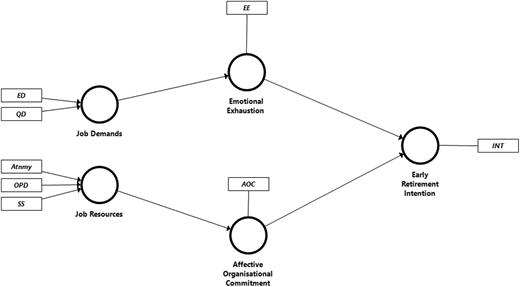
The higher-order formative latent variables (JD and JR) were also examined for their convergent validity, collinearity of indicators and significance of outer weights (Sarstedt et al., 2019; Hair et al., 2019). The convergent validity of JD and JR was assessed with the help of redundancy analysis (Cheah, Sarstedt, Ringle, Ramayah & Ting, 2018; Chin, 1998). A single general indicator capturing the overall essence, each of JD and JR, was included. The correlation was calculated between the formatively measured variables with their corresponding single indicator variables, which came out to be 0.755 (t-statistics = 19.612, p-value = 0.000) and 0.772 (t-statistics = 20.079, p-value = 0.000) for JD and JR, respectively. Both the values are well above 0.70 (Hair et al., 2016). Hence, convergent validity is sufficiently established. Next, the collinearity among the indicators of JD and JR was checked using the variance inflation factor (VIF). The values of VIF were ED: 1.186, QD: 1.186, Atnmy: 1.432, OPD: 1.307 and SS: 1.234. All the values were less than 3, signifying absence of collinearity (Hair et al., 2019). Finally, bootstrapping was run to examine the significance of outer weights of indicators. The outer weights were found to be significant, except for Atnmy (Table 5). However, the correlation between JR and Atnmy was 0.527 (t-statistics = 6.995, p-value = 0.000), i.e. more than 0.5. Hence, Atnmy was not removed from the model (Hair et al., 2019). Hence, the validity is clearly established for the reflective–formative second-order latent variable.
6.2 Analysis of structural model
After evaluation of the measurement model, the structural model was examined as per the guidelines by Hair et al. (2019) and Wong (2016). This includes the assessment of collinearity, significance of path coefficients, value of R2 and value of Q2 for predictive relevance. In total, 5,000 bootstrapped samples (Shrout & Bolger, 2002) were used to test the significance of ß values (Preacher & Hayes, 2008). All the results were analyzed at significance level (α) of 0.05 and t-statistics is 1.96.
The latent variable scores of the exogenous constructs were used to calculate VIF values, which came out to be less than 3. Hence, there was no problem of collinearity in the model. The results revealed that the direct effect of both JD and JR on INT was highly significant with path coefficients of 0.271 (t-values = 7.830) and –0.552 (t-values = 14.896), respectively. The amount of variance explained by the two variables was also significant with value of R2 = 0.471 (t-values = 12.723, p-value = 0.000). The model revealed medium predictive relevance with value of Q2 = 0.344 for INT (Hair et al., 2019; Stone, 1974; Geisser, 1974).
The introduction of EE and AOC as mediators between JD → INT and JR → INT, respectively, further improved the value of R2 to 0.571 (t-statistics 18.387, p-value 0.000). Although, the direct effect of JD on INT reduced, it remained significant (ß = 0.201, t-values= 6.173). The ß value for direct effect JR → INT was also found to be significant (ß = –0.360, t-values = 7.841).
Variance accounted for (VAF) and t-values (Hair et al., 2016; Wong, 2016) were used to determine the magnitude of mediation. EE was found to have significant and partial mediating effect with ß value 0.094 (t-statistics = 4.918, VAF = 31.86%) for indirect path JD → EE → INT. Similarly, partial significant mediating effect was observed for AOC with ß value of –0.110 (t-statistics = 5.393, VAF = 23.40%). Thus, H1 and H2 were supported (Table 6). The predictive relevance for the model (blindfolding-based value of Q2) also improved to 0.416 (Hair et al., 2019).
Mediation analysis
| Hypothesised path | ß | t-statistics | p-value | VAF (%) | Decision | |
|---|---|---|---|---|---|---|
| H1 | JD → EE → INT | 0.094 | 4.917 | 0.000 | 31.86 | Supported |
| H2 | JR → AOC → INT | −0.110 | 5.393 | 0.000 | 23.40 | Supported |
Notes:
VAF = indirect effect/total effect * 100, total effect (JD → INT): ß = 0.295, t-values = 8.796, p-value = 0.000, total effect (JR → INT): ß = –0.470, t-values = 11.431, p-value = 0.000
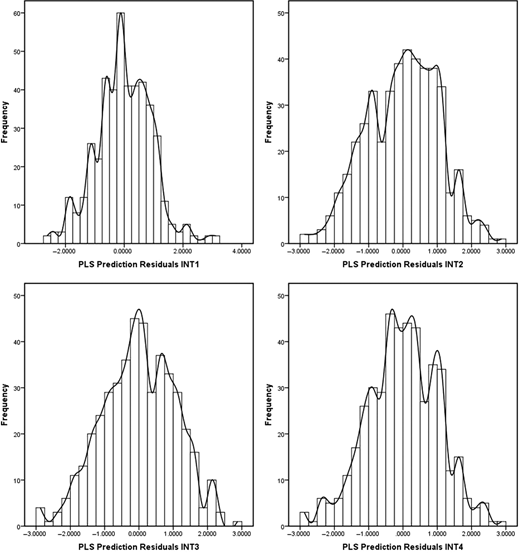
Further, PLSpredict (Shmueli, Ray, Estrada & Chatla, 2016) procedure was used in line with the steps given by Shmueli, Sarstedt, Hair, Cheah, Ting, Vaithilingam and Ringle (2019) to check the model’s predictive power. The values for Q2predict statistic for every indicator of INT are greater than zero (Table 7). Next, the PLS prediction residuals, i.e. the difference between the actual values in the data set and the corresponding values predicted by PLS-SEM (Danks and Ray, 2018) for every indicator of INT, are analyzed. The frequency distribution of these errors is plotted as shown in Figure 2. The test results of Shapiro–Wilk suggest that the residuals are normally distributed (p-value > 0.01 for every indicator). Also, the visual examination of the plots shown in Figure 2 reveals that distribution for INT1, INT2, INT3 and INT4 is not highly non-symmetric. Hence, root-mean-square error (RMSE) was used as the basis for the assessment of the results. However, it worth mentioning that the results of PLSpredict do not vary even if the residuals are perceived to be non-symmetric, and mean absolute error (MAE) is used as basis. The values of RMSE from PLS results were compared with those of naïve Lagrange multiplier (LM) benchmark (Table 6). All the indicators of INT depict lower PLS prediction errors in contrast to that of LM. Hence, the model possesses high predictive power (Shmueli et al., 2019; Hair et al., 2019).
Results of PLSpredict
| Indicator | PLS | PLS | LM |
|---|---|---|---|
| Q²_predict | RMSE | RMSE | |
| INT1 | 0.325 | 0.954 | 0.987 |
| INT2 | 0.359 | 1.055 | 1.081 |
| INT3 | 0.362 | 1.067 | 1.088 |
| INT4 | 0.360 | 1.024 | 1.054 |
7. Discussion
Our primary purpose in this study was to determine INT in the light of various job-related factors, as described by the JD-R model. More explicitly, the study attempted to examine if intention to retire early was an ultimate outcome of EE and AOC, which plays a fundamental role in the JD-R model. The result indicated that both JR and JD have a direct significant impact on INT. The results corroborated the findings of previous studies measuring the impact of JD (Sejbaek, Nexo & Borg, 2012; Thirapatsakun, 2013; Liebermann, Wegge & Müller, 2013) and JR (Carr et al., 2016; Browne, Carr, Fleischmann, Xue & Stansfeld, 2019; Kubicek, Korunka, Hoonakker & Raymo, 2010) on INT.
The JD-R model proposed that the stress that originates from highly demanding job leads further to job burnout in the form of exhaustion (Demerouti et al., 2001), and hence, workers tend to withdraw from work (Hu et al., 2011). Hence, it was hypothesized in the study that EE might bear a mediation effect between JD and INT (H1), which was significantly established in the study. Similar findings have been reported by researchers in the past as well (Khan, Teoh, Islam & Hassard, 2018; Hu et al., 2011; Golden, 2006).
The JD-R model also advocated that JR initiates a motivational process among the employees in the form of high work engagement (Demerouti & Bakker, 2011 and Schreurs et al., 2011a, 2011b). Among other motivational outcomes, AOC has been found to be negatively related to INT (Riaz et al., 2016; Adams et al., 2002). Accordingly, the mediating role of organizational commitment was tested by Bakker et al. (2003c) and concluded that it significantly mediated the relation of JR with absence frequency. Similarly, in the present study also, a significant mediating effect of AOC has been found out on the relationship between JR and INT (H2). This finding is in line with the previous literature (Bakker et al., 2003c; Joarder, Sharif & Ahmmed, 2011).
8. Theoretical implications
Keeping into consideration the JD-R perspective, our study makes two major theoretical contributions to the literature. First, the study supports health impairment patterns of JD via the mediating mechanism of EE. JD is found to be positively related to EE, which further positively relates to INT. This implies that the impact of JD on INT passes partially through EE. Second, the motivational process, as demonstrated in the JD-R model, has also been found to be corroborated in this study through the role of AOC. This implies that affective organizational commitment significantly intervened in the relationship of JR with INT.
9. Practical implications
Besides theoretical contributions, our study has got several practical implications because it highlights the role of both deterrent and motivational factors that either instigate or discourage INT among employees. That is to say, the study suggests that the organizations should employ efforts to curtail the JD that leads to EE and extends more JR leading to development of AOC that helps sustaining its workforce until their actual retirement age. Thus, to retain employees till their official retirement age, organizations should provide conducive job characteristics. More specifically, efforts should be made to motivate the employees by providing them with the freedom to perform their task, necessary support from peers and supervisors and prospects for their professional development. Such activities will boost the morale of employees, resulting into increased levels of AOC, leading further to preventing lesser INT. Similarly, attempt should be made by the organizations that EE arising out of excessive JD in the form of workload should be reduced, so the employees feel happy and mentally relaxed at their workplace and remain attached to the workplace till their actual retirement age.
The study has been carried out on the employees of the banking sector, where public dealing for funds management is a prominent affair. Therefore, excessive workload and ED might affect clientele dealing in an adverse manner. Also, banks are accountable for ensuring the safeguard of public money. If there will be frequent untimely retirements in banks, because of excessive JD, then there may be chances of mishandling or mismanagement of funds on account of multiple roles and responsibilities swapping. Moreover, there may also be lack of trust in the minds of clients for newly appointed employee in place of the retiree, who was dealing with their respective bank accounts previously. Hence, the banks should strive for providing adequate JR to the employees while keeping the JD up to an acceptable level so that the INT is reduced considerably and banking operations are carried out smoothly.
10. Limitations and future scope for research
The limitations of this study and future scope for research are as follows. The study takes into account only job factors for examining INT. Therefore, future studies can test the role of personal or psychological aspects that might affect INT such as perceived health, marital quality, leisure orientation, etc. Retirement can be seen as the function of financial preparedness also. It would be interesting to explore how it affects the relationship of JD and JR with INT. Further, the sample of only banking sector employees of the Punjab state has been taken in the study. Therefore, a nationwide study can be conducted for commenting upon the INT across whole country and with respect to other employment sectors also. Lastly, it would be interesting for future research to examine the moderating effects of demographic variables like gender, income, area, etc. on the relationships established in this study.
Note
Informed consent: The data for the study was collected through a survey questionnaire only which did not include any identifying detail of the participants (such as names, date of birth, identity card numbers and any other personal information). They were told about the purpose of the study, and an oral consent for participation in survey was obtained from the participants.

