


This study aims to use the ego depletion theory to examine the impact of hindrance stressors on knowledge sharing behaviors by investigating the mediating role of ego depletion and the moderating role of self-enhancing humor.
Data were obtained from a two-wave sample of 226 dyads, including employees in the manufacturing industry and their direct supervisors. The hypotheses were tested by hierarchical regression analyzes and Hayes’ PROCESS macro.
The results demonstrated that employees’ self-enhancing humor style could alleviate the impact of hindrance stressors on employees’ ego depletion state and buffer the negative indirect effect of hindrance stressors on employees’ knowledge-sharing behaviors.
Although the authors collected mediator and dependent variables from different sources, this study used a cross-sectional research design, making it difficult to draw causal conclusions. Besides, hindrance stressors, ego depletion and self-enhancing humor style were all reported by employees.
Through the study, the authors highlight the important role of the self-control view in explaining proactive behavior in the workplace and a great awareness of the unforeseeable consequences of ego depletion for employees.
Introduction
As work becomes more complicated and requires higher problem-solving skills and innovative thinking, organizations increasingly rely on employees’ knowledge sharing to gain a competitive advantage. Knowledge sharing has a broad scope of implications for organizations. To illustrate, knowledge sharing can enhance coworkers’ task performance and creativity (Kim & Yun, 2015), improve organization innovation and performance (Ganguly, Talukdar & Chatterjee, 2019; Muhammed & Zaim, 2020). In light of this, researchers were concerned about its antecedents. From a dispositional perspective, employees with specific characteristics, such as high-level dutifulness (Chae, Park & Choi, 2019), self-efficacy (Cabrera, Collins & Salgado, 2006) and learning orientation (Lee, Yoo & Yun, 2015), are more likely to share knowledge with peers. From a contextual perspective, knowledge sharing behaviors tend to occur when leaders are open, supportive, ethical and inclusive (Bavik, Tang, Shao, & Lam, 2018; Liu, Lin, Chen, Chen, & Chen, 2020; Muhammed & Zaim, 2020). Moreover, employees are reluctant to share knowledge in a competitive environment (Willem & Scarbrough, 2006) or when the job gives them little autonomy (Gagné et al., 2019).
Although many studies have explored antecedents of knowledge sharing, the literature on proactive behaviors suggests that there are other factors influencing knowledge sharing behaviors (Bolino & Grant, 2016) in the workplace. Particularly, the ego depletion theory (Baumeister et al., 1998) informs that one potentially significant, but untested, an inhibitor to knowledge sharing would be employees’ self-control. Ego depletion theory points out that exercising self-control behaviors will run out of individuals’ resources for self-control, thereby reducing the willpower to exercise such control in further endeavors (Muraven, Tice & Baumeister, 1998). Scholars have studied the consumption of self-control resources in various situations (Lin, Koopmann & Wang, 2020; Yam, Fehr, Keng-Highberger, Klotz, & Reynolds, 2016). Nevertheless, relatively few studies have explored its impact on knowledge sharing behaviors.
In the present study, by integrating ego depletion theory and literatures concerning job demands (Cavanaugh, Boswell, Roehling, & Boudreau, 2000), we develop an alternative view on why knowledge sharing behaviors do not occur. First, from an ego depletion perspective, willpower resources are vulnerable to depletion (Baumeister et al., 1998). This study argues that employees may be vulnerable to depletion in particular where excessive or undesirable job demands, i.e. hindrance stressors, consume their limited resources and energy, and such depletion will mediate the effect of hindrance stressors on employees’ knowledge sharing behaviors. Second, based on studies of individual differences in humor styles, we argue that employees’ self-enhancing humor style could attenuate the depleting effect of hindrance stressors. Our research model is shown in Figure 1.
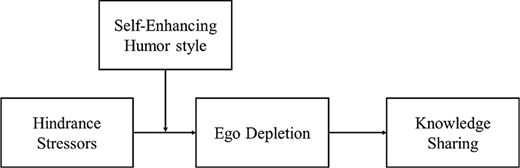
The depleting effect of hindrance stressors
Hindrance stressors refers to the job requirements perceived as barriers to personal growth or demands that impede individuals from achieving their goals (Crawford, LePine & Rich, 2010). Commonly recognized hindrance stressors include red tape, administrative headaches, role ambiguity and organizational politics. Hindrance stressors may induce a variety of negative behaviors and harmful attitudes, such as emotional exhaustion, turnover intentions, withdrawal behavior and counterproductive behaviors (Abbas & Raja, 2019; Charoensukmongkol & Phungsoonthorn, 2020; Lin, Ma, Wang, & Wang, 2015).
According to the ego depletion theory (Baumeister et al., 1998), employees’ behaviors, emotions, and attitudes to counteract hindrance stressors, such as mentally and physically exhausting bureaucratic red tape and organizational politics, will consume their self-control resources. Specifically, the responses to hindrance stressors involve restraining automatic response mode (e.g. states of mind and body expressions), thereby reducing the motivation and ability to use psychological resources in subsequent interaction with colleagues. This argument is supported by several studies, which showed that hindrance stressors would trigger negative affective states that consume energy and psychological resources, such as anxiety and anger (Lin et al., 2015). Overall, the ego depletion theory and related literature on hindrance stressors suggest that due to the hindrance stressors employees often encountered at work, their spontaneous response inhibition could deplete self-control resources.
Hindrance stressors is positively related to employees’ ego depletion.
Implications for knowledge sharing
Knowledge sharing was defined as “providing task information and know-how to help others and develop collaborative problem solving, new ideas, and implementing novel policies and procedures” (Wang & Noe, 2010). These behaviors involve sharing explicit knowledge (e.g. formulas, processes and routines) and tacit knowledge (e.g. experiences and know-how) to facilitate problem-solving, creativity, innovation or change (Gagné, 2009; Wang & Noe, 2010).
We argue that the resource depletion effect induced by hindrance stressors could restrain knowledge sharing behaviors. Avoid sharing knowledge with colleagues may yield short-term gains, but is detrimental to the achievement of long-term objectives. As an example, employees may turn a blind eye to colleagues’ problems and undermine long-term relationships and team performance to pursue immediate rewards (e.g. a lower workload). Empirical studies have found that depletion of self-control resources could elicit deviant behaviors (Yam et al., 2016) and render employees reluctant to help colleagues (Lin et al., 2015).
Taken together, these studies indicate that the decline in self-control resources triggered by hindrance stressors could make employees less likely to engage in knowledge-sharing behaviors with colleagues. There are empirical studies that offer indirect supporting evidence for this argument. For example, Trougakos, Beal, Cheng, Hideg, & Zweig (2015) found that employees who had exhausted self-control resources were unlikely to display discretionary pro-organizational behaviors, such as citizenship behaviors directed toward other individuals. Besides, a study conducted by Lin, Koopmann, & Wang (2020) suggested that employees at higher levels of emotional exhaustion were inclined to quit their jobs and experience lower motivation toward helping others.
Hindrance stressors is negatively associated with employees’ knowledge sharing behaviors, mediated by ego depletion.
The moderating role of self-enhancing humor style
Employees are reluctant to share knowledge when hindrance stressors deplete their self-control resources. However, it is unlikely that hindering stressors will have an equal impact on all employees. An argument from the ego-depletion theory suggests that people’s sensitivity to depleting resources is not identical (Baumeister et al., 1998). We believe that this individual difference can be captured by a self-enhancing humor style. Self-enhancing humor is a characteristic that “holds a generally humorous view on life, a propensity to be constantly amused by the incongruities in daily life and to maintain a sense of humor when facing challenging situations or enormous stress” (Martin, Puhlik-Doris, Larsen, Gray, & Weir, 2003).
Self-enhancing humor style is a positive and self-focused humor style characterized by an overall sense of humor about life, even when alone or in difficult situations (Cheng & Wang, 2015). Individuals with a high self-enhancing humor style are able to adopt humor as emotion regulation and coping mechanism, which could allow them to avoid excessive negative sentiments while preserving a realistic perception of potential aversions (Sliter, Kale & Yuan, 2014). Because they are likely to use entertainment to restore the exhausted resources, people with self-enhancing humor style are likely to use humor as a way to relieve tension, cope with stress and increase courage (Martin et al., 2003). Thus, people with a self-enhancing humor style can replenish energy and psychological resources more quickly when encountering exhausting events. They are particularly good at maintaining physical and mental well-being and close interpersonal relationships (Chiew, Mathies & Patterson, 2019; Horn, Samson, Debrot, & Perrez, 2019).
We argue that employees with a self-enhancing humor style are less likely to be affected by the depletion effect of hindrance stressors than their peers. Although few studies have tested the effects of self-enhancing humor style, several studies provide indirect evidence in support of the argument. As an example, Schmeichel and Vohs (2009) revealed that when the resources were exhausted, self-affirmation interventions can promote higher levels of mental construal. Besides, Jiang (2018) showed that self-affirmation attenuated the negative relationship between job insecurity and creativity.
The effect of hindrance stressors on ego depletion is moderated by employees’ self-enhancing humor style, such that this relationship is weaker when employees’ self-enhancing humor style is high.
Integrating H2 and H3, we propose an integrated moderated mediation model.
Self-enhancing humor style moderates the negative indirect relationship of hindrance stressors with knowledge sharing through ego depletion such that the relationship is less negative for those showing more self-enhancing humor.
Method
Participants and procedure
We collected data across nine companies from the manufacturing industry located in northern China to increase the generalizability of our findings. During a management training session in which the third author was one of the organizers, we explained the study objectives to the senior executives and asked if they could help to conduct the study. As a result, senior executives from nine companies responded positively.
The data collection procedure was the same for all sites. At each site, employees participating in the study were assigned to a conference room on site. Supervisors were placed in a separate room to ensure that the employees and their supervisors would not meet. In the survey, participants were given a cover letter ensuring the confidentiality of their responses, a questionnaire and an envelope. Each questionnaire was coded so that the first and second responses from employees could be matched and employees could be matched to their direct supervisors. At Time 1, employees completed measures of hindrance stressors and self-enhancing humor style. Two weeks later, at Time 2, the employees completed the measure of ego depletion and the leaders rated the employees’ knowledge sharing behaviors.
To make sure people actually pay attention when completing our survey, the reverse wording attention check was used, in which we reverted the answer options when asking the same question twice. Each participant was compensated with a gift worth 5 RMB as a token of appreciation for their participation. A total of 320 employees participate in the study. A total of 226 valid dyads were finally gathered (70% response rate). The average age of employees was 27.5, and 58% women.
Measures
Hindrance stressors. We measured hindrance stressors with 10 items that LePine, Zhang, Crawford, & Rich (2016) used. The measure includes job demands such as administrative hassles, role ambiguity and organizational politics (e.g. “conflicting instructions and expectations from your boss or bosses”). Participants used a five-point Likert scale (from 1 for “never” to 5 for “extremely often”) to assess the frequency of the 10 demands in their daily work (a = 0.94).
Self-enhancing humor style. The Humor styles questionnaire from Martin et al. (2003) was used to measure self-enhancing humor style. We used the subscale of self-enhancing humor style, which contains 8 items. A sample item was, “If I am feeling depressed, I can usually cheer myself up with humor.” Participants used a five-point scale (from 1 [strongly disagree] to 5 [strongly agree]) to indicate how much they agreed with the items (a = 0.95).
Ego depletion. We used a five-item scale to measure ego depletion (Johnson, Lanaj & Barnes, 2014; Yam et al., 2016). A sample item was, “I feel emotionally drained from my work.” Participants indicated the extent to which the items captured how they felt in their daily work using a five-point scale (from 1 [not at all] to 5 [very much]) (a = 0.89).
Knowledge sharing. Supervisors used eight items developed by Bartol, Liu, Zeng, & Wu (2009) to rate subordinate’s knowledge-sharing behaviors. A sample item was, “This employee readily passes along information that may be helpful to the work of the group.” Supervisors use a five-point scale (from 1 [strongly disagree] to 5 [strongly agree]) to indicate how much they agreed with these measures (a = 0.95).
Controls variables. Following previous research, we controlled for the following demographic variables to partial out their influences on knowledge sharing: age, gender, tenure and educational level (Chae, Park & Choi, 2019; Kim & Yun, 2015). For example, individuals with more years of education, longer tenure and those who are older may have a greater amount of knowledge to share (Reinholt, Pedersen & Foss, 2011). Previous studies have also found that women are more willing to share knowledge (Connelly & Kevin, 2003).
Results
Preliminary analyzes
Confirmatory factor analyzes was conducted to check whether core constructs in this study presented acceptable discriminant validity. The results showed that the four-factor model is well fitted with the data (χ2 (428) = 528.40; root mean square error of approximation (RMSEA) = 0.03; CFI = 0.96) and was superior to a model where all items were set to load on a single factor (Δχ2 (6) = 3,478.17, p < 0.01).
Descriptive statistics and bivariate correlations between all variables are presented in Table 1.
Means, standard deviations and correlations of the focal variables
| Variables | Mean | SD | 1 | 2 | 3 | 4 | 5 | 6 | 7 | 8 |
|---|---|---|---|---|---|---|---|---|---|---|
| 1.Gendera (T1) | 0.58 | 0.50 | ||||||||
| 2.Age (T1) | 27.54 | 5.63 | −12 | |||||||
| 3. Education (T1) | 1.61 | 0.58 | 0.00 | −0.02 | ||||||
| 4.Tenure (T1) | 4.19 | 4.34 | −0.25* | 0.80** | −0.08 | |||||
| 5.Hindrance stressors (T1) | 3.23 | 0.56 | 0.08 | 0.11 | −0.07 | 0.07 | (0.94) | |||
| 6.Self-enhancing humor style(T1) | 2.11 | 0.57 | 0.11 | 0.06 | 0.09 | 0.01 | 0.17* | (0.95) | ||
| 7.Ego depletion (T2) | 3.80 | 0.52 | 0.04 | 0.12 | 0.15* | 0.11 | 0.20** | 0.21** | (0.89) | |
| 8. Knowledge sharing (supervisor report; T2) | 2.29 | 0.61 | −0.05 | −0.01 | −0.06 | 0.03 | −0.22** | −0.14* | −0.34** | (0.95) |
Notes:
N = 226 dyads.
Dummy variable (0 = male, 1 = female). The alpha internal consistency reliability coefficients appear in parentheses along the diagonal.
p < 0.05;
p < 0.01 (two-tailed)
Hypotheses tests
To test H1, we performed ordinary least squares regression. As shown in Table 2, hindrance stressors has a positive effect on employees’ ego depletion (β = 0.18, p < 0.01, Model 2). Therefore, H1 was supported.
Summary of regression results
| Variable | Ego depletion | Knowledge sharing | ||||||||
|---|---|---|---|---|---|---|---|---|---|---|
| Model 1 | Model 2 | Model 3 | Model 4 | Model 5 | Model 6 | Model 7 | ||||
| Gender | 0.08 | 0.06 | 0.04 | 0.04 | −0.05 | −0.02 | 0.00 | |||
| Age | 0.01 | 0.00 | 0.00 | −0.01 | −0.01 | −0.01 | 0.00 | |||
| Education | 0.14* | 0.15** | 0.14* | 0.13* | −0.06 | −0.08 | −0.02 | |||
| Tenure | 0.01 | 0.01 | 0.01 | 0.02 | 0.01 | 0.01 | 0.01 | |||
| Hindrance stressors | 0.18** | 0.16** | 0.15* | −0.25** | −0.18* | |||||
| Self-enhancing humor style | 0.15* | 0.17** | ||||||||
| Hindrance stressors × self-enhancing humor style | −0.43** | |||||||||
| Ego depletion | −0.37** | |||||||||
| F | 2.51 | 3.93 | 4.37 | 6.42 | 0.49 | 2.75 | 6.32 | |||
| R2 | 0.04* | 0.08** | 0.11** | 0.17** | 0.01 | 0.06** | 0.15** | |||
| Bootstrap results for the mediated effect | ||||||||||
| Effect | Boot SE | Boot LL 95% CI | Boot UL 95% CI | |||||||
| Ego depletion | −0.07 | 0.03 | −0.14 | −0.02 | ||||||
Notes:
N = 226 dyads. Unstandardized regression coefficients are reported. Bootstrap sample size = 5,000; LL = lower limit; CI = confidence interval; UL = upper limit.
p < 0.05;
p < 0.01
We followed the recommendations of Preacher and Hayes (2008) and used the PROCESS developed by Hayes (2013) to test our H2 using bootstrapped samples. As shown in Table 2, hindrance stressors was negatively related to knowledge sharing behaviors (β = −0.25, p < 0.01, Model 6). Besides, when hindrance stressors and ego depletion were simultaneously entered into the model, ego depletion was significantly related to knowledge sharing behaviors (β = −0.37, p < 0.01, Model 7).
Furtherly, as can be seen from the bottom column of Table 2, the bootstrapping analyzes showed a statistically significant mediating effect. The value for the mediating effect was −0.07, with a bias-corrected 95% confidence interval (CI) excluding 0 ([−0.14, −0.02]), suggesting that H2 was supported.
In H3, we predicted employees’ self-enhancing humor style to attenuate the effect of hindrance stressors on employees’ ego depletion. The cross – product was significantly related to employees’ ego depletion (β = −0.43, p < 0.01, Model 4). To further qualify the moderation effect, we draw a simple slope. Figure 2 shows that when employees’ self-enhancing humor style was high, hindrance stressors was less strongly related to employees’ ego depletion. Therefore, H3 was supported.
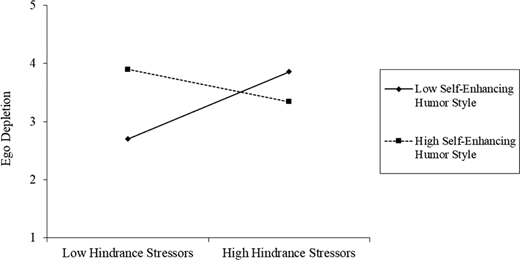
Interactive effect between l hindrance stressors and employees’ self-enhancing humor style on employees’ ego depletion
Interactive effect between l hindrance stressors and employees’ self-enhancing humor style on employees’ ego depletion
To test H4 in an integrated manner, we used Hayes’s (2013) Process for examining the mediating effect of one-standard deviation above and below the average value of the moderator (with 5,000 resamples). Besides, we used an inference test called the “index of moderated mediation” (Hayes, 2015) to test whether the overall indirect effect depends linearly on the moderator.
As can be seen from Table 3, the indirect effect is significant when employees’ self-enhancing humor style is low, but not significant when it is high. The index of moderated mediation was 0.16 (95% CI = [0.05, 0.29]). Overall, the results supported H4.
Conditional indirect effect and index of moderated mediation
| self-enhancing humor style | Indirect effects | Boot SE | LL 95% CI | UL 95% CI |
|---|---|---|---|---|
| Low self-enhancing humor style (−1 SD) | −0.14 | 0.05 | −0.26 | −0.06 |
| High self-enhancing humor style (+1 SD) | 0.04 | 0.03 | −0.02 | 0.11 |
| Index of moderated mediation | ||||
| Index | SE (Boot) | Boot LLCI | Boot ULCI | |
| 0.16 | 0.06 | 0.05 | 0.29 | |
Notes:
N = 226. Bootstrap sample size = 5,000; LL = lower limit; CI = confidence interval; UL = upper limit
Discussion
Drawing from the ego depletion theory, we developed and tested a moderated mediation model to illustrate the function ego depletion in explaining the impact of hindrance stressors on employees’ knowledge sharing behaviors. It was shown that hindrance stressors’ depleting effect could exert a detrimental influence on the knowledge sharing behaviors of employees. Furthermore, we identified employees’ self-enhancing humor style as a moderator of the mediating effect. In the following paragraphs, the theoretical and practical implications of this study are discussed.
Theoretical contributions
First, by identifying a novel mechanism that hinders employees from sharing knowledge in the workplace, this study makes a contribution to the literature regarding knowledge sharing behaviors. Several studies have investigated the factors preventing knowledge sharing in organizations (Chae, Park & Choi, 2019; Gagné et al., 2019). Complementing previous research, we argued that restraint of knowledge sharing stems from employees’ inabilities to execute self-controlled initiatives. Even though the subject of this study were only hindrance stressors in the workplace, the depletion of self-control resources was identified as a key inhibitor of knowledge sharing, which underlines the great value of sustaining self-control resources for employees over time. Thus, ego depletion theory may offer a complementary lens on the antecedents of knowledge sharing behaviors (e.g. the variables drawn from self-determination theory, such as job autonomy) and open doors to a set of antecedents of knowledge sharing, such as upper management disruptive behaviors, sleep deprivation and interpersonal injustice behaviors.
Second, the findings enrich our knowledge on the detrimental consequences of hindrance stressors. Research on hindrance stressors and job demands has emphasized its negative effects on organizational citizenship behaviors and performance (Pooja, De Clercq & Belausteguigoitia, 2016; Van Laethem et al., 2019), as well as positive effects on emotional exhaustion (Oppenauer & Van De Voorde, 2018) and unethical behaviors (Mawritz, Folger & Latham, 2014). The present research verified that hindrance stressors may suppress an employee from engaging in knowledge sharing behaviors. Therefore, the current study provides an additional contribution to the literature on hindrance stressors and job demands as well.
Finally, using a moderated mediation model, our research suggests how the mediating effect of ego depletion depends on the level of employees’ self-enhancing humor style. This is the first time, to our knowledge, to investigate the moderating role of humor style in job demands-outcome relationships. This finding underscores the role of employees’ humor style as an important variable of inter-individual variation in organizational behavior.
Practical implications
With regard to practical implications, it is suggested that the self-control perspective of knowledge sharing behaviors offers a promising avenue for interventions which can be used by organizations to alleviate the potentially deleterious impacts of hindrance stressors upon employees. For instance, some studies have indicated that organizations attempt to reduce bureaucracy and optimize cumbersome administrative procedures by improving job design, reducing task ambiguity and reforming organizational design. Given numerous positive consequences of knowledge sharing and the ineffectiveness of hindrance stressors, organizations might get huge benefits from reducing employees’ hindrance stressors.
Moreover, given that depletion of resources for self-control serves as a potential inhibitor to knowledge sharing, this study demonstrates that knowledge sharing behaviors could likewise be rehabilitated through the replenishment employees’ resource of self-control. Organizations may, for example, facilitate employees’ recovery of self-control resources by granting them a chance for a short break during work (Hunter & Wu, 2016; Kim, Park & Niu, 2017). Likewise, this study suggests that self-enhancing humor may make it easier for employees to replenish exhausted self-control resources.
Limitations and directions for future research
Our study has several limitations. First, while the mediating and dependent variables in this study were rated by different participants (i.e. employees and their supervisors) and yet they were gathered concurrently. Thus, knowledge sharing could be theorized to drive resource depletion. Therefore, the research design limits us to inferring causal effects. The results of our study do not necessarily suggest that ego depletion accounts for the decrease in employees’ knowledge sharing behaviors, as one might argue that knowledge sharing could be theorized to drive resource depletion. However, further studies may employ a longitudinal research design or field experiment to confirm the causal links between the variables under examination in the present research.
Second, ratings for hindrance stressors, ego depletion and self-enhancing humor style were all derived from employees. Hence, our findings are inevitably confounded by common method variance. Nevertheless, we have attempted to mitigate the concerns arising from common method variance by measuring them at different times, and obtaining data on an employee’ knowledge sharing behaviors from his/her supervisor. Furthermore, there is an argument that common method variance is unlikely to account for the statistically significant results of the moderating effect analysis (Schaubroeck & Jones, 2000). Therefore, it can be conceived that the results of the present research were not significantly influenced by common method variance.
In addition to methodological concerns, this study also suggests several future research directions worth exploring. While we have only investigated the depletion of resources for self-control with respect to scenarios of hindrance stressors, other constraints could also deplete employees’ self-control resources and lead to a retreat of knowledge sharing behaviors. For instance, impression management requests employees to behave in such a manner as to be socially desirable and to hide the real needs and emotions during interactions with colleagues, supervisors and customers (Bolino, Kacmar, Turnley, & Gilstrap, 2008; Grant & Mayer, 2009). The continuous surveillance of self-image and inhibition of undesired conduct may probably exhaust self-control resources and result in a decrease in knowledge sharing behaviors. Interestingly, several recent studies have indicated that enacting helping behaviors could unexpectedly also cause a depletion of self-control resources as complying with rules needs self-control resources (Lin, Koopmann & Wang, 2020; Trougakos, Beal, Cheng, Hideg, & Zweig, 2015). As a result, employees may confront a dilemma. From one side, they might wish to be a good soldier, offering help whenever possible. From the other side, undertaking such actions might cause a depletion of self-control resources and subsequently undermine other initiatives, such as knowledge sharing behaviors. These issues deserve academic attention in future research.
Conclusion
Operating in a competitive, uncertain and complex commercial environment, knowledge sharing is essential to ensuring the effectiveness of organizations. In the present study, the results illustrated how the resource-depleting hindrance stressors in the workplace may hinder employees from sharing knowledge, and deprive them of the resources they would otherwise use to exhibit knowledge sharing behaviors. The study highlights the value of a self-control perspective in explaining proactive behaviors in the workplace and provided new evidence on the detrimental consequences of employees’ ego depletion.
This research was supported by a grant from the National Natural Science Foundation of China (Project No. 71772135), the Ministry of Education of Humanities and Social Science project (No. 15YJC630050).

