The study investigates the effect of ethical leadership on administrative corruption, focusing on the mediating role of job satisfaction in Pakistan.
Survey data was collected from 402 public employees in the local government of the Gilgit-Baltistan (GB), Pakistan. Hypotheses were tested using confirmatory factor analysis and structural equation modelling (SEM) in SPSS and AMOS23.
The findings demonstrated adequate model fitness, indicating that job satisfaction acts as a critical mediator between ethical leadership and the reduction of corruption among public employees. Ethical leadership fosters job satisfaction by enhancing employees’ intrinsic satisfaction in serving the public, thereby reducing their inclination to engage in corruption.
This study contributes to the literature on ethical leadership in public administration by examining how public managers’ ethical leadership shapes subordinates’ job satisfaction and mitigates workplace corruption in the public sector of a developing Muslim country in South Asia.
Introduction
Ethical practices and behavior have been a focus of scholarly and media attention (Gan, 2018) due to numerous reports of unethical issues and scandals in both private and public organizations (Kaptein, 2011). Unethical behavior in the workplace is a critical challenge for management in every sector, particularly a specific sort of unethical conduct known as corruption. Corruption is a significant global challenge for governments, especially in low-income countries, undermining public trust, economic growth, and good governance.
Despite persistent global efforts to curb corruption, it remains a deeply entrenched challenge in public sectors, especially in developing countries like Pakistan. Traditional anti-corruption strategies, such as institutional reforms, legal frameworks, and disciplinary measures, have achieved limited success due to systemic weaknesses, implementation gaps, and the cultural acceptance of informal practices (Mungiu-Pippidi, 2015), emphasizing the need to explore behavioral factors that can promote ethical conduct from within institutions. Regarding behavior changes, Leadership is increasingly recognized as a critical driver of ethical behavior in organizations (Leroy et al., 2012). Academics have explored various leadership theories to promote integrity, such as transformational leadership, which inspires followers through a shared vision, and values (Burns, 1978). Similarly, servant leadership emphasises serving others (Greenleaf, 1970), while authentic leadership underscores self-awareness and relational transparency (Luthans and Avolio, 2003). These leadership styles often lack explicit mechanisms for enforcing norms, ensuring ethical accountability, and rewarding moral conduct. Without these mechanisms, it is harder to establish a causal chain of relationships. On the other hand, ethical leadership, as presented by Brown et al. (2005), directly addresses these dimensions by emphasizing the leader’s role in demonstrating normatively appropriate behavior and promoting ethical standards through two-way communication, fair decision-making, and effective reinforcement mechanisms.
In recent years, as the public sector has faced increasing ethical challenges and scandals, scholars in public administration have progressively focused on ethical leadership as a potential driver of ethical conduct within organizations. The growing interest is driven by the identification that ethical leadership is crucial for promoting integrity and accountability in the public sector (Reddick et al., 2024). A growing body of studies has explored the association between ethical leadership and general adverse workplace behaviors, including deviant behavior, counterproductive work behavior, bullying, and job burnout (Mayer et al., 2009; Stouten et al., 2010), while enhancing positive outcomes such as job satisfaction and psychological well-being, factors that are essential for reducing corrupt practices (Kim, 2023; Manara et al., 2020).
Despite this potential, the specific role of ethical leadership in mitigating corruption remains understudied, particularly in the context of developing countries. Unlike other deviant behaviors, corruption entails abuse of public office for personal gain and has broader institutional and societal implications, particularly in the public sector. Thus, it is conceptually and practically unique from other forms of misconduct and merits focused investigation. Although there is emerging evidence that ethical leadership reduces deviance and misconduct (Mayer et al., 2009; Stouten et al., 2010), empirical investigations rarely focus on corruption as a distinct behavioral outcome, nor do they sufficiently address why and how ethical leaders shape subordinates’ moral behavior through job satisfaction. Accordingly, this study addresses the gap by investigating ethical leadership as a mechanism to reduce subordinate corruption through the mediating effects of job satisfaction. By putting this inquiry within the context of the public sector in Pakistan, this study contributes to ethical leadership theory and the broader literature by expanding the theoretical and practical understanding of the role of ethical leadership in curbing corruption in non-Western contexts. More specifically, this study aims to achieve the following objectives:
- 1.
To examine whether there is a direct relationship between ethical leadership and corruption.
- 2.
To assess whether ethical leadership is related to job satisfaction.
- 3.
To test whether job satisfaction mediates the association between ethical leadership and corruption.
The study extends the ethical leadership framework of Brown et al. (2005) by proposing and testing a mediated pathway in which ethical leadership boosts job satisfaction, thereby mitigating subordinates’ propensity for corruption. Additionally, it addresses the gap in ethical leadership theory, which overlooks the role of effective job attitudes in achieving behavioral integrity outcomes. Also, the study contributes to the geographical and contextual gaps in scholarly literature. Existing evidence is overwhelmingly based on Western-centric, high-governance capacity contexts. In contrast, corruption in the public sector is more systemic in developing countries like Pakistan, where leadership behavior may interact differently with institutional norms, resource constraints, and cultural expectations. Exploring these dynamics enriches the generalizability of ethical leadership theory and offers actionable insights for leadership development and anti-corruption strategies in non-Western settings.
The paper is structured as follows: the next section covers the theoretical framework and a review of concepts, with a focus on social learning theory, ethical leadership, job satisfaction, and corruption. Then, hypotheses are developed. Next, it presents the sources of data and the methods adopted in data collection and analysis. After that, the study’s results and findings are presented, followed by its theoretical and practical contributions and conclusion.
Theoretical background and hypotheses development
Social learning theory
Social learning theory (SLT), initially presented by Bandura and Walters (1977), is globally regarded as one of the most influential theories of learning and behavioral development, with extensive application across disciplines such as criminology, psychology, and management (Edinyang, 2016). In the last few years, scholars within the field of public administration have increasingly adopted social learning theory to explore behavioral dynamics in public sector organizations (Siddiki et al., 2017). According to Bandura and Walters (1977), social learning theory postulates that employees learn by observing and imitating the behaviors of role models in the workplace. This process is known as observational learning, which includes four important processes: attention, retention, reproduction, and motivation.
Brown et al. (2005) underscored that the conceptual foundation of ethical leadership is deeply rooted in social learning theory. This theory provides a fundamental insight into how leaders influence follower behavior by modeling appropriate conduct. Prior studies have consistently demonstrated that individuals tend to emulate the behaviors of credible and ethical role models, leading to observable changes in workplace behavior (Bandura and Walters, 1977). Ethical leaders, characterized by honesty, integrity, and fair decision making, function as moral exemplars within organizational settings (Brown et al., 2005). Accordingly, social learning theory has become the predominant theoretical lens through which the influence of ethical leadership on subordinates’ behavior is examined.
Relationship between ethical leadership and corruption
Ethical leadership is defined by Brown et al. (2005, p. 120) as “the demonstration of normatively appropriate conduct through personal action and interpersonal relationships, the promotion of such conduct to followers through two-way communication, reinforcement, and decision making.” According to Brown et al. (2005), ethical leaders operate in dual capacities: as moral individuals and as moral managers. As moral individuals, ethical leaders demonstrate high moral standards, honesty, and integrity, thereby setting an exemplary standard for their followers. Meanwhile, as moral managers, ethical leaders set ethical standards, norms, values, and policies and implement them in the organization. According to social learning theory, this leadership style assumes that subordinates learn appropriate conduct by observing the attitudes and behaviors of their supervisor as a role model in the workplace. When a supervisor consistently follows organizational rules, upholds ethical codes, and exhibits integrity, their followers are more likely to replicate such conduct. Therefore, ethical leaders set the tone for ethical behaviors and serve as influential role models who reinforce accountability, transparency, and justice. These factors have been demonstrated as a potential driver to reduce the prevalence of corruption within organizations, including administrative corruption, which is defined as “corrupt acts involving public servants/bureaucrats in their dealings with either their supervisors, during the implementation of public policies, or while interacting with the public for service delivery.” (Mugellini et al., 2021, p. 15). Corruption is a double-edged sword, it not only erodes an institution from within affecting its operations, but it also deteriorates public trust, leading people to resort to informal institutions rather than trusting the government. Emerging studies highlight the crucial role of ethical leadership in combating corrupt practices. For example, Zhu (2008) reveals that ethical leaders encourage principled decision-making while discouraging unethical behavior, reducing conditions that may facilitate corruption (Lee et al., 2022).
A growing body of studies further supports the influence of ethical leadership in mitigating unethical conduct (Paterson and Huang, 2019). Ethical leaders can act as moral exemplars, promoting integrity, fairness, and transparency that discourage misconduct. Prior studies have found that ethical leadership is negatively associated with deviant behavior, service sabotage, counterproductive behaviors, and workplace bullying (Mayer et al., 2009; Stouten et al., 2010). However, ethical leadership may not always eliminate unethical conduct, particularly when contextual and organizational factors interfere with leadership effectiveness. For instance, Sun et al. (2024) found that ethical leadership has a negative relationship with employees' uncertainty; however, this association becomes non-significant when leaders’ close monitoring is high. Likewise, Al Halbusi et al. (2022) disclose that organizational climate moderates the influence of ethical leadership, meaning that in environments where unethical behavior is normalized or rewarded, the effect of ethical leadership may be weakened. These contradictory findings highlighted the need to critically re-examine the assumption that ethical leadership affects unethical conduct and the underlying mechanisms that govern this effect. Our study attempts to study this mechanism through the following hypothesis:
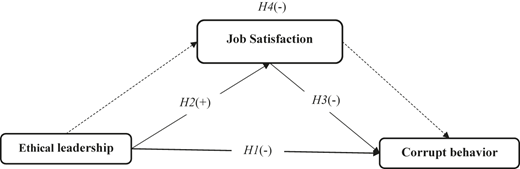
Ethical leadership is directly and negatively related to corruption.
Ethical leadership and job satisfaction
Drawing on social learning theory, ethical leadership is conceptualized as a behavioral model through which leaders transmit values such as fairness, honesty, and integrity, which subordinates observe, internalize, and follow (Bandura and Walters, 1977). When subordinates perceive that their supervisors consistently reveal respect, support, and moral integrity, they develop a psychological sense of obligation to reciprocate through positive workplace behaviors, including fostering job satisfaction (Ren and Chadee, 2017; Aunin et al., 2024).
Ethical leadership influences job satisfaction through several mechanisms. First, ethical leaders provide clear moral guidance and act as role models for their followers (Brown et al., 2005). They reduce ambiguity and increase clarity regarding organizational expectations by setting a vivid standard for acceptable or unacceptable conduct. This clarity contributes to structured and psychologically safe working conditions supporting employee satisfaction. Secondly, ethical leaders treat their subordinates with dignity and fairness, promoting a respectful work environment. Such ethical environments boost subordinates’ positive attitudes towards the organization, enhancing their engagement and satisfaction at the workplace. Additionally, empirical studies further support these relationships, revealing that ethical leadership is positively associated with an ethical climate, innovative work behavior (Islam et al., 2024b), and work engagement (Islam et al., 2024a). Given these insights, our study proposes the following hypothesis:
Ethical leadership is positively related to job satisfaction.
The mediating role of employee satisfaction
In addition to its direct relationship to corruption, ethical leadership may indirectly influence subordinates' corruption through the mediating effects of job satisfaction. Building on Hypothesis 2, which posits a positive relationship between ethical leadership and job satisfaction, this section reviews theoretical and empirical studies that examine how job satisfaction may mitigate corruption, thereby contributing to anti-corruption efforts in organizational settings.
Job satisfaction is defined as “a pleasure or positive emotional state resulting from the appraisal of someone’s or job experience, indicating that both emotional and cognitive processes may be involved” (Locke, 1976, p. 1304). It is globally recognized as a key determinant of employees’ behavior and organizational performance (Qing et al., 2020). It has several factors, including working relationships, job security, workload (Taylor and Westover, 2011), remuneration, promotion prospects, and connection with organizational principles (Lumley et al., 2011). Job satisfaction is an employee’s response to various aspects of the job, including the work environment, job nature, and peer relationships (Lee and Kim, 2023).
In the existing scholarship, several studies consistently provide evidence of the positive relationship between job satisfaction and employee motivation, commitment, loyalty, and performance (Andreas, 2022; Inuwa, 2016). On the other hand, ethical leadership has been recognized as a crucial factor in fostering job satisfaction by creating a workplace environment founded on trust, fairness, and mutual respect. In such settings, subordinates are more engaged, have greater morale, and are less likely to engage in unethical conduct (Gan, 2018). Thereby, the study hypothesizes the following associations:
Job satisfaction is negatively related to corruption.
Job satisfaction mediates the relationship between ethical leadership and corruption.
Figure 1 presents the proposed conceptual framework of this study.
Methods and materials
Research context
Gilgit-Baltistan (GB), Pakistan, is the site for the research study because of its unique culture, socio-economic background, and administrative structure, which provide a distinct context within the public sector in Pakistan. It is globally acknowledged that corruption undermines governance, transparency, socio-economic development, and public trust. This issue is even more critical in the context of GB, a region characterized by its unique political and administrative status, limited institutional autonomy, and substantial reliance on the public sector for both employment and service delivery. The 2024-25 audit report of the GB government revealed financial irregularities of more than 122.59 billion rupees (approximately USD438 million) in various departments (Tanveer Abbas, 2025). Within such weak governance, the conduct of public officials directly influences citizens’ daily lives, making the study of corruption and its possible remedies highly relevant.
Despite its distinct governance status and high corruption, this region has received little scholarly attention in the fields of leadership and corruption. Most existing studies have focused on federal or provincial contexts, thereby overlooking GB. The study addresses this critical gap by offering region-specific empirical evidence and advancing the understanding of how ethical leadership can contribute to mitigating corruption in the public sector in GB.
Participants and procedure
The study employed a quantitative survey to investigate whether and how ethical leadership influences the control of employees’ corrupt behavior in Pakistan’s GB region. A structured questionnaire was used to collect data, employing the random sampling method, as this approach provides an equal chance for all respondents to be selected and minimizes selection bias. Data was collected from public employees working in local government in GB. Five hundred questionnaires were distributed in person to respondents, and four hundred ten were returned, yielding a response rate of 82 percent. Eight questionnaires were eliminated due to incomplete responses. Finally, 402 responses were used in the data analysis. A sufficient sample is critical for drawing meaningful findings and accurate study conclusions. Considering this, the authors calculated the minimum required sample size for this study using the G*power analysis approach. The findings suggest that a sample size of 89 is the minimum required for this examination. The study covers 402 respondents, a sufficient sample size for investigation.
Most respondents were male (325), 80.8 percent, and (77), 19.2 percent were female. In terms of experience, (56) 13.9 percent have less than one year, (80) 19.9 percent have 2-5 years, (125) 31.1 percent have 6-9 years, (96) 23.8 percent have 10 -13 years, and (45) 11.2 percent respondents have more than 13 years. Regarding educational background, the distribution is as follows: Bachelor’s (201) 50.0 percent, Master’s (156) 38.80 percent, PhD (9) 2.2 percent, and others (36) 9 percent.
Instrumentations
Ethical leadership
Ethical leadership (Cronbach’s alpha = 0.841) was measured using five items originally developed by Brown et al. (2005) to assess public employees’ perceptions of their managers’ ethical leadership behaviors. Participants were asked to evaluate the managers' honesty, credibility, trust, and fairness using a five-point Likert-type scale, “1 = strongly disagree to 5 = strongly agree”. For example: “My manager is a decent person who does not seek personal interests” and “My manager practices what he preaches”.
Corruption
The authors adopted the five scales from Gorsira et al. (2018) and edited them according to the study’s requirements to measure corruption (Cronbach’s alpha = 0.897). For example, did you notice or hear about someone at the workplace (1) taking or demanding a bribe? (2) “Receiving gifts or personal favors from a client in exchange for a service” using a five-point Likert scale ranging from “1 = never to 5 = very often”.
Job satisfaction
Job satisfaction (Cronbach’s alpha = 0.724) was measured using a three-item scale adopted from Qing et al. (2020). This study assessed perceived job satisfaction by asking participants to indicate their level of agreement with a series of questions concerning their satisfaction using a five-point Likert scale, ranging from “1 = strongly disagree to 5 = strongly agree”. For example, “I am satisfied with my job”.
Analytical strategy
The study employed data analysis using SPSS and AMOS 23. First, we employed descriptive and correlation analyses to discover the mean, standard deviation, and correlation. Second, we tested the reliability and validity of the variables using a confirmatory factor analysis approach. Third, we conducted a model fitness test. Finally, we empirically tested the proposed hypotheses using structural equation modeling. In addition, we used SEM with bootstrapped standard errors based on 5000 samples to test the 95 percent significance levels, leading to more robust findings.
Data analysis and results
Descriptive statistics
Table 1 shows the descriptive statistics, including means, standard deviations, and Pearson’s Correlations of the variables. The results show a statistically significant positive correlation between ethical leadership and job satisfaction. However, a negative correlation exists between ethical leadership and job satisfaction in the presence of corruption. For example, ethical leadership is negatively related to corruption (r = -0.400, p < 0.01) and exhibits a positive relationship with job satisfaction (r = 0.365, p < 0.01). Meanwhile, job satisfaction is negatively associated with corruption (r = -0.322), p < 0.01).
Confirmatory factor analysis
Confirmatory factor analysis was conducted to examine the reliability and validity of each scale. Table 2 provides the factor loadings (FLs), composite reliability (CR), and average variance extracted (AVE) for all the variables. Although we determined the Cronbach’s alpha, but it is not a robust measure of reliability; therefore, we have examined the CR, which should be greater than 0.70 (Hair et al., 2006). This study accounts for it in a range of 0.812 to 0.870, showing no reliability issues. To establish the convergent validity, we assessed the AVE, which must be greater than 0.50. The study reports the AVEs for all three constructs in the ideal range of 0.573 to 0.592. The study also assessed discriminant validity by comparing the square root of the average variance extracted (AVE) with inter-variable correlations. Ideally, the square root of the AVE value must be above the correlation values among the constructs. The study reports that the square root of the AVE values is greater than the inter-constructs’ correlation values, as shown in Table 3. For instance, the correlation between ethical leadership and job satisfaction is 0.36, which is less than the square root of the AVE.
Model fitness
The model fitness has been checked first for proposed model testing through structural equation modeling (SEM). This study performed confirmatory factor analysis (CFA) using SPSS and AMOS23 software to determine the model fitness of all the constructs. According to the global standard, the chi-square divided by the degree of freedom (x2/DF) must be less than 3 (Hair et al., 2006). This study reports that the value of x2/DF is 1.65, indicating a better result. We also determined other criteria, such as the goodness-of-fit index (GFI), the Adjusted Goodness-of-Fit Index (AGFI), the Comparative Fit Index (CFI), the Tucker-Lewis Index (TLI), the Non-Normed Fit Index (NFI), and the Root Mean Squared Error Approximation (RMSEA). The ideal GFI, AGFI, CFI, TLI, and NFI values must be greater than 0.90 (Hair et al., 2006). The study reports that all the values sound greater than the global criteria. The RMSEA value must be less than 0.070 (Hair et al., 2006); however, the study reports a value of 0.040. Details are presented in Table 4.
Structural model results and hypothesis testing
A structural equation modelling approach was used to test the proposed hypotheses using AMOS 23 software. Four hypotheses were tested, focusing on the direct effect, indirect association (mediating effect), and total effect. Tables 5 and 6 show the estimates of various associations.
The first claim is associated with the direct relationship between ethical leadership and subordinate corruption, and the finding shows that ethical leadership has a negative impact on corruption (β = -0.450, t = -4.932, p < 0.001), which is statistically significant, thereby supporting Hypothesis 1. Hypothesis 2 claimed a positive relationship between ethical leadership and job satisfaction, and the data analysis shows a positive relationship (β = 0.510, t = 6.975, p < 0.001), which is statistically significant, supporting Hypothesis 2. Hypothesis 3 claimed that job satisfaction is negatively related to subordinate corruption, and the result (β = -0.447, t = -4.981, p < 0.001) supported Hypothesis 3. Finally, Hypothesis 4 claims that the indirect effect of ethical leadership on subordinates' corruption is mediated by job satisfaction. To test this indirect effect, we used the bootstrap resampling technique 5,000 times in SPSS and AMOS23. The findings reported the direct effects, indirect effects, and total effects values, as well as a 95 percent confidence intervals and significance levels. Table 6 shows that the indirect effect of ethical leadership on corruption (β = -0.155, p < 001, Z = -3.780) is statistically significant. The direct relationship between ethical leadership and corruption (β = -0.306, p < 0.001, Z = -4.5) is also significant; hence, Hypothesis 4 is supported with partial mediation.
Discussion
Ethical leaders play a vital role in organizational management as moral agents. Drawing on social learning theory, this study examines the association between managerial ethical leadership behavior and subordinates’ corrupt behaviors by analyzing job satisfaction as a mediator. The findings reveal that an increase in ethical leadership is associated with a decline in subordinates’ corruption. More specifically, the finding demonstrates that job satisfaction mediates the association between ethical leadership and subordinates' corrupt behaviors.
This study makes a significant contribution to the public administration literature in several ways. First, most prior studies have found a negative relationship between ethical leadership and unethical behavior (Kim, 2023; Paterson and Huang, 2019). However, corruption in public sector organizations as a distinct type of unethical conduct has remained understudied. This study fills the gap by examining administrative corruption within the context of public administration, investigating the role of ethical leadership in reducing administrative corruption in developing countries like Pakistan, and thus testing its generalizability as a concept. This study develops a framework and empirically tests it with an original dataset from local officials of GB-Pakistan’s government.
Secondly, extant studies on corruption have generally focused on identifying the causes and consequences, with limited focus on anti-corruption strategies. This study advances scholarship by examining how ethical leadership mitigates administrative corruption in the public sector, taking into account the potential mediating effect of job satisfaction. While prior studies explored the link between ethical leadership and unethical conduct by focusing on the mediating effect of variables like PSM, ethical climate (Al Halbusi et al., 2022), and psychological well-being (Lee and Kim, 2023), the role of job satisfaction as a potential mediator has not been empirically tested. The study bridged this gap with theoretical underpinnings that extend beyond the context of Pakistan, as it suggests that job satisfaction explains one of the underlying mechanisms through which ethical leadership reduces unethical conduct. Honesty, integrity, and fair decision-making are key traits of leaders that contribute to employees’ job satisfaction.
The findings show that public servants reporting higher levels of job satisfaction are less likely to be engaged in corruption which suggests that subordinates’ job satisfaction is a crucial predictor for curbing corruption in public organizations. Employees who are satisfied with their job have a high commitment to following the organization’s rules and regulations and are less likely to be involved in corruption.
Additionally, this study brings ethical leadership, job satisfaction, and corruption together in a non-Western context (Pakistan). Prior ethical leadership studies have typically overemphasized Europe and Western countries (Mayer et al., 2009; Stouten et al., 2012). However, novel examinations uncovering other cultural contexts, particularly non-Western contexts, are essential to generalize the robustness of the theory. The research was conducted in Pakistan, a high-power distance society and a Muslim majority (“Islam is a predominant religion”) country in South Asia, representing a developing country in non-Western contexts.
To summarize, this study makes three contributions. First, it argues that public administration literature needs to broaden the conceptualization of explanatory variables for corruption. This study demonstrated that ethical leadership has a strong negative relationship with administrative corruption in the public sector. Second, job satisfaction is argued as a novel potential underlying mechanism in the ethical leadership-corruption relationship. We tested the job satisfaction hypothesis and found support for its relevance for reducing corruption. Finally, this study provides empirical evidence from the public sector context of a developing country, thus addressing a gap in cross-contextual studies with potential generalizability across contexts as the proposed mechanism can be applied in other contexts.
From a practical perspective, this study offers significant implications for public managers, policymakers, and particularly Pakistan’s government, which is actively seeking to combat corruption in public organizations. First, our study provides evidence that ethical leadership effectively mitigates corruption in the public sector, which is essential for fostering public service and enhancing governance. It highlights the importance of training and evaluation of government employees in leadership positions to avoid the pitfalls of losing public trust, economic stagnation, and a weak rule of law due to corruption. This study advocates for a mechanism that not only ensures the rigorous selection of individuals for higher government positions but also promotes transparency in this process. This approach aims to attract people with integrity, openness, and fairness to these positions, thereby fostering an environment that promotes job satisfaction. Second, the process of ensuring ethical leadership does not stop with selecting ethical leaders, but it also includes setting up processes such as establishing clear ethical standards, providing transparent ethical guidelines, and, most importantly, holding employees accountable for unethical conduct.
This study reveals the significant role of job satisfaction in reducing employees’ inclination to engage in corruption. This finding suggests that boosting job satisfaction within an organization can serve as an additional mechanism for mitigating unethical conduct. Public managers, therefore, need to treat subordinates with dignity, equity, and fairness, which enhances employees’ job satisfaction. The public sector has to provide people-centered practices to foster job satisfaction (Kim, 2004). To summarize, the current study’s findings offer detailed insights into cultivating ethical leadership, enhancing accountability, and promoting job satisfaction, thereby mitigating the risks of unethical conduct and enhancing public service delivery and good governance.
Conclusion
Ethical leadership has been a subject of debate among scholars due to its relevance to both the public and private sectors. Corruption scandals not only cost financial setbacks, but they also erode trust in the governing structure. This erosion of trust affects societies, and the public tends to engage in games of defection rather than cooperation. Although prior studies have explored the role of ethical leadership in reducing employees’ unethical behaviors, this study focuses on a specific category of unethical conduct known as corruption which is a global issue, particularly in low-income countries, that undermines public trust, governance, and overall economic growth.
This study found that job satisfaction serves as a strong link through which ethical leadership reduces corruption among public employees. In addition, ethical leadership fosters job satisfaction in a way that enhances employees’ intrinsic satisfaction in serving ethically, thereby decreasing their inclination to engage in corruption. This study extends the ethical leadership framework of Brown et al. (2005) by proposing and testing a mediated pathway in which ethical leadership enhances job satisfaction, which in turn leads to reduced corruption among subordinates. By doing so, it addresses an important gap in ethical leadership theory, which has rarely considered how positive job attitudes translate into behavioral integrity outcomes. Furthermore, this study contributes to the geographic and contextual gaps in the scholarship. Existing evidence is overwhelmingly based on Western, high-governance contexts. In contrast, corruption in the public sector is more systemic in developing countries like Pakistan, where leadership behavior may interact differently with institutional norms, resource constraints, and cultural expectations. Exploring these dynamics enhances the cross-cultural validity of ethical leadership theory and provides actionable insights for leadership development and anti-corruption strategies in non-Western settings.
Despite its contributions, this study has limitations. First, generalizability is constrained as data were collected only from GB, Pakistan, a region with unique cultural and historical characteristics. However, since ethical leadership and job satisfaction are not context-bound, the findings may extend to similar settings. Further research should test the model in different contexts, including most- and least likely cases. Second, the use of cross-sectional data limits causal inference; longitudinal designs would strengthen causality. Finally, only job satisfaction was examined as a mediating variable due to data availability. Further studies could explore additional mediators or moderators, such as ethical climate, organizational culture, or public service motivation.