This mixed-method, collaborative study investigated parents’ perceptions of STEM (Science, Technology, Engineering and Mathematics) learning through use of STEM kits specifically designed for in-home use by parents and preschool-age children.
Parents with a child attending a community-based childhood development center and ranging in age from three to four were invited to participate. Data were analyzed for the participants’ surveys, which were completed at two different times (pre and post) for this study.
After utilizing the STEM materials with their child over a two-week period, the parents’ perceptions of STEM content changed. The results indicate that regardless of the at-home STEM materials, positive outcomes for their child occurred, including the likelihood that their child would pursue additional STEM opportunities.
With a small sample size and a short timeframe for conducting the study, the results lack generalizability. The findings add information about the effectiveness of STEM materials for preschoolers while providing insight into educational opportunities in home environments.
As the nation addresses workforce shortages in many areas, including STEM, rethinking STEM education during the first five years is important. The more opportunities for young children to engage in meaningful STEM, the greater the potential to pique interest and develop critical thinking skills.
Introduction
STEM (Science, Technology, Engineering and Mathematics), “reflects an interdisciplinary approach to learning where content is coupled with real-world lessons as learners apply (content) in a context” (Tippett & Milford, 2017, p. 68). Beyond the foundational skills that are formed across the four content disciplines, STEM emphasizes problem solving, reasoning, and critical thinking. Young children begin to develop foundational STEM skills before ever beginning formal schooling (Simoncini & Lasen, 2018). In fact, toddlers new to oral language frequently pose “why” questions that pertain to natural wonders and aspects of STEM (Clements & Sarama, 2016). Moreover, early engineering behaviors are often present in young children's play (Bairaktarova, Evangelou, Bagiati, & Brophy, 2011) when they construct things with accessible materials (e.g. blocks, gears) and then make improvements to their creation.
Professional development schools
Providing learning opportunities through collaborative work, reflection and research is an essential component for education and successful Professional Development Schools (PDS). This article highlights how one PDS university in the Midwest engages in research to enhance educational practices and learning. The National Association for Professional Development Schools (NAPDS) Nine Essentials, 2nd edition (National Association for Professional Development Schools, 2021) addressed in this study centers on Essential #5, a community that engages in collaborative research and participates in the public sharing of results in a variety of outlets. Following the recent expansion of the university’s campus to include a community-based childhood development center and a STEM classroom in the College of Education, two university students along with teacher educators collaborated to investigate the early implementation of STEM. The undergraduate researcher had the opportunity to share the findings with an Early Childhood Research Advisor who serves as a liaison between the community-based childhood development and university. In addition, the findings were shared at a campus-wide research conference.
Literature review
Productive habits of mind
Quality STEM experiences in the early years are influential for STEM-related habits of mind. These habits include curiosity, critical thinking, communicating, collaborating, persistence and problem solving (Clements & Sarama, 2018). According to Moore et al. (2014), high-quality STEM learning should emphasize teamwork and critical thinking that builds on opportunities for productive failure and redesign. For example, using newspaper and cardboard to create a table that can support weighted objects invites the learner to solve an age-appropriate problem, young children are actively engaged in critical thinking, using materials, creating, evaluating and redesigning. Hence, young children learn to persist when faced with challenges, forming important dispositions necessary for future success in school and life. Young children who demonstrate dispositions such as grit and open-mindedness are more likely to develop and transfer STEM-related habits across different settings and situations (Clements, Chih-Ing Lim, & Sarama, 2021).
Cross-curricular learning
STEM is a way of thinking that promotes cross-curricular learning, collaboration and project-based education. This “way of thinking” stimulates creative and critical thinking for the learner. Educators have acknowledged the value of cross-curricular instruction for piquing the learners’ interests and developing foundational skills such as math readiness, vocabulary development and literacy skills (Gerde, Schachter, & Wasik, 2013). Recent work supported by the National Science Foundation described connections between STEM learning and other curricular content areas and skills, including reading and executive functions. Furthermore, cross-curricular connections were noted between math knowledge and executive functions (McClure et al., 2017). While cross-curricular learning holds potential for positive outcomes for young children, it is important to remember that educators must have more than just discipline specific content knowledge (e.g. math, science). Particularly when working with young children across multiple age-ranges, which is common in the early years, they must have knowledge of developmentally appropriate practices and lesson planning integration (American University, 2020).
Career development
The “catalyst” for learner engagement and interest is opportunity (Tay, Salazar, & Lee, 2018, p. 8). It is not enough to have young children create, build and model; instead, they need to be engaged in tasks that reflect real-world situations and experiencing STEM through multiple senses. In early childhood, STEM learning may influence the children’s attitudes for future schooling/career choice. In fact, learners who are “intellectually curious” about STEM are more likely to enter STEM careers (e.g. engineers, technicians, scientists, architects). (Simoncini & Lasen, 2018). In, Chambers, Rehill, Kashefpakdel and Percy (2018), reported that young children formed “sophisticated” and “thought-through ideas” about their future careers. This research further outlined multiple factors impacting young children’s (i.e. ages 7 – 11) future career aspirations, including: gender stereotyping, social background, parent/family member career choices and careers portrayed through media (i.e. tv, radio, movies). Importantly, Chambers et al. (2018) noted parental and/or extended family members as the most influential in young children’s career aspirations.
Parental engagement
Parent engagement in developmentally appropriate activities is central to supporting young children’s social-emotional development (Pleck, 2010). Parents who engage frequently with their infants and toddlers support and promote key skills (e.g. persistence, attention, problem solving) that are necessary for future social and academic success (Carter & Briggs-Gowan, 2006; Lang et al., 2014). Furthermore, parents’ influence on education typically increases during the preschool years. Providing children with opportunities to acquire current information in various environments promotes learning (Edwards, Sheridan, & Knoche, 2010). In addition to academic readiness, characteristics such as improved social skills, productive work habits and perseverance were found to correlate with parent engagement in the early years. Although parents from low-resource communities acknowledge the merit of both home and school for developing early literacy, Cannon and Ginsburg (2008) found that parents rely more heavily on the school than on home for early math learning.
In recent studies (Tay et al., 2018; Tippett & Milford, 2017), parents' perceptions of early STEM were examined. In Tippett and Milford’s (2017) yearlong study, parents of Prekindergarten learners at a private, all-girl school held positive viewpoints of early childhood STEM education and reported an increase in their daughters’ STEM skills (e.g. questioning and exploring). The survey results also suggested that the parents were eager to seek additional information to support STEM learning outside of the school setting. Tay et al. (2018) studied parental perceptions of a STEM enrichment program for prekindergarten and kindergarten students. Following the STEM intervention, the young learners were reported to be more receptive to situations deemed as challenges.
During the first five years of life, young children are often exposed to multiple learning environments (e.g. home, childcare, school). Supportive environments are essential for positive developmental outcomes during the early years when young children’s brains are most malleable. Previous studies indicate that parental engagement yields positive influences on children’s interest and achievement in STEM (Ing, 2014; Perera, 2014).
Obstacles may deter parental engagement for supporting STEM activities in the home environment. Parents may lack self-efficacy, content knowledge, or experience cultural gaps (Milner-Bolotin & Marotto, 2018). Parents with language barriers may experience limited understanding of presented STEM materials, therefore less likely to engage in related STEM opportunities at home with their children. It is imperative that the home-school partnership be supported in ways that provide meaningful STEM interactions for all parents including those from diverse backgrounds. In fact, interventions with diverse populations in mind have been shown to increase parent-child cooperation and collaboration. Some parents, regardless of their background, lack the necessary tools (e.g. knowledge, engagement skills/instructional strategies, materials) to provide opportunities to enrich educational needs. The results of this study will provide insight into parental engagement with STEM learning materials and activities for young children. Moreover, the findings may inform possible curricular decisions for early childhood educators who want to support parent engagement in the home setting.
STEM learning evolves over time, correlates with learners’ engagement in school and holds the potential to increase interest in STEM careers.
Research questions
The study seeks to find out:
Do at-home STEM materials change parents’ perceptions of STEM content and/or STEM careers?
While using at-home STEM materials with a preschooler, what observations are made by the parent?
Methods
Participants
A flier was distributed by the director of the community-based child development center located in a rural, Midwest community. The flier communicated the requirements and served as a recruitment tool to solicit participants for the STEM study. Additionally, one of the research faculty attended a parent meeting and further promoted consent to participate. Due to limitations on supplies and the timing of the study, a random drawing of all interested applicants took place.
Three applicants were selected and consented to participate. The participants in this study were white females with a preschool-aged child, ages 3-4 and attending the community-based center early childhood development center. The participants held varying levels of academic degrees; one with a doctorate, another held a Master’s degree and the third participant reported her highest level of education as an Associate’s degree. For this study, each participant was assigned a letter to indicate their highest level of education (A = Associate’s degree, M = Master’s degree; and D = Doctorate). Two of the participants identified their preschool-aged children as female, whereas the third participant was a parent to twins, one male and the other, female.
Before distributing the at-home STEM materials, participants were asked to write about their decision to participate in the study. Two of the participants indicated a desire to continue with STEM types of age-appropriate experiences for their preschooler, which suggested the parents held some familiarity with STEM instruction. On the contrary, one participant shared that she worked in a non-STEM field and was interested in exposing her preschooler to thinking “that may not come as naturally.”
Measures
The study used modified versions of the STEM Semantics Survey (Knezek & Christensen, 2008) and a parental survey on STEM (Tay et al., 2018). The surveys were converted to an online format using Google forms and gathered data to begin the project and again after engaging in the project. The survey questions explored the impact of STEM materials for at-home use over a two-week intervention period.
The STEM Semantics Survey uses a 7-point rating scale for five scales with 25 items. Each scale has the same adjective descriptors although some are negatively worded and are reversed for scoring (7 becomes 1, 6 becomes 2, etc.). Cronbach’s alpha for each scale is reported to be in the range of 0.85 - 0.95.
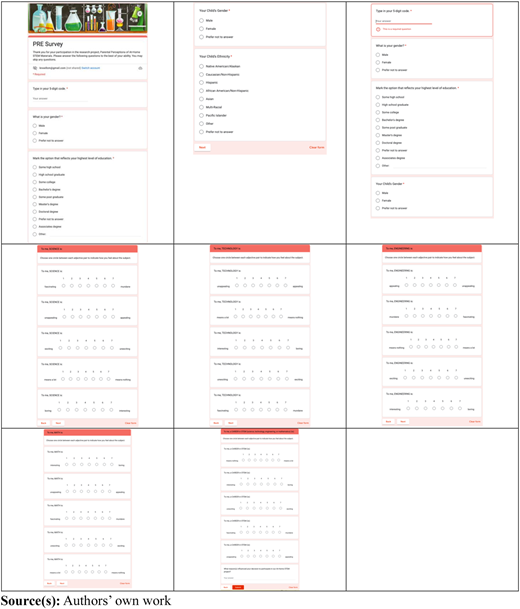
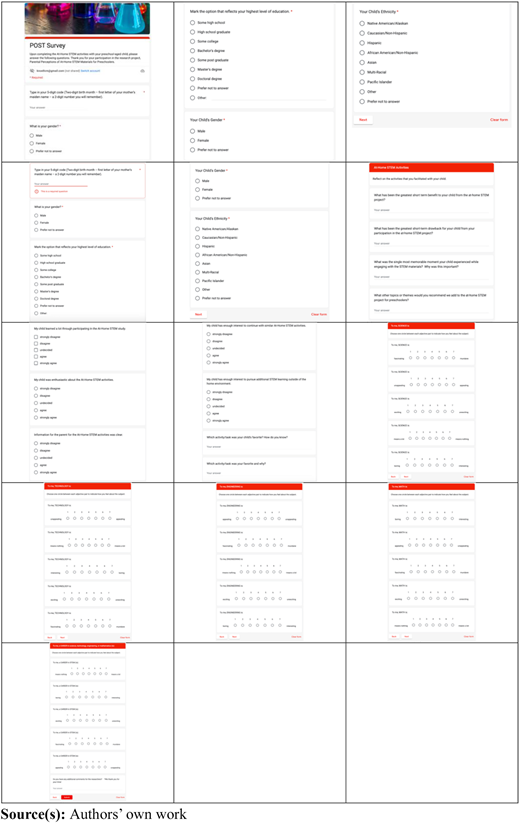
The parent survey (Tay et al., 2018) was adapted to include several five-point Likert scale items and open-ended reflective questions. See the survey questions in Figures A1 and A2.
Procedures and materials
At the time of the project, the undergraduate student was in Math and Science Methods course, which focused on teaching children birth through age 8. The undergraduate student was invited by the course instructor (also one of the faculty researchers) to present and demonstrate the STEM challenges to her peers. After gaining experience and feedback, the at-home STEM materials for the study were finalized.
The initial online survey was emailed to the parents. Upon completion of the survey, the STEM materials and instructions were distributed at the community-based center for use at home over a two-week period. The materials included four color-coded STEM bags with the materials, instructions and an overview of the STEM content. The STEM overview was adapted from the Nebraska Department of Education (2018) and a previous study on engineering in preschool (Laguzza, Katzerm, McDonnell, and Cunningham, 2021). See Table 1.
Within the participant instructions, supporting academic questions were included to enhance STEM learning for the children. See Table A1.
Within the two-week intervention period, the families were free to use the STEM materials conducive to their household schedules. Considering the children’s age, the participants were encouraged to allocate 15 minutes per STEM bag or for longer, if the child remained interested and engaged.
Two of the four at-home STEM bags included MathStart picture books by Stuart Murphy. The use of age-appropriate picture books illustrates how STEM concepts are part of the real world. A short video by the book series author, entitled “How to read a MathStart storybook,” was included for the participants. See Appendix 3.
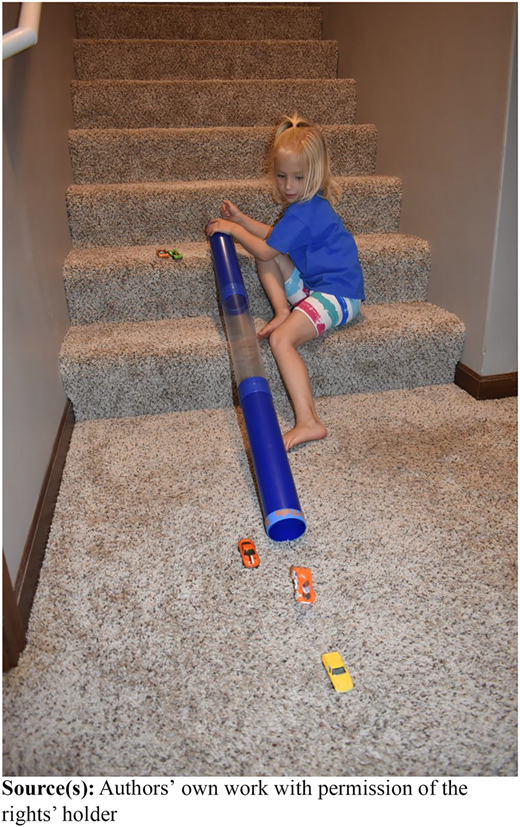
Much like an “anticipatory set,” the implementation instructions for the three participants recommended that the child be involved in unpacking the STEM bag materials. After time for exploration of the materials, the participants were prompted to present the STEM challenge by asking an open-ended question, such as, “How can we make the car go farther?” See Figure 1.
Critical to STEM learning, the provided academic questions promoted trial-and-error opportunities and connected to science and/or math concepts. After the two-week period, the participants returned the materials and completed a second online survey. The post-survey provided a second data point to examine change after the STEM at-home intervention.
Results
Do at-home STEM materials change parents’ perceptions of STEM content and/or STEM careers?
A two-tailed paired samples t-test was conducted to examine whether the mean difference of each participant’s pre- and post-survey was significantly different from zero. For Participant A, the result of the two-tailed paired samples t-test was significant based on an alpha value of 0.05, t (24) = −2.28, p = 0.032, indicating that the null hypothesis can be rejected. On the initial survey, Participant A’s mean score was significantly lower than the mean on the post survey. For Participant M and Participant D, the result of the two-tailed paired samples t-test was not significant, indicating the null hypothesis cannot be rejected. This finding suggests the difference in the mean scores from the initial online survey to the post-survey at the conclusion of the intervention was not significant. The results are shown in Table 2 below.
In addition, descriptive statistics for each of the four content areas of STEM show change from pretest to posttest, as measured on a seven-point scale. See Table 3 below.
In addition to the content area scales above, the participants answered a series of five questions with contrasting adjective pairs to indicate their feelings about STEM careers. Two of the participants’ scores for this scale reflect a slight decline following the two-week intervention. Mean scores are shown in Table 4 below.
While using at-home STEM materials with a preschooler, what observations are made by the parent?
Participants’ post-survey responses provided insight for the second research question. The Constant Comparative analysis was used to code the data. Following individual analysis, common themes were discussed among the data. The researchers determined there were two prominent themes that occurred during the intervention, child engagement and enthusiasm for learning.
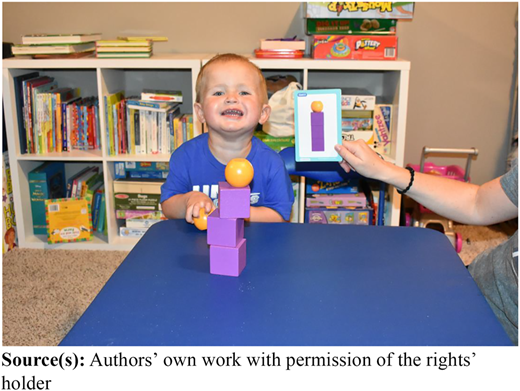
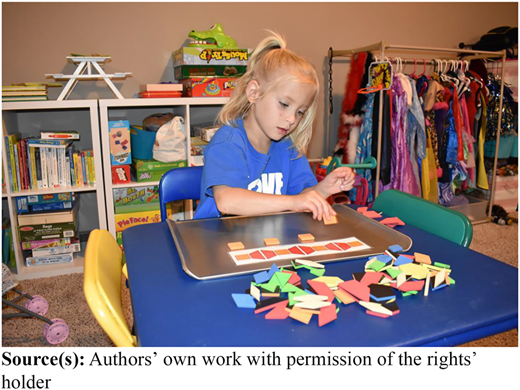
When asked to reflect on a favorite STEM activity, participant responses varied. See Table 5. One participant indicated her top choice was based on what the child most enjoyed and that both the length of time spent on STEM tasks and her child’s verbal expressions were indicators of enjoyment. Furthermore, another participant shared that the more novel the STEM materials (e.g. magnetic pattern blocks), the higher the interest. In contrast, less interest was reported by the participant’s observation of the child’s interest when more familiar household items were used. Another participant expressed surprise in her preschool-aged child’s perseverance during the Engineered to Build activity. Overall, the participants indicated that engagement and interest were positive outcomes. See Figure 2.
When reporting the “greatest short-term benefit to their child from the at-home STEM intervention, participants shared that it was quality one-to-one time and purposeful activities that were designed specifically for the child. Additional feedback from the participants described positive emotions, including the terms “enjoyment,” “pride,” “laughter,” and “excitement.” In fact, all the participants rated the overall experience as positive for their children, while predicting that their child/children would continue to pursue STEM learning outside of the home environment. One of the participants wrote that there were many benefits, sharing that it was “thought-provoking and an enjoyable parent-child interaction that encouraged analytical thinking and understanding the world around them.” See Figure 3.
Discussion
This study set out to explore parental perceptions about STEM after engaging with at-home materials designed for preschoolers. To examine the change in perceptions of the parents regarding STEM content and STEM careers, quantitative data were analyzed. The analyses indicated a significant difference in the pre- and post-surveys for one participant, Participant A, whose highest level of education was an Associate’s degree. For this participant, the mean score of the pre-survey was significantly lower than the mean of the post-survey, suggesting that her STEM beliefs changed after the two-week intervention. For the other participants, there was no significant change. A potential reason for the lack of notable change from pre-survey to post-survey in perceptions for those with the advanced degrees beyond an Associate’s degree may be attributed to the increased quantity and degree of STEM-related experiences in the additional coursework required for attaining an advanced degree.
In an analysis of mean scores, each of the four core STEM areas yielded increases after the at-home experience. Engineering and math showed the largest increases. With our background in early childhood/elementary mathematics, the change in math may be attributed to the variety of mathematics concepts integrated within the STEM tasks. Engineering for young children was presented as the process of design/redesign and presented in the context of problem solving. While none of the participants commented specifically about how the STEM engagement impacted their viewpoints about engineering, they did indicate that the provided age-appropriate STEM tasks led to increased interest and productive habits of mind, including persistence with the activity. The post survey mean score for the participants’ feelings about STEM careers showed a slight decrease after the intervention; however, the overall mean reflects that they are in support of STEM careers.
Consistent with the findings from Tippett and Milford (2017), results from this at-home study support the notion that carefully designed STEM activities can result in positive experiences for preschool-aged children. The results for this study also reinforce Milner-Bolotin and Marotto’s (2018) finding where STEM-homework and other at-home projects for young children was found to foster positive STEM interactions between families and children. Each of the three participants expressed how beneficial the one-to-one time was with their child during the at-home STEM intervention and the usefulness of the carefully designed resources. With the purposeful at-home STEM intervention used in our study, we found that including scaffolded support for the parents positively influenced the impact of the STEM learning materials.
Despite the small sample size, the collaborative nature of the study allows for further dissemination of the results, which is especially beneficial for parents and prospective teachers.
Conclusion
As noted by NAPDS, “collaboration is the keystone of a PDS” (NAPDS, 2021). Through our collaborative study, which involved a partnership between teacher educators and a community-based preschool, the PDS university engaged in research to examine educational practices that were designed by university students, specifically for application in the home setting. The purposefully designed STEM activities were facilitated by parents of preschool-aged children who attended the community-based preschool. The parents’ perceptions of STEM following this intervention have guided us to better understand the effectiveness of STEM materials for preschoolers while also providing university students with clearer insight for the value of educational opportunities provided through home environments. Furthermore, the collaborative nature of this study allowed for dissemination of the findings in a variety of outlets, from conversations with the community-based center to presentations. In fact, the results from the study may be beneficial for other educational entities including community programs (e.g. library, summer programs), childcare providers, home visitation programs and preservice teacher education. The scales used in the STEM Semantics Survey, which were designed for teachers and older learners yielded increases on the post-survey for all participants in STEM content. The mean score for the participant with the lowest level of education shows a statistically significant change from the initial survey to the post survey.
The study has several limitations in that it was conducted over a brief period of two weeks and with a small sample that lacked diversity. To increase generalizability, it is suggested that the at-home STEM study be repeated with participants holding varying levels of education, extending this to participants with no schooling beyond high school. It may also be beneficial to replicate the study in other community-based preschool settings, including Head Start, as well as draw from a wider variety of populations and on a larger scale over an extended period.
Affiliate's Experiential Learning Program provided a mini-grant ($250) to support experiential learning activities for the undergraduate student author.
Since acceptance of this article, the following author(s) have updated their affiliation(s): Nicole Shundoff is a teacher at the Royse City Independent School District and Angela Bardell is a teacher at Hastings Public Schools.
References
Reference (Appendix)
Appendix 1
Appendix 2
Appendix 3 Stuart J. Murphy on How to Read a Math Storybook
(Source: video courtesy of Murphy, 1996).