In this article, the authors explore one way that teacher preparation programs and elementary schools can collaborate to enhance science instruction for elementary school learners. This paper provides an overview of a project where a teacher candidate worked with six classroom teachers to organize science materials and prepare for science lessons.
This project included targeted assistance from a teacher candidate in “unpacking” a kit of science materials and a feedback survey given to classroom teachers after the project.
After the teacher candidate helped “unpack” the science kits, teachers reported that they were more confident in teaching lessons from the curriculum. The teacher candidate reported that she learned more about how materials can be used in science teaching and learning.
This project showed how PDS can involve teacher candidates in spanning boundaries to elementary science teaching to enhance outcomes for all stakeholders.
Elementary teachers are expected to be ready to teach all content areas, but often science is an area that is challenging to teach. This is especially true with the implementation of the Next Generation Science Standards (NGSS), requiring teachers to have a richer understanding of science teaching and learning (Windschitl & Stroupe, 2017). Many schools have purchased science kits full of materials that are meant to help provide engaging instruction aligned with the new standards, but teachers may struggle with making sense of the materials and getting them classroom ready (Ross & Cartier, 2015). At the same time, teacher preparation programs are seeking to place elementary teacher candidates in Professional Development School (PDS) classrooms and trying to prepare them for success with teaching the new science standards. This article is a general review of a project showing one way that teacher preparation programs and elementary schools can collaborate to enhance science instruction for P–6 learners.
In this project, a teacher candidate provided targeted assistance in “unpacking” science kits and solicited feedback from teachers about how this impacted their science teaching. This project aligned with PDS Essential 3: Professional Learning and Leading, as it enhanced continuous learning for all participants and PDS Essential 8: Boundary-Spanning Roles, as it involved college/university and P–12 faculty operating in boundary-spanning roles that transcended institutional settings.
The challenge of elementary science
U.S. policy makers have long been concerned about the preparation of U.S. students in the areas of science and mathematics (President’s Council of Advisors on Science and Technology, 2012). Since the Soviet Union launched the Space Age with Sputnik, politicians have worried about U.S. students falling behind other nations in the practical applications of math and science (Dana, Campbell, & Lunetta, 1997). According to the most recent National Survey of Science and Mathematics, primary teachers (K–3) reported spending an average of 18 minutes per week on science, a 22% decrease since 2000. Intermediate teachers (Grades 4–6) reported spending an average of 27 minutes per week, a 13% decrease from 2000 (Banilower et al., 2018).
Researchers have posited a number of explanations for the decline of instructional time dedicated to science in elementary school classrooms. Explanations have included: lack of elementary teachers’ confidence in science content, a deficit in pedagogical content knowledge in science, and increased time for ELA and Math due to high stakes testing (Gilbert & Byers, 2017). Elementary teachers across the United States are certified in multiple subject areas and are expected to be masters of a large amount of content, including English Language Arts, Mathematics, Science, and Social Studies. Each of these content areas has content to span grade levels K–6, all of which elementary teachers are expected to be able to teach when they graduate from a teacher education program. In science specifically, the NGSS K–5 include 75 unique performance expectations that elementary teachers should be ready to teach (NGSS Lead States, 2013).
Among these content areas, elementary science teacher preparation is particularly difficult because of identified deficits in science content knowledge and the prevalence of negative attitudes towards science teaching and learning among both preservice elementary teachers and current elementary teachers. Studies have found that elementary teachers often have negative attitudes towards teaching science (Kazempour & Sadler, 2015) and that they find science “difficult, intimidating, and/or uninteresting” (Long, 2019, p. 77). Many current undergraduate students were elementary students during the time of declining science instruction. Also, when they did receive science in elementary school it was often presented as a collection of vocabulary and facts (Banilower et al., 2018). This is problematic because having a vision of what effective science teaching looks like is crucial in becoming an effective science teacher (Canipe & Coronado Verdugo, 2020).
Positive attitudes towards teaching science in elementary teachers can lead to positive attitudes in their students (Kazempour & Sadler, 2015). Teacher preparation programs have been found to impact preservice elementary teachers’ attitudes towards science (Canipe & Coronado Verdugo, 2020) as being able to see oneself as a science teacher is a vital part of becoming a science teacher (Davis, Petish, & Smithey, 2006). Research in this area suggests that elementary science methods instructors should consider how elementary teacher candidates’ attitudes about science and science teaching can impact their participation and learning in the course.
Demystifying science curriculum for teachers and preservice teachers
Curriculum materials are often the main means by which science practices and content knowledge are integrated into science lessons. Curriculum materials and the ways teachers interact with these materials influence which science concepts they choose and how they teach these concepts (Beyer & Davis, 2009). Elementary teachers who lack science expertise often rely on prepared science curriculum materials as they organize science instruction (Mikeska, Anderson, & Schwarz, 2009) and may have difficulty selecting and organizing tasks included in available curriculum materials (Ross & Cartier, 2015).
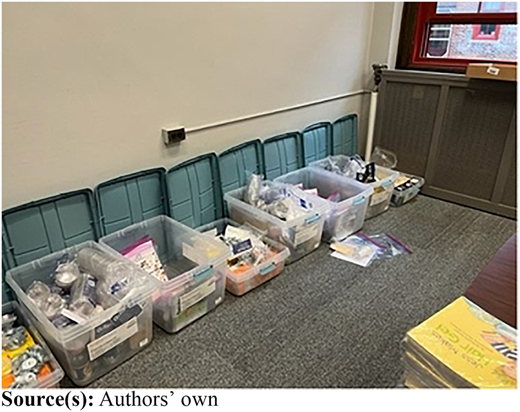
The adoption of the NGSS has prompted many schools to buy new science curriculum materials for their elementary teachers. When a science curriculum is purchased, teachers often get a large tote bin full of science materials, books, and posters, as well as sets of class investigation notebooks, often called a “kit” (Davis, Janssen, & Van Driel, 2016). These items are often disorganized in a bin with no information about what to do with the various materials (see Plate 1). Knowing which items are which and keeping track of what is needed for each lesson is daunting, on top of planning for other subjects, reviewing the actual curriculum and lessons, and teaching students.
While designing this project, we interviewed teachers about their science teaching, and one teacher confessed, “All the kits I got, I never used because I was intimidated by them…I was so overwhelmed, and then when it came time, I was just like, ‘I don’t have time to do that.’” Another agreed, “It was always just so difficult to bring in the kits and have to do everything in them. And a lot of times they would just get pushed to the side…I don’t even think anyone opened them this year.” These quotes show how the hands-on science materials in kits can sometimes be elusive for teachers to use. This provides an opportunity to offer support to teachers so that these hands-on materials can become classroom ready. Teacher candidates in the school are a ready resource for this support.
Research shows that preservice elementary teachers may also experience difficulty using and interacting with curriculum materials effectively (Beyer & Davis, 2009). They may need support in learning how to critically examine and adapt curriculum materials (Ross & Cartier, 2015). It is important that teacher educators provide preservice elementary teachers with tools and practice with available curriculum materials. Additionally, teacher candidates need opportunities to practice this in scaffolded ways (Grossman, Hammerness, & McDonald, 2009). These overlapping needs for teachers and teacher candidates led to the boundary-spanning PDS project described below.
Description of the project
The PDS involved in this project is an urban charter school that serves about 400 students in Grades K–8. Ninety-six percent of the students are economically disadvantaged and 84% of the students are Black. The University has been collaborating with this PDS for 10 years, as graduate teacher candidates help to run an after-school Book Club and the school hosts student teachers regularly. At our university, talented undergraduate students are chosen as PDS representatives and invited to conduct research projects for presentation at the NASUP Conference. One undergraduate PDS representative chose this school for her research project and wanted to do a project related to elementary science teaching. The curriculum leaders at the school as well as her faculty mentor identified the challenges related to new hands-on science teaching materials at the school as an area of study.
The school recently purchased a new science curriculum for Grades K–8 in response to the NGSS. At this school, grade levels are departmentalized beginning in third grade, but the K–2 teachers are required to teach all subjects. Therefore K–2 teachers were selected for this project to provide them with support in teaching science. Each K–2 teacher had received three science curriculum kits.
Nine K–2 teachers were asked if they wanted assistance in organizing their kits, and six indicated that they would appreciate this support. Teachers specified that they would like help organizing and preparing materials for each lesson. The PDS representative, who is also a teacher candidate, worked with the curriculum leaders at the school to organize kits for teachers who requested it.
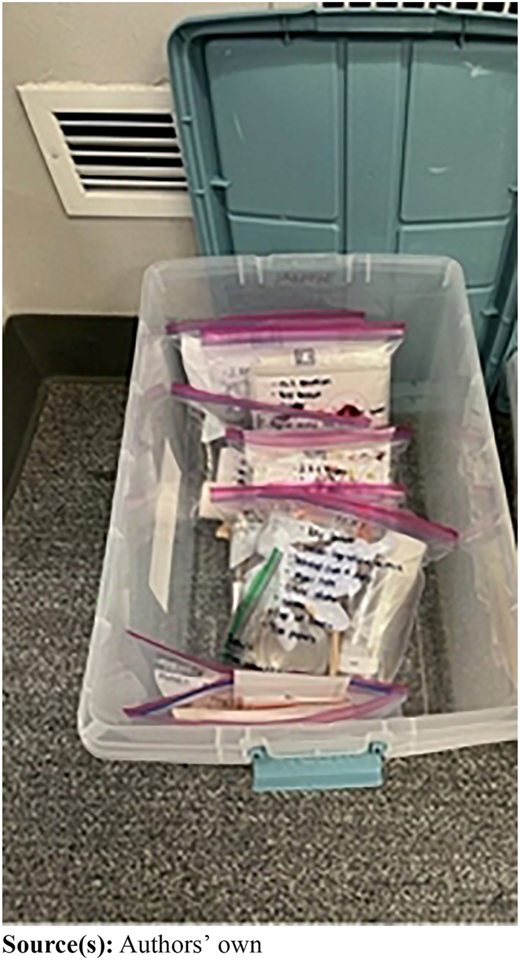
The curriculum leaders at the school had a 1-h meeting with the teacher candidate and demonstrated how she could unpack the kit and organize materials by lesson. For example, one lesson included preparing materials for four student groups in a classroom. Each group needed to receive 5 paper cups, 20 tongue depressors, 1 m of string, and 2 balls of clay. The teacher candidate organized all of these materials into baggies for each group, then put everything into one large baggie labeled with the lesson number (see Plate 2). On the day of the lesson, the teacher could simply pull out the large baggie of materials, give a small baggie to each group, give directions, and begin the lesson. This saved teacher time before instruction and during the lesson. The curriculum leaders provided the teacher candidate with support in reading through the teacher manuals and finding the sections for materials in each lesson and provided the baggies.
The teacher candidate came to the school 10 times for 3 or 4 hours each time and organized the kits by lesson for the K–2 teachers. The curriculum leaders met with the K–2 teachers, explained the system, and facilitated delivery of the organized kits.
Results and conclusions
After working with the new kits, teachers provided feedback via an anonymous survey on Google Forms. They were asked to describe in 1–2 sentences how the organization of the kits has impacted their science teaching and to rate on a Likert scale of 1–5 how much they agreed with the following statement: The organization of the kits has made me more confident in teaching the science curriculum lessons (1 = strongly disagree, 5 = strongly agree). Four of the five teachers who completed the survey strongly agreed with the statement, and one teacher agreed. When describing how the organization of the kits impacted them, teachers noted:
The [organized] kits are incredibly helpful! Some lessons included many materials and it has been extremely convenient, helpful, and a HUGE time saver
[It is] so easy to just grab them and get your lesson started. Reduces time needed for prep! Love it!
[The organized kits] saved me so much time and sanity. They took the overwhelming aspect away and made it all feasible.
With the kits so organized, it takes less time to pull materials and gives me more time to look at the content being covered in the lesson.
These comments revealed the value of organizing the science kits and how this organization allowed teachers time to “look at the content” and teach science lessons instead of preparing materials. The teachers at this PDS taught three or four 30-min science lessons a week with their organized kits, for a total of 90–120 minutes of science per week; well above the national average of 18 minutes (Banilower et al., 2018).
Benefits and downfalls
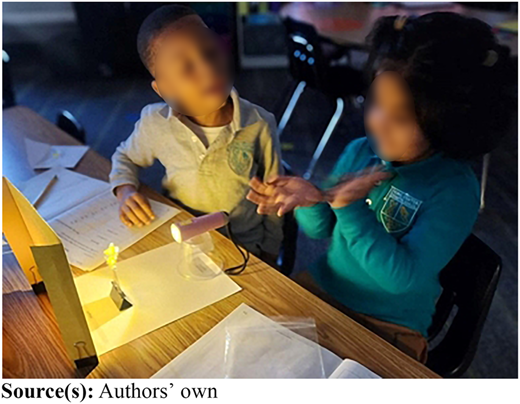
This project was beneficial for the teachers at the school as they were able to grab the bag of materials for a particular lesson and be ready to deliver instruction. The elementary students at the school benefitted from the richer, more engaging science instruction (see Plate 3). The teacher candidate also benefitted as she learned more about the new science standards and the lessons that aligned with the standards. She used the lesson-by-lesson master list as well as the detailed lesson plans for each lesson when creating the baggies of materials. When teacher candidates are provided with scaffolded opportunities to engage with science curriculum materials, they are then more likely to use the curriculum materials given to them when they are teaching in their own classroom (Beyer & Davis, 2009; Ross & Cartier, 2015).When asked about the experience, she wrote, “Overall, from being a part of this experience I have learned the importance of organization and planning in the classroom, and I also got to see how the standards I was studying in my learning related to actual curriculum books and how it was taught to the students.” Additionally, the teacher candidate engaged in conversations with the science coordinator at the PDS about how the standards were being enacted in schools.
One downfall of the project was that some teachers did not take as much ownership of the lesson materials as they might have if they had sorted the materials themselves. Some teachers would call the curriculum leaders saying that they were missing a material (e.g. a cup of salt) and not be as proactive in thinking through how they could resolve this in the moment (e.g. by getting salt from the cafeteria). It may be more beneficial to have the teacher candidates work with the classroom teachers on this task in the future, rather than taking over the task without the teacher present. A more collaborative approach may provide the same helpful assistance while keeping the classroom teachers more engaged with the materials before the actual lesson delivery days.
Implications for science methods instructors
This project may inspire science methods instructors to consider providing opportunities on campus for teacher candidates to practice looking through a kit of materials to find what is needed for a specific lesson. These materials could then be used for microteaching science lessons with peers. Additionally, they could discuss ways that they could organize materials in their future classrooms to make the lessons from the kits classroom ready. While on site at their PDS, teacher candidates could be encouraged to work with their mentor teachers to “unpack the science kits” to prepare for lessons being taught by the teacher and/or the teacher candidates. If a PDS receives a shipment of kits during the course time, the methods instructor could facilitate a service project where teacher candidates assist with preparing the materials as described in this article. In order to leverage the value of this, the methods instructor will want to emphasize how the lesson materials are used to develop scientific understanding and engage P–6 students in the science practices.
Implications for research
It seems that each year, elementary teachers receive new kits of materials, not just for science, but also for math and English Language Arts. This project has inspired the university faculty members involved to consider ways to leverage the teacher candidates in our PDS sites to be part of the team in unpacking other kits. College faculty members plan to join the teacher candidates in future “unpacking” sessions to scaffold the experience and help the teacher candidates learn more about how the materials relate to the instructional goals of the lessons and how teachers can plan to use the materials to maximize learning. Future research could examine how scaffolded unpacking experiences impact the confidence and competence of teacher candidates and how this work at the PDS impacts instructional practices at the school. This work can be powerful in spanning boundaries and helping classroom teachers deliver the best instruction for their students while also allowing the teacher candidates to enrich their understanding of the intricacies of curriculum, teaching and learning—PDS in action!