Skip to Main Content
Purpose

This study investigates the differential effectiveness of leadership styles within the German Federal Police Office, focusing on how these styles interact with employees' personal values to influence organizational identification (OI). Thus, we investigate the augmentation hypothesis and explore the moderating effects of personal values on leadership effectiveness regarding OI.

Design/methodology/approach

Utilizing a quantitative cross-sectional design, the study analyzes responses from 1,816 police employees via the Multifactor Leadership Questionnaire and Portraits Value Questionnaire. Hierarchical regressions are used to analyze the hypothesized associations.

Findings

The results indicate that transformational leadership significantly enhances OI more than transactional or laissez-faire leadership. Moderating effects of personal values reveal complex interactions: while transformational leadership consistently predicts higher OI, transactional leadership’s effectiveness varies according to the employees' values such as Conformity and Tradition enhancing OI, Universalism and Benevolence diminishing it. These findings suggest that leadership effectiveness in policing is contingent on aligning leadership style with the personal values of the employees.

Originality/value

This research contributes to the understanding of how personal values modulate the impact of leadership styles on organizational outcomes within police organizations. It underscores the necessity for police leaders to consider the value profiles of their employees to optimize OI and effectiveness. The study is among the first to systematically explore these dynamics within a law enforcement context, providing empirical evidence to inform targeted leadership development and policy-making in policing.

Leaders play a crucial role in an organization’s success. Leadership behavior significantly influences employees' job satisfaction, well-being, organizational commitment, overall organizational performance and organizational identification (OI) as a perception of unity and belonging to an organization (Effelsberg et al., 2013; Epitropaki and Martin, 2005; Judge and Piccolo, 2004; Mael and Ashforth, 1992; Montano et al., 2017).

Leadership behaviors that are based on a positive, concrete vision of organizational goals and that clearly communicate each employee’s role in achieving these goals are linked to positive individual and organizational outcomes (Abbas and Raza, 2023; Judge and Piccolo, 2004; Montano et al., 2017). Specifically, transformational leadership behaviors (TFLB), characterized by inspiring and motivating employees through a compelling vision and role modeling, is often associated with high levels of OI and positive organizational outcomes. Transformational leaders act as role models, gain trust, set future goals, innovate and empower followers to reach their full potential. Transactional leadership behaviors (TALB), on the other hand, focus on clarifying responsibilities, rewarding achievements and correcting failures to meet objectives. These behaviors emphasize structured exchange relationships between leaders and employees. While it may enhance OI to some extent by clarifying roles and expectations, it typically does so less profoundly compared to transformational leadership. Conversely, laissez-faire leadership adopts a hands-off approach, failing to provide direction or take responsibility for managing (Bass, 1999; Judge and Piccolo, 2004). This leadership behavior is described as passive, avoidant, or authoritarian and has negative effects on employee well-being and job performance (Montano et al., 2017; Pizzolitto et al., 2023; Skogstad et al., 2007). Laissez-faire leaders' lack of engagement can undermine OI by creating an environment where employees feel unsupported and disconnected from organizational goals. Leadership is particularly critical in police organizations due to their hierarchical structure and the necessity for a clear command chain in many daily operations. At the same time, societal changes require adaptive leadership to cater to the needs of individuals who prefer a more egalitarian work culture that prioritizes employees’ well-being over “traditional” police culture.

In Germany, for example, police organizations face two primary challenges: a shortage of skilled workers that requires strategies to attract and retain professionals, such as IT specialists, who are essential to modernizing policing and often find more lucrative opportunities in the private sector. Simultaneously, police organizations are seeing increased diversity with more female officers, ethnic minorities and professionals from non-police backgrounds. This development is expected to lead to increased value diversity. In fact, recent studies from Germany show that employees in police organizations are far from homogenous regarding their value profiles and attitudes (DHPol, 2023; Striebing et al., 2023). Thus, effective leadership in these settings should not only be understood in terms of operational efficiency but must also focus on maintaining competitiveness as an employer and retaining specialized talent vis a vis a demanding and diversified labor market.

In the police context, TFLB, in the sense of charismatic leaders who foster intrinsic motivation in employees, and TALB, in the sense of clear rules and guidelines, are the most researched leadership behaviors (e.g. Campbell and Kodz, 2011). However, there is a paucity of research in the policing context on whether TFLB and TALB universally benefit all employees, regardless of their values and expectations. While it has been shown that there is a relationship between values and psychological-well-being and coping-strategies in the policing context (e.g. Gutschmidt and Vera, 2022), the interplay between values and leadership behavior has not been examined. Therefore, this study examines how different leadership behaviors vary in effectiveness based on the personal values of employees at the German Federal Police Office. Using cross-sectional design, it explores the relationship between leadership styles and OI and how personal values moderate this relationship. The study discusses the implications for personnel and organizational development based on the findings.

To facilitate a structured cognitive understanding of the social environment humans, tend to categorize other humans into groups (Haslam et al., 2008; Tajfel and Turner, 1986). When individuals ascribe prototypical characteristics to members of other groups, perceiving them as “others,” they simultaneously classify themselves as part of their own group, referring to it as “us” or “we”. They identify with the prototypical characteristics of their ingroup. This concept is relevant to organizational settings, where identification with a psychological group or organization (IDPG) involves perceiving oneself as sharing experiences and characteristics with members of the organization (Ashforth and Mael, 1989; Greco et al., 2022; Weisman et al., 2022). Unlike broader social identities, which are typically associated with general social categories, IDPG is more specific, focusing on the perception of shared experiences and attributes within an organizational context. Individuals with a strong OI position themselves relative to in-groups (part of the organization) and out-groups (not part of it), exploring questions such as “Who are we and what distinguishes us from others?”.

Organizational Identification (OI) is characterized by a perception of unity with or belonging to an organization (Mael and Ashforth, 1992, p. 104), as in self-referential oneness (Van Knippenberg and Sleebos, 2006). OI has various implications for work-related outcomes (e.g. Caza et al., 2018; Lee et al., 2015), like Organizational Citizenship Behavior (Greco et al., 2022; Wu et al., 2016), counterproductive work behaviors (Al-Atwi and Bakir, 2014) and enhanced job performance (e.g. Greco et al., 2022). Moreover, meta-analytical evidence supports relations with lower turnover intention, higher job satisfaction and organizational commitment (Greco et al., 2022). Distinguishing organizational commitment to OI, the first focusses on social exchange processes that presume that individual and organization are separate entities psychologically, while identification expresses the unity, belongingness and oneness of individual and organization (Van Knippenberg and Sleebos, 2006).

Recent research explored the relevance of OI in police organizations and the requirement for reducing incongruencies between organizational and personal identities for example for employee retention (Charman and Tyson, 2023; Workman-Stark, 2024). Leadership plays a pivotal role in shaping and influencing the organizational culture and a shared social identity of an organization’s members in policing contexts (Hogg et al., 2012; Workman-Stark, 2020). In what follows, we will explore the nexus between organizational identity and leadership within police organizations.

Leaders embody and communicate the group’s values, norms and goals, to enhance their influence and leadership effectiveness (e.g. Haslam et al., 2022). Given the full range theory of leadership (Bass, 1987) as a widely used classification of leadership behaviors (Felfe, 2006), TFLB and TALB positively correlate with OI (Effelsberg et al., 2013; Epitropaki and Martin, 2005). TFLB fosters shared values and goals, leading to stronger OI and a shared social identity (e.g. Hoffmann et al., 2011; Schaubroeck et al., 2013; Weisman et al., 2022). TFLB helps individuals to align their personal values, needs and expectations with organizational values and goals, creating a shared vision and fostering identity formation. TALB also correlates with OI but is less impactful, focusing on performance expectations lacking the concept of a shared vision with individual consideration. Laissez-faire leadership often leads to role conflict and ambiguity, inhibiting OI (Skogstad et al., 2007). According to Bass’s augmentation hypothesis (1997), TFLB build on TALB, to further enhance their effectiveness (Judge and Piccolo, 2004).

In policing contexts, TFLB is considered more effective (Campbell and Kodz, 2011; Jang and Jeong, 2022; Russell, 2017; Sarver and Miller, 2014) and there is some evidence that a combination of TFLB and TALB might be most effective (Campbell and Kodz, 2011). Specifically, being communicative, acting as a role model and creating a shared vision as central elements of TFLB are attributed to effective police leaders (de Moura et al., 2023). TFLB and TALB have been shown to positively impact job satisfaction, organizational commitment, satisfaction with the leader and leadership effectiveness (Amalina et al., 2022; Baek et al., 2018; Jang and Jeong, 2022; Masal, 2015; Masal and Vogel, 2016; Sarver and Miller, 2014; Shim al., 2015). Additionally, TFLB positively affects employee performance, organizational citizenship behavior and organizational culture (Aamalina et al., 2022; Jang and Jeong, 2022); while laissez-faire leadership behaviors tend to increase employee presenteeism and is associated with decreased leadership effectiveness and decreased satisfaction with the leader in policing contexts (Hinse and Mathieu, 2023; Russell, 2017). However, there is considerable heterogeneity in when specific leadership behaviors are effective given the follower characteristics as outlined next.

Followers’ traits, goals and values might influence the perception and effectiveness of leadership behaviors (e.g. Abbas and Raza, 2023; Bono and Judge, 2004; Breevaart and DeVries, 2019; Ehrhart and Klein, 2001). Additionally, considering OI, individual needs, such as social contact and belonging, are associated with higher OI and thus as well dependent on individuals’ predispositions (Rockman and Ballinger, 2017; Wiesenfeld et al., 2001). Hence, it can be assumed that the effect of leadership behaviors on OI might be conditional on followers’ expectations, goals and needs (Thoroughgood and Sawyer, 2017). Social identity theory suggests that shared values and goals are central to group membership and OI. Leaders must address and shape these values and goals to influence OI effectively, as proposed by TFLB. In the following, we will discuss the content and structure of personal values and their hypothesized influence on the nexus of leadership behaviors and OI.

Values are cognitive representations of motives and secondary drivers of behavior that play a critical role in influencing human action and decision-making (Sagiv and Schwartz, 2022; Schwartz, 1992). They serve as cross-situational goals, reflecting the subjective importance of goals and describing an individual’s life expectations (Arieli et al., 2020).

The most established theoretical framework for assessing individual values is Schwartz’s theory of basic human values (Schwartz, 1992). This theory identifies ten basic human values, organized into two contrasting pairs that reflect conflicting motivations, goals and desirable behaviors. These pairs are as follows: Openness to Change (emphasizing independent thinking, acting, feeling, challenging and changing; values include Hedonism, Stimulation, Self-Direction) versus Conservation (focusing on self-retention, securing the past, order and resistance to change; values include Conformity, Tradition, Security) and Self-Enhancement (prioritizing one’s own interests, success and dominance over others; values include Power, Achievement) versus Self-Transcendence (concerned with the well-being and interests of others; values include Universalism, Benevolence).

For leaders, understanding and aligning with these values is crucial in providing environments where employees can fulfill their own values (Lyons et al., 2009). Research indicates that preferences for specific leadership behaviors are influenced by individuals’ Self-Enhancement vs Self-Transcendence values (Ehrhart and Klein, 2001; Fein et al., 2011; Groves and LaRocca, 2011; Thoroughgood and Sawyer, 2017). These findings also manifest in the association between effectiveness of leadership and the alignment of leadership behaviors with members’ value preferences like Openness to Change and Self-Transcendence (Groves, 2013; Groves, 2016; Ritz et al., 2014).

Based on these empirical findings, this study seeks to identify how the personal values of members of a policing organization influence the relationship between leadership behaviors and OI. Leadership effectiveness is assumed to be context-dependent, with varying preferences for leadership styles among members possessing diverse values, which in turn may impact OI differently. We therefore investigate values as a potential moderator between leadership and identification.

Our first hypothesis focuses on the direct association between leadership and OI. Given that different types of leadership behaviors exhibit varying degrees of exploratory power for OI as an outcome (Campbell and Kodz, 2011; Judge and Piccolo, 2004), we hypothesize that TFLB explains variance in OI above that of TALB and laissez-faire leadership in policing contexts (H1).

We further propose that this relationship is moderated by the personal values of employees in police organizations. Empirical findings suggest that individual values shape both OI and preferences for leadership behaviors. As members’ values are integral to the social context in which leaders operate, we propose that different values affect the link between leadership behavior and OI.

TFLB consists largely of providing members with a sense of relevance of their activities within a higher collective structure. Therefore, we hypothesize that Self-transcendence values will have a positive moderating effect on the relationship between TFLB and OI (H2a). Conversely, we hypothesize a negative moderating effect of Self-Transcendence values on the relationship between TALB and OI (H2b). This is grounded in existing empirical evidence for the preference of TFLB behaviors given higher importance of Benevolence values and their effect on leadership effectiveness in public administration (Fein et al., 2011; Groves, 2016; Groves and LaRocca, 2011; Ritz et al., 2014).

Self-Enhancement values, which prioritize personal interests, relative success and dominance, may enhance the effect of both leadership behaviors. Fein et al. (2011) found individuals’ emphasis on achievement values to be positively related to preference for TALB and TFLB. TFLB seeks to inspire and motivate members by creating a shared vision, which aligns with the pursuit of personal success. Similarly, TALB focus on performance evaluation and rewards might also be appealing to individuals with Self-Enhancement values. Thus, we hypothesize a positive moderating effect of Self-Enhancement values on both the TFLB–OI relationship (H3a) and the TALB–OI relationship (H3b).

Conservation values emphasize stability, order and adherence to tradition. TFLB often involves advocating for change and new directions, which might conflict with the stability-oriented nature of Conservation values. Grounded in the circular arrangement of personal values (Schwartz, 1992), the conflicting goals of Conservation with Openness to Change may disfavor change-oriented behaviors and thus, negatively moderate the association of TFLB to OI (Groves, 2016). Thus, we hypothesize a negative moderating effect of Conservation values on the relationship between TFLB and OI (H4a). Conversely, Conservation values align with the structure and predictability emphasized by TALB, which involves clear expectations and responsibilities. Therefore, we hypothesize a positive moderating effect of Conservation values on the relationship between TALB and OI (H4b).

Openness to Change values refer to flexibility, innovation and new experiences, which are congruent with the change-oriented nature of TFLB. Therefore, we hypothesize that Openness to Change values positively moderate the relationship between TFLB and OI (H5a). On the other hand, these values may not align with the stability and predictability emphasized by TALB. Thus, we hypothesize a negative moderating effect of Openness to Change values on the relationship between TALB and OI relationship (H5b).

The study employs a quantitative cross-sectional design with self-reported data to examine the relationships between personal values, leadership styles and OI within the German Federal Criminal Police Office (BKA). It aims to understand how different basic values moderate the relationship between leadership style and OI.

The sample comprises 1,816 employees from the BKA, which describes itself as the central agency of German police forces. In addition to classic police work, carrying out a range of administrative activities is a critical part of the BKA employees' roles. Of the participants, 40.2% (730) identified as women, 59.4% (1,078) as men and 0.4% identified as non-binary. Age was categorized to ensure data protection, with 26.2% aged between 15 and 29 (including trainees), 24.3% between 30 and 39, 20.2% between 40 and 49, and 29.3% aged 50 or older. 23.9% worked longer than 23 years for the BKA, 38.6% started their employment between the last 5–22 years and 37.5% entered the organization in the last 4 years. Employment categories included law enforcement officers (51.5%), administrative/technical/scientific or other civil servants (16.6%), and employees under collective bargaining agreements (32.0%). A significant portion (24.2%) held management responsibility.

Values were assessed using the 21-item German version of the Portraits Value Questionnaire (PVQ) by Schwartz, developed by Schmidt et al. (2007). Table 1 shows the definition of the ten types of values (subscales) postulated by Schwartz (1994). Participants rated their similarity to the person described on a scale from 1 (low similarity) to 6 (high similarity). The reliabilities displayed in Table 2 for all value scales are in line with the range of Cronbach’s α displayed in Schmidt et al. (2007). Nevertheless, some of them are considerably low and deviate from established conventions (e.g. Self-Direction). We address this issue in the discussion section and by analyzing the structural validity of our used subscales in the result section.

Leadership behaviors were assessed using the German adaption of the Multifactor Leadership Questionnaire (MLQ) by Felfe and Goihl (2014). The questionnaire measures the perceived frequency of transformational, transactional and laissez-faire leadership behaviors. Participants responded to statements about their manager, such as (“The manager I rate talks to others about her most important beliefs and values,.”) on a scale ranging from 1 (never) to 5 (often/always). Cronbach’s α for the respective scales is displayed in Table 2. The items of TFLB display slightly higher, of TALB and laissez faire leadership slightly lower internal consistencies compared to Felfe and Goihl (2014). All scales are above recommended thresholds of Cronbach’s α.

Organizational identification of the participants was measured using a unidimensional scale developed by Mael and Ashforth (1992), consisting of ten items rated from 1 (strongly disagree) to 5 (strongly agree). Internal consistency of these items was in line with other studies using corresponding measures (Avanzi et al., 2020). The corresponding items can be found in  Appendix.

The analysis was conducted in R (version 2023.12.1 + 402). The structural validity of the scales was assessed using Confirmatory Factor Analysis, with fit indices reported according to the model fit criteria from Gäde et al. (2020). Intraindividual mean centered scores were used to examine the associations of basic values (Rudnev, 2021; Schwartz and Cieciuch, 2022). This aligns the data with theoretical assumptions of the theory of basic human values and accounts for a common variance factor.

The augmentation hypothesis of leadership behaviors is assessed via hierarchical regressions of individuals’ responses as subjective perceptions of leadership behavior. The R2adjusted of the baseline model (consisting of TALB and laissez-faire leadership) is considered in comparison to the regression model with TFLB (additional explained variance ΔR2adjusted). Due to violations of normality assumptions assessed with Shapiro-Wilk-Test and heteroscedasticity assessed via Breusch-Pagan test the regressions were performed via bootstrapping (5,000 iterations).

Due to doubts about traditional means of assessing moderation effects and significance tests in general, an approach proposed by Liu and Yuan (2021) is applied. The focus of the analysis is put on the measure ΔR2mo. In particular, the changed effect of the predictor (X) on the criterion (Y) by the moderator (Z) is considered here. The measure provides information on the proportion of variance explained in Y by X and XZ, which can only be assigned to XZ. Hence, a multiplicative interaction approach (XZ) is used. To visualize the effect, the Johnson-Neyman intervals and diagrams are displayed for the corresponding analyses supplemented with simple slopes analysis (package: interactions). The latter indicates the correlation between X and Y given different levels ( ± 1 SD and Mean) of the moderator.

The analysis of interaction effects of values and TFLB is conducted while controlling for the other leadership behaviors. Thus, the incremental effect of TFLB is considered above TALB and laissez-faire leadership (Judge and Piccolo, 2004).

Descriptive statistics are displayed in Table 2. The measurement model exhibited acceptable fit to the collected data (χ2 = 2976.38, df = 867, p < 0.001, χ2/df = 3.43, CFI = 0.89, RMSEA = 0.044 [0.042, 0.046], SRMR = 0.042) and thus supporting the structural validity of the used scales and underlying construct measures.

The results presented in Table 3 support the augmentation hypothesis, with TFLB explaining additional variance in OI beyond what is accounted for by TALB and laissez-faire leadership. This finding thus substantiates the first hypothesis (H1), indicating that TFLB has a more significant impact on OI compared to the other leadership styles examined.

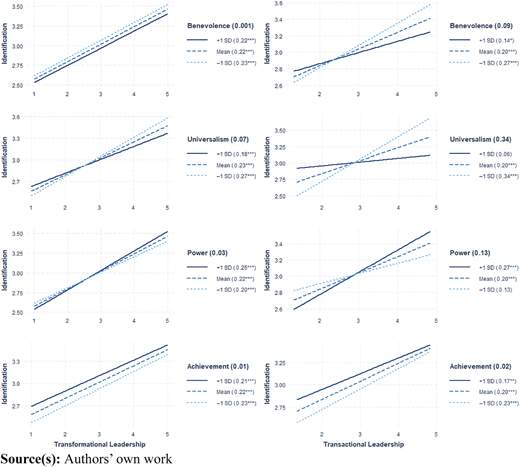
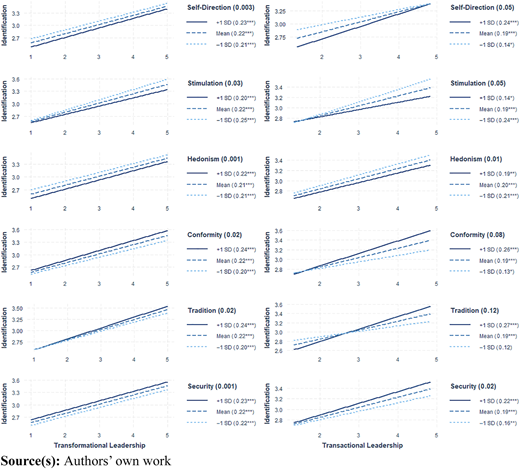
The indirect effects (Figures 1 and 2) of basic values on the relation between TFLB and OI are generally low as indicated by the ΔR2mo. The association between predictor and criterion does not variate considerably. Only a small interaction effect can be identified for Universalism (ΔR2mo = 0.07). Here, the correlation between TFLB and OI is higher when the value of Universalism is lower (b = 0.27***). Thus, given the data, our hypotheses for differential effects of TFLB on OI based on basic values (H2a, H3a, H4a and H5a) is not supported.

For TALB as a predictor, the interaction effects of basic values are larger compared to TFLB. The value of Stimulation shows a small moderating effect (ΔR2mo = 0.05), where the association between TALB and OI is lower when the value of Stimulation is higher (b = 0.14*). This stands in line with our hypothesis 5b. In contrast, Conformity (ΔR2mo = 0.08) and Tradition (ΔR2mo = 0.12) displayed interaction effects, where the association between TALB and OI is stronger if these values are more important (bConformity = 0.26***; bTradition = 0.27***), supporting H4b. Additionally, for Benevolence (ΔR2mo = 0.09) and Universalism (ΔR2mo = 0.34) interaction effects explain considerable additional variance in the association between predictor and criterion. The relation between TALB and OI is significantly lower if Benevolence (b = 0.14*) and Universalism (b = 0.06*) is ascribed more importance. Hence, hypothesis 2b is supported. Conversely, if the value of Power was rated more important, the association between TALB and OI increases (ΔR2mo = 0.13; b = 0.27***). This stands in line with hypothesis 3b.

Our study examines how the reactions of police organization members to specific leadership behaviors vary according to their basic values, focusing on OI as a dependent variable due to its relevance in policing and other organizational contexts (Charman and Tyson, 2023; Workman-Stark, 2024). Utilizing social identity theory, the full range theory of leadership and the theory of basic human values, we analyzed data from a cross-sectional, single source survey conducted at the German Federal Criminal Police Office. By adopting a broad perspective that encompasses a wide range of value profiles (Arieli et al., 2020) and exploring how different individuals respond to established leadership behaviors, we build upon previous research that has primarily focused on specific and isolated values associated with perceptions of TFLB.

The results underscore several key considerations for leadership within policing contexts. Firstly, as indicated by the Pearson correlations, both TFLB and TALB are correlated with OI, with TFLB demonstrating a stronger relationship. This aligns with previous research findings (Campbell and Kodz, 2011; Weisman et al., 2022).

Secondly, the augmentation hypothesis, supported by extensive meta-analytical evidence, is corroborated in this study (Judge and Piccolo, 2004). Consequently, and compared to other leadership behaviors, TFLB is linked with a higher degree of OI in our police sample.

Thirdly, the basic value preferences do not overtly affect the relationship between TFLB and OI. In this case, TFLB is consistently positively correlated with higher levels of OI. This finding contrasts with our initial hypotheses. Other than predicted, TFLB seems to be universally associated with higher OI among participants of this study.

Fourthly, the effect of TALB on OI is moderated by various basic values. Specifically, Conformity and Tradition are important moderators. Higher subjective importance of Conservation values is linked with a stronger correlation of TALB and OI. This suggests that individuals who value Conservation are more likely to associate TALB with a shared social identity of OI. Additionally, aligning with our hypotheses, placing high importance on Benevolence and particularly Universalism significantly diminishes the correlation between TALB and OI. Conversely, valuing Power highly correlates with a stronger association of frequent TALB and OI. The data suggest that while TALB may be effective for individuals who value structure, predictability and control (Conformity, Tradition, Power), it may be less suitable for those who are motivated by values that emphasize altruism and broader societal impacts (Benevolence, Universalism).

The overt positive association of TFLB with OI may stem from the theoretical assumption of TFLB helping individuals to align their personal values with organizational values and goals, regardless of differences in value profiles. Differentiations in the associations of TALB and OI given different value profiles may be a result of the strict focus on performance expectations. For individuals with specific value emphasis (Power, Tradition, Conformity), these behaviors may relate more to their individual guiding principles and motivational foundations, thus additionally fostering OI. However, this effect reverses if personal values contradict strict performance evaluations and strive for more self-transcending goals (Benevolence and Universalism). These findings support the assumption that leaders should display relatively more TFLB than TALB, aligning our study with previous research findings in policing contexts on the combination of both leadership styles.

Given the consistently positive impact of TFLB on OI and positive effects of TFLB training programs on leadership performance indicators in the policing context (Aymerich et al., 2021), our findings suggest that police organizations should integrate strategies and tools into their training programs to enhance the prevalence of TFLB. Such programs could address vision setting, inspirational communication and individualized consideration. Furthermore, police organizations should aim to establish a culture that fosters TFLB across all levels of management. Considering the hierarchical structure of police organizations, this involves granting lower-level management sufficient autonomy to exhibit TFLB without being restricted by overly rigid rules that may not suit all areas of operation within the organization.

TFLB can be promoted from a higher management level through the identification and formalization of shared values. Since the development and implementation of a shared vision is central to TFLB and because this is primarily a communicative activity, it is plausible that organizational mission statements provide guidance for communicating the organizational purpose for all management levels and can serve as a basis for team-specific visions within an organization (Schein, 2010).

Additionally, our results indicate that employees who highly value the well-being and interests of others are most at risk of disengaging from the organization when they perceive their leaders as focusing on performance expectations. This insight is particularly pertinent for police organizations in today’s job market, where the emphasis on doing meaningful work and helping others is a key recruitment message. To prevent the unintended loss of these altruistic, idealistic employees, it is crucial for police organizations to maintain high leadership standards. This can be addressed by monitoring the extend of perceived TALB as their effect on OI seems to be more dependent on employees’ values. Considering the augmentation hypothesis, it might be appropriate to engage in relative fewer TALB. However, if the circumstances require leaders to engage in TALB, they could foster OI by giving employees an explanation of and opportunities to be part in the decision-making process (Weisman et al., 2022).

This study challenges the prevalent leadership notion that TALB may be more effective than TFLB depending on an employee’s personality or work context, especially when clear commands are important, as in operational situations. It appears that only employees who hold certain values may be more tolerant towards TALB. The findings demonstrate the universality of TFLB even within a diverse police organization, encompassing a range of duties from active policing to administrative tasks. However, this study specifically examined the relationship between leadership style and OI, leaving open the question of whether these findings can be replicated across other psychological outcomes.

Considering methodological limitations, the internal reliabilities of the PVQ scales for assessing values, such as Self-Direction, were notably low. This issue arises because the broad values underlying the surveyed scales result in heterogeneous items (Schwartz et al., 2012). Considering these challenges, the CFA supports the overall fit and the questionnaires validity, confirming the latent representation of the constructs. Future studies could investigate the differences in the moderating effects of more detailed value constructs such as Tolerance and Concern as subordinate dimensions of Universalism (Schwartz et al., 2012). This approach might provide a more nuanced understanding of leader–member relationships.

We focused on OI as a potential outcome variable of effective leadership behavior, selected for its foundation on shared values and goals. However, leadership impacts more broadly in policing contexts, including outcomes like employee well-being, OCB, ethical misconduct and counterproductive work behaviors, all of which could further illuminate the understanding of leadership effectiveness.

Haslam et al. (2024) critically review past approaches to leadership studies and highlight their potential drawbacks. Leadership that specifically addresses a shared social identity may offer a more suitable framework for studying the fundamental processes by which leaders’ influence translates into desirable outcomes. Given the contextual sensitivity of this approach, it’s crucial to examine how shared social identities manifest in policing behavior. Research on “police culture” could also address potential undesirable outcomes of strong identification, such as conservative values, masculinity norms and an us-versus-them attitude (Kappeler et al., 1998; Reiner, 2010).

Recent studies on OI and its outcomes also shed light on the non-linearity of these relationships. For instance, the concept of “too much of a good thing” (Avanzi et al., 2020) suggests that over-identification may lead to decreased well-being. Therefore, future leadership studies in policing contexts might benefit from considering different levels of identification and their implications for various outcomes (Greco et al., 2022). Implementing multilevel designs that account for different organizations or levels of identification could significantly enhance the practical relevance and external validity of research findings.

In conclusion, our study offers detailed evidence on the influence of various leadership behaviors on OI, highlighting the importance of considering employees’ value profiles. Utilizing a large sample from the German Federal Criminal Police Office, we analyzed moderating effects across the entire spectrum of basic human values. The findings provide valuable insights for organizations and leaders suggesting that certain leadership strategies can enhance organizational effectiveness and employee engagement in policing contexts with diverse value hierarchies. We encourage practitioners to apply these insights to develop more inclusive and effective leadership practices.

This research was funded by the Federal Criminal Police Office of Germany.
Abbas
,
M.
and
Raza
,
A.
(
2023
), “
Transformational versus transactional leadership styles and project success: a meta-analytic review
”,
European Management Journal
, Vol. 
41
No. 
1
, pp. 
125
-
142
, doi: .
Al-Atwi
,
A.A.
and
Bakir
,
A.
(
2014
), “
Relationships between status judgments, identification, and counterproductive behavior
”,
Journal of Managerial Psychology
, Vol. 
29
No. 
5
, pp. 
472
-
489
, doi: .
Amalina
,
N.N.
,
Armanu
and
Susilowati
,
C.
(
2022
), “
The effect of transformational leadership and organizational justice toward employee performance mediated by job satisfaction: a study of Blitar, Indonesia police
”,
International Journal of Research in Business and Social Science
, Vol. 
11
No. 
4
, pp. 
95
-
105
,
(2147-4478)
doi: .
Arieli
,
S.
,
Sagiv
,
L.
and
Roccas
,
S.
(
2020
), “
Values at work: the impact of personal values in organisations
”,
Applied Psychology
, Vol. 
69
No. 
2
, pp. 
230
-
275
, doi: .
Ashforth
,
B.E.
and
Mael
,
F.A.
(
1989
), “
Social identity theory and the organization
”,
Academy of Management Review
, Vol. 
14
No. 
1
, pp. 
20
-
39
, doi: .
Avanzi
,
L.
,
Savadori
,
L.
,
Fraccaroli
,
F.
,
Ciampa
,
V.
and
Van Dick
,
R.
(
2020
), “
Too-much-of-a-good-thing? The curvilinear relation between identification, overcommitment, and employee well-being
”,
Current Psychology
, Vol. 
41
No. 
3
, pp. 
1256
-
1266
, doi: .
Aymerich
,
N.
,
Batista-Foguet
,
J.M.
,
Velasco
,
F.
,
Rueff-Lopes
,
R.
and
Marques-Quinteiro
,
P.
(
2021
), “
Assessing the effects of a transformational leadership training programme within the Catalan police force
”,
Policing: Journal of Policy Practice
, Vol. 
15
No. 
4
, pp. 
2391
-
2406
, doi: .
Baek
,
H.
,
Byers
,
E.H.
and
Vito
,
G.F.
(
2018
), “
Transformational leadership and organizational commitment in Korean police station: test of second-order MLQ-6 S and OCQ
”,
International Journal of Police Science and Management
, Vol. 
20
No. 
2
, pp. 
155
-
170
, doi: .
Bass
,
B.M.
(
1987
), “
Leadership and performance beyond expectations
”,
Academy of Management Review
, Vol. 
12
No. 
4
, p.
756
, doi: .
Bass
,
B.M.
(
1997
), “
Does the transactional–transformational leadership paradigm transcend organizational and national boundaries?
”,
American Psychologist
, Vol. 
52
No. 
2
, pp. 
130
-
139
, doi: .
Bass
,
B.M.
(
1999
), “
Two decades of research and development in transformational leadership
”,
European Journal of Work and Organizational Psychology
, Vol. 
8
No. 
1
, pp. 
9
-
32
, doi: .
Bono
,
J.E.
and
Judge
,
T.A.
(
2004
), “
Personality and transformational and transactional leadership: a meta-analysis
”,
Journal of Applied Psychology
, Vol. 
89
No. 
5
, pp. 
901
-
910
, doi: .
Breevaart
,
K.
and
De Vries
,
R.E.
(
2019
), “
Followers' HEXACO personality traits and preference for charismatic, relationship-oriented, and task-oriented leadership
”,
Journal of Business and Psychology
, Vol. 
36
No. 
2
, pp. 
253
-
265
, doi: .
Campbell
,
I.
and
Kodz
,
J.
(
2011
), “
What makes great police leadership? What research can tell us about the effectiveness of different leadership styles, competencies and behaviours: a Rapid Evidence Review
”,
National Policing Improvement Agency
,
available at:
 https://www.academia.edu/download/32149777/Great_Police_Leader_REA.pdf
Caza
,
B.B.
,
Vough
,
H.C.
and
Puranik
,
H.G.
(
2018
), “
Identity work in organizations and occupations: definitions, theories, and pathways forward
”,
Journal of Organizational Behavior
, Vol. 
39
No. 
7
, pp. 
889
-
910
, doi: .
Charman
,
S.
and
Tyson
,
J.
(
2023
), “
Over and out: the damaged and conflicting identities of officers voluntarily resigning from the police service
”,
Policing and Society
, Vol. 
33
No. 
7
, pp. 
767
-
783
, doi: .
de Moura
,
R.C.
,
Borges
,
A.
,
Morgado
,
S.
and
Ramalho
,
N.
(
2023
), “
Police Leadership 2.0.: a comprehensive systematic review of the literature
”,
Policing: Journal of Policy Practice
, Vol. 
17
, pp. 
1
-
11
, doi: .
Deutsche Hochschule der Polizei (DHPol)
(
2023
), “
Projekt MEGAVO – Zwischenbericht 2023
”,
available at:
 https://www.polizeistudie.de/
Effelsberg
,
D.
,
Solga
,
M.
and
Gurt
,
J.
(
2013
), “
Transformational leadership and follower's unethical behavior for the benefit of the company: a Two-Study investigation
”,
Journal of Business Ethics
, Vol. 
120
No. 
1
, pp. 
81
-
93
, doi: .
Ehrhart
,
M.G.
and
Klein
,
K.J.
(
2001
), “
Predicting followers' preferences for charismatic leadership: the influence of follower values and personality
”,
The Leadership Quarterly
, Vol. 
12
No. 
2
, pp. 
153
-
179
, doi: .
Epitropaki
,
O.
and
Martin
,
R.
(
2005
), “
From Ideal to Real: a longitudinal study of the role of implicit leadership theories on Leader-Member exchanges and employee outcomes
”,
Journal of Applied Psychology
, Vol. 
90
No. 
4
, pp. 
659
-
676
, doi: .
Fein
,
E.C.
,
Vasiliu
,
C.
and
Tziner
,
A.
(
2011
), “
Individual values and preferred leadership behaviors: a study of Romanian managers
”,
Journal of Applied Social Psychology
, Vol. 
41
No. 
3
, pp. 
515
-
535
, doi: .
Felfe
,
J.
(
2006
), “
„Validierung einer deutschen Version des “Multifactor Leadership Questionnaire“ (MLQ Form 5 x Short) von
”,
Zeitschrift Fur Arbeits-und Organisationspsychologie
, Vol. 
50
No. 
2
, pp. 
61
-
78
, doi: .
Felfe
,
J.
and
Goihl
,
K.
(
2014
), “
Deutscher multifactor leadership questionnaire (MLQ)
”,
Zusammenstellung sozialwissenschaftlicher Items und Skalen (ZIS)
doi: .
Gäde
,
J.C.
,
Schermelleh-Engel
,
K.
and
Brandt
,
H.
(
2020
), “Konfirmatorische Faktorenanalyse (CFA)”, in
Moosbrugger
,
H.
and
Kelava
,
A.
(Eds),
Testtheorie und Fragebogenkonstruktion
,
Springer eBooks
, pp. 
615
-
659
, doi: .
Greco
,
L.M.
,
Porck
,
J.P.
,
Walter
,
S.L.
,
Scrimpshire
,
A.
and
Zabinski
,
A.M.
(
2022
), “
A meta-analytic review of identification at work: relative contribution of team, organizational, and professional identification
”,
Journal of Applied Psychology
, Vol. 
107
No. 
5
, pp. 
795
-
830
, doi: .
Groves
,
K.S.
(
2013
), “
Examining Leader–Follower congruence of social responsibility values in transformational leadership
”,
Journal of Leadership and Organizational Studies
, Vol. 
21
No. 
3
, pp. 
227
-
243
, doi: .
Groves
,
K.S.
(
2016
), “
Testing a moderated mediation model of transformational leadership, values, and organization change
”,
Journal of Leadership and Organizational Studies
, Vol. 
27
No. 
1
, pp. 
35
-
48
, doi: .
Groves
,
K.S.
and
LaRocca
,
M.
(
2011
), “Responsible leadership outcomes via stakeholder CSR values: testing a values-centered model of transformational leadership”, in
Pless
,
N.M.
and
Maak
,
T.
(Eds),
Responsible Leadership
,
Springer eBooks
, pp. 
37
-
55
, doi: .
Gutschmidt
,
D.
and
Vera
,
A.
(
2022
), “
Organizational culture, stress, and coping strategies in the police: an empirical investigation
”,
Police Practice and Research
, Vol. 
23
No. 
5
, pp. 
507
-
522
, doi: .
Haslam
,
S.A.
,
Jetten
,
J.
,
Postmes
,
T.
and
Haslam
,
C.
(
2008
), “
Social identity, health and well-being: an emerging agenda for applied psychology
”,
Applied Psychology
, Vol. 
58
No. 
1
, pp. 
1
-
23
, doi: .
Haslam
,
S.A.
,
Gaffney
,
A.M.
,
Hogg
,
M.A.
,
Rast
,
D.E.
and
Steffens
,
N.K.
(
2022
), “
Reconciling identity leadership and leader identity: a dual-identity framework
”,
The Leadership Quarterly
, Vol. 
33
No. 
4
, 101620, doi: .
Haslam
,
S.A.
,
Alvesson
,
M.
and
Reicher
,
S.
(
2024
), “
Zombie leadership: dead ideas that still walk among us
”,
The Leadership Quarterly
, Vol. 
35
No. 
3
, 101770, doi: .
Hinse
,
E.
and
Mathieu
,
C.
(
2023
), “
The impact of leadership on employee presenteeism: a comparison between police and non-police samples
”,
International Journal of Police Science and Management
, Vol. 
25
No. 
1
, pp. 
3
-
16
, doi: .
Hoffman
,
B.J.
,
Bynum
,
B.H.
,
Piccolo
,
R.F.
and
Sutton
,
A.W.
(
2011
), “
Person-Organization Value Congruence: how transformational leaders influence work group effectiveness
”,
Academy of Management Journal
, Vol. 
54
No. 
4
, pp. 
779
-
796
, doi: .
Hogg
,
M.A.
,
Van Knippenberg
,
D.
and
Rast
,
D.E.
(
2012
), “
The social identity theory of leadership: theoretical origins, research findings, and conceptual developments
”,
European Review of Social Psychology
, Vol. 
23
No. 
1
, pp. 
258
-
304
, doi: .
Jang
,
J.
and
Jeong
,
J.
(
2022
), “
A meta-analysis of police leadership and organizational effectiveness: focusing on the South Korean police
”,
Policing: International Journal
, Vol. 
45
No. 
2
, pp. 
315
-
333
, doi: .
Judge
,
T.A.
and
Piccolo
,
R.F.
(
2004
), “
Transformational and Transactional Leadership: a Meta-Analytic test of their relative validity
”,
Journal of Applied Psychology
, Vol. 
89
No. 
5
, pp. 
755
-
768
, doi: .
Kappeler
,
V.E.
,
Sluder
,
R.D.
and
Alpert
,
G.P.
(
1998
),
Forces of Deviance: Understanding the Dark Side of Policing
, (2nd ed.) ,
Waveland Press
,
Prospect Heights, IL
.
Lee
,
E.
,
Park
,
T.
and
Koo
,
B.
(
2015
), “
Identifying organizational identification as a basis for attitudes and behaviors: a meta-analytic review
”,
Psychological Bulletin
, Vol. 
141
No. 
5
, pp. 
1049
-
1080
, doi: .
Liu
,
H.
and
Yuan
,
K.
(
2021
), “
New measures of effect size in moderation analysis
”,
Psychological Methods
, Vol. 
26
No. 
6
, pp. 
680
-
700
, doi: .
Lyons
,
S.
,
Higgins
,
C.
and
Duxbury
,
L.
(
2009
), “
Work values: development of a new three-dimensional structure based on confirmatory smallest space analysis
”,
Journal of Organizational Behavior
, Vol. 
31
No. 
7
, pp. 
969
-
1002
, doi: .
Mael
,
F.A.
and
Ashforth
,
B.E.
(
1992
), “
Alumni and their alma mater: a partial test of the reformulated model of organizational identification
”,
Journal of Organizational Behavior
, Vol. 
13
No. 
2
, pp. 
103
-
123
, doi: .
Masal
,
D.
(
2015
), “
Shared and transformational leadership in the police
”,
Policing: An International Journal of Police Strategies and Management
, Vol. 
38
No. 
1
, pp. 
40
-
55
, doi: .
Masal
,
D.
and
Vogel
,
R.
(
2016
), “
Leadership, use of performance information, and job satisfaction: evidence from police services
”,
International Public Management Journal
, Vol. 
19
No. 
2
, pp. 
208
-
234
, doi: .
Montano
,
D.
,
Reeske
,
A.
,
Franke
,
F.
and
Hüffmeier
,
J.
(
2017
), “
Leadership, followers' mental health and job performance in organizations: a comprehensive meta-analysis from an occupational health perspective
”,
Journal of Organizational Behavior
, Vol. 
38
No. 
3
, pp. 
327
-
350
, doi: .
Pizzolitto
,
E.
,
Verna
,
I.
and
Venditti
,
M.
(
2023
), “
Authoritarian leadership styles and performance: a systematic literature review and research agenda
”,
Management Review Quarterly
, Vol. 
73
No. 
2
, pp. 
841
-
871
, doi: .
Reiner
,
R.
(
2010
),
The Politics of the Police
,
Oxford University Press
,
New York
.
Ritz
,
A.
,
Giauque
,
D.
,
Varone
,
F.
and
Anderfuhren-Biget
,
S.
(
2014
), “
From leadership to citizenship behavior in public organizations
”,
Review of Public Personnel Administration
, Vol. 
34
No. 
2
, pp. 
128
-
152
, doi: .
Rockmann
,
K.W.
and
Ballinger
,
G.A.
(
2017
), “
Intrinsic motivation and organizational identification among on-demand workers
”,
Journal of Applied Psychology
, Vol. 
102
No. 
9
, pp. 
1305
-
1316
, doi: .
Rudnev
,
M.
(
2021
), “
Caveats of non-ipsatization of basic values: a review of issues and a simulation study
”,
Journal of Research in Personality
, Vol. 
93
, 104118, doi: .
Russell
,
J.S.
(
2017
), “
A meta-analysis: the full range of leadership model impacting policing organizations
”,
Doctoral dissertation, Walden University
.
Sagiv
,
L.
and
Schwartz
,
S.H.
(
2022
), “
Personal values across cultures
”,
Annual Review of Psychology
, Vol. 
73
No. 
1
, pp. 
517
-
546
, doi: .
Sarver
,
M.B.
and
Miller
,
H.
(
2014
), “
Police chief leadership: styles and effectiveness
”,
Policing: An International Journal of Police Strategies and Management
, Vol. 
37
No. 
1
, pp. 
126
-
143
, doi: .
Schaubroeck
,
J.
,
Peng
,
A.C.
and
Hannah
,
S.T.
(
2013
), “
Developing trust with peers and leaders: impacts on organizational identification and performance during entry
”,
Academy of Management Journal
, Vol. 
56
No. 
4
, pp. 
1148
-
1168
, doi: .
Schein
,
E.H.
(
2010
),
Organizational Culture and Leadership
,
John Wiley & Sons
,
Hoboken, NJ
.
Schmidt
,
P.
,
Bamberg
,
S.
,
Davidov
,
E.
,
Herrmann
,
J.
and
Schwartz
,
S.H.
(
2007
), “
Die Messung von Werten mit dem ‘Portraits Value Questionnaire’
”,
Zeitschrift für Sozialpsychologie
, Vol. 
38
No. 
4
, pp. 
261
-
275
, doi: .
Schwartz
,
S.H.
(
1992
), “Universals in the content and structure of values: theoretical advances and empirical tests in 20 countries”, in
Zanna
,
M.P.
(Ed.),
Advances in Experimental Social Psychology
,
Academic Press
, pp. 
1
-
65
, doi: .
Schwartz
,
S.H.
(
1994
), “
Are there universal aspects in the structure and contents of human values?
”,
Journal of Social Issues
, Vol. 
50
No. 
4
, pp. 
19
-
45
, doi: .
Schwartz
,
S.H.
and
Cieciuch
,
J.
(
2022
), “
Measuring the refined theory of individual values in 49 cultural groups: psychometrics of the Revised Portrait Value Questionnaire
”,
Assessment
, Vol. 
29
No. 
5
, pp. 
1005
-
1019
, doi: .
Schwartz
,
S.H.
,
Cieciuch
,
J.
,
Vecchione
,
M.
,
Davidov
,
E.
,
Fischer
,
R.
,
Beierlein
,
C.
,
Ramos
,
A.
,
Verkasalo
,
M.
,
Lönnqvist
,
J.
,
Demirutku
,
K.
,
Dirilen-Gümüş
,
Ö.
and
Konty
,
M.
(
2012
), “
Refining the theory of basic individual values
”,
Journal of Personality and Social Psychology
, Vol. 
103
No. 
4
, pp. 
663
-
688
, doi: .
Shim
,
H.S.
,
Jo
,
Y.
and
Hoover
,
L.T.
(
2015
), “
Police transformational leadership and organizational commitment: mediating role of organizational culture
”,
Policing: An International Journal of Police Strategies and Management
, Vol. 
38
No. 
4
, pp. 
754
-
774
, doi: .
Skogstad
,
A.
,
Einarsen
,
S.
,
Torsheim
,
T.
,
Aasland
,
M.S.
and
Hetland
,
H.
(
2007
), “
The destructiveness of laissez-faire leadership behavior
”,
Journal of Occupational Health Psychology
, Vol. 
12
No. 
1
, pp. 
80
-
92
, doi: .
Striebing
,
C.
,
Schneider
,
J.
,
Maier
,
M.J.
,
Loos
,
S.
and
Hochfeld
,
K.
(
2023
),
Werthaltungen und wertbezogene Erwartungen der Mitarbeiter/-innen des BKA
,
Fraunhofer-Institut für Arbeitswirtschaft und Organisation
, doi: .
Tajfel
,
H.
and
Turner
,
J.C.
(
1986
), “The social identity theory of intergroup behavior”, in
Worchel
,
S.
and
Austin
,
W.G.
(Eds),
Psychology of Intergroup Relations
, (2nd ed.) ,
Nelson-Hall
, pp. 
7
-
24
.
Thoroughgood
,
C.
and
Sawyer
,
K.
(
2017
), “
Who wants to follow the leader? Using personality and work value profiles to predict preferences for charismatic, ideological, and pragmatic styles of leading
”,
Journal of Business and Psychology
, Vol. 
33
No. 
2
, pp. 
181
-
202
, doi: .
Van Knippenberg
,
D.
and
Sleebos
,
E.
(
2006
), “
Organizational identification versus organizational commitment: self‐definition, social exchange, and job attitudes
”,
Journal of Organizational Behavior
, Vol. 
27
No. 
5
, pp. 
571
-
584
, doi: .
Weisman
,
H.
,
Wu
,
C.
,
Yoshikawa
,
K.
and
Lee
,
H.
(
2022
), “
Antecedents of organizational identification: a review and agenda for future research
”,
Journal of Management
, Vol. 
49
No. 
6
, pp. 
2030
-
2061
, doi: .
Wiesenfeld
,
B.M.
,
Raghuram
,
S.
and
Garud
,
R.
(
2001
), “
Organizational identification among virtual workers: the role of need for affiliation and perceived work-based social support
”,
Journal of Management
, Vol. 
27
No. 
2
, pp. 
213
-
229
, doi: .
Workman-Stark
,
A.L.
(
2020
), “
Who Am I? Who are we? Exploring the factors that contribute to work-related identities in policing
”,
Policing A Journal Of Policy And Practice
, Vol. 
15
No. 
2
, pp. 
995
-
1010
, doi: .
Workman-Stark
,
A.
(
2024
), “
‘Me, us, and them’: policing and the dynamics of identity work
”,
Police Quarterly
, Vol. 
24
No. 
2
, doi: .
Wu
,
C.
,
Liu
,
J.
,
Kwan
,
H.K.
and
Lee
,
C.
(
2016
), “
Why and when workplace ostracism inhibits organizational citizenship behaviors: an organizational identification perspective
”,
Journal of Applied Psychology
, Vol. 
101
No. 
3
, pp. 
362
-
378
, doi: .
Bundeskriminalamt
(
2024
), “
„Aufgabenbereiche des BKA
”,
available at:
 https://www.bka.de/DE/UnsereAufgaben/Aufgabenbereiche/aufgabenbereiche_node.html
Published by Emerald Publishing Limited. This article is published under the Creative Commons Attribution (CC BY 4.0) licence. Anyone may reproduce, distribute, translate and create derivative works of this article (for both commercial and non-commercial purposes), subject to full attribution to the original publication and authors. The full terms of this licence may be seen at http://creativecommons.org/licences/by/4.0/legalcode

Data & Figures

Figure 1

Interaction effects of openness to change and conservation basic values and leadership behaviors on OI

Figure 1

Interaction effects of openness to change and conservation basic values and leadership behaviors on OI

Close modal
Figure 2

Interaction effects of self-transcendence and self-enhancement basic values and leadership behaviors on OI

Figure 2

Interaction effects of self-transcendence and self-enhancement basic values and leadership behaviors on OI

Close modal
Table 1

Constructs in the theory of basic human values

SubscaleDefinition: importance of …
HedonismPleasure and sensuous gratification for oneself
StimulationExcitement, novelty, and challenge in life
Self-directionIndependent thought and action, choosing, creating, and exploring
BenevolencePreservation and enhancement of the welfare of people with whom one is in frequent personal contact
UniversalismUnderstanding, appreciation, tolerance, and protection for the welfare of all people and of nature
ConformityRestraint of actions, inclinations, and impulses likely to upset or harm others or violate social expectations or norms
TraditionRespect, commitment and acceptance of the customs and ideas that traditional culture or religion provides
SecuritySafety, harmony and stability of society, relationships, and self
PowerSocial status and prestige, control or dominance over people and resources
AchievementPersonal success through demonstrating competence according to social standards

Source(s): Authors’ own work

Table 2

Means, standard deviations, and correlations with confidence intervals

VariableMSD12345678910111213
1. Self-direction (α = 0.39)0.370.78             
2. Stimulation (α = 0.76)−0.650.980.21** [0.17, 0.25]            
3. Hedonism (α = 0.77)−0.210.91−0.08** [−0.13, −0.03]0.31** [0.26, 0.35]           
4. Benevolence (α = 0.53)0.980.62−0.03 [−0.08, 0.02]−0.14** [−0.18, −0.09]−0.12** [−0.17, −0.07]          
5. Universalism (α = 0.54)0.880.640.11** [0.07, 0.16]−0.03 [−0.07, 0.02]−0.16** [−0.21, −0.12]0.27** [0.23, 0.32]         
6. Conformity (α = 0.56)−0.220.92−0.37** [−0.41, −0.33]−0.47** [−0.50, −0.43]−0.38** [−0.42, −0.34]−0.06** [−0.11, −0.02]−0.14** [−0.19, −0.10]        
7. Tradition (α = 0.27)−0.400.97−0.29** [−0.33, −0.24]−0.39** [−0.43, −0.35]−0.29** [−0.33, −0.25]0.03 [−0.01, 0.08]−0.16** [−0.20, −0.11]0.29** [0.24, 0.33]       
8. Security (α = 0.52)0.240.85−0.29** [−0.33, −0.24]−0.54** [−0.58, −0.51]−0.26** [−0.31, −0.22]−0.02 [−0.06, 0.03]−0.13** [−0.18, −0.08]0.29** [0.25, 0.33]0.27** [0.23, 0.31]      
9. Power (α = 0.47)−0.990.78−0.10** [−0.14, −0.05]−0.08** [−0.12, −0.03]−0.00 [−0.05, 0.04]−0.37** [−0.41, −0.33]−0.47** [−0.50, −0.43]−0.08** [−0.12, −0.03]−0.15** [−0.20, −0.11]−0.07** [−0.12, −0.03]     
10. Achievement (α = 0.74)−0.440.93−0.07** [−0.12, −0.02]0.01 [−0.03, 0.06]−0.06* [−0.10, −0.01]−0.30** [−0.34, −0.26]−0.31** [−0.35, −0.26]−0.12** [−0.17, −0.07]−0.36** [−0.40, −0.32]−0.20** [−0.25, −0.16]0.36** [0.31, 0.40]    
11. Transformational leadership (ω = 0.95)3.200.86−0.06* [−0.11, −0.00]−0.01 [−0.07, 0.04]−0.01 [−0.07, 0.04]0.06* [0.00, 0.11]0.06* [0.00, 0.11]0.02 [−0.04, 0.07]0.02 [−0.03, 0.07]0.02 [−0.03, 0.07]−0.07** [−0.12, −0.02]−0.01 [−0.06, 0.04]   
12. Transactional leadership (ω = 0.76)3.040.43−0.05 [−0.10, 0.00]−0.03 [−0.08, 0.02]−0.00 [−0.05, 0.05]0.01 [−0.04, 0.07]−0.02 [−0.07, 0.03]0.02 [−0.03, 0.07]0.05 [−0.00, 0.10]0.05 [−0.00, 0.10]−0.02 [−0.07, 0.03]−0.01 [−0.06, 0.04]0.31** [0.26, 0.35]  
13. Laissez−faire leadership (α = 0.73)2.380.940.08** [0.03, 0.12]0.03 [−0.02, 0.08]−0.03 [−0.08, 0.02]−0.03 [−0.08, 0.02]−0.04 [−0.09, 0.01]−0.01 [−0.06, 0.04]−0.00 [−0.05, 0.04]−0.04 [−0.09, 0.01]0.05 [−0.00, 0.09]0.01 [−0.03, 0.06]−0.69** [−0.72, −0.66]−0.23** [−0.28, −0.18] 
14. Identification (ω = 0.86)3.020.75−0.11** [−0.15, −0.06]−0.09** [−0.13, −0.04]−0.11** [−0.16, −0.06]−0.05 [−0.09, 0.00]−0.03 [−0.08, 0.02]0.10** [0.06, 0.15]0.02 [−0.02, 0.07]0.09** [0.04, 0.13]0.02 [−0.02, 0.07]0.12** [0.08, 0.17]0.25** [0.20, 0.29]0.11** [0.06, 0.16]−0.15** [−0.20, −0.11]

Note(s): M and SD are used to represent mean and standard deviation, respectively. Values in square brackets indicate the 95% confidence interval for each correlation. * indicates p < 0.05. ** indicates p < 0.01. The values for Cronbach’s alpha and McDonald’s omega, which are used to assess reliability, can also be found in the table

Source(s): Authors’ own work

Table 3

Hierarchical regression results for hypothesis 1

Model 1Model 2
(R2adjusted = 0.03 [0.02, 0.05])(R2adjusted = 0.07 [0.04, 0.09])
Model informationPredictorβ [95%-CI]SEβ [95%-CI]SE
ΔR2adjusted = 0.04Transactional leadership0.08** [0.30, 0.52]0.050.04 [−0.01, 0.10]0.03
 Laissez-faire−0.15*** [−0.20, −0.09]0.020.02 [−0.05, 0.09]0.05
F for R2change = 41.69***Transformational leadership  0.25*** [0.18, 0.33]0.03

Source(s): Authors’ own work

Table A1

Example items of assessed variables

SubscaleExample items (German)Example items (English translation)
Basic valuesHedonismEs ist ihm wichtig, Spaß zu haben. Er gönnt sich selbst gern etwasHaving a good time is important to him. He likes to “spoil” himself
StimulationEr mag Überraschungen und hält immer Ausschau nachneuen Aktivitäten. Er denkt, dass im Leben Abwechslung wichtig istHe likes surprises and is always looking for new things to do. He thinks it is important to do lots of different things in life
Self-DirectionEs ist ihm wichtig, neue Ideen zu entwickeln und kreativ zu sein. Er macht Sachen gern auf seine eigene originelle Art und WeiseThinking up new ideas and being creative is important to him. He likes to do things in his own original way
BenevolenceEs ist ihm sehr wichtig, den Menschen um ihn herum zu helfen. Er will für deren Wohl sorgenIt is very important to him to help the people around him. He wants to care for their well-being
UniversalismEr hält es für wichtig, dass alle Menschen auf der Welt gleich behandelt werden sollten. Er glaubt, dass jeder Mensch im Leben gleiche Chancen haben sollteHe thinks it is important that every person in the world should be treated equally. He believes everyone should have equal opportunities in life
ConformityEr glaubt, dass die Menschen tun sollten, was man ihnen sagt. Er denkt, dass Menschen sich immer an Regeln halten sollten, selbst dann, wenn es niemand siehtHe believes that people should do what they are told. He thinks people should follow rules at all times, even when no-one is watching
TraditionEs ist ihm wichtig, zurückhaltend und bescheiden zu sein. Er versucht, die Aufmerksamkeit nicht auf sich zu lenkenIt is important to him to be humble and modest. He tries not to draw attention to himself
SecurityEs ist ihm wichtig, in einem sicheren Umfeld zu leben. Er vermeidet alles, was seine Sicherheit gefährden könnteIt is important to him to live in secure surroundings. He avoids anything that might endanger his safety
PowerEs ist ihm wichtig, dass andere ihn respektieren. Er will, dass die Leute tun, was er sagtIt is important to him to get respect from others. He wants people to do what he says
AchievementEs ist ihm wichtig, seine Fähigkeiten zu zeigen. Er möchte, dass die Leute bewundern, was er tutIt is important to him to show his abilities. He wants people to admire what he does
Leadership behavior Die Führungskraft die ich einschätze …The manager I assesss …
Transformational leadership behaviors… macht mich stolz darauf, mit ihr zu tun zu haben… makes me proud to be involved with her
Transactional leadership behaviors… macht deutlich, wer für bestimmte Leistungen verantwortlich ist… makes it clear who is responsible for certain accomplishments
Laissez-faire leadership… trifft schnell und ohne zu zögern Entscheidungen. (−)… makes decisions quickly and without hesitation. (−)
Organizational identification Erfolge des BKA sind meine persönlichen ErfolgeThe BKA successes are my successes

Source(s): Authors’ own work

Supplements

References

Abbas
,
M.
and
Raza
,
A.
(
2023
), “
Transformational versus transactional leadership styles and project success: a meta-analytic review
”,
European Management Journal
, Vol. 
41
No. 
1
, pp. 
125
-
142
, doi: .
Al-Atwi
,
A.A.
and
Bakir
,
A.
(
2014
), “
Relationships between status judgments, identification, and counterproductive behavior
”,
Journal of Managerial Psychology
, Vol. 
29
No. 
5
, pp. 
472
-
489
, doi: .
Amalina
,
N.N.
,
Armanu
and
Susilowati
,
C.
(
2022
), “
The effect of transformational leadership and organizational justice toward employee performance mediated by job satisfaction: a study of Blitar, Indonesia police
”,
International Journal of Research in Business and Social Science
, Vol. 
11
No. 
4
, pp. 
95
-
105
,
(2147-4478)
doi: .
Arieli
,
S.
,
Sagiv
,
L.
and
Roccas
,
S.
(
2020
), “
Values at work: the impact of personal values in organisations
”,
Applied Psychology
, Vol. 
69
No. 
2
, pp. 
230
-
275
, doi: .
Ashforth
,
B.E.
and
Mael
,
F.A.
(
1989
), “
Social identity theory and the organization
”,
Academy of Management Review
, Vol. 
14
No. 
1
, pp. 
20
-
39
, doi: .
Avanzi
,
L.
,
Savadori
,
L.
,
Fraccaroli
,
F.
,
Ciampa
,
V.
and
Van Dick
,
R.
(
2020
), “
Too-much-of-a-good-thing? The curvilinear relation between identification, overcommitment, and employee well-being
”,
Current Psychology
, Vol. 
41
No. 
3
, pp. 
1256
-
1266
, doi: .
Aymerich
,
N.
,
Batista-Foguet
,
J.M.
,
Velasco
,
F.
,
Rueff-Lopes
,
R.
and
Marques-Quinteiro
,
P.
(
2021
), “
Assessing the effects of a transformational leadership training programme within the Catalan police force
”,
Policing: Journal of Policy Practice
, Vol. 
15
No. 
4
, pp. 
2391
-
2406
, doi: .
Baek
,
H.
,
Byers
,
E.H.
and
Vito
,
G.F.
(
2018
), “
Transformational leadership and organizational commitment in Korean police station: test of second-order MLQ-6 S and OCQ
”,
International Journal of Police Science and Management
, Vol. 
20
No. 
2
, pp. 
155
-
170
, doi: .
Bass
,
B.M.
(
1987
), “
Leadership and performance beyond expectations
”,
Academy of Management Review
, Vol. 
12
No. 
4
, p.
756
, doi: .
Bass
,
B.M.
(
1997
), “
Does the transactional–transformational leadership paradigm transcend organizational and national boundaries?
”,
American Psychologist
, Vol. 
52
No. 
2
, pp. 
130
-
139
, doi: .
Bass
,
B.M.
(
1999
), “
Two decades of research and development in transformational leadership
”,
European Journal of Work and Organizational Psychology
, Vol. 
8
No. 
1
, pp. 
9
-
32
, doi: .
Bono
,
J.E.
and
Judge
,
T.A.
(
2004
), “
Personality and transformational and transactional leadership: a meta-analysis
”,
Journal of Applied Psychology
, Vol. 
89
No. 
5
, pp. 
901
-
910
, doi: .
Breevaart
,
K.
and
De Vries
,
R.E.
(
2019
), “
Followers' HEXACO personality traits and preference for charismatic, relationship-oriented, and task-oriented leadership
”,
Journal of Business and Psychology
, Vol. 
36
No. 
2
, pp. 
253
-
265
, doi: .
Campbell
,
I.
and
Kodz
,
J.
(
2011
), “
What makes great police leadership? What research can tell us about the effectiveness of different leadership styles, competencies and behaviours: a Rapid Evidence Review
”,
National Policing Improvement Agency
,
available at:
 https://www.academia.edu/download/32149777/Great_Police_Leader_REA.pdf
Caza
,
B.B.
,
Vough
,
H.C.
and
Puranik
,
H.G.
(
2018
), “
Identity work in organizations and occupations: definitions, theories, and pathways forward
”,
Journal of Organizational Behavior
, Vol. 
39
No. 
7
, pp. 
889
-
910
, doi: .
Charman
,
S.
and
Tyson
,
J.
(
2023
), “
Over and out: the damaged and conflicting identities of officers voluntarily resigning from the police service
”,
Policing and Society
, Vol. 
33
No. 
7
, pp. 
767
-
783
, doi: .
de Moura
,
R.C.
,
Borges
,
A.
,
Morgado
,
S.
and
Ramalho
,
N.
(
2023
), “
Police Leadership 2.0.: a comprehensive systematic review of the literature
”,
Policing: Journal of Policy Practice
, Vol. 
17
, pp. 
1
-
11
, doi: .
Deutsche Hochschule der Polizei (DHPol)
(
2023
), “
Projekt MEGAVO – Zwischenbericht 2023
”,
available at:
 https://www.polizeistudie.de/
Effelsberg
,
D.
,
Solga
,
M.
and
Gurt
,
J.
(
2013
), “
Transformational leadership and follower's unethical behavior for the benefit of the company: a Two-Study investigation
”,
Journal of Business Ethics
, Vol. 
120
No. 
1
, pp. 
81
-
93
, doi: .
Ehrhart
,
M.G.
and
Klein
,
K.J.
(
2001
), “
Predicting followers' preferences for charismatic leadership: the influence of follower values and personality
”,
The Leadership Quarterly
, Vol. 
12
No. 
2
, pp. 
153
-
179
, doi: .
Epitropaki
,
O.
and
Martin
,
R.
(
2005
), “
From Ideal to Real: a longitudinal study of the role of implicit leadership theories on Leader-Member exchanges and employee outcomes
”,
Journal of Applied Psychology
, Vol. 
90
No. 
4
, pp. 
659
-
676
, doi: .
Fein
,
E.C.
,
Vasiliu
,
C.
and
Tziner
,
A.
(
2011
), “
Individual values and preferred leadership behaviors: a study of Romanian managers
”,
Journal of Applied Social Psychology
, Vol. 
41
No. 
3
, pp. 
515
-
535
, doi: .
Felfe
,
J.
(
2006
), “
„Validierung einer deutschen Version des “Multifactor Leadership Questionnaire“ (MLQ Form 5 x Short) von
”,
Zeitschrift Fur Arbeits-und Organisationspsychologie
, Vol. 
50
No. 
2
, pp. 
61
-
78
, doi: .
Felfe
,
J.
and
Goihl
,
K.
(
2014
), “
Deutscher multifactor leadership questionnaire (MLQ)
”,
Zusammenstellung sozialwissenschaftlicher Items und Skalen (ZIS)
doi: .
Gäde
,
J.C.
,
Schermelleh-Engel
,
K.
and
Brandt
,
H.
(
2020
), “Konfirmatorische Faktorenanalyse (CFA)”, in
Moosbrugger
,
H.
and
Kelava
,
A.
(Eds),
Testtheorie und Fragebogenkonstruktion
,
Springer eBooks
, pp. 
615
-
659
, doi: .
Greco
,
L.M.
,
Porck
,
J.P.
,
Walter
,
S.L.
,
Scrimpshire
,
A.
and
Zabinski
,
A.M.
(
2022
), “
A meta-analytic review of identification at work: relative contribution of team, organizational, and professional identification
”,
Journal of Applied Psychology
, Vol. 
107
No. 
5
, pp. 
795
-
830
, doi: .
Groves
,
K.S.
(
2013
), “
Examining Leader–Follower congruence of social responsibility values in transformational leadership
”,
Journal of Leadership and Organizational Studies
, Vol. 
21
No. 
3
, pp. 
227
-
243
, doi: .
Groves
,
K.S.
(
2016
), “
Testing a moderated mediation model of transformational leadership, values, and organization change
”,
Journal of Leadership and Organizational Studies
, Vol. 
27
No. 
1
, pp. 
35
-
48
, doi: .
Groves
,
K.S.
and
LaRocca
,
M.
(
2011
), “Responsible leadership outcomes via stakeholder CSR values: testing a values-centered model of transformational leadership”, in
Pless
,
N.M.
and
Maak
,
T.
(Eds),
Responsible Leadership
,
Springer eBooks
, pp. 
37
-
55
, doi: .
Gutschmidt
,
D.
and
Vera
,
A.
(
2022
), “
Organizational culture, stress, and coping strategies in the police: an empirical investigation
”,
Police Practice and Research
, Vol. 
23
No. 
5
, pp. 
507
-
522
, doi: .
Haslam
,
S.A.
,
Jetten
,
J.
,
Postmes
,
T.
and
Haslam
,
C.
(
2008
), “
Social identity, health and well-being: an emerging agenda for applied psychology
”,
Applied Psychology
, Vol. 
58
No. 
1
, pp. 
1
-
23
, doi: .
Haslam
,
S.A.
,
Gaffney
,
A.M.
,
Hogg
,
M.A.
,
Rast
,
D.E.
and
Steffens
,
N.K.
(
2022
), “
Reconciling identity leadership and leader identity: a dual-identity framework
”,
The Leadership Quarterly
, Vol. 
33
No. 
4
, 101620, doi: .
Haslam
,
S.A.
,
Alvesson
,
M.
and
Reicher
,
S.
(
2024
), “
Zombie leadership: dead ideas that still walk among us
”,
The Leadership Quarterly
, Vol. 
35
No. 
3
, 101770, doi: .
Hinse
,
E.
and
Mathieu
,
C.
(
2023
), “
The impact of leadership on employee presenteeism: a comparison between police and non-police samples
”,
International Journal of Police Science and Management
, Vol. 
25
No. 
1
, pp. 
3
-
16
, doi: .
Hoffman
,
B.J.
,
Bynum
,
B.H.
,
Piccolo
,
R.F.
and
Sutton
,
A.W.
(
2011
), “
Person-Organization Value Congruence: how transformational leaders influence work group effectiveness
”,
Academy of Management Journal
, Vol. 
54
No. 
4
, pp. 
779
-
796
, doi: .
Hogg
,
M.A.
,
Van Knippenberg
,
D.
and
Rast
,
D.E.
(
2012
), “
The social identity theory of leadership: theoretical origins, research findings, and conceptual developments
”,
European Review of Social Psychology
, Vol. 
23
No. 
1
, pp. 
258
-
304
, doi: .
Jang
,
J.
and
Jeong
,
J.
(
2022
), “
A meta-analysis of police leadership and organizational effectiveness: focusing on the South Korean police
”,
Policing: International Journal
, Vol. 
45
No. 
2
, pp. 
315
-
333
, doi: .
Judge
,
T.A.
and
Piccolo
,
R.F.
(
2004
), “
Transformational and Transactional Leadership: a Meta-Analytic test of their relative validity
”,
Journal of Applied Psychology
, Vol. 
89
No. 
5
, pp. 
755
-
768
, doi: .
Kappeler
,
V.E.
,
Sluder
,
R.D.
and
Alpert
,
G.P.
(
1998
),
Forces of Deviance: Understanding the Dark Side of Policing
, (2nd ed.) ,
Waveland Press
,
Prospect Heights, IL
.
Lee
,
E.
,
Park
,
T.
and
Koo
,
B.
(
2015
), “
Identifying organizational identification as a basis for attitudes and behaviors: a meta-analytic review
”,
Psychological Bulletin
, Vol. 
141
No. 
5
, pp. 
1049
-
1080
, doi: .
Liu
,
H.
and
Yuan
,
K.
(
2021
), “
New measures of effect size in moderation analysis
”,
Psychological Methods
, Vol. 
26
No. 
6
, pp. 
680
-
700
, doi: .
Lyons
,
S.
,
Higgins
,
C.
and
Duxbury
,
L.
(
2009
), “
Work values: development of a new three-dimensional structure based on confirmatory smallest space analysis
”,
Journal of Organizational Behavior
, Vol. 
31
No. 
7
, pp. 
969
-
1002
, doi: .
Mael
,
F.A.
and
Ashforth
,
B.E.
(
1992
), “
Alumni and their alma mater: a partial test of the reformulated model of organizational identification
”,
Journal of Organizational Behavior
, Vol. 
13
No. 
2
, pp. 
103
-
123
, doi: .
Masal
,
D.
(
2015
), “
Shared and transformational leadership in the police
”,
Policing: An International Journal of Police Strategies and Management
, Vol. 
38
No. 
1
, pp. 
40
-
55
, doi: .
Masal
,
D.
and
Vogel
,
R.
(
2016
), “
Leadership, use of performance information, and job satisfaction: evidence from police services
”,
International Public Management Journal
, Vol. 
19
No. 
2
, pp. 
208
-
234
, doi: .
Montano
,
D.
,
Reeske
,
A.
,
Franke
,
F.
and
Hüffmeier
,
J.
(
2017
), “
Leadership, followers' mental health and job performance in organizations: a comprehensive meta-analysis from an occupational health perspective
”,
Journal of Organizational Behavior
, Vol. 
38
No. 
3
, pp. 
327
-
350
, doi: .
Pizzolitto
,
E.
,
Verna
,
I.
and
Venditti
,
M.
(
2023
), “
Authoritarian leadership styles and performance: a systematic literature review and research agenda
”,
Management Review Quarterly
, Vol. 
73
No. 
2
, pp. 
841
-
871
, doi: .
Reiner
,
R.
(
2010
),
The Politics of the Police
,
Oxford University Press
,
New York
.
Ritz
,
A.
,
Giauque
,
D.
,
Varone
,
F.
and
Anderfuhren-Biget
,
S.
(
2014
), “
From leadership to citizenship behavior in public organizations
”,
Review of Public Personnel Administration
, Vol. 
34
No. 
2
, pp. 
128
-
152
, doi: .
Rockmann
,
K.W.
and
Ballinger
,
G.A.
(
2017
), “
Intrinsic motivation and organizational identification among on-demand workers
”,
Journal of Applied Psychology
, Vol. 
102
No. 
9
, pp. 
1305
-
1316
, doi: .
Rudnev
,
M.
(
2021
), “
Caveats of non-ipsatization of basic values: a review of issues and a simulation study
”,
Journal of Research in Personality
, Vol. 
93
, 104118, doi: .
Russell
,
J.S.
(
2017
), “
A meta-analysis: the full range of leadership model impacting policing organizations
”,
Doctoral dissertation, Walden University
.
Sagiv
,
L.
and
Schwartz
,
S.H.
(
2022
), “
Personal values across cultures
”,
Annual Review of Psychology
, Vol. 
73
No. 
1
, pp. 
517
-
546
, doi: .
Sarver
,
M.B.
and
Miller
,
H.
(
2014
), “
Police chief leadership: styles and effectiveness
”,
Policing: An International Journal of Police Strategies and Management
, Vol. 
37
No. 
1
, pp. 
126
-
143
, doi: .
Schaubroeck
,
J.
,
Peng
,
A.C.
and
Hannah
,
S.T.
(
2013
), “
Developing trust with peers and leaders: impacts on organizational identification and performance during entry
”,
Academy of Management Journal
, Vol. 
56
No. 
4
, pp. 
1148
-
1168
, doi: .
Schein
,
E.H.
(
2010
),
Organizational Culture and Leadership
,
John Wiley & Sons
,
Hoboken, NJ
.
Schmidt
,
P.
,
Bamberg
,
S.
,
Davidov
,
E.
,
Herrmann
,
J.
and
Schwartz
,
S.H.
(
2007
), “
Die Messung von Werten mit dem ‘Portraits Value Questionnaire’
”,
Zeitschrift für Sozialpsychologie
, Vol. 
38
No. 
4
, pp. 
261
-
275
, doi: .
Schwartz
,
S.H.
(
1992
), “Universals in the content and structure of values: theoretical advances and empirical tests in 20 countries”, in
Zanna
,
M.P.
(Ed.),
Advances in Experimental Social Psychology
,
Academic Press
, pp. 
1
-
65
, doi: .
Schwartz
,
S.H.
(
1994
), “
Are there universal aspects in the structure and contents of human values?
”,
Journal of Social Issues
, Vol. 
50
No. 
4
, pp. 
19
-
45
, doi: .
Schwartz
,
S.H.
and
Cieciuch
,
J.
(
2022
), “
Measuring the refined theory of individual values in 49 cultural groups: psychometrics of the Revised Portrait Value Questionnaire
”,
Assessment
, Vol. 
29
No. 
5
, pp. 
1005
-
1019
, doi: .
Schwartz
,
S.H.
,
Cieciuch
,
J.
,
Vecchione
,
M.
,
Davidov
,
E.
,
Fischer
,
R.
,
Beierlein
,
C.
,
Ramos
,
A.
,
Verkasalo
,
M.
,
Lönnqvist
,
J.
,
Demirutku
,
K.
,
Dirilen-Gümüş
,
Ö.
and
Konty
,
M.
(
2012
), “
Refining the theory of basic individual values
”,
Journal of Personality and Social Psychology
, Vol. 
103
No. 
4
, pp. 
663
-
688
, doi: .
Shim
,
H.S.
,
Jo
,
Y.
and
Hoover
,
L.T.
(
2015
), “
Police transformational leadership and organizational commitment: mediating role of organizational culture
”,
Policing: An International Journal of Police Strategies and Management
, Vol. 
38
No. 
4
, pp. 
754
-
774
, doi: .
Skogstad
,
A.
,
Einarsen
,
S.
,
Torsheim
,
T.
,
Aasland
,
M.S.
and
Hetland
,
H.
(
2007
), “
The destructiveness of laissez-faire leadership behavior
”,
Journal of Occupational Health Psychology
, Vol. 
12
No. 
1
, pp. 
80
-
92
, doi: .
Striebing
,
C.
,
Schneider
,
J.
,
Maier
,
M.J.
,
Loos
,
S.
and
Hochfeld
,
K.
(
2023
),
Werthaltungen und wertbezogene Erwartungen der Mitarbeiter/-innen des BKA
,
Fraunhofer-Institut für Arbeitswirtschaft und Organisation
, doi: .
Tajfel
,
H.
and
Turner
,
J.C.
(
1986
), “The social identity theory of intergroup behavior”, in
Worchel
,
S.
and
Austin
,
W.G.
(Eds),
Psychology of Intergroup Relations
, (2nd ed.) ,
Nelson-Hall
, pp. 
7
-
24
.
Thoroughgood
,
C.
and
Sawyer
,
K.
(
2017
), “
Who wants to follow the leader? Using personality and work value profiles to predict preferences for charismatic, ideological, and pragmatic styles of leading
”,
Journal of Business and Psychology
, Vol. 
33
No. 
2
, pp. 
181
-
202
, doi: .
Van Knippenberg
,
D.
and
Sleebos
,
E.
(
2006
), “
Organizational identification versus organizational commitment: self‐definition, social exchange, and job attitudes
”,
Journal of Organizational Behavior
, Vol. 
27
No. 
5
, pp. 
571
-
584
, doi: .
Weisman
,
H.
,
Wu
,
C.
,
Yoshikawa
,
K.
and
Lee
,
H.
(
2022
), “
Antecedents of organizational identification: a review and agenda for future research
”,
Journal of Management
, Vol. 
49
No. 
6
, pp. 
2030
-
2061
, doi: .
Wiesenfeld
,
B.M.
,
Raghuram
,
S.
and
Garud
,
R.
(
2001
), “
Organizational identification among virtual workers: the role of need for affiliation and perceived work-based social support
”,
Journal of Management
, Vol. 
27
No. 
2
, pp. 
213
-
229
, doi: .
Workman-Stark
,
A.L.
(
2020
), “
Who Am I? Who are we? Exploring the factors that contribute to work-related identities in policing
”,
Policing A Journal Of Policy And Practice
, Vol. 
15
No. 
2
, pp. 
995
-
1010
, doi: .
Workman-Stark
,
A.
(
2024
), “
‘Me, us, and them’: policing and the dynamics of identity work
”,
Police Quarterly
, Vol. 
24
No. 
2
, doi: .
Wu
,
C.
,
Liu
,
J.
,
Kwan
,
H.K.
and
Lee
,
C.
(
2016
), “
Why and when workplace ostracism inhibits organizational citizenship behaviors: an organizational identification perspective
”,
Journal of Applied Psychology
, Vol. 
101
No. 
3
, pp. 
362
-
378
, doi: .
Bundeskriminalamt
(
2024
), “
„Aufgabenbereiche des BKA
”,
available at:
 https://www.bka.de/DE/UnsereAufgaben/Aufgabenbereiche/aufgabenbereiche_node.html

Languages

or Create an Account

Close Modal
Close Modal