This study aims to examine how trust in the police shapes reporting decisions for theft and robbery and whether this relationship varies by offense type, race and crime characteristics in a Global South context.
Using nationally representative survey data on victims of theft and robbery in Brazil, crime reporting is conceptualized as a post-victimization decision under uncertainty. Separate probit models are estimated for theft (N = 3,417) and robbery (N = 677). Results are presented as average marginal effects, controlling for prior victimization, socioeconomic characteristics and crime attributes, including incidents involving vehicles, documents or mobile phones.
Trust in the police is positively associated with reporting for both types of offenses, but the magnitude differs substantially. The association is considerably stronger for robbery than for theft and is amplified in incidents involving higher material or administrative stakes. Non-white victims are consistently less likely to report, even after accounting for trust and socioeconomic differences, suggesting that racial disparities in engagement with the criminal justice system extend beyond attitudinal factors.
By distinguishing between theft and robbery and incorporating crime-specific attributes, the study refines existing debates on trust and reporting behavior. Focusing on Brazil contributes evidence from the Global South to a literature largely centered on the Global North and highlights how institutional trust, structural inequality and instrumental incentives jointly shape crime reporting.
1. Introduction
People decide to call the police after a theft or robbery based on whether they think it's worth it, risky, or just too much hassle. Although crime reporting depends on many factors, such as individual characteristics, neighborhood conditions, and the wider social environment (Sampson and Raudenbush, 1999, 2004; Skogan and Meares, 2004; Sunshine and Tyler, 2003; Tyler, 2006), trust in the police is especially important, shaping expectations about how responsive authorities will be and what costs might come with getting involved (Tyler, 2005; Murphy et al., 2008, 2014; Peyton et al., 2019). While some studies find that higher trust increases reporting, others show that this association weakens once crime characteristics, neighborhood context, or prior victimization are taken into account (Boateng, 2016, 2018; Goudriaan et al., 2004; Kääriäinen and Sirén, 2011; Mazerolle et al., 2013; Murphy et al., 2014; Timukaite and Buil-Gil, 2025). One explanation for these mixed findings is that reporting behavior is shaped not only by attitudes toward the police, but also by the nature of the crime itself (Asiama and Zhong, 2022; Bowles et al., 2009; Timukaite and Buil-Gil, 2025; Xie and Baumer, 2019). Property crimes differ in confrontation, perceived threat, and the expected value of police involvement, which can alter the relevance of trust in the reporting process.
Theft and robbery, in particular, involve distinct forms of victimization and interaction with law enforcement, while certain incidents carry material and administrative stakes that may independently motivate reporting, such as vehicle-related crimes or the theft of (IDs)/other documents or mobile phones (Bowles et al., 2009; Corbacho et al., 2012; Farrell et al., 2019; Goudriaan et al., 2004, 2006; Xie and Lauritsen, 2012; Xie et al., 2023). In addition, reporting behavior is embedded in broader structures of inequality, as racial disparities in police contact and institutional trust shape expectations about the risks and benefits of engaging law enforcement (Brunson and Weitzer, 2009; Schuck et al., 2008; Weitzer and Tuch, 1999, 2005; Wu et al., 2009; Zaykowski et al., 2019).
While robbery is typically classified as a violent crime in criminological research due to the use or threat of force, the present study adopts a property-oriented perspective by focusing on offenses that involve the loss of material goods. Theft and robbery are therefore analyzed jointly as forms of property victimization, while their differences in terms of confrontation and risk are explicitly acknowledged. This approach enables a direct comparison of reporting behavior across incidents that result in similar material losses but involve distinct underlying mechanisms. In empirical research in Brazil, theft and robbery are often analyzed jointly in studies of property victimization, as both involve the loss of material goods, despite their differences in terms of violence (Fajnzylber et al., 2000; Scorzafave et al., 2015; Melo et al., 2017).
This paper examines reporting behavior for property crimes in Brazil, a context marked by high crime rates, persistent racial inequality, and historically strained police–citizen relations (Adorno and Cardia, 2000; Caldeira, 2000; Ahnen, 2007; Misse, 2007; Peres et al., 2008; Flom, 2022; Moreira and Ceccato, 2024). Brazil also provides an important empirical setting, as much of the literature on crime reporting is concentrated in the Global North, limiting external validity for contexts in the Global South characterized by higher inequality and distinct institutional dynamics. Using nationally representative survey data, the analysis focuses on victims of theft and robbery and addresses three research questions. Does trust in the police relate to the likelihood of reporting property crimes, and does this relationship differ between theft and robbery? Does race condition reporting behavior after controlling for previous victimization and socioeconomic characteristics? Do crime attributes associated with higher material and administrative stakes, such as vehicle-related incidents or the theft of documents or a cellphone, influence reporting net of trust and race?
Rather than treating crime reporting as a straightforward indicator of institutional trust or police legitimacy, this study approaches reporting as a post-victimization decision made under conditions of institutional risk. Reporting reflects how victims weigh expected benefits against anticipated costs of police contact, and these assessments vary systematically by crime type, racial position, and the presence of material and administrative stakes. By distinguishing theft from robbery and separating attitudinal motivations from instrumental necessities, the analysis highlights that similar reporting outcomes may arise from different underlying mechanisms. This perspective helps to nuance the common assumption that higher reporting necessarily signals greater trust in the police, and illustrates how reporting behavior may both reproduce institutional inequality and serve administrative purposes in contexts marked by violence and unequal policing, such as Brazil.
2. Trust, inequality, and crime reporting
2.1 Trust in the police and reporting behavior
Trust in the police is a core component of police legitimacy and a central mechanism through which citizens come to view law enforcement as a rightful and appropriate authority (Huq et al., 2016; Oliveira et al., 2019; Oliveira and Jackson, 2021; Sunshine and Tyler, 2003). Within the legitimacy framework, trust reflects shared expectations that police officers will exercise power fairly, predictably, and effectively, thereby warranting voluntary compliance and cooperation rather than mere obedience (Tyler, 2005; Tankebe, 2013; Hamm et al., 2017; Ray et al., 2024). When police are perceived as legitimate, citizens are more willing to engage with them in situations characterized by discretion and uncertainty, as the anticipated risks of institutional contact are reduced (Bouckaert and Van de Walle, 2003; Rothstein and Uslaner, 2005; Murphy et al., 2008, 2014).
Building on this perspective, a substantial body of empirical research links higher levels of trust in the police to a greater willingness to cooperate with law enforcement, including the decision to report crime (Anwar et al., 2023; Guzy and Hirtenlehner, 2014; Boateng, 2018; Kwak et al., 2018). Victims who perceive the police as legitimate, respectful, and responsive tend to view engagement with law enforcement as more likely to yield benefits than additional burdens (Goudriaan et al., 2004; Elliott et al., 2012; Boateng, 2018; Graziano and Gauthier, 2019; Peyton et al., 2019; Bradford et al., 2020). Conversely, lower trust is associated with expectations of indifference, blame, or mistreatment, which raises the perceived costs of police contact and discourages reporting (Kääriäinen and Sirén, 2011; Desmond et al., 2016; Farrell et al., 2019).
Despite this general pattern, empirical evidence linking trust in the police to crime reporting remains heterogeneous. Prior studies document positive, null, and conditional associations that vary by crime type, social group, and modeling strategy (Füstös, 2024). This heterogeneity is especially evident in analyses of property crime and in studies stratified by race or neighborhood context, suggesting that trust does not exert a uniform influence across reporting situations but instead interacts with situational and structural conditions (Timukaite and Buil-Gil, 2025; Xie and Baumer, 2019; Goudriaan et al., 2006; Kwak et al., 2018).
One explanation for this variation is that trust is not formed in isolation but is embedded in broader social and institutional contexts. Neighborhood conditions, exposure to aggressive or intrusive policing, and uneven patterns of surveillance and use of force shape how individuals assess the likely consequences of police contact (Goudriaan et al., 2006; Hagan et al., 2018; Chen et al., 2025). These contexts generate systematic variation in trust across social groups and territories, helping to explain why similar victimization experiences may lead to different reporting behavior.
Trust therefore operates as a contextual mechanism within the broader framework of police legitimacy rather than as a universal determinant of reporting behavior. Its influence depends on how victims interpret the expected benefits and risks of police contact within specific social, institutional, and crime-related environments. In this sense, reporting decisions can be understood as cost–benefit evaluations under uncertainty, in which individuals assess the expected returns of police involvement against potential costs, such as time, effort, or negative treatment. These expectations are shaped by perceptions of procedural fairness and institutional legitimacy, which influence whether contact with the police is viewed as beneficial or risky. This conditionality suggests that reporting should be understood as one possible form of cooperation whose relationship with legitimacy varies across offenses and populations, a point that motivates the present study's focus on crime type, inequality, and material and administrative stakes incentives in shaping reporting decisions.
2.2 Inequality, race, and expectations of police contact
Racial inequality is closely intertwined with trust in the police (Kochel, 2019; Macdonald and Stokes, 2006). Across different national contexts, nonwhite individuals consistently report lower levels of institutional trust and greater exposure to coercive or involuntary police contact, including intrusive stops, surveillance, and use of force (Weitzer and Tuch, 1999, 2005; Brunson and Weitzer, 2009; Schuck et al., 2008; Wu et al., 2009; Fryer, 2019; Pierson et al., 2020). These experiences weaken expectations of fair and predictable treatment and undermine trust as a resource that facilitates engagement with law enforcement.
Racialized policing practices shape anticipatory trust and reporting behavior. Repeated exposure to aggressive enforcement and discriminatory treatment contributes to expectations that police contact entails higher risks for nonwhite individuals, even when they are victims of crime (Desmond et al., 2016; Hagan et al., 2018; Long, 2021). As a result, trust is unevenly distributed across racial groups, conditioning the likelihood that victims will report crimes to the police.
Empirical evidence indicates that racial disparities in crime reporting persist even after accounting for socioeconomic status, neighborhood context, and crime characteristics (Baumer, 2002; Goudriaan et al., 2004, 2006; Xie and Baumer, 2019; Powers et al., 2018). This persistence suggests that race captures not only differences in general attitudes toward the police, but also expectations about how institutional trust is translated into concrete interactions. Consequently, disparities in reporting reflect broader inequalities in access to institutional protection rather than attitudinal differences alone. These findings suggest that expressed trust in the police does not carry the same behavioral implications across racial groups.
2.3 Crime characteristics and reporting
Reporting behavior varies across offenses, reflecting differences in perceived severity, confrontation, and the expected value of police involvement (Asiama and Zhong, 2022; Bowles et al., 2009; Timukaite and Buil-Gil, 2025; Xie and Baumer, 2019). Although robbery is typically classified as a violent crime, we treat theft and robbery jointly as forms of property victimization given their shared material objective, while explicitly accounting for differences in confrontation and risk. Victims implicitly assess what reporting may offer relative to the burdens associated with engaging law enforcement, and these assessments differ across crime types and incident characteristics, shaping both reporting decisions and the role of trust in the police.
Robbery typically involves direct confrontation and the threat or use of force. This increases the perceived seriousness of the incident and can raise the expected value of reporting, for instance in terms of protection, investigation, or deterrence. At the same time, confrontation heightens uncertainty about police response, making trust in the police more salient in the reporting decision. When victims expect fair and effective intervention, reporting robbery may appear worthwhile. When trust is low, concerns about indifference, blame, or exposure to coercive authority can discourage reporting even in serious cases (Kääriäinen and Sirén, 2011; Desmond et al., 2016; Xie and Baumer, 2019).
Theft, by contrast, is generally less confrontational and involves lower perceived threat. In these cases, the perceived value of reporting may be limited, particularly when recovery is seen as unlikely. Reporting decisions may therefore depend less on expectations of police assistance and more on practical considerations, such as whether an official report is required for insurance claims or administrative procedures (Goudriaan et al., 2004; Corbacho et al., 2012).
Material and administrative stakes play an important role in shaping reporting behavior. Certain property crimes carry material and administrative stakes that can motivate reporting independently of trust in the police. Vehicle-related incidents and the theft or robbery of (IDs)/other documents or mobile phones often require an official police report to activate insurance coverage, cancel documents, or obtain replacements. In such situations, victims may report crimes even when trust in the police is low, as contact with law enforcement becomes a necessary step for accessing other institutional resources. Administrative necessity refers precisely to these situations in which formal or bureaucratic procedures make police reporting instrumentally necessary (Hernández and Heimark, 2021; Bowles et al., 2009; Sheu and Chiu, 2012; Farrell et al., 2019; Buil-Gil and Mawby, 2022).
Overall, variation in reporting behavior reflects two distinct but complementary dimensions. First, differences between theft and robbery relate to the degree of confrontation and uncertainty involved in police contact. Robbery typically entails direct interaction with offenders and a higher perceived threat, increasing both the potential benefits of reporting and the uncertainty surrounding police response, which makes trust in the police more salient in the decision to report. Theft, by contrast, is generally less confrontational and involves lower perceived risk, reducing the extent to which reporting depends on expectations about police conduct. Second, reporting decisions are shaped by the economic and administrative importance of the stolen good, regardless of crime type. Incidents involving vehicles, (IDs)/other documents, or mobile phones often require an official police report to activate insurance claims or administrative procedures, increasing reporting even when trust in the police is low.
3. Current study
3.1 Trust in the police and reporting decisions in Brazil
Brazil provides a critical context for examining crime reporting decisions. Although the country operates under democratic institutions, policing practices remain marked by high levels of violence, unequal enforcement, and limited accountability. Organizational features such as militarized training, hierarchical command structures, and an emphasis on order maintenance shape everyday police activity and influence how citizens interpret law enforcement (Adorno and Cardia, 2000; Caldeira, 2000; Oliveira et al., 2020). In addition, Brazil's public security system is institutionally fragmented, with different police forces operating under distinct mandates, contributing to variation in how policing is experienced across territories and social groups.
High crime rates coexist with deep socioeconomic inequality, and police presence is uneven across regions and between urban and rural areas. Access to police services, institutional capacity, and response times vary substantially. In metropolitan centers such as São Paulo, victims face fewer logistical barriers to contacting the police, whereas in more remote areas, including parts of the North region, access may be limited by distance and infrastructure constraints. These differences shape both perceptions of police effectiveness and the feasibility of reporting.
Research documents the frequent use of coercive force, particularly in disadvantaged urban areas, where interactions with the police are more likely to involve confrontation than assistance (Ahnen, 2007; Cano, 2010; Flom, 2022; Oliveira, 2022, 2025). Weak accountability mechanisms reinforce perceptions of impunity and unpredictability (Ceccato et al., 2018).
Racial hierarchies are central to this context. Nonwhite Brazilians are disproportionately exposed to intrusive stops and aggressive policing, shaping expectations of unequal treatment and higher risks of police contact (Caldeira, 2000; Cano, 2010; Hoelscher and Norheim-Martinsen, 2014). These patterns help explain variation in trust and reporting behavior across social groups.
Within this context, trust in the police emerges as a key mechanism shaping post-victimization behavior. Individuals who perceive the police as fair and effective are more likely to report crimes, whereas negative experiences or expectations of mistreatment reduce the perceived value of reporting (Jackson et al., 2022; Moreira and Ceccato, 2024).
3.2 Empirical framework and hypotheses
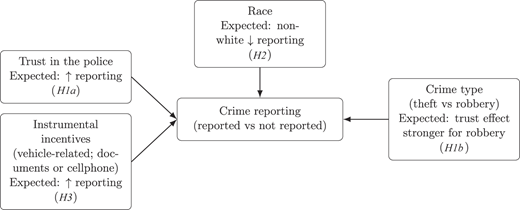
The research questions outlined above lead to three hypotheses. Consistent with a cost–benefit framework under uncertainty, these hypotheses reflect how perceptions of police legitimacy and expected outcomes of police contact shape reporting decisions across different contexts. First, trust in the police is expected to increase the likelihood that victims report property crimes. However, the relevance of trust is likely to vary across crime types. Robbery typically involves direct confrontation and higher perceived risk, making expectations about police behavior more salient in the reporting decision than in cases of theft.
Trust in the police is positively associated with crime reporting.
The positive association between trust in the police and reporting is stronger for robbery than for theft.
Reporting decisions are shaped by racial inequality beyond individual attitudes toward the police. Given unequal exposure to coercive policing and discriminatory treatment, nonwhite individuals may anticipate higher costs of police contact, even when levels of trust and socioeconomic characteristics are held constant.
Nonwhite individuals are less likely to report theft and robbery than white individuals, net of trust in the police and socioeconomic factors.
Reporting may be driven by instrumental considerations that are distinct from trust and race. Certain crime attributes raise the material and administrative stakes of reporting. Incidents involving vehicles or the theft of (IDs)/other documents or mobile phones often require an official police report to initiate insurance claims or administrative procedures, increasing the likelihood of reporting independently of attitudes toward the police.
Crimes involving higher material and administrative stakes are more likely to be reported, net of trust in the police and race.
Figure 1 presents the empirical framework used in the analysis, illustrating how crime reporting is shaped by trust in the police, race, crime type, and material and administrative stakes. The framework summarizes the mechanisms underlying hypotheses H1–H3 and clarifies how these factors are expected to jointly influence reporting behavior for property crimes.
4. Methods
4.1 Data
The study uses data from the 2021 nationally representative victimization survey conducted in Brazil, collected as a complementary module of the Continuous National Household Sample Survey (PNAD Contínua). The 2021 wave includes detailed measures of trust in the police, victimization experiences, crime characteristics, and reporting behavior, allowing for a direct examination of how trust, race, and crime attributes shape the decision to report theft and robbery. The survey employs a stratified multistage sampling design with full national coverage and provides sampling weights that correct for household selection and nonresponse, which are used in all analyses to ensure population representativeness.
4.2 Selected variables
Table 1 summarizes the variables used in the analysis, their operational definitions, and coding schemes. The table reports the dependent variables capturing crime reporting behavior for theft and robbery, the key explanatory variables measuring trust in the police and race, crime attributes related to administrative and economic incentives, and a set of individual, socioeconomic, and contextual control variables.
4.2.1 Dependent variable
The dependent variable captures whether a victim reported a property crime to the police following victimization. In line with our analytical focus, property crime includes both theft and robbery, which are grouped based on the material objective of the offense while differing in levels of confrontation and threat. Reporting is defined as having registered a police report after a theft or robbery, based on direct survey questions that ask whether the police were contacted. Separate indicators are constructed for theft and robbery. In all specifications, the dependent variable is binary, taking the value one if the incident was reported and zero otherwise. This operationalization focuses on actual reporting behavior rather than stated intentions or attitudes, allowing the analysis to examine concrete decisions to engage with law enforcement after victimization. By distinguishing theft and robbery, the measure also captures differences in crime severity, confrontation, and institutional relevance that may shape reporting decisions in distinct ways (Goudriaan et al., 2004; Xie and Baumer, 2019; Timukaite and Buil-Gil, 2025).
4.2.2 Key independent variables
The central explanatory variable is trust in the police. Trust is derived from a survey item that asks respondents how much they trust the Military Police, the primary uniformed law enforcement agency responsible for routine patrolling, crime prevention, and first response to incidents in Brazil. The Military Police operate at the state level and are typically the main point of contact between citizens and law enforcement in everyday situations. Trust is coded as a binary indicator: individuals reporting high or moderate trust are classified as having high trust, while those reporting low or no trust are classified as having low trust. This operationalization reflects the structure of the survey and facilitates interpretation in terms of reporting versus non-reporting decisions.
At the same time, this coding reduces variation in the underlying construct. Dichotomization entails some loss of information and may affect the magnitude of estimated effects or introduce sensitivity to the chosen threshold, particularly when the underlying variable is ordinal, and may limit the ability to capture non-linearities or distinct dimensions of trust. It is also important to note that different modeling traditions approach the measurement of trust in distinct ways. In quantitative approaches that emphasize parsimony and clear behavioral interpretation, binary indicators are commonly used for explanatory variables as a measurement strategy to enhance interpretability and maintain tractability (MacQueen and Bradford, 2015; Blair et al., 2021), whereas criminological research more often relies on ordinal or multi-item scales to capture the multidimensional nature of trust and legitimacy (e.g. Tyler, 2005; Murphy et al., 2014; Peyton et al., 2019). In this context, the binary specification provides a parsimonious representation of trust within the empirical framework adopted.
Race is included as a binary variable based on the PNAD racial classification. Respondents identifying as White are coded as zero, while those identifying as Black, Brown, Indigenous, or Asian are coded as one. In the Brazilian census framework, Brown corresponds to pardo, a self-identified category that broadly refers to individuals of mixed racial background. This aggregation is adopted due to sample size constraints that limit statistical power for disaggregated racial categories. In the sample used in the statistical analysis, the racial composition prior to aggregation is 43% White, 9% Black, 46% Brown, 0.9% Asian, and 0.04% Indigenous, meaning that the nonwhite category is composed predominantly of Black and Brown respondents. The resulting indicator captures nonwhite racial identification and reflects well-documented racial disparities in police contact, exposure to coercive policing, and expectations regarding institutional treatment (Weitzer and Tuch, 1999, 2005; Brunson and Weitzer, 2009; Schuck et al., 2008; Wu et al., 2009).
Crime attributes that raise material and administrative stakes are captured through two binary indicators. The first identifies vehicle-related incidents, defined as theft or robbery involving a car or motorcycle. The second identifies cases in which (IDs) / other documents or a mobile phone were taken. These attributes are theoretically relevant because they often require an official police report to activate insurance claims, cancel documents, or initiate replacement procedures, making reporting more instrumental and potentially less dependent on trust in the police (Corbacho et al., 2012; Farrell et al., 2019).
Administrative necessity is operationalized through these crime characteristics that imply formal or bureaucratic requirements following victimization. Incidents involving vehicles, identification documents, or mobile phones are therefore treated as cases with higher administrative necessity, as victims are more likely to need an official police report to recover losses or initiate institutional procedures. These variables capture situations in which reporting is driven not only by trust or willingness to cooperate, but also by practical and administrative constraints.
4.2.3 Control variables
The models include a set of individual, socioeconomic, and contextual controls commonly associated with crime reporting decisions. All measures are self-reported. Individual characteristics include gender, age, educational attainment, employment status, and household income. Gender is coded as a binary indicator for men, reflecting evidence that men and women face different patterns of victimization and police contact (Kaukinen, 2002). Age is included as a continuous variable, given its association with routines, exposure to crime, and expectations about institutional behavior (Boateng, 2018).
Education is measured through an indicator identifying respondents with higher education, capturing differences in familiarity with bureaucratic procedures and access to information relevant for reporting (Goudriaan et al., 2004; Elliott et al., 2012). Household income is included through income quartiles, with the lowest quartile serving as the reference category. Income is associated with differential exposure to crime, resources to absorb losses, and expectations regarding institutional responsiveness (Adaramoye et al., 2025; Stiller et al., 2025).
Prior victimization is captured through a binary indicator identifying whether the respondent experienced one or more previous incidents of the same crime type. Previous victimization may increase familiarity with reporting procedures or, alternatively, discourage reporting if prior experiences were negative (Boateng, 2018; Farrell et al., 2019).
Contextual controls include urban residence, macro-region of residence, and perceived crime in the neighborhood. Urban residence captures differences in police availability and reporting norms between urban and rural areas. Regional indicators are included for the Northeast, Southeast, South, and Center-West, with the North as the reference category, accounting for heterogeneity in policing practices, institutional capacity, and crime environments across Brazil (Jackson et al., 2022; Moreira and Ceccato, 2024; Oliveira, 2022). Perceived neighborhood crime reflects local exposure to criminal activity and everyday environmental cues that shape expectations about police effectiveness and the perceived necessity of reporting (Sampson and Raudenbush, 1999, 2004).
4.3 Analytical strategy
The core analysis relies on binary response models estimated separately for theft and robbery. Estimating models by crime type reflects theoretical expectations that reporting decisions are shaped by different mechanisms across offenses, particularly with respect to confrontation, uncertainty, and the relevance of trust in the police. The dependent variable is a binary indicator equal to one if the victim reported the incident to the police and zero otherwise. A probit specification is employed to model the reporting decision, given by Eq. (1):
where denotes the standard normal cumulative distribution function, is a vector of individual characteristics, crime attributes, and contextual controls (Table 1), and is a vector of parameters estimated by maximum likelihood using survey weights (Cameron and Trivedi, 2005).
Results are reported exclusively as average marginal effects. For continuous regressors, marginal effects correspond to the derivative of the reporting probability with respect to the covariate. For binary regressors, they represent discrete changes in predicted probabilities when the variable shifts from zero to one. This approach facilitates comparison across specifications and allows for a direct interpretation of effect sizes in terms of reporting probabilities.
5. Results
5.1 Descriptive patterns in reporting behavior
In Brazil, 36% of theft victims report property crime to the police, compared to 67% among robbery victims. Reporting is therefore substantially more frequent for robbery than for theft. Regional composition differs across offenses, with robbery more concentrated in the Northeast (35%) and theft more prevalent in the Southeast (39%). The sample is predominantly urban for both crime types, with 90% of theft victims and 91% of robbery victims residing in urban areas. Perceived neighborhood crime is considerably more common among robbery victims (63%) than among theft victims (32%). Table 2 presents descriptive statistics for victims of property crimes, reported separately for theft and robbery.
Among individual characteristics, high trust in the police is slightly more prevalent among theft victims (59%) than among robbery victims (54%). Non-white individuals represent 60% of theft victims and 63% of robbery victims. Crime attributes associated with reporting incentives are markedly more common in robbery cases. Vehicle-related incidents account for 52% of robberies, compared to 18% of thefts. Similarly, (IDs)/other documents or mobile phones are taken in 6% of robberies, against 1% of thefts.
5.2 Reporting determinants across theft and robbery
Table 3 reports average marginal effects from a sequence of probit models estimated separately for theft and robbery. For each crime type, specifications are progressively augmented with additional sets of controls. The baseline models include trust, race, and individual socioeconomic characteristics (T1-R1). Subsequent specifications incorporate contextual variables, regional fixed effects (T2-R2), and crime attributes related to material and administrative stakes (T3-R3).
Across all modeling specifications, trust in the police is positively associated with crime reporting, with effect sizes differing by crime type. For theft, the marginal effect of high trust ranges from 3.0 to 4.7% points across specifications and declines slightly in the fully specified model. For robbery, the estimated effect of trust is substantially larger, varying from 5.7 to 8.3% points across specifications.
Racial disparities in crime reporting are consistently observed across all models. Non-white individuals exhibit lower reporting probabilities for both theft and robbery, with larger gaps for robbery. In theft models, marginal effects range from −1.6 to −2.7% points, while in robbery models they range from −3.3 to −6.2% points. The stability of these estimates across specifications indicates that the observed racial gaps are not driven by differences in trust, socioeconomic status, or contextual controls.
Crime attributes related to material and administrative stakes enter only in the final specifications and display large effects. Vehicle-related incidents are associated with substantial increases in reporting, amounting to 47.4% points for theft and 37.2% points for robbery. Incidents involving (IDs)/other documents or a mobile phone also raise reporting probabilities, by 8.9% points for theft and 8.8% points for robbery.
Several control variables display systematic patterns across specifications. Previous victimization is positively associated with reporting in theft models, with marginal effects between 8.8 and 17.9% points, although the magnitude declines as additional controls are included. In robbery models, the association similarly weakens across specifications, declining from 21.3 to 7.6% points in the fully adjusted model. Perceived neighborhood crime and urban residence are positively associated with reporting in the specifications where they are included.
Regional indicators reveal persistent spatial heterogeneity. Relative to the North, reporting probabilities are lower in the Northeast for theft, while higher reporting probabilities are observed in the Southeast and Center-West for robbery. These regional differences remain qualitatively consistent across specifications.
6. Discussion
The findings are consistent with H1, H2, and H3 and suggest that reporting behavior reflects a structured post-victimization decision rather than a purely procedural response. Crime reporting is not a mechanical outcome of police contact. Instead, it emerges under conditions of uncertainty, as victims evaluate expected benefits and anticipated costs of contacting law enforcement. This interpretation aligns with research emphasizing institutional trust and cost–benefit considerations in shaping cooperation with the police (Tyler, 2005; Tankebe, 2013; Murphy et al., 2014; Peyton et al., 2019; Hamm et al., 2017).
Consistent with H1, trust in the police is positively associated with reporting (H1a), but its magnitude varies across crime types (H1b). In theft models, the effects of trust are statistically significant but substantively modest. In robbery models, the association is considerably stronger. This pattern indicates that the role of trust depends on the nature of the offense. In less confrontational contexts such as theft, trust plays a limited role, whereas in robbery, where discretion and uncertainty surrounding police response are greater, expectations about police behavior become more consequential (Kääriäinen and Sirén, 2011; Desmond et al., 2016; Xie and Baumer, 2019; Timukaite and Buil-Gil, 2025). The differentiation between theft and robbery helps clarify why prior research pooling property crimes may have produced mixed findings regarding trust. These estimates should be interpreted with caution given the binary and single-item nature of the trust measure.
Consistent with H2, non-white individuals remain significantly less likely to report victimization across all specifications and crime types, even after controlling for trust, socioeconomic characteristics, prior victimization, neighborhood context, and region. The persistence of this gap suggests that racial disparities in reporting are not fully accounted for by differences in expressed trust alone. The disparity is particularly pronounced in robbery, a context characterized by direct confrontation and heightened exposure to police discretion. Although the non-white category is internally heterogeneous, it is predominantly composed of Brown (pardos) and Black respondents in this sample. While aggregation is required for statistical power, the stability of the reporting gap across models suggests that racial inequality in institutional engagement persists independently of attitudinal differences in trust. These findings are consistent with evidence from other settings showing that racial disparities in reporting reflect unequal exposure to coercive policing and differential expectations regarding institutional treatment (Weitzer and Tuch, 1999, 2005; Brunson and Weitzer, 2009; Schuck et al., 2008; Wu et al., 2009; Desmond et al., 2016; Long, 2021).
Regarding H3, material and administrative stakes also shape reporting behavior. Vehicle-related incidents and crimes involving (IDs)/other documents or mobile phones substantially increase reporting probabilities for both theft and robbery, with particularly large effects in robbery cases. These large magnitudes likely reflect institutional requirements rather than purely discretionary cooperation. These results are consistent with the role of administrative necessity, suggesting that reporting in such cases is partly driven by formal requirements rather than trust alone. These results indicate that reporting is often driven by administrative or economic necessity rather than by trust alone. In several specifications, the magnitude of these effects exceeds that associated with trust in the police, especially for robbery. Reporting therefore reflects not only institutional confidence, but also procedural requirements embedded in insurance and administrative systems (Goudriaan et al., 2004; Corbacho et al., 2012; Hernández and Heimark, 2021; Farrell et al., 2019).
Control variables behave as expected. Prior victimization increases reporting, consistent with learning effects and accumulated material costs (Baumer, 2002; Boateng, 2018; Farrell et al., 2019). Urban residence and perceived neighborhood crime are positively associated with reporting. These patterns likely reflect differences not only in exposure but also in access to police services and institutional visibility. Situational and structural factors related to geographic location further contextualize these findings. Access to police services, institutional capacity, and physical proximity to law enforcement vary substantially across Brazil's regions and between urban and rural areas (Moreira and Ceccato, 2024). In remote areas, particularly in parts of the North region, victims may face greater logistical barriers and more limited institutional presence. In contrast, metropolitan areas in the Southeast provide greater physical access to police stations and more developed administrative infrastructure. These territorial differences help explain the observed urban–rural and regional patterns and may also contribute to variation associated with perceived neighborhood crime. Reporting is therefore partly conditioned by institutional availability, in addition to trust and social inequality.
From a policy perspective, the findings caution against interpreting reported crime as a neutral indicator of public confidence or cooperation. For property crimes, reporting is frequently linked to administrative requirements, while racial and geographic disparities suggest uneven patterns of institutional engagement. When some crimes and groups are more likely to report due to administrative necessity and others systematically report less, official crime statistics may constitute a selective representation of victimization. Policies that rely heavily on reported crime to allocate resources or assess performance should therefore account for the structured and unequal nature of reporting behavior. In practical terms, this implies that policymakers should complement police records with victimization surveys to obtain a more accurate picture of crime. It also suggests that performance metrics based solely on reported crime may misrepresent underlying trends, particularly across regions and social groups with different reporting patterns. Accounting for systematic underreporting and administratively driven reporting is therefore essential for more equitable resource allocation and policy evaluation. This may include the use of correction factors or weighting schemes based on victimization survey estimates when comparing crime levels across regions or groups (Moreira et al., 2018).
7. Conclusions and recommendations
Crime reporting for property offenses in Brazil reflects how victims navigate post-victimization decisions within an institutional environment marked by uncertainty and unequal access to protection. Rather than operating as a purely procedural response, reporting emerges from evaluations of expected benefits, anticipated costs, and the practical consequences of contacting law enforcement. These evaluations vary systematically with trust in the police, racial inequality, crime type, administrative or economic requirements, and geographic context. Trust plays a differentiated role across offenses, with stronger associations observed in robbery than in theft, while material and administrative considerations such as vehicle-related incidents or the loss of (IDs)/other documents and mobile phones substantially increase reporting independently of trust. At the same time, racial disparities persist across all model specifications, indicating that reporting behavior cannot be reduced to attitudinal orientations alone.
The persistence of racial disparities in reporting and the differentiated role of trust across offenses call for further research into the mechanisms linking inequality, territorial context, and institutional engagement. Although the non-white category is heterogeneous and predominantly composed of Brown and Black respondents, the present data do not directly measure how expectations about police treatment are formed or how prior experiences shape reporting decisions. Future studies should examine how perceived risks, anticipated treatment, and local institutional conditions influence reporting behavior across racial groups and regions. Incorporating more direct measures of access to police services, institutional capacity, and prior contact with law enforcement would help clarify how trust, inequality, and situational factors jointly structure engagement with the police.
This study has limitations. The analysis relies on self-reported survey data and cross-sectional associations, which restrict causal interpretation. In addition, all key variables are operationalized as binary indicators, which simplifies the underlying variation in the constructs of interest. While this approach facilitates a clear interpretation of reporting as a discrete decision, it may obscure meaningful differences in intensity, perception, and experience. This limitation is particularly relevant for the measure of trust in the police, which is based on a single survey item and therefore does not capture its multidimensional nature. As a result, the estimated effects of trust should be interpreted with caution, as more nuanced or multi-item measures could lead to different effect sizes or alter the relative importance of trust in explaining reporting behavior. Although the use of binary variables is common in some disciplines such as economics and geography, in criminology, this practice may be seen as overlooking the complexity and gradation inherent in key concepts such as victimization, fear, and crime reporting. Future research should therefore explore alternative dependent variables that capture variation in frequency and severity, such as ordinal or continuous measures and composite indices. Such approaches would allow for a more nuanced understanding of reporting practices and the mechanisms that shape it.
In particular, the relationship between trust in the police and reporting behavior may be subject to endogeneity. Prior experiences with police contact, including previous reporting episodes, may shape levels of trust, while trust itself may influence the decision to report. Because both processes can operate simultaneously, the estimated associations should be interpreted as conditional relationships rather than causal effects. Measures of trust capture stated attitudes rather than situational evaluations at the moment of victimization and do not directly measure perceptions of risk or anticipated treatment. Despite these constraints, the findings provide systematic evidence that reporting behavior reflects structured differences in institutional engagement across crime types, racial groups, and geographic contexts.