


This study aims to explore the relationships between strategic improvisation, organizational culture and higher education institutions (HEIs) performance. The dynamic nature of today’s environment, increased population and demand and budget cuts have created a lot of pressure on HEIs around the world. Hence, the need for effective human resource capable of providing advanced policies for efficiency and sustainability of these institutions.
A total of 229 questionnaires were filled and returned by academic leaders from HEIs in Kano state, Nigeria. The study used partial least squares path modelling to test the hypotheses postulated.
The major findings indicate that both strategic improvisation and organizational culture dimensions have direct relationship with HEIs performance. However, only innovative culture moderates the relationship between strategic improvisation and HEIs, while bureaucratic culture and supportive culture fail to support the proposed hypothesis.
More studies are needed to further validate the impact of strategic improvisation (SI) on other public sector performance. Also, future studies should use longitudinal approach to establish at which stage SI has more impact on performance. Also, future studies should identify the difference that exists between units, department and faculty leaders, as some are more likely to engage in SI due to the nature of their specialization.
It is obvious that HEIs performance is not only limited to organizational factors but also individual characteristics such as ability to improvise. Hence, HEIs should consider SI ability during employment to ensure efficiency, performance and sustainability. Moreover, organizational culture of HEIs needs to be updated and to be more flexible in accommodating new initiatives or failure to encourage display of such ability.
Previous studies especially in the for profit sector have demonstrated the role of SI and organizational culture on performance. Thus, the present study is one of the early studies in the non-profit sector, specifically the HEIs. Moreover, the inconsistent result of the previous findings necessitates the study to test the moderating effect of organizational culture.
Introduction
Higher education institutions (HEIs) have been linked with economic prosperity and development that is achieved in a particular country (Chapman and Sarvi, 2017). This is made possible by transforming economic structure through the provision of educated workforce, highly skilled labour that are technologically competent and capable of competing not only locally but also globally (Banya, 2015). Knowledge economy, globalization and rapid technological change have been identified as the major factors forcing the need for change in an organization such HEIs (de Boer et al., 2017; Kiran et al., 2013). For organizations to achieve their objectives, they need to constantly learn, respond and adapt to fast changing environment of today’s world (Owen and Dietz, 2012). HEIs are not left out as they do not operate in a vacuum. HEIs face serious pressure by the changes and competitive nature of the new environment (Collis, 2002; Mullin, 2001). Hence, the need for them to provide enhanced academic programmes in line with the current needs of students, labour market and the economy at large (Al Zameli et al., 2015).
Continuous shrinking of funds almost on yearly basis, coupled with obsolete facilities, understaffing, technological change and higher public expectations are the major challenges of HEIs around the world (Chapman and Sarvi, 2017; Nayyar and Mahmood, 2014). Additionally, transforming the educational sector is one of the key issues facing developing countries like Nigeria (Banya, 2015). In Nigeria, the case is even worse, as HEIs failure has also been attributed to poor quality of leadership and governance, and prioritization of resource allocation (Dike, 2014). Specifically, academic leaders are seriously lacking in entrepreneurial skills to be progressive to attract funds that will contribute to performance of these institutions. For instance, Nkamnebe (2009) posits that Nigerian HEIs lack innovative leaders that have the ability to scan the environment to make tactical decisions. Consequently, HEIs fail to integrate the rapid changes that occur in the environment and the needs of the society. The Nigerian HEIs are in a sorry state, as a result of many or all of the aforementioned problems (Emmanuel, 2015); thus, the conclusion that the country’s HEIs is the worst within the West African sub-region (Apekhade, 2015). As a result of this, HEIs relevance in Nigeria has been seriously questioned in providing the required work force needed by the country. This is evidenced from the clear mismatch between societal needs and graduates produced by these institutions. Thus, there is an increased concern on HEIs (Zajda, 2013), with a lot of calls on them to adopt entrepreneurship as a panacea to their numerous problems (Gibb and Hannon, 2006).
In a competitive and dynamic environment of this nature, it is crucial for organizations including HEIs to be flexible (improvisation) so as to face uncertainty strategically (Goldman and Grinstein, 2010). Strategic improvisation (SI) has been attributed to an opportunity of exploring new ideas as a result of unexpected events (MacNab and Worthley, 2012; Moorman and Miner, 1998b). SI is increasingly important for employees, teams and organizations operating in a constantly changing environment. It is valuable in exploring opportunities out of the conventional fields, thus creating radically new ideas (Fisher and Amabile, 2009) as a result of unexpected events. In line with the above, organizational scholars argued that the increased pressure is as a result of an increased pace in competition, which provides opportunity for organization to use improvisational capability to succeed (Brown and Eisenhardt, 1995). Precisely, HEIs are complex organizations with non-routine crisis which requires immediate response and action to ensure efficiency. Consequently, HEIs are in need of leaders who have the zeal to ignore the formal rules in today’s rapid dynamic environment to ensure sustainability (Joyce and O’Boyle, 2013). In essence, traditional techniques are restricted to narrow area, hence providing effective results only in specific environment. Therefore, there is the need for continuous optimization and updating organizational (Nepal and Ramakrishna, 2017). For the avoidance of doubt, strategic planning is not completely bad; however, SI will help in reducing cost and time waste associated with planning (Sethi and Iqbal, 2008), which may be affected by the nature of the environment.
Empirical studies on SI have largely focussed on private sector, specifically product innovation, IT implementation, firm strategy and city administration (Kyriakopoulos, 2015; Magni et al., 2009; Vera and Crossan, 2005). Thus, neglecting non-profit organizations particularly HEIs. Additionally, most of the studies were conducted in high-velocity environment of developed countries (Cunha, 2005), neglecting emerging economies (Hodgkinson et al., 2016), which is characterized by rapid and unpredictable environmental changes (Zheng and Mai, 2013). It is apparent that HEIs need to adapt to today’s changing environment, and thus the research question on the impact of SI on HEIs performance. In essence, the need for organizational performance realization in this twenty-first century requires organizations to be flexible (improvise) to identify and accommodate new knowledge about their customers (Ahuja et al., 2016). Thus, resulting into increase in customer satisfaction, loyalty and by extention organizational performance as a result of continual retention of the customers (Levesque and Mcdougall, 1996).
Besides improvisation, organizational culture (OC) has also been linked to organizational performance (Bititci et al., 2015). In fact, OC is a major determinant of promoting critical thinking that facilitates innovativeness (Zhu, 2015). Hence, SI and OC are posits to influence organizational performance. However, past studies failed to look on the possible link between SI, OC and OP, especially in HEIs. In addition, strategic role of middle line managers have been fully documented in the for profit sector (Olayo et al., 2015), neglecting the non-profit sector like HEIs. As such, the link between leaders’ characteristics or leadership style and organizational performance is not complete when OC is ignored (Ogbonna and Harris, 2000). Apparently, OC largely depends on leaders in creating and maintaining a specific culture that suits their style, need, characteristics, ambition and corporate strategy of the organization (Turker and Altuntas, 2015). Certainly, OC has been identified as not only important in enhancing organizational performance but also vital for innovativeness and adaptation in HEIs (Schneckenberg, 2009). Hence, the need to consider the role of OC in Nigerian HEIs in this era of change, to ascertain its role in today’s dynamic environment. Despite the increase attention on SI in today’s environment, studies are still limited (Smith and Blundel, 2014); hence, there is the need to shed light on its impact and the moderating role of OC in enhancing HEIs performance. Thus, this study attempts to fill in the identified gap by examining the moderating role of OC on the relationship between SI and HEIs performance.
Strategic improvisation and organizational performance
For decades, strategic planning has been considered as the only best way of ensuring competitive advantage by corporate leaders in the late 1960s (Mintzberg, 1994). However, organizations struggling for survival that need to adapt to today’s rapid changing environment turn to improvisation (Wind and Mahajan, 1997). Ciborra (1996) defined improvisation as the process of overcoming the turbulent circumstances facing organizations by using available information and structure at their disposal. Improvisation is also defined as the deliberate and substantive convergence of the design and execution process (Miner et al., 2001; Moorman and Miner, 1998a, 1998b).
The concept of SI is an emerging field of study in the management science that deals with providing solutions on how organizations adapt to dynamism of today’s environment (Bakar et al., 2015b; Hadida and Tarvainen, 2014). Besides, strict adherence to strategic planning has been identified as a hindrance to creativity, flexibility and the development of an appropriate plan for the organization (Slotegraaf and Dickson, 2004). In view of that, SI is viewed as a new paradigm for fast learning, adaptation and strategic renewal (Moorman and Miner, 1998b; Vera and Crossan, 2005). The accelerated rate at which changes occur within the environment cannot be overemphasized, thus making it difficult for organizations to always have the time to plan. As such employees are frequently forced to act before they can fully analyse all available options. Consequently, leaders improvise when they are faced with complex and dynamic situations that cannot be managed using the available routines. The abilitity of leaders to improvise will not only solve the problem but also give them the ability to capitalize on opportunities that will move the organizations forward, as a result of their novel startegic decisions (Hmieleski et al., 2013).
SI is defined as an action taken in real-time situations where it encompasses a high amount of spontaneity and creativity (Arshad et al., 2015b). SI is operationalized as the leaders’ ability to respond to unforeseen circumstances intelligently and effectively to solve a problem or use an opportunity. It involves making a creative decision or action outside the formal organization structure (Vera and Crossan, 2005). SI is seen as a behavioural strategy used by leaders on behalf of their organizations to respond to uncertainty, time pressure and resources insufficiency (Hu et al., 2017).
Previous studies have linked SI to organizational performance (Ahmad et al., 2015; Bakar et al., 2015c; Bingham, 2009). For instance, Bergh and Lim (2008) conducted a study on the absorptive capacity and improvisation from the organizational learning point of view using a sample of 205 of companies that announced and also implement restructuring actions. The findings revealed that both absorptive capacity and improvisation have an influence on subsequent restructuring (spin off) and performance, thereby establishing a relationship with improvisation and organizational performance. In another study, Hmieleski et al. (2013) also established a positive relationship between SI and organizational performance. Other studies using measures like product success or product development as an indicator of performance have also found a positive relationship between SI and firm performance (Akgün and Lynn, 2002; Leybourne and Sadler-Smith, 2006).
As such, scholars have called for more investigation on SI especially in public sector to devise means of eradicating HEIs emerging needs. SI is more of timely response, which may lead to new solutions and innovation that will serve as core competency advantage for these institutions (Yeboah Banin et al., 2016). Thus, we hypothesized that:
SI is positively related to HEIs performance.
Organizational culture as a moderator
OC is defined as:
[…] the pattern of basic assumptions which a given group has invented, discovered, or developed in learning to cope with its problems of external adaptation and internal integration, which have worked well enough to be considered valid, and, therefore, to be taught to new members as the correct way to perceive, think, and feel in relation to those problems (Schein, 2010, p. 18).
OC is a well-established construct that has been used both as dependent and independent variable (Turker and Altuntas, 2015). As such, OC has been well-established with other factors such as leadership (Ogbonna and Harris, 2000; Schein, 1984), employee turnover, job satisfaction (Uzkurt et al., 2013) and organizational performance (Parry and Proctor-Thomson, 2003; Scott et al., 2003) to mention a few.
OC concept has matured to generate a number of theories and models (Yiing and Ahmad, 2009; Zhu, 2015). The most common is that of Wallach (1983) where OC is divided into bureaucratic, innovative and supportive dimensions. He argued that OC can be fully understood using these three basic components. Bureaucratic culture (BC) is more hierarchical in nature with clear descriptions of authority and responsibilities, where activities are organized systematically and channel to the lower level. An innovative culture (IC) is that in which creativity and result-oriented activities are encouraged and condoned, whereas a supportive culture (SC) is that which encourages teamwork and people oriented activities. In the past, government organizations are known to be bureaucratic in nature, whereas private organizations are more supportive and innovative. However, today’s dynamic environment requires all organizations to be entrepreneurial in nature; hence, there is the need for HEIs to combine all the component of OC to fully recognize, use and exploit available opportunities to ensure achievement of set objectives and sustainability.
Empirical studies on SI especially on its outcomes and consequences have not been fully exhausted (Arshad et al., 2015b; Chelariu et al., 2002). The findings were inconsistent; hence, studies remain inconclusive, and thus the possible need for a moderator. Studies such as Arshad and Hughes (2009), Arshad (2011), Bakar et al. (2015a) and Bakar et al. (2015c) reported a significant relationship, whereas Leybourne and Sadler-Smith (2006) reported insignificant or negative relationship. Additionally, the certainty of improvisation yielding positive impact is still not clear. As noted by Miner et al. (2001), improvisation can be good or bad, i.e. can have a positive or negative impact. Besides, improvisation may be highly innovative or chaotic, and it may solve a problem or worsen it (Vera and Crossan, 2005).
Thus, we argued that OC (bureaucratic, innovative and supportive) will moderate the relationship between SI and HEIs performance. First, Villa et al. (2003) posit that, to fully understand construct related to performance and leadership, OC should be considered as a situational variable. Second, research has found that the harmonious combination of appropriate leadership behaviours with certain types of OCs can positively influence employees’ performance (Ismiyarto et al., 2015; Ogbonna and Harris, 2000). Third, culture is one of the major sources of nurturing and developing new ideas in an organization (Uzkurt et al., 2013). Thus, the means for adapting to increasing needs of today’s dynamic and evolving environment by facilitating new initiatives implementation are provided, and this also provides for long-term competitive advantage and organizational success. In essence, OC has been identified as a core factor affecting the overall success of an organization, which does not only connect to daily routine of employees toward achieving their goal but also provides an avenue for fast adaption to today’s changing environment (Khuong and Nhu, 2015). In fact, only organizations that have the culture of tolerating failure (Sonenshein, 2014) and have little resistance to change will provide environment for improvisation (Leybourne, 2006). Hence, we propose the following hypotheses:
BC is positively related to HEIs performance.
IC is positively related to HEIs performance.
SC is positively related to HEIs performance.
BC has a significant and positive influence on the relationship between SI and HEIs performance.
IC has a significant and positive influence on the relationship between SI and HEIs performance.
SC has a significant and positive influence on the relationship between SI and HEIs performance.
Research method
Survey design was used because it enhances result generalization (Dooley, 2001). The items were adapted from previous studies and guaged on five-point likert scale with 5 strongly disagree to 1 strongly agree. In addition, some basic and relevant demographic information were also collected as presented in Table I. Prior to the main data collection process, the researcher conducted a pilot test using a sample of 40 respondents, after which some adjustments were made based on experts suggestions. The main sample of the study was 370 out of which only 229 responses were recorded from academic leaders across ten HEIs in Kano state, northwest part of Nigeria. In a bid to enhance validity and credibility of the result, the researcher emphasized on the confidentiality of the respondents and that there were no wrong or right answers to minimize social-desirability bias (Podsakoff et al., 2003). Also, to confirm whether common method variance (CMV) was not a major concern in the present study, Harman’s one factor test was conducted. The result showed 35.6 per cent which indicates that CMV is not an issue in the present study.
Profile of respondents
| Characteristics | Frequency | (%) |
|---|---|---|
| Gender | ||
| Male | 204 | 89.1 |
| Female | 25 | 10.9 |
| Highest qualification | ||
| HND/degree | 72 | 31.4 |
| Masters | 124 | 54.1 |
| PhD | 23 | 10 |
| Years in current position | ||
| 1 < 2 years | 95 | 41.5 |
| 2 < 3 years | 65 | 28.4 |
| 3 < 4 years | 30 | 13.1 |
| 4 < 5 years | 16 | 7 |
| 5 and above years | 17 | 7.4 |
| Missing | 6 | 2.6 |
| Academic position | ||
| Below senior lecturer | 139 | 60.7 |
| Senior lecturer | 65 | 28.4 |
| Associate professor | 5 | 2.2 |
| Professor | 2 | 0.9 |
| Missing | 18 | 7.9 |
| Institution | ||
| University | 78 | 34.1 |
| College of education | 91 | 39.7 |
| Polytechnic | 26 | 11.4 |
| Others | 27 | 11.8 |
| Missing | 7 | 3.1 |
| Employer | ||
| Federal government | 85 | 39.2 |
| State government | 125 | 57.6 |
| Missing | 7 | 3.2 |
Research instruments
SI construct was measured using seven items guaged on a five-point Likert scale adapted from Vera and Crossan (2005). The items originated from the work of Moorman and Miner (1998a, 1998b), Tierney et al. (1999), Unger and Kernan (1983) and has a Cronbach’s alpha of 0.91. The study operationalized SI as the best strategy to cope with flexibility and provide the organization with capabilities to adapt to changing environmental demands rapidly and effortlessly (Bakar et al., 2015b).
In terms of OC, the popular Wallach (1983) items of 24 were used. Wallach (1983) assigned eight items each to the three dimensions of OC (bureaucratic, innovative and supportive). This classification has been used by other researchers such as Hamzah et al. (2013). In line with the above, OC is operationalized as a set of key values, assumptions, understandings and norms that is shared by members of an organization and taught to new members as correct (Daft, 1995).
The study operationalized performance as a uni-dimensional construct and subjective (non financial) based on Dess and Robinson (1984) submission, using scale from Berman and West (1998), Brewer and Selden (1998), Choi and Rainey (2010), Morris and Jones (1999), Moynihan and Pandey (2005) and Pitt and Tucker (2008). Performance is operationalized as the ability of the institutions to efficiently used its few resources and also provide the needed service to the satisfaction of its employees and customers. The items covered both managerial efficiency in terms of cost and service delivery, general employees performance and customer satisfaction.
Analytical procedure
The study made use of PLS-SEM version 3 to analysed the hypotheses of the study. Besides its friendly graphic nature, PLS-SEM has minimal restriction to both size and normality of data (Chin, 1998) and also accommodates both reflective and formative measures. The model of the study is reflective in nature, with some organizations dominants in one or more of these OC dimensions. Explicitly, the removal or absence of any of the dimensions does not affect the meaning of the latent variable (OC).
Furthermore, PLS-SEM is ideal for moderating analyses because it provides for measurement error. Thereby providing better and precise results (Chin, 1998). Also, PLS-SEM has the ability to estimate relationship of both inner model (measurement model) and outer model (structural model) simultaneously, which are the two basic two-steps process identified by Chin (2010). Assessing the outer model involves reliability and validity of the items in relation to the latent variables (LVs), while inner model deals with the association between LVs of the study (Chin, 2010; Hair et al., 2014). In fact, the use of PLS-SEM in analysis has become common in management, marketing and entrepreneurship studies in recent times (Gelhard and von Delft, 2016). Thus, a considerable increase is observed in advancement (PLSc, HTMT) to ensure rigorous analysis and applicability (Henseler et al., 2016).
Assessment of measurement model
Measurement model is a confirmatory process of items and LVs to ensure their reliability and validity (Hair et al., 2011). The three basic requirements of a reflective measurement model are internal consistency, convergent validity and discriminant validity. In this study, internal consistency was measured using three different criteria; Cronbach’s alpha (A), composite reliability (CR) (Chin, 2010) and Dijkstra–Henseler’s rho (ρA) (Dijkstra and Henseler, 2015) all have a threshold of 0.70 (Henseler et al., 2016; Henseler et al., 2009). Table II indicates that all path loading values and that of the construct validity (A, ρC, ρA) are close to or exceed the threshold, hence satisfying and achieving internal consistency. In the same vein, convergent validity using average variance extracted (AVE) was also established as values in Table II exceed the 0.50 threshold (Hair et al., 2011; Kock, 2011). Following Henseler et al. (2016) recommendation, Fornell–Larcker and Heterotrait–Monotrait (HTMT) criterion was used to achieve discriminant validity. According to Fornell and Larcker (1981), submission diagonal element (square root of AVE) is expected to be higher than the off diagonal one as presented in Table III. Similarly, Henseler et al. (2015) argued that comparing heterotrait–heteromethod correlations and the monotrait–heteromethod (HTMT) is more reliable in identifying discriminant validity. Accordingly, HTMT values presented in Table IV are all less than 0.90 which indicates that discriminant validity is not an issue in the present study.
Measurement model result
| Items | Loadings | Factor loadings | A | ρC | ρA |
|---|---|---|---|---|---|
| BC1 | 0.674 | 0.905 | 0.909 | 0.924 | 0.603 |
| BC2 | 0.789 | ||||
| BC3 | 0.671 | ||||
| BC4 | 0.849 | ||||
| BC5 | 0.817 | ||||
| BC6 | 0.833 | ||||
| BC7 | 0.810 | ||||
| BC8 | 0.749 | ||||
| IC1 | 0.806 | 0.786 | 0.803 | 0.856 | 0.547 |
| IC2 | 0.793 | ||||
| IC4 | 0.709 | ||||
| IC6 | 0.540 | ||||
| IC8 | 0.814 | ||||
| OP2 | 0.743 | 0.885 | 0.889 | 0.909 | 0.556 |
| OP3 | 0.764 | ||||
| OP4 | 0.733 | ||||
| OP5 | 0.747 | ||||
| OP6 | 0.653 | ||||
| OP7 | 0.813 | ||||
| OP8 | 0.697 | ||||
| OP9 | 0.804 | ||||
| SC1 | 0.697 | 0.780 | 0.815 | 0.848 | 0.531 |
| SC2 | 0.553 | ||||
| SC5 | 0.816 | ||||
| SC6 | 0.737 | ||||
| SC7 | 0.811 | ||||
| SI2 | 0.741 | 0.730 | 0.746 | 0.830 | 0.551 |
| SI3 | 0.771 | ||||
| SI4 | 0.786 | ||||
| SI7 | 0.664 |
Structural model assessment
The study used 5,000 standard bootstrapping routine and 229 cases to evaluate the path coefficient and R2 which are the two preliminary requirement of validating structural model (Hair et al., 2014; Rasoolimanesh et al., 2017). The structural model deals with establishing the link between and among constructs of the study through path coefficient, while the R2 evaluates the explanatory power of the LVs in explaining the endogenous variables. The path coefficient values as presented in Table IV and Figure 1 involves the full model using Kock (2015) submission of one-tailed p-value. Specifically, the structural model that includes both main and moderating effect was run at once to evaluate the postulated hypotheses of the study.
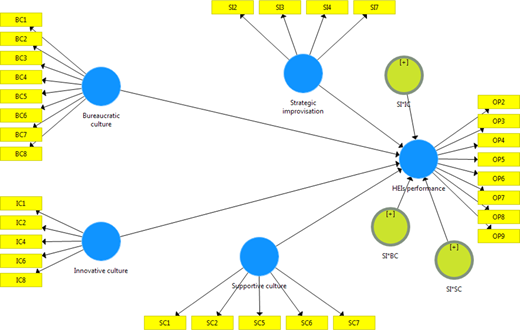
The result shows that H1 which stated that there is a positive significance relationship between SI and HEIs performance is supported with a beta value of β = 0.163, t = 3.306 and p < 0.1 respectively. H2a predicted a positive and significant relationship between BC and HEIs performance was also accepted with β = 0.307, t = 3.358 and p < 0.001. H2b found IC to have a positive relationship with HEIs performance with β = 0.220, t = 2.860 and p < 0.01. The final direct relationship also confirmed the hypothesized relationship between SC and HEIs performance, where we have β = 0.271, t = 3.396 and p < 0.001, respectively. In addition, the path coefficient after the 5,000 resampling bootstrapping technique has no any sign of change at 95 per cent confidence level as presented in Table I to further validate the significance of the findings. Specifically, confidence intervals further confirm the rejection of the hypothesis after reporting negative lower level and positive upper level respectively.
The postulation that BC moderates the relationship between SI and HEIs performance was rejected. The hypothesis recorded a very low beta value of β = 0.073, t = 1.185 and p < 0.118 which above the 0.1 acceptable threshold. Interestingly, IC moderates the relationship between SI and HEIs performance with a beta value of β = 0.089, t = 0.1359 and P > 0.1, in such a way that the more innovative activities initiated by these institutions the more their performance. The relationship between SI and HEIs performance is negatively moderated by SC, and hence the rejection of the hypothesis. Despite recording t = 1.962 and P > 0.05, the negative beta value of β = −0.128 necessitates the rejection as we postulate a positive moderating effect.
The next criteria for vindicating the structural model as highlighted above is the R2 (Henseler et al., 2009), which largely depends on the research area. Accordingly, Chin (1998) identified three orders of R2 values of 0.67, 0.33 and 0.19 to represent substantial, moderate and weak, respectively. The R2 value in of 0.641 (64 per cent) as presented in Table V can be classified as moderates in line with Chin (1998). Specifically, SI and BC, IC and SC explain 67 per cent of factors that affect HEIs performance in Nigeria (Table VI).
Results of hypotheses testing
| Hypo | Relationship | Beta | T statistics | P-values | Confidence interval | ||
|---|---|---|---|---|---|---|---|
| 95% LL | 95% UL | Decision | |||||
| 1 | SI → HEIs perf. | 0.163 | 3.306 | 0.000 | 0.080 | 0.241 | Accepted |
| 2 | BC → HEIs perf. | 0.307 | 3.358 | 0.000 | 0.163 | 0.462 | Accepted |
| 3 | IC → HEIs perf. | 0.220 | 2.860 | 0.002 | 0.095 | 0.346 | Accepted |
| 4 | SC → HEIs perf. | 0.271 | 3.396 | 0.000 | 0.138 | 0.400 | Accepted |
| 5 | SI × BC → HEIs perf. | 0.073 | 1.185 | 0.118 | Rejected | ||
| 6 | SI × IC → HEIs perf. | 0.089 | 1.359 | 0.087 | Accepted | ||
| 7 | SI × SC → HEIs perf. | −0.128 | 1.962 | 0.025 | Rejected | ||
Notes:
LL = low level; UL = upper level
Effect size and predictive relevance
Apart from path coefficient and R2 discussed above, Cohen (1988) effect size (f2) submission was used in determining the relative effect of SI, organizational culture on HEIs performance. The effect size measure is a process of substantiating the specific effect of each exogenous variable has on endogenous variables of the study (Chin, 2010). Sullivan and Feinn (2012) emphasized the used of effect size because some findings may be of significance by chance; hence, there is the need to verify the magnitude of the contribution of each exogenous variables in the relationship. Accordingly, Cohen (1988) suggested three categories of f2 values of 0.02, 0.15, and 0.35 representing low, moderate, and high effect sizes, respectively. Table V indicates that the study recorded low effect size.
In addition, Woodside (2013) has suggested the use of other criteria apart from R2 in determining how well hypothesized relationship explain the model of the study. He argued that R2 is more likely to increase in a complex model than in a simple one. Hence, present study used Henseler et al.’s (2014) standardized root mean square residual (SRMR) and Stone–Geisser (Q2) predictive relevance using blind-folding in line with Hair et al.’s (2014) submission. Accordingly, the study recorded SRMR value of 0.070 to achieve a good model fit, taking a conservative threshold of 0.081 recommended by Hu and Bentler (1999). The study also established the predictive validity of the model using Stone–Geisser having recorded a value of 0.417, which is greater than the zero threshold suggested by Henseler et al. (2009).
Discussion
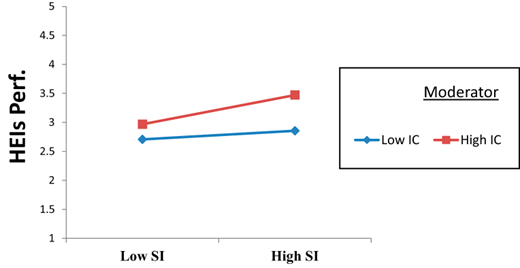
The study was based on two key arguments. One, complexity and uncertainty are major attributes of today’s environment in which most businesses (HIEs inclusive) operate. Therefore, these organizations are expected to adapt and engaged in SI especially during intense and unforeseen situations (Hmieleski and Corbett, 2008). Two, HEIs are exposed to competition; hence, the only way they can respond to this is to ensure that the culture of the organization undergoes change, which will surely take time to be achieved. Therefore, we argued that SI and OC dimensions are positively related to performance. Also, OC dimensions moderates the relationship between SI and performance (Figure 2).
From the proposed hypotheses, the finding establishes that SI is positively related to HEIs performance (H1). Consistent with H1, a positive and significant relationship was found between SI and HEIs performance. The finding is in line with previous studies (Arshad et al., 2015b; Bakar et al., 2015a; Gao et al., 2015) mostly conducted in the for profit sector. Putting resource base theory (Barney, 1986; Barney et al., 2001) into consideration indicates that leaders with improvisational ability are unique and source of competitive advantage in today’s environment. It also provides support for the need for management in non-profit organizations such as HEIs to recognize and appreciate improvisational behaviour especially during recruitment to ensure that only candidates with this ability are recognized during employment and leadership roles (Mohan et al., 2016; Ogbonna and Harris, 2000). In addition, the finding highlights the need for HEIs and other governmental organizations to seek for alternative to strategic planning in improvisation; thus, the ability to face and manage the current environmental pressure and unprecedented fast changes (Wind and Mahajan, 1997). Moreover, not-for-profit organizations should acknowledge the effect of SI behaviour across the institutions for performance and sustainability (Arshad et al., 2015a).
Furthermore, our postulations that organizational culture dimensions (BC, IC and SC) correlate positively with HEIs performance (H2) was significant, thus accepted. The finding is consistent with previous studies where either the dimensions or OC as a whole affects performance (Bititci et al., 2015). This is to say that, HEI activities are bureaucratic in nature, which hinders innovation especially at this critical time of increase pressure and the need for change in their instructional policies and activities (Zhu, 2015). HEIs are expected to be open for change both from the management perspectives as well as the operational staff to ensure success and sustainability. The study vindicates the saying that organizational culture creates people-oriented management, which serves as an intangible asset that defines individual and organizations behaviours (Maull et al., 2001). As such, organizational culture encourages innovation and creativity which affect performance.
The postulation that BC positively moderates the relationship between SI and HEIs performance was insignificant and thus rejected. The finding is in line with Brewer and Clippard (2002) and Yiing and Ahmad (2009) where empirical evidences revealed that organizational culture where BC is the dominant usually affects innovation and performance. The finding is not surprising, as today’s environment largely depends on the situation at hand; hence, there is the need for flexibility and contingency approach to respond and adapt.
H3b stated that IC will positively moderate the relationship between SI and HEIs performance in such a way that, the more the ability to innovate, the better the performance of the HEIs was significant and accepted. This is in line with the argument of O’Cass and Viet Ngo (2007) that IC is very vital because it deals with the ability to read, predict and develop a unique way of providing superior customer satisfaction. This may not be unconnected with the fact that today’s environment is very complex and dynamic, which requires flexibility and innovation to ensure stability and cohesion to adapt to contemporary changes. In essence, HEIs are encouraged to ensure coherence of purpose among all units, provide reward and recognition, relaxation of their strict rule and innovative policies to develop a new culture that will provide competitive advantage and sustainability. However, H3 that postulated the moderating effect of organizational culture dimension SC on the relationship between SI and HEIs performance is rejected. Most HEIs education in Nigeria favours individual effort especially in research and academic activities. For example, an article written by one person gets more point during promotion than one with two or more authors. Consequently, affecting team work and supportive ability within HEIs as compared to other country where all authors get equal points.
Though the present study provides empirical support on the impact of SI on HEIs performance and the moderating role of IC, the study fails to establish the moderating role of BC and SC. However, the findings have significantly contributed to literature by acknowledging and establishing the impact of SI in non-profit organization like HIEs. Despite the contribution of the study, conclusion cannot be drawn as a result of a number of limitations discussed below. First, the use of a relatively smaller sample that only covers academic leaders in HEIs in one state in Nigeria, in a study that is exploratory in nature affects the generalization of the findings. Hence, the need to cover broader sample that includes leaders and non-leaders in all HIEs in Nigeria. Another limitation of the study is the failure to acknowledge the peculiarities associated with units, departments and centres, where improvisation and adaptation differs. Leaders from entrepreneurial centres, business and accounting departments, business schools as well as consultancy centres are more likely to engage in improvisational and entrepreneurial activities that will enhance their performance. Future study should identify the differences that exist between leaders from different departments, centres and units, to ascertain those leaders who are adamant to change which affects the whole organization. Finally, both improvisation and organizational culture are behavioural in nature, which differs with time and stage in which it occurs. Hence, a longitudinal study is suggested, to monitor the changes and the most important time in which these factors affect performance.

