

Structural adhesives win battle against traditional fastening methods
Structural adhesives win battle against traditional fastening methods
Keywords Adhesives,Europe
Acrylics, epoxies and polyurethanes are set to spearhead growth in the market for structural adhesives, according to a new study by Frost & Sullivan, the international marketing consulting company. The total European market, which in 1997 was estimated at $728.5 million, is forecast to remain buoyant for the foreseeable future, as structural adhesives replace traditional fastening methods in a number of end-user markets.
Robert Peacock, industry analyst at Frost & Sullivan, reports that success in these sectors is, in part, a reaction to the increased popularity of plastics and composites as materials for construction. Mr Peacock explains: "The use of aluminium and plastic pads on vehicle bodies, appliances and other goods, as well as (to a lesser extent) in the construction industry, has led to the increased use of structural adhesives, as traditional fastening methods either cannot be used or are not technically suitable," a trend which he expects to continue.
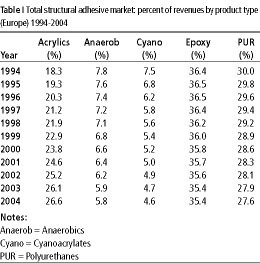
Manufacturers and suppliers of structural adhesives have been working hard to convince potential customers of the superiority of adhesives over mechanical fasteners. Where poor customer awareness regarding the capabilities of high performance structural adhesives once threatened market penetration, the educational efforts of suppliers have driven demand and ensured the continued acceptance of adhesive technology. Frost & Sullivan predicts that overall revenues for structural adhesives will reach US$1.03 billion in 2004, representing a compound annual growth rate of 5.1 per cent (Table I).
Recovery from recession in the automotive industry has had a major impact on structural adhesives. General economic performance in the end-user markets affects the market for adhesives,but this has been most apparent in the transportation sector. Throughout Europe,growth in truck and coach building, in which the use of structural adhesives has been increasing, has been satisfactory over the past few years and this trend is set to continue.
The aerospace industry in Europe also offers considerable growth potential, owing to increased commercial airliner production, although the volumes used in this market are not as high as in the other transportation sectors.
Pricing is the most important overall factor in these markets, especially so in the industrial cyanoacrylate market and for suppliers to the automotive industry. It is always important for companies to be competitive on pricing, if the products are well known. Stable prices for most product types, apart from cyanoacrylates, which can be treated as commodity products in some cases, and for which prices have been falling in the industrial market, should ensure continued market buoyancy.
Despite the market maturity of anaerobics and cyanoacrylates, performance improvements have been made to all products, such as rubber-toughened cyanoacrylates, new formulations of structural acrylic and polyurethane, and the continued development of epoxy materials. Through closer working relationships with customers, technical advances are expected which can be transferred to a variety of new applications.
Mr Peacock concludes that the ability of specialist companies to offer customers and potential customers close developmental co-operation will be an important factor in retaining business. In addition to being able to compete on price, a high level of technical support is a necessity in the supply of high performance products.
In summary, the European Market for structural adhesives offers numerous opportunities for growth,although growth rates will differ for each product type, with acrylics forecast to show the highest growth rates, followed by epoxies and polyurethanes. The overall market is predicted to continue to show good growth for the foreseeable future with a high level of competitive activity.
For further details contact Frost & Sullivan. Tel: +44 (0)171 915 7824; +49 69 23 5057; +33 1 42 8154 50.


