This study aims to examine the relationships of career management, job crafting and compensation management with turnover intention among private school teachers in Indonesia, positioning teacher retention as a condition for sustaining quality education. It also tests whether psychological well-being mediates the job crafting−turnover intention relationship and whether teacher resilience moderates the effects of the three HRM-related predictors.
A cross-sectional survey was conducted with 482 non-civil-service private school teachers aged under 31 in Central Java and the Special Region of Yogyakarta. Data were analysed using partial least squares structural equation modelling. Career management, job crafting and turnover intention were estimated as higher-order constructs using a disjoint two-stage approach, and the hypothesised direct, indirect and interaction effects were assessed through bootstrapping.
The model explained 36.9 % of the variance in turnover intention. Compensation management had a significant negative direct effect on turnover intention, whereas career management and job crafting did not. Psychological well-being mediated the effect of job crafting on turnover intention. Resilience strengthened the job crafting−turnover intention relationship, but did not moderate the effects of career management or compensation management.
This study contributes to quality education research by positioning teacher retention as a condition for sustaining instructional continuity in private schools. It integrates social exchange theory, the job demands-resources model and conservation of resources theory to show that retention depends on differentiated organisational and psychological resources.
Introduction
Teacher turnover has become a persistent management problem for schools because it disrupts instructional continuity, weakens collegial relationships and generates costs for recruitment, induction and training. Studies of teacher attrition show that recurrent turnover can harm student achievement and deplete school resources (Carver-Thomas and Darling-Hammond, 2017, 2019; Ingersoll, 2001; Ronfeldt et al., 2013; Sorensen and Ladd, 2020). Although actual turnover is observable only when teachers leave, turnover intention is an important early indicator because it captures the cognitive and motivational withdrawal process that may precede job search behaviour and resignation (Mobley, 1977; Tett and Meyer, 1993).
Teacher retention is also a quality education issue. Stable teaching workforces help schools maintain instructional continuity, sustain relationships with students and colleagues and preserve institutional knowledge needed for consistent learning support (Menzies, 2023; Sorensen and Ladd, 2020). In private schools, where staffing, compensation and career systems are often managed by foundations rather than civil-service structures, teacher retention becomes an important condition for sustaining quality education (Alifuddin and Widodo, 2021). Understanding how management-related and psychological resources shape teachers’ intention to leave can therefore help private schools strengthen their capacity to provide stable and high-quality education (Collie, 2023; Hascher et al., 2021).
These issues are particularly salient for private schools in developing education systems. In Indonesia, private schools employ many teachers whose employment status, compensation packages and career paths are governed by foundation policies rather than civil-service structures. For non-civil-service private school teachers, employment in private schools can offer a professional entry point, teaching experience and relational attachment; at the same time, it can be perceived as less secure than civil-service employment. Previous Indonesian studies have linked teacher turnover intention to low compensation, weak organisational commitment, work stress and unclear working conditions (Alifuddin and Widodo, 2021; Banata et al., 2023; Dwiyanti et al., 2022).
Educational managers in Indonesian private schools therefore face a dual retention challenge. They must design organisational systems that make private schools credible places in which to build a career while also enabling teachers to sustain their psychological functioning in demanding work. This study focuses on three management-related antecedents. Career management refers to organisational support for career development together with teachers’ efforts to manage their professional trajectories (De Vos et al., 2009; Runhaar et al., 2019). Job crafting refers to proactive changes that teachers make to their tasks, relationships and work cognitions (Tims et al., 2012; Wrzesniewski and Dutton, 2001). Compensation management concerns teachers’ perceptions of pay levels, pay structures, pay raises, variable-pay procedures and benefits (Williams et al., 2008).
These organisational and behavioural resources are unlikely to influence retention independently of teachers’ psychological functioning. Psychological well-being captures positive functioning in terms of self-acceptance, environmental mastery, purpose in life, personal growth and positive relationships (Ryff, 1989; Ryff et al., 1995), whereas teacher resilience reflects the capacity to adapt to professional demands and recover from adversity (Beltman et al., 2011; Nguyet Trang and Thang, 2023). Both constructs are relevant because teacher retention is closely associated with the balance between job demands and resources, the quality of teacher well-being and teachers’ capacity to mobilise personal and contextual resources when facing occupational pressures (Collie, 2023; Hascher et al., 2021; Madigan and Kim, 2021).
The existing evidence remains fragmented across distinct research streams. Career-management studies generally associate organisational career support with career progress, affective commitment and lower turnover intention. Systematic reviews also indicate that career-management practices influence employee outcomes primarily when organisational support is translated into credible experiences of career success and growth (Bagdadli and Gianecchini, 2019; De Vos et al., 2009; Weng and McElroy, 2012). This stream establishes the potential retention value of career support, but does not fully resolve whether developmental activities alone are sufficient when promotion, professional status and remuneration growth remain limited or uncertain. This distinction is particularly important for non-civil-service private-school teachers, because increased competence and employability may encourage them to remain when internal opportunities are credible, but may also enable them to pursue better opportunities elsewhere when such opportunities are absent.
Job-crafting research has followed a different process logic. Rather than consistently demonstrating a uniform direct relationship with turnover intention, prior studies commonly identify meaningful work, work engagement and psychological functioning as proximal mechanisms through which proactive work redesign produces adaptive outcomes (Oprea et al., 2022; Tims et al., 2013; Zheng et al., 2024). This evidence suggests that job crafting may operate as a resource-building process rather than as an automatic retention instrument. Teachers may redesign instructional tasks, strengthen relationships and reframe the meaning of their work, but these activities may not reduce turnover intention when they merely add responsibilities or fail to improve teachers’ psychological condition. Despite this process logic, psychological well-being has received limited attention as the specific mechanism linking job crafting to turnover intention among teachers while simultaneously accounting for a personal resource that may determine whether crafted work experiences are successfully converted into reasons to stay.
Compensation and resilience have also largely been examined in separate bodies of literature. Compensation studies explain lower turnover intention through pay satisfaction, salary justice and perceived organisational support, indicating that pay and benefits operate through both economic and social-exchange mechanisms (Jolly et al., 2021; Y. Liu et al., 2023; Williams et al., 2006; Zhou and Ma, 2022). Resilience studies, by contrast, predominantly examine whether resilience protects teachers from burnout or weakens the effects of specific work stressors on turnover intention (Fang et al., 2024; F. Liu et al., 2021). The literature does not clearly indicate whether resilience is a general boundary condition that strengthens the retention value of all management-related resources or a selective boundary condition that matters primarily for proactive resources requiring active psychological interpretation and conversion.
The preceding literature review identifies three interrelated research gaps in current explanations of teacher turnover intention. Firstly, a resource-differentiation gap remains because career management, job crafting and compensation management have largely developed in separate research streams. Career-management research has focused on organisational career support, career progress and career growth (Bagdadli and Gianecchini, 2019; De Vos et al., 2009; Weng and McElroy, 2012), job-crafting research has emphasised proactive work redesign, meaningful work and psychological functioning (Oprea et al., 2022; Tims et al., 2013; Zheng et al., 2024), and compensation research has concentrated on pay satisfaction, salary justice and perceived organisational support (Jolly et al., 2021; Y. Liu et al., 2023; Williams et al., 2006; Zhou and Ma, 2022). Consequently, it remains unclear whether these resources function as interchangeable retention resources or follow different pathways to turnover intention. Secondly, there is a mechanism gap because the literature has not sufficiently established whether job crafting reduces turnover intention directly or primarily by improving psychological well-being. Thirdly, there is a boundary−condition gap because it remains uncertain whether resilience strengthens all three relationships or only the relationship involving proactive work redesign. Reviews of teacher turnover research similarly demonstrate that organisational conditions, job demands, burnout, job satisfaction and psychological resources constitute important but frequently disconnected areas of explanation (Li and Yao, 2022; Madigan and Kim, 2021; Yang and Chan, 2025).
These gaps are particularly consequential for non-civil-service private-school teachers in Indonesia. Their retention decisions are made within foundation-based employment systems that can differ considerably in career structures, employment security, compensation practices and professional-development opportunities. Indonesian evidence has associated teacher turnover intention with compensation, organisational commitment and stressful working conditions, but has not adequately explained how management-related resources and teachers’ psychological resources work together within a single process model (Alifuddin and Widodo, 2021; Banata et al., 2023; Dwiyanti et al., 2022). The unresolved issue is therefore not merely whether each factor is related to turnover intention, but whether different types of resources operate directly, through a psychological mechanism or under particular personal-resource conditions.
The contribution of this study therefore lies not in the simple combination of six variables, but in testing a differentiated resource model of teacher retention. The study compares the relationships of career management, job crafting and compensation management with turnover intention, specifies psychological well-being as a mechanism through which job crafting may influence turnover intention and evaluates whether resilience functions as a broad or selective boundary condition. By integrating social exchange theory (SET), the job demands–resources model and conservation of resources theory, the study examines whether structural-economic resources, proactive work-redesign resources and personal resources perform distinct functions in explaining teachers’ intention to leave (Bakker and Demerouti, 2017; Cropanzano and Mitchell, 2005; Hobfoll et al., 2018). The research question is: how are career management, job crafting and compensation management related to turnover intention among private school teachers in Indonesia and how do psychological well-being and resilience explain these relationships?
Theoretical framework and hypotheses
Turnover intention in private school teaching
Turnover intention is the conscious inclination to leave an organisation or profession and is a strong attitudinal antecedent of actual turnover (Mobley, 1977; Tett and Meyer, 1993). In teaching, turnover intention is multidimensional because teachers may intend to leave their current school while remaining in the profession, or they may consider leaving the teaching profession altogether (Skaalvik and Skaalvik, 2011). This distinction is important in private schools because a teacher may remain committed to teaching while seeking another school, civil-service status or a more secure occupation.
Teacher turnover intention is shaped by organisational, relational and psychological conditions. The job demands-resources (JD-R) perspective explains that teachers’ motivation to stay depends on the balance between demands such as workload, emotional pressure and administrative pressure and resources such as autonomy, support and professional learning (Bakker and Demerouti, 2007, 2017; Collie, 2023). Conservation of resources (COR) theory adds that teachers seek to protect and accumulate resources, and that turnover intention emerges when teachers anticipate resource loss or do not see credible opportunities for resource gain (Hobfoll, 1989; Hobfoll et al., 2018).
Career management and turnover intention
SET conceptualises employment relationships as reciprocal relationships in which employees respond to organisational support with commitment, loyalty and willingness to contribute (Blau, 1964; Cropanzano and Mitchell, 2005). From this perspective, career management should reduce turnover intention because career planning, mentoring, development opportunities and internal mobility signal that an organisation is willing to invest in employees’ futures (Al Balushi et al., 2022; De Vos et al., 2009; Weng and McElroy, 2012). Clear career paths in schools and opportunities for growth can help teachers view staying at their school as a viable professional choice rather than a temporary stage.
This relationship may be more complex for non-civil-service teachers in private schools. Career support that does not translate into improved status, promotion, remuneration growth or professional recognition may increase competence without reducing the desire to look for better opportunities. This study begins from the conventional SET expectation while allowing for contextual complexity:
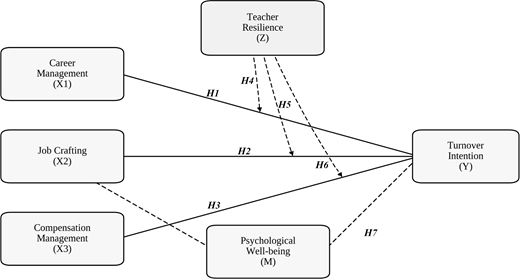
Career management is negatively related to turnover intention among private school teachers.
Job crafting and turnover intention
Job crafting refers to proactive changes employees make to tasks, relationships and work cognitions to create a better person−job fit and more meaningful work (Wrzesniewski and Dutton, 2001). From the perspective of JD-R theory, job crafting can increase structural and social resources, add challenging demands and reduce hindering demands (Tims et al., 2012; Tims and Bakker, 2010). A growing body of evidence links job crafting with engagement, meaningful work and lower turnover intention (Oprea et al., 2022; Zheng et al., 2024).
For teachers, job crafting may include redesigning pedagogical methods, strengthening relationships with students and colleagues, reframing administrative work as part of student support or collaborating with peers to improve classroom practices (Leana et al., 2009; Van Wingerden and Poell, 2019). Such behaviours are expected to reduce turnover intention because they enhance autonomy, meaningfulness and efficacy. However, job crafting does not automatically reduce turnover intention if it becomes an additional burden or if the school context fails to support the improvements teachers create:
Job crafting is negatively related to turnover intention among private school teachers.
Compensation management and turnover intention
Compensation is one of the most visible organisational resources. SET portrays fair and adequate pay as a tangible reward that can build reciprocal commitment. COR theory indicates that compensation is an economic resource that protects teachers from financial pressure and supports stability (Hobfoll, 1989; Williams et al., 2006). Compensation management is therefore expected to reduce turnover intention when teachers perceive pay and benefits as fair, transparent and aligned with workload and contribution (Jolly et al., 2021; Williams et al., 2008).
Teacher compensation is particularly important in private schools because non-civil-service private school teachers can compare their current pay, benefits and prospects for growth with other schools or public-sector career paths. Evidence on teacher compensation shows that pay satisfaction, pay justice and financial incentives are associated with teacher retention or lower turnover intention (de Ree et al., 2018; Y. Liu et al., 2023; Zhou and Ma, 2022):
Compensation management is negatively related to turnover intention among private school teachers.
Resilience as a moderator
COR theory states that personal resources can shape how individuals use organisational resources and withstand resource loss (Hobfoll et al., 2018). Resilience is one such personal resource. Resilient teachers are better able to regulate emotions, persist under pressure, seek support and transform work challenges into learning opportunities (Beltman et al., 2011; Liu et al., 2021). Evidence across teaching and adjacent work contexts also suggests that resilience can condition relationships between work stressors and turnover intention (Fang et al., 2024). Resilience may therefore strengthen the capacity of career management, job crafting and compensation management to reduce turnover intention.
The moderating role of resilience may not be uniform. Resilience may be especially important when the predictor requires active psychological conversion, such as job crafting. Career paths and compensation systems, by contrast, are more structural and economic; their effects may depend more strongly on organisational design than on personal resilience. This study nevertheless tests three moderation hypotheses to assess whether resilience operates as a broad or selective boundary condition:
Resilience strengthens the negative relationship between career management and turnover intention among private school teachers.
Resilience strengthens the negative relationship between job crafting and turnover intention among private school teachers.
Resilience strengthens the negative relationship between compensation management and turnover intention among private school teachers.
Psychological well-being as a mediator
JD-R theory explains that job crafting can increase job resources and motivational states that subsequently reduce withdrawal. Psychological well-being is a plausible mediator because job crafting can make work feel more meaningful, more controllable and more relationally supported (Tims et al., 2013; Zheng et al., 2024). Teachers with stronger psychological well-being are more likely to maintain energy, preserve professional purpose and resist turnover intention (Collie, 2023; Hascher et al., 2021).
This mechanism is theoretically important because it distinguishes job crafting as a resource-building process from a direct retention tool. Teachers can redesign lessons, relationships and work meaning, but turnover intention will decline only if these efforts improve well-being rather than merely add responsibilities. Psychological well-being is therefore expected to explain why job crafting matters for retention:
Psychological well-being mediates the relationship between job crafting and turnover intention.
Figure 1 integrates the seven hypotheses into a single structural model. It distinguishes the direct relationships of career management, job crafting and compensation management with turnover intention from the mediating role of psychological well-being and the moderating role of teacher resilience.
Method
Research design and participants
This study used a quantitative cross-sectional survey design. The population frame consisted of private lower- and upper-secondary school teachers in Central Java and the Special Region of Yogyakarta, Indonesia. The focus on private schools was selected because private school teachers often have work arrangements that differ from public school teachers, including foundation-based contracts, varied compensation systems and diverse career management practices.
The planned sample size was 550 teachers based on power analysis for a mediation-moderation model (Faul et al., 2007; Fritz and MacKinnon, 2007). Field implementation yielded 509 responses, and 27 responses were removed after screening for invalid response patterns. The final data set contained 482 usable responses. Respondents were non-civil-service (non-ASN/PNS) teachers younger than 31 years, had more than one year of teaching experience and taught at private SMP/MTs, SMA/MA or SMK schools. Most respondents were from Central Java (75.52%), while 24.48% were from the Special Region of Yogyakarta. The sample consisted of 61.62% female teachers and 38.38% male teachers.
The initial sampling plan was stratified two-stage cluster sampling based on province and school level. Limited access at the school level constrained full implementation of the probability design. Data collection was therefore adjusted through an online questionnaire distributed through formal and informal teacher networks, which developed into a snowball strategy. This adjustment is treated as a methodological limitation and considered when interpreting the generalisability of the findings.
The questionnaire began with an informed consent statement explaining the purpose of the study, voluntary participation, confidentiality and the use of data for academic purposes. Respondents provided consent before completing the questionnaire.
Ethics approval and informed consent
The research protocol was reviewed and declared ethically acceptable by the Health Research Ethics Committee, Faculty of Medicine, Universitas Muhammadiyah Surakarta, Surakarta, Indonesia. The ethical approval number was 5888/B.1/KEPK-FKUMS/X/2025, dated 14 October 2025. The ethics approval letter stated that the study complied with the Declaration of Helsinki 1975, the Council for International Organizations of Medical Sciences (CIOMS) and the World Health Organization (WHO) 2016 guidelines. All respondents received information about the study purpose, voluntary participation, confidentiality, anonymity and the use of data for academic purposes, and provided informed consent before completing the questionnaire. Table 1 summarises the geographical, demographic, employment and certification characteristics of the 482 respondents, providing the contextual profile of the final analytical sample.
Measures
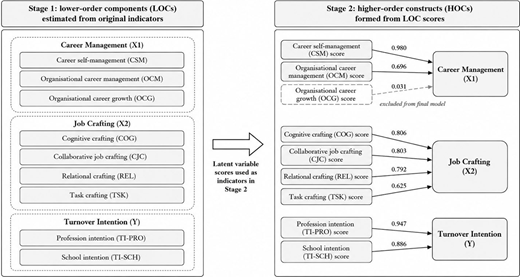
All constructs were measured using a five-point Likert scale ranging from 1 = strongly disagree to 5 = strongly agree. Career management was initially measured using lower-order components adapted from career self-management, organisational career management and organisational career growth scales (De Vos et al., 2009; Runhaar et al., 2019; Weng and Hu, 2009). At Stage 2, organisational career growth showed a negligible loading on the higher-order construct (0.031) and was removed. The final career management construct was therefore represented by career self-management and organisational career management.
Job crafting was measured using items based on the job crafting scale and collaborative job crafting items relevant to teachers (Leana et al., 2009; Tims et al., 2012). Its lower-order components were cognitive crafting, collaborative job crafting, relational crafting and task crafting. Compensation management was measured as a first-order reflective construct using items from the Comprehensive Compensation Satisfaction Questionnaire, covering pay level, pay structure, pay raises, variable-pay procedures, benefit level, benefit determination and benefit administration (Williams et al., 2008).
Psychological well-being was measured as a first-order reflective construct using Ryff’s psychological well-being framework (Ryff, 1989; Ryff et al., 1995). The final measurement model retained seven reverse-coded items that functioned consistently after recoding. Because the final psychological well-being measure retained only reverse-coded indicators after recoding, the construct should be interpreted as the empirically retained representation of psychological well-being in this data set. This measurement decision is addressed further in the limitations section.
Resilience was measured as a first-order reflective construct using the Vietnam Teachers’ Resilience Scale, which represents professional, emotional, motivational and social aspects of teacher resilience (Nguyet Trang and Thang, 2023). Turnover intention was specified as a higher-order construct with two lower-order components: intention to leave the teaching profession and intention to leave the current school (Bothma and Roodt, 2013; Skaalvik and Skaalvik, 2011).
Higher-order construct specification
Career management, job crafting and turnover intention were modelled as reflective-reflective higher-order constructs: the item indicators reflect their lower-order components, and the lower-order components reflect the corresponding higher-order construct. Compensation management, psychological well-being and resilience remained first-order reflective constructs. Figure 2 illustrates the disjoint two-stage specification of the higher-order constructs, showing the lower-order components estimated at Stage 1, the component scores used at Stage 2 and the exclusion of organisational career growth from the final model.
Data analysis
The data were analysed using PLS-SEM in SmartPLS. PLS-SEM was selected because the study sought to explain variance in psychological well-being and turnover intention within an integrated hierarchical model containing three higher-order constructs, one mediation pathway and three latent interaction effects. It also provides the lower-order component scores required for the second-stage estimation of the higher-order constructs. Thus, the choice of PLS-SEM was based on the study’s variance-explanation objective and hierarchical model specification rather than merely on the presence of several latent variables, mediation or moderation (Hair and Alamer, 2022; Sarstedt et al., 2019).
Following the conventional two-step assessment sequence, the measurement models were evaluated before the structural model. This two-step assessment sequence is distinct from the disjoint two-stage approach used to estimate the higher-order constructs. At Stage 1, the lower-order components were estimated from their original indicators and assessed for indicator reliability, internal consistency reliability, convergent validity and discriminant validity. At Stage 2, the saved lower-order component scores were used as indicators of their corresponding higher-order constructs. The repeated-indicator approach was not used (Sarstedt et al., 2019; Schuberth et al., 2020).
Reliability was assessed using Cronbach’s alpha and composite reliability. Convergent validity was assessed using average variance extracted (AVE). Discriminant validity was assessed using HTMT and the Fornell−Larcker criterion (Fornell and Larcker, 1981; Henseler et al., 2015). The reflective higher-order measurement models were evaluated using the Stage 2 loadings and the final construct-level reliability and validity statistics. Structural paths, indirect effects and interaction effects were tested using bootstrapping at the 5% significance level. Interaction effects were interpreted using standard moderation logic (Aiken and West, 1991). Because the hypotheses specified negative or strengthening effects based on prior theory, one-tailed p-values were reported for directional hypothesis testing.
Results
Response diagnostics and potential non-response bias
Before assessing the measurement model, response diagnostics were examined to evaluate potential non-response and screening-related bias. The survey yielded 509 submitted responses during the data-collection period. After screening for invalid response patterns, 27 responses were excluded, leaving 482 usable responses for analysis. Thus, 94.70% of the submitted responses were retained in the final data set. Because the questionnaire was distributed through formal and informal teacher networks and developed into a snowball strategy, a conventional response rate could not be calculated. This assessment was treated as a diagnostic check rather than as conclusive evidence that non-response or self-selection bias was absent. The response and screening summary is presented in Table 2.
Common method bias assessment
Because the data were collected through a single cross-sectional self-report questionnaire, common method bias was considered as a potential methodological concern (Podsakoff et al., 2003, 2012). Several procedural remedies were used to reduce the likelihood of common rater effects. At the beginning of the questionnaire, respondents were informed that participation was voluntary, responses would be treated confidentially and anonymously and the data would be used only for academic purposes. These procedures were intended to reduce evaluation apprehension, social desirability pressure and respondents’ tendency to provide answers that they perceived as expected by the researchers. In addition, the study used established measurement scales adapted from prior research, clear item wording and a standardised response format to reduce item ambiguity and improve respondents’ comprehension.
Although these procedural remedies helped reduce the possibility of common method bias, the risk cannot be completely eliminated because the study did not use multi-source data, time-lagged measurement or an independent marker variable. Therefore, the findings should be interpreted as associations among teachers’ perceptions rather than as causal effects that are entirely free from common method variance. This issue is acknowledged as a methodological limitation, and future studies are encouraged to collect predictor and outcome variables at different time points or combine teacher survey data with school-level administrative records.
Measurement model
The retained lower-order components met the reliability and validity criteria applied at Stage 1. At Stage 2, career management was represented by career self-management (loading = 0.980) and organisational career management (0.696). Job crafting was represented by cognitive crafting (0.806), collaborative job crafting (0.803), relational crafting (0.792) and task crafting (0.625). Turnover intention was represented by intention to leave the teaching profession (0.947) and intention to leave the current school (0.886). Organisational career management and task crafting were retained despite loadings below 0.70 because their values remained above 0.60, they were conceptually central to the constructs and the corresponding higher-order constructs met composite reliability and AVE criteria (Hair and Alamer, 2022). Organisational career growth was excluded because its Stage 2 loading was 0.031. Figure 2 presents the final two-level structure.
At the final construct level, composite reliability ranged from 0.831 to 0.926 and AVE ranged from 0.511 to 0.842. Job crafting had composite reliability of 0.844 and AVE of 0.578; career management had composite reliability of 0.835 and AVE of 0.722; compensation management had composite reliability of 0.926 and AVE of 0.511; psychological well-being had composite reliability of 0.900 and AVE of 0.562; resilience had composite reliability of 0.831 and AVE of 0.554; and turnover intention had composite reliability of 0.914 and AVE of 0.842.
Discriminant validity at the final construct level was acceptable. The maximum HTMT value was 0.825 between job crafting and career management, below the recommended threshold of 0.90. The Fornell−Larcker results showed that the square root of AVE for each construct was greater than its correlations with other constructs. These results indicate that the constructs in the model were empirically distinguishable and suitable for structural analysis. Table 3 reports the final construct-level reliability and convergent validity results, including Cronbach’s alpha, composite reliability and AVE for the retained first-order and higher-order constructs.
Structural model
The model explained 3.7% of the variance in psychological well-being (R2 = 0.037; adjusted R2 = 0.035) and 36.9% of the variance in turnover intention (R2 = 0.369; adjusted R2 = 0.358). Effect-size analysis indicated that psychological well-being had the strongest effect on turnover intention (f2 = 0.392), which was large. Job crafting had a small effect on psychological well-being (f2 = 0.038), whereas the direct effects of career management, job crafting, compensation management and resilience on turnover intention were small or very small.
The R2 value of 0.037 indicates that the model explained only a limited proportion of the variance in psychological well-being. This result should be interpreted in relation to the restricted specification of the model, in which job crafting was the sole antecedent of psychological well-being. The model should not be presented as a comprehensive explanation of teachers’ psychological well-being.
The small effect size of job crafting on psychological well-being (f2 = 0.038) indicates that job crafting made a modest incremental contribution to explaining differences in psychological well-being. By contrast, psychological well-being had a large effect size in relation to turnover intention (f2 = 0.392). The low R2 value for psychological well-being is not inconsistent with a statistically significant indirect effect. A predictor may explain only a limited proportion of variance in a mediator, while the variation associated with that mediator may still have a substantial downstream relationship with the outcome. The mediation result should consequently be interpreted as evidence of a specific indirect mechanism rather than as evidence that the model comprehensively explains psychological well-being. Table 4 summarises the explanatory power and key effect-size estimates of the structural model for psychological well-being and turnover intention.
Bootstrapping results supported three of the seven hypotheses. Career management was not significantly related to turnover intention (beta = −0.053, t = 1.035, p = 0.150), so H1 was not supported. Job crafting had no significant direct relationship with turnover intention (beta = 0.010, t = 0.192, p = 0.424), so H2 was not supported. Compensation management had a significant negative effect on turnover intention (beta = −0.114, t = 1.961, p = 0.025), so H3 was supported.
The moderation results showed that resilience did not significantly moderate the career management−turnover intention relationship (beta = −0.030, t = 0.790, p = 0.215), so H4 was not supported. Resilience significantly moderated the job crafting−turnover intention relationship (beta = −0.073, t = 1.949, p = 0.026), so H5 was supported. This negative interaction indicates that job crafting is more likely to reduce turnover intention when teachers have higher resilience. Resilience did not significantly moderate the compensation management-turnover intention relationship (beta = 0.048, t = 1.002, p = 0.158), so H6 was not supported. Table 5 presents the bootstrapping results for the direct and moderation hypotheses, including path coefficients, t-values, one-tailed p-values and hypothesis decisions.
The mediation result supported H7. Job crafting had a significant negative indirect effect on turnover intention through psychological well-being (beta = −0.106, t = 4.506, p < 0.001). Job crafting reduced turnover intention not through a significant direct path, but through improved psychological well-being, which then reduced teachers’ intention to leave. Table 6 reports the indirect effect of job crafting on turnover intention through psychological well-being and the corresponding decision for H7.
Discussion
These findings have implications for quality education in private school contexts. Teacher retention supports instructional continuity, stable school routines and sustained teacher−student relationships, whereas turnover can damage student achievement, organisational routines and school human capital (Menzies, 2023; Ronfeldt et al., 2013; Sorensen and Ladd, 2020). The results suggest that sustaining quality education requires more than encouraging teachers to be proactive or resilient; it also requires organisational systems that provide fair compensation, credible career pathways and conditions that protect psychological well-being (Collie, 2023; Hascher et al., 2021; Zhou and Ma, 2022).
The findings show that turnover intention among private school teachers is best understood as a combination of economic exchange, psychological well-being and personal resilience, consistent with recent teacher turnover research that emphasises the need to integrate organisational, psychological and contextual predictors rather than relying on single-factor explanations (Collie, 2023; Li and Yao, 2022; Madigan and Kim, 2021). The model explained more than one-third of the variance in turnover intention, indicating that this integrated framework has practical explanatory value for educational managers because teacher turnover intention is shaped by job resources, job demands, well-being, burnout, job satisfaction and organisational conditions (Yang and Chan, 2025). The findings challenge the simple assumption that all HRM practices directly reduce turnover intention, because HRM-related resources often operate through psychological, attitudinal or contextual mechanisms rather than through uniform direct effects (Bagdadli and Gianecchini, 2019; Q. Weng and McElroy, 2012).
Firstly, compensation management emerged as the only significant direct organisational predictor, which is theoretically consistent with SET and empirical evidence showing that pay, benefits and salary justice are closely related to lower turnover intention (Cropanzano and Mitchell, 2005). This finding supports SET because fair and comprehensible compensation is a concrete exchange signal: teachers perceive that the school values their efforts and respond with lower turnover intention (Jolly et al., 2021; Williams et al., 2006).
The result is also consistent with compensation satisfaction research linking pay satisfaction, benefit satisfaction and salary justice with lower turnover intention (Zhou and Ma, 2022). Compensation may be the most tangible organisational resource because it directly affects financial stability, perceived organisational support and perceived justice, which are especially salient for teachers whose retention decisions are influenced by salary adequacy and working conditions (de Ree et al., 2018).
Secondly, career management did not directly reduce turnover intention significantly, suggesting that career-related HRM practices may not always translate immediately into retention unless they are perceived as credible growth opportunities (Bagdadli and Gianecchini, 2019). This does not mean that career management is irrelevant, because organisational career management and career self-management are linked with affective commitment, career success and career progress in prior career research (De Vos et al., 2009).
Rather, the finding indicates that career support may not be sufficient when it is not connected to visible career growth, formal promotion, status improvement or remuneration, because organisational career growth is usually defined through career goal progress, professional ability development, promotion speed and remuneration growth (Q. Weng and McElroy, 2012). The final measurement model showed that organisational career growth was not a strong dimension of career management, which can be interpreted in light of prior research showing that career support needs to be translated into concrete career growth experiences to influence employee outcomes. Career conversations and self-directed career management may support professional development, but they may not be enough to make staying at the school a credible long-term career choice when internal advancement, promotion and remuneration growth are weak or unclear (Bagdadli and Gianecchini, 2019; De Vos et al., 2009).
Thirdly, job crafting did not directly reduce turnover intention, but operated through psychological well-being, which is consistent with evidence that job crafting often reduces intent to leave through meaningful work, engagement and well-being rather than through an automatic direct effect (Oprea et al., 2022). This finding supports a JD-R interpretation in which job crafting is a resource-building process rather than an automatic retention mechanism, because employees use job crafting to reshape demands and resources that subsequently influence work engagement, satisfaction, burnout and well-being (Bakker and Demerouti, 2017).
Teachers who craft tasks, relationships, meaning and collaboration may still intend to leave if these behaviours do not produce well-being, because job crafting becomes retention-relevant mainly when it creates meaningful work, engagement, supportive relationships and psychological functioning (Zheng et al., 2024). When job crafting improves positive functioning, meaningfulness and relational support, turnover intention declines because teacher well-being and work engagement are consistently associated with lower intention to leave (Collie, 2023; Madigan and Kim, 2021). This aligns with studies that position meaningful work, engagement and well-being as pathways linking job crafting with lower intent to leave (Oprea et al., 2022; Tims et al., 2013).
Fourthly, resilience strengthened the relationship between job crafting and turnover intention but did not strengthen the effects of career management or compensation management, suggesting that personal resources are especially relevant when teachers must actively transform work experiences into psychological resources (F. Liu et al., 2021). This pattern extends COR theory by showing that personal resources are most powerful when employees must actively convert work experiences into psychological resources, because COR theory emphasises resource investment, resource caravans and the role of personal resources in preventing resource loss (Halbesleben et al., 2014; Hobfoll et al., 2018).
Job crafting requires teachers to interpret constraints, modify work and sustain effort; resilient teachers are better able to convert these behaviours into reasons to stay because resilience helps teachers cope with stress, protect well-being and reduce turnover intention (Chen, 2024). Compensation and career paths, by contrast, are structural resources that depend on organisational systems, salary management, career growth opportunities and formal HRM practices rather than on personal coping capacity alone (Jolly et al., 2021; Zhou and Ma, 2022). Resilience cannot replace concrete organisational systems when teachers need fair pay and credible career growth; therefore, school leaders should treat resilience as a complementary personal resource, not as a substitute for fair compensation, transparent promotion systems and meaningful career pathways (de Ree et al., 2018; Hobfoll et al., 2018).
Theoretical implications
This study provides partial support for SET. The supported compensation path shows that tangible organisational rewards can reduce turnover intention. The non-significant career management path indicates that exchange logic requires credible and concrete rewards; symbolic or developmental support alone may not reduce turnover intention among private school teachers.
The findings strengthen JD-R theory by identifying psychological well-being as a central mechanism through which job crafting becomes a retention resource. Job crafting contributes to retention when it enhances well-being, not merely because teachers behave proactively. This distinction is important because educational managers often encourage teachers to innovate, adapt and collaborate, even though these demands can either support or drain well-being depending on workload and school support.
The study also provides selective support for COR theory. Resilience served as a boundary condition for job crafting but not for career management or compensation management. This suggests that personal resources interact most strongly with resources that require active psychological investment. The finding theoretically refines the resource caravan assumption by distinguishing resources that can be psychologically converted from structural resources that require organisational action.
This study contributes to construct modelling in educational management. Turnover intention can be usefully represented by intentions to leave the profession and the current school. Job crafting is represented through cognitive, collaborative, relational and task crafting. Career management was ultimately represented by career self-management and organisational career management, whereas organisational career growth did not load strongly. This indicates that career support and actual career growth may be empirically distinct in the private school context. The study extends quality education research by showing that teacher retention in private schools is not only a staffing issue but also a resource-based condition for sustaining instructional continuity and school capacity.
Practical implications
For private schools, teacher retention should be treated as part of quality education strategy because stable teachers help sustain instructional continuity, student support and institutional learning capacity. The findings offer several implications for private school foundations, principals and educational HRM managers. Firstly, compensation management should be treated as a retention priority. Schools need transparent salary structures, predictable pay reviews, clear incentive criteria and benefit administration that teachers can understand. Procedural clarity and perceived fairness can reduce uncertainty and strengthen trust even when school budgets are limited.
Secondly, schools need to translate career support into credible career ladders. Individual development plans and training programmes should be linked to visible pathways, such as novice teacher, intermediate teacher, senior teacher, subject coordinator, programme head, laboratory head, guidance coordinator or pedagogical specialist. Career development should also be connected to recognition, role expansion and compensation progression so that teachers can see a future within the school.
Thirdly, job crafting should be designed as a healthy job resource, not as an informal demand to compensate for organisational constraints. Schools can support healthy job crafting through instructional autonomy, collaborative planning time, peer learning groups, lesson study, mentoring and recognition of pedagogical innovation. Job crafting should not become an expectation that teachers must continuously adapt to inadequate resources without institutional support.
Fourthly, psychological well-being should be monitored as a strategic indicator of teacher retention. The large effect of well-being on turnover intention shows that retention programmes should include workload management, emotionally supportive supervision, psychological safety, feedback quality, administrative simplification and support for teacher−student relationships. Well-being is not merely an employee benefit; it is a proximal psychological mechanism explaining how proactive work behaviour affects retention.
Fifthly, resilience development should be integrated into professional development, but it should not be used to avoid addressing organisational problems. Resilience training may focus on emotion regulation, adaptive coping, problem-solving, reflective practice and peer support. Resilience cannot replace fair compensation or credible career systems. Its most valuable role is helping teachers transform job crafting into positive psychological resources. Table 7 translates the supported findings into managerial interpretations and recommended actions for private school foundations, principals and educational HRM managers.
Limitations and future research
Several limitations should be noted. Firstly, this study used cross-sectional self-report data, so causal claims should be interpreted carefully. Because all variables were collected from the same respondents at one point in time using the same questionnaire, common method bias cannot be fully ruled out. Several procedural remedies were applied to reduce this risk, including voluntary participation, informed consent, anonymity, confidentiality and clear item wording. However, these procedures cannot completely eliminate common method variance. Future studies should use longitudinal or time-lagged designs, separate the measurement of predictor and outcome variables, collect data from multiple sources or combine teacher survey data with school-level administrative records to examine whether compensation, job crafting, psychological well-being and resilience predict turnover intention and actual turnover in subsequent periods.
Secondly, the sampling design shifted from a stratified cluster design to an adaptive snowball strategy because of limited school access. Although response diagnostics indicated that data screening did not materially alter the observable sample profile, this procedure cannot fully rule out non-response or self-selection bias. The questionnaire was distributed through formal and informal teacher networks, and the number and characteristics of eligible teachers who received but did not complete the questionnaire could not be identified. Future studies should use a sampling frame that records the number of invited teachers and enables direct comparison between respondents and non-respondents or between early and late response waves. In addition, this study focused on teachers younger than 31 years in lower- and upper-secondary private schools in Central Java and the Special Region of Yogyakarta. The findings should therefore be generalised cautiously to private school teachers with similar characteristics, rather than to all Indonesian teachers. Future research could compare age groups, public and private schools, school levels, regions and teacher employment statuses.
Thirdly, the measurement and explanatory scope of psychological well-being should be interpreted cautiously. Although psychological well-being was based on Ryff’s framework, the final measurement model retained only seven reverse-coded items after recoding. These retained indicators met the required reliability and validity criteria, but they may not fully capture the positive and multidimensional nature of psychological well-being. Moreover, the model explained only 3.7% of the variance in psychological well-being because job crafting was specified as its only antecedent. The mediation result should therefore be understood as evidence of a specific indirect mechanism rather than as a comprehensive explanation of teacher well-being. Future studies should retest the full multidimensional psychological well-being scale, use teacher-specific well-being measures and include additional predictors such as workload, leadership style, teacher−student relationships, administrative pressure, family−work conflict, emotional demands, professional autonomy and school climate. Future research could also test multilevel models that distinguish individual teacher resources from HRM systems, leadership climate and other school-level conditions.
Conclusion
This study shows that turnover intention among private school teachers in Indonesia is shaped by a combination of organisational and psychological mechanisms. Compensation management directly reduces turnover intention, demonstrating the importance of fair and transparent economic exchange. Job crafting is not a direct solution to turnover intention; it becomes a retention mechanism when it improves psychological well-being and when teachers have sufficient resilience to transform proactive work changes into positive resources. Although career management remains conceptually important, it does not reduce turnover intention unless it is connected to credible career growth. For quality education, the main lesson is that stable and committed teachers are supported not only by individual resilience but also by organisational systems that protect well-being, provide fair compensation and create credible career pathways. Teacher retention in private schools should therefore be understood as both an educational management priority and a condition for sustaining instructional continuity and school quality.
The authors thank the private school teachers who voluntarily participated in this study.
Funding
The authors received no specific funding for this work.
Ethics statement
The research protocol was reviewed and declared ethically acceptable by the Health Research Ethics Committee, Faculty of Medicine, Universitas Muhammadiyah Surakarta, Surakarta, Indonesia. The ethical approval number is 5888/B.1/KEPK-FKUMS/X/2025, dated 14 October 2025. The ethics approval letter states that the study complied with the Declaration of Helsinki 1975, the Council for International Organizations of Medical Sciences (CIOMS) and the World Health Organization (WHO) 2016 guidelines.
Informed consent
All respondents received information about the study purpose, voluntary participation, confidentiality, anonymity and the use of data for academic purposes, and provided informed consent before completing the questionnaire.
Data availability
The data that support the findings of this study are not publicly available due to ethical and confidentiality restrictions. Anonymised data may be made available from the corresponding author upon reasonable request and subject to institutional approval.
Authors’ contributions
Rehan Sapto Rosada: Conceptualisation, research design, conceptual framework, methodology, data collection, initial manuscript drafting and data interpretation. Suliyanto Suliyanto: Supervision, manuscript review and editing, validation of the conceptual argument and assistance in preparing the manuscript for submission. Nur Wening: Supervision, manuscript review and editing, validation of the theoretical framing and assistance in preparing the manuscript for submission. Eka Pariyanti: Initial data analysis, manuscript review and editing, project coordination and assistance in preparing the manuscript for submission.
AI use statement
AI-assisted tools were used only for language editing, grammar checking and improving the clarity of author-generated text. The authors reviewed, verified and take full responsibility for all content, analyses, interpretations and references in the manuscript.