While distance education continues to grow in higher education, students express the concern that they feel isolated. The purpose of this study was to determine if the implementation of a cooperative learning strategy would affect social presence and achievement. Each group completed an individual assignment and a cooperative learning assignment working in groups. There were no differences in achievement due to a possible ceiling effect on the assessment. While the results are mixed, they suggest additional studies using cooperative learning as a strategy to increase student engagement in a distance education environment.
Introduction
Online course offerings are growing at an exponential rate to accommodate a diverse student audience. According to the National Center for Educational Statistics, the percentage of undergraduates who took a distance education courses rose from 16% in 2003–04 to 20% in 2007–08 (National Center for Education Statistics, 2011). Distance education is defined as a formal education process in which the students and the instructor are not in the same place. Therefore, instruction could be delivered synchronously or asynchronously. The advances in technology provide instructors with a variety of synchronous and asynchronous tools and methods to deliver instruction from a distance. However, one of the continued complaints from students about distance education courses is the feeling of isolation (Johnson, 2006). Online courses are an attractive option for undergraduate students because they enable students to work while completing a degree. However, students report a lesser sense of cohesiveness and involvement in addition to a sense of less teacher support in online courses (Hughes, McLeod, Brown, Maeda, & Choi, 2007). Therefore, when designing instruction in an online environment, designers/instructors should take into account that learners would benefit from incorporating opportunities for interaction.
The importance of creating interaction is often guided by the assumption that social construction of knowledge is essential for learning (Vygotsky & Cole, 1978). Social constructivism suggests learning experiences are social in nature, and proposes learning cannot be separated from the social context where learners develop their sense of identity from first a social perspective and then an individual perspective (Powell & Kalina, 2009). One potential solution is to apply instructional strategies that encourage interaction through the use of technology to overcome learning in isolation. Moore (1989) defines three types of interaction: student-content, student-instructor, and student-student. Bernard et al. (2009) conducted a meta-analysis of the distance education literature on interaction which concluded stronger course design features made a substantial difference in achievement and engagement. Increased effect sizes were found with the student-content interaction and the combinations of student-content plus student-student and student-content plus student-instructor. Two of these types of interaction, studentteacher instructor and student-student, require connecting with other individuals. This finding suggests that student-student or student-instructor interactions in a course should be well designed and have a strong link to the course content.
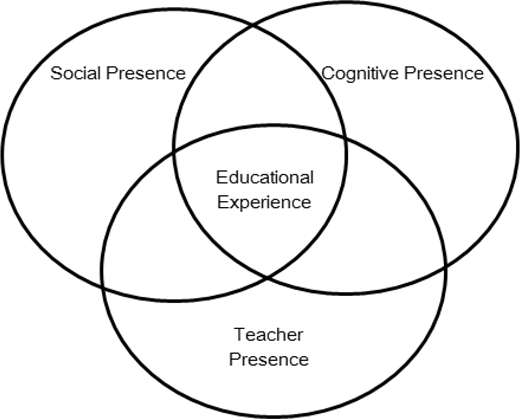
Connected learning environments that encourage interaction are often referred to as communities (Swan, 2002). Community has several definitions in the educational research literature, but community can be summarized as a sense of belonging and trust experienced by learners engaging in meaningful discourse in the learning environment (Blanchard, 2007; Dawson, 2006; Exter, 2009; Ouzts, 2006; Wighting, 2008; Xiaojing, 2007). These definitions reinforce the idea that developing a community is important for the learning process whether it is online or face to face (Xiaojing, 2007). The community of inquiry (CoI) framework was designed to explain the online educational experience and encompasses three interdependent elements: social presence, cognitive presence, and teaching presence (Garrison, Anderson, & Archer, 2010). The overlapping of all three constructs creates the online educational experience. The overlapping section of each pair of constructs defines the following: supporting discourse (overlap of cognitive and social presence), selecting content (overlap of cognitive and teaching presence), and setting climate (overlap of social and teaching presence). Figure 1 provides a visual representation of the community of inquiry framework.
One instructional strategy that aids in creating meaningful interaction and developing a community of inquiry is cooperative learning (Palloff & Pratt, 1999). Although collaborative learning and cooperative learning are terms that are often used interchangeably, cooperative learning (Slavin, 1991) is defined as a set of instructional methods in which learners are required to complete academic assignments together as a whole class or in small mixed ability groups. The entire group is held responsible through reward or punishment for each group members learning. Therefore, much of the activity of the group revolves around the group members teaching one another and the lowest achieving group member can contribute the most growth or points to the group achievement. There is less agreement on the term collaborative learning in the literature; however, we will use Panitz's (1996) definition that states collaborative learning is the social interaction and engagement among small or large groups of learners to complete academic assignments by choice. Hence, cooperative learning is teacher imposed and collaborative learning is student generated. Cooperative learning can generate all three of Moore's (1989) types of interaction throughout the learning activity that aids in developing a community of inquiry. Cooperative learning requires the entire group to be held responsible through reward or punishment for each group members learning and each group member has a group or instructor defined role. Therefore, much of the activity of the group revolves around the group members teaching one another and the lowest achieving group member can contribute the most growth or points to the group achievement (Slavin, 1991).
There are several defined applications of the cooperative learning strategy: student team achievement division (STAD), teams-games-tournament (TGT), team assisted individualization (TAI), cooperative integrated reading and composition (CIRC), jigsaw, learning together, and group investigation (Slavin, 1991). All of these cooperative learning methodologies require students to work in small groups, but they differ in team member selection, roles and assessments. This study employed the group investigation strategy (Sharan & Sharan, 1976) in which students group themselves into two to six member teams.
Literature Review
This review of the literature focuses on the two primary frameworks. The first section presents the research on cooperative learning while the second section focuses on community of inquiry.
Cooperative Learning
Cooperative learning exists when students work together to accomplish shared learning goals (Johnson & Johnson, 1999). There are various methods of cooperative learning developed by different researchers. The table below shows selected cooperative learning methods and their developers.
Cooperative learning is one of the most fruitful areas of research in education due to its diversity of theoretical basis, its validation in a multitude of research studies, and the availability of a variety of methodologies (Johnson, Johnson, & Stanne, 2000). Johnson et al. (2000) conducted a meta-analysis of 158 cooperative learning studies and found that eight methods including the group investigation method increased achievement as well as improving cognitive and social development. This finding suggests that cooperative learning is an effective method in a face-to-face environment providing the instructor implements the methodology effectively. This meta-analysis found that considerable research has been conducted, eight cooperative learning methods have been researched, all eight methods have produced higher achievement, and more conceptual approaches may produce higher achievement than direct methods. Conceptual approaches provide general frameworks that have more flexibility in implementation, whereas direct approaches have specific procedures that provide fewer choices in implementation. Group investigation is one of the conceptual methods with a framework that can be applied flexibly in a variety of instructional situations.
Cooperative learning has also been shown to be an effective method in multiple disciplines in higher education. Johnson, Johnson, and Smith (1998) conducted a meta-analysis of cooperative learning studies in higher education and found over 305 studies in three broad categories: academic success, quality of relationships, and psychological adjustment. One hundred sixty eight studies compared cooperative, competitive, and individualistic learning on the achievement of individuals 18 years or older. These results indicated cooperative learning strategies promoted higher achievement than competitive or individualistic learning strategies. They also found advantages in meta-cognitive thought, risk taking, goal persistence, intrinsic motivation, learning transfer, and greater time on task. The results showed that students learning cooperatively perceive more social support, both academic and personal, from peers and instructors than students working competitively or individually. These positive relationships should support the development of communities of inquiry.
More recently, Kyndt et al. (2013) conducted a meta-analysis of 65 cooperative learning studies in face-to-face classrooms of all levels from 1995 onwards. The goal was to verify previous research on cooperative learning. The results of this meta-analysis confirmed previous research results showing a positive effect of cooperative learning on achievement and attitudes.
There are relative few studies on cooperative learning in distance education. A search of the literature reveals many studies that focus on collaborative learning (Auyeung, 2004; Bliesener, 2006; Chang, 2004; Lafifi & Touil, 2010; Lambropoulos, Faulkner, & Culwin, 2012; LaVoie et al., 2010; Lee & Tsai, 2011; Liu & Burn, 2007; McArdle & Bertolotto, 2012). Riley and Anderson (2006) examined the use of cooperative learning in a graduate level public health course. They found no difference in test scores on declarative knowledge between the cooperative treatment and selfpaced (control) group. However, they did find that the cooperative group showed significantly higher scores on procedural knowledge than the control group.
Borokhovski, Tamim, Bernard, Abrami, and Sokolovskaya (2012), conducted an analysis of 32 studies in which student-student interactions in experimental groups rated higher that control groups in distance education courses. These studies were a subset of studies used in a meta-analysis examining the effects of the three types of interaction on student achievement in distance education conducted by Bernard et al. (2009). Bernard et al.’s meta-analysis found that stronger student-student interactions increased achievement. Borokhovski et al.’s analysis suggested that the most effective student-student interaction treatments in distance education or online learning were those designed with the opportunities to work cooperatively. Collectively these studies on the use of cooperative learning in online instruction show that cooperative learning can be effective in the online environment. However, more empirical research is needed to identify best practices in implementing cooperative learning online.
Community of Inquiry
The CoI framework is a widely used researched model for online learning (Garrison et al. 2000). However, most of this research has been conducted regarding this model has been based on asynchronous online learning (Garrison, et al., 2010). The three constructs of CoI are social presence, cognitive presence, and teaching presence. Shea and Bidjerano (2009) explored the causal relationships among the three variables in asynchronous online courses and found that social presence is the mediating variable between teaching and cognitive presence. This same study found that the learner characteristics age, gender, and academic level significantly affected the perception of teaching presence. Rourke and Kanuka (2009) conducted a literature review of 252 CoI studies and found that only five studies measured student learning, all were subjective measures. Their finding calls into question the validity of this framework's use to ensure deep and meaningful learning that is the claim of the developers of this framework. They encourage researchers to conduct more substantial investigations of the framework's ability to achieve deep and meaningful learning. There has also been research conducted on the three constructs of the community of inquiry framework individually. Social presence is defined as the ability of community participants to project their personal characteristics into the community (Garrison, Anderson, & Archer, 2000). The three operationalized categories of social presence are effective communication, open communication, and group cohesion. Garrison and Arbaugh (2007) summarize research findings for social presence as: there is a positive correlation between social presence and student satisfaction in eLearning; collaborative learning activities can develop social presence; and participants attend to different aspects of social presence as online discourse matures. Conversely, Annand (2011) questions the role of social presence and presents research evidence that shows that social presence does not impact cognitive presence in any meaningful way.
Cognitive presence is defined as the extent to which community participants are able to construct meaning through sustained communication (Garrison et al., 2010). Cognitive presence is operationalized into four phases of the practical inquiry model: triggering an event, exploration, integration, and resolution. A study of the comparison of face-to-face course with web-enhanced discussion boards and fully online course with discussion boards indicated a higher percentage of triggering events occurred in face-to-face settings. When comparing the two online discussions exploration was dominant in for both face-to-face and online formats, there was a greater percentage of integration comments in the online format, and the resolution phase was almost nonexistent in both forums (Vaughn & Garrison, 2005). Vaughn and Garrison (2005) recommended more emphasis placed on teaching presence to better ensure that participants achieved resolution. This conclusion implies that the design of the course and its supporting structures (e.g., teaching presence) would drive the cognitive presence higher. Rourke and Kanuka (2009) found that students believe that they learn more using the CoI framework, but the type of learning was actually low-level factual knowledge. They recommend that future research include more substantial studies of learning.
Teaching presence is defined as the design, facilitation, and direction of cognitive and social processes for the purpose of obtaining meaningful and worthwhile learning outcomes (Garrison et al., 2010). The operationalized variables in teaching presence are: design and organization, facilitation, and direct instruction. A case study examining the nature and interactions created by instructors on all three presences of the CoI framework concluded that generating a teaching presence with supportive structures reinforces the cognitive and social presences (Ke, 2010). Garrison and Arbaugh (2007) conducted a literature review and concluded that teaching presence is a significant determinant of student satisfaction, perceived learning, and sense of community but not achievement.
There have been a considerable number of studies investigating the community of inquiry framework (Finegold & Cook, 2006,Kanuka. Rourke, & Laflamme, 2007; Rourke & Kanuka, 2009; Xin & Feeberg, 2006) however, few studies reported any objective measures of learning that would support the purported claims of the framework leading to deeper levels of learning. Similarly, Vaughn and Garrison's (2005) failed to find resolution in their analysis, which brings us to question the effectiveness of the community of inquiry framework.
Problem Statement
It is unclear if the instructional strategy of cooperative learning would increase the social, teaching, and/or cognitive presence or learner achievement in an online education course. The purpose of this quasi-experimental study was to determine whether cooperative learning increases the achievement and/or sense of community in online education courses. Community will be measured by the community of inquiry instrument (Shea & Bidjerano, 2009) yielding subscales for each of the constructs: cognitive, social and teaching presence. We predicted that cooperative learning would increase achievement. Two different populations of students were studied: extension students and campus students. Extension students are students taking all online classes and have no physical connection to campus. Campus students are taking some online courses and some face-to-face courses on campus. Second, it was hypothesized that cooperative learning will have a higher effect on cognitive, social, and teaching presences. The third hypothesis predicted that cooperative learning would increase learning satisfaction with the instruction.
Method
Participants
The participants in this research study were 34 undergraduate level college students enrolled in of two sections of an online educational technology course at a southeastern U.S. 4-year university. The population of students varied from traditional campus students taking some online courses to nontraditional students at a distance taking only online courses.
Two fully online sections of an instructional technology education course were selected to participate in this research. One section was comprised of traditional main campus students. The other section was comprised of nontraditional extension campus students. Both sections were enrolled in asynchronous sections. The sections contained 20 and 27 students respectively that were treated as intact groups. The intact groups were assigned a treatment of either cooperative assignment or an individual assignment (control group), for each unit. Group 1 (N = 20) had the cooperative treatment in the first unit and had the individual treatment in the second unit. The second group (N = 27) had the individual treatment followed by the cooperative treatment (see Table 2). Participant's names remained anonymous, but every participant in each treatment group was assigned a number in order to match the pre and post data into pairs for statistical analysis and to match the survey and achievement data.
The duration of the study was 6 weeks. Each unit's duration was 3 weeks. The two units of study were presented as an individual treatment and as a cooperative treatment. The students had the duration of the each unit to complete an assignment cooperatively or individually depending on assigned treatment. Data collection occurred during Weeks 1, 3, and 6 of the study.
Materials
The content of the units of instruction and assignments were the same for both treatments. The individual or control treatment required students to complete the same assignment individually. The cooperative treatment employed the group investigation (Sharan & Sharan, 1976) method of cooperative learning, which allowed students to work on an individual assignment in self-selected small groups of two to four members with defined roles and a group presentation at the conclusion of the assignment. The cooperative groups used synchronous/asynchronous technology tools to communicate and complete the same assignment as the students in the individual treatment. The cooperative group members submitted an individual product (i.e., the same for both treatments) and had to present a group project video evaluating the group performance. Each member of the group presented their group roles, responsibilities, and contributions to the group investigation in addition to their group performance evaluation. The cooperative groups received a group grade based upon individual contributions to the product produced by the group, the quality of the product, and the individual's participation in the group presentation of the product upon completion. In the individual treatment, the grade was based on each individual's product using the same criteria.
The evaluation of the assignment that was completed by both groups has face validity based on a curriculum committee developed rubric. The assignment instructions were also developed by a curriculum committee. These instructions and rubric have been revised and refined from semester to semester based upon student and faculty feedback.
The education course selected had in-depth instructional development projects, which required students to apply course objectives to their future teaching discipline. One unit required students to develop an instructional lesson for online learning. This entailed students choosing a grade level and subject area, developing an online lesson around a topic in that area, and developing the online lesson in a learning management system. Students were assessed on their design and the quality of the content. The other unit required students to develop an online portfolio that included their teaching philosophy, instructional resources, and a detailed lesson plan for a grade level and subject area of their choosing and that could be delivered via any medium. This assignment required students to develop a webpage with multiple pages containing the required contents. Students were evaluated on their webpage design as well as the quality of the content. Both units provided detailed instructions and assessment rubrics. Specific instructions regarding group roles, communication tools, and grading were provided for the cooperative learning groups.
Instrumentation
A modified version of the Community of Inquiry survey (Shea & Bidjerano, 2009) was used to measure each student's perceptions of cognitive, social, and teaching presence at the completion of each unit assignment. The text was modified to solicit unit perceptions instead of course perceptions. This survey was administered electronically in the first, third, and sixth week of the study to both treatment groups. The survey contained 34 Likert-type items designed to measure perceptions of cognitive presence, social presence, and teaching presence constructs of community of inquiry framework. A score of 1 = strongly disagree, 2 = disagree, 3 = uncertain, 4 = agree, 5 = strongly agree. The cumulative scores could range from 0 to 170, with high scores indicating a stronger measure of presence. The survey also reports on three subscales: cognitive presence, teaching presence, and social presence. Cronbach's Alpha reliability coefficients have been reported as 0.96 for teaching presence, 0.92 for social presence, and 0.95 for cognitive presence (Shea & Bidjerano, 2009).
A modified satisfaction survey was used to measure each student's satisfaction of learning (Gunawardena & Zittle, 1997). Two of the original items of the survey were omitted because they were not pertinent to this study. The rest of the items were edited to reflect the language of this project and study. Reliability was reported by an earlier study as .87 using Cronbach's Alpha. This survey was also deployed electronically and it was administered at the end of the first, third, and sixth weeks of the study. The survey contained seven Likert-type items designed to measure satisfaction. A score of 1 = strongly disagree, 2 = disagree, 3 = uncertain, 4 = agree, 5 = strongly agree. The cumulative scores could range from 0 to 35 with high scores indicating more satisfaction of learning.
The links to the online surveys were sent via e-mail within the course management system from the instructor to all students of the courses. Students were encouraged by the instructor to complete the online survey.
Students used a scheme to develop a unique, but unidentifiable alphanumeric code that was recorded in each instrument. This code was generated by listing the first letter of items such as birth city and mother's maiden name, and numbers such as number of siblings or year of high school graduation that are typically only known to the participant and easily duplicated for each instrument. Participation was voluntary and anonymous.
Demographic data such as race, gender, age, number of online courses taken, were also collected via additional questions at the end of the CoI instrument to categorize data for reporting purposes during the first administration. One additional item was added to the surveys in order to identify the treatment group to which each student assigned.
Achievement data for the projects was collected in the form of the final grades calculated from the project assignment for groups and individuals. The instructor of the course graded these projects using the course assignment rubrics developed by the course curriculum committee and provided the grades to the researcher with numerical identifiers generated by the students in order to match this data to the survey outcomes. The instructor kept the identifier information upon completion of data collection. An identifier item was also included on the achievement instrument in order to separate treatment group data for statistical analysis and reporting. Once collected the data were sorted by treatment groups to investigate whether or not the cooperative learning strategy affected the three presences and/or achievement.
Results
The data were compiled and analyzed for completeness. Since the surveys were voluntary, some of the students did not complete all three surveys. The data for these cases were eliminated from the data set. The researcher was also unable to connect two student identifier numbers with a survey data set because they did not submit their research identifier to the instructor. The data for these students were also eliminated. Upon the completion of this analysis, there were 34 participants in the final data set.
Descriptive statistics were calculated. Twenty-eight participants were within the 18-30 age range with the remaining six in the 31-50 range. There were 29 female participants and five male participants. The student classification background was as follows: 9 sophomores, 19 juniors, 4 seniors, and 2 nontraditional participants. The participants classified their computer skills into the following: 4 had some knowledge but needed assistance at times, 27 were comfortable with computers, and three were advanced.
Achievement
The first hypothesis was that the cooperative learning treatment would affect learner's achievement. ANOVA tests were performed to compare means of the within group responses to achievement data. Table 3 summarizes the results for achievement data from each unit of instruction. The achievement score maximum was 30 points.
The results indicate that there were no significant differences in achievement in either unit. Both groups of students were able to achieve the intended instructional outcomes for each unit regardless of instructional method.
Community of Inquiry
The second hypothesis predicted that the cooperative learning treatment would improve cognitive, social, and teaching presence. ANOVA tests were performed to compare the means of the within group responses to the community of inquiry survey total score and the three subscales: cognitive presence, social presence, and teaching presence. Table 4 summarizes the results for the community of inquiry survey data.
In the first unit of instruction in which the campus students received the cooperative treatment, the total CoI survey scores were not significantly different based on treatments. However, the teaching presence subscale and the cognitive presence subscale did show significant differences in favor of the individual assignment treatment. In the second unit of instruction in which the extension students received the cooperative treatment, the total CoI, the social subscale, and the cognitive subscale showed significant differences in favor of the cooperative treatment.
Satisfaction
The third hypothesis predicted that the cooperative learning treatment would increase learner satisfaction. ANOVA tests were performed to compare means of the within group responses to the satisfaction survey. Table 5 summarizes for the satisfaction data in each unit.
The results show no significant differences in satisfaction for either group of students. However, there was a trend indicating the extension students were more satisfied with the cooperative treatment while the campus students were more satisfied with the individual treatment.
Discussion
The results of this study suggest that the group investigation cooperative learning strategy did not affect online students’ achievement or satisfaction. This finding is not consistent with the research conducted for face-to-face delivery. Slavin (1991) found that cooperative learning had effects on achievement, intergroup relations, mainstreaming, and self-esteem. Most of the studies at the time had been conducted with minors in the face-to-face setting. Johnson et al. (2000) also found that cooperative learning methods resulted in higher individual achievement than competitive or individualistic methods. They suggest that if cooperative methods are implemented effectively, the likelihood of positive results is high. However, they also state that the studies conducted on the impact of cooperative learning methods on achievement had methodological shortcomings. More research should be conducted on implementing cooperative methods in online learning to identify how it can be used most effectively. The results in this study suggest a ceiling effect with the mean scores ranging from 24 to 27 out of 30. A more discriminating achievement measure might have produced different results. This level of achievement may be due to the level of students, effectiveness of the assignment instructions, or the scaffolding done by the instructor during assignment development. The assignments in these units were also not hierarchical in nature meaning that they did not build on each other from one unit to the next. Hierarchical tasks lend themselves to higher achievement measures with cooperative learning because assistance from others helps learners progress faster through the hierarchy (Kyndt et al., 2013). The results of this study do suggest that the cooperative group investigation method may help build a community of inquiry for certain student populations, particularly, the population of students that do not have a connection to the campus or the extension students. These results are partially consistent with research results on cooperative learning with minor students in the face-to-face setting (Mitchell, Montgomery, Holder, & Stuart, 2008). The results of that literature analysis indicated that cooperative learning was more successful with low- and middle-achieving students, but varied for high achieving students. This finding suggests that this method can vary in success for different populations of students. The current study contained two distinct student populations: main campus students taking some online courses and extension students enrolled in all online courses. The main campus students also took face-to-face courses allowing contact with their peers. Thus, main campus students may have already build community outside of the online course in other face-to-face courses or socially on campus meaning they do not experience the same since of isolation as the extension students.
In Unit 1, the main campus students received the cooperative treatment. In Unit 2, the extension (away from campus) students received the cooperative treatment. When the extension students were in the individual treatment, their ratings of social and cognitive presence did not differ significantly from the main campus group. However, in Unit 2, the extension students were given the cooperative learning treatment and their ratings of cognitive and social presence were significantly higher than the main campus group suggesting cooperative learning may be a useful strategy for increasing social and cognitive presence for away from campus students or extension students. The extension student's results are consistent with Agada (1998) who found that learners gained social skills and cognitive knowledge through the group investigation method of cooperative learning. Mitchell et al. (2008) stated that further research needed to be conducted on which students may benefit most from cooperative learning.
Limitations
This study was limited by the number of students in the two treatments. Having more intact classes to participate in the study would have provided a more robust data set. Similarly, a larger number of participants would have been impacted less by participants who did not complete the instruments. This study may have also been limited by the timing of the activity or the cooperative method that was used. The cooperative learning activities were completed in the last two modules of an eightmodule course. Another cooperative learning method may also have yielded different results.
Conclusion
This study sought to show that cooperative learning strategies were as effective in the online environment as the face-to-face environment of earlier studies. However, this study did not show a higher level of effectiveness for cooperative learning as found in classroom studies (Johnson et al., 2000; Kyndt et al., 2013). Future studies might extend the treatment time and number of cooperative units to allow students time to become familiar with the strategy. The results did not find that cooperative learning did have an effect on community of inquiry development for the students who do not have campus contact. Cooperative learning strategies in the online classroom may be effective in assisting extension students (away from campus) build communities of inquiry. This strategy could ease the feeling of isolation or disconnection online students often report.