Online learning, an essential component of the higher education landscape on a global scale, has become a lucrative operation for colleges and universities. Enrollment in online programs continues to outpace enrollment in higher education overall, particularly in the North American market. Even so, there is little evidence that graduates of North American higher education and student affairs preparation programs enter the workforce with the knowledge, skills, and competencies required to support undergraduate and graduate online learners. A mixed-method national survey of programs in the United States was conducted to develop a picture of the ways higher education and student affairs graduate preparation programs currently prepare future professionals to address the needs of online learners. Results indicate that preparation of higher education and student affairs professionals for the delivery of services to online students is not yet seen as an integral component of these graduate programs.
Introduction
The need to equip today’s college graduates and professional workforce to excel in a global economy has made online learning an attractive and lucrative approach in both postsecondary education and professional development settings. An “efficient and cost-effective solution when workers—especially those in organizations with a widely geographically distributed workforce—need to be brought up to speed quickly on relevant knowledge and skills” (Docebo, 2015, p. 5); revenues for online learning were expected to reach $51.5 billion worldwide by 2016 (Docebo, 2015). While the highest growth rate in online learning is predicted to occur in Asia at 17.3%, Eastern Europe at 16.9%, Africa at 15.2%, and Latin America at 14.6%, the United States, closely followed by Western Europe, is still the most mature and largest user of online learning products and services (Ambient Insight, 2012).
Consequently, online learning is now an essential component of the North American higher education landscape. It has become a lucrative operation for colleges and universities, generating new and continuous sources of revenue without the costs associated with building new facilities or expanding the campus footprint (Allen & Seaman, 2011). In fact, 70.8% of North American universities view online learning as a critical piece of an institution’s long-term strategy (Allen & Seaman, 2015). As a practical example, the University of Florida accepted 3,118 freshmen students into its Pathway to Campus Enrollment program during the spring of 2015. Students accepted into the program earn 60 credit hours in the fully online program, at a tuition rate 25% lower than residential students. These students did not apply for an undergraduate online program. Instead, they became part of a university experiment that allowed the institution to “offer admission to additional qualified applicants with academic potential and demonstrated success” (Strauss, 2015, p. 1).
Online enrollment rates continue to surpass those of traditional brick-and-mortar settings. For the past decade, the annual growth rate in online student enrollment in higher education institutions in the United States was significantly higher than overall growth in higher education itself. In fall terms annual online student enrollment growth rate across the United States was 16.9% in 2008, 21.1% in 2009 and 10.1% in 2010 (Britto & Rush, 2013). Comparatively, growth in higher education enrollment overall grew 4.7% in 2008, 2.2% in 2009, and 0.6% in 2010 (Allen & Seaman, 2011). Recently, the National Center for Education Statistics (2015) tracked online student enrollment growth rates in 2013 and 2014, at an annual increase of 3.7% as compared to lower or decreasing on-campus enrollments.
As the population of online learners continues to grow, higher education professionals will need to be prepared to support this population “by providing adequate services and by understanding when and how online students become fully engaged in their academic pursuits” (Gordon, 2011, p. 72). Student affairs professionals must “develop [their] own capacity to assess, analyze, and/or use some of the more basic data sources” in order to support the academic achievement of all students (Peterson, 1975, p. 169). While online, mobile and e-learning may differ internationally, in terms of motivation for growth, government influence and tools of choice, higher education institutions from around the world struggle with similar educational and professional preparation challenges, emphasizing the need for an international exchange of practices. For this study, the online learning higher education structure found in the United States was the selected geographical location for examining long term preparation of higher education administration and student affairs professionals for working with online learners.
Online Learners
Online Learners and Institutional Efforts
Online learners used to be described as students of nontraditional age, fully employed, and highly motivated individuals. However, the online learner profile is changing. Even though universities still market fully online programs to working adults, online students are getting younger, the percentage of 18- to 24-year-olds doubling since 2012 (Clinefelter & Aslanian, 2016). Despite the geographical flexibility of an online campus, this group tends to now live closer to the physical campus. In their 2016 report, Clinefelter and Aslanian found that 75% of surveyed students lived within 100 miles of their campus.
Similarly, the student who attends class in the traditional campus setting now shares many of the characteristics formerly associated with nontraditional learners: full-time employment, spouses and children, elderly care or responsibilities (Roby, Ashe, Singh, & Clark 2013). Forty-two percent of these students are 25 years of age or older, a fact that may inform why only 14% of all college students choose to live on campus full time (Allen & Seaman, 2015).
Like traditional face-to-face students, online learners require assistance and support to aid in their retention. Heyman (2010) found that two important factors in retaining online students are support and a perceived relationship to the institution. In response to this increased need for support, campuses are attempting to address the issue in a variety of ways. Several institutions developed orientation programs to help online students build a connection to the campus. Some of these programs are face to face, acquainting the student with the physical campus community (Bauman, 2002), while others provide more of an introduction to the learning management system and the online environment rather than the institution itself (Paloff & Pratt, 2003). Institutions have also developed strategies to help learners be academically successful in the online environment (Britto & Rush, 2013). Thirty percent of institutions that have online programs implement a mandatory assessment tool to gauge a student’s readiness to participate in online education (Mercer & Simmons, 2010). The results are intended to be used by the institution, which designs and delivers any needed remediation or training.
The support strategies described above place pressure on institutions with increased financial and staffing costs. Unfortunately, providing staff to assist online learners at the point of need can be difficult since many online students require help after traditional business hours (Britto & Rush, 2013). Sometimes institutions absorb the costs into budgets already developed to support face-to-face students. In other instances campuses must incur new expenditures and outsource these services to other agencies. Whether adding staff, developing or improving upon processes and technologies, or outsourcing services, for most institutions it is still too early to tell which of these efforts to meet the needs of online learners, if any, are actually working (Parkay, Sponsler, & Fong, 2014).
Online Learners and Graduate Preparation Programs
In spite of its reputation for keeping up with current technology trends (Guidry, 2008), there is little to no evidence that technology integration in instruction for the purposes of preparing higher education and student affairs professionals for online learner support is directly addressed in graduate curricula (Barratt,2001; Bowman & Cuyjet, 1999; Kretovics, 2003; Renn & Zeligman, 2005). Valliere (2014) informally assessed the role of technology in professional preparation, recommending topics necessary for inclusion into graduate programs such as foundations of technology, digital identity, digital literacy, ethical and legal issues, and assessment. Again, the informal assessment lists technological topics, but not the application of these topics to online learner support.
In 2010, the American College Personnel Association (ACPA) and the National Association of Student Personnel Administrators (NASPA) released a joint document outlining competencies for professional development within student affairs. This document is a guiding force for both preparation programs and professional development within the field. It stated that “the appropriate identification and use of technology in one’s work” should be “woven throughout” each competency area (ACPA & NASPA, 2010). In this document, technology was addressed as a thread in only three competencies: Ethical Professional Practice and Assessment & Evaluation (Basic Level), Leadership (Intermediate & Advanced Level), and Human & Organizational Resources (description). It was neither defined nor listed as a specific competency area. In August of 2015, recognizing the need for student affairs professionals to better incorporate technology into practice and support online learners, a joint task force added a dedicated competency area focused on technology. It states:
The technology competency area focuses on the use of digital tools, resources, and technologies for the advancement of student learning, development, and success, as well as the improved performance of student affairs professionals. Included within this area are knowledge, skills and dispositions that lead to the generation of digital literacy and digital citizenship within communities of students, student affairs professionals, faculty members and colleges and universities. (ACPA & NASPA, 2015, p. 33)
The Council for the Advancement of Standards in Higher Education (CAS) serves as another guiding document for professional preparation. The most recent update of the CAS Professional Standards for Higher Education (8th edition, 2012) lists technology as one of its 12 standards and technological competence as one of its learning and development outcomes. According to CAS (2012), technological competence includes a demonstration of “technological literacy and skills,” the “ethical application of intellectual property and privacy,” and the using of “technology ethically and effectively to communicate, solve problems and complete tasks” while remaining “current with technological innovations” (p. 26). While the CAS document describes the role of technology in much more detail than the joint ACPA and NASPA document, it still does not clarify how mastery of technological competence should be evaluated. Neither document defines how technological knowledge and skills are to be applied professionally to serve the specific needs of online students.
Transforma Tive Learning as a Theoretical Framework
Transformative learning is “the process of using a prior interpretation to construe a new or revised interpretation of the meaning of one’s experience in order to guide future action” (Mezirow, 1996, p. 162). Knowledge is categorized in two different ways: schemes that are explicit knowledge, skills, beliefs, and articulated values (Hodge, 2014), and meaning perspectives “the structure of cultural and psychological assumptions within which our past experience assimilates and transforms new experience” (Kitchenham, 2008 p. 109). Through three phases, adult learners “discover determinants of their thoughts, feelings, and actions that have been at work unconsciously” (Hodge, 2014, p. 172). First, the learner adds newly acquired information to existing schemes. Second, the learner creates new schemes that neatly fit with existing schemes (but do not confront the learner’s meaning perspective). Third, the learner engages with information that cannot fit into an existing scheme, and cannot be added to a new scheme under an existing meaning perspective. This third learning process phase occurs when learners experience “disorienting dilemmas,” when their existing assumptions are confronted and disrupted, leading to the creation of new meaning perspectives (Kitchenham, 2008). Transformative learning is an effective way to examine the unique learning process of adult learners, and is particularly useful in capturing the process as they negotiate large paradigmatic shifts (Taylor, 2007).
Much of the discussion and research on transformative learning and resulting paradigmatic shifts point to the significance of the relationship between an individual and his or her community of practice (Hodge, 2014). Courtenay, Merriam, and Reeves (1998) refer to the norms, beliefs, issues, and practices that an organization or group (e.g., a profession) ascribes to as a “consolidation of meaning.” “The concept of meaning perspectives applies to the tacit, unconscious, shared understanding that underpin practices” (Hodge, 2014, p. 179). The act of immersing oneself in the social practices of a community such as a graduate preparation program encourages the creation and adoption of meaning perspectives common to that particular community (or profession). These meaning perspectives are oftentimes at odds with perspectives and understandings held by those outside of the profession—at odds even with society itself (Hodge, 2011, Mezirow, 1978). Therefore, it is reasonable to propose that the beliefs, assumptions, and perspectives future student affairs professionals develop concerning the profession’s responsibility toward, and relationship with online learners, will be strongly informed by the practices and “consolidation of meaning” they encounter in their preparation programs. Consequently, the theory of transformative learning is a focused lens through which to examine the current beliefs and perspectives on technology and online learning held by the field of student affairs.
Methodology
In order to examine a large data set representing a nationwide overview of graduate programs in student affairs, a mixed-method survey methodology was employed (Czaja & Blair, 2005). The survey attempted to answer the following research question: In what ways are graduate preparation programs preparing future student affairs professionals to serve a population of online learners?
Data Collection
The questionnaire used in this study was adapted with permission from the Kennedy and Archambault (2012) National Survey of Teacher Education Preparation Programs for Virtual K–12 Schools and the Jones and Green (2012) Transforming Collaboration State Survey. The instrument was peer reviewed and subsequently adjusted for clarity, accuracy, and appropriateness.
The resulting instrument contained both closed and open-ended questions that sought to elicit information on program structure, format of delivery, program standards, program culture in relation to technology-enabled learning, and program preparation of student affairs professionals for future online settings. A crossreference of programs listed by the Association for the Study of Higher Education and ACPA and NASPA generated a list of 140 program and program director or coordinator contacts. These individuals were specifically selected for their leadership roles and in-depth knowledge of program curriculum. E-mail invitations for survey completion were sent to the identified contacts along with three subsequent reminder e-mails (if necessary). Of the 140 programs contacted, 51 responses representing 31 states were collected, resulting in a 36% response rate, a rate well within an acceptable range for online surveys in higher education settings (Nulty, 2008, Shih & Fan, 2008).
Data Analysis and Limitations
Closed survey items were analyzed quantitatively using descriptive statistical measures in order to develop a detailed picture of the ways graduate programs are structured, ways program culture and course design are informed by national standards, and ways technology-enabled learning is supported within programs. Open-ended questions were analyzed qualitatively using inductive content analysis and open-coding allowing researchers to cull themes emerging from the data (Glaser, 1965). Data analysis was validated using member-checking of findings to ensure that themes accurately represented participant responses (Kennedy & Archambault, 2012). While findings are not generalizable to all graduate preparation programs in higher education administration nationwide, the analysis of both quantitative and qualitative data engendered a rich and thorough description of the information collected, so that the reader may determine what is transferable to his or her context and setting (Creswell, 2009).
Findings
The collection of both qualitative and quantitative data in the administered survey aided in highlighting complex phenomena present in higher education settings so that results further informed each type of data set (Onwuegbuzie & Leech, 2004). The following section outlines quantitative and demographic information about the study sample including data on program location, enrollment, degree focus, practicum requirements, format of delivery, and organization of students.
Quantitative Data
Location and Student Enrollment
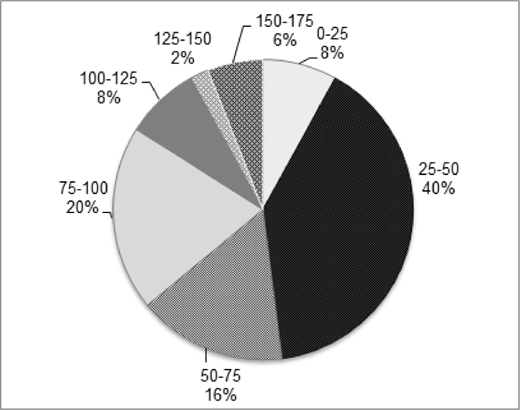
The distribution of respondents included states in the West, Midwest, Northeast, and Southern regions of the United States. As shown in Figure 1, 40% of the respondents reported a program enrollment of 25–50 candidates followed by 20% with 75–100 candidates and 16% with 50–75 candidates. Fewer universities reported more than 100 enrolled candidates (100–125, 8%; 150–175, 6%; 125– 150, 2%) or less than 25 (8%).
Program Format and Student Organization
The participants were asked to report all formats of program delivery (face-to-face, hybrid/blended, and/or fully online) that applied to their specific program descriptions. Accounting for combined responses, 44 (84.6%) universities reported a face-to-face format, with 25 (48%) featuring a hybrid/ blended format. By comparison, only 12 (23%) programs included a fully online format of delivery. Related to the program format is how the students are organized, which specifies if a graduate preparation program is designed as a cohort or noncohort approach. With some programs reporting the use of both approaches, 32 (61.5%) indicated students were organized as cohort compared to 30 (57.6%) programs organized as noncohort.
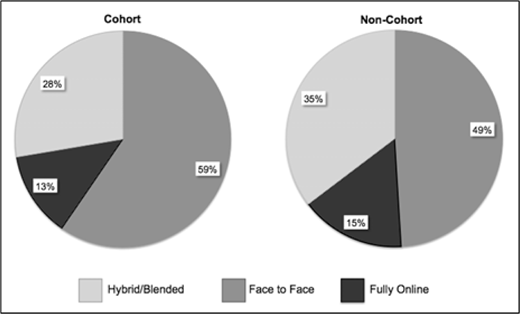
The data showed that both cohort and noncohort designs utilized face-to-face delivery more often when compared to hybrid/blended or fully online formats. Figure 2 illustrates 59% of cohort and 49% of noncohort programs applied face-to-face platforms. The data also indicated that programs with a noncohort organization of students used hybrid/blended (35%) and/or fully online (15%)delivery formats more so than programs with cohort student organization (28% hybrid blended, 13% fully online; see Figure 2).
The responding programs’ clear preference for face-to-face student organization suggests that, although technological competence is a component of the professional efficacy criteria laid out by national standards (ACPA/NASPA and CAS), its integration into the educational experiences and career development of future professionals remains unclear. Clarity on the role of technology in graduate preparation programs is essential to identifying the ways in which these are equipping candidates to serve a diverse and unique population of online learners. In an attempt to examine graduates’ professional preparation, the following section comprises information about the topic of online learners is addressed in programs. It reports results on: (a) the relationship between national standards and program format; (b) technology tools used in instruction and student work; (c) how technology competency is addressed in programs; (d) how programs approach the concept of student services for fully online students; and (e) skills addressed related to preparing graduates to meet the needs of online learners.
National Standards and Program Format
The vast majority of responding programs (96.1%) required candidates to participate in a practicum, internship, and/or graduate assistantship as part of their degree fulfillment. When asked which professional standards and organization were used to design these required experiences, 34 programs based their design on CAS standards compared to 11 programs following ACPA/NASPA and 9 using other standards (e.g., Association for the Study of Higher Education, Council for Accreditation of Counseling and Related Educational Programs, National Academic Advising Association). Minimal overlap occurred given that five of the respondents listed the use of both CAS and ASPA/NASPA standards.
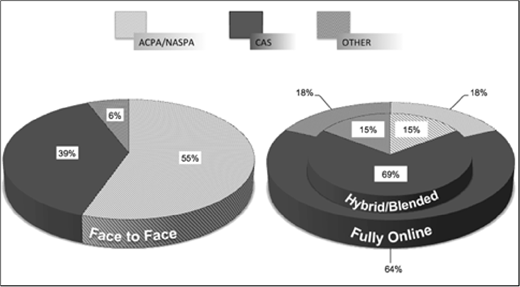
Correspondingly, Figure 3 displays the relationship between the national standards and program formats chosen by this sample. Programs based on ACPA/NASPA standards were primarily geared toward a face-to-face format (55.6%), whereas CAS standards appeared to lead fully online (63.6%) and hybrid/blended (69.2%) settings, comparatively. By showing that technology-dependent programs tend to be modeled after CAS more so than ACPA/NASPA or other standards, this suggests that CAS’s guidance regarding technological skill expectancy is readily applicable for graduate preparation programs seeking to implement technology into their delivery formats. Nonetheless, a link between national standards and program format does little to quantify the actual use of technology tools in instruction and student work.
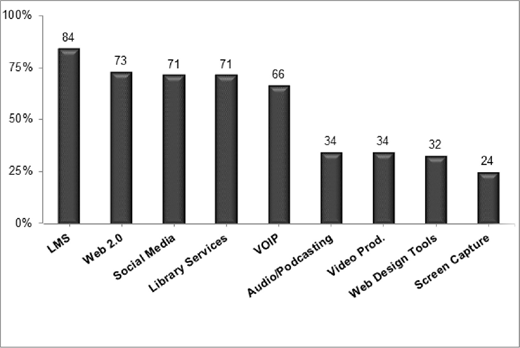
The data also identified technology tools that are commonly used in instruction and student work among the participating programs. Figure 4 reveals that online learning management systems (84%; e.g., Blackboard, D2L) were the most employed, followed by Web 2.0 technologies (73%; e.g., YouTube, Prezi, Flickr), social media (71%; e.g., Twitter, Facebook), digital library services (71%; e.g., online databases, interlibrary loan), and VOIP (66%; e.g., Skype, Google Hangout). The least used were audio/podcasting (34%; e.g., Audacity, GarageBand), video production software (34%; e.g., Moviemaker, iMovie), web-based web-design tools (32%; e.g., Weebly, Google Sites), and screen capture software (24%; e.g., Captivate, Camtasia).
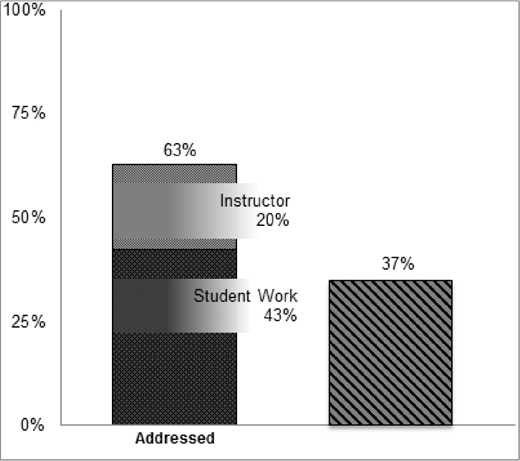
To further assess technology’s role in and contribution to graduate preparation, participants were asked if and how their individual program(s) address technology competency. As seen in Figure 5, 37% relayed that technology competency was not addressed at all in their program(s), while 43% reported competency was primarily addressed in student course work, and the remaining 20% addressed technology competency via course facilitation.
Student Services for Online Students
Participants were asked how their programs address the issue of providing student services to fully online students (if applicable). In answering this question, 83% of the programs reported that they addressed the concept of student services availability for online students either formally or informally. Seventeen percent of participants communicated their program did not address this concept compared to 52% of programs that reported indirectly addressing it through incidental discussion and/or as needed, whereas only 31% reported that they directly addressed online student services through scheduled online discussion, presentation, as a course component, and/or via online “office hours.”
Skills to Accommodate Online Learners
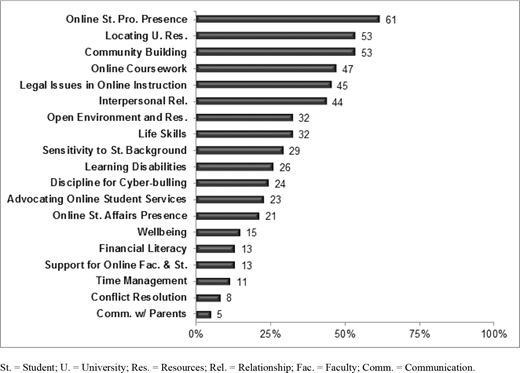
The scope of this study focuses on the ways graduate preparation programs are furnishing their students with the skills necessary to accommodate online learners. The participants were presented with a list of student services skills relevant to online teaching and learning and asked to choose all that were addressed through program activities and/or coursework. These findings, exemplified in Figure 6, detail a wide margin between the most and least addressed student service skills and issues among this sample. The most addressed skills were maintaining a professional personal online presence (61.3%), locating university resources (53.2%), and community building (53.2%), followed by oral and written communication in online formats (46.8%), familiarity with legal issues surrounding higher education (e.g., Family Educational Rights and Privacy Act, academic integrity) pertaining to online instruction (45.2%), and interpersonal relationships (43.5%).
A moderate range of programs reported making online students aware of available services via an open environment and resources (32.3%; e.g., approachability and hospitality to online students), addressing life skills development (32.3%), sensitivity to and awareness of online students’ backgrounds (29%; e.g., cultural, socioeconomic, sexual identities), student learning disabilities as related to online learning (25.8%), student discipline in terms of cyber-safety and cyber-bullying (24.2%), advocating for online student services (22.6%), and harnessing Web 2.0 technologies and web-based tools to create and maintain an online presence for student affairs (21%). The least addressed skills and issues included wellbeing (14.5%), financial literacy (12.9%), supporting online faculty (in terms of student development, student identity, and self-efficacy issues; 12.9%), time management (11.3%), conflict resolution (8.1%), and communication with parents of online students (4.8%).
Qualitative Data
The following section describes the themes identified by the researchers based upon an analysis of participant responses to the open- ended questions. These were: (1) formal versus informal technology use, (2) assumption of candidate expertise, (3) formal vs. informal discussion of online student needs, and (4) perceived impact of online instruction. These four themes reflect commonalities in responses of graduate preparation programs such as the differences between program driven, faculty driven and candidate driven technology use, institutional and cultural barriers to technology integration, and inconsistency in the perceived impact of online students on the field of student affairs. A caveat: it is important to remember that people define technology in different ways. Some survey respondents included every available technology in their answers (e.g., e-mail, office productivity tools). Others only considered tools outside of what people typically use on a daily basis.
Theme 1: Formal Versus Informal Technology Use
The first theme, formal versus informal technology use, relates to ways technology use was promoted by a program, how technology was addressed in coursework, and how its use was modeled by faculty members and program administrators. Informal technology use, for the purposes of this study, indicates instances where technology use was not a required part or focus of candidate assignments. Informal technology use occurred in several different ways. First, it occurred when candidates chose to integrate technology tools in coursework without being required to do so: “The students [candidates] take advantage of the university library system that offers a lot of technologybased tools. Students might use technology to present their ideas via PowerPoint or Prezi.” Second, informal technology use occurred when its use was part of a learning management system or productivity suite (word processing, e-mail): “Most courses involve the use of a course management platform, primarily for access to course readings and Internet informational resources.” Faculty modeling of informal technology use also occurred more frequently than formal use. These instances happened outside of the learning management system and included online office hours using Skype, as well as sharing of online resources.
Formal technology use, for the purposes of this study, indicates instances where technology was a required part or key component of candidate assignments, or was part (i.e., platform for) of institutional programs and efforts. Three types of formal technology use were evidenced in responses collected. The first described technology as a way for candidates to collect artifacts of learning during their course of study through video projects, picture projects, summer internship blogs, and eportfolios: “Students [candidates] use technology in their development of electronic portfolios that summarize their work in the program. They write reflections and develop artifacts for all of the Counseling and Related Educational Programs standards.” The second type of formal use was documented by two institutions that made technology a formal course topic: “One program course is on Emerging Technologies and other courses include modules on technology in curriculum and management;”or key assignment component: “All students [candidates] must use the four social media platforms (FB, Twitter, G+, LinkedIn) and complete a digital footprint assignment.”
The third type of formal technology use appeared in responses referring to use for recruitment and retention: “Technology plays much more of a role in communicating about our program to prospective students, current students and alumni.” This type of formal use was recorded a bit more frequently in survey responses. Faculty formal use of technology as intentional integration in teaching was not often mentioned. In fact, faculty use of technology was, again, more commonly reported as a tool for recruitment and retention: “We use social media to maintain contact with students completing practicums. We have hosted Google Hangouts between alumni and current students.” Other faculty technology integration efforts were actually perceived to be ineffective: “If a faculty member used power point, then they would think that was using technology in their classroom.” Several responses also alluded to institutional barriers to faculty technology use outside of the learning management system: “We have a policy against using FB [Facebook] or other social media with students at this institution.”
Theme 2: Assumption of Candidate Expertise
The second theme, assumption of candidate expertise, refers to ways faculty and programs measure candidate technological competency without any determination or assessment of any kind. Fifty-five percent of programs surveyed had a method for determining candidate technological competency. These assessments occurred in different phases of the program. Over half of the 55% measured competency as part of assignments embedded throughout coursework (discussed fully in the previous theme). The other half assessed competency as part of a course (e.g., workforce development, practicum) or as a prerequisite for admission into the program. Forty-five percent of programs surveyed did not measure candidate technological competency in any way. The responses collected highlighted a tendency on the part of higher education faculty to assume candidates had facility or experience with technology due to personal characteristics such as youth.
This assumption of candidate expertise showed up in several ways. Some faculty looked toward candidates to lead technological innovation in the program, claiming candidates “typically push the faculty for more and newer technology.” One respondent described candidate technology leadership as having a broad impact at the institutional level: “they are very involved in pushing the envelope in their graduate assistantships and in field experiences to get different departments to expand social media and online offerings.” Others assumed candidate expertise and comfort with technology far surpassed that of faculty in general: “students [candidates] use a wide variety of technologies in their work; faculty desperately try to play catch-up.” Interestingly, faculty assumed candidate technological expertise despite clear evidence to the contrary:
They use it every day. I’m surprised that more of them are not proficient with video, webpage development and other online services. But they submit their work electronically, organize their lives with Oracle calendar, and use a variety of other software in their daily work and personal lives.
This misalignment between assumed and observed candidate technology use seemed to occur because faculty proposed technology use happened outside of class: “I think the students [candidates] embrace technology and use it frequently, but do not use it much in their work for classes.”
Theme 3: Direct Versus Indirect Discussion of Online Student Needs
The third theme highlighted differences between indirect and direct discussion of online student needs. Again, in the context of this paper, this theme concerns itself with how student affairs professionals prepare themselves to meet the unique needs of online students they will service once employed. It does not refer to the individuals who are themselves, candidates in the programs surveyed. For the purposes of this theme, direct is defined as intentional discussion within a course. Thus, every candidate enrolled in the program engages in this discussion at one point or another. Indirect discussion is not a required part of the program. It may come up as part of a special topics class or a presentation panel; however, it is not required for degree completion and may not be experienced by every candidate enrolled in that program.
Several programs pointed to concerted efforts to directly address the topic of online learners through discussion: “This item is discussed in the capstone course specifically and broadly in other courses as it ties into various student populations.” Others embedded this discussion within a “project [that] requires students [candidates] to identify and explore ways in which to adapt current services to meet the needs of online learners.” One program designed a course to target this topic in an extensive manner: “Higher Education in the New Technological Frontier.” Even so, indirect discussion was the overwhelmingly prevalent approach taken by the programs surveyed in this study:
It is not addressed directly in our program. As part of “career panels” we have brought in alums who work with fully online students. So alums are able to share a bit about what it that was like, but it [the panel] focused more on career development than professional development.
Programs that used indirect discussion sometimes recognized this approach as inadequate: “it is only addressed peripherally ... we ought to do more, but have not done this yet.”
Theme 4: Perceived Impact of Online Instruction
The fourth and last theme identified the ways online instruction and the online student population would impact the higher education administration and student affairs profession. Respondents overwhelmingly concluded that online learning would change the structure or nature of services provided. Many perceived a change in practice while still maintaining the core beliefs of the profession. Responses made clear that concepts within the field (e.g., social justice, equity, adaptation of services, and counseling) would not be eliminated but, rather, delivered in different ways: “We will need to expand our understanding of how student affairs works—but the major tenets and philosophy won’t change” and “I hope it helps student affair grads and student affair pros remember the purpose of the field. We’re here to foster learning and development, regardless of the structure of the learning environment.” These core beliefs were also threaded through responses that claimed inequity in services provided to online students: “The profession of student affairs must more aggressively make the case that ALL students need support, and, in most cases, are paying for services they do not receive.”
Some identified a strong economic motivation behind preparing candidates who can adapt and provide student services to online learners: “I think online education calls on a limited number of student affairs functions. Some traditional student life functions may be seen as costly hanger-ons without benefit or value to online students.” Others framed perception of impact in terms of professional relevancy:
Student affairs is going to have to grapple with how to make themselves relevant in an online environment. Many students who participate in fully online programs may not be interested in traditional programming, so student affairs professionals need to figure out ways to provide relevant programming for this population.
A few referred to a refocusing of services:
I think it will cause a shift towards the areas that for-profit institutions invest in: entrance, academic progress/retention/ persistence, graduation ... social programming changes dramatically and there’s no need for residence halls, dining, athletics,recreation, conferences, a student union, and more.
Discussion
In terms of content focus, usage, and candidate ability, the delivery of services to online students is not yet seen as an integral component of student affairs preparation programs. On the other hand, faculty respondents recognized a high level of interest, expressed by program candidates, in technology and online student services. This recognition of “when students [candidates] are susceptible to or desiring a transformative experience” is a crucial step in fostering transformative learning (Taylor, 2007, p. 183). Throughout the responses collected for this study, there remained a number of misperceptions around the topic of technology and online learners. These misperceptions failed to recognize online learners as a population with its own unique identity, deserving of the same attention and focus within the curriculum as any other student population.
Along with the current limited focus on technological proficiency, these misperceptions make a clear case for a more formal incorporation of technology and services in online learning environments into professional standards and competencies. Whether CAS standards, ACPA/NASPA competencies, or standards of some other entity, most programs look for guidance and direction from parent organizations and agencies within the profession. With the role of technology and the identity of online learners more clearly defined and highlighted in the 2015 iteration of the governing documents and standards of these organizations, graduate preparation faculty will be better positioned to further develop curricula that trains new professionals on how best to support and assist this demographic.
At the program level, it is critical that faculty embrace and endorse technology and online pedagogy in course preparation, design, and delivery. In a comprehensive review of transformative learning studies, it was determined that:
cognitive awareness of underlying epistemic assumptions and changing the form of meaning making was not enough, other factors needed to be in place [including] ... ongoing institutional support to act on this new understanding as well as, at times explicit guidance on how to act on this new understanding in practice. (Taylor, 2007, p. 187)
This indicates that for true transformative learning to occur, graduate candidates and faculty should move beyond using technology for enhancement or discussion purposes and allow it to modify and redefine practice. Ideally, courses dedicated to the role of technology and online learning within higher education settings should be included as part of the curriculum. Whenever possible, faculty should intentionally develop technology-enhanced assignments and practical experiences within course requirements.
These technology-enhanced experiences should also be present during practicum placements. In a study of social services and health care providers undergoing professional training, Garvett (2004) found that direct and active learning experiences were among the most powerful methods for supporting true, transformative learning, providing “pedagogical entry-points” that engaged these professionals in a deep awareness of the challenges within that learning context. Practicum placements in fully online settings as well as assignments that require candidates to modify or redesign services and programs for the online environment are concrete ways to create pedagogical entry-points and foster transformative learning of the online learning platform. Formal work in the area of online pedagogy and online student services also helps future professionals develop expertise in best practices for online design and delivery. Just as one’s personal experience as a college student does not prepare the individual to be a student affairs professional, one’s personal experience as an online student (or discussions of online learning) does not prepare the individual to be a professional in a fully online environment. This preparation is, instead, developed through candidate engagement with “learning experiences that are direct, personally engaging and stimulate reflection upon experience” (Taylor, 2007, p. 182).
Higher education institutions located in international areas poised for explosive online learning growth (e.g., Asia, Eastern Europe, Africa, Latin America), while facing different economic and structural challenges, may want to consider the experiences of higher education and student affairs professionals in the United States in order to better plan for the training of these individuals. It is important to note that the data collected in this study do not represent all global experience with online learning and higher education. Rather, they can serve as a starting point to encourage research that uncovers experiences and practices on a broader international scale.
Conclusion
It has been over a decade since Kretovics (2003) challenged those within the field of student affairs to embrace technology:
As technology continues to evolve, educators will find ways to integrate these advances into the delivery of course material. Will student affairs professionals be there to assist in the process by encouraging community building as a planned and developmental process or will the profession remain on the sidelines? (p. 11)
The findings of this study indicate that several graduate programs have begun to formally embrace technology and the online learner population, moving the profession off the sidelines and into the forefront. However, others are still skeptical of the need for curricular changes, unsure of how to accomplish these tasks while still honoring the foundational beliefs of the profession. Despite this reticence, online learners are a growing population with distinct needs: “when thousands of students are actively participating in online- only learning, this topic is no longer a fringe issue. We have a professional mandate to serve all students—on-campus and online” (Stoller, 2012, para. 3). If the profession of student affairs expands its vision of services provided in the online learning setting, the basic tenets of the field, to support students as they grow and develop, remains intact while the profession rises to the future challenges of higher education.