There is an increased demand for online courses and programs. As a result, institutions are experimenting with different ways to train and support faculty to teach online. There is very little recent literature, though, describing the various ways that institutions actually train faculty to teach online. In this article, we report on the results of our inquiry into how institutions with large online programs train faculty to design online courses and teach online.
Introduction
There is an increased demand for online courses and programs (Allen & Seaman, 2017; Bichsel, 2013). As a result, colleges and universities are investing in institutional support for faculty to design and teach online courses to meet this increased demand (Chen, Lowenthal, Bauer, Heaps, & Nielsen, 2017; Magda, 2019). While faculty often like to think of good teaching as good teaching, online instruction requires a skill set that many faculty lack and/or need additional training and support to further develop (Baran, Correia, & Thompson, 2011; Palloff & Pratt, 1999; Salmon, 2012). While faculty may have experience designing and teaching face-to-face courses, they often lack experience with the technologies, instructional strategies, communication processes, and organizational structures involved with teaching online (Baran et al., 2011; Davidson-Shivers, Rasmussen, & Lowenthal, 2018; Salmon, 2012). As a result, faculty often find themselves needing additional support as they learn how to design courses and teach online (Bichsel, 2013; Magda, 2019). Given this problem, we set forth to investigate how universities with large online programs, with high enrollments, train and develop faculty to teach online.
Background
Institutions have various approaches to support faculty new to teaching online, ranging from highly structured to very informal types of training and support (Herman, 2012; Meyer, 2013; Meyer & Murrell, 2014). On one end, there are institutions that use a for-profit “enterprise” type of model where they centralize online course development and online teaching; at these institutions, among other things, faculty are often required to complete formal programs before teaching their first course online (Lowenthal & White, 2009). On the other end, there are institutions that simply provide faculty with a blank course shell in a learning management system, along with access to a technical help desk for support, before teaching their first course online (Lowenthal & White, 2009). The literature, coupled with our own experiences working at different colleges and universities, suggests though that most public or nonprofit institutions lie somewhere in the middle of this centralized versus decentralized continuum (cf. Meyer, 2013; Meyer & Murrell, 2014). That is, these institutions might provide faculty some type of support to learn how to teach online or to design an online course, whether that be pedagogical or technical, but faculty do almost all of the course development or teaching themselves. The support faculty have available in these types of institutions likely comes in the form of traditional face-to-face training programs, online workshops or seminars, or just-in-time support (Lowenthal & Davidson-Shivers, 2019; Meyer, 2013; Meyer & Murrell, 2014).
The University of Colorado Denver and Boise State University are two examples of institutions that lie somewhere in the middle of this continuum. The University of Colorado Denver has historically taken a decentralized approach to online course development, online teaching, and training and support. At this institution, individual faculty have, for the most part, decided what, if anything, they want to teach online. The institution has a centralized unit for support if faculty and/or departments decide they want to use it; the support ranges from just-in-time instructional design support, regular workshops, an online seminar learning to teach online, and annual events to support faculty developing online courses (Gasell & Lowenthal, 2015; Lowenthal & Thomas, 2010), but the majority of faculty do not take advantage of these services. Boise State University also lies somewhere in the middle of the continuum, though perhaps leans a little more toward the centralized end.
Boise State University has a centralized unit called eCampus. In terms of training and developing faculty to design courses and teach online, the eCampus center developed the eCampus Quality Instruction Program. The program consists of three components: a design and development seminar, a teaching online seminar, and a Quality Matters peer review of online courses. Faculty can choose to complete one of these components or all of them. The eCampus center also offers a series of faculty development workshops and just-in-time support to further train and develop faculty to teach online. But departments, programs, or faculty at Boise State for the most part do not have to use any of these supports or other eCampus services (e.g., resources to develop complete online programs) if they do not want to.As a result, some faculty and programs rely heavily on the eCampus center to help train and develop faculty while other programs do not.
Overall, though, given the continued growth of online learning at colleges and universities, we contend there is comparatively little literature on how institutions train and develop faculty to teach online (in terms of both designing and facilitating online courses), as well as which training and development strategies are the most successful.
Method
The purpose of this study was to explore how institutions prepare and support faculty to design and teach online courses. More specifically, we were interested in identifying and describing the various ways public and nonprofit institutions with large online programs, with high online enrollments, train and support faculty to teach online. Thus, this study was both exploratory and descriptive in nature. We began by identifying institutions with large numbers of online enrollments. Working from a list of the top 50 institutions with the highest numbers of students taking at least one online course (based on the Integrated Postsecondary Education Data System database) created by Hill and Menard (n.d.), we identified 30 public or nonprofit institutions. We then identified personnel (e.g., administrators, instructional designers) involved with online learning at each institution to survey. We created a brief survey to learn how these institutions train and develop and support faculty to teach online. Personnel from 16 of the 30 institutions completed the survey. We then conducted follow up semistructured interviews with personnel from one large public institution, one large private institution, and one large community college. The goal of the follow-up interviews was to learn more about what each of these institutions do to support faculty to teach online. The interviews were recorded, transcribed, and analyzed. Rich descriptions of each institutions approach to supporting and developing faculty were created.
Results
Phase 1: Survey
We first asked participants about their institutions’ total enrollments and what percent of these enrollments were completed online. At these 16 institutions, enrollments ranged from 19,000 to 120,000, with an average total enrollment of 55,000. Members of these participating institutions estimated that 10%to 100%, with an average of 46%, of their total enrollments were completed online. Overall, 10 of the 16 institutions, or 62.5%, reported that they required faculty to take part in some kind of training to teach online at their institutions.
How Do Faculty Learn to Teach Online at Colleges and Universities With Large Online Programs?
We then asked the participants how faculty learn to teach online at their institutions. At this point, we did not define what we meant by “teach online”; in other words, we did not distinguish (nor ask participants with this question to distinguish) between learning how to design online courses verses learning how to teach online courses. While responses to this open-ended question varied to a degree, every institution reported offering some type of support for faculty to learn to teach online. These responses ranged from consultations with instructional designers, webinars and workshops (both face-to-face and online), mentoring and coaching, to multiweek online courses. These supports were offered either at the department, school, or college level. The following are a few examples of how the participants described how faculty learn to teach at their institution:
We have a required certification course that consists of 4 self-paced modules, 2 instructor-led modules, and a semester of required mentoring.
A required 2-week certification course; required membership and activity in an online teaching group of peers for duration of time teaching online; available (optional) coaching and other online development opportunities (training modules, webinars, short courses, etc.).
Through a variety of workshops, primarily offered online, but also in person. The primary one is an “Introduction to Online Teaching Course” that takes about 20 hours/4 weeks to complete.
Presentations, workshops, and courses are offered in face-to-face and online formats. Many instructors do complete training. Instructional designers also work one-on-one with faculty on the design of courses and discuss teaching techniques in online courses.
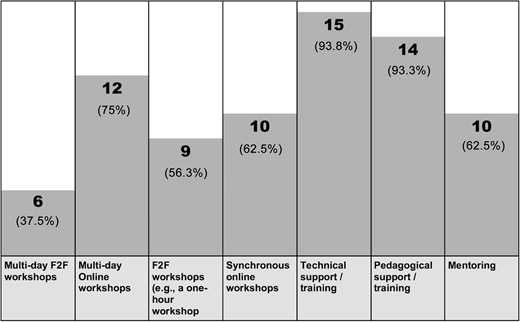
We then specifically asked what types of training and support each institution offered their faculty. The most frequently types of support offered where technical support/training (e.g., workshops on how to use a learning management system) (93.8%), followed next by pedagogical support/training (e.g., workshops on rubrics) (93.3%) and multiday online workshops, programs, and seminars (e.g.,3 week online workshop) (75%). However, over 50%of the institutions also offered synchronous online workshops (e.g., a 1-hour webinar) (62.5%), mentoring (62.5%), and face-to-face (F2F) workshops (e.g., a 1-hour workshop) (56.3%). Multiday F2F workshops, programs, and seminars (e.g., week-long institute) (37.5%) were offered least. See Figure 1 for a comparison of each.
How Do Faculty Learn to Design/Develop Online Courses at Colleges and Universities With Large Online Programs?
Large online programs often have more personnel to help support the programs (e.g., instructional designers, student support, online administrators, etc.). We were first interested in learning how the online courses were designed and developed in these large programs to help better understand the role that faculty played in designing and developing courses in these large programs and in turn the needs they might have with training, development, and support with designing and developing online courses. We found that 9 out of 16 (56.3%) of these institutions require faculty to take part in some training to design and develop online courses. We then asked at what level of the institution were online courses designed/developed. There was a general trend toward either developing online courses at the university level, 7 out of 16 (43.8%), or at the department level, 6 out of 16 (37.5%). Though, one participant did point out that things are becoming more centralized over time as captured in this comment:
Traditionally they have been developed at the dept level by individual faculty, however, we have a strong centralized unit of instructional designers and have been moving more toward a centralized unit working with each college to develop a strategy and support model for that college.
We also found that 10 out of 16 (62.5%) used some type of “master course” approach to designing and developing online courses; this is a type of approach where a course is designed and developed by one or more people but then copies are made each semester for other faculty to teach using the same online course.
We then specifically asked how online courses were developed and the specific role that faculty played in developing these online courses. The majority of the participants, 10 out of 16 (62.5%), reported that online courses were developed by faculty but with the assistance of instructional designers. The following are a few examples in the participants’ own words:
Campus faculty develop the courses, with the assistance of instructional designers and developers provided by the central Online Learning organization.
Faculty-driven with support from the Center for Distributed Learning. Faculty are responsible for designing online courses. They have support from the Center for Distributed Learning including instructional designers, graphics, video, and programming.
Our faculty work with instructional designers to design and develop their online course.
The majority of the remaining participants reported that faculty serve in some role as a subject matter expert (SME), but that the majority of the development for an online course was done centrally by course developers or by external providers, as captured in the following quotes:
The Center for Learning and Technology develops all online courses, and the Center works with the Schools to determine which SME’s will be utilized during the course development project. Mentors (our equivalent of faculty) are brought into the course project to provide SME-level guidance. Universitywide academic practices are enforced centrally within the Center for Learning and Technology, and the center provides a team of resources to work with the SME on the project.
Faculty develop required competencies (outcomes) and work directly with providers to develop curriculum from scratch. Online courses are developed within the program development department. Faculty act as SMEs and as consultants for student needs.)
Internal faculty program directors determine the scope of the course and how it will fit into the degree program. Content may be developed by an internal or external subject matter expert, but a faculty program director supervises and provides final sign off for all phases of the project (review and approval of outcomes, assessment activities, content).
Only two of the participants suggested that their faculty were completely in charge of designing and developing the online courses at their institutions.
Ultimately though we were interested in learning how faculty learn to design and develop online courses at these institutions, regardless of the course development process used. The most frequent way that these institutions trained faculty to design online courses is through consultations with instructional designers,6 out of 16 (37.5%). For instance, some participants reported:
through professional development and work with instructional designers;
they work with instructional designers or faculty mentors who have been teaching online for a period of years; and
working one on one with our instructional designers.
However, a few participants reported that their faculty learn to design and develop online courses through a combination of consultations with instructional designers and participating in various trainings and workshops, 3 out of 16 (18.8%), as captured in the following quotes:
Through courses provided by instructional technology services and one-on-one guidance from instructional designers within instructional technology services.
Workshops and instructional designers’ consultations.
For faculty working directly with our online team (have signed a contract and get compensation), there is a 12-week design/ development period of working directly with an instructional designer and educational technologist. We have an iterative approach with the expectation of a revision after it is taught. We also conduct bootcamps for larger groups that may be working together, and provide in-house instructional designers to assist with individual course development. We have developed a “design, build, teach” framework with instructions on our website and also provide workshops and presentations that may also be requested and offered to cohorts of instructors.
However, a couple of participants reported that faculty are trained solely through training and workshops, and two others reported that their faculty get no training on how to design and develop online courses.
What Types of Incentives Do Faculty Receive to Take Part in Training at Colleges and Universities With Large Online Programs?
Colleges and universities differ in certain ways from other places of employment (e.g., corporate or industry). Among other things, the faculty who work at colleges and universities are traditionally accustomed to having a greater degree of freedom for how they do their job. In particular, faculty, generally speaking, are not required to complete training and development. Instead, those who do attend training and development (i.e., faculty development) are usually those who decide to do this on their own volition. Given this, we were interested in how, if at all, these institutions incentivize faculty to take part in training and development to teach online courses. We found that 8 out of 16 (50%) institutions provide faculty with some type of stipend; 3 out of 16 (18.8%) give faculty a course release; and 3 out of 16 (18.8%) give faculty some type of certificate or badge for participating in training and development. Participants also added some details such as,
faculty receive swag;
faculty are not able to teach online if do not complete the training;
faculty used to receive stipends or course release; the current administration sees this as a part of their job, so there are no stipends or course releases; and
part of their instructional load.
Phase 2: Follow-Up Interviews
We purposely identified three institutions to conduct follow-up interviews with: one large public university, one large private nonprofit university, and one large community college.
Large Public University
The large public university has over 70,000 total enrollments with 10,000 of them being conducted completely online and over 26,000 students taking some online courses. They have over 60 online programs. Online courses at this institution are developed, administered, and supported by the Center for Distributed Learning. Faculty are required to complete a 10-week blended professional development course on designing and teaching online courses; they receive a stipend for completing this training. Faculty, though, with previous online teaching experience can provide artifacts of past experience to have the required professional development course waived. Chair/dean approval is needed to develop / teach a course without Center for Distributed Learning support. Instructional designers are usually paired up with instructors and consult faculty during the course development process; however, they report that this entire process is faculty driven but centrally supported.
Large Private Nonprofit University
The large private university has over 35,000 total enrollments, with about 12,000 of these enrollments being done completely online, but over 25,000 students taking some online courses as a part of their program of study. They have two different units involved with online learning: one is in charge of developing courses and the other is in charge of delivering online courses. The group in charge of developing the online courses is called the curriculum development group. The group in charge of delivering the online courses is called the online learning group. There is a committee that is run by the curriculum development group that decides what courses are offered online. Faculty, though, have more flexibility on deciding what courses are offered in a hybrid format for local students. Instructional designers work with faculty to develop the online courses. Larger courses are designed by multiple faculty. They use a master course model where online courses are designed for anyone to teach. To teach online, faculty must complete a 2-week course as an evaluation during the interview process. After that, faculty complete a 2-week training course that focuses on learning about the learning management system and teaching online; they receive a small stipend for completing this training course. Faculty then join a faculty learning community that involves monthly meetings, with a group of peers and a leader called a coach, that focuses on different online teaching concepts each month. Coaches provide additional support as needed.
Large Community College
The community college has almost 70,000 total students, with over 20,000 students taking courses online, making it one of the largest community colleges in terms of online enrollments. There is a centralized unit to support faculty who teach in any format at the institution. Faculty though are in charge of developing their online courses all on their own. There is, however, a select number of instructional designers who can support faculty designing or teaching online courses. There is also a teaching and learning excellence program which consists of a series of faculty development courses and follow up consultations with instructional designers to train and support faculty teaching in any format (e.g., face to face, hybrid, online). The college does not provide any faculty development courses focused solely on developing online courses. In fact, faculty are not systemically given a course to teach if they are teaching online; however, faculty might ask to use a copy of another faculty members course. Faculty can seek additional support through faculty mentors as needed.
There is no consistent quality control framework used; however, the college is a member of Quality Matters and some faculty or groups use it. Faculty, though, must be certified to teach online; they get certified by completing five courses that focus on things like the learning management system, instructional design, and copyright.
Discussion and Implications
Too often institutions get caught up in doing things the same way that they have in the past. We contend that online learning requires new approaches to not only teaching and learning but also to faculty development. The changes brought about with the introduction of fully online courses and programs provides institutions an opportunity to experiment with new ways of supporting faculty. Effective online courses and programs begin and end with quality faculty (Dunlap, 2005; Wilson, Ludwig-Hardman, Thomam, & Dunlap, 2004).
The problem, though, faculty confront is that most faculty were never taught how to teach; faculty are seen as content experts (Boyer, 1990; Stevens, 1998). As such, faculty often teach the way that they were taught. The issue though when it comes to teaching online is that most faculty have never had the opportunity to take a course online as a student and thus cannot draw from much, if any, prior experiences of online teaching. Therefore, it is imperative for institutions to find ways to train and develop faculty on how to design and develop online courses, as well as how to teach online. There is not one right way to accomplish this. In fact, as this research suggests, even very large online programs have different ways of training and developing faculty to teach online. Some institutions require faculty to complete training, while others do not. Some institutions put faculty in charge of the online course design and development process, whereas others team faculty up with instructional design consultants. More research is needed to better understand how instructional designers serve in a consultant role when supporting faculty. This research in turn would have direct implications for the graduate programs in charge of teaching instructional designers how to do theirjobs.
The results of our inquiry should not be generalized. However, our research should help institutions better understand the various ways that faculty can be supported to design and teach online courses and in turn meet the growing demand for new online courses and programs.